
Brother QL-820NWB
4.3Editor score
Multiple wired wireless interfaces
Up to 110 labels per minute
Standalone monochrome display
Three-foot maximum label length
A library label printer helps staff identify books, media, equipment, storage containers, shelves, and circulation materials consistently. The most useful model balances accurate printing, dependable label handling, straightforward connectivity, and a workflow that suits both public-facing counters and busy back-of-house processing areas.
This guide compares ten label printers and label makers for their connectivity, resolution, supported media, print speed, template options, and practical organization features. It covers standalone desktop units, connected professional printers, portable Bluetooth devices, and compact handheld models for different library environments and staffing needs.
Each pick highlights the capabilities that matter most for library work, along with compatibility limitations and trade-offs to consider. Ratings and product details reflect the supplied listings, while availability and pricing change over time, so readers should confirm current specifications and costs before purchasing.
4.3Editor score

4.5Editor score

4.5Editor score
As an Amazon Associate we earn from qualifying purchases.
The comparison below organizes all ten options by their most relevant library features, including connection methods, output speed, label compatibility, and the environments in which each device is most practical.



The Brother P-Touch PT-D610BT earns a 4.5 rating and stands out as the most versatile all-around choice in this guide. It combines a QWERTY keyboard, a full-color two-line LCD, Bluetooth, and USB connectivity in a compact business label maker. That balance makes it suitable for circulating books, marking media, identifying equipment, and producing polished shelf or storage labels from one device.
We may earn a commission when you buy through this link, at no additional cost to you.
Its creative controls are particularly useful for libraries that need more than plain typed text. The supplied information lists 17 fonts, 17 styles, 160 frames, and 900 symbols, along with 175 preloaded business templates for asset management and inventory tracking. Staff can create professional designs, add logos or barcodes, and preview the intended layout on the 20-character color display before committing media to the printer.
Convenience is another major strength. Built-in memory can retain up to 90 frequently used labels, which helps when the same asset tag, location code, or standard processing label is printed repeatedly. The automatic cutter and QWERTY keyboard streamline a long session at a processing table, while Bluetooth and USB support let users design from a computer or mobile device through the appropriate workflow.
The main limitation is its one-inch maximum label width, which is narrower than the capability expected from a high-volume desktop printer. Nevertheless, it is not designed to be one. It is best suited to libraries wanting a flexible, template-rich device for staff counters, collection maintenance, media processing, and recurring small labels. For those users, the PT-D610BT is the strongest overall recommendation in the lineup.
The color LCD lets users inspect a label before printing, which is valuable when a catalog number, barcode, or location code must be exact. This visibility helps avoid wasted media and supports a more consistent appearance across staff and departments.
Bluetooth and USB options accommodate both mobile and computer-based label design. This is useful for staff who create labels in an office application, while Bluetooth can reduce cable clutter at shared work tables or mobile processing stations.
We may earn a commission when you buy through this link, at no additional cost to you.
The Brother QL-820NWB has a 4.3 rating and is the premium option for libraries that need a dependable professional-grade printer across multiple workstations. It supports Bluetooth, Ethernet, and 802.11b/g/n wireless connectivity, as well as a USB host interface for a peripheral such as a scanner. That network flexibility makes it a strong candidate for centralized operations with several departments or processing points.
We may earn a commission when you buy through this link, at no additional cost to you.
Speed is the clearest reason to choose it for routine work. The printer can produce up to 110 standard address labels per minute with black text at 300 dpi. It also supports black-and-red labels through DK 2251 media and accommodates labels up to three feet long, providing room for larger signage, shelf markers, archival identifiers, and custom notices beyond ordinary address-label dimensions.
Although it has more advanced capabilities, the device can still be used independently. A readable monochrome LCD allows staff to select settings without relying on a connected computer, and the auto-cutter helps keep label handling efficient. Those characteristics are valuable in circulation areas, mail rooms, media departments, and other locations where staff may need to print a small number of labels without opening a design application.
It is not the most compact or simple option, and the listed feature set emphasizes monochrome output rather than full-color graphics. Nevertheless, its multiple connectivity interfaces, speed, resolution, and longer label support give it a clear advantage for high-volume professional use. Libraries that label thousands of items or need network-wide access will find this model especially compelling.
Ethernet, Wi-Fi, and Bluetooth allow the printer to fit into different network plans. Staff can move from a wired cataloging station to a wireless processing table, while centralized offices can share access across compatible computers.
A stated speed of up to 110 labels per minute suits repetitive processing work. Three-foot maximum label length also broadens the device beyond standard shipping labels, making it more adaptable for institutional signage.
We may earn a commission when you buy through this link, at no additional cost to you.
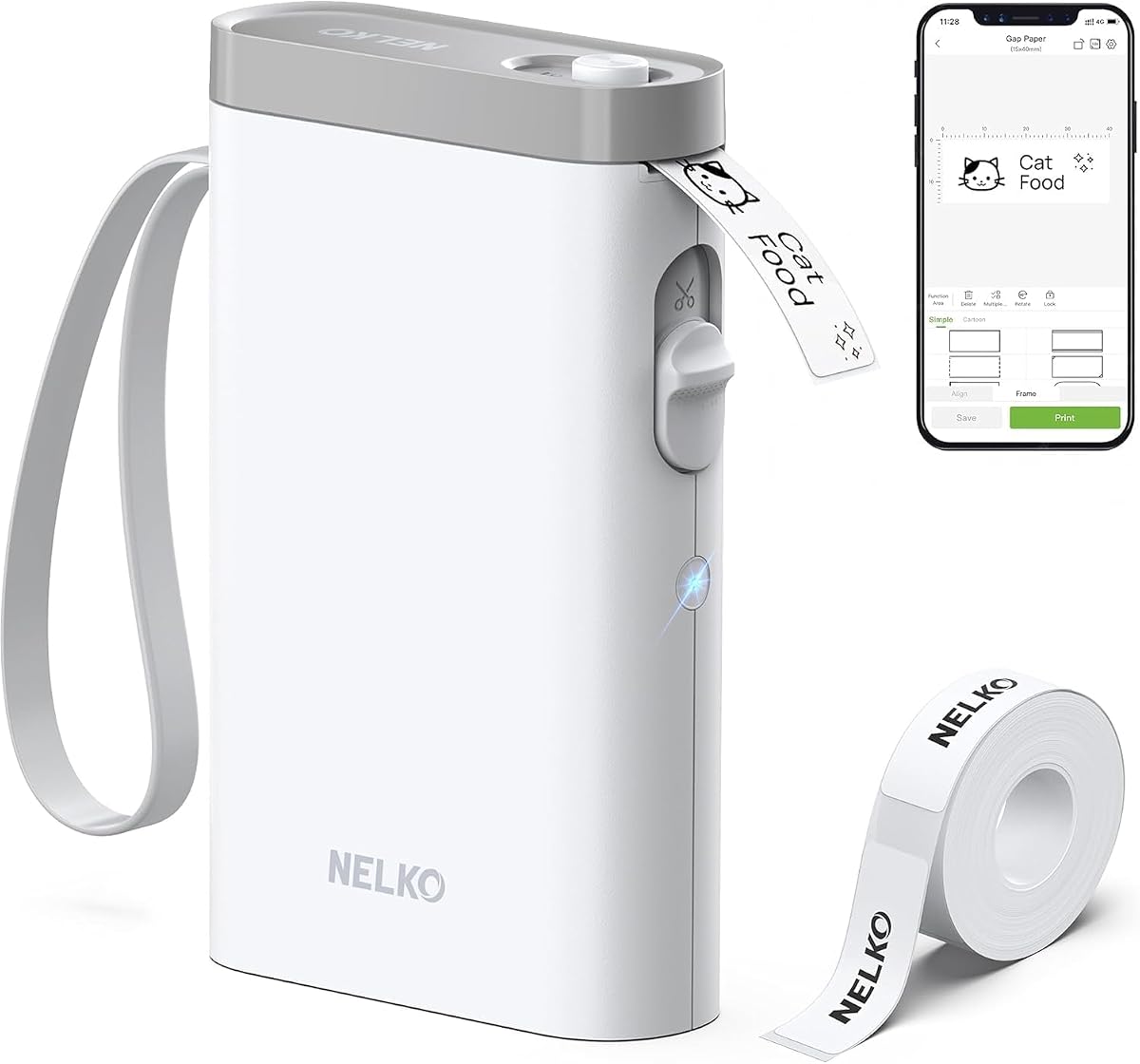
The Nelko P21 carries a 4.4 rating and offers a highly portable way to label library materials away from a fixed desk. Its reduced size and weight make it easy to carry between shelves, storage areas, classrooms, or community programs. A built-in rechargeable battery adds further convenience for staff who perform labeling directly where objects are located.
We may earn a commission when you buy through this link, at no additional cost to you.
Printing uses 203 dpi direct thermal technology, so the machine does not require ink or toner. The companion app supports text, QR codes, barcodes, images, borders, and other design elements. According to the supplied information, the app library includes more than 3,600 icons, 700 borders, 5,500 materials, 750 templates, and support for 29 languages, giving users considerable creative flexibility from a phone.
There are meaningful constraints. The P21 works with iOS and Android phones through Bluetooth but does not work with computers. It supports fixed label lengths, including 14-by-40-millimeter, 14-by-50-millimeter, and 14-by-75-millimeter formats, but not continuous tapes. The listing also specifically states that it is incompatible with Google Pixel phones running Android 14.
Despite those limitations, it is a practical option for temporary signs, classroom kits, book-cart organization, or mobile library outreach. Users who need a pocket-sized printer and can design from a compatible phone will appreciate its portability, template-rich app, and ink-free operation. It is best treated as a supplementary library tool rather than a replacement for a networked desktop printer.
The compact body and internal battery let staff label items without returning to a workstation. This is particularly helpful for community events, classroom visits, book-cart maintenance, and other situations where a permanent printer is impractical.
Templates, icons, borders, and code support make it easy to produce recognizable labels from a phone. Users can create functional identifiers for folders, supply bins, student belongings, and general household-style organization.
We may earn a commission when you buy through this link, at no additional cost to you.
The Brother PT-M95 has a 4.5 rating and is an accessible choice for libraries that mainly need short, clear identifiers. It is a lightweight, portable label maker with a QWERTY keyboard and easy-view display. Rather than requiring a computer or phone connection, it handles basic labeling directly, which can make it a straightforward option for part-time staff, volunteers, and occasional cataloging projects.
We may earn a commission when you buy through this link, at no additional cost to you.
The bundle includes one sample tape and three full-length black-on-white tapes, allowing users to begin labeling without separately sourcing compatible media. Genuine Brother M tapes are offered in 9-millimeter and 12-millimeter widths and a range of colors, giving users some flexibility for visual coding. The device itself prints one or two lines of text and provides type styles, frames, symbols, and eight Deco Mode patterns.
Its limitations are closely related to its simplicity. The narrow tape widths and one- or two-line format are not appropriate for shipping-size labels, shelf signs with extensive wording, or large graphic identifiers. It is also less useful for libraries that need barcodes, QR codes, database integration, or batch printing from a central cataloging system.
Even so, the PT-M95 fills a useful niche. It can label files, folders, media cases, book-cart contents, storage boxes, gift bags, school projects, and other small items that need concise text. For an institution seeking a dependable first label maker without the complexity of an app or professional desktop unit, it remains a practical, well-rated recommendation.
The built-in keyboard and display remove the need for app-based design. Volunteers and occasional staff can type a short identifier, preview it, and print without learning a complex software workflow.
The included black-on-white tapes and support for multiple type styles are enough for coding files, labeling folders, and identifying small collection or supply items. A broad quantity of identical labels is easy to produce once the wording is finalized.
We may earn a commission when you buy through this link, at no additional cost to you.
The Brother QL-810W earns a 4.2 rating and is a strong high-speed option for libraries that want wireless access without moving to the more configurable QL-820NWB. It prints up to 110 standard address labels per minute with black text at 300 dpi and can produce black-and-red labels using DK 2251 media. That combination suits busy processing stations and routine institutional labeling.
We may earn a commission when you buy through this link, at no additional cost to you.
USB and Wi-Fi connectivity provide both direct and network-based workflows. The supplied information lists Windows and Mac compatibility, plus AirPrint, Brother iPrint & Label, and mobile-device support. Staff can therefore print from several types of devices, which is useful where a shared printer serves circulation, programming, cataloging, and administrative staff.
The QL-810W is designed for common office labels. The listing identifies package labels, envelopes, file folders, name badges, and postage as use cases, all of which map well to library mail, interdepartmental correspondence, badge preparation, and material processing. It also has a substantial cutter life, stated as up to 300,000 die-cut labels or 150,000 continuous labels.
Its listed operating system compatibility includes older Windows and Mac versions, so a library with a recently managed or tightly controlled IT environment should verify current support before deployment. There is also no Ethernet interface listed, so the QL-820NWB may be more appropriate where wired network stability is essential. Even with those considerations, the QL-810W remains a fast and accessible choice for wireless library workflows.
A rate of up to 110 standard labels per minute is well suited to batches of media cases, folders, badges, and mailing labels. High resolution helps preserve sharp text and readable barcodes on compact formats.
Wi-Fi allows compatible devices to send jobs to the printer without a direct cable. This can simplify shared access across multiple work areas, while USB remains available for a direct connection.
We may earn a commission when you buy through this link, at no additional cost to you.
The SUPVAN T50M Pro has a 4.5 rating and combines a compact label maker with a broad selection of editing features. It prints labels between three-quarters of an inch and two inches wide, giving it more flexibility than many small handheld devices. That range is useful for library bin labels, folder identifiers, product-style tags, QR code labels, and other medium-sized organizational labels.
We may earn a commission when you buy through this link, at no additional cost to you.
The companion app can import images from a phone, tablet, or computer and offers more than 30 fonts, 50 frames, and 660 icons. The listing also describes high-resolution image processing and support for branding elements. These features make the device useful for libraries that want labels to look consistent with institutional colors, logos, or visual codes rather than simply printing plain text.
Setup is designed to be approachable. The app requires no registration, includes automatic label-size recognition, and uses thermal printing without ink or toner. Compatibility covers square, round, address, cable, jewelry, and file labels according to the supplied information, giving staff multiple options for different objects within a collection or storage area.
The main dependency is the app-based design process, which is less autonomous than a keyboard-equipped standalone label maker. Color output is not explicitly claimed, so the device should not be chosen for full-color graphics. Even so, the broad media support and creative tools make it a flexible choice for small libraries, program departments, and staff who want to design from several types of devices.
Support for labels from three-quarters of an inch to two inches wide broadens the range of tasks the printer can handle. A single device can cover compact file labels, bin markers, address labels, and larger branded identifiers.
Built-in fonts, frames, icons, and image editing let staff create recognizable designs without installing separate graphics software. Automatic size detection reduces the chance of selecting incorrect media settings.
We may earn a commission when you buy through this link, at no additional cost to you.
The Brother QL-800 has a 4.3 rating and provides a professional, direct-connect option for a library with a dedicated computer or a stable USB printer station. It prints up to 93 labels per minute at 300 dpi and supports both black and red output. For processing media, preparing badges, marking folders, and creating shipping or transfer labels, its speed and output quality are well matched to the workload.
We may earn a commission when you buy through this link, at no additional cost to you.
Its Plug & Label integration is a particularly useful feature for a Windows or Mac office. The supplied information states that compatible users can print from Microsoft Word, Excel, and Outlook without installing additional software. This can streamline labeling tasks that begin with catalog information, spreadsheet data, or a message, allowing a library to produce labels without first transferring content into a dedicated label-design program.
The printer includes an automatic cutter and works with Brother Genuine DK pre-sized labels. It also accepts continuous-length tapes up to three feet long, allowing staff to create custom banners, signs, and institutional notices. Those broader media options separate it from units restricted to standard rolls or short labels.
Its lack of built-in wireless connectivity makes the QL-800 less flexible for shared or mobile use. It is best for a fixed desk with a computer, not for staff who need to print from a phone or move between locations. For a central processing station where predictable office integration and fast, clean output matter most, it remains a well-balanced professional choice.
Plug & Label compatibility lets suitable Windows and Mac users select the QL-800 from familiar applications. This reduces workflow steps when labels originate from spreadsheets, documents, or email content.
The automatic cutter helps separate finished labels cleanly, while 300 dpi output supports crisp text and small details. Black-and-red capability can also highlight selected information within otherwise monochrome designs.
We may earn a commission when you buy through this link, at no additional cost to you.
The NIIMBOT B1 receives a 4.3 rating and offers a compact, rechargeable approach to everyday library labeling. It supports Bluetooth connections with iOS and Android devices and can also be used with a PC through USB, with a driver available from the manufacturer's official website. This mix of wireless and wired options gives it practical flexibility for both mobile and desktop workflows.
We may earn a commission when you buy through this link, at no additional cost to you.
The NIIMBOT app automatically detects label size, reducing one common source of setup errors. It includes more than 30 fonts, multilingual support, over 100 borders, and more than 1,500 symbols. Saved templates also support quick reprinting, which is useful when the same label format is needed for a group of books, media cases, supply bins, or inventory items.
Thermal operation means the B1 needs no ink or toner, while a built-in battery and automatic shutoff after 15 minutes of inactivity help conserve energy. The package includes two 1.18-inch white label rolls, and the ABS housing is designed for repeated handling in homes, offices, schools, and retail environments.
The listing states that tablets are not supported, so a phone or computer is required rather than an iPad or similar larger mobile device. Its available label width also makes it better for compact identifiers than large shelf signs. It is nonetheless a capable supplementary printer for libraries that need small, attractive labels and want a rechargeable device that can be used without a permanent power connection.
Automatic size detection simplifies the beginning of a label job, while saved templates make repeated identifiers faster to produce. These features help when processing many similar items with only minor text changes.
The built-in battery eliminates the need for a power cable at the point of use. That portability supports shelving, storage audits, classroom labeling, and other tasks that take place away from the main workstation.
We may earn a commission when you buy through this link, at no additional cost to you.
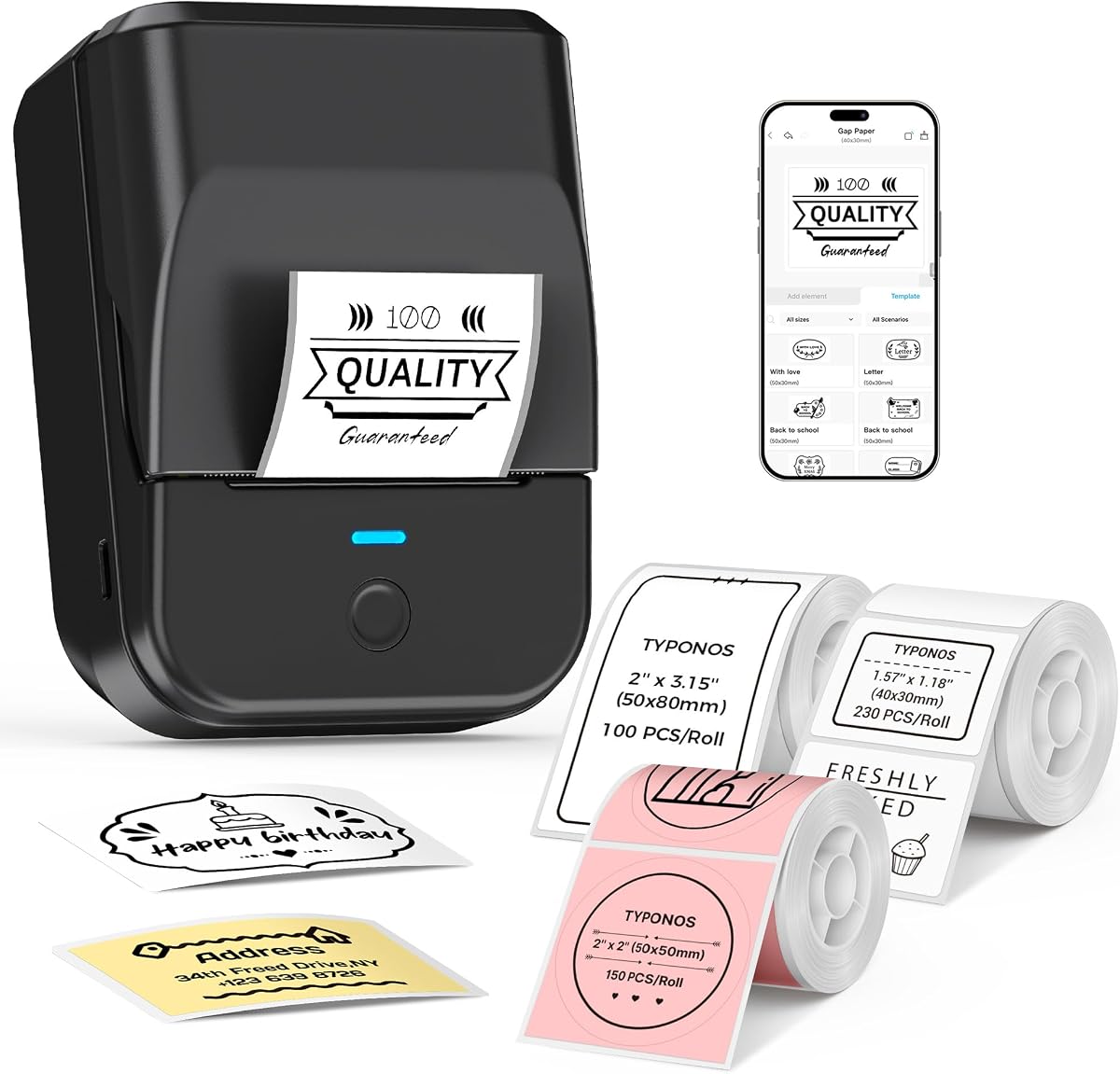
The PM240 carries a 4.4 rating and combines a portable rechargeable format with an unusually broad app feature set. It supports 203 dpi monochrome printing and one- to two-inch square, round, and transparent labels. The included media consists of 40-by-30-millimeter white rectangles, 50-by-80-millimeter white rectangles, and a 50-millimeter pink round roll, providing several shapes right out of the box.
We may earn a commission when you buy through this link, at no additional cost to you.
Its Labelnize app is the device's defining strength. The supplied information lists more than 2,500 icons, 3,800 templates, and 430 fonts, along with Excel import, batch printing, AI text-to-image, and OCR text recognition. RFID-equipped compatible labels allow the app to detect size automatically, which can streamline workflows involving many media types or larger production runs.
Connectivity is handled through Bluetooth for phones and tablets and USB for a computer. The device is portable enough for classrooms, offices, library outreach, and college environments, while a 1,500 mAh rechargeable battery is stated to provide up to 100 days of standby time after a full charge. Its stated weight of 207 grams also supports pocket-carrying use.
There are constraints. The printer produces only monochrome text, and Bluetooth and USB cannot be connected at the same time. The listing also warns not to remove the green liner sticker from compatible rolls, because doing so can cause printing errors. For users who value flexible formats, batch features, and portability, the PM240 is a capable option for both school-style library activities and general institutional organization.
Excel import and batch printing can reduce repetitive work when many labels share a structure. OCR and text-to-image tools add flexible ways to transfer or create information within the app.
The included rectangular and round rolls allow users to try different label layouts immediately. Additional compatible one- to two-inch media expands the device's use for jars, bins, shipping, and classroom coding.
We may earn a commission when you buy through this link, at no additional cost to you.
The Seiko Smart Label Printer 620 earns a 4.4 rating and offers a straightforward desktop approach for libraries that need consistent address, shipping, file-folder, and name-badge labels. It supports PC and Mac workflows and is stated to print at 2.76 inches per second. That speed is well suited to routine production of envelopes, correspondence, badges, and internal material labels.
We may earn a commission when you buy through this link, at no additional cost to you.
Its front-loading design simplifies media changes. Instead of threading a roll through a complicated path, staff can drop in a new roll, reducing interruptions during a busy processing period. The included software is designed to format, customize, and organize labels, which provides a central path for creating recurring designs without relying on a separate mobile app.
This simplicity comes with fewer connectivity choices. The supplied information does not list Bluetooth or Wi-Fi support, so the printer is most appropriate for a fixed computer-based station. It also describes crisp, clear monochrome output without claiming colored printing, making it more suitable for functional identifiers than decorative or brand-heavy labels.
The Seiko Smart Label Printer 620 is a practical choice for libraries that need a basic, fast, desktop workflow and do not require networking. It can be particularly useful for mailroom, administrative, or program-office tasks where labels originate in a computer file and are printed in batches. For those needs, it offers an uncomplicated alternative to more complex connected models.
The front-loading format makes media replacement intuitive. Staff can swap rolls more efficiently, reducing downtime when a processing session involves several label sizes or frequent replenishment.
Support for address, shipping, file-folder, multipurpose, and name-badge labels covers common institutional tasks. Dedicated desktop software keeps formatting and organization in one place.
We may earn a commission when you buy through this link, at no additional cost to you.
The right library label printer depends on the objects being labeled, the number of jobs, the staff workflow, and the level of technical support available. The following factors help separate a basic handheld identifier from a connected production printer.
Standalone label makers have built-in keyboards and displays, allowing users to type and print without installing software. They are ideal for occasional jobs, volunteers, and simple labels with short text. Connected devices instead use Bluetooth, USB, Wi-Fi, or Ethernet to accept designs from a phone, tablet, or computer, making them better suited to data-driven cataloging, batch processing, and custom graphics. Libraries should consider who will use the machine and whether those users can manage companion apps and drivers without creating extra support requests.
Label width determines what can be identified. Narrow nine- or twelve-millimeter tapes suit folders, small cases, and concise codes, while wider formats support addresses, bin labels, QR codes, and more prominent signage. Some devices use fixed-length rolls, some accept continuous media, and others require pre-sized labels. Maximum label length matters for banners and custom notices. Before purchasing, compare the printer's accepted formats with the dimensions and materials staff expect to use most often, and confirm whether replacement rolls are readily available in the required colors and finishes.
A high stated label-per-minute rate helps during accessioning, media processing, and bulk corrections. The Brother QL-820NWB and QL-810W are listed at up to 110 standard address labels per minute, while the QL-800 reaches up to 93 labels per minute at 300 dpi. Smaller handheld devices commonly use 203 dpi thermal output. Resolution is particularly important for small barcodes, fine print, and dense catalog information, while speed matters more when a staff member must produce hundreds of similar labels in one sitting.
Bluetooth is convenient for portable phones and nearby design work, while Wi-Fi and Ethernet are better for fixed shared printers. A library with several departments may prefer a networked model so staff can submit jobs from different computers, but it must also have reliable wireless coverage and a clear network-access policy. USB remains useful as a stable direct connection or fallback. A model that supports several methods can accommodate more locations, although each added interface may increase setup and administration demands.
Templates can save considerable time when libraries repeatedly produce the same labels for new acquisitions, media collections, shelving, or equipment. The PT-D610BT includes 175 preloaded business templates, while the Nelko P21, SUPVAN T50M Pro, NIIMBOT B1, and PM240 rely on substantial mobile app libraries. For advanced data workflows, the PM240 supports Excel import and batch printing, and the QL-800 can work directly with selected office applications. Check whether the required software runs on the library's managed devices and whether recurring design work can be saved.
Many high-speed professional printers emphasize monochrome output, sometimes with the option to print red as well. Monochrome is appropriate for most barcodes, shelf marks, asset identifiers, and internal workflow labels. Color can make categories, warnings, and public-facing signs easier to distinguish, but the color requirement should be weighed against cost, speed, and specialized media. Any barcode or QR code should be printed with enough space and resolution to scan reliably, and staff should test actual labels with the library's scanning equipment before committing to a broad deployment.
Portable devices are valuable for shelving, storage audits, outreach programs, and classroom labeling. Rechargeable models eliminate the need for a nearby outlet, while their app-based operation can make them easy to carry between locations. Their constraints may include fixed label lengths, limited screen-free design, reduced media width, or incompatibility with certain devices. Desktop printers generally handle larger rolls and longer jobs better. Libraries with mobile teams can select one portable model for field work and one desktop printer for centralized production rather than expecting a compact device to cover every role.
Thermal printers generally require less maintenance than inkjet models because they do not use ink or toner, but media handling still matters. Staff should avoid damaging rollers, exposing print heads to heat, and pulling labels from the device incorrectly. Before installation, check operating system compatibility, mobile platform support, driver availability, and whether a charging adapter is included. Some listings state that adapters are not included, while others require the use of specified tapes for accurate size detection. Building a small maintenance and replacement-media plan prevents a convenient label maker from becoming a bottleneck.
Begin by selecting the correct label type and checking the printer's compatibility requirements. Install the roll according to the supplied instructions, leave any protective liner or green sticker intact, and confirm that the app or computer software recognizes the media size. For a first test, print one plain label with a short title and a second label containing the actual barcode or QR code used in the library. Scan both with the equipment staff will use daily to confirm that text and codes are positioned correctly.
Create a reusable template for recurring identifiers and lock in essential details such as location, call number, barcode, and item type. Review the preview before sending a large batch, particularly when using continuous media or variable-width labels. Fixed-width devices should receive the exact supported format, and a desktop model should be connected through its intended network or USB workflow. For high-volume jobs, test one or two labels before processing the entire queue and keep replacement media near the station.
Care for the device by using compatible rolls, keeping the print path free of adhesive residue, and following the manufacturer's instructions for cutter and print-head care. Do not pull a jammed label forcefully because that can damage the mechanism or leave a partial label inside the printer. Keep mobile units charged, store them within their recommended temperature range, and use the app to adjust automatic power-off behavior when frequent Bluetooth access is necessary. Periodically clean or inspect the device according to its manual and verify that stored templates remain available after a software update.
A handheld model such as the Brother PT-M95 is usually sufficient when staff mainly need short identifiers for folders, media cases, bins, or book carts. It offers standalone typing and printing without a computer connection. If the library also wants QR codes, logos, or phone-based design, a portable Bluetooth model such as the Nelko P21 or NIIMBOT B1 may be more appropriate.
A standalone label maker uses its own keyboard and display to create labels, making it convenient for occasional tasks. A desktop label printer usually connects to a computer and is better suited to larger rolls, faster output, office application integration, and batch jobs. Libraries with recurring cataloging or processing work will often receive greater value from a desktop model.
Several models in this guide support barcodes or QR codes through their companion apps, including the Nelko P21, SUPVAN T50M Pro, and PM240. The device must also use compatible media and correctly sized code graphics. Always test a sample with the library's actual scanner, and avoid adding a print margin that interferes with the code's quiet zone.
It depends on how and where the printer will be used. USB is dependable at a fixed workstation, while Wi-Fi is convenient when several compatible computers need access from different locations. A library with stable networking can also consider the Brother QL-820NWB, which adds Ethernet alongside Bluetooth and wireless connectivity for more deployment options.
No. The portable and professional models described here use thermal printing, so labels are produced without ink or toner. The printer still requires compatible thermal media, and results can vary with label quality, darkness, and environmental conditions. Using the media specified or recommended by the manufacturer can help maintain print consistency.
Libraries use labels for audiovisual media, equipment, storage bins, shelving, furniture, supply drawers, keys, cables, program materials, outgoing mail, and interdepartmental transfers. Larger desktop models are useful for name badges, file folders, packages, and signs, while portable devices work well for classroom supplies, book carts, outreach kits, and labels applied directly to shelves.
It depends on the model. The Brother PT-D610BT supports colorful design options through its full-color display and broad font, frame, and symbol selection, while many high-speed desktop models emphasize monochrome output and sometimes black-and-red printing. Check the exact specification before choosing a device for color-coded library categories or branded signage.
Check the printer's stated width, maximum length, and supported label family, then match those requirements to the media in use. Some portable printers detect size electronically, while others require a manually selected fixed format. Continuous labels are not interchangeable with fixed-length rolls, and removing a green liner or protective sticker can interfere with automatic detection or print quality.
The Brother PT-D610BT is the strongest all-around recommendation because it combines standalone capability, Bluetooth and USB connectivity, a color preview screen, stored labels, and extensive design options. The Brother QL-820NWB is the premium choice for high-volume and networked operations, while the Brother PT-M95 provides a simple, economical route to short library identifiers without app-based design.
The right choice ultimately depends on workload and staff habits. Choose a desktop printer for batch processing, larger media, and computer-based integration; choose a portable Bluetooth model for shelving, outreach, classrooms, and work away from a desk; choose a standalone label maker when simplicity and low setup are the priorities. Whichever category fits, test labels with the actual media, applications, and scanning devices used by the library before a full rollout.
Product features and prices can change over time, so confirm the current listing, availability, compatibility details, and included accessories before purchasing. The best Label Printer for Library is not simply the model with the most features; it is the one that supports the library's real labels, workload, and staff workflow reliably.