
Gorilla Super Glue Gel XL
4.6Editor score
No-run gel formula
Ten-to-45-second set
Crystal-clear finish
Glue to fix plastic refrigerator shelf? Our guide compares 10 adhesives for plastic strength, control, cure speed, and clean, reliable repairs at home.
Repairing a cracked plastic refrigerator shelf requires an adhesive that forms a strong, lasting bond without leaving an obvious mark on the repaired area. Application control, plastic compatibility, cure speed, gap filling, and resistance to moisture also matter when choosing among the leading options.
We compared ten products based on their stated bonding capabilities, applicator design, setting and cure times, finish, material compatibility, and suitability for controlled household repairs. The guide covers cyanoacrylate liquids and gels, two-part urethanes, epoxy, and a dedicated plastic bonding system.
Each review explains the product's standout qualities, limitations, and best-fit repair scenario so you can choose with confidence. Product details, ratings, availability, and prices can change, so verify the current listing before purchasing.
4.6Editor score
4.6Editor score

4.6Editor score
The following comparison highlights applicator style, advertised setting behavior, material capabilities, and finish. These differences matter because a refrigerator shelf may need a discreet clear bond, controlled gap filling, or a stronger structural adhesive.



The GH1200 2-in-1 Super Glue combines a fine brush applicator with a dispensing nozzle, making it especially interesting for a plastic refrigerator shelf repair where neat application matters. It carries a 4.5 rating and is marketed as a fast-setting, crystal-clear adhesive for solid plastic bonds. The dual applicator design gives the user a way to cover a narrow crack precisely or spread adhesive over a slightly wider joint.
We may earn a commission when you buy through this link, at no additional cost to you.
Its main strength is control. The brush is designed to place controlled amounts of cyanoacrylate without the broad, uneven coverage associated with a liquid super glue. The nozzle is useful when more adhesive is needed or when the repair extends over a larger surface area. The product is also described as waterproof, temperature resistant, and suitable for applications involving ABS, PVC, toys, models, and three-dimensional figures.
There are important limitations. GH1200 states that its adhesive will not work on hard plastics such as plastic bags and containers, so the exact refrigerator shelf polymer must be identified before use. The advertised 10-to-45-second set is an initial handling time rather than the complete cure, and the manufacturer recommends allowing 24 hours for better results. Applying a cyanoacrylate too heavily can also create a visible excess around the seam.
This is a strong choice when the shelf is a known plastic type, the crack is small, and appearance matters. It is especially useful for precision seam work where a brush can keep adhesive away from visible surfaces. For a broad structural repair involving uncertain plastic or a substantial gap, one of the two-part plastic bonders may offer a more appropriate combination of strength and gap filling.
The built-in brush provides more deliberate coverage along a hairline crack, while the nozzle can deliver additional adhesive when a repair requires more material. This flexibility is helpful on a shelf where an over-applied liquid could run or leave a noticeable glossy patch.
The advertised 10-to-45-second set is useful for quickly positioning a loose section, but the shelf should remain undisturbed while the bond cures. Allow the recommended 24-hour period when possible, especially around a joint that will carry weight.
We may earn a commission when you buy through this link, at no additional cost to you.
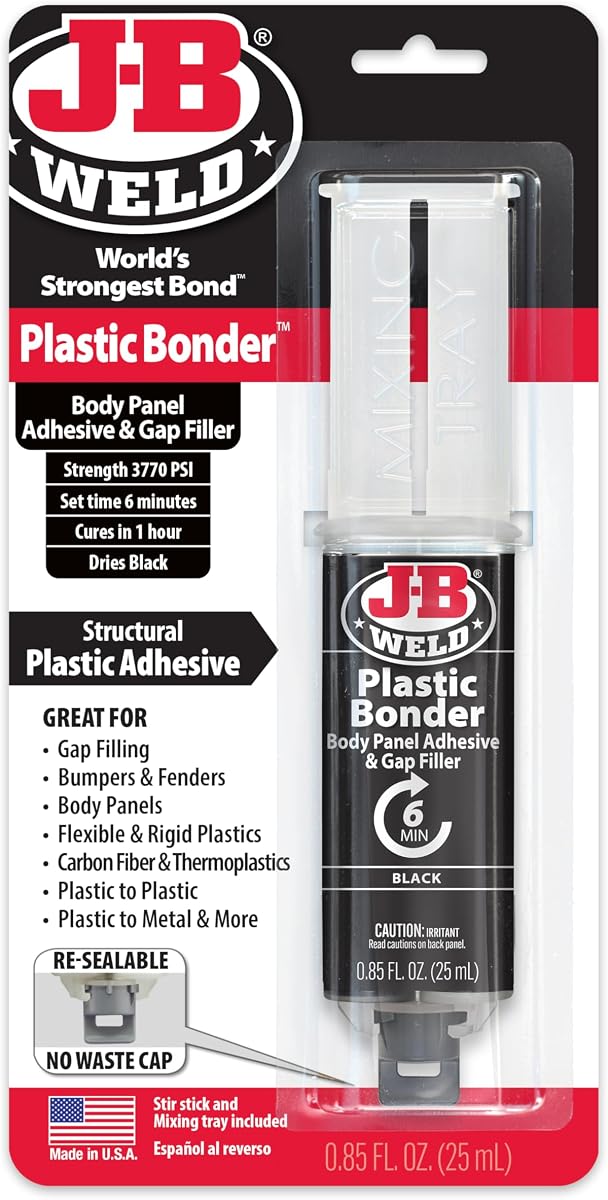
The J-B Weld 50139 Plastic Bonder is a quick-set, two-part urethane adhesive and gap filler with a 4.6 rating. It is designed for strong, lasting repairs across thermoset and thermoplastic materials, carbon fiber composites, coated metals, concrete, and other surfaces. For a broken plastic refrigerator shelf, its structural approach and gap-filling capability make it a particularly versatile option.
We may earn a commission when you buy through this link, at no additional cost to you.
The syringe format is a meaningful convenience. It dispenses the resin and hardener in a 1:1 mixing ratio, reducing the guesswork associated with a multi-part epoxy kit. After mixing, the adhesive sets in 15 minutes and can be sanded after 30 minutes. Its stated tensile strength is 3770 PSI, and the product is suitable for indoor or outdoor repair work. Once cured, the black adhesive provides a robust repair that can be shaped if needed.
The tradeoff is its appearance and preparation process. A black bond line will be more obvious than a clear repair on a light-colored or transparent shelf. Mixing must be thorough, and the material needs time to develop its full strength. Because refrigerator shelves commonly support bottles, food containers, and their own weight, a shelf that has a major fracture or damaged mounting feature may be better replaced rather than heavily patched.
This is the strongest all-around recommendation for a substantial plastic shelf repair. It is particularly suitable when a small gap must be filled, the shelf and joint can be held in position during the set, and appearance is less important than a durable structural bond. For a nearly invisible hairline crack, a clear gel or liquid cyanoacrylate may be more appropriate.
With a listed tensile strength of 3770 PSI and a hard permanent cure, this adhesive is better aligned with a shelf that must support everyday loads than with purely cosmetic crack repair. Its urethane system is intended to create more than a thin surface connection.
The dual syringe encourages a consistent 1:1 ratio, while the included mixing tray and stir stick simplify preparation. After the initial set, the repair can be sanded after 30 minutes, which is useful for smoothing an uneven joint or making the bonded area fit more neatly.
We may earn a commission when you buy through this link, at no additional cost to you.
Super Glue All-Purpose Gel is a larger-format instant adhesive with a 4.6 rating and a 50-gram supply. Its gel format is less prone to running than a thin liquid, making it more practical for a vertical refrigerator shelf or a seam where neat placement matters. The product dries clear and is positioned for household and heavier-duty repair tasks.
We may earn a commission when you buy through this link, at no additional cost to you.
A major advantage is its claimed content. The 50-gram container is much larger than many standard adhesive tubes, making it suitable for a repair kit with several plastic components or for repeated household projects. The precision tip and anti-clogging safety cap help maintain consistent flow and support long-term storage. The adhesive reaches maximum handling durability in seconds, which can simplify immediate repositioning of a small shelf fragment.
The product information does not provide the same detailed plastic-specific compatibility list found on some dedicated plastic adhesives. That means the user should confirm compatibility with the shelf material before committing to a full repair. Gel can also be less precise than a brush or extra-long needle nozzle if the break is extremely narrow. Although the formula dries clear, adhesive residue around a repair can still be noticeable on smooth surfaces.
This gel is a good middle ground for a medium-sized shelf repair where controlled application, quick handling, and a discreet finish are priorities. It may be especially practical if the larger container will be shared with other household repairs. For an extensive structural break, the J-B Weld Plastic Bonders offer a more clearly defined gap-filling and structural workflow.
The 50-gram format provides more adhesive than a small disposable tube and is useful for a household repair kit. It can handle more than one plastic component without being designed around a single tiny application.
A thicker formula stays closer to the application point and is less likely to run down a shelf edge. This makes the gel format more forgiving when working on a vertical or angled refrigerator component.
We may earn a commission when you buy through this link, at no additional cost to you.
Gorilla Super Glue Gel XL is a 25-gram, clear gel with a 4.6 rating. Its thicker formula is specifically designed for precision repairs and vertical applications where ordinary liquid super glue may run. That makes it a strong candidate for a plastic refrigerator shelf whose broken section needs to stay in place without adhesive migrating across a visible surface.
We may earn a commission when you buy through this link, at no additional cost to you.
The gel is reinforced with Impact Tough technology and sets in 10 to 45 seconds without clamping. It bonds to a broad range of materials, including plastic, glass, wood, metal, ceramic, rubber, leather, and paper. The squeeze bottle includes a metal pin anti-clog cap that creates an airtight seal. The manufacturer also specifies a crystal-clear finish without foaming or residue, which is valuable for a repair that remains visible.
As with other fast-setting glues, the short working time requires preparation before application. The shelf should be clean, dry, and held in its final position before opening the bottle. Although the initial set happens quickly, the stated full cure is 24 hours. A repair supporting considerable weight should not be loaded during that period, and the small container may not be ideal for a large surface area.
This is an excellent choice for a small but visible crack where clean application and fast handling are the main priorities. It is less appropriate when the repair needs to bridge a large void, because a gel is not a replacement for a gap-filling structural system. Confirm the shelf plastic is compatible before use, then apply a small amount along the joint.
The controlled gel consistency stays where it is placed and is less likely to drip down a shelf edge. It offers a practical alternative to thin liquid super glue when the shelf must be bonded in its installed orientation.
Impact Tough technology is intended to increase resistance after curing, while the clear, no-foam finish helps the repair blend into smooth plastic. The result is a visually discreet bond with greater strength than many basic gel adhesives.
We may earn a commission when you buy through this link, at no additional cost to you.
The J-B Weld 50133 Plastic Bonder is a 25-milliliter, two-part urethane structural adhesive with a 4.6 rating. It is designed for strong, lasting bonds to many plastic surfaces and can also fill dents and gaps. Although it shares the Plastic Bonder name with the black version higher on this list, its tan color and longer stated cure time distinguish it.
We may earn a commission when you buy through this link, at no additional cost to you.
The syringe uses an easy 1:1 mixing ratio and includes a mixing tray and stir stick. Once the components are combined, the adhesive takes 15 minutes to set and 30 hours to cure. The listed tensile strength is 3770 PSI, and the range of stated surface applications includes thermoplastics, thermosets, coated metals, PVC, concrete, ceramic, tile, fiberglass, and aluminum. A re-sealable cap helps prevent the material from drying out or leaking between uses.
Its main drawback is the 30-hour cure. That makes it less convenient for an urgent repair, even though the initial set occurs much sooner. The tan finish may be noticeable on a clear or light-colored shelf, and thorough mixing is essential to achieve the intended properties. Like all gap fillers, it can create excess material around a joint that later needs trimming or sanding.
This is a sensible value-oriented structural option for a DIY repair involving a known compatible plastic and a joint that does not need to carry weight immediately. It is especially useful when the shelf has a dent or small missing section as well as a crack. Clear cyanoacrylate remains preferable for a nearly invisible hairline repair, while the black Plastic Bonder is better suited to dark surfaces.
This product is not limited to a single plastic category. Its stated compatibility with thermoplastics, thermosets, PVC, fiberglass, metals, and other materials gives it broader repair potential within the home.
The re-sealable syringe cap reduces waste by limiting exposure to air between uses. Its built-in ratio and included mixing tools also simplify the first repair, although both parts must still be measured and blended thoroughly.
We may earn a commission when you buy through this link, at no additional cost to you.
The Loctite Super Glue Longneck is a two-bottle pack of 10-gram clear cyanoacrylate adhesives with a 4.8 rating, the highest rating in this comparison. Its extra-long precision nozzle is designed to place a small amount of liquid accurately, making it useful for narrow cracks and recessed seams on a plastic refrigerator shelf.
We may earn a commission when you buy through this link, at no additional cost to you.
The quick-dry formula sets in 15 to 30 seconds without clamping, allowing a small broken section to be positioned quickly. It works on porous and non-porous surfaces and is listed for plastics, leather, ceramic, and wood. The liquid dries transparent for nearly invisible repairs, while the anti-clog cap is intended to reduce spills, nozzle buildup, and dried material around the opening.
The primary concern is liquid behavior. Cyanoacrylate can run or spread beyond the intended joint, especially on smooth vertical surfaces, and the repair may need careful support immediately after application. A precision needle helps mitigate this, but the formula does not have the no-run consistency of a gel. The pack format is also more about convenience and having a spare than about delivering a gap-filling structural bond.
This product is a strong choice for a fine, clean crack that needs a nearly invisible connection. It works particularly well when the repair location is easy to access and the broken edges meet neatly without a wide gap. For a shelf that is heavily loaded or cracked through a thick mounting feature, select a dedicated plastic bonder or epoxy instead.
The extra-long nozzle makes it easier to reach a recessed crack or place adhesive into a narrow line without moving a large bottle over the repair. This is a practical benefit when working inside a refrigerator shelf or support area.
The transparent formula is appropriate when appearance is the main concern and the plastic edges align closely. Support the piece in position until the 15-to-30-second set, then avoid stressing the joint while it completes curing.
We may earn a commission when you buy through this link, at no additional cost to you.
Loctite Super Glue Professional Liquid is a two-pack of clear, 0.7-fluid-ounce cyanoacrylate bottles with a 4.7 rating. It combines a fast 15-to-30-second set with a pinpoint nozzle and a patented quick-open, lock-closed cap. Those controls make it a practical repair option for a visible plastic shelf when precise placement is more important than gap filling.
We may earn a commission when you buy through this link, at no additional cost to you.
The adhesive is described as heavier duty than ordinary super glue and is intended to bond a broad range of porous and non-porous materials. The listed surfaces include hard plastics, wood, rubber, metal, paper, ceramic, and leather. It dries transparent, reducing visual disruption, and the locking cap is designed to prevent spillage, clogging, and adhesive buildup between openings.
A thin liquid adhesive still needs careful handling. Work on a clean, dry surface, position the shelf before opening the bottle, and apply only enough adhesive to cover the joint. Excess can wick into adjacent areas and remain visible. The two bottles are useful for separate jobs or as a backup, but the product does not provide the dedicated activator system offered by the Loctite Plastics Bonding System.
Choose this adhesive for a fine crack, chipped edge, or small plastic fixture that requires a fast and nearly invisible connection. It is a good general-purpose option for households that want a dependable super glue with strong nozzle control. A broad or heavily loaded break is better served by a gap-filling plastic bonder.
The quick-open and lock-closed cap helps keep the bottle stable during storage and reduces accidental spills. It also makes it easier to keep residual adhesive from hardening around the tip between uses.
The larger 0.7-fluid-ounce bottle and two-pack format offer convenient storage and multiple sessions of use. This is useful for a repair kit containing several household adhesives rather than a one-time miniature tube.
We may earn a commission when you buy through this link, at no additional cost to you.
The Loctite Super Glue Plastics Bonding System is a two-part kit containing adhesive and an activator, with a 4.2 rating. Its defining feature is the ability to bond plastics that may be difficult for ordinary cyanoacrylate, including polyethylene, polypropylene, and polytetrafluoroethylene. That makes it worth checking when the refrigerator shelf is made from one of these polymers.
We may earn a commission when you buy through this link, at no additional cost to you.
The activator primes the surfaces before the glue is applied, helping create a stronger connection than an unactivated instant adhesive. No mixing is required, which simplifies the process compared with a resin-and-hardener system. The adhesive dries transparent, sets quickly, and does not require clamping. The finished bond is also described as resistant to water, most chemicals, and freezing temperatures, useful qualities for a cold, damp appliance interior.
Its 4.2 rating is lower than those of the other listed products, so it should be considered alongside customer feedback and the specific material involved. The workflow also has a built-in tradeoff: the surface must be treated with activator before the adhesive can create the intended bond. Applying the two products incorrectly may reduce performance. The small 0.21-fluid-ounce kit is compact but better suited to a localized repair than a large shelf surface.
This is the most targeted option for low-surface-energy plastics. It is a strong recommendation when the shelf has been identified as polyethylene or polypropylene and the crack is small. If the material is unknown, identify it first; a general-purpose gel or two-part plastic bonder may offer a more dependable path when compatibility is uncertain.
Polyethylene, polypropylene, and PTFE are among the plastics explicitly addressed by this system. Its activator creates a prepared surface that gives the cyanoacrylate a better opportunity to form a durable connection.
There are no resin components to measure or blend. Follow the activation sequence carefully, then apply the adhesive to the prepared joint and hold the shelf in position until the fast set is complete.
We may earn a commission when you buy through this link, at no additional cost to you.
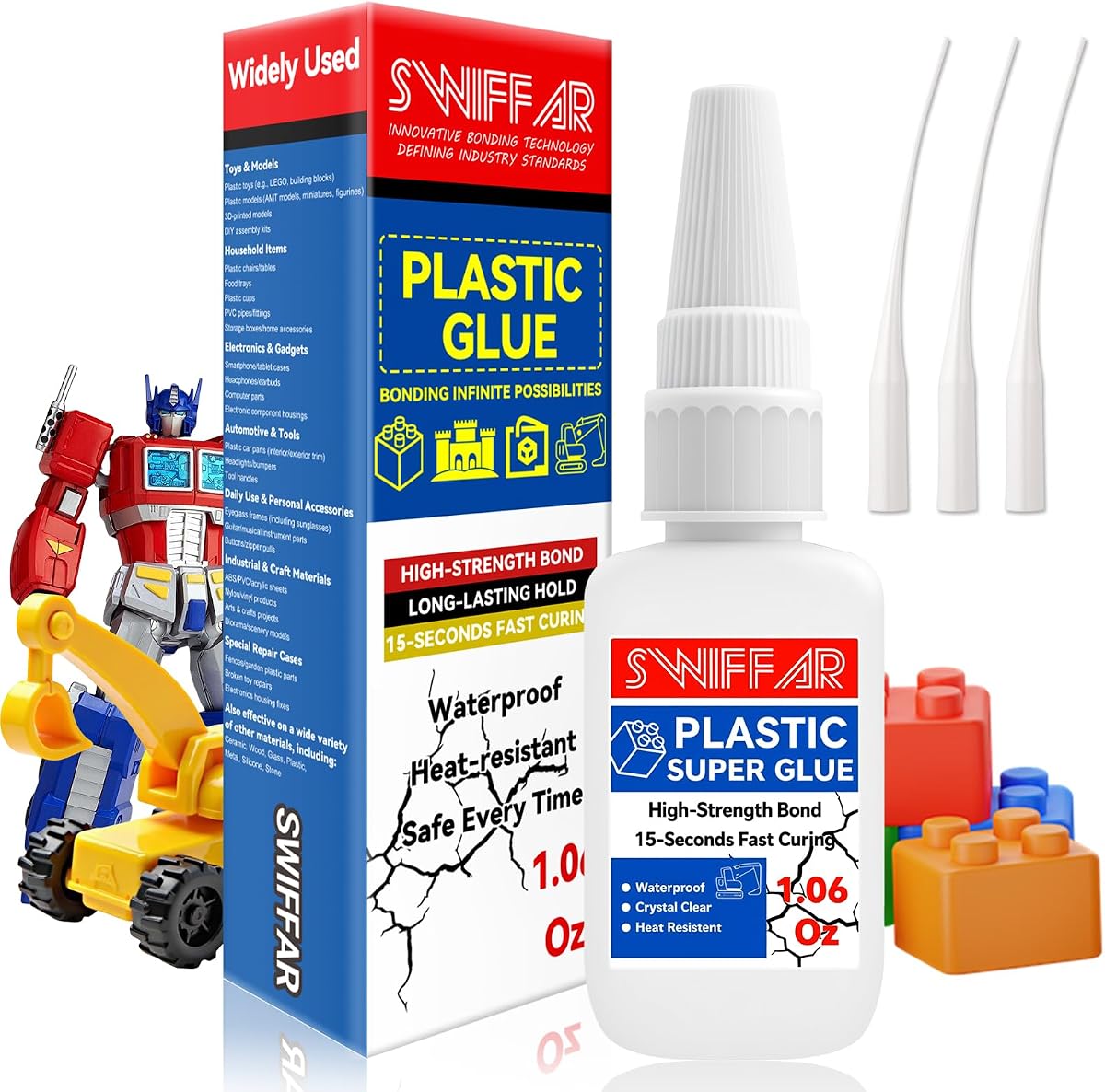
The Plastic Glue Permanent Cement Kit is a clear, fine-tip adhesive with a 4.5 rating. It is marketed for plastic repair and for bonding models, miniatures, three-dimensional prints, acrylic, PLA, metal, and vehicle parts. The pen-like applicator is designed to flow into tiny cracks and seams without dripping, which makes it a useful option for small shelf fractures.
We may earn a commission when you buy through this link, at no additional cost to you.
Its fast-bonding formula is said to penetrate cracks and form a secure connection in seconds. The finished bond is described as waterproof and heat resistant, with resistance to pulling, bending, and daily wear. The product is also presented as colorless, odorless, and residue-free, allowing the repaired section to blend into visible plastic surfaces. The fine tip can be used like a pen for controlled placement along irregular joints.
The product information makes unusually broad claims for a general adhesive, covering plastics, metals, ceramic, glass, and leather as well as model-building uses. A repair should therefore be placed on a compatible material rather than assumed to work everywhere. The exact full-cure time is not stated, so the shelf should be left unloaded longer than the brief handling period. Like other cyanoacrylates, it may become difficult to clean from unintended surfaces.
This kit is most appealing for precise, small repairs on a plastic shelf where the fine tip can reach the damaged area and a clear finish is important. It is also a sensible addition to a model or craft repair kit because of its controlled applicator. For a large structural shelf break, choose an adhesive with explicit gap-filling and load-bearing features instead.
The fine-tip applicator makes it easier to follow a hairline crack or place adhesive inside a recessed seam. This reduces the need to apply excess material and can improve the appearance of a visible repair.
The colorless formula is intended to leave a discreet repair without visible residue. Combined with its stated waterproof and heat-resistant properties, it suits indoor household components that experience normal temperature variation.
We may earn a commission when you buy through this link, at no additional cost to you.
Gorilla 2 Part Epoxy is a 0.85-ounce epoxy kit with a 4.5 rating. It combines a five-minute set time with clear curing and gap-filling capability. Although it is not a dedicated plastic adhesive, these qualities make it a credible choice for a refrigerator shelf with an uneven crack or a small missing section that a thin super glue cannot fill.
We may earn a commission when you buy through this link, at no additional cost to you.
Separate barrels keep the epoxy resin and hardener unmixed until use, and the syringes dispense both components evenly. Once combined, the adhesive sets in five minutes, providing enough time to reposition and adjust the shelf. It can bond uneven or vertical surfaces, fill voids, and withstand moderate exposure to water. The clear finish helps limit the visual impact of the repair on light-colored plastic.
The central tradeoff is that the user must measure and mix the two components correctly. An improper ratio can undermine the bond, and the repair should be held securely while the epoxy sets. The stated water resistance covers moderate exposure rather than constant immersion, and the product information does not specifically confirm compatibility with every refrigerator shelf polymer. A small compatibility test on an inconspicuous area is prudent.
Choose this epoxy when a structural or gap-filling repair is more important than a nearly invisible instant bond. Its five-minute working window is a major convenience compared with longer-setting two-part plastic bonders. For a simple hairline crack in a known compatible plastic, a gel cyanoacrylate will be faster and less involved.
Unlike a thin instant adhesive, this epoxy is designed to fill voids and connect uneven surfaces. It is therefore a better candidate when a refrigerator shelf has a small chunk missing or the broken edges do not meet precisely.
The clear result suits a visible household repair, while moderate water resistance helps the bond cope with routine cleaning and condensation. It is not presented as a continuous-submersion adhesive, so the repaired shelf should still be protected from persistent moisture.
We may earn a commission when you buy through this link, at no additional cost to you.
The best adhesive depends on the shelf polymer, break type, load, and desired appearance. Confirm material compatibility, compare the applicator and curing process, and choose a formula that fits both the size and importance of the repair.
Match the adhesive to the plastic rather than relying on the broad phrase plastic compatible. A repair product designed for models may work on rigid decorative parts but may not be suitable for a food-contact appliance component.
Use thin, precise glue for clean seams and structural filler for uneven joints. A fast-setting adhesive is not automatically the strongest choice for a heavily loaded shelf.
For a loaded shelf, prioritize proven strength and complete cure over a quick initial set. Support the repair and keep it unloaded until the manufacturer-stated cure period has passed.
Choose the applicator that matches the repair. A brush helps spread controlled adhesive, a gel resists running, and a long narrow nozzle reaches recessed cracks.
Use set time to position the repair and cure time to determine when it can be loaded. Longer curing can be worthwhile when durability matters more than convenience.
Choose a clear finish for a visible cosmetic repair and a colored structural adhesive when surface appearance is secondary. Appearance should never override compatibility or strength.
Use gap filler for missing or uneven material and precision glue for close-fitting seams. A filler can also be sanded or shaped after it sets, depending on the product.
Read the product label before use, protect your hands and eyes, and store the adhesive as directed. Fast-setting chemistry deserves respect even when the repair itself is small.
Begin by removing the shelf and unloading it completely. Clean and dry the damaged area, removing loose fragments, dust, oil, and residue without abrading the surrounding plastic. If the crack has a gap, determine whether the edges can be held together; use a gap-filling adhesive for missing material and a precision adhesive for a clean, close-fitting seam. Arrange supports and tools before opening the product because many formulas begin setting quickly.
Read the adhesive instructions and follow its application sequence. Two-part products require accurate mixing, while the Loctite Plastics Bonding System requires the activator to be applied before the glue. Apply only the recommended amount, position the broken section, and hold or support it until the stated set time. Keep the shelf unloaded throughout the complete cure period and avoid flexing the joint to test the repair.
After curing, inspect the bond gently and clean away any cured excess according to the product guidance. Reinstall the shelf only when the adhesive has fully cured and the joint is dry, firm, and free of gaps. If a crack was near a mounting tab or support rib, or if the shelf flexes under light pressure, replace it rather than using adhesive as a substitute for a sound structural component. Store the remaining product upright with its cap secured.
The best choice depends on the plastic and the size of the break. J-B Weld Plastic Bonder is a strong option for a structural or gap-filling repair, while a clear gel cyanoacrylate is better for a small, visible crack with closely aligned edges. Confirm compatibility with the shelf material before applying any adhesive.
It can work when the shelf is made from a compatible plastic and the crack is narrow. General-purpose super glues include many plastics in their stated applications, but low-surface-energy plastics such as polyethylene and polypropylene may require a dedicated bonding system. Test on a hidden section and allow the full cure time before loading the shelf.
Choose a clear adhesive and use the narrowest practical application method. A brush, gel, or fine nozzle helps keep glue inside the joint, while a two-part epoxy or plastic bonder can be sanded after curing if the repair is visible. Excess cured glue may still be apparent, so controlling the amount applied is more important than simply choosing a clear product.
A well-supported cosmetic repair may be reasonable if the manufacturer and adhesive instructions permit the material combination. A crack through a mounting tab, hinge, support rib, or heavily stressed area can make the shelf unsafe, and replacement is the better option. The repair should also remain clear of surfaces that directly contact food.
Clamping is helpful when it keeps the edges aligned without squeezing out adhesive, but the product should remain supported even if clamping is unnecessary. Some fast-setting glues do not require clamping, yet alignment still matters during the initial set. Use a temporary support that will not scratch the plastic and avoid loading the shelf during the full cure.
Wait for the full cure time stated by the adhesive, not merely the initial set time. Products in this comparison range from a five-minute epoxy set to longer full-cure periods of approximately 24 to 30 hours. The shelf should be completely cured, dry, and free of flexing before you reinstall and load it.
Only after the adhesive has cured sufficiently. J-B Weld 50139 states that it can be sanded after 30 minutes, while the 50133 version requires the full 30-hour cure. Other products do not provide specific sanding instructions, so check their labels and work gently to avoid damaging the surrounding plastic.
Avoid applying a permanent adhesive until you can check the refrigerator documentation or identify the material. Look for a manufacturer marking, inspect the original replacement part, or ask the appliance manufacturer. If identification remains impossible, use a general-purpose product only after a hidden compatibility test and avoid relying on a small cosmetic repair for a structural break.
The J-B Weld 50139 Plastic Bonder is the most versatile recommendation for a substantial repair because it combines two-part structural adhesion, gap filling, and a convenient mixing syringe. Gorilla Super Glue Gel XL is the premium choice for a controlled, clear, fast-setting repair, while the J-B Weld 50133 Plastic Bonder offers a cost-conscious two-part approach for compatible plastics and larger joints.
Prioritize the shelf material, the nature of the break, and the load it must support before focusing on speed. Fine cracks benefit from precision liquids, gels, and brushes; uneven or missing sections need gap-filling urethane or epoxy. If the damage compromises a mounting tab or support rib, replacing the shelf is safer than creating a bond that may fail under repeated loading.
Confirm the current product details, compatibility statements, and availability before buying, and read the adhesive's full curing instructions. Product ratings, formulation details, packaging, and prices can change, so the current listing should be treated as the final source for purchasing information.