
Dell Precision 7780
5.0Editor score
Core i9-13950HX processor
128GB high-speed memory
NVIDIA RTX 3500 Ada
2TB NVMe storage
Choosing a laptop for Matlab involves balancing processor speed, memory capacity, graphics performance, and enough storage for complex data sets. The best machine is not necessarily the most expensive, but one that can support demanding simulations, large matrices, toolboxes, and other MATLAB-oriented development work without frustrating delays or thermal throttling.
This guide compares ten business, creator, and workstation laptops based on their published hardware, operating systems, connectivity, displays, and stated professional use cases. The selections include systems with Intel Core i9 and Core Ultra processors, AMD Ryzen performance, integrated graphics, and dedicated NVIDIA workstation GPUs for demanding graphical workloads.
Each placement reflects how the listed configuration supports MATLAB and related engineering, data analysis, simulation, and programming tasks. Ratings come from the supplied product information, while availability, configurations, and prices can change, so readers should confirm the current listing before making a purchase.
5.0Editor score

4.4Editor score

As an Amazon Associate we earn from qualifying purchases.
This side-by-side comparison highlights the processor, memory, graphics, and storage differences that matter most for MATLAB, from efficient everyday systems to powerful mobile workstations.




The Dell Precision 7680 earns the top position because it combines a flagship Intel Core i9-13950HX processor with 32GB of DDR5 CAMM memory, a fast 1TB PCIe NVMe SSD, and a 16-inch FHD+ display. Its supplied rating is 4.4, and the hardware profile is especially well suited to MATLAB scripts, simulations, engineering analysis, and development workflows that demand sustained multicore performance.
We may earn a commission when you buy through this link, at no additional cost to you.
The processor's 14 cores and boost speed up to 5.5GHz provide a useful foundation for parallel MATLAB workloads, compiling code, running simulations, and moving between MATLAB, Python, SQL, and visualization tools. CAMM memory is designed to overcome conventional SODIMM limitations while allowing faster memory and thinner workstation designs. The 1TB NVMe drive also provides ample room for data sets, simulation outputs, toolboxes, and local project files.
Its main limitation is that the listed configuration relies on integrated Intel UHD Graphics rather than a discrete GPU. That is less important for CPU-centric numerical analysis, but it may not satisfy users who need hardware-accelerated 3D rendering, GPU computing, or intensive visualization in addition to MATLAB. The 16-inch chassis and workstation positioning also make it less convenient for frequent travel than a compact notebook.
Despite those trade-offs, this is the strongest all-around recommendation for users who want a capable, expandable workstation without moving to the largest 17.3-inch model. It is especially attractive to engineers, architects, data analysts, developers, and technical professionals who need Windows 11 Pro, broad port selection, multi-monitor support, and dependable professional-application credentials.
For MATLAB specifically, the combination of processing power, memory, storage, and workstation software support is more versatile than most conventional business laptops. Buyers who regularly perform GPU-heavy rendering should consider the discrete-GPU Precision 7780, while the 7680 remains an excellent choice for general engineering computation, algorithm development, and mixed professional workloads.
The Core i9-13950HX gives MATLAB workloads a substantial number of processing cores, which can improve parallel functions, simulations, and compilation-heavy tasks. Its high boost clocks also help responsive performance when working interactively in the MATLAB desktop.
The anti-glare 1920-by-1200 panel is practical for long sessions, while HDMI, USB-C, Thunderbolt, USB-A, and Ethernet simplify laboratory and office setups. Support for multiple external displays is especially helpful when MATLAB figures remain open beside code editors and documentation.
We may earn a commission when you buy through this link, at no additional cost to you.
The Dell Precision 7780 is the premium option in this guide, combining a 5.0 supplied rating with a 17.3-inch workstation design. Its defining advantage is the combination of 128GB RAM, a 2TB NVMe SSD, an Intel Core i9-13950HX processor, and an NVIDIA RTX 3500 Ada GPU with 12GB of VRAM for demanding professional applications.
We may earn a commission when you buy through this link, at no additional cost to you.
The unusually generous memory capacity is particularly relevant to MATLAB users who routinely work with large arrays, image stacks, simulation models, or multiple virtual environments. The dedicated professional GPU adds value when MATLAB code uses GPU arrays, parallel computing workflows, computer vision toolboxes, or demanding 3D visualization. Its 2TB drive reduces the need to manage large project files manually.
The compromises are physical and thermal. A 17.3-inch mobile workstation is heavier and less portable than the smaller business laptops in the list, and the Core i9 plus discrete graphics configuration can produce substantial heat and power draw during extended computations. Buyers who need this level of capability should expect a machine intended primarily for desk-based or docked use rather than constant travel.
This laptop is best for engineers, architects, researchers, and simulation specialists whose MATLAB work genuinely benefits from abundant RAM and professional graphics. Users running ordinary scripts, teaching MATLAB, or doing only light analysis may find more than they need in a smaller and less powerful system. For maximum MATLAB headroom in this list, however, the Precision 7780 is the clear premium selection.
Its ISV-certified workstation positioning adds confidence for users who depend on professional applications, while Windows 11 Pro provides enterprise-oriented features. For heavy datasets, GPU-enabled analysis, and complex development projects, the combination of processor, memory, graphics, and storage is exceptionally persuasive.
With 128GB of RAM, this system can accommodate large working sets without relying on virtual memory as frequently. That helps when multiple MATLAB instances, data files, virtual machines, and engineering applications must remain responsive at the same time.
The NVIDIA RTX 3500 Ada with 12GB of VRAM provides a meaningful upgrade over integrated graphics. It is better suited to GPU arrays, rendering, visualization, and professional applications that benefit from dedicated graphics hardware.
We may earn a commission when you buy through this link, at no additional cost to you.
The Dell Precision 3581 is the value-focused choice for MATLAB users who want dedicated graphics and workstation-class construction without moving to the cost of the larger Precision models. It pairs a 14-core Core i7-13800H processor with 32GB of DDR5 memory, 1TB of NVMe storage, and an NVIDIA RTX A500 with 4GB of dedicated memory.
We may earn a commission when you buy through this link, at no additional cost to you.
Its multicore processor is capable of supporting common MATLAB scripts, numerical routines, data processing, and multitasking alongside development tools. The 32GB RAM configuration provides useful headroom for students, educators, and working engineers who may open several projects or keep larger data sets locally. Fast NVMe storage also improves application loading and project access compared with a conventional hard drive.
The RTX A500 is a meaningful advantage over integrated graphics, although its 4GB of VRAM is modest by current workstation standards. GPU-heavy visualization or parallel computing projects may eventually exceed that limit. The listing also describes the computer as renewed, which may matter to buyers concerned about cosmetic condition or previous use, and it ships with Windows 11 Home rather than the Pro edition found on several alternatives.
Despite those limitations, the Precision 3581 represents one of the most balanced ways to obtain a dedicated GPU for MATLAB. It is well suited to engineering coursework, control systems, signal processing, data visualization, and general technical computing. Buyers who need more VRAM, greater storage, or enterprise features should step up to the Precision 7780 or a newer discrete-GPU system.
Among the list, it is the most sensible budget workstation for users who value a dedicated GPU and 32GB memory. Those primarily running lightweight scripts may find similar performance in less specialized notebooks, but this model delivers the most convincing workstation value here.
The RTX A500 gives MATLAB users hardware beyond basic integrated graphics without moving to a full-size workstation. It is a practical option for 3D plotting, GPU-assisted visualization, and engineering software that benefits from a dedicated renderer.
Thirty-two gigabytes of DDR5 is comfortable for typical coursework and professional analysis. It also allows MATLAB to coexist with browsers, documentation, editors, and other engineering applications without immediately exhausting available memory.
We may earn a commission when you buy through this link, at no additional cost to you.
The HP 17-inch laptop is a practical option for MATLAB learners, educators, and professionals who prioritize memory, screen size, and everyday productivity. Its supplied rating is 4.7, and the combination of an AMD Ryzen 5 7430U processor, 32GB of memory, and 1TB SSD supports common analytical, coding, and simulation tasks well.
We may earn a commission when you buy through this link, at no additional cost to you.
The 17.3-inch 1920-by-1080 IPS anti-glare display offers ample room for MATLAB's desktop, command window, plots, and documentation. A numeric keypad makes repetitive data entry easier, while the long battery-life claim is useful for classes and remote work. Wi-Fi 6, Bluetooth 5.4, HDMI, USB-C, and multiple USB ports provide the connectivity expected from a business notebook.
The main limitation is its integrated graphics. CPU-based MATLAB calculations can perform well, but users who need GPU arrays, intensive rendering, or professional 3D workflows should favor a machine with a discrete NVIDIA GPU. The 17-inch form factor also offers more screen space at the cost of bulk, and the DDR4 memory is not as modern as DDR5 alternatives.
This laptop is best for users whose MATLAB work is centered on scripting, coursework, data visualization, textbook exercises, and moderately sized analysis problems. It provides enough RAM and storage for a well-equipped student workstation, while the Pro operating system adds management and security features useful in institutional environments.
It is not the most specialized MATLAB machine in the guide, but it is a credible all-rounder for users who want a large display and abundant memory without chasing the highest-end mobile workstation. For heavier engineering computation, a Core i9 or dedicated-GPU configuration would provide more headroom.
The anti-glare IPS display is useful when placing code beside plots, documentation, and simulation results. Its roomier canvas reduces the need to constantly rearrange windows, while the numeric keypad improves spreadsheet and parameter entry.
The 32GB configuration gives MATLAB users room for multiple applications and larger projects. Windows 11 Pro, fast charging, and a stated battery life of up to nine hours make the system convenient for classes and mobile professional work.
We may earn a commission when you buy through this link, at no additional cost to you.
The NIMO 15.6 AI Creator is the most approachable entry point in this roundup for students and lighter MATLAB users. It carries a 5.0 supplied rating and combines a six-core AMD Ryzen 5 6600H processor, 16GB of DDR5 memory, 512GB of PCIe storage, and Radeon 660M integrated graphics.
We may earn a commission when you buy through this link, at no additional cost to you.
The Ryzen 5 6600H offers 12 threads and boost speeds up to 4.5GHz, giving MATLAB scripts and coding tasks a responsive foundation. The FHD display, backlit keyboard, fingerprint reader, and broad port selection make it convenient for daily study or remote work. Two full-function USB-C ports, HDMI, three USB-A ports, a card reader, and an audio jack also reduce adapter dependence.
The primary weakness is memory. Sixteen gigabytes is usable for learning and ordinary analysis, but users who regularly open large models or many applications may want to upgrade. Fortunately, the supplied information describes dual SO-DIMM slots and support for memory expansion up to 64GB, as well as a replaceable M.2 2280 SSD format with stated capacity up to 4TB. Radeon 660M is suitable for everyday graphics but not a dedicated GPU.
This model makes sense for MATLAB students learning syntax, plotting, basic algorithms, signal processing examples, and general numerical work. It is also suitable for programmers who need a capable daily notebook but do not yet require workstation graphics. Users with serious large-data or 3D-rendering needs should look toward a discrete-GPU Precision system.
Its upgradeability makes the initial configuration less limiting than the headline memory amount suggests. For buyers on a constrained budget who plan to grow the machine over time, the NIMO offers a flexible path into MATLAB-oriented computing.
Dual SO-DIMM slots and an M.2 2280 drive make it possible to expand memory and storage as MATLAB projects grow. Upgrading later can be a practical way to extend the laptop without replacing the entire system.
The Ryzen 5 6600H, FHD IPS display, and full complement of ports suit office work, coding, media handling, and remote collaboration. Integrated Radeon graphics are adequate for visual work but remain the limit for advanced GPU computing.
We may earn a commission when you buy through this link, at no additional cost to you.
The Dell 16 DC16251 is a mainstream laptop suited to MATLAB learners and professionals who want a comfortable display without purchasing a mobile workstation. Its supplied rating is 4.4, while its Intel Core 7-150U processor, 16GB of memory, and Windows 11 Home configuration provide a familiar general-purpose platform.
We may earn a commission when you buy through this link, at no additional cost to you.
The 16-inch FHD+ display uses a 16:10 aspect ratio, offering more vertical workspace than a conventional 16:9 screen. That extra space can make MATLAB's command window, scripts, and figures easier to arrange side by side. ComfortView Plus is intended to reduce harmful blue-light emissions, and the FHD camera with wide dynamic range and temporal noise reduction supports clearer video calls.
Its 16GB of memory is the most important limitation for heavy MATLAB work. It is sufficient for teaching, basic modeling, and modest data sets, but large arrays or many concurrent applications may pressure the system. Integrated graphics and a vague listing that does not provide a clear storage capacity also make this less attractive for buyers with demanding visualization needs.
Adaptive thermal technology adjusts power and thermals when the computer rests on a stable surface, while Dell's one-year onsite service adds convenience for covered hardware issues. This makes the Dell 16 a good general office and study machine, particularly for users who value display size and mainstream manageability.
For MATLAB, it is best suited to scripts, coursework, basic simulation, and normal productivity use. Those handling large models or 3D graphics should consider a system with at least 32GB of memory and stronger graphics, such as the Precision 3581 or one of the Core i9 notebooks.
The 16:10 display creates a more useful area for code editors, figures, and command output. That makes the Dell 16 a comfortable general-purpose platform for MATLAB work that does not require a dedicated GPU.
The Core 7-150U processor handles routine productivity and moderate MATLAB scripts efficiently. Adaptive thermals and onsite service add convenience, although buyers with heavy workloads should prioritize a larger memory and storage configuration.
We may earn a commission when you buy through this link, at no additional cost to you.
The Lenovo ThinkBook 16 Gen 8 stands out as a productivity-focused hybrid for MATLAB users who also need portability, security, and modern connectivity. It has a supplied rating of 4.2 and pairs an Intel Core Ultra 7 255H processor with 32GB DDR5 RAM, 1TB NVMe storage, and Intel Arc 140T integrated graphics.
We may earn a commission when you buy through this link, at no additional cost to you.
The 16-core hybrid architecture includes six performance cores, eight efficient cores, and two low-power efficient cores, allowing the processor to adapt to different workloads. Its AI Boost NPU and broad multitasking capability suit a mixed environment of MATLAB, browser sessions, code editors, virtual machines, and office applications. The 32GB memory configuration is particularly welcome for professional development.
Its 16-inch 1920-by-1200 IPS display provides a roomy 16:10 workspace, but the stated 300-nit brightness is modest for brightly lit rooms. Intel Arc graphics can handle video editing and CAD as well as everyday visualization, but they do not match a dedicated workstation GPU for heavy 3D or GPU-compute workloads. The thin chassis may also mean less sustained thermal headroom than a larger Precision model.
Windows 11 Pro adds BitLocker, TPM 2.0, Remote Desktop capabilities, and a fingerprint reader in the power button. Thunderbolt 4, Wi-Fi 6E, Bluetooth 5.3, HDMI 2.1, Ethernet, USB-A, USB-C, and an SD card reader provide a strong selection of connections for data-intensive workflows.
This ThinkBook is best for a MATLAB engineer or student who needs strong general-purpose performance, 32GB memory, and excellent connectivity without carrying a bulky workstation. It also suits users who need to travel between lectures, meetings, and client sites while still doing meaningful technical computing. For GPU-intensive simulations, choose a discrete-GPU alternative.
The Core Ultra 7 255H combines performance and efficiency cores to balance computational tasks with everyday power use. This design is effective for interactive MATLAB sessions interrupted by browsing, writing, and video calls.
At a stated 3.75 pounds, the ThinkBook is lighter than the full-size Precision models. Thunderbolt 4, Wi-Fi 6E, Ethernet, HDMI, and USB ports make it well equipped for labs, offices, and external storage workflows.
We may earn a commission when you buy through this link, at no additional cost to you.
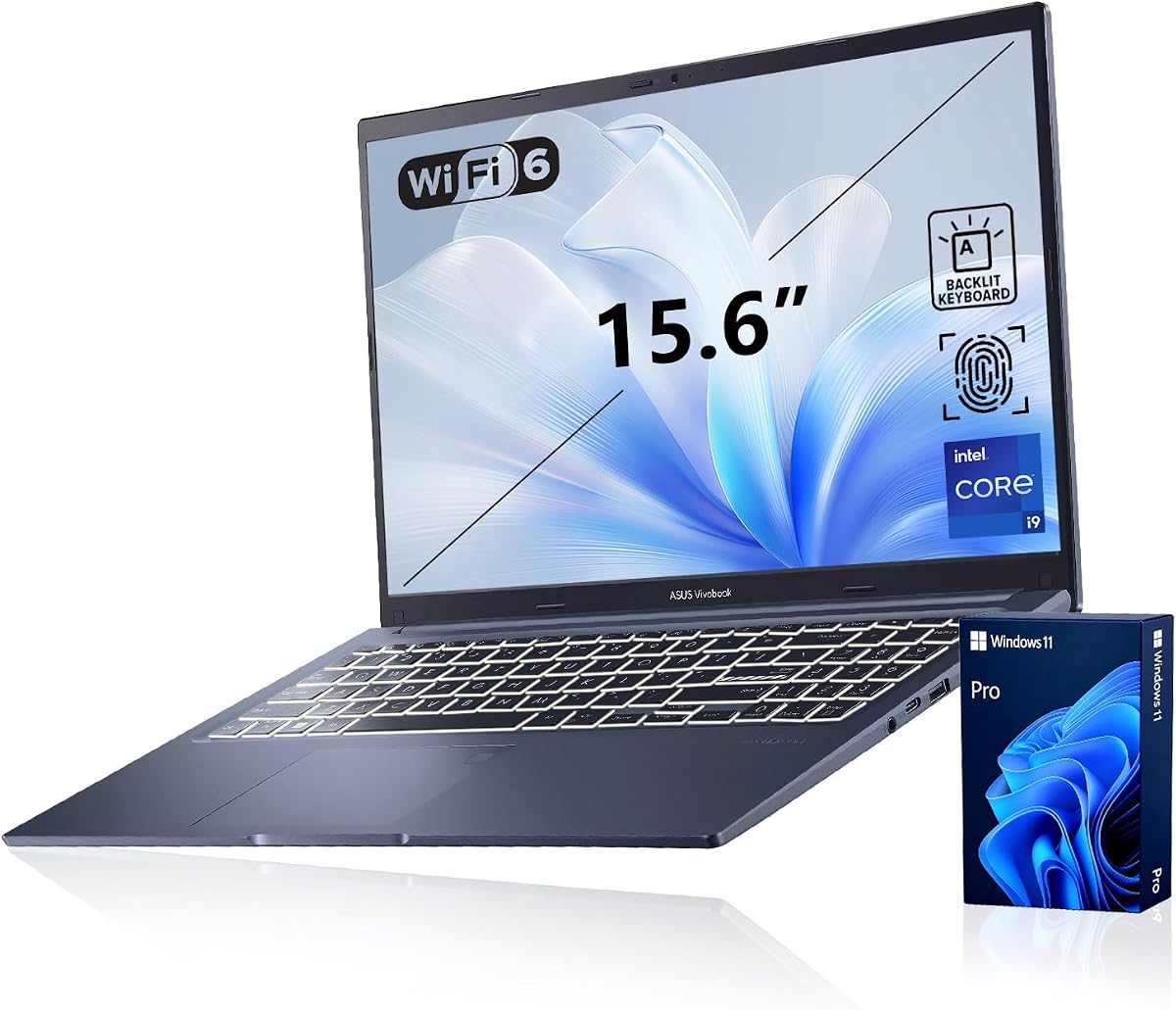
The ASUS Vivobook Core i9-13900H offers a flexible range of memory and storage configurations, allowing buyers to tailor a notebook for MATLAB without moving to a workstation-class design. It has a supplied rating of 5.0 and uses a 14-core processor capable of handling demanding simulations, code compilation, and serious multitasking.
We may earn a commission when you buy through this link, at no additional cost to you.
The listing offers configurations ranging from 16GB to 48GB of DDR4 memory and from 1TB to 2TB of PCIe M.2 SSD storage. For MATLAB, the middle and upper configurations are the most attractive: 32GB supports large working sets and multiple engineering applications, while 48GB provides additional room for virtual environments, datasets, and memory-intensive operations.
The main limitation is integrated graphics. The machine can drive MATLAB's standard plotting environment and perform CPU-based numerical work, but users who require NVIDIA GPU arrays, detailed 3D rendering, or professional graphics should choose a discrete-GPU laptop such as the Precision 3581. The Core i9 platform can also generate considerable heat during extended computation.
Other features make the Vivobook appealing for daily work. The 15.6-inch FHD non-touch display is suitable for code and figures, while a numeric keypad, backlit keyboard, and fingerprint reader support productive use. Physical webcam shielding and Windows 11 Pro add privacy and business functionality. USB-C, several USB-A ports, HDMI, and a 3.5mm audio connection cover common accessory needs.
This is a strong choice for MATLAB students, software developers, and engineers whose work is primarily code- and CPU-oriented. Buyers should select the 32GB or 48GB memory option and adequate storage rather than relying on the minimum configuration. It delivers strong processing power in a conventional notebook format.
The available memory and storage options are more important than the generic product name. A 32GB configuration with 1TB or 2TB storage gives MATLAB users a better balance between active data, project files, and concurrent applications.
The 14-core Core i9-13900H provides strong performance for compilation, simulations, and mixed desktop workflows. It is well suited to CPU-bound MATLAB tasks, although sustained heavy loads require attention to cooling and ventilation.
We may earn a commission when you buy through this link, at no additional cost to you.
The Lenovo ThinkPad L16 is a business-oriented MATLAB companion for professionals, students, and small organizations that value configurability, connectivity, and manageability. Its supplied rating is 4.4, and the listed Intel Core Ultra 5 225U processor is supported by configurable DDR5 memory and NVMe storage ranging from 16GB to 64GB and 512GB to 2TB.
We may earn a commission when you buy through this link, at no additional cost to you.
For the best MATLAB experience, buyers should choose at least 32GB of memory. The 64GB option is worth considering for very large data sets, multiple virtual environments, or users running MATLAB alongside other memory-intensive engineering tools. The processor's 12 cores and up-to-4.8GHz performance are sufficient for code development, analysis, and moderate parallel workloads.
The 16-inch WUXGA display offers 1920-by-1200 resolution, a 16:10 aspect ratio, 400-nit brightness, and anti-glare treatment. That makes it a good screen for environments with variable lighting. The webcam has a privacy shutter, and Windows 11 Pro brings BitLocker, Remote Desktop, and Copilot support for business users.
Connectivity is a major strength. Two Thunderbolt 4 ports, two USB-A 3.2 Gen 1 ports, USB-A 2.0, HDMI 2.1, Ethernet, and audio connections support docks, external displays, laboratory instruments, and storage devices. The stated ability to drive up to three external displays can improve multi-window MATLAB workflows.
Its integrated graphics limit it compared with discrete-GPU Precision models, and the entry-level 16GB configuration is not ideal for serious analysis. Nevertheless, the ThinkPad L16 is a well-balanced business laptop for MATLAB users who need a dependable screen, flexible specifications, strong ports, and long battery life.
Memory and storage choices allow the L16 to serve many budgets and project sizes. Selecting 32GB or 64GB of memory and at least 1TB of storage materially improves suitability for substantial MATLAB work.
Two Thunderbolt 4 ports, HDMI, Ethernet, and USB connections make the L16 well suited to a multi-monitor workstation. Keeping MATLAB, code, results, and documentation visible across several screens can materially improve analysis productivity.
We may earn a commission when you buy through this link, at no additional cost to you.
The ASUS Vivobook 15 PCO Bundle combines a Core i9-13900H processor, 32GB of DDR4 memory, and a 1TB PCIe M.2 SSD in a familiar 15.6-inch notebook. Its supplied rating is 4.5, and the configuration is well matched to CPU-intensive MATLAB programming, simulation, data analysis, and mixed application workloads.
We may earn a commission when you buy through this link, at no additional cost to you.
The 32GB memory is a meaningful strength. It provides enough capacity for MATLAB plus development tools, browser sessions, and other business applications without requiring an immediate upgrade. The 1TB NVMe SSD also creates room for datasets, model files, simulation outputs, and installed toolboxes while supporting quick application and project loading.
The bundle includes a PCO cooler intended to complement the laptop's internal thermal system and help sustain processor frequency during demanding tasks. That can be useful for repeated MATLAB calculations, although a laptop cannot eliminate the fundamental limits of its cooling hardware. The machine should still be operated on a firm, ventilated surface, and users should allow room around its air paths.
Integrated graphics are the main limitation. The notebook can handle MATLAB plotting and standard visual work, but it does not offer the GPU throughput or memory of a dedicated NVIDIA configuration. Users doing advanced 3D rendering, GPU arrays, or professional visualization should move to a workstation model.
Other conveniences include a backlit keyboard, fingerprint reader, physical webcam shield, Wi-Fi 6, HDMI, and a full set of USB connections. Windows 11 Pro adds useful business functionality. This Vivobook is a strong choice for engineers and developers who prioritize processor speed, memory, and storage in a conventional and relatively portable design.
The Core i9-13900H and 32GB of memory form a capable pairing for code-heavy MATLAB workflows. This combination supports quick application switching, compilation, simulation, and analysis without moving to the bulk of a 17-inch workstation.
The included PCO cooler can help manage heat during extended processor workloads and complement the internal cooling system. It is most useful when the laptop has adequate space around its vents and operates on a stable hard surface.
We may earn a commission when you buy through this link, at no additional cost to you.
The right MATLAB laptop depends on project size, toolboxes, graphics requirements, and portability. Processors and memory deserve priority, but display quality, storage, connectivity, cooling, and operating system can materially shape the daily experience.
MATLAB workloads range from lightweight educational scripts to large simulations, iterative optimization, and parallel computations. A recent Core i7, Core i9, Core Ultra, or Ryzen 5 processor can handle typical work, but higher-tier chips offer more headroom for compiling code, processing large data, and running several engineering applications at once. Core count matters when the code can distribute work across threads, while clock speed influences interactive responsiveness.
Prioritize a modern multi-core processor with sustained performance rather than judging by the marketing tier alone. For students and standard analysis, a Ryzen 5 7430U or Core 7 150U may be adequate. For intensive simulation, machine learning, or engineering development, the Core i9-13950HX in the Precision models offers considerably stronger capability. Cooling and chassis design determine whether that potential remains sustainable during long runs.
Memory determines how much data MATLAB can keep active without excessive paging. Sixteen gigabytes is workable for lessons and modest scripts, but 32GB is a more comfortable minimum for professionals who use browsers, editors, virtual machines, and MATLAB simultaneously. Very large arrays, image stacks, and complex simulations can justify 64GB or more, making the 128GB Precision 7780 relevant to specialized users.
Choose at least 32GB when possible, especially if the laptop will be used for data science or engineering rather than a single introductory course. Also check whether memory can be upgraded. The NIMO and several configurable business laptops offer upgrade paths, while workstation memory configurations may be fixed or more specialized.
Integrated graphics are sufficient for standard MATLAB plots, numerical work, and many classroom exercises. Dedicated graphics become important when using GPU arrays, demanding 3D models, high-resolution rendering, computer vision, or other accelerated toolboxes. The Precision 7780's NVIDIA RTX 3500 Ada with 12GB of VRAM offers the strongest listed graphics capability, while the RTX A500 in the Precision 3581 provides a more affordable dedicated-GPU starting point.
Check the software path before buying a dedicated GPU. MATLAB workflows can use NVIDIA hardware, but the benefit depends on the exact toolbox, algorithm, driver, and data set. A machine with strong CPU performance and ample RAM may still serve general MATLAB users better than a poorly balanced system with an expensive but insufficient GPU.
NVMe storage keeps MATLAB, toolboxes, code, and project directories responsive. A 1TB drive is a practical starting point because applications and engineering assets can consume considerable room, while generated outputs may consume much more. Users who keep large sensor records, image libraries, or simulation histories need 2TB or more, or should plan to manage archives on external storage.
Prefer PCIe NVMe drives over slower storage and leave additional capacity for future project growth. Also consider how the operating system and applications are distributed. A single large drive is simple, but it means losing the drive can affect both programs and data unless a robust backup routine is in place.
MATLAB often benefits from screen space because the desktop, command window, editor, figures, and documentation compete for room. A 16-inch 16:10 display provides a practical balance between workspace and portability, while the 17.3-inch Precision 7780 offers maximum room but is bulkier. A 15.6-inch 1920-by-1080 panel remains usable and is easier to carry.
Look beyond size and consider brightness, anti-glare treatment, and color quality. The ThinkPad L16's stated 400-nit brightness is useful in bright environments, while the ThinkBook 16 has a more modest 300-nit panel. For accurate visual evaluation, consider calibrating the display rather than relying on factory appearance alone.
A MATLAB user may move between a laboratory, classroom, office, and home, so weight and battery capability can be as important as raw speed. The HP 17-inch and ThinkPad L16 list strong battery-life figures, while the 3.75-pound ThinkBook 16 favors mobility. Full-size 17.3-inch workstations and larger 16-inch business laptops generally offer more screen space at the cost of portability.
Choose a lightweight system if travel and battery life dominate the schedule. Choose a larger workstation if it will usually remain on a desk and run long computations. Connectivity matters too: Thunderbolt 4, USB-C, HDMI, Ethernet, and multiple USB-A ports simplify charging, external storage, networking, and multi-monitor arrangements.
Windows 11 Pro is a sound environment for MATLAB because it combines modern security, management, Remote Desktop, and enterprise features. Some listings use Windows 11 Home, which is adequate for personal use but offers fewer business-oriented capabilities. Dell's workstation positioning also emphasizes ISV certification and professional application support, which can be valuable in engineering organizations.
Check whether your institution or employer requires particular management, encryption, or remote-access tools. Business support, onsite service, and warranty terms can be meaningful advantages when the laptop is a primary work device. The supplied listings differ in coverage, so buyers should verify the current terms directly rather than assume every configuration carries the same support.
Sustained MATLAB calculations can generate sustained CPU and GPU load. A large workstation chassis, adequate ventilation, and stable cooling can maintain higher processor frequencies for longer than a slim notebook. The ASUS PCO bundle adds an external cooler, but it cannot fully replace a well-designed internal cooling system. Buyers should always use a hard, open surface and avoid blocking vents.
For travel, look for durable business systems. The ThinkPad L16 is described as MIL-STD-810H certified, while the Precision 7680 also cites MIL-STD-810H testing. These claims indicate attention to demanding office, studio, and on-site environments, although they should not be interpreted as permission to ignore heat management or physical care.
After setting up MATLAB, update the operating system, graphics drivers, MATLAB release, and required toolboxes. Activate MATLAB on the new machine, confirm that the license recognizes it, and run a small calculation or plotting example before migrating important projects. Update third-party libraries, compilers, and hardware interface packages one at a time so that any compatibility issue can be traced to a specific change.
Create a clear folder structure for scripts, functions, data, simulation outputs, figures, and generated reports. Keep active projects on the internal NVMe drive and archive completed material to reliable external storage or a properly managed backup solution. Large intermediate files should be cleaned regularly, and important results should never depend on a single copy. MATLAB's path and project tools can help maintain a consistent working environment.
For long computations, use a hard desk surface, leave space around every vent, and avoid placing the laptop directly on fabric. Monitor CPU, memory, storage, and temperature behavior during the heaviest task. Save before major simulations, use version control for code, and use incremental checkpoints when a tool or application supports them. Periodically clean vents, carry the system in a padded case, and avoid leaving it in extreme heat or prolonged direct sunlight.
Sixteen gigabytes is enough for introductory coursework and many light scripts, while 32GB is a more practical minimum for regular professional use. Large data sets, multiple virtual environments, or several applications running at once can require 64GB or more. Choose based on the largest data you expect to work with rather than on ordinary document editing alone.
No, most standard MATLAB analysis, plotting, and numerical routines do not require a discrete GPU. Dedicated graphics become valuable for GPU arrays, advanced 3D rendering, computer vision, and other accelerated toolboxes. Check whether your specific toolbox supports GPU execution and how much graphics memory your model requires before paying for a workstation GPU.
A Core i9 is helpful but not essential for learning MATLAB or running typical scripts. A recent Core i7, Core Ultra 7, or Ryzen 5 can provide satisfactory performance for many users. The need increases with large simulations, compilation, parallel functions, local AI workflows, and several demanding applications running simultaneously.
Yes. MATLAB can run on mainstream Windows business notebooks with 16GB or 32GB of memory and modern processors. A thin laptop may offer less sustained performance under extended calculations and has no dedicated GPU in several configurations. For occasional or moderate use, it can be an excellent and more portable choice.
A 1TB NVMe drive is a sensible starting point for the operating system, MATLAB, toolboxes, and active projects. Two terabytes or more is preferable for large datasets, simulation outputs, virtual machines, and local model files. Keep archival data on backed-up storage rather than filling the system drive with rarely used files.
Workstation laptops often emphasize professional certification, ECC or specialized memory where available, enterprise support, and ISV-tested applications. Gaming laptops can provide strong graphics and cooling at lower cost, but their support and application certification may differ. For MATLAB alone, prioritize the actual processor, memory, GPU, and thermal design rather than the workstation label by itself.
A 15.6-inch model is easier to carry and works well for scripts, standard plots, and classroom use. A 16-inch display, particularly with a 16:10 ratio, provides more room for code, figures, documentation, and multiple applications. The 17.3-inch Precision 7780 maximizes workspace but is best for users who will usually keep the system docked.
Check the condition, warranty, return window, battery health, display quality, port functionality, and whether the manufacturer seal was opened only for an authorized upgrade. A refurbished workstation can offer excellent value, but it should be purchased with clear coverage and a return process. Verify the exact RAM, storage, graphics, and operating system configuration in the current listing.
The Dell Precision 7680 is the strongest overall recommendation because it combines a Core i9-13950HX processor, 32GB of DDR5 memory, fast storage, a useful workstation display, and extensive connectivity. The Precision 7780 is the premium choice for users who need 128GB of RAM and a professional NVIDIA GPU, while the Precision 3581 offers the most compelling dedicated-GPU workstation value.
For students, educators, and lighter users, the HP 17-inch, NIMO, and Dell 16 can handle everyday MATLAB work with fewer compromises. The ThinkBook 16, ThinkPad L16, and ASUS Vivobook models suit professionals who prioritize Core i9 or Core Ultra performance, memory, portability, or a Windows 11 Pro environment. GPU-intensive work should start with the discrete-GPU Precision options.
Before purchasing, compare the exact configuration rather than the product family alone. Verify processor, RAM, graphics, storage, warranty, and operating system details, and leave enough performance headroom for the projects you expect to run. Product listings, configurations, and prices change, so checking the current Amazon page before ordering is essential.