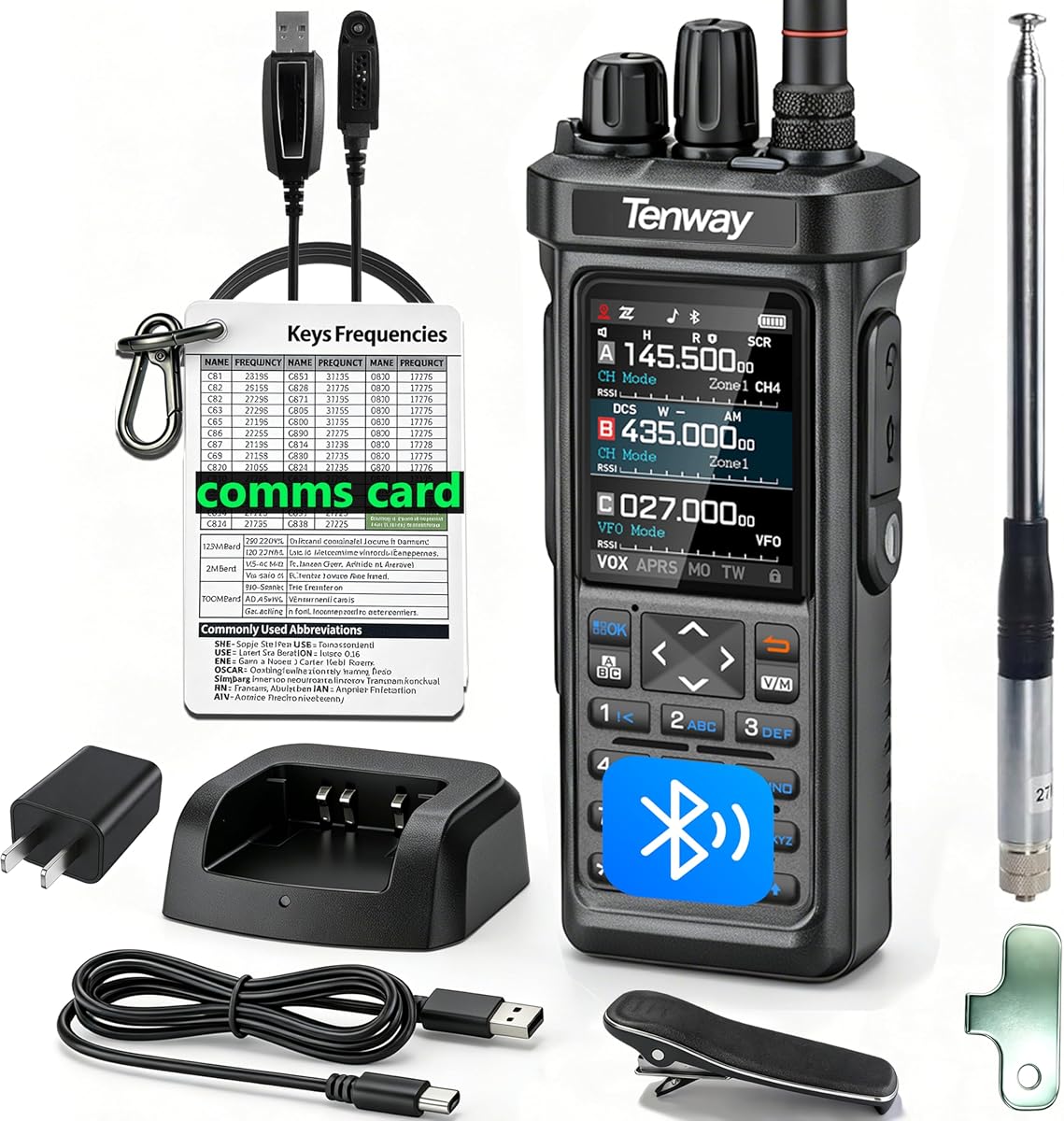
Tenway TP-900 PRO
5.0Editor score
10W FM transmission power
Integrated GPS and APRS
Bluetooth programming support
Wideband AM and FM reception
Ham radios for POTA compared by range, features, power, programmability, and portability, with expert picks for hiking, camping, and field operations in 2026.
Ham radios for POTA must balance useful transmit power, dependable battery life, straightforward controls, and a body that is comfortable to carry away from a vehicle. The strongest choices also support reliable programming, emergency weather reception, and accessories that simplify antenna, charging, and field operation.
This guide compares ten handheld radios across transmission bands, receiver coverage, channel capacity, GPS and APRS availability, NOAA reception, charging options, programmability, and outdoor-friendly features. It covers conventional analog models, digital and dual-mode radios, and feature-rich radios intended for operators who want more than basic local communication.
Each selection demonstrates a different balance of portability, capability, and convenience, from a straightforward budget handheld to advanced radios with GPS, Bluetooth programming, or wideband reception. Ratings and product details reflect the supplied information, while prices and availability can change, so readers should confirm current listings before purchasing.
5.0Editor score

4.3Editor score

4.5Editor score
The table below places all ten radios side by side, emphasizing the capabilities that most affect POTA use: operating bands, channel storage, programming options, positioning features, charging, and emergency reception. Ratings reflect customer feedback supplied for each listing and should be considered alongside feature needs and operator experience.
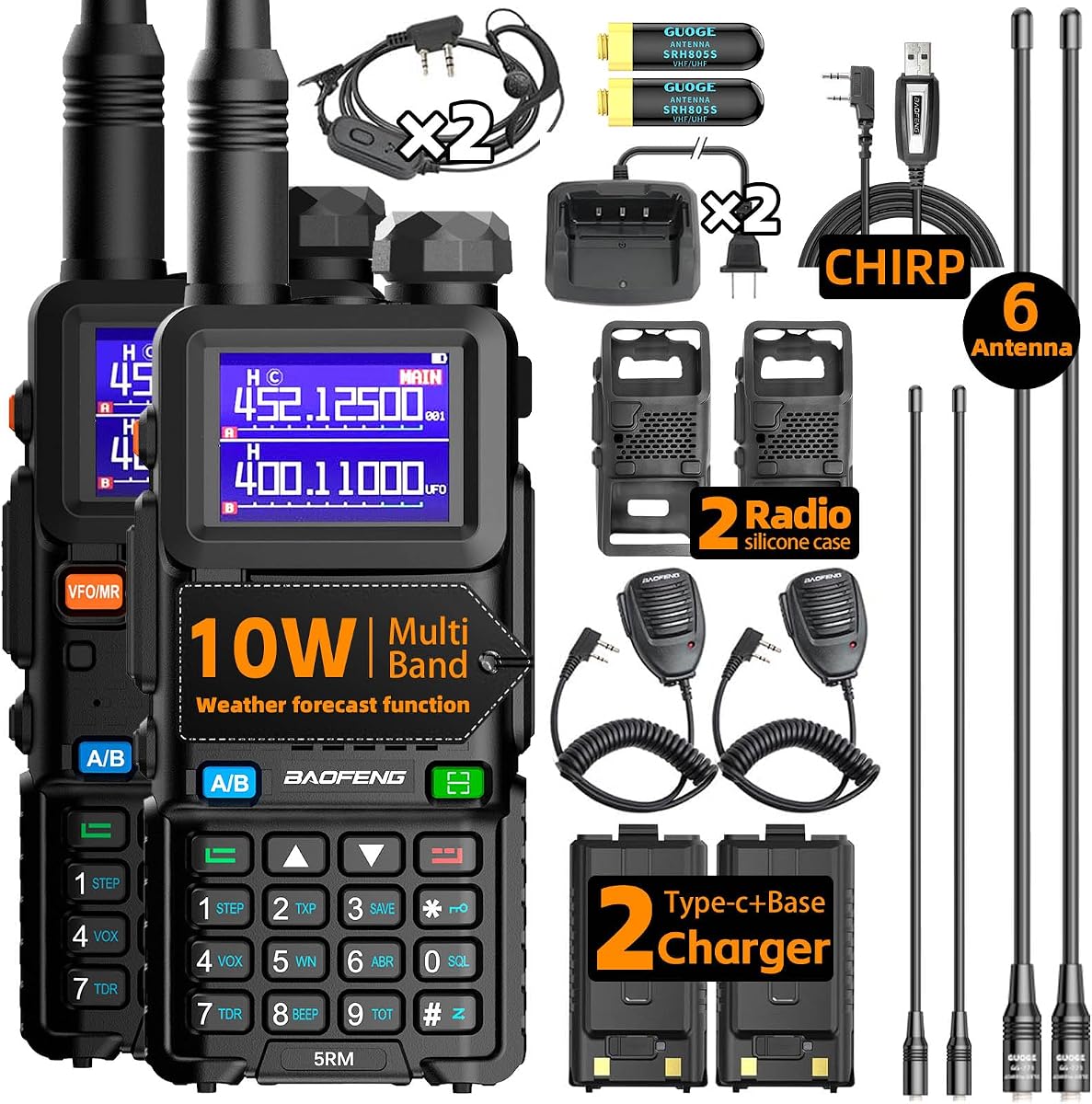


The Baofeng UV-5RM is a conventional dual-band handheld with a supplied rating of 4.6, giving it one of the strongest customer feedback profiles in this guide. Its most appealing POTA qualities are practical rather than exotic: a color display, 999 memory channels, a 2500mAh battery, flexible charging, NOAA alerts, and a supplied speaker microphone.
We may earn a commission when you buy through this link, at no additional cost to you.
Receiver coverage extends beyond the two amateur transmit bands, while actual transmission is specified for 144–148MHz and 420–450MHz. That makes it useful for monitoring local services and amateur activity when those receive features are appropriate. CHIRP compatibility gives operators a structured path for importing planned channels, and the frequency-copy function helps avoid repetitive keypad entry when working with another compatible radio.
The flexible charging arrangement is especially relevant in the field. The radio can be charged through its USB-C cable, desktop base, wall outlet, power bank, laptop, or car adapter. The trade-off is that CHIRP use requires compatible programming equipment and some setup knowledge, while operators must remain within their authorized frequencies and comply with local rules. The radio's physical controls and menu system are also not as refined as those found in some more expensive models.
This is an attractive recommendation for a POTA operator who wants familiar analog operation, generous channel storage, and dependable outdoor utility without moving to a digital platform. It is especially useful for people who will prepare a channel list at home and need flexible charging during multi-day activations. For new ham radio users, it offers plenty of capability, provided they invest time in learning programming and operating procedures.
With 999 memory channels, the UV-5RM can hold local repeaters, simplex channels, park frequencies, and other planned contacts without forcing constant menu changes. Operators should still label channels carefully in CHIRP so they can identify the right contact quickly in the field.
USB-C and desktop charging options reduce dependence on proprietary power supplies. A spare 2500mAh battery can be useful during long operating periods, provided it is charged from a reputable source and stored according to the manufacturer's guidance.
We may earn a commission when you buy through this link, at no additional cost to you.
This two-radio AR-5RM package is tailored to POTA partners, families, or field teams that want matching handhelds without assembling accessories separately. It carries a supplied rating of 4.5 and includes two radios, batteries, USB-C cables, desktop charging bases, a programming cable, speaker microphones, earpieces, belts, hand straps, and a manual.
We may earn a commission when you buy through this link, at no additional cost to you.
Each radio supports the same licensed amateur transmit bands and broad receiver ranges, with up to 999 stored channels and a 1.77-inch color display. NOAA reception, VOX, one-touch frequency copying, CHIRP support, and the included high-quality speaker microphone make it well suited to camp-to-car or park-to-park communication. Separate desktop bases also help maintain both batteries during overnight stops.
The obvious trade-off is pack weight and bulk: two complete radios with external accessories require more space than one radio. Including a programming cable is helpful, but CHIRP setup still involves learning the process of creating and transferring a channel list. The package description also places considerable emphasis on emergency and outdoor use, which may matter more to some buyers than compact dimensions.
The AR-5RM two-pack is a strong choice for anyone planning to operate with a partner or carry a backup radio. It reduces the chance of discovering missing cables, microphones, or chargers after reaching a site. For solo operators with a large pack, the same core radio functionality may be more practical without the duplicate accessories.
Two identical units simplify coordination when one operator handles portable operation and another stays with a vehicle. Frequency cloning can help match basic settings, although each radio should still receive its own final programming and channel labels.
The included earpieces, speaker microphones, straps, belts, and dual charging method cover several common field needs. These accessories are especially useful when hands-free operation, discreet audio, or independent battery management is important.
We may earn a commission when you buy through this link, at no additional cost to you.
The Baofeng UV-5R remains a practical way to enter amateur radio and POTA without starting with a feature-heavy handheld. Its supplied rating is 4.5, and its core specifications are well suited to conventional analog communication: dual-band transmission, 128 channels, selectable power, dual display, dual standby, and independent A/B band operation.
We may earn a commission when you buy through this link, at no additional cost to you.
The large LCD, tri-color backlight, keypad lock, VOX, CTCSS, and DCS functions cover many needs of a new operator. CHIRP support allows a channel list to be prepared on a computer, while manual programming provides a fallback. An integrated LED flashlight adds practical utility during arrival after dark or during an emergency, although it does not replace a dedicated headlamp.
Its limitations are easy to understand. The 128-channel capacity is modest beside models offering 999 or 1,000 memories, and the display is less colorful and information-rich than newer alternatives. The radio is also strictly limited to the listed 144–148MHz and 420–450MHz transmit ranges, so operators should verify frequency plans and local restrictions before using it on an activation.
For a budget-conscious POTA beginner who mainly wants reliable simplex and repeater operation, the UV-5R offers a sensible feature set and a well-known programming approach. It is best suited to operators who value simplicity and compactness over wideband reception, advanced menus, location functions, or large color screens.
Dual display, dual standby, and independent A/B operation are easy to appreciate once the basics are learned. The keypad lock helps prevent accidental changes in a pack, while the flashlight offers limited emergency utility.
CHIRP quick programming helps users create a useful set of local channels without manually scrolling through every parameter. The smaller channel list also keeps the on-air selection more manageable for an operator who is still learning the hobby.
We may earn a commission when you buy through this link, at no additional cost to you.
The BAOFENG BF-F8HP PRO is built for operators who want a structured channel system rather than a long, unstructured memory list. Its supplied rating is 4.3, while 1,000 memories, ten named zones, and clear English menus distinguish it from basic dual-band handhelds. The idea is especially helpful for POTA operators traveling among parks with different local channels.
We may earn a commission when you buy through this link, at no additional cost to you.
Users can group home, travel, club, event, simplex, and receive channels into named zones, then determine which zones participate in scanning. The two-channel display can show names and frequencies together, while Dual Watch alternates between displayed channels and Single Watch gives one channel a full-screen view. Approximate dBm readings add useful signal context without turning the radio into a complicated spectrum analyzer.
Programming begins on the keypad, with BTECH CPS or supported CHIRP-next available for larger plans. The PC03 programming cable is sold separately, and firmware updates also require BTECH CPS, that cable, and model-specific instructions. Bluetooth location sharing can exchange location with another compatible radio on the same channel, but it is not a full APRS system and does not provide continuous tracking through repeaters.
This radio is best for a methodical operator who values organization, readable menus, and future firmware refinement. It may feel excessive for someone who only needs a few local simplex channels, but it offers a more polished way to manage activations across multiple regions. Airband, broadcast FM, and NOAA reception are receive-only, and amateur transmissions still require valid authorization.
Named zones separate channels needed at home from those used at an event or during a trip. This structure makes it easier to scan only the relevant group and reduce accidental calls on channels that do not belong in the current operating plan.
Direct radio-to-radio location sharing can be convenient between compatible units, but it does not replace a dedicated APRS tracker or mapping service. Operators should treat it as a supplementary convenience rather than a complete navigation solution.
We may earn a commission when you buy through this link, at no additional cost to you.
The BAOFENG K5PLUS is designed around portability, a large memory capacity, and an unusually long flexible antenna. It has a supplied rating of 4.5 and includes a 15.35-inch high-gain antenna, 999 channels, NOAA reception, frequency copying, desktop charging, USB-C charging, and a 10W licensed-band transmit capability.
We may earn a commission when you buy through this link, at no additional cost to you.
Its feature set includes airband, FM radio, an LED flashlight, stopwatch, DTMF, VOX, alarm, CTCSS, DCS, and time-out timer functions. These additions make it useful for general outdoor communications as well as amateur radio. The one-click frequency-copy process helps operators match a compatible radio without a full computer-based programming session.
The long antenna may improve signal performance in some situations, but it also makes the radio less compact and more likely to catch on vegetation while moving through brush. While the supplied data confirms its capacity and functions, the listing provides less detail about programming software than some competing products. Users who require advanced digital modes, mapping, or extensive regional channel organization should confirm that conventional analog operation meets their needs.
The K5PLUS is a good fit for POTA operators who prefer a conventional handheld and want a long antenna without moving to a full-featured digital radio. It is particularly appealing for camping, hiking, and general outdoor preparedness. Its combination of memory capacity, flexible charging, emergency alerts, and broad display-related functions gives it useful versatility.
The 15.35-inch flexible antenna gives the radio more physical presence than a standard stub antenna. Operators should allow extra room in a pack and account for the antenna when working around dense vegetation or attaching the radio to a belt or backpack.
One-click copying reduces the need for complex keypad programming when coordinating with another compatible unit. For larger regional plans, an established computer-programming workflow may still provide better labels and organization.
We may earn a commission when you buy through this link, at no additional cost to you.
This AR-5RM two-pack stands out with a supplied rating of 4.8, the highest customer rating among the listed radios. It pairs that strong feedback profile with two 5RM-style handhelds, 999 channels, a 1.77-inch color display, 2500mAh batteries, NOAA reception, frequency copy, CHIRP support, and both USB and desktop base charging.
We may earn a commission when you buy through this link, at no additional cost to you.
The receiving range covers 108–136MHz, 136–174MHz, 220–260MHz, 350–390MHz, and 400–520MHz, while transmitting is limited to 144–148MHz and 420–450MHz. Features such as CTCSS, DCS, VOX, DTMF, alarm, time-out timer, and an LED flashlight add value during camp operations, travel, and emergency preparation.
A two-pack is operationally useful because it provides a backup unit and allows a partner to monitor from a separate location. The cost is more weight and another charging setup to manage. Advanced programming remains necessary for a polished channel list, and the many available settings may require a learning period for an operator new to programmable radios.
This set is a compelling recommendation for pairs, families, or solo operators who value redundancy. It combines one of the guide's most favorable ratings with generous memory, flexible charging, and a comprehensive outdoor feature set. It is especially practical for POTA teams that expect to separate temporarily while remaining able to contact each other.
Carrying a second matching radio provides backup when a unit is dropped, exhausted, occupied, or unexpectedly unavailable. It also permits one operator to remain at a vehicle or campsite while another moves farther into a park.
The ability to use USB charging or the included desktop base makes it easier to maintain the radios at camp or in a vehicle. Two radios still require deliberate charging rotation during long activations.
We may earn a commission when you buy through this link, at no additional cost to you.
The BAOFENG UV-32 takes the familiar 5RM-style platform and adds features aimed at users who want more from a field radio. It carries a supplied rating of 4.4 and includes GPS, three-level power selection, frequency duplication, AM reception, FM radio, stopwatch, flashlight, alarm, DTMF, VOX, a 2500mAh battery, and NOAA forecasting.
We may earn a commission when you buy through this link, at no additional cost to you.
Its 18.89-inch high-gain tactical antenna is the most visually distinctive element and may improve signal characteristics in some setups. The radio can also copy frequencies through the side keys or write frequencies through an app, giving users two ways to adjust channels. A USB-C cable and desktop base provide flexible charging for travel or camp use.
This is not the most compact choice because the long antenna and broad feature set can make belt mounting and pack organization less convenient. The built-in GPS should not be confused with a complete APRS mapping solution, because the supplied information does not identify it as an APRS radio. App-based programming and side-key copying also do not replace a carefully tested channel list.
The UV-32 two-pack is suited to operators who want traditional analog ham radio plus positioning and more extensive utility functions. It is a strong choice for two-person teams, particularly when one member can remain near transport while the other activates a park. Users who prioritize compactness and simple menus may prefer a less elaborate model.
Built-in GPS can help an operator or partner understand position and movement context during an activation. The feature should be paired with sound navigation practices and should not be relied upon as the sole means of finding a trail, vehicle, or group member.
Side-key copying is convenient for quick matches, while app writing supports more frequent changes. Users should verify written frequencies before transmitting and maintain separate paper or device backups of important contacts.
We may earn a commission when you buy through this link, at no additional cost to you.
The Tenway TP-900 PRO is the most feature-focused premium selection in this guide and carries a supplied rating of 5.0. It combines up to 10W of FM output with 27MHz amateur operation, integrated GPS, APRS support, NOAA reception, wideband reception, Bluetooth app programming, and a spectrum analyzer.
We may earn a commission when you buy through this link, at no additional cost to you.
APRS makes it a strong fit for POTA operators who want to transmit position information as part of a field activity. The spectrum analyzer can help identify nearby signal activity and choose cleaner frequencies, while Bluetooth programming removes much of the need for a cable during routine setup. AM, FM, SW, MW, and LW receive coverage expands its usefulness beyond ordinary simplex communications.
The radio's wide capabilities create a learning curve. POTA participants should understand APRS, privacy considerations, band plans, and local operating rules before relying on advanced features. The 27MHz operation supports FM modulation only, so it should not be mistaken for a universal mode on that band. Bluetooth setup and any accompanying application workflow also need to be tested before departing for a remote park.
This is the recommendation for an experienced or ambitious operator who wants navigation, digital position reporting, flexible programming, and wideband monitoring in one handheld. It is less compelling for a beginner who only wants easy simplex operation, yet it offers a complete platform for building a serious POTA kit with location awareness and flexible field configuration.
Integrated APRS provides a more complete location-reporting capability than a simple coordinate display. Operators can combine position data with a POTA activation, but they should still verify their call sign, path, destination, and privacy settings before transmitting.
App-based programming can make frequent channel-list changes easier than cable-based workflows. Operators should still export and back up their programming and confirm that the app is paired correctly before leaving reliable coverage behind.
AM, FM, SW, MW, and LW reception give the radio value beyond amateur channels. It can be useful for monitoring weather broadcasts, aviation-related receive signals, and other services, subject to local reception rules and equipment restrictions.
We may earn a commission when you buy through this link, at no additional cost to you.
The Retevis RT85 two-pack offers a more rugged-looking alternative to the many Baofeng models in this guide. It has a supplied rating of 4.5 and emphasizes durability, stable voice communication, 5W output, 200 channels, SOS alarm, a flashlight, repeater support, and a reinforced housing designed to tolerate shock and vibration.
We may earn a commission when you buy through this link, at no additional cost to you.
Its A/B bands operate independently and can display and answer calls on two channels, allowing separate teams to communicate without interference. CHIRP support gives operators a familiar programming route, while VFO and DTMF provide additional flexibility. The pair format is useful for partners, event teams, or as a backup for an operator who does not want to depend on one device.
The primary limitation is transmit power. At 5W, the RT85 produces less maximum output than the listed 10W radios, and actual range also depends on antenna design, terrain, battery condition, and the other station's equipment. Its 200 channels are sufficient for many local plans but less accommodating than models with 999 or 1,000 memories. The product description also provides fewer details about charging and programming accessories.
The RT85 is a sensible choice for operators who value physical toughness, dual-band simplicity, and a two-radio package. It is particularly useful for local POTA events, hiking communications, and backup use. Those seeking higher output, GPS, APRS, or very large channel lists should look toward the 10W, position-aware models in this guide.
The rugged housing is intended to withstand shock and vibration better than a basic consumer handheld. It is still prudent to protect the display and connector from impacts, moisture, and abrasive surfaces during transport.
Independent A/B operation makes it possible to monitor two channels and answer calls on either band. This is useful when a park team, campsite, or travel group is using separate local systems.
We may earn a commission when you buy through this link, at no additional cost to you.
The BAOFENG DM-32 is the most flexible radio in the guide for operators who may encounter both conventional analog systems and DMR. It carries a supplied rating of 4.3 and includes dual-mode operation, 10W maximum output with three power levels, a 2.0-inch screen, full keyboard, and up to 4,000 channels.
We may earn a commission when you buy through this link, at no additional cost to you.
GPS and APRS add meaningful value for POTA, while TDMA dual-time-slot capability can improve efficiency within compatible DMR systems. The radio also supports text messaging, voice recording, remote monitoring, programmable side keys, and digital encryption options. FM, AM, and NOAA reception extend its use beyond voice communication, and Type-C connectivity handles charging, frequency writing, and firmware updates.
The important qualification is interoperability. DMR is not automatically compatible with every analog repeater, club system, or digital network, so operators must confirm the system they intend to use and program the radio correctly. Encryption settings and messaging should also follow local rules. The single-radio listing makes it less convenient for a matched pair unless another unit is purchased separately.
The DM-32 is an excellent choice for a technically capable POTA operator who values DMR, APRS, large channel capacity, and extensive computer-based programmability. It also supports analog operation, giving it broader relevance than a digital-only handheld. Newcomers focused entirely on simple analog parks can find more approachable alternatives, but this radio offers considerable room to grow.
Dual-mode operation lets the radio participate in conventional FM and DMR systems without changing hardware. Because digital networks use different talkgroups, colors, and repeater settings, familiarity with DMR is still necessary for reliable operation.
Integrated positioning can support location reporting during portable operations. Operators should learn APRS conventions and avoid transmitting through unsuitable repeaters or paths that may not support the packet data.
A single Type-C connection is listed for charging, writing frequencies, and firmware updates. This reduces cable complexity, although successful programming still depends on compatible software and careful configuration.
We may earn a commission when you buy through this link, at no additional cost to you.
Choosing a POTA handheld requires balancing legal transmit capability, useful receiving, battery endurance, programming convenience, and pack-friendly size. The best radio is the one that matches your operating methods, local infrastructure, and willingness to configure equipment before reaching an activation site.
Begin by confirming that the radio transmits on the amateur bands you expect to use and that your license class authorizes those operations. Most of the listed conventional models transmit on 144–148MHz and 420–450MHz, while the BF-F8HP PRO adds a third amateur transmit band. The Tenway TP-900 PRO also supports 27MHz FM operation, but only with FM modulation. Wide receiver ranges can be useful for monitoring, yet they do not grant permission to transmit outside authorized amateur frequencies.
Read the transmit specification, not merely the word long range. A radio may receive commercial, aviation, broadcast, or other bands while restricting transmission to amateur allocations. Operators should also follow band plans, emergency traffic procedures, and local rules at every activation.
Most handhelds here offer up to 10W, while the Retevis RT85 lists 5W high output. Higher power can improve the ability to establish contact, but it does not guarantee a specific distance and often consumes more battery. Antenna design matters too: the K5PLUS includes a 15.35-inch flexible antenna, the UV-32 includes an 18.89-inch tactical antenna, and the Tenway TP-900 PRO is supplied with a 27MHz antenna.
Choose output and antenna together based on how you move. Long antennas may improve some signal conditions but take more pack space. A shorter, conventional antenna is easier to manage while hiking. In every case, keep a spare approved antenna available if your operating plan depends on it.
Several models include 2500mAh rechargeable batteries and offer USB-C or USB charging, while the listed UV-32 and AR-5RM packages also support desktop bases. For POTA, charging flexibility can be as important as battery capacity because operators may move between a vehicle, campsite, and pack. Look for a connector type you already carry and a charging method that works with available power banks or vehicle outlets.
Bring a charging plan rather than relying on one full battery. For multi-day activity, rotate batteries or recharge from a dependable power source, and store cells in appropriate conditions. Accessory descriptions vary, so verify whether a spare battery, charging cable, and base charger are included for the exact listing selected.
Programming support determines how easily a radio can be prepared for regional channels, park hotspots, repeaters, and simplex contacts. CHIRP compatibility appears on multiple conventional models, while the BF-F8HP PRO supports BTECH CPS or selected CHIRP-next workflows and the DM-32 emphasizes computer-based configuration. The Tenway TP-900 PRO supports Bluetooth app programming, and several other models provide one-touch frequency copy.
Favor a method you are comfortable using and verify the radio model before downloading programming software. A radio may have a similar-looking model name but different USB data behavior or supported options. Keep a written frequency list as a backup and test the programmed radio before leaving home.
The selections range from 128 channels in the original UV-5R to 4,000 in the DM-32. Capacity alone does not determine usability: a radio with fewer, well-labeled channels may be easier for a beginner than one containing thousands of entries. The BF-F8HP PRO addresses this with ten named zones, while other models rely more heavily on memory order and programmed labels.
For most local POTA operating, 128 to 200 channels may be sufficient. Large regional itineraries or digital networks benefit from greater capacity. Choose enough room for planned contacts without creating a menu that is difficult to navigate in poor light or while wearing gloves.
GPS and APRS can improve team awareness and position reporting, making them valuable for expeditions and coordinated activations. The Tenway TP-900 PRO and BAOFENG DM-32 include full APRS support, while the UV-32 includes a GPS function and the BF-F8HP PRO offers direct radio-to-radio location sharing without the same repeater, mapping, or continuous-tracking capabilities. The DM-32 also supports DMR, text messaging, recording, and encryption features.
Advanced functions create more ways to configure and use a radio, so they are not automatically better for every operator. Confirm that local repeaters or clubs use the same digital mode and talkgroup structure. APRS also calls for attention to privacy, routing, and appropriate transmission paths.
NOAA weather reception is a meaningful safety feature for remote parks and exposed camps. Most of the advanced Baofeng models and the Tenway TP-900 PRO include NOAA weather reception or alerts. Such functions can provide forecasts and emergency information when cellular service is unreliable, but they do not guarantee reception in every location.
Treat a handheld weather receiver as a supplement rather than the sole source of emergency information. Carry a separate forecast source where possible, check alerts before departure, and ensure your radio and batteries remain usable in cold or wet conditions.
A large color screen can help show channel names, frequency, signal context, and GPS information, but menu complexity can slow down operation. The original UV-5R has a straightforward LCD, while the BF-F8HP PRO emphasizes clear English menus and display options. The DM-32 includes a 2.0-inch screen and full keyboard, and the UV-32 adds several programming and utility options.
Consider readability in sunlight, button spacing, keypad lock, flashlight availability, and the ease of changing channels while wearing gloves or moving on uneven ground. A radio that is feature-rich but frustrating to operate may be less useful than a simpler model with a channel plan that works immediately.
Begin by confirming your amateur license, reading the radio's instructions, and installing the approved antenna and battery correctly. Program the relevant amateur channels, local repeaters, simplex frequencies, and any digital talkgroups while stationary and with reliable power. Confirm transmit ranges, time-out settings, power levels, and emergency alert channels before traveling.
At the activation site, begin with low power and identify yourself clearly. Follow the applicable POTA exchange procedure, record the required station information, and use the correct logging method. Monitor the channel before transmitting, avoid interfering with emergency traffic, and follow any instructions from the park, land manager, event organizer, or local amateur radio association.
Protect the radio from moisture, extreme heat, impact, and connector damage. Keep the contacts clean, use a protective case, and avoid charging a wet radio. Monitor battery condition, carry appropriate spares, and remove batteries for long storage. Periodically verify channel memory, transmit function, GPS or APRS accuracy, and emergency reception before relying on the equipment for another field activation.
Yes. Transmitting on amateur frequencies requires a valid amateur radio license, and the authorized bands depend on your license class and the activation location. POTA status does not grant permission to transmit on frequencies outside your authorization. Review the rules published by the relevant licensing authority and use only approved amateur frequencies and modes.
Ten watts is common among the handhelds in this guide and provides useful power without requiring a vehicle-mounted setup. Five watts may still be effective for local contacts, especially with a suitable antenna. Actual range depends on terrain, antenna performance, battery condition, and the other station, so starting low and increasing only as needed is good operating practice.
Neither is necessary for basic voice contacts, but both can improve coordination and position awareness. The Tenway TP-900 PRO and BAOFENG DM-32 provide GPS and APRS, while the UV-32 includes GPS and the BF-F8HP PRO offers direct location sharing with limitations. Operators should learn the relevant position-reporting conventions before transmitting.
Most models can transmit on frequencies entered manually, and several provide one-touch or side-key frequency copying. However, computer programming makes regional travel, local repeaters, and large channel collections much easier to manage. Operators should create and test a programmed list before a POTA trip and keep a backup frequency record.
No. A radio may receive aviation, broadcast, commercial, or other frequencies while restricting transmissions to amateur bands. Several models in this guide explicitly list broad receiver coverage but only 144–148MHz and 420–450MHz transmit ranges. Operators must identify the actual transmit capability and never infer permission from receive capability.
A two-pack is valuable for partners, family groups, event teams, and solo operators seeking redundancy. It also provides separate charging bases and accessories, but adds weight and pack space. A single radio may be sufficient for a lightweight solo kit, provided the operator carries a backup power plan and can access another communication method.
NOAA reception can provide weather forecasts and emergency alerts when cellular service is unavailable or unreliable. It is especially useful in remote parks, but reception depends on location, terrain, antenna condition, and battery power. Operators should still check forecasts before leaving and carry a separate emergency communication plan.
Yes, provided you remain within your authorization and follow local rules while the radio is in use. Many operators keep communication available during travel and begin formal park exchanges at the designated activation area. A lightweight radio, comfortable belt clip, spare battery, and accessible antenna are generally more important than maximum feature count for the hike.
The Tenway TP-900 PRO stands out as the premium all-in-one option with GPS, APRS, Bluetooth programming, wideband reception, and a spectrum analyzer. The BAOFENG DM-32 is the strongest editorial choice for operators who want both analog and DMR, while the original Baofeng UV-5R remains a practical budget starting point with familiar programming and a focused feature set.
For most POTA operators, prioritize legal band coverage, a reliable battery, an antenna suited to the way you travel, and a programming method you understand. Add GPS or APRS when position reporting will improve coordination, and choose NOAA reception as useful safety support rather than a substitute for preparation. A simpler radio that is configured correctly can serve a park activation better than an advanced model that remains confusing in the field.
Ratings, product configurations, and listings can change, so confirm the exact model, included accessories, firmware notes, and current specifications before buying. Current prices also fluctuate, which is why this guide focuses on capabilities rather than fixed cost. With the right radio, a tested channel plan, responsible power use, and proper logging, a handheld can become a dependable centerpiece of a POTA kit.