
QNAP TL-D1600S
4.5Editor score
Sixteen mixed-size drive bays
Bundled QXP-1600eS interface card
Desktop SATA 6Gbps expansion
Broad multi-platform compatibility
Explore the best 16 Bay NAS Enclosures, comparing drive support, networking, expansion, compatibility, cooling, and features for homes and business storage
A 16 Bay NAS enclosure provides a high-density way to organize hard drives, protect important files, and share storage across a home or business network. The right model should balance drive compatibility, throughput, cooling, expansion options, management features, and the type of NAS software you prefer.
This guide compares ten products that fall into several practical categories: complete 16-bay NAS systems, external JBOD enclosures, Synology expansion units, and rack or workstation-style drive chassis. We evaluated the supplied specifications, drive layouts, networking capabilities, expansion paths, and physical design rather than claiming hands-on testing.
The recommendations show which products stand out for value, performance, or premium business features. Some options serve as standalone network storage, while others expand an existing NAS or present a DIY enclosure project. Current prices and availability can change, so compare the latest listing details before purchasing.
4.5Editor score
4.3Editor score

4.0Editor score
The comparison below covers complete NAS systems, external diskless enclosures, expansion chassis, and a DIY server case. It highlights the most important differences in drive capacity, network performance, expandability, and intended deployment environment.


The QNAP TL-D1600S is a diskless 16-bay storage enclosure built for users who already have a capable NAS, workstation, or server. It has a 4.5 rating and stands out because the QXP-1600eS PCIe SATA interface card is included. Rather than offering a basic external box, it provides a direct path to substantial SATA storage expansion.
We may earn a commission when you buy through this link, at no additional cost to you.
Its layout accepts twelve 3.5-inch SATA 6Gb/s drives and four 2.5-inch SATA 6Gb/s drives, allowing a mixture of desktop hard drives, 2.5-inch hard drives, and solid-state drives. The four SFF-8088 connections and SATA 6Gbps interface are intended to provide efficient host-level access, while the supplied host card simplifies integration with compatible systems.
The important qualification is that this is a JBOD storage enclosure rather than a complete NAS with its own processor, operating system, and network interface. It must be connected to a host that can manage the drives and provide file services or block storage. It is therefore not the right option for someone who wants plug-and-play network sharing from a fresh setup.
This is our top overall recommendation for buyers focused on value and expansion flexibility. It makes the most sense for a QNAP NAS, Windows or Linux computer, or server with a compatible PCIe slot and adequate power, cooling, and operating-system support. Check the host interface and drive requirements before buying, but for a high bay count without a full NAS appliance, it offers a particularly practical combination of capacity and expandability.
The combination of twelve 3.5-inch and four 2.5-inch positions makes the enclosure flexible for bulk archives, media libraries, backups, and fast SSD pools. Matching the drive mix to the workload can improve both capacity and responsiveness.
Including the QXP-1600eS card and four SFF-8088 connectors avoids the need to source several of the enclosure's core connection components separately. It remains important to verify that the host computer or server has a compatible PCIe slot and can supply the necessary power.
We may earn a commission when you buy through this link, at no additional cost to you.
The Synology RackStation RS4021xs+ is a diskless 16-bay rackmount system intended for organizations that need more than a simple shared-folder appliance. It combines an eight-core Intel processor with performance figures of up to 234,698 random read IOPS and 6,258 MB/s sequential read throughput, making it a strong foundation for intensive storage workloads.
We may earn a commission when you buy through this link, at no additional cost to you.
Business continuity is a central strength. Two redundant power supplies reduce the impact of a single power component failure, while two PCIe expansion slots allow administrators to add M.2 NVMe cache adapters or high-bandwidth network cards. The enclosure can also support as many as 40 drive bays when paired with two RX1217(RP) expansion units.
This is a specialist platform, and its rack-oriented design, enterprise feature set, and Synology ecosystem create a steeper learning curve than a simpler desktop NAS. Diskless units also require compatible storage, networking, and deployment planning. Those demands are reasonable for a business, but they are unnecessary for a light household file-sharing task.
Choose the RS4021xs+ when continuous operation, centralized management, scalable storage, and specialized performance matter more than simplicity. It is best suited to IT teams, studios, and organizations operating multiple compute-intensive services. For those buyers, the premium construction and expansion path justify positioning it as the strongest business-oriented option in this guide.
The eight-core processor and high stated read performance provide a stronger foundation for virtualization, intensive file access, and concurrent services than basic entry-level enclosures. PCIe expansion further allows the system to be tailored as workloads grow.
Redundant power supplies support continuity, and the ability to reach 40 bays provides a path for gradual growth. The five-year warranty adds reassurance for organizations that view the NAS as infrastructure rather than a peripheral.
We may earn a commission when you buy through this link, at no additional cost to you.
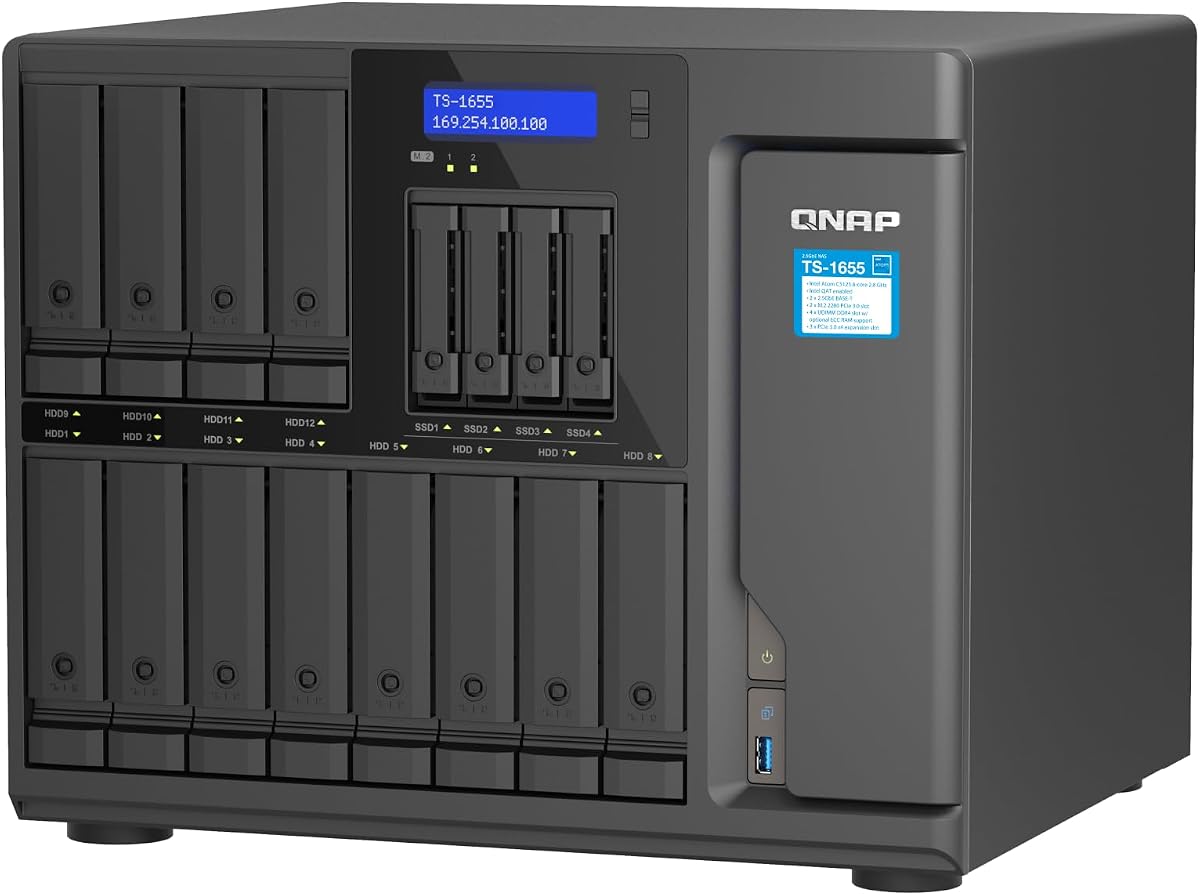
The QNAP TS-1655-8G-US is a complete 16-bay hybrid NAS that offers one of the most balanced configurations in the list. Its 4.3 rating reflects a versatile package: an Intel Atom C-5125 eight-core processor, 8GB of DDR4 memory, dual 2.5GbE networking, and a flexible mix of large and small drive bays.
We may earn a commission when you buy through this link, at no additional cost to you.
Network performance is a major strength in a dense enclosure. The two 2.5GbE ports can accelerate large file transfers, intensive shared storage, backup and restoration tasks, virtualization, and multimedia workflows. Two M.2 NVMe PCIe Gen 3 slots add further options for SSD caching, a dedicated SSD storage pool, or a Coral M.2 accelerator used in supported image-recognition workflows.
The included 8GB of memory is a sensible starting point, but memory can be upgraded as high as 128GB with ECC support. The Atom processor is appropriate for many file, backup, and virtualization tasks, though it is not the same class of hardware as the Xeon-based Synology DS3622xs+ or Ryzen-based Asustor AS6810T. Users with sustained, unusually demanding workloads should assess that limitation before committing.
This model is an excellent general recommendation for a home lab, creative team, or small business seeking sixteen drive positions in a complete NAS. It requires no separate host computer and provides a clearer management experience than a raw JBOD enclosure. It is best for buyers who prioritize drive density, useful network speed, and future SSD options in a single platform.
Dual 2.5GbE connectivity is more useful than a single gigabit connection when moving large media collections, virtual disks, or backup archives. The additional port also provides room for link aggregation when the QNAP system, switch, and configuration support it.
Upgradable ECC memory can improve resilience as the system takes on more demanding applications. Meanwhile, the M.2 slots let administrators use NVMe devices for caching or fast storage rather than devoting every high-speed task to a traditional magnetic drive.
We may earn a commission when you buy through this link, at no additional cost to you.
The Synology DX1222 is a 12-bay diskless expansion unit with a 4.7 rating, making it a particularly well-regarded option in this comparison. Rather than operating independently, it adds capacity to selected Synology DiskStation systems and lets administrators configure the new storage through Synology's unified DSM tools.
We may earn a commission when you buy through this link, at no additional cost to you.
Its strongest advantage is ecosystem simplicity. An existing Synology owner can add drives, create or extend volumes, and manage the new bays through the same interface used for the primary NAS. That avoids the cross-platform configuration complexity associated with generic JBOD products and makes the DX1222 a natural fit for organizations already committed to Synology.
The limitation is dependence. It cannot act as a stand-alone NAS, and it is intended for selected Synology models rather than every DSM-compatible device. It also has 12 drive positions, so it is not an exact 16-bay enclosure. Buyers seeking a one-time 16-bay desktop unit may prefer the TS-1655, while a Synology expansion buyer gets a more integrated result.
Choose the DX1222 if you already own a compatible Synology DiskStation and need to separate a large archive or backup pool onto additional drives. Its strong rating, straightforward DSM integration, and five-year warranty make it an attractive expansion choice. Verify your exact Synology model and its supported expansion units before ordering.
DSM tools provide a familiar path for creating storage, assigning shares, and managing the expanded pool. This consistency reduces administrative friction for teams that have standardized on Synology.
A separate 12-bay chassis can help divide backup, archive, or production storage across more drives. It can also make it easier to expand gradually instead of replacing an existing base system.
We may earn a commission when you buy through this link, at no additional cost to you.
The Generic ZhenLoong 15-Bay Chassis is a DIY server and workstation foundation with a 4.6 rating. It supports up to fifteen 3.5-inch or 2.5-inch hot-swappable drives, provides a 15-port SATA 3 backplane, and accommodates a broad range of motherboard sizes from ITX through EEB.
We may earn a commission when you buy through this link, at no additional cost to you.
Its physical design gives builders considerable freedom. It supports EEB, EATX, ATX, MATX, and ITX motherboards, along with standard ATX power supplies or a redundant 1+1 CRPS configuration. Eight full-height PCI expansion slots leave room for networking, controllers, graphics, and other accelerator hardware, making the case relevant to specialized storage projects.
The enclosure is not a plug-and-play NAS. It does not include a processor, memory, storage controller, operating system, or network interface, and its drive status and front controls are more limited than those of a dedicated NAS appliance. The stated sea-shipping cycle of approximately 30 to 40 days is another consideration for buyers who need equipment quickly.
This chassis is best for technically experienced users building a custom storage server, virtualization host, or workstation. Its hot-swap support, flexible power options, and expansion slots are meaningful advantages over an ordinary tower. However, buyers seeking a finished network appliance should choose the QNAP or Synology systems instead.
The fifteen SATA 3 backplane positions and support for both 3.5-inch and 2.5-inch drives create a dense foundation for custom storage arrays. Hot-swappable bays can simplify maintenance when paired with suitable controller and operating-system support.
Eight full-height expansion slots and multiple power-supply options make the chassis useful for projects that need more than a basic NAS. Builders can create a tailored system around their chosen motherboard, controller, network interface, and storage software.
We may earn a commission when you buy through this link, at no additional cost to you.
The Asustor Lockerstor 10 Gen3 AS6810T is a 10-bay diskless NAS built for users who want high-speed networking, memory, and flash acceleration. Its 4.1 rating reflects a technically ambitious configuration based on an AMD Ryzen Embedded V3C14 quad-core processor, 16GB of ECC DDR5 memory, and four M.2 NVMe PCIe 4.0 slots.
We may earn a commission when you buy through this link, at no additional cost to you.
Networking is the model's most dramatic advantage. Dual 10GbE and dual 5GbE ports create substantial bandwidth for large shared files, editing workflows, virtualization, and multi-user environments. The network options also provide room for link aggregation and can complement the system's high-speed internal components when properly configured.
Four NVMe slots are valuable for caching, high-speed storage pools, databases, editing, and other latency-sensitive workloads. The included 16GB of ECC memory can be expanded to 64GB, while USB4 at 40Gbps provides a fast route for external storage. Ten main drive bays, however, place the AS6810T below the advertised 16-bay category, and its premium hardware may be excessive for basic file sharing.
This model is a compelling choice for a studio, advanced home lab, or enthusiast who values fast networking and NVMe flexibility. It supports virtualization, containerized applications, AI-oriented workloads, and centralized business storage. If you need exactly 16 conventional drive positions, one of the QNAP or Synology 16-bay systems is the closer fit; otherwise, the AS6810T offers exceptional performance density.
The combination of 10GbE and 5GbE ports provides a high-performance path for large media files, database access, and concurrent users. A compatible switch and client hardware are necessary to realize the benefits of these interfaces.
Four M.2 NVMe slots offer room to separate hot data, cache, or storage pools across multiple solid-state drives. This makes the system especially adaptable to applications where magnetic-drive latency would be a weakness.
We may earn a commission when you buy through this link, at no additional cost to you.
The Synology DS3622xs+ is a 12-bay diskless NAS aimed at power users and business applications. Its 3.9 rating is the lowest among the products with numerical feedback, yet the supplied specifications describe a capable platform with more than 260,000 4K random read IOPS and sequential read and write performance of 4,700 and 2,400 MB/s.
We may earn a commission when you buy through this link, at no additional cost to you.
A six-core Intel Xeon processor provides substantial headroom for backup systems, virtual machines, video management, and consolidated services. The system can use up to 48GB of memory, while optional 10GbE or 25GbE networking, Fibre Channel support, and NVMe SSD Cache 4 offer meaningful upgrades for demanding environments.
Its main structural limitation is that the base chassis has 12 rather than 16 drive bays. It can scale to 36 bays by adding two DX1222 expansion units, but buyers focused on immediate 16-bay density will incur additional cost and complexity. The same broad ecosystem dependency affects some optional features, which are generally most complete when paired with supported Synology components.
The DS3622xs+ makes sense for an organization that values performance, memory, and a mature expansion path over immediate 16-bay capacity. It can serve as a central backup platform, virtual-machine host, or media-management server. For a single enclosure with more base bays, the QNAP TS-1655 is the more direct alternative.
The Xeon processor and large memory ceiling give the DS3622xs+ more headroom for VMs and concurrent applications than a basic NAS. The optional networking paths further improve access to large datasets.
Adding two DX1222 units can take the installation to 36 drive bays, allowing administrators to grow capacity in planned stages. This is a better fit for long-term infrastructure than a one-and-done storage purchase.
We may earn a commission when you buy through this link, at no additional cost to you.
The QNAP TL-R1600PES-RP-US is a 16-bay 3U short-depth rackmount JBOD designed to expand a QNAP NAS into very large storage pools. It supports sixteen 3.5-inch SATA 6Gb/s drives and uses Mini-SAS HD connectivity through one two-port interface, giving the enclosure a clear role in high-capacity petabyte-oriented deployments.
We may earn a commission when you buy through this link, at no additional cost to you.
Redundant power supplies are an important feature for a rack enclosure expected to operate continuously. The short-depth format is also practical for cabinets with limited depth or dense cable routing. Together, these characteristics make the unit more appropriate for an equipment room or data-center-style deployment than a home desk.
This is not a standalone network appliance. It requires a compatible Mini-SAS host and appropriate QNAP expansion support, and the rail kit is sold separately. The lack of listed customer feedback also means buyers should pay close attention to system compatibility and installation requirements rather than relying on user reviews alone.
Choose this enclosure when you operate a QNAP environment, need a full 16 large-drive slots, and value redundant power in a rack installation. It is especially relevant to organizations consolidating storage at a scale that makes a multi-terabyte or larger array practical. For a simpler desktop environment, the TL-D1600S is easier to integrate.
All sixteen positions accept large 3.5-inch drives, which keeps the enclosure focused on maximizing storage density. Mini-SAS HD provides a suitable backbone for a compatible QNAP installation.
Redundant power and a short-depth chassis support denser, service-oriented deployments. Administrators should plan for the separately sold rail kit and confirm that the adjacent rack provides suitable space, airflow, and power connections.
We may earn a commission when you buy through this link, at no additional cost to you.
The QNAP TL-D1600S is a desktop 16-bay SATA JBOD enclosure with a 4.5 rating. It accepts twelve 3.5-inch and four 2.5-inch SATA 6Gb/s drives, includes the QXP-1600eS PCIe card, and offers four SFF-8088 connections for integration with a compatible host.
We may earn a commission when you buy through this link, at no additional cost to you.
Its appeal lies in adding substantial storage without replacing an entire NAS. It can be used with a QNAP system, Windows or Linux computer, or server, allowing administrators to consolidate drives in a standalone enclosure. The mix of bay sizes gives flexibility for both bulk storage and faster 2.5-inch solid-state drives.
Compared with the rackmount TL-R1600PES-RP-US, this model trades redundant power and SAS connectivity for a desktop form and a broader host-oriented interface. It also differs from a complete NAS because drive management, networking, and file services depend on the host. A compatible PCIe slot, power supply, cooling environment, and operating-system support are required.
This is a good choice for a home lab, editing workstation, or existing server that needs 16 drive positions. It may be especially attractive to buyers who understand storage arrays and want to keep the enclosure separate from the main computer. For users wanting a self-contained network device, the TS-1655 is the easier recommendation.
Keeping large drive arrays in a dedicated enclosure can simplify host management and make it easier to add capacity. The included interface card supports a direct connection to compatible systems.
Support for QNAP NAS systems, Windows, and Linux hosts broadens the possible use cases. The correct partitioning, file system, and connection method still depend on the host and the user's storage goals.
We may earn a commission when you buy through this link, at no additional cost to you.
The QNAP TS-1655-8G-US is a 16-bay high-performance and high-capacity hybrid NAS with a 4.3 rating. It combines an Intel Atom C-5125 eight-core processor with 8GB of upgradeable DDR4 memory, dual 2.5GbE networking, and support for both large 3.5-inch and compact 2.5-inch SATA drives.
We may earn a commission when you buy through this link, at no additional cost to you.
The 12-by-4 drive layout accommodates twelve 3.5-inch and four 2.5-inch SATA 6Gb/s or 3Gb/s drives. Two M.2 NVMe PCIe Gen 3 slots can be used for SSD cache acceleration, an SSD storage pool, or a supported Coral M.2 accelerator. This gives administrators a practical way to add speed where a magnetic array would otherwise create a bottleneck.
The system's principal limitation is its processor class. It is well suited to file sharing, backup, media, and moderate virtualization, but organizations running sustained heavy compute should compare it with a Xeon- or Ryzen-based system. As a diskless product, it also does not include any hard drives, so the total capacity and cost of the finished system depend on the selected storage.
This listing is especially relevant for buyers who value long-term availability and a balanced mix of capacity, networking, and NVMe options. It provides a complete network platform rather than requiring a separate host, making it a strong all-around option for a growing home or small-business storage environment.
Mixing 3.5-inch and 2.5-inch drives lets administrators balance high-capacity storage with fast flash devices. The dedicated M.2 options add another layer for cache and low-latency data.
Dual 2.5GbE ports suit demanding file access, backups, restoration, virtualization, and multimedia transfers. As a complete NAS, it also removes the need to design and maintain a separate host for basic file services.
We may earn a commission when you buy through this link, at no additional cost to you.
The best 16-bay enclosure depends on whether you want a complete network appliance, an external disk array, an expansion unit, or a custom server chassis. Capacity, connection method, software, cooling, and future growth should guide the decision.
A complete NAS includes its own processor, memory, operating system, and network interface, making it the simplest route to shared storage. A JBOD enclosure is essentially an external drive array that depends on a separate host for management and file services. A diskless expansion unit belongs to a specific NAS ecosystem, while a DIY chassis provides only the physical foundation. These categories should be separated before comparing bay counts, because a 16-bay JBOD does not automatically provide 16-bay NAS functionality.
Many 16-bay products use a hybrid layout rather than providing 16 large 3.5-inch positions. The QNAP TS-1655 provides 12 3.5-inch and 4 2.5-inch bays, while the TL-D1600S follows a similar split. By contrast, the TL-R1600PES-RP-US supports 16 3.5-inch drives, and the RS4021xs+ is designed as a 16-bay rack system. Buyers should count expected 3.5-inch drives separately from 2.5-inch SSDs, since the mixed layout can be excellent for tiered storage but may not satisfy a requirement for 16 full-size disks.
Drive capability matters only if the network can feed it. Gigabit Ethernet may bottleneck large transfers and sustained multi-user access, making dual 2.5GbE, 10GbE, or faster connections more appropriate for professional media, backup, and virtualization workloads. The QNAP TS-1655 offers dual 2.5GbE, while the Asustor AS6810T provides dual 10GbE and dual 5GbE. The Synology DS3622xs+ supports optional 10GbE or 25GbE networking. Remember that the client device, switch, cabling, and storage configuration must support the same level of performance.
NVMe cache and flash storage pools can greatly improve responsiveness for active files, databases, containers, and virtual machines. The QNAP TS-1655 provides two M.2 NVMe slots, while the Asustor AS6810T offers four PCIe 4.0 positions. The Synology DS3622xs+ supports NVMe SSD Cache 4, and the RS4021xs+ can accept M.2 NVMe cache adapters through its PCIe expansion slots. Verify slot generation, supported capacities, adapter requirements, and whether the intended application is supported by the NAS operating system before planning a flash tier.
A full 16-bay chassis offers room now, but storage pools often grow beyond the original installation. The Synology RS4021xs+ can reach 40 drive bays with two RX1217(RP) expansion units, while the DS3622xs+ can scale to 36 bays through two DX1222 units. The Synology DX1222 itself adds 12 bays to a compatible base unit. QNAP JBOD products offer another path by attaching to compatible hosts. Expansion is rarely just a bay-count decision: it requires compatible cables, power, cooling, management software, and a host with enough addressable storage and performance.
Sixteen spinning drives generate heat, vibration, and acoustic noise, so the enclosure's power and thermal design affects reliability. Rack-oriented systems such as the TL-R1600PES-RP-US include redundant power supplies, and the RS4021xs+ also emphasizes power continuity. The CENMATE aluminum 12-bay external enclosure uses three cooling fans, though it is not a NAS. Whichever design you choose, allow unobstructed airflow, avoid tightly stacking drive cages, use quality power protection, and monitor drive temperatures and SMART data.
Compatibility determines whether a JBOD or expansion unit can perform as intended. The TL-D1600S is aimed at QNAP NAS, Windows, and Linux hosts and includes a QXP-1600eS card, while the TL-R1600PES-RP-US uses Mini-SAS HD and requires a compatible QNAP environment. The DX1222 works with selected Synology DiskStation units. Check the exact host model, interface generation, operating system, file system, and management utilities before purchase; a bay-for-bay physical match does not guarantee software support.
The right enclosure depends on what the storage must accomplish. Simple household backups and media sharing may be well served by a complete hybrid NAS with 2.5GbE. A studio handling large video files may prioritize 10GbE and NVMe acceleration. A business requiring rack deployment, redundant power, and centralized compute services may prefer the RS4021xs+, while a technically experienced builder may find the ZhenLoong chassis more adaptable. Buying for expected tasks is more sensible than paying for advanced features that will never be used.
Begin by confirming every mechanical, electrical, and software requirement before installing drives. Use a supported host for JBOD and expansion products, verify that the enclosure receives adequate power, and read the NAS operating system's storage guidance. Label each drive, install it in the proper caddy or tray, and record its position so a later failure can be identified quickly. Configure the storage pool, shares, user permissions, and backup destination before migrating important data.
For a new system, test the installation carefully rather than immediately filling every bay. Add drives in manageable groups, allow each storage operation to finish, and confirm that the management interface recognizes every disk at the expected size and health status. When the CENMATE 12-bay external enclosure is used for diagnostics, its supplied guidance recommends checking drives individually by adding one at a time and confirming whether it remains online. Always shut the unit down before changing a drive configuration.
Ongoing care includes monitoring SMART data, temperature, and pool status; keeping vents clear; and protecting the enclosure with a reliable uninterruptible power supply. Replace failed drives with the same or a supported size and rebuild the affected volume according to the manufacturer's procedure. Keep the NAS operating system and management utilities updated, maintain an independent backup of critical data, and periodically test whether the backup can actually be restored.
No. A JBOD primarily combines drives and presents them to a compatible host computer, while a NAS includes its own processor, memory, operating system, and network connection. A JBOD can be an excellent expansion component, but it needs a suitable host to manage the drives and provide shared storage.
No. Several hybrid NAS designs combine 12 3.5-inch positions with 4 2.5-inch positions, while other rack or JBOD products use all 16 positions for larger drives. Check the exact bay diagram and supported drive dimensions before purchasing, especially if your plan depends on a specific number of full-size disks.
Not always, but it can be important for sustained large-file transfers, multiple users, virtualization, and fast backups. A single gigabit connection may restrict a high-performance array, while dual 2.5GbE can offer a useful middle ground. The client computer, switch, cabling, and network configuration must also support the selected speed.
Many models can accept both 3.5-inch and 2.5-inch SATA drives, as seen in the QNAP TS-1655 and TL-D1600S. However, mixing capacities or drive types within one traditional storage pool can affect usable capacity and rebuild behavior. A separate SSD pool or cache tier often provides more predictable performance.
NVMe slots can provide cache acceleration or dedicated high-speed storage pools for frequently accessed data, databases, containers, and virtual machines. They do not replace the main drive bays and should be configured according to the NAS software's supported workflows. Slot generation, cooling, capacity, and adapter compatibility should be verified first.
A complete diskless NAS is generally more approachable because it includes the processor, operating system, and network interface, though you must supply and initialize the drives. A diskless JBOD requires a compatible host, suitable cabling, operating-system support, and correct storage configuration. More technical knowledge is therefore required for a bare enclosure.
Leave the manufacturer's recommended clearance around intake and exhaust vents, avoid placing the unit inside a closed cabinet without airflow, and confirm that all installed drive trays lock properly. Monitor drive temperatures and system alerts, keep the enclosure away from heat-generating equipment, and use active cooling whenever the model includes fans.
The maximum depends on the individual drive capacities, filesystem limits, NAS software, RAID or storage-pool configuration, and any reserve space for redundancy or metadata. Sixteen maximum-capacity drives do not translate directly into 16 times that figure for usable storage because protection features consume capacity. Check the current product documentation for drive and filesystem limitations.
The QNAP TL-D1600S is the strongest value choice for buyers expanding a compatible host, while the QNAP TS-1655-8G-US provides the most balanced complete 16-bay NAS experience. The Synology RackStation RS4021xs+ leads the premium business category with strong processing, expansion, and redundant power support.
Prioritize the product category that matches your setup before focusing on individual specifications. A complete NAS offers the simplest path to network storage, a JBOD is best for a capable host, an expansion unit supports a specific ecosystem, and a DIY chassis requires substantial building expertise. Then balance drive layout, network speed, flash support, cooling, and planned growth.
Before ordering, verify current compatibility, included components, warranty terms, and the latest listing details. Prices and availability can change, but the most durable purchase is one whose enclosure type, drive plan, and expansion path match how you intend to use the storage.