
RC Digital Servo Tester 7 Channels
4.8Editor score
Seven independent output channels
Microsecond pulse-width display
Three practical diagnostic modes
Anti-reverse wiring protection
Compare 10 Rc Servo Tester models by channel capacity, signal control, precision, protection, compatibility, and ease of use, helping you select a diagnostic
An RC servo tester gives hobbyists a convenient way to diagnose servos and electronic speed controllers without relying on a radio transmitter during every bench check. The most useful units combine manual positioning, neutral-point calibration, automatic sweeping, clear signal readouts, and dependable power handling across a wide range of RC models.
This guide compares ten RC servo testers based on the functions and specifications supplied for each product. It examines channel count, control modes, pulse-width options, displays, construction, protection features, and compatibility with aircraft, cars, helicopters, boats, robots, and other hobby applications.
Each pick highlights a different reason to choose, ranging from compact portable diagnostics to multi-channel consistency testing and battery-aware equipment. Ratings, configurations, and availability can change over time, and current prices should always be checked on the linked product pages before making a purchase.
4.8Editor score

5.0Editor score

4.9Editor score
The comparison below places all ten testers side by side, focusing on the most consequential differences in channel capacity, control methods, signal display, protection, construction, and intended RC applications.




The OGRC RC Digital Servo Tester/ESC Consistency Tester is a compact diagnostic device with a 4.4 rating and a clear focus on comparing servo and ESC response. Its standout specification is two-microsecond accuracy, allowing users to inspect subtle changes in control output rather than merely confirming that a component moves. The display and PPM signal test function also make it useful when visual observation of the horn is not enough to understand a response issue.
We may earn a commission when you buy through this link, at no additional cost to you.
Three button-controlled operating modes cover the main bench tasks. Manual mode allows the output to be adjusted for direct testing, neutral mode returns the connected servo toward its center point, and automatic mode provides a broader movement cycle. Pulse-width settings cover 50-hertz analog signals as well as 125-hertz and 250-hertz digital servo signals, giving the tester flexibility across different servo standards.
The main trade-off is that the supplied description centers on testing one steering gear or steering system at a time rather than operating several independent channels. It also emphasizes selecting the correct digital or analog signal mode before connection, which is a sensible safety practice but requires users to understand their equipment. Buyers seeking a simple signal-focused tester may find this narrower approach advantageous rather than restrictive.
This is a strong choice for technicians who want precise pulse-width observation, a useful PPM display, and simple access to the three core test modes. It suits hobbyists diagnosing one servo or ESC at a time and pilots who need to compare output behavior. Those requiring simultaneous multi-channel consistency testing should examine one of the channel-rich alternatives in this guide.
The stated two-microsecond accuracy is particularly valuable when a servo seems sluggish, noisy, or inconsistent but still completes its full movement. Because the tester can display the PPM signal, it provides a more objective view of the output than watching the linkage alone.
Support for 50, 125, and 250-hertz pulse-width options broadens the range of servo systems the unit can evaluate. Choosing the proper signal type before connecting the servo also helps reduce the risk of component damage.
We may earn a commission when you buy through this link, at no additional cost to you.
The Multifunctional Steering Gear Tester combines a digital display, a storage case, and several diagnostic modes in one portable package. It has a 4.4 rating and is designed for RC helicopters, airplanes, cars, boats, and motor-related testing. Its most notable feature is the combination of a readable display, a PPM signal test function, and an output range of 800–2200 microseconds.
We may earn a commission when you buy through this link, at no additional cost to you.
Manual mode gives the user direct control over signal width through a potentiometer. Neutral mode centers the connected device, while automatic mode provides a repeated movement cycle for evaluating response. The tester can pass the input signal through synchronously, allowing the same command to be used when comparing the behavior of different servos or assessing the changes within a servo’s micro-circuit.
Power comes from a five-to-six-volt DC source, which suits common four-cell AA arrangements, although users should confirm that their chosen supply matches this range. The product information also stresses selecting the correct digital or analog signal setting before connecting a servo. The absence of a stated multi-channel output means this is best viewed as a focused consistency and response tester rather than a complete multi-servo bench console.
Choose this model when portability, an included case, and an easy-to-read display are priorities. It is a practical pick for comparing a replacement servo with an existing unit, centering a newly installed servo, or carrying a small diagnostic tool to a flying field or hobby workbench. Users with multi-device systems will need a tester that explicitly supports multiple outputs.
A dedicated display makes signal changes easier to interpret than a tester that only indicates movement through a servo horn. It is particularly helpful when checking centering, subtle output differences, and whether a command is reaching the connected component as expected.
The synchronous output approach lets the tester issue the same control signal to components being compared. This makes it useful when evaluating whether a second servo responds like the first or when checking a device for internal inconsistencies.
We may earn a commission when you buy through this link, at no additional cost to you.
The Servo Tester, Servo Controller, Speed Controler Checker stands out with a 5.0 rating and the broadest explicitly stated device capacity in the group. It can connect one to three servos or electronic speed controllers, allowing users to inspect synchronization and response time across multiple components. That makes it especially relevant to aircraft and helicopter setups where matching movement across channels matters.
We may earn a commission when you buy through this link, at no additional cost to you.
Its three modes cover the core needs of a practical diagnostic bench. The rotary knob gives precise manual control of servo response speed, neutral mode returns a device to its center position, and wiper mode creates a continuous sweep across the movement range. These modes support both quick functional checks and more deliberate evaluation of dead zones, response consistency, and synchronization.
The body is made from anodized aluminum alloy and measures 48 by 42 by 17 millimeters, with a listed weight of 44 grams. That construction combines a modest footprint with a durable, heat-conscious design. On the other hand, the product data does not mention an LCD, numerical pulse-width readout, or explicit input-voltage range, so buyers who require a visible signal display or precise voltage compatibility should verify those details.
This is our Editor's Choice because it combines the highest listed rating with a capable three-device connection, useful manual, center, and sweep functions, and broad platform support. It is a strong general-purpose choice for RC planes, cars, boats, helicopters, and other hobby systems. The absence of a display is the main compromise, but the tester’s simultaneous device capacity makes it particularly valuable for consistency work.
The ability to connect as many as three servos or ESCs at once makes this more useful than a single-output tester for multi-channel projects. Users can look for matching response times and synchronization without reconnecting each device for every test.
At 48 by 42 by 17 millimeters and 44 grams, the anodized aluminum unit is compact enough for a field bag or a small workbench. Its listed dimensions make it easy to carry while still offering a more substantial housing than a minimal plastic tester.
We may earn a commission when you buy through this link, at no additional cost to you.
The seven-channel RC Digital Servo Tester is a feature-rich choice for users who need to examine several components at once. Its 4.8 rating reflects a strong overall proposition, while the seven independent output channels make it the most explicitly multi-channel device in this roundup. The LCD can show pulse width down to one microsecond and provide a real-time PWM readout during testing.
We may earn a commission when you buy through this link, at no additional cost to you.
Manual, neutral-point, and automatic-sweep modes cover the core diagnostic sequence. Manual mode adjusts pulse width with a knob, neutral mode establishes a center reference, and auto swing mode drives the connected servos through their stroke to reveal response speed and dead zones. Because a radio transmitter is not required, users can perform pre-installation checks and calibrations with less setup.
Protection details add practical value. The anti-reverse wiring feature is intended to reduce the risk of damage from reversed power connections, while shortcut buttons make mode and parameter changes more convenient. Its 4.8-to-6-volt input range should be checked against the batteries or power supply in the intended project, and no protective case is mentioned in the supplied information.
This is the best budget-oriented option for a user who values channel capacity, a numerical signal display, and a broad range of test modes more than a case or higher listed input voltage. It is particularly appropriate for helicopter swashplate synchronization, multi-servo aircraft, robot arms, cars, and other RC projects where an inactive or mismatched channel needs to be found quickly.
Testing several channels at once can expose a weak servo, inconsistent neutral point, or mismatched response without repeated unplugging. This makes the tester especially useful for complex models where every control surface or mechanism depends on coordinated movement.
The one-microsecond LCD resolution and real-time PWM display make the unit more useful for exact setup than a simple motion-only tester. The readout provides a reference while adjusting pulse width, centering components, or checking for changes under movement.
We may earn a commission when you buy through this link, at no additional cost to you.
The Spektrum Accessories XBC200 Smart Battery Checker & Servo Tester takes a different approach from the other products by combining battery checking with servo testing in one purpose-built RC accessory. Its 4.9 rating places it near the top of the list, and its official product identity makes it especially recognizable to Spektrum users who want a single compact diagnostic tool for their equipment.
We may earn a commission when you buy through this link, at no additional cost to you.
The key advantage is the combination of functions. Servo testing addresses the movement and control checks needed when setting up or troubleshooting a model, while the smart battery checker adds value for assessing the power system. That broader scope can help organize a workbench and may reduce the need to carry separate tools for common preflight and bench tasks.
The supplied product information is intentionally limited, however. It does not state the number of output channels, supported test modes, display characteristics, input-voltage range, or exact battery-checking procedures. As a result, this tester is harder to compare on technical granularity than the models with detailed signal and channel specifications. Users who need several servos tested simultaneously should not assume multi-channel support from the product name.
This is the premium pick for an RC hobbyist who values the Spektrum brand, wants combined battery and servo diagnostics, and prefers a recognized accessory over a generic tester. It is a sensible choice for a well-equipped bench, particularly when battery condition and servo behavior need attention together. For highly specific multi-channel analysis, one of the channel-rich digital testers may be the better technical fit.
Combining servo and battery diagnostics is useful for model builders who routinely check both control response and power-system condition. The combined format can streamline routine setup without separating the tester and battery checker across the workspace.
The Spektrum name and SPMXBC200 model identity give the product a clear position within a branded RC ecosystem. That is especially appealing to users who already favor Spektrum equipment and want a matching diagnostic accessory.
We may earn a commission when you buy through this link, at no additional cost to you.
The WWZMDiB four-piece RC Servo Tester is unusual in the roundup because it includes four testers rather than one. Each unit is designed to check servos or ESCs using manual, neutral, and automatic modes. The 4.2 rating reflects a functional and accessible proposition, while the multi-unit package gives hobbyists a practical way to keep separate diagnostics for different models or work areas.
We may earn a commission when you buy through this link, at no additional cost to you.
The manual mode uses the control knob at different speeds so users can check reaction time. Neutral mode returns the servo to its reference point, and automatic mode creates a broad wiper-like movement. The supplied information also says the tester can evaluate control accuracy, response speed, and torque output, as well as detect virtual space, jitter, and a median reference. These are particularly valuable observations when a component moves but does not behave predictably.
Because the tester is small, portable, and battery-powered, it is easy to use for on-site testing and debugging. The downside is that the description does not identify the number of output channels, provide a display specification, or list a detailed input-voltage range. Buyers needing exact pulse-width readings, several independent channels, or wired protection features should treat this model as a motion-based diagnostic set rather than a fully instrumented bench console.
The four-unit configuration is the main reason to choose this product. It can serve a club, classroom, family hobby group, or a builder working on several models without requiring everyone to share one tester. It is also a straightforward choice for checking response and center behavior in the field. For one-person precision calibration with numerical signal visibility, a single-channel or LCD-equipped alternative is more specialized.
Having four units can be more useful than several features on one device when several people or models need independent diagnostics. The package is well suited to hobby groups, teaching environments, or multiple work areas that need their own tester.
Manual, center, and wiper movements expose common practical faults without requiring a complex transmitter setup. Users can watch for delay, irregular travel, jitter, or an incorrect neutral position while the component runs through its range.
We may earn a commission when you buy through this link, at no additional cost to you.
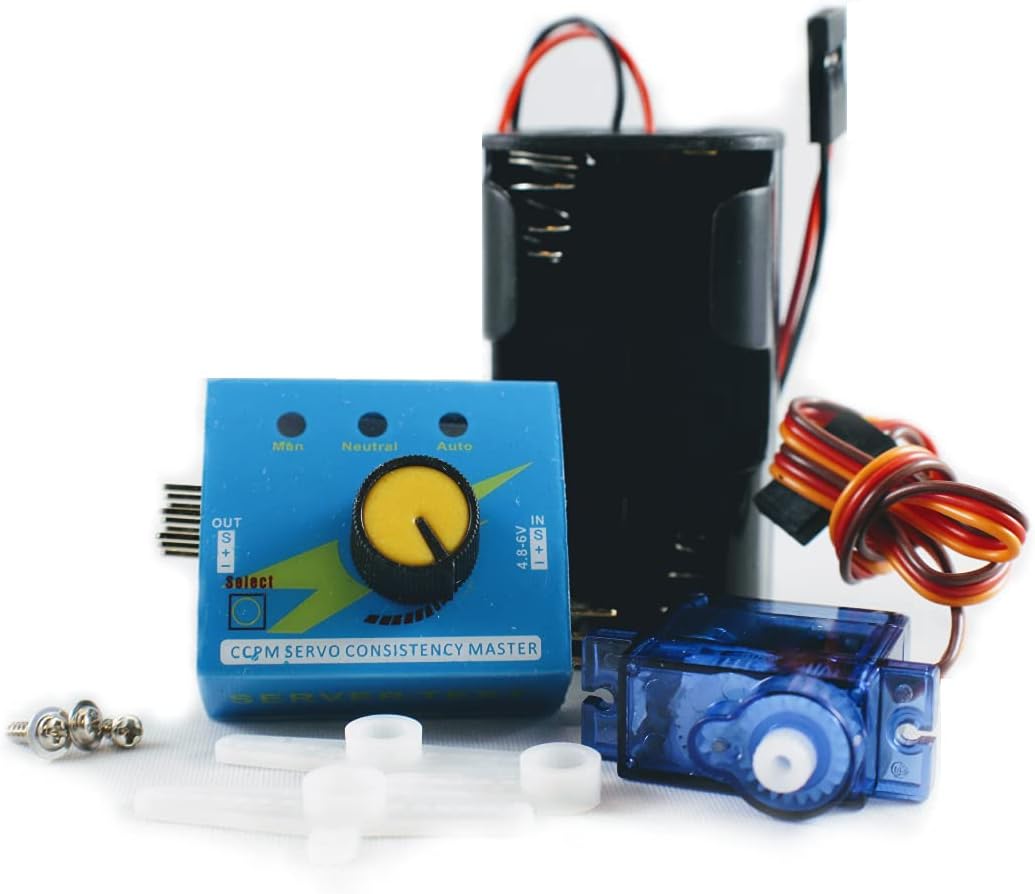
The Servo Motor Tester Kit is the most complete starter package in the group. It combines a controller, a 9g 180-degree servo motor, three types of servo horns, and a holder for four AA batteries. The 4.4 rating reflects a useful package for learning, centering, robotics, and RC experiments that require both a tester and a servo to operate.
We may earn a commission when you buy through this link, at no additional cost to you.
The included tester offers manual dial, neutral, and automatic modes, with a stated range of motion of approximately 45 to 135 degrees. Those modes make it possible to move a new servo, establish its neutral point, or run it through a repeated sweep before installing it. The four-cell AA holder produces six volts for the tester and servo, while the included horns allow the user to choose a suitable attachment for the project.
The important distinction is that this is a kit centered on one included 9g servo rather than a multi-channel instrument. Its 45-to-135-degree operating range is narrower than the included servo's full 180-degree capability, and the supplied information does not list a numerical display or advanced channel controls. That makes it ideal for basic calibration and experimentation but less appropriate for exact multi-channel signal comparison.
Choose this kit if you want a ready-to-use bench starter rather than a tester alone. It is particularly helpful for students, first-time RC builders, robotics hobbyists, and anyone who wants a spare standard servo to test cables, horns, and control behavior. Experienced users who already own several servos and a reliable power source may prefer a more capable diagnostic unit.
Including a servo, three horns, the controller, and a six-volt battery holder removes the need to source several separate items. The package gives new users a functioning setup for understanding servo movement and practicing neutral-point calibration.
The standard 9g servo and simple three-mode controller create an approachable way to experiment with robotics, RC mechanisms, and hobby electronics. It can also serve as a backup test component for checking whether a controller can operate a typical servo.
We may earn a commission when you buy through this link, at no additional cost to you.
The HJ three-channel digital servo tester is a kit-oriented option for helicopter and car builders who need to check more than one control channel. It has a 4.3 rating and includes two four-cell AA battery holder cases with JR connectors. The tester supports manual, neutral, and automatic modes, while its frequency selections cover 50-hertz analog, 125-hertz digital, and 250-hertz digital servo signals.
We may earn a commission when you buy through this link, at no additional cost to you.
Three-channel capability gives it more relevance for CCPM helicopter consistency checks and multi-servo car installations than a single-output unit. The broad pulse-width selection set also allows users to match the tester to different analog and digital servo systems. Its included battery cases reduce the need to build or source a holder, although the AA batteries themselves are not included.
The connection process requires attention. The red lead from the battery holder connects to the positive input terminal and the black lead to the negative terminal, and users must also select the appropriate signal mode before connecting the servo. The product data does not mention a display resolution, anti-reverse protection, or an exact physical size. These omissions make it more of a practical motion and consistency tester than a precision measurement console.
This tester is well suited to a builder who wants three-channel support and a ready-made battery arrangement. It is especially useful for checking helicopter control consistency, confirming that several car servos respond similarly, or setting neutral points before final installation. Users who demand a visible numerical signal readout should consider the LCD-equipped alternatives instead.
Helicopters and performance cars often depend on several servos moving in a coordinated way. Three channels allow a user to compare response and centering across those components without moving between isolated tests.
Two JR-equipped four-cell AA cases make it easier to set up the tester in different locations or maintain a spare power arrangement. They provide a convenient six-volt source, though users must supply their own AA batteries.
We may earn a commission when you buy through this link, at no additional cost to you.
The six-channel RC Digital Servo Tester is built around protected PWM output, accurate manual positioning, and a broad power-input range. It has a 4.4 rating and measures 76 by 53 millimeters, with a listed weight of 37 grams. A high-accuracy potentiometer provides manual servo adjustment, and the stated control accuracy reaches 0.09 degrees with a one-microsecond PWM limit for minimal changes.
We may earn a commission when you buy through this link, at no additional cost to you.
Six channels make it a strong option for RC cars, airplanes, robot arms, grippers, and other systems that need multiple servos connected at once. The tester supports PWM servos and includes a servo reset function, which is useful for returning outputs to a known reference. Its 5-to-8.4-volt operating range accepts a LiPo battery or a suitable power adapter, offering flexibility in how the bench is powered.
Overcurrent protection is provided on three channels and is intended to reduce the risk of damage to connected servos. This is an important safeguard when a mechanical problem causes a servo to stall or draw excessive current. The trade-off is that the product description lists two control modes rather than the three modes common among competitors, and it does not specify an LCD, pulse-width display, automatic sweep, or protection for the other three channels.
Choose this model for multi-channel PWM work that emphasizes accurate manual positioning and some electrical protection. It fits builders who need a LiPo-compatible bench tester and may work with robotics as well as conventional RC vehicles. Those who need automatic sweeping or a numerical signal display will find more specialized options elsewhere in the roundup.
A stuck, damaged, or obstructed servo can behave unpredictably during a test. The stated three-channel overcurrent protection adds a layer of safety for those channels when diagnosing a component that may not move freely.
The five-to-8.4-volt range supports a LiPo battery or an appropriate power adapter. This makes the tester adaptable to different RC workbenches and reduces dependence on a single battery configuration.
We may earn a commission when you buy through this link, at no additional cost to you.
The HiLetgo three-piece RC Servo Tester is a multi-unit package centered on the same three operating methods found in many compact hobby testers. It has a 4.2 rating and is intended for helicopters, cars, boats, and other RC equipment. Because the package includes three units, it offers flexibility for multiple models, multiple users, or keeping a tester available in more than one workspace.
We may earn a commission when you buy through this link, at no additional cost to you.
Manual mode turns the knob at different speeds to evaluate reaction time, neutral mode sends the servo back to its center, and automatic window-wiper mode moves it through its largest angle. Those modes are easy to understand and cover the most common tasks: checking movement, comparing response, and establishing a neutral reference for an ESC or servo.
The main limitation is the amount of technical information provided. The supplied data does not state an input-voltage range, display type, pulse-width resolution, protection features, or whether all three channels are independent. As a result, buyers seeking numerical signal readings or formal multi-channel comparison should verify the full product details before relying on it for precision calibration.
This package is most attractive to hobbyists who need more than one basic tester or want a spare for field use. It can support RC helicopter, car, and boat projects without requiring a transmitter for routine servo checks. Users who work primarily with detailed signal analysis may prefer a tester with a clearly specified LCD and pulse-width resolution, while many casual builders will appreciate the simple three-mode operation.
Three testers allow a user to keep one at the main bench, another in a field bag, and a third as a spare or shared unit. This is a practical advantage in hobby spaces where several models are maintained at once.
Manual, center, and sweep controls are sufficient for basic diagnosis. New users can see how a servo responds without navigating complicated programming, while experienced users can repeat the same quick checks across multiple components.
We may earn a commission when you buy through this link, at no additional cost to you.
The right RC servo tester depends on the number of devices you diagnose, the signal detail you need, and the kind of models or robots you maintain. The following factors help narrow the options without overlooking basic safety and setup requirements.
Channel capacity determines how many servos or ESCs can be evaluated at the same time. A single-channel tester is convenient for focused troubleshooting and simple kits, but a three-, six-, or seven-channel model is more efficient when a helicopter swashplate, car steering system, aircraft, or robot uses several synchronized devices. Multi-channel testing can reveal a mismatched response while the rest of the system remains connected, reducing repeated setup and making consistency checks more direct.
Prioritize enough channels for the most complex model on your bench. More channels are not automatically better for simple work, but they add flexibility when you move from one-off servo checks to coordinated RC systems.
Manual, neutral, and automatic-sweep modes form the core workflow of most useful testers. Manual control lets you move a servo slowly and watch response speed, neutral mode establishes a center reference, and automatic sweeping exposes irregular travel, dead zones, or a device that stalls at one end. A two-mode tester may still handle basic adjustment, but three modes provide a more complete diagnostic cycle without requiring a radio transmitter.
Choose a tester with at least these three operating concepts if you regularly install or repair servos. They cover the most common setup and troubleshooting tasks in a straightforward sequence.
A numerical display can turn a visual movement check into a more precise measurement. Pulse-width or PWM readouts help users compare commands, detect subtle output changes, and document a center setting. The products in this guide range from motion-only observation to stated resolution as precise as one microsecond, so decide whether you need an approximate functional check or a bench instrument for calibration and consistency analysis.
If your work includes frequent centering, fine-tuning, or diagnosing unusual behavior, prioritize a clear LCD and a stated accuracy figure. For occasional movement checks, a simple tester may be sufficient.
RC servos may operate with different signal rates and timing expectations, so a tester should support the formats found in your collection. Several models offer 50-hertz analog plus 125- or 250-hertz digital settings, while others emphasize broad pulse-width output. The correct selection matters because connecting a servo to an inappropriate signal mode can damage it.
Match the tester to the signal type of the equipment you own. Always use the manual or neutral position to change settings before connecting a servo, as several product descriptions specifically warn about this sequence.
Power requirements determine where and how the tester can be used. Some units accept a five-to-six-volt DC input, one supports five to 8.4 volts, and another accepts four AA cells through an included holder. A tester with a broad input range may be easier to power from existing RC equipment, while a kit with a battery case is more self-contained but may require separate batteries.
Compare the listed input range with your battery packs, adapters, and connector standards before buying. Also note whether batteries, cases, servos, or power cables are included; these accessories affect convenience even when they do not alter the core test functions.
Protection matters because a diagnostic tool may be connected to a servo that is not operating correctly. Anti-reverse wiring protection can reduce the consequences of incorrect power polarity, while overcurrent protection is valuable when a jammed or damaged servo begins drawing excessive current. A sturdy anodized aluminum housing may also feel more durable in a frequently used workbench, although housing material does not replace correct wiring and safe operating practices.
Look for explicit protection features when working with valuable or unfamiliar equipment. If a product does not state its safeguards, verify the manual and use a correctly rated, protected power source.
Portability matters if the tester will travel to a field, a club, or a competition setup. Compact aluminum units, small battery-powered testers, and units supplied with a case are easy to carry, while a full-size bench controller may be better suited to a fixed work area. Application is just as important: aircraft and helicopters reward channel-rich consistency testing, cars and boats often need several steering or control servos, and robotics users may value PWM outputs, accuracy, and protection.
Choose the format that matches where you diagnose equipment. A compact, simple tester is often enough for a single model, while a multi-channel display model is better for a shared workshop or advanced builder.
Before connecting a servo, identify whether it expects an analog or digital signal and select the matching mode on the tester. Review the polarity markings for the input, power source, and servo connection. For testers with a stated input range, confirm that the battery or adapter is appropriate, then power up the unit before attaching the servo if that is the manufacturer’s instructed sequence.
Begin in neutral mode to establish the servo’s center position. Use manual mode for slow, controlled movement while watching for hesitation, jitter, irregular noise, or a stall. Automatic sweep mode is useful for comparing full-travel behavior and checking whether several connected servos respond consistently. When multiple channels are installed, adjust them one at a time and compare their response, center, and synchronization before securing linkages.
After testing, disconnect the servo before changing signal type or altering power connections. Keep the tester dry, protect its display and controls from impact, and store it in a closed case or clean compartment. Periodically inspect cables, connectors, and battery holders for looseness or corrosion, and remove batteries from a stored unit if the design is not intended for long-term battery-powered storage.
A transmitter remains necessary for normal flight control, but a dedicated tester is useful during installation and troubleshooting. It can center servos, sweep their full travel, compare multiple channels, and expose response issues without requiring a complex transmitter setup each time. The two tools are complementary rather than interchangeable.
Many testers in this roundup are designed for both servos and ESCs. The tester sends control signals and lets the user observe the motor or servo response, but behavior differs between the two component types. Confirm that the tester supports the control format and power requirements of the specific ESC before connecting it.
Digital and analog servos can expect different signal rates or timing characteristics. Selecting the wrong mode may cause incorrect movement or potentially damage a connected component. Several product descriptions explicitly advise choosing the correct servo system before plugging in the servo, so treat mode selection as a required setup step rather than a convenience.
Manual mode provides direct control, which is best for slow diagnosis and response-time checks. Neutral mode sends the device to its center reference and is useful during installation and calibration. Automatic sweep mode moves the device repeatedly through its range, helping reveal uneven travel, dead zones, or failure to reach an endpoint.
The right number depends on the model’s control and servo layout. Multiple channels let a tester compare coordinated movements and identify a single inconsistent servo. A seven-channel model offers the most stated capacity here, while three- and six-channel options cover many common installations, and a single-channel unit is enough for isolated bench checks.
Only if the tester’s specified input-voltage range includes the battery’s voltage and its connector and polarity are compatible. The six-channel model explicitly supports a five-to-8.4-volt range and can use a LiPo or suitable adapter, while other testers list different ranges. Check the specifications and manufacturer instructions before applying power.
No. An RC servo tester primarily evaluates control output and visible component response, including movement, centering, consistency, and sometimes signal timing. It may not identify every fault involving radio receivers, battery packs, wiring outside the tester, or complex electronics, so additional equipment and a systematic troubleshooting process may still be necessary.
A display is valuable when you need exact pulse-width information, precise centering, or documented consistency comparisons. A motion-based tester is often sufficient for basic functional checks and can be less complex to operate. The best choice depends on whether your work requires visual precision or only confirmation that a servo moves normally.
The Servo Controller Speed Checker is the most balanced general pick because it supports up to three devices, offers manual, neutral, and sweep modes, and combines those capabilities with a compact anodized aluminum body. The seven-channel digital tester is an excellent budget-oriented alternative when a high-resolution LCD and multi-channel consistency testing matter most, while the Spektrum XBC200 is the premium choice for users who want combined battery and servo diagnostics.
Prioritize the requirements that match your actual work: use a multi-channel model for synchronized aircraft, helicopter, car, or robotic systems; choose a numerical display for exact signal inspection; and look for wider input-voltage support when using varied power sources. Basic kits can be especially useful for beginners, while multi-unit packages make sense for clubs, shared benches, or users who want a spare.
Product ratings, configurations, included accessories, and prices can change, so verify the current listing and compatibility information before purchasing. Connecting the tester correctly, selecting the proper signal mode, and using a suitable power source remain essential regardless of which model you choose.