
PUBAMALL 9-Strobe Rodent Repellent
4.2Editor score
Nine visible LED strobes
Four selectable operating modes
Attic and barn ready
Discover the best strobe light for squirrels in attic by comparing ultrasonic repellers, flash patterns, power options, coverage, and installation needs.
A strobe light for squirrels in an attic should create an environment that feels unpredictable, uncomfortable, and unsuitable for nesting. The most useful units combine flashing LEDs with ultrasonic frequencies, offer multiple operating modes, and can be positioned where rodents travel between openings, stored items, and structural beams.
This guide compares ten ultrasonic rodent deterrents and purpose-built strobe lights based on their stated coverage, light configuration, ultrasonic output, selectable modes, power methods, sensing functions, and suitability for attics, garages, barns, and vehicle storage areas. The list includes plug-in, battery-powered, USB-powered, and vehicle-ready designs.
Each review explains the product’s strongest feature, practical limitations, and ideal installation environment. The top picks represent the strongest balance of attic relevance, versatility, and dedicated protection features, while the remaining options show where simpler or vehicle-oriented designs may fit. Prices and availability can change, so check the current listing before buying.
4.2Editor score

4.0Editor score

4.8Editor score
The table below compares all ten options by their principal controls, light output, power approach, and intended use. Products with dedicated attic placement and multiple ultrasonic modes stand out for focused squirrel deterrence, while the portable and vehicle-style units provide flexible options where wiring or protected power is available.




The Indoor Ultrasonic Pest Repeller is the most purpose-built choice in this guide for an attic occupied by squirrels or other rodents. It combines a plug-in ultrasonic system, an LED strobe light, a visible display, and separate scene and strobe controls. Its 4.0 rating reflects a useful combination of features, although the listing does not independently verify how quickly squirrels will leave.
We may earn a commission when you buy through this link, at no additional cost to you.
Its strongest selling point is the number of ways the environment can be varied. The device provides three operating modes, three scene modes, and three strobe-light modes. Eight speakers, including four pulsed metal speakers, are intended to distribute sound broadly. A frequency-conversion chip is also included to reduce the possibility that rodents become accustomed to a fixed ultrasonic pattern. The screen makes it easier to see which settings are active rather than guessing at their status.
The main compromise is dependence on a nearby outlet. A squirrel can enter or move through an attic along routes far from the device, and a single compact unit will not create a sealed barrier. The stated coverage of up to 3900 square feet is useful for larger spaces, but walls, stored objects, floor debris, and irregular attic geometry can reduce effective sound distribution. The product also requires an attentive setup process because the mode changes are most valuable when coordinated with observed movement patterns.
This is the strongest general pick for a homeowner who wants a dedicated indoor unit rather than a repurposed party light. Place it near the active travel route but away from the squirrel’s exact entry point, use the display to cycle through settings, and give the unit time to establish an inhospitable zone. For an attic with a reliable outlet and substantial squirrel activity, it offers more control than almost every other model listed.
Combining selectable sonic scenes with three strobe patterns reduces the chance of relying on one repetitive stimulus. This is especially useful in an attic where a constant flashing pattern could become predictable over time.
The eight-speaker arrangement and stated coverage make this unit more suitable for a broad attic, garage, basement, or barn than a small decorative strobe. Position it centrally and clear obstructions from the immediate area.
We may earn a commission when you buy through this link, at no additional cost to you.
LeafZap is rated 4.4 and stands out for its unusually flexible power system. A single unit can operate from four AA batteries, a DC connection, or a USB adapter. That makes it easier to adapt an attic device to temporary battery use, continuous power from an adapter, or a vehicle connection. The package includes two units, allowing the owner to establish protection in more than one location.
We may earn a commission when you buy through this link, at no additional cost to you.
The device uses 25–55 kHz ultrasonic waves and six white LED strobe lights. Its built-in vibration sensor is designed to detect engine activity, switch to standby while the vehicle is moving, and reactivate after the vehicle has been parked. Although that feature is less important in a static attic, the automatic operating logic remains useful for garages where a vehicle is regularly started.
There is no dedicated screen and the operating cycle alternates between active ultrasonic and light output and a longer standby period. Rodents that habitually remain in sheltered corners may benefit from distributing two units rather than concentrating them in one location. As with any ultrasonic deterrent, the presence of insulation, stored boxes, or dense accumulated material can reduce the useful range. The wide ultrasonic range is a positive feature, but placement and sound reflection remain important.
Choose LeafZap when the attic lacks an outlet or you also need protection around a vehicle, workshop, or storage area. It is less conventionally attic-specific than the first product, but its three power methods and two-pack format offer greater deployment flexibility. For renters, seasonal spaces, and locations with unreliable electrical access, that versatility is a compelling reason to select it.
Battery operation is convenient for temporary placement, while USB and DC connections support continuous use. The ability to switch methods makes the device less dependent on a single power source.
The two-pack can divide protection between an attic and garage, or place devices at opposite ends of a larger property. Separate units are often more useful than expecting one compact device to reach every route.
We may earn a commission when you buy through this link, at no additional cost to you.
The PUBAMALL unit earns a 4.2 rating and is one of the most visually assertive products in the guide. Its nine LED strobe lights are explicitly paired with ultrasonic waves to disturb a rodent’s visual perception in a dark environment. The product description identifies squirrels, mice, bats, and other rodents as intended targets and names attics, houses, and barns as suitable locations.
We may earn a commission when you buy through this link, at no additional cost to you.
Four modes make it more flexible than a simple strobe lamp. Test mode simulates the sound rodents hear, allowing the owner to confirm that the ultrasonic section is operating. Fixed mode sends a 25 kHz signal from the central sensor, sweep mode uses side speakers across 22–32 kHz, and double mode runs the fixed and sweep functions together. This structure allows the owner to test the device and then vary the approach rather than leaving it on one static setting.
Its most important limitation is expectation. The manufacturer warns that some rodents may initially become more active because they are irritated, and it states that obvious results can take three or four weeks. A device is not a physical barrier, so entry points should still be repaired. The plug-in design also requires an outlet close enough to the area where squirrels travel, and stored insulation can interrupt both sound and light.
This is an attractive choice for an owner who wants a clearly visible strobe array and several sound patterns without moving to a full vehicle-protection system. Position the unit where the squirrel moves between the roof opening and a nesting area, and use test mode first. For readers seeking the most visible dedicated option at a comparatively modest cost, it is a strong budget-focused recommendation.
The nine-light array creates a conspicuous flash source, while ultrasonic output adds a second sensory layer. Combining them can make a dark attic feel less suitable for rodents.
Test mode provides a basic way to verify the ultrasonic output before relying on a longer deterrent cycle. It also helps identify whether changing the unit’s position is necessary.
We may earn a commission when you buy through this link, at no additional cost to you.
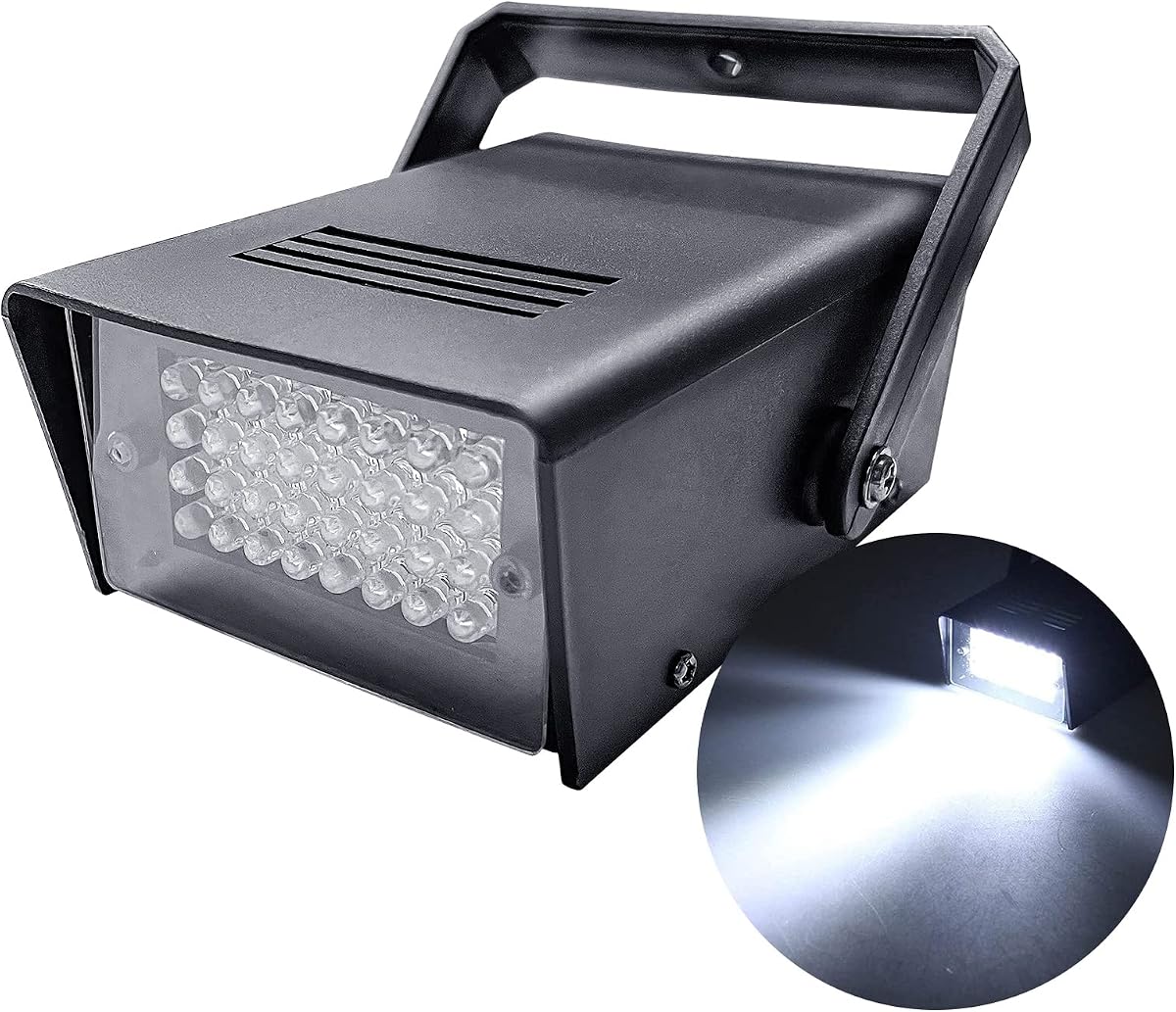
The Disco Strobe Light is a straightforward flashing lamp that includes a rotating speed control, 32 white LEDs, and a plastic mounting bracket. Its 4.2 rating reflects a generally positive response among customers, and the product description specifically suggests placement in an attic or garage to deter mice, squirrels, bats, and spiders.
We may earn a commission when you buy through this link, at no additional cost to you.
Its primary advantage is simplicity. There are no ultrasonic settings, menu screens, or sensors to configure. After plugging it in, the rotating control changes the flash speed, allowing the owner to create a less predictable pattern than a steady light. The palm-sized enclosure and included bracket make it easy to mount on a beam, wall, or another elevated surface where the flashing effect is visible.
The critical distinction is that this is only a light, not a combined ultrasonic repeller. It may discourage an animal from lingering in a brightly flashing location, but it does not create the additional ultrasonic stimulus offered by most dedicated repellents. The product is also described as intended for indoor use. Moisture, roof leaks, condensation, and dust in an unfinished attic can shorten its useful life, so it should be protected from water.
This is a sensible secondary device for an attic where the goal is inexpensive visible disruption and the owner prefers a simple control. Place it where it cannot shine into an occupied room at night, because continuous flashing is uncomfortable for people as well as pests. It works best as one part of a broader squirrel-control plan that includes sealing entry points and removing attractants.
The rear control lets the owner vary the flash rate rather than leaving a fixed pattern. That flexibility is the most useful feature for deterrence.
The bracket and compact housing allow installation on an attic beam or near a wall without taking up much room. Keep the unit away from moisture and combustible storage.
We may earn a commission when you buy through this link, at no additional cost to you.
This two-pack of mini strobe lights is built for parties and Halloween but is also described as useful in barns, lofts, and garages. Each unit has 32 white LEDs, a 5-watt power rating, and a control knob for adjusting the flash rate. The included plastic case and bracket make the lights easy to hang, attach to a wall, or secure to another object.
We may earn a commission when you buy through this link, at no additional cost to you.
The inclusion of two units is significant for attic deterrence. Squirrels often move along a defined path between an entry opening, stored materials, and a nesting location. Two lights can be placed along that route rather than concentrating all of the light around one device. The stated LED life of up to 100,000 hours also supports the idea of using the units as long-running warning lights, provided electrical connections are safe.
These are strobe lights, not continuous fixtures, and the manufacturer explicitly recommends indoor use. They therefore require protection from rain, snow, condensation, and leaks. They also lack ultrasonic frequencies, so their influence depends entirely on visible flashing. A squirrel entering from a separate opening may avoid the light but still remain in the attic. Physical exclusion remains essential even when the lights are operating.
This multipack is a good choice when a homeowner wants light-only deterrence at two separate points. It may suit a loft, garage, or indoor storage area where a constant flashing effect is acceptable. It is less comprehensive than the dedicated repellers, but the matching pair makes placement easier and more systematic. Confirm that the wiring method and housing are appropriate for the conditions before installation.
Two separately controlled lights can bracket a travel route or cover an attic and adjacent garage. This is often more useful than placing both units together.
The low five-watt rating and stated long LED life suit continuous deterrence use. Electrical safety and moisture protection remain the owner’s responsibility.
We may earn a commission when you buy through this link, at no additional cost to you.
The Variable-Frequency Vehicle Repellent has the highest rating in the guide at 4.8. Although it was designed with under-hood use in mind, the product also names garages, covered carports, indoor parking areas, and other protected spaces as suitable environments. That makes it a strong option for an attic only when the space is dry and the unit can be securely mounted.
We may earn a commission when you buy through this link, at no additional cost to you.
Its key technical feature is the 18–36 kHz variable-frequency ultrasonic output paired with flashing light. Rather than maintaining one fixed tone, the product changes the ultrasonic stimulus across the stated range. The built-in vibration sensor automatically enters standby while a vehicle is moving and resumes after parking. In an attic without vehicle movement, that feature has limited value, but the automatic cycling and broad frequency range remain relevant.
Three power methods provide flexibility: four AA batteries, a 5–12V USB supply, or a direct 12V vehicle battery connection. Batteries are not included with the device. The unit should be kept out of direct rain and snow, which is a meaningful restriction in an unfinished attic. The ultrasonic output should also be positioned where it is not blocked by dense insulation or stored objects.
This model is best for a property where squirrels are active around a vehicle and the attic is sheltered. Its strong rating, automatic sensing, and variable output make it a premium pick for users who value sophisticated operation. In a dry, insulated attic with available USB power, it can function as a flexible ultrasonic-and-light deterrent, though a model designed specifically for indoor rooms may be simpler.
The eighteen-to-thirty-six-kilohertz variable output is designed to keep the auditory stimulus from remaining static. That can be helpful in a space where a fixed tone might become less effective.
Automatic sensing reduces unnecessary operation while a vehicle is moving. The same design logic can simplify use in garages with frequently started or stored vehicles.
We may earn a commission when you buy through this link, at no additional cost to you.
The ENUOLI Mini LED Strobe is the smallest dedicated light in the group, with 24 bright LEDs and a compact rectangular form. It provides variable speed control and is marketed primarily for parties, clubs, Halloween, and similar events. The product data does not claim ultrasonic operation, so it belongs in the guide as an accessible visual deterrent rather than a complete rodent repeller.
We may earn a commission when you buy through this link, at no additional cost to you.
Compact dimensions make it easy to carry from one area to another and quick to reposition when squirrel movement changes. Variable speed is a useful deterrent feature because it gives the owner some control over the pattern. LEDs are energy efficient, which also suits repeated or continuous operation compared with older incandescent flashers.
Because it has only 24 LEDs and no ultrasonic output, it offers less sensory disruption than the dedicated repellers. It may be bright enough to discourage an animal from settling directly in front of it, but it cannot create the broader ultrasonic environment described by the other products. The listing also provides limited information about weather resistance, so it should be used only in a dry location unless the manufacturer confirms otherwise.
Choose the ENUOLI for a small, dry attic, loft, or indoor storage nook where a basic adjustable light is enough for supplementary deterrence. It can complement a stronger repeller or provide a temporary warning light near a squirrel route. It is not the leading choice for a heavily infested attic, but its simple design and portable size make it a practical supplementary option.
The small housing can be moved as squirrel habits change. Repositioning the light near a new trail may be more useful than adding a larger but permanently placed device.
The speed control creates a more dynamic flash pattern without complex setup. It remains a light-only solution with no ultrasonic deterrent layer.
We may earn a commission when you buy through this link, at no additional cost to you.
The IYZ Ultrasonic Rodent Repeller carries a perfect 5.0 rating and combines sweeping ultrasonic waves with four LED strobe lights. The product data identifies garages, attics, basements, storage rooms, living spaces, workshops, warehouses, barns, and sheds among its intended uses, giving it one of the broadest stated indoor applications in the group.
We may earn a commission when you buy through this link, at no additional cost to you.
Its three power options include four AA batteries, a USB-to-Type-C cable, and a vehicle power cable. The battery-operated option is useful where wiring is inconvenient, while USB supports continuous placement near a suitable adapter. A vibration sensor pauses operation during vehicle movement and reactivates 90 seconds after the vehicle stops. The listing also states that it can work for at least three months after battery replacement under normal vehicle use.
The perfect rating should be interpreted as customer feedback rather than laboratory proof. The listing does not provide a detailed room-capacity specification or a precise ultrasonic range, and the restarting delay is not especially fast for an attic. Since batteries are not included, a user planning to rely on battery power must account for replacements. Positioning near a path, rather than directly beside an entry hole, remains more sensible.
This device is an excellent choice for a dry attic with several possible power sources, especially when the same unit must also protect a vehicle or stored equipment. Its four lights and sweeping sound give it more deterrent capability than a standard party strobe, while the compact format makes it easier to mount. The combination of a 5.0 rating and broad placement options makes it one of the most promising options for a property-wide setup.
The repeller combines changing ultrasonic waves with a four-light strobe array. This dual approach offers more disruption than a visible flashing light alone.
Battery, USB, and vehicle connections allow the device to move from an attic to a garage or camper. The same flexible platform can cover multiple vulnerable areas.
We may earn a commission when you buy through this link, at no additional cost to you.
This two-pack uses fluctuating ultrasonic output and flashing white light to discourage rodents, with squirrels specifically named among the target animals. Its 3.9 rating is slightly lower than several alternatives, but the pair provides an effective way to establish more than one deterrent zone. The product description explicitly extends the use case beyond vehicles to garages, warehouses, attics, barns, sheds, basements, and farms.
We may earn a commission when you buy through this link, at no additional cost to you.
Three power methods are offered: four AA batteries, a DC-to-USB cable, and a cable for vehicle power. Batteries are not included. A self-check function indicates whether the device is powered, and vibration detection turns the unit off when motion is detected. A safety switch is included to help prevent unnecessary battery drain. These features are especially useful for owners who want to install a device in an unattended area.
The direct vehicle connection is limited to 12V vehicles, so homeowners planning to use direct power in an attic may not have a relevant connection. AA batteries or a suitable USB supply are more practical alternatives. As with other light-and-sound repellers, effectiveness depends on clean positioning and unobstructed sound paths. Flashing white light can also be distracting if it shines into a frequently used room or neighboring window.
This model is worth considering when the owner wants to protect an attic and another nearby space with a matched pair. Place one unit along the primary squirrel route and the other near stored equipment, an opening, or a second travel corridor. The two-pack format offers better spatial coverage than a single unit, although dedicated indoor models may be easier to configure and read.
Two devices can divide a property or bracket a likely route. This is especially helpful when a single compact unit would leave large areas unprotected.
Power self-check and vibration detection can simplify unattended operation. A safety switch offers another way to stop unnecessary battery use.
We may earn a commission when you buy through this link, at no additional cost to you.
The four-pack version of the Under Hood Rodent Repellent is the most extensive multipack in the guide. It uses variable-frequency ultrasound and flashing white light to make spaces less inviting to mice, rats, squirrels, and other rodents. Its 3.9 rating places it near the bottom of the customer-rating range, but the four included units provide unusually broad placement flexibility.
We may earn a commission when you buy through this link, at no additional cost to you.
Each device supports four AA batteries, DC-to-USB power, or a direct vehicle-power cable. Batteries are not included. A power-on self-check, vibration detection, and a safety switch help manage unattended operation. The package can be divided among an attic, garage, vehicle, warehouse, barn, or shed, which is valuable for a property with several known entry routes.
Four units demand more thoughtful placement than a single device. Installing all of them in one confined area wastes the multipack’s advantage, while poor positioning can leave the actual entry path untouched. The direct vehicle connection is intended for 12V vehicles, and attic users will need AA batteries or another suitable power supply. Bright flashes also require care to avoid directing them into living spaces.
Choose this pack when you have several distinct areas to protect or a very large property. A practical arrangement might place one unit near the attic opening, one deeper along a travel route, and the others around vulnerable vehicles or storage areas. It is less convenient for a single-room user, but for broad coverage the four-pack delivers a degree of deployment flexibility that a single device cannot match.
Four units can be distributed around an attic, garage, vehicle, and storage building. Separate placement is more valuable than clustering the lights in one location.
AA batteries, USB power, and 12V vehicle wiring let each unit match a different installation. Confirm that every location is protected from moisture before setup.
We may earn a commission when you buy through this link, at no additional cost to you.
The right attic deterrent combines visible disruption, ultrasonic output, suitable coverage, and a power method that can reach the location safely. Because squirrel routes and attic conditions vary, the most important factors are placement potential, environmental protection, and the ability to vary or distribute the deterrent stimulus.
A dedicated ultrasonic-and-strobe repeller provides a stronger deterrent concept than a flashing party light alone. Ultrasonic output introduces a high-frequency acoustic stimulus, while the LED array disrupts the dark, sheltered conditions that squirrels may favor. Variable frequency, sweep mode, or multiple scenes can make the environment feel less predictable. A light-only device may still discourage an animal from remaining directly in front of it, but it does not deliver the broader combined effect described by the dedicated models.
Prioritize a unit with both sound and light, particularly when the attic is large or the squirrel has repeatedly ignored ordinary lighting. Check whether the ultrasonic output changes, how many modes are offered, and whether a test function is available.
Coverage claims should be considered alongside the actual size and layout of the attic. A device advertised for a broad area may still be weakened by stored boxes, insulation, floor debris, wall cavities, and irregular framing. Multiple modes are particularly useful because squirrels can learn to tolerate a repeated pattern. Fixed, sweep, double, scene, and adjustable strobe settings allow the owner to change the stimulus while monitoring the animal’s response.
Choose enough units to cover distinct travel routes rather than relying on one unit to fill the entire attic. Look for mode variety and, where possible, a visible display that makes active settings easy to understand.
Power needs are one of the most practical constraints in an attic. Plug-in models are simple when an outlet is nearby, but extension cords can be awkward, trip or fire hazards, and unsuitable for exposed construction. Battery units offer flexible placement but require maintenance. USB power is convenient when a safe adapter and cable can be routed. Direct vehicle power is relevant only to locations with a compatible 12V source.
Match the power method to the installation environment and maintain safe electrical connections. Do not use extension cords in ways that violate local electrical codes or expose them to moisture, heat, or damaged building materials.
Attics are rarely consistent environments. Some are dark and dry, while others are hot, dusty, ventilated, or vulnerable to condensation and roof leaks. Many decorative strobe lights are explicitly intended for indoor use, and even devices marketed for vehicles or outdoor-adjacent locations may need protection from direct rain and snow. A sealed or semi-protected location is preferable for electrical equipment.
Check the product guidance and the condition of the attic before installation. Keep lights and cables away from standing water, damaged insulation, combustible storage, and extreme heat. A device that works in a garage may not be suitable for an unconditioned roof cavity without added protection.
Vibration sensors, standby modes, self-check functions, and safety switches can make unattended operation easier. These features are especially valuable in engine compartments, where continuous operation during driving is undesirable and battery drainage matters. In a stationary attic, they are less central, but they can still help confirm that a unit is powered or prevent unnecessary operation when the property is busy.
Consider automatic sensing a convenience rather than the core deterrent. Confirm how long the restart delay is and whether the sensing behavior suits the location where the device will operate.
The number of units should reflect the squirrel’s likely route and the attic’s geometry. One device may be sufficient for a small, focused area, while a two-pack or four-pack can cover an entry zone, a deep nesting section, a garage, and a vehicle. More units are not automatically better, because poorly distributed devices waste coverage and create unnecessary installation work.
Map the space before buying a multipack. Give each unit a distinct role, such as covering a travel corridor or a vulnerable storage area, and avoid pointing intense flashes toward windows or occupied rooms.
An electronic deterrent is one component of a complete wildlife-control plan. Inspect the attic from a safe position, identify likely entry points, and look for food sources such as pet food, birdseed, garbage, or accessible insulation. Repair gaps where appropriate and remove attractants. The repeller can then make the protected area less attractive, but it should not be treated as a physical barrier that squirrels cannot pass.
Plan for a trial period and adjust placement or modes if activity continues. The PUBAMALL listing specifically notes that rodents may initially become more active and that obvious results may take several weeks, which is a useful reminder to evaluate the whole setup rather than judging a device after a single day.
Begin by inspecting the attic safely and identifying where squirrels enter, travel, and shelter. Remove food and other attractants where possible, repair obvious access gaps, and clear a small working area around the intended device position. Install the unit on a stable, dry surface or bracket, with the ultrasonic output directed into an open path and the lights aimed where they can be seen without shining into living spaces.
Choose the power method that suits the location, secure every cable, and follow the device’s control instructions. If the product includes a test mode, use it before changing through its deterrent settings. For ultrasonic repellers, begin with a standard mode and observe activity over several days. Rotate among available frequencies, scenes, or strobe speeds if the squirrel appears accustomed to one pattern, but avoid frequent repositioning unless testing indicates the location is ineffective.
Check the lights, ultrasonic operation, sensor behavior, and power supply periodically. Replace batteries before performance declines, keep lenses and housings free of dust, and ensure the device remains dry. Do not aim intense strobes at people or animals, and avoid leaving exposed electrical connections near insulation. If squirrel activity continues, reassess entry points, attractants, and device placement; adding another unit or changing the approach may be more useful than simply increasing flashing speed.
A strobe light may discourage squirrels from lingering in a dark area, but it does not form a physical barrier and it cannot close an entry point. For dependable results, combine flashing light with ultrasonic output when possible, remove attractants, and repair access gaps. Squirrels that are already established inside may require a more comprehensive exclusion plan.
The products in this guide describe their ultrasonic frequencies as inaudible to humans and identify themselves as suitable for use around people and pets. Nevertheless, follow the manufacturer’s placement instructions, keep the unit within its intended environment, and avoid direct contact with the ultrasonic speaker. Do not rely on the general description if a household includes unusually sound-sensitive individuals or animals.
The correct number depends on the attic’s size, layout, obstruction level, and the number of squirrel routes. One unit may work in a small area, but a long attic with separated entry and nesting zones often benefits from two or more units. Positioning devices at separate travel points is generally more useful than placing them together.
Place the unit close to the route squirrels use but not directly where animals enter, because the device should discourage use of the space rather than create a loud point at the opening. Aim the ultrasonic output across an open path, keep stored objects from blocking it, and position the lights where they are visible from the affected area.
Only use a device outdoors if the manufacturer explicitly approves that exposure. Several products are designed for indoor use or for protected vehicle and garage spaces, and rain, snow, condensation, or dust can damage them. Even an indoor-rated unit should remain dry and be protected from temperature extremes and direct water.
Some rodents may initially increase their movement because the new sound and light are irritating or unfamiliar. The PUBAMALL description specifically warns that this can occur and notes that obvious results may take three or four weeks. Monitor the space, vary the available modes, and evaluate the entire exclusion plan before concluding that the device is ineffective.
Yes. Electronic repellents discourage animals from spending time in a protected area, but they do not physically prevent entry. Sealing entry points, removing attractants, and protecting vulnerable stored items are important parts of preventing damage and keeping squirrels from establishing a new nest.
A light-only strobe can disrupt a dark area and may discourage an animal from remaining directly in front of it, especially when the flash speed is adjustable. Dedicated ultrasonic-and-light repellents offer an additional sensory layer, which is why they are generally the stronger choice for a squirrel with established access to the attic.
The Indoor Ultrasonic Pest Repeller is the most attic-focused overall choice because it combines a display, multiple ultrasonic scenes, three strobe modes, and eight speakers. PUBAMALL is the budget-focused alternative for buyers who prioritize a visible nine-light array and four operating modes, while the Variable-Frequency Vehicle Repellent earns the premium position for its variable output, automatic sensing, and flexible power options.
Prioritize placement over brightness, and think of the device as one part of a complete plan. A unit works best near a confirmed travel route, with sound and light reaching the open space. Map the attic, protect the power connection, remove attractants, repair access points, and use multiple devices when the property has several vulnerable zones rather than relying on a single flashing unit.
Finally, check the current listing, ratings, included accessories, and available power options before purchasing, because prices, bundles, and product details can change. Compare the unit’s environmental limitations with your attic, and choose the model that combines the most relevant controls with a safe and practical installation.