
Rodweil RO05 Mic Preamp Ambient Noise Gate
5.0Editor score
Fully analog signal processing
Nearly latency-free operation
Balanced channel-strip design
Explore our Rackmount Noise Gate guide comparing ten dynamics processors, channel strips, equalizers, and pedals for studio, live, streaming, and instrument
A rackmount noise gate can clean up vocals, instruments, broadcast feeds, and live recordings by reducing unwanted signal during quiet passages. The most useful unit offers transparent level detection, flexible threshold and decay controls, reliable metering, and connectivity that fits naturally into a studio rack or PA system.
This guide compares ten available processors across useful rack-oriented features such as expander and gate timing, XLR and TRS routing, sidechain control, signal-path flexibility, status displays, and physical installation. It covers dedicated dynamics processors, channel strips, an analog gate, an equalizer, and instrument pedals to clarify which options suit each environment.
The selections show why noise suppression is rarely a one-size-fits-all purchase. Some products excel as complete rack processors, while others offer focused gate functions, detailed channel-strip control, or compact pedal solutions. Ratings and product configurations can change, and current prices should always be checked before purchasing.
5.0Editor score

4.5Editor score

4.7Editor score
This side-by-side overview compares the included processors by format, core noise-control function, connectivity, monitoring features, and intended use, helping readers distinguish true rack devices from channel strips, equalizers, and instrument pedals.





This dual-channel dynamic processor combines compression, a built-in noise gate, and sidechain access in a single 1U-rack enclosure. Its 4.5 rating reflects a versatile feature set, while the independent channel layout makes it practical for pairing instruments or processing a stereo mix without duplicating rack equipment.
We may earn a commission when you buy through this link, at no additional cost to you.
Overeasy compression, automatic attack and release settings, and adjustable attack and release controls give the processor flexibility across vocals, guitars, drums, streaming, and stage work. XLR and quarter-inch TRS inputs and outputs simplify connections to interfaces, mixers, and PA systems, while the sidechain insert supports frequency-based ducking for bass and kick arrangements.
The trade-off is that this is a comprehensive dynamics unit rather than a gate-only appliance. Users who need only basic threshold control may find its broader feature set unnecessary. Accurate setup also depends on understanding how compression and gating interact, particularly when the same source contains both quiet noise and intentional low-level phrases.
It is a strong overall choice for a home studio, project room, rehearsal space, or compact live rig that needs two channels of clean level control. Choose it when independent processing, flexible connections, and sidechain functionality matter more than having the smallest possible dedicated gate.
The dual-channel format can handle two separate sources, making it more economical than installing two single-channel units. Stereo material can also be processed in parallel when the control settings are matched.
The gate reduces unwanted background sound while compression controls level variation. Their interaction requires careful threshold and release setup, but that combined workflow can produce cleaner and more consistent recordings.
We may earn a commission when you buy through this link, at no additional cost to you.
This rackmount processor pairs compression, limiting, noise gating, and sidechain functionality in a dual-channel format. Its 4.1 rating is lower than several alternatives, yet the supplied specifications make it a credible option for studios, podcasting setups, live sound, streaming, and stage environments where flexible I/O matters.
We may earn a commission when you buy through this link, at no additional cost to you.
Overeasy compression and adjustable attack and release controls support natural gain reduction, while the VCA-based design is intended to improve vocal clarity, warmth, and presence. Balanced XLR and quarter-inch TRS connections allow straightforward integration with mixers, interfaces, PA systems, and studio racks. LED indicators provide feedback for gain reduction, compression level, and gate threshold.
Its main drawback is that a lower customer rating may suggest less consistent satisfaction than the more highly rated products in this guide. The broad combination of functions can also make initial configuration less intuitive for someone who only wants a straightforward expander or gate. Sidechain and limiting features remain valuable, provided the user understands how they affect the source.
This model is most suitable for buyers who want a two-channel dynamics package with extensive connection options. It deserves consideration alongside the similarly formatted top-ranked processor, especially for users whose workflow relies equally on compression, vocal shaping, gating, and live routing.
XLR and TRS connections let the processor work with professional microphones, line-level instruments, mixers, and interfaces. That makes it easier to integrate into an existing studio or live signal path.
Separate LEDs for gain reduction, compression, and gate thresholds make it easier to see when each function begins acting. This visual feedback helps balance noise control without guessing from sound alone.
We may earn a commission when you buy through this link, at no additional cost to you.
The Rodweil RO05 is a dedicated analog expander and noise gate designed to remove ambient noise, preamp hum, and low-level recording artifacts. Its 5.0 rating and emphasis on a fully balanced circuit make it appealing to home-studio and podcasting users seeking hardware noise control without a recurring software subscription.
We may earn a commission when you buy through this link, at no additional cost to you.
Four audio chips analyze and process the signal in real time, while the analog design avoids the analog-to-digital and digital-to-analog conversions associated with many software-based noise reducers. According to the supplied information, this produces nearly zero latency and avoids the signal loss that can accompany those conversions. An XLR-to-TRS cable is also included.
The RO05 must be placed after a microphone preamp or in a line-level signal chain; a microphone should not connect directly to it. It also draws more power because of its processing design, and a slight circuit echo during power-down is described as normal internal voltage release rather than a defect. These are important installation and handling considerations.
This is a strong choice for a focused noise-control setup that sits between a preamp and the next stage in the recording chain. It is less appropriate for buyers who need an all-in-one compressor, rack unit, or direct microphone input, but it may deliver exactly what vocal recording and podcasting users need from a dedicated gate.
Keeping the signal analog avoids the conversion steps used by many digital gates. The result is a direct signal path with nearly zero latency and no stated signal loss.
The unit belongs after the microphone preamp. Connecting a raw microphone directly can leave the signal too weak for the gate to identify and control properly.
We may earn a commission when you buy through this link, at no additional cost to you.
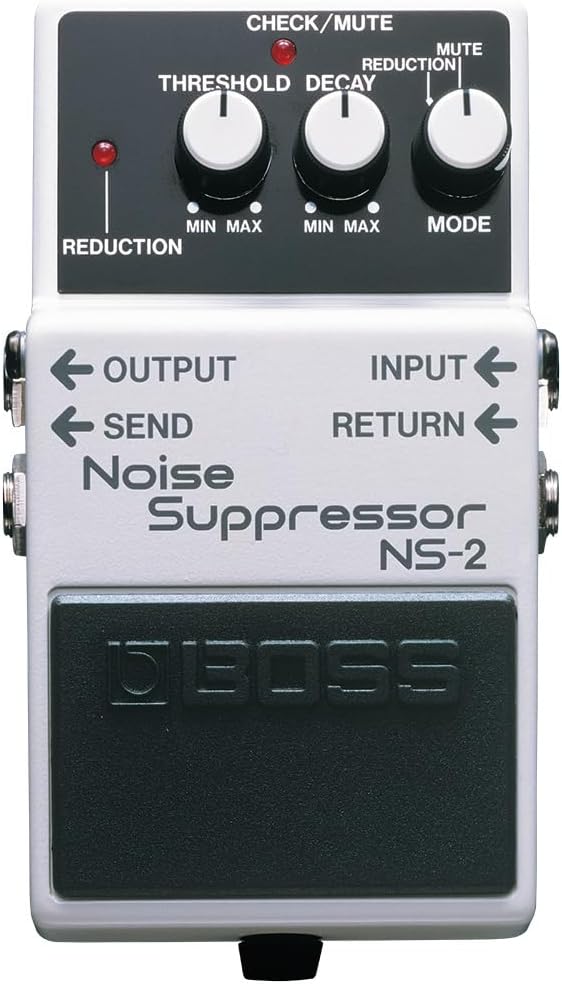
The BOSS NS-2 is a compact pedal built to suppress hum and unwanted noise in guitar and bass effects chains. Although it is not physically rackmountable, it remains relevant to this comparison because the keyword is often used by musicians seeking practical hardware noise control.
We may earn a commission when you buy through this link, at no additional cost to you.
Its unique noise detection circuit is designed to preserve the natural attack and envelope of the instrument rather than simply chopping every low-level signal. Threshold and Decay controls shape how aggressively noise is removed and how long the pedal takes to return to normal operation after a note ends.
The main limitation is format and scope. It is designed around instrument-level pedal use, not microphone preamp routing, live PA gating, or rack installation. A guitarist with a crowded high-gain pedalboard may need to experiment carefully to avoid cutting the natural tail of a note or reacting too slowly to fast passages.
The NS-2 is a compelling option for guitarists and bassists who want straightforward noise suppression without navigating a large compressor or channel strip. It is best suited to a pedalboard where short, controlled bursts of noise are the problem and the player can hear the gate respond in real time.
The noise-detection approach is intended to distinguish unwanted noise from the meaningful attack of an instrument. This makes the pedal more appropriate than indiscriminate cutoff for responsive playing.
Threshold establishes where the pedal begins treating a signal as noise, while Decay governs the release behavior. The limited control set is approachable for guitarists who want fast results.
We may earn a commission when you buy through this link, at no additional cost to you.
The dbx 266xs is a purpose-built compressor and expander/gate that occupies one rack space. Its 4.7 rating, portable touring orientation, program-adaptive gate, and precise threshold displays make it the strongest premium choice for users who want a dedicated rack processor rather than a pedal or multifunction channel strip.
We may earn a commission when you buy through this link, at no additional cost to you.
The gate timing algorithms are designed to create smooth release characteristics, and the program-adaptive expander/gate can adapt to different material. Separate LEDs display gain reduction, compression threshold, and gate threshold, giving the operator useful setup feedback. A sidechain insert adds further control for applications that require frequency-triggered dynamics.
As a single-channel unit, it does not match the dual-channel convenience of the leading two processors. Users working with stereo pairs or multiple simultaneous sources may need two units or a separate multichannel rack device. Its single-space enclosure may also place physical demands on a densely populated studio rack.
Despite those limitations, the dbx 266xs is ideal for a professional rack where dependable gating, straightforward metering, and compact construction matter. It is particularly convincing for touring, portable rigs, podcast production, and studio channels that need dedicated dynamics control.
The program-adaptive expander and revised gate timing are intended to deliver smooth release behavior across different sources. This reduces the need for constant manual adjustment when a channel changes character.
Independent displays for gain reduction, compression threshold, and gate threshold make the operating state visible. Accurate visual references are especially valuable during live work or a fast studio session.
We may earn a commission when you buy through this link, at no additional cost to you.
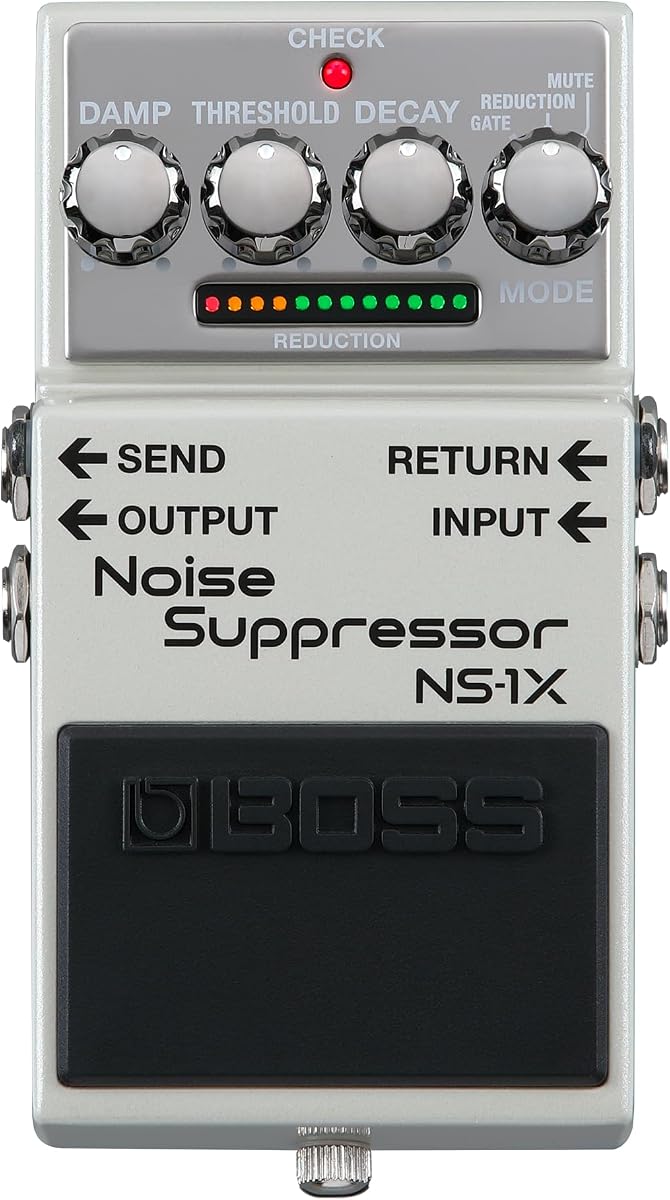
The BOSS NS-1X is a next-generation instrument noise suppressor with separate Reduction and Gate modes. Its 4.7 rating and combination of fast gating, detailed controls, and an integrated send/return loop make it one of the most capable guitar and bass noise-control products in the guide.
We may earn a commission when you buy through this link, at no additional cost to you.
Reduction mode is intended to quiet a general playing setup, while Gate mode offers ultra-fast response for precise, high-gain passages. Threshold, Decay, and Damp controls shape the behavior, and a dynamic indicator displays the current suppression status. The pedal also includes a five-year BOSS warranty.
Its send/return loop is the standout feature for pedalboards containing overdrives, distortions, and other noise-producing effects. It also includes a DC output for distributing power, but that function requires the optional PSA adaptor and PCS-20A parallel cable. Those requirements add complexity for players who want a completely self-contained signal chain.
The NS-1X is a strong choice for electric guitarists or bassists who need responsive noise reduction and control over an entire effects loop. It is not a rackmount gate, but its specialized operation makes it a valuable alternative for instrument applications where speed and tonal preservation are the priorities.
Reduction mode handles broad background noise in a typical playing environment. Gate mode reacts quickly when a performer needs sharp separation between notes and high-gain sustain.
The send/return connection allows noisy pedals to be placed within the controlled loop. This can be more effective than relying on a gate to manage residual noise after the entire chain.
We may earn a commission when you buy through this link, at no additional cost to you.
The dbx 286s is a full channel strip that combines a microphone or instrument preamp, compression, de-essing, enhancement, and an expander/gate in a rack-mountable 1U enclosure. Its 4.5 rating makes it a strong option for studios that want to consolidate several channel functions into one rack unit.
We may earn a commission when you buy through this link, at no additional cost to you.
The floating balanced XLR input accepts microphones, while two quarter-inch TRS line inputs handle instruments or pre-recorded material. The insert jack sits between the preamp and processing sections, creating a loop-out point for additional processors. A full LED array provides level and status monitoring without requiring separate rack meters.
One limitation is that it is a single-channel architecture with one quarter-inch TRS output. A stereo pair or larger session would therefore require multiple units, and the many processing sections can initially make the control layout more involved than that of a dedicated gate. The insert point also requires correct routing to avoid unexpectedly bypassing or duplicating processing.
The dbx 286s suits studio owners who want a microphone preamp and multiple dynamics tools in one space. It is a particularly good fit for vocals, voice-over, broadcast-style recording, and project studios where a clean channel-strip workflow is more useful than a standalone gate.
Combining preamp, compression, de-essing, enhancement, and gating reduces the need for separate processors. This can simplify a studio rack while preserving access to essential channel tools.
The XLR microphone input and TRS line inputs support different sources. Balanced routing can help maintain a clean signal path in professional recording and live environments.
We may earn a commission when you buy through this link, at no additional cost to you.
The Rowin LEF-319 is a compact true-bypass pedal designed to reduce unwanted noise from guitar or instrument signals. Its 4.3 rating and straightforward operating model make it an accessible option for pedalboards where basic level-based suppression is sufficient.
We may earn a commission when you buy through this link, at no additional cost to you.
A single noise-reduction adjustment spans negative 70 to positive 10dB, while Hard and Soft modes provide different suppression characteristics. The zinc-alloy enclosure is designed for durability, the LED indicates operating status, and true bypass keeps the pedal out of the signal path when it is not in use.
The pedal cannot run from batteries and requires a center-negative 9V power supply, which must be purchased separately. That need for an extra accessory reduces its convenience compared with self-contained alternatives. Its adjustment range also puts the burden of precise noise-floor identification on the player.
The LEF-319 is best for guitarists who want a small, straightforward gate and already have a suitable power supply. It may suit practice, rehearsal, and straightforward pedalboard configurations, although a more specialized suppressor will offer finer control for complex high-gain chains.
Hard mode produces a more decisive reduction, while soft mode approaches the signal more gradually. Selecting the appropriate character can make the pedal less conspicuous during normal playing.
Because the unit requires a center-negative 9V supply and cannot use batteries, players should confirm their pedalboard power arrangement before buying. A compatible adapter is not included.
We may earn a commission when you buy through this link, at no additional cost to you.
The 31-band graphic equalizer is a professional sound-system processor rather than a noise gate. Its inclusion helps illustrate an important purchasing distinction: an equalizer shapes frequency content, but it does not perform the time-based signal detection and attenuation that defines a gate or expander.
We may earn a commission when you buy through this link, at no additional cost to you.
The unit uses DSP technology to process digitally integrated audio input and output, with thirty-one bands for detailed tonal adjustment. Its stated applications include radio stations, conference rooms, recording studios, entertainment halls, live-event systems, home theaters, and high-fidelity audio installations. A compact cabinet-style design is also mentioned for rooms such as apartments, bedrooms, offices, basements, and garages.
The supplied information does not document a noise gate, expander, threshold control, or hold-and-release timing. It also provides no customer rating, so it should not be evaluated as a proven gate alternative. Using it to suppress noise could lead to undesirable tonal changes because a constant boost or cut is not the same as briefly muting an unwanted signal.
This product makes the most sense for a fixed installation that needs system equalization. Buyers searching specifically for rackmount noise-gate behavior should instead choose a product with explicit expander or gate controls, such as the dbx 266xs, dbx 286s, or one of the dual-channel rack processors.
An equalizer adjusts relative levels across the frequency spectrum. A gate listens to overall or selectable signal level and closes when the source falls below a threshold, making the two functions complementary but not interchangeable.
The stated venue and home-audio applications make this a system-level tool. It may complement a separately installed gate in a larger commercial or event environment.
We may earn a commission when you buy through this link, at no additional cost to you.
The Electro-Harmonix Silencer can function as a conventional inline noise gate or gate an entire effects loop. Its 4.5 rating, included battery, and flexible release range make it a practical instrument pedal for players who want to control noise at the source.
We may earn a commission when you buy through this link, at no additional cost to you.
The unit delivers up to negative 70dB of noise reduction and offers release times ranging from 8 milliseconds to 4 seconds. Buffered bypass allows the signal to continue through the pedal even when the gate is bypassed, which can be useful in a pedalboard where the pedal remains in the signal path.
This is an instrument pedal rather than a rack device, and it will not replace a rackmount processor for microphones, broadcast channels, or live system inputs. The broad release range offers useful flexibility, although very short settings may feel abrupt and long settings may remain open between sparse notes. Buffering should also be considered when designing a larger pedalboard.
The Silencer is a good fit for guitarists and bassists who want either inline suppression or control over a noisy effects loop. It is especially relevant for players who prefer adjustable release behavior and want a straightforward gate without a large compressor front panel.
The pedal can operate directly on the instrument signal or encompass a group of effects. The second arrangement can address noise generated by multiple noisy stompboxes more comprehensively.
The range from 8 milliseconds to 4 seconds allows quick suppression or a gradual return. Shorter values suit tight passages, while longer values can preserve more sustain and natural decay.
We may earn a commission when you buy through this link, at no additional cost to you.
Choosing a rackmount noise gate requires matching the processor to the source, installation, level, and operating environment. The most important distinction is whether a dedicated gate, a combined dynamics processor, a channel strip, or an instrument pedal best fits the signal path.
A noise gate must detect signal level and reduce attenuation when a source falls below a chosen threshold. A compressor may control loud passages, and an equalizer changes tonal balance, but neither feature should be treated as equivalent to gate behavior. Check the specifications for an explicit expander, noise suppressor, or gate section and review the available threshold and release controls.
Choose a documented gate function whenever clean silence between phrases is the main objective.
Dedicated rack gates provide focused control and often occupy one rack space. Dual-channel dynamics processors can handle two sources and add compression, while channel strips combine a preamp with several processing stages. Instrument pedals solve noise at the pedalboard level but do not offer rack installation or microphone-channel control.
Match the format to the signal path rather than choosing on appearance alone.
The threshold determines the signal level at which the gate begins attenuating, while release or decay determines how quickly it reopens. A short release can feel abrupt on sustained notes, whereas a long release can leave background noise audible between phrases. Program-adaptive timing and separate hold controls can simplify operation, but they also add complexity.
Look for enough control to handle different dynamics without constant adjustment.
A gate must receive a signal strong enough for its detector to identify accurately. The Rodweil RO05, for example, is specified for placement after a microphone preamp or at line level and should not receive a raw microphone directly. Rack devices may support microphone-level XLR, line-level TRS, or both, so verify the intended source before making a connection.
Correct input level prevents unreliable detection and distorted processing.
XLR connections are common for microphones and balanced professional signals, while quarter-inch TRS inputs support line-level instruments and outputs. Sidechain inserts add frequency-triggered control, and loop or insert points allow external processors to be added. A useful rack gate should integrate with the user's interface, mixer, preamp, PA system, and patchbay without unnecessary adapters.
List the equipment already in the signal chain before selecting a processor.
An analog gate can avoid the conversion stages associated with digital or software processing. The RO05 is described as fully analog, nearly latency-free, and free of the stated signal loss caused by repeated conversions. Digital processors may provide advanced detection or automation, but the signal path and monitoring setup should be evaluated for timing, transparency, and compatibility with the recording chain.
For live performance and overdubbing, predictable timing is a priority.
LED indicators for gain reduction, gate threshold, and compression level provide visible feedback during setup. A dedicated threshold display makes it easier to establish a repeatable starting point, while a dynamic suppression indicator helps users understand when a pedal is actively reducing noise. This visual information is particularly helpful in dim live environments.
Metering does not replace listening, but it makes precise adjustment easier.
Rack processors should be checked for rack height, depth, power requirements, ventilation, and connector placement. A single-rack-space device may fit a crowded studio, while a pedal may be convenient for musicians who already use a board. Rackmount products may also require careful high/low-level routing to avoid noise entering through long cable runs.
Measure the rack and plan the patch layout before ordering.
Begin by placing the gate in the correct signal path. For a dedicated analog unit such as the Rodweil RO05, position it after the microphone preamp or in a line-level chain. With a rack compressor, connect the source to the proper XLR or TRS input, use the relevant output, and confirm that the sidechain insert remains unconnected unless external frequency triggering is required.
Set the threshold with the intended source present. Speak or play at the lowest level that must remain natural, then adjust the gate so it does not attenuate that material. Add or lengthen the release so quiet passages and sustained notes fade naturally rather than being cut abruptly. If the unit also includes compression, introduce that function after establishing a stable gate setting.
Care for the hardware by following its power and ventilation requirements, avoiding moisture and unstable placement, and allowing adequate space around rack connections. Pedal models should use the specified power supply and secure the enclosure to a stable board. Clean connectors, inspect cables for damage, and periodically revisit thresholds when the microphone, preamp, source level, or acoustic environment changes.
Yes, a properly configured gate can reduce room noise, preamp hum, and other background sound between phrases. It works best when the threshold is set above unwanted noise but below the quietest intentional vocal material. A slow or fast release can sound unnatural, so listen carefully and adjust the timing to preserve breaths, consonants, and vocal tails.
A gate reduces signal when it falls below a threshold and restores it when the source becomes loud enough. A compressor controls louder signal by reducing gain as its level increases. Rack units such as the dbx 266xs and the dual-channel processors include both functions, allowing the gate to handle quiet noise while compression manages level variation.
Choose a rackmount unit for microphones, mixers, interfaces, PA systems, broadcast channels, and studio recording. Choose a pedal for guitar or bass pedalboards where the unwanted noise originates from the instrument or effects chain. A pedal may be physically smaller, but it does not replace the balanced connections and rack-level workflow of a studio processor.
No. The supplied information states that the RO05 must be placed after a microphone preamp or within a line-level signal chain. A raw microphone-level signal is too weak for the unit to recognize and process correctly. Connect the microphone to a suitable preamp first, then route the preamp output into the gate.
The threshold may be too high, the release may be too fast, or the attack may be reacting before the source reaches a stable level. Test with a quieter playing or speaking level, lower the threshold slightly, and adjust the release or decay. High-gain instrument users may get better results by including the noisy effects in a gated send-return loop.
No. A graphic equalizer changes the relative level of frequency bands, while a gate opens and closes according to signal level and timing. An equalizer may alter the character of hum or noise, but it does not provide the temporary attenuation that a proper expander or gate is designed to deliver.
A sidechain insert lets an external control signal trigger the processor's dynamics action. It is commonly used to make bass or kick drum content duck other sources. The dbx 266xs and both dual-channel rack processors include this capability, giving users more control than basic level-based gating.
Set the threshold just high enough to identify the unwanted noise, then choose a release that matches the material. Leave the sidechain disconnected unless frequency-triggered operation is wanted, and verify that the source is entering at the correct level. Compare the processed signal with the gate bypassed whenever the unit provides that option.
The Rodweil RO05 stands out for focused analog noise control, the top-ranked dual-channel processor provides the most versatile rack feature set, and the dbx 266xs delivers a dedicated premium compressor-and-gate solution in one rack space. Each serves a different but valid need: a focused gate, a broad two-channel processor, or a professional dynamics centerpiece.
Prioritize correct signal level, usable threshold and release controls, and connectivity that matches your microphones, preamps, instruments, mixers, or PA system. Consider whether a dedicated gate, dual-channel compressor, channel strip, or effects-loop pedal is the correct functional format rather than choosing solely by appearance or the keyword used in the listing.
Ratings, product configurations, and current prices can change over time, so verify the latest details before purchasing. Checking the manufacturer's instructions and confirming signal routing will help you get dependable noise control without sacrificing the natural character of vocals, instruments, or live performances.