
WiiM Amp Pro Streaming Amplifier
4.6Editor score
60W per channel at eight ohms
Wi-Fi 6 and Bluetooth 5.3
HDMI ARC television connection
Room correction and independent EQ
Our amps for passive speakers guide compares ten compact and high-power options, covering connectivity, sound quality, speaker compatibility, and ease of use.
An amplifier for passive speakers supplies the power that the speakers themselves cannot generate, making it the central component of a traditional stereo system. A capable unit should deliver clean output, match your speakers’ impedance, provide the inputs you need, and offer enough control to shape the sound without complicating everyday operation.
The ten products in this guide range from compact desktop Class D amplifiers to powerful professional power amps and network-connected streaming models. We compared their stated power configurations, supported speaker impedances, source connections, control features, wireless capabilities, cooling provisions, and intended applications to show how each model differs.
Each review identifies the strongest use case for that amplifier while acknowledging important limitations, such as wired-only operation or the need to match output claims with the correct power supply and speakers. Product availability and pricing can change, so readers should verify current specifications and conditions before purchasing.
4.6Editor score

4.5Editor score
4.5Editor score
This side-by-side comparison highlights the major differences in output power, connectivity, speaker compatibility, and intended use, helping you distinguish a simple shelf amplifier from a streaming model or professional power amp.


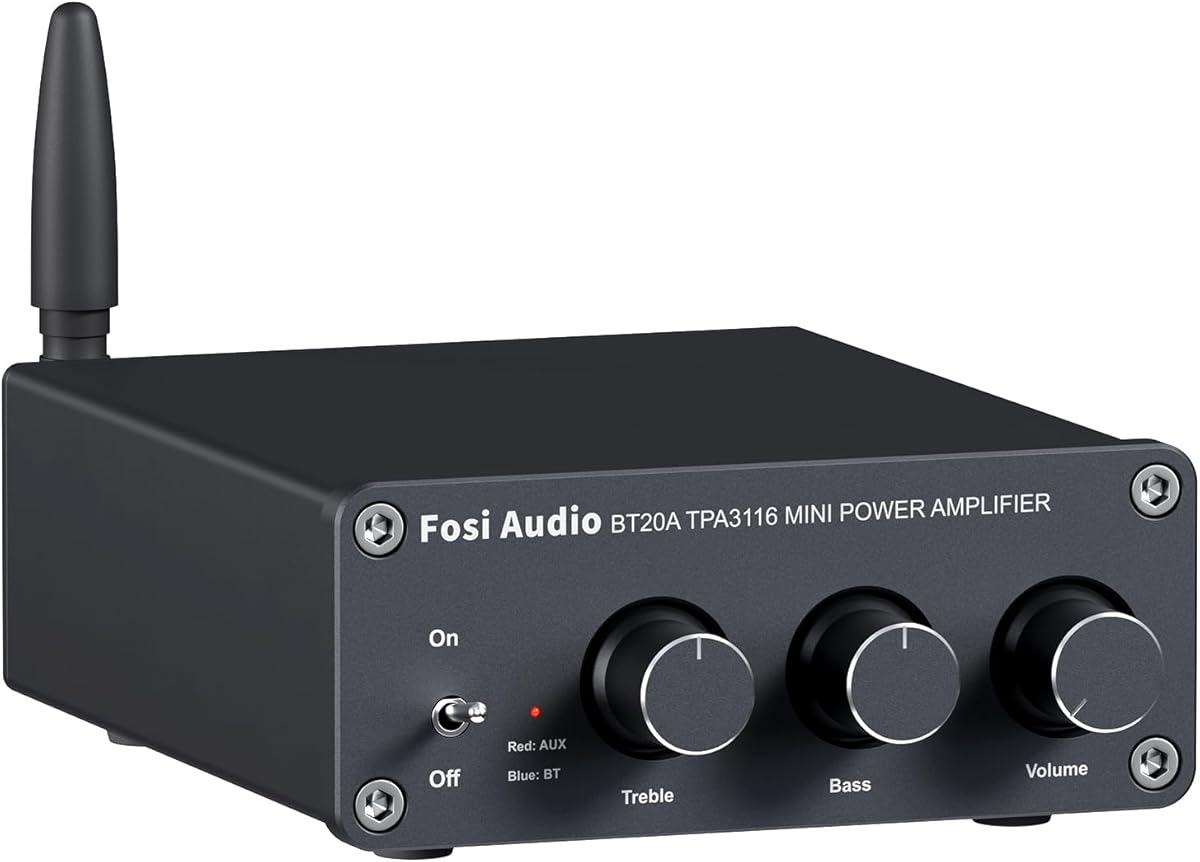
The Fosi Audio BT20A is a compact two-channel Class D amplifier intended to give passive speakers power in a home, office, garage, patio, or other modest listening space. Its 4.5 rating reflects a generally favorable reception, while the most appealing feature is the combination of straightforward operation and both Bluetooth and RCA connectivity.
We may earn a commission when you buy through this link, at no additional cost to you.
Its maximum stated output is 100W x 2, and the product is designed to power multiple passive speaker cabinets. Bluetooth allows a phone to become a convenient music source without a cable, while RCA inputs support traditional analog equipment. Bass and treble controls on the unit provide basic tonal adjustment without requiring a separate processor, and a one-touch power switch helps keep daily operation uncomplicated.
The trade-offs are mostly about simplicity rather than refinement. It does not offer the replaceable op-amps, pre-out functionality, advanced cooling design, or wide-ranging input selection found in more specialized mini amplifiers. Maximum wattage should also be treated as a headline configuration figure rather than a guarantee of identical output into every speaker combination.
This is an appealing choice for a first passive-speaker system, a small office, a bedroom, or a secondary listening area. Buyers seeking simple Bluetooth playback, compact dimensions, and enough power for modest home use will find it easier to live with than a feature-heavy component.
Bluetooth makes the BT20A particularly friendly to everyday listening, while RCA inputs preserve compatibility with traditional stereo components. This mix is useful when you want casual streaming without giving up a straightforward wired pathway.
The small enclosure can sit on a shelf, desk, or other available surface, and separate bass and treble controls allow basic matching to the room and speakers. It is a practical choice when simplicity matters more than advanced system integration.
We may earn a commission when you buy through this link, at no additional cost to you.
The Fosi Audio BT20A Pro raises the technical ceiling of the original BT20A while retaining a compact Class D form and wireless convenience. It carries a 4.4 rating and is built around the TI TPA3255 amplifier chip, with stated maximum output of 300W x 2 for passive-speaker and home-audio applications.
We may earn a commission when you buy through this link, at no additional cost to you.
A major distinction is the accessible op-amp section. The supplied dual NE5532 op-amps can be replaced with compatible LME49720HA, MUSES02, OPA2604AP, OPA2134PA, LM4562, or NJM4556AD alternatives. Bluetooth 5.0 includes a pairing-memory function, while bass and treble controls can be set to neutral positions for a less processed presentation.
Measured specifications include an SNR of at least 108dB and THD of no more than 0.005%, according to the supplied product information. These figures indicate a high level of attention to signal purity, although real performance still depends on the source, speakers, power supply, and installation. The included 32V 5A adapter, antenna, power cord, and manual make the package relatively complete.
Choose the BT20A Pro if you want more output potential and an op-amp upgrade path in a compact wireless amplifier. It is best suited to listeners who enjoy experimenting with sound components and understand that maximum wattage is a conditional rating rather than a promise of effortless power with any speaker.
The plug-in op-amp design lets owners compare several families of dual op-amps without replacing the amplifier. That makes the Pro appealing for hobbyists who want a meaningful degree of personalization in a compact system.
Bluetooth 5.0, pairing memory, and an alert tone reduce friction when a phone is the regular source. The amplifier remains suitable for outdoor, desktop, and other space-conscious stereo configurations.
We may earn a commission when you buy through this link, at no additional cost to you.
The Fosi Audio TB10D is a two-channel TPA3255 Class D amplifier built for passive speakers, desktop audio, and specialized installations involving a bass shaker. It has a 4.5 rating and advertises 300W per channel, with support for speakers from 2 to 8 ohms.
We may earn a commission when you buy through this link, at no additional cost to you.
Its flexibility comes from working with a wide range of conventional sources, including phones, computers, TVs, DVD and CD players, and other analog equipment through RCA connections. Bass and treble controls make tonal preferences easy to adjust, while the included power switch reduces operating friction. Built-in protection circuits are designed to support stable operation and prolong component life.
The headline 600W total output can be misleading if read without context, so speakers should still be matched carefully to the amplifier and its operating conditions. The lack of wireless streaming may also be limiting for a modern living room, but it is a benefit for listeners who prefer a fixed, predictable signal path and do not need app-based control.
The TB10D is a strong match for a compact stereo, game-room system, personal studio, or installation that needs a passive speaker connection and possibly a bass shaker. It is especially useful for buyers who prioritize broad device compatibility, tactile controls, and straightforward integration over streaming sophistication.
RCA input and passive speaker outputs make the TB10D easy to incorporate into established analog systems. Its support for phones, computers, TVs, disc players, and other sources reduces the need for specialized adapters in many common setups.
Unlike a basic stereo amp, the TB10D can also serve a bass shaker, making it interesting for gaming and home-theater experiments. That specialized capability broadens its usefulness beyond ordinary two-speaker playback.
We may earn a commission when you buy through this link, at no additional cost to you.
The Fosi Audio V3 is a compact, enthusiast-oriented stereo amplifier with a 4.5 rating and a stated maximum output of 300W x 2. Designed for passive bookshelf and tower speakers, it supports 2–8 ohm loads and includes a 48V power supply, making it one of the most technically complete mini amplifiers in this guide.
We may earn a commission when you buy through this link, at no additional cost to you.
Its component choices are central to the appeal. The TPA3255 Class D chipset is combined with Japanese NCC and ELNA capacitors, German WIMA capacitors, and Japanese Sumida inductors. Stated performance reaches up to 88dB SINAD, 110dB SNR, and a 140uV noise floor, while vents at the top and bottom and a full-body heatsink support heat dissipation.
The V3 also embraces customization. Compatible eight-pin dual op-amps include Sparkos SS3602, MUSES02, OPA2604, OPA2134PA, OP249, AD827, RM4559, LM4562, and LME49720HA. Its pre-out is controlled by the main volume, making it easier to add another power amplifier or powered device. The trade-off is that these enthusiast features are less immediately useful to someone seeking built-in streaming or a simple guided setup.
This is our overall choice for buyers who want a compact wired power amplifier with serious component specifications, thermal design, and upgrade potential. It is especially appropriate for a dedicated desktop, bookshelf, or home-theater system where analog source control and speaker flexibility matter more than wireless convenience.
Top and bottom vents, a whole-body heatsink, and low-noise component selections support both sustained power and clean signal performance. These details make the V3 more compelling for extended listening than a basic mini amp with minimal thermal management.
A broad range of compatible dual op-amps gives owners a direct way to experiment with tonal characteristics. For listeners who enjoy comparing hardware changes, that flexibility can be as valuable as the raw power specification.
We may earn a commission when you buy through this link, at no additional cost to you.
The AIYIMA A07 Premium is a compact TPA3255 Class D stereo amplifier that combines passive-speaker output with a useful full-range pre-out. It holds a 4.4 rating and is positioned for hi-fi listeners who may want to build a stereo or 2.1-channel system around a desktop or bookshelf setup.
We may earn a commission when you buy through this link, at no additional cost to you.
Maximum output is listed at 300W x 2, with compatibility for 2–8 ohm passive speakers. The 3.5mm pre-out follows the volume control and can feed active speakers, a separate power amplifier, or a powered subwoofer amplifier. This is a more versatile arrangement than a basic mini stereo amplifier with only source inputs and speaker terminals.
The supplied NE5532 dual op-amp can be replaced with compatible OPA, LM, or MUSES series devices, adding another layer of enthusiast flexibility. Japanese ELNA capacitors, WIMA capacitors, filter capacitors, a full-metal housing, upgraded knobs, and enhanced internal cooling reinforce the component-focused design. A 32V 5A adapter is included, although a compatible 48V 10A supply can be used to pursue higher output.
The A07 is best for someone building a deliberate wired hi-fi system, particularly one that might grow from two passive speakers into a more elaborate active or 2.1-channel arrangement. It will not satisfy buyers seeking built-in wireless audio, but that limitation keeps the focus on flexible analog integration.
The volume-controlled full-range pre-out can connect to active speakers, a powered subwoofer amplifier, or another power amp. That makes the A07 useful as the central control point in a developing stereo or 2.1-channel system.
Replaceable op-amps, recognized component types, and an upgraded metal enclosure give the amplifier a more component-oriented character. It rewards owners interested in fine-tuning their system rather than seeking an all-in-one network appliance.
We may earn a commission when you buy through this link, at no additional cost to you.
The Aveek TPA3255 is a compact and uncomplicated two-channel amplifier for passive bookshelf and tower speakers. It carries a 4.5 rating, uses the TI TPA3255 Class D chip, and offers a clear division between the output available with the included supply and the greater output possible with a compatible 48V supply.
We may earn a commission when you buy through this link, at no additional cost to you.
With the included 32V 5A adapter, the stated configuration delivers up to 100W per channel into 4 ohms. A compatible 48V 5A supply raises the maximum figure to 240W per channel. Supporting a 24–48V DC input range gives buyers room to adjust the amplifier to their speaker requirements, although they must select a correctly rated supply for higher output.
Connectivity is centered on RCA and 3.5mm analog inputs, allowing connection to a phone, computer, DAC, preamp, CD player, or TV. The stated SNR of at least 110dB and THD below 0.01% support a clean listening objective. There is no dedicated subwoofer output, so adding a powered subwoofer requires another route.
This is our budget recommendation for buyers who want a straightforward wired amplifier and do not need Bluetooth, streaming, or balanced connections. Its included power supply makes setup convenient, while the wider voltage range provides a useful path to increased output when the speakers and installation justify it.
The included supply offers a usable baseline, while support for 24–48V DC input lets a correctly matched 48V supply unlock the stated higher output. This gives the amplifier a clear upgrade path without changing the main unit.
RCA and 3.5mm inputs cover most consumer audio sources without adding network complexity. The compact aluminum chassis also helps save space and dissipate heat during extended listening.
We may earn a commission when you buy through this link, at no additional cost to you.
The Fosi Audio ZA3 is a premium compact amplifier distinguished by balanced connectivity, trigger control, and flexible operating modes. It has a 4.5 rating and is intended for passive speakers in desktop, home-theater, subwoofer, and more serious home-audio arrangements.
We may earn a commission when you buy through this link, at no additional cost to you.
In stereo mode, maximum output is stated as 180W, while mono mode can reach 235W. Two ZA3 amplifiers can be configured in mono to create a more substantial system. The balanced combo input accepts XLR or 1/4-inch TRS plugs, and the 12V trigger input allows synchronization with other equipment so they can be operated as a coordinated system.
Signal quality is supported by the TPA3255 Class D chip, Japanese NCC and ELNA capacitors, German WIMA capacitors, and Japanese Sumida inductors. Stated figures reach 89dB SINAD, 106dB SNR, and a 150uV noise floor. A larger chassis, side vents, and dust covers improve sustained high-power operation, while five swappable op-amp positions extend tuning options.
The ZA3 is ideal for listeners seeking balanced or professional-style connections, system triggering, and future mono expansion. Its feature set may be excessive for a simple Bluetooth setup, but it offers a more integrated and scalable path for a carefully assembled passive-speaker system.
XLR and TRS balanced inputs can reduce interference and noise in suitable installations. The trigger connection further improves coordination when the amplifier sits within a larger home-theater or multi-component setup.
Switching between stereo and mono modes allows the same amplifier to serve different speaker arrangements. Pairing two units in mono provides a scalable route to greater output without abandoning the compact Class D platform.
We may earn a commission when you buy through this link, at no additional cost to you.
The Peavey IPR2 2000 is a lightweight, two-channel professional power amplifier for serious passive-speaker installations. Its 4.2 rating is slightly lower than those of the leading compact models, but the feature set is aimed at a different environment: live sound, fixed installations, and users who prioritize crossover and routing control.
We may earn a commission when you buy through this link, at no additional cost to you.
Each channel has an independent fourth-order Linkwitz-Riley crossover, allowing the amplifier to integrate with a multiway speaker system. DDT distortion control, detented input controls, revolutionary IPR Class D topology, and Speakon output connectors form the core feature set. These are professional-oriented details rather than the home-listening conveniences found in streaming amplifiers.
The main limitation is specialization. There is no mention of Bluetooth, Wi-Fi, room correction, a pre-out, or consumer bass-and-treble controls. Buyers who want to place the amplifier on a shelf and control a phone or television may find the interface less approachable than that of the Fosi, AIYIMA, Aveek, or WiiM options.
Choose the IPR2 2000 when it will be integrated into a professionally designed passive system or portable event rig. For a living-room stereo where convenience and wireless access are primary, one of the compact home-audio amplifiers will be a more natural fit.
Independent fourth-order Linkwitz-Riley crossovers provide a useful level of control for multiway speaker management. That level of detail is most valuable in a system designed around the crossover settings.
Speakon outputs and detented input controls suit a working audio environment where stable connections and repeatable settings matter. The lightweight chassis also simplifies transport compared with a full-size rack amplifier.
We may earn a commission when you buy through this link, at no additional cost to you.
The Peavey IPR2 3000 is a two-channel professional power amplifier that combines independent crossover control with flexible balanced and unbalanced input options. It has a 4.3 rating and is better suited to fixed installations, stage equipment, and serious passive-speaker rigs than a casual desktop system.
We may earn a commission when you buy through this link, at no additional cost to you.
The two channels can be managed independently with fourth-order Linkwitz-Riley crossover controls, and the amplifier includes DDT distortion control and IPR Class D topology. Combi XLR and 1/4-inch inputs give integrators more source options than models offering only RCA or 3.5mm connections, while Speakon outputs support robust speaker wiring in professional environments.
As with the IPR2 2000, the absence of streaming, room correction, and household-oriented tone controls narrows its appeal. The model also assumes that the user understands channel routing, crossover behavior, signal levels, and speaker wiring. Those are meaningful requirements in a fixed system but unnecessary complications for many casual listeners.
The IPR2 3000 is a strong candidate for installers, live-sound users, and owners of serious passive systems seeking professional connections. For a compact home stereo, the ZA3 offers more approachable compact features, while the WiiM Amp Pro provides far more convenient wireless control.
Combi XLR and 1/4-inch inputs make the amplifier easier to integrate with professional mixers, preamps, and other balanced equipment. This is a meaningful advantage when long cable runs or electrically noisy environments are concerns.
Separate crossover controls for each channel support precise system design. Buyers should configure the amplifier around the intended speaker architecture rather than treating the crossover as a general-purpose tone control.
We may earn a commission when you buy through this link, at no additional cost to you.
The WiiM Amp Pro is the most connected amplifier in this guide and the only model centered on a full streaming experience. It holds the highest rating at 4.6, with 60W per channel into 8 ohms and 120W per channel into 4 ohms, enough for many passive bookshelf and smaller tower-speaker systems.
We may earn a commission when you buy through this link, at no additional cost to you.
Wi-Fi 6, Bluetooth 5.3 with two antennas, a premium DAC, and support for high-resolution playback make it suitable for listeners who want a phone, television, local library, and streaming services to share one component. The WiiM Home App provides volume control, speaker synchronization, favorites, alarms, settings, and voice-command support through Alexa or Google Assistant.
Its HDMI ARC port adds a particularly practical home-theater function, while a powered subwoofer can be added for deeper low-frequency impact. Room correction and independent EQ settings can help adapt playback to the room, and multiroom control can synchronize the amplifier with compatible devices. One important limitation is that the product is incompatible with AirPlay and cannot serve as an AirPlay receiver.
The WiiM Amp Pro is the strongest choice for a modern connected household, particularly when passive speakers should handle both music and television sound. Buyers needing extremely high power, balanced pro-audio inputs, or a dedicated subwoofer output should consider a specialist alternative instead.
Wi-Fi 6, Bluetooth 5.3, popular music services, local-library playback, and multiroom synchronization cover nearly every common listening source. The app-based controls make the amplifier approachable even for users who do not want to manage a complex network audio system.
HDMI ARC lets a television send its audio to the amplifier, allowing passive speakers to become a much better-sounding alternative to built-in television speakers. Adding a compatible powered subwoofer can extend the system's low-end performance without requiring a full receiver.
We may earn a commission when you buy through this link, at no additional cost to you.
The right amplifier depends on speaker impedance, power requirements, available sources, room size, and desired features. Use the specifications below to narrow the field before considering a product’s headline output figure.
A passive speaker’s impedance is expressed in ohms and describes the electrical load presented to the amplifier. Most of the compact Class D amplifiers reviewed here are specified for 2–8 ohm passive bookshelf or tower speakers. That broad range gives you more freedom, but you should still check the speaker manufacturer’s recommended minimum impedance and avoid wiring configurations that present a lower load than the amplifier supports.
A four-ohm pair is common, while some floorstanding models use six- or eight-ohm nominal loads. Never assume that every passive speaker can be connected to every mini amplifier, and never parallel outputs in a way that reduces the load below the manufacturer’s guidance.
Maximum wattage figures often describe output under specific voltage, impedance, and frequency conditions. They should not be compared as though every amp maintains the same figure with every pair of speakers. A two-channel amp also shares its available power between channels, and an included power supply may limit performance compared with a compatible higher-voltage supply.
Look for the continuous or rated configuration where it is provided, check the supported load, and match the amplifier to the manufacturer’s recommended power range for your speakers. A modestly powerful amp that operates cleanly is preferable to one driven beyond its practical limits.
RCA inputs cover many traditional sources, while 3.5mm connections are convenient for phones, computers, and compact DACs. Bluetooth is useful for casual wireless playback, and HDMI ARC is especially valuable when the amplifier will handle television audio. Balanced XLR or TRS inputs matter in professional installations, while a 12V trigger enables coordinated startup with other equipment.
Choose more inputs only if you will use them. An audiophile network amplifier offers excellent convenience, but it does not replace a well-matched analog connection for every setup. Conversely, a wired-only model can be the cleaner choice when all sources are already local and fixed.
Most passive-speaker systems begin as stereo, with one amplifier channel driving each speaker. Some models, including the Fosi Audio ZA3, can also operate in mono mode. That makes it possible to power a single speaker more forcefully or to deploy two amplifiers in a larger configuration. Specialized bass-shaker support, as found on the TB10D, serves a different role and should not be confused with a conventional subwoofer output.
Think about your actual layout before paying for advanced modes. A flexible amplifier can be valuable if you may reconfigure the system, but a straightforward stereo unit is usually easier to operate.
Class D amplifiers are efficient, but they still generate heat under load. The Fosi Audio V3 uses top and bottom vents along with a body heatsink, while the ZA3 employs side vents and a larger chassis. Other models use an aluminum enclosure to help dissipate warmth. None of these features eliminates the need for ventilation, and none should be placed in a sealed cabinet during high-volume use.
Allow space around the chassis and keep the unit away from heat-sensitive equipment. A shelf, desktop, or media-console position is generally preferable to a closed compartment.
Replaceable op-amps, pre-out connections, upgradable power supplies, and selectable crossover filters can make an amplifier more engaging for component enthusiasts. They are not essential for every listener. Wireless streaming, room correction, and multiroom synchronization may deliver more value if your system is used casually or shared throughout the home.
Make a list of the sources you need, the speakers you own, and the room where the system will live. Choose the amplifier that directly solves those needs rather than one that simply has the longest specification list.
The power supply can determine the amp’s operating level, and some products include a higher-voltage supply while others do not. The supplied adapter must match the amplifier’s requirement. The BT20A Pro includes a 32V 5A adapter, the V3 and ZA3 include 48V supplies, and the Aveek supports 24–48V DC input with a 32V 5A adapter included.
Also check whether Bluetooth antennas, speaker cables, trigger leads, or balanced cables are supplied. The absence of a cable is not necessarily a problem, but it is important to know before the amplifier arrives.
Begin by confirming that the passive speakers are compatible with the amplifier’s impedance range and recommended power range. Disconnect power, connect the source to the correct input, wire each passive speaker to its channel with the polarity marked on the amplifier and speaker terminals, and then add the approved power supply before switching the system on.
Begin listening at a modest volume and use the amplifier’s tone, crossover, or equalization controls sparingly. Establish the correct balance and polarity first. If you are using a streaming amplifier, complete network setup and room calibration before making extensive changes; if you are using an op-amp upgrade or different power supply, switch the system off and follow the component instructions exactly.
Keep the ventilation paths open, avoid placing the unit inside a closed cabinet during demanding playback, and route cables so they are not pinched or sharply bent. Clean the exterior with a dry or lightly damp cloth, keep liquids away from the chassis and controls, and disconnect power before changing connections. Regular checks of terminals, cables, and airflow help maintain safe, consistent operation.
A passive speaker amplifier supplies power to passive speakers through their input terminals. The speakers contain the drivers but do not include their own amplification, so they require an external power amplifier to produce audible sound. The amplifier also handles source selection, volume control, and often tone or system functions.
Yes, passive speakers require an amplifier with adequate power and compatible impedance. An active speaker contains its own amplifier and can be connected directly to a source, while a passive speaker only has the driver and crossover. Using an underpowered amplifier can restrict volume, while using an unsuitable or overloaded amp may distort or damage the speakers.
A two-channel amplifier can normally power one speaker per channel, provided the speaker impedance falls within the amplifier’s supported range and the combined load does not exceed its design limits. Check the manual for guidance on parallel wiring, impedance changes, and minimum allowable speaker loads before connecting multiple cabinets to one channel.
The amplifier should support the nominal impedance of the speakers, and many compact Class D models are intended for 2–8 ohm speakers. Four-ohm bookshelf speakers are common, but the exact requirement depends on the model and wiring arrangement. A speaker rated at a lower impedance should not be connected unless the manufacturer expressly permits it.
It can be, because Class D efficiency allows substantial power in a compact enclosure. Suitability depends on room size, speaker sensitivity, listening levels, and the amplifier’s continuous output under the intended load. Check the speaker maker’s recommended power range and avoid selecting an amp solely from its maximum wattage claim.
A speaker output delivers amplified power intended to drive passive speakers directly. A pre-out provides a line-level signal, normally controlled by the main volume, for another power amplifier, active speaker, or powered device. The AIYIMA A07 and Fosi Audio V3 include pre-out functionality for more flexible system expansion.
Not necessarily. Wired-only amplifiers can provide a stable connection to a DAC, streamer, turntable with a phono preamp, television, or computer. Bluetooth is convenient for casual phone playback, while Wi-Fi supports streaming services, app-based control, and multiroom systems. Choose based on the sources you use most often.
Only if it has a suitable powered-subwoofer or subwoofer output, or if you use a pre-out to feed a compatible powered subwoofer amplifier. A standard passive speaker output should not be used as a subwoofer output. The WiiM Amp Pro can add a powered subwoofer, while the A07 and V3 offer pre-out routes for more flexible configurations.
The Fosi Audio V3 stands out as the strongest all-around compact wired amplifier, combining substantial stated output, 2–8 ohm support, detailed component specifications, effective cooling, and op-amp flexibility. The WiiM Amp Pro is the connected-system winner, while the BT20A offers one of the simplest ways to add power and Bluetooth to passive speakers.
Prioritize the factors that will affect daily use: correct impedance, suitable continuous output, adequate inputs, ventilation, and the power supply included with the unit. Replaceable op-amps, balanced connections, pre-outs, triggers, and crossover controls are valuable when they solve a real system requirement, but they are unnecessary additions for a simple stereo.
Before ordering, verify the amplifier’s latest specifications, included accessories, and compatibility with your speakers and source equipment. Product configurations and market conditions can change, so checking current details will help ensure that the selected amplifier remains the right fit for your passive-speaker system.