
Tecsun PL330
4.4Editor score
Single-sideband reception
Comprehensive worldwide band coverage
850 station memory locations
Premium full-range speaker
Portable World Radio guide comparing reception, bands, power options, portability, audio, and emergency features across ten top models.
Portable world radios bring AM, FM, shortwave, and sometimes longwave or aviation-band listening into compact packages suited to travel, camping, emergency preparation, and everyday use. A capable model should balance sensitive reception, intuitive controls, useful presets, dependable power, and audio that remains clear across different environments.
The radios in this guide were compared using the supplied specifications to evaluate supported frequency bands, antenna and DSP capabilities, memory and scanning functions, speaker and headphone options, charging methods, physical size, and emergency features. The list covers simple pocket models, multipurpose NOAA radios, and more advanced worldband receivers.
Each review explains the strongest reasons to consider a particular radio, along with its meaningful limitations. Ratings and feature descriptions reflect the available product information, while availability, promotions, and pricing can change at any time. Check the current listing before making a final purchase.
4.4Editor score

4.4Editor score
4.4Editor score
The comparison highlights each radio's band coverage, power options, size or weight, and most useful special features, making it easier to distinguish basic portable models from full emergency kits and advanced worldband receivers.



The Greadio Portable Shortwave Radio combines AM, FM, and shortwave reception with a straightforward layout that suits home listening, travel, picnics, and casual outdoor use. Its 4.3 rating reflects a broadly capable package, while the large LCD, long antenna, DSP chip, and dual built-in speakers make it more satisfying than a minimal transistor-style set.
We may earn a commission when you buy through this link, at no additional cost to you.
Its most practical distinction is the choice between AC power and four D-cell batteries. That makes the radio useful across a kitchen, bedroom, campsite, or backup location without locking the user into one power system. The long handle also improves portability, and the display shows the tuned station clearly while the large tuning knobs should be easier to manipulate than tiny buttons.
The radio does not offer the NOAA band, Bluetooth, memory-card playback, or the extensive preset storage found on more specialized models. The available information also does not identify the exact number of memory locations or describe a digital scanning system. Those omissions matter primarily to users who want automated station management or emergency weather broadcasts.
This is a practical recommendation for someone seeking a readable, easy-to-control shortwave radio that works on household power or replaceable batteries. It is particularly useful for casual listeners and families, while travelers wanting aviation channels, weather alerts, or media playback should consider the R11 or C. Crane CC Skywave 2 instead.
The dual charging approach allows continuous listening at home with AC power and continued operation during outages with four D cells. Batteries are not included, so buyers should keep a spare set available for emergency use.
A large LCD, generous knobs, two built-in speakers, and a 3.5 mm headphone jack make the radio approachable for different ages. Private headphone listening is helpful in offices, bedrooms, and shared spaces.
We may earn a commission when you buy through this link, at no additional cost to you.
The R11 NOAA Shortwave Radio is the most versatile all-purpose model in this guide, with NOAA, AM, FM, and shortwave reception in one emergency-oriented package. Its 4.4 rating reflects a strong combination of radio coverage, channel storage, independent power options, media playback, and useful outdoor features rather than a single specialized function.
We may earn a commission when you buy through this link, at no additional cost to you.
Automatic scanning can locate and store channels across AM, FM, and shortwave, with a stated capacity of 70 locations per band and 210 in total. The radio also includes a five-watt speaker, Bluetooth 5.0, a 3.5 mm headphone connection, and access to USB drives or TF cards. White-noise options and a programmable shutoff add value for relaxation and battery conservation.
The 4000mAh rechargeable battery can provide up to 32 hours of playback when charged through the included Type-C cable, while solar power and the hand crank offer backup methods. Actual emergency runtime will depend on conditions and use. The digital search also depends on local signal conditions, so the stored-channel total should not be mistaken for guaranteed reception in every location.
Choose the R11 when you want one device to cover ordinary radio listening, weather awareness, camping, outages, and media playback. It is less convenient than the D220 for a jacket pocket and less refined as a dedicated worldband tuner than the Tecsun PL330, but its broad feature set makes it a particularly complete portable choice.
NOAA alerts, a 120-lumen flashlight, compass, SOS signal, and emergency phone charging extend the radio beyond entertainment. These functions make it more relevant to evacuation kits, vehicle kits, and camping equipment.
Bluetooth, TF card access, and USB drive playback let the R11 serve as a portable media player. Automatic scanning and 210 memory positions reduce the need to retune favorite stations manually.
We may earn a commission when you buy through this link, at no additional cost to you.
The Portable AM/FM Transistor Radio with Loud Speaker emphasizes simplicity, strong output, and accessible controls. Its 4.2 rating makes sense for a straightforward model that supports AM, FM, and shortwave without the preset-heavy feature set found in advanced receivers or emergency devices.
We may earn a commission when you buy through this link, at no additional cost to you.
A DSP anti-jamming chip, telescopic antenna, and wide frequency coverage support reception across the available stations in the user's area. The stated five-watt speaker is intended to provide clear music, talk, and sports audio, while the large channel tuner and separate volume buttons should make the radio approachable for seniors and younger listeners.
Power comes from a built-in rechargeable battery or standard five-volt USB charging, making it convenient for bedrooms, kitchens, offices, and camping. The product information does not mention NOAA reception, aviation bands, longwave, digital station memory, a headphone jack, or a hand-crank generator, so it should not be treated as a complete emergency radio.
This radio makes sense for buyers who want a large speaker, broad basic-band coverage, and uncomplicated operation. It is a strong fit for casual home listening and straightforward portable use, while anyone needing weather channels, aviation monitoring, extensive presets, or off-grid charging should look farther up the list.
Large function buttons, a prominent tuning control, and dedicated volume controls reduce the learning curve. The design emphasizes quickly finding a station rather than navigating dense menus or small interfaces.
The five-watt speaker is designed to provide enough volume for music, conversation, and sporting coverage. That makes the radio more appealing for a kitchen, office, or campsite than for private headphone listening.
We may earn a commission when you buy through this link, at no additional cost to you.
The Tecsun PL330 is the most advanced dedicated worldband receiver in this collection, offering AM, FM, longwave, shortwave, and single-sideband reception. Its 4.4 rating reflects the value of comprehensive frequency coverage, modern signal processing, extensive memory, and a premium speaker for listeners who want more than local broadcasting.
We may earn a commission when you buy through this link, at no additional cost to you.
Digital DSP demodulation and synchronized detection are designed to improve sensitivity, selectivity, and resistance to image interference. With 850 memory locations, users can organize frequently used stations across numerous bands, while direct tuning and external antenna input support more deliberate shortwave listening than a basic preset radio.
The 8-ohm, 250-milliwatt full-range speaker is specified for loud, clean, dynamic output, and included stereo earphones support private listening. A clock, alarm, 120-minute sleep timer, and key lock add everyday convenience, but the absence of NOAA weather reception, a hand crank, and solar charging means this is not a dedicated emergency kit.
The PL330 is best for shortwave enthusiasts, travelers who want broad international coverage, and listeners willing to learn more controls than a simple transistor radio requires. Its specialized reception and memory system justify the premium position for the right buyer, although occasional listeners may prefer the easier Greadio model.
Longwave, shortwave, and single-sideband reception separate the PL330 from compact AM/FM/SW models. The feature set supports international news, cultural programming, utility signals, and hobby listening across a much wider range of frequencies.
With 850 memory locations, favorite stations can be stored more comprehensively than on most models in this guide. The external antenna connection also gives dedicated listeners another way to improve shortwave reception.
We may earn a commission when you buy through this link, at no additional cost to you.
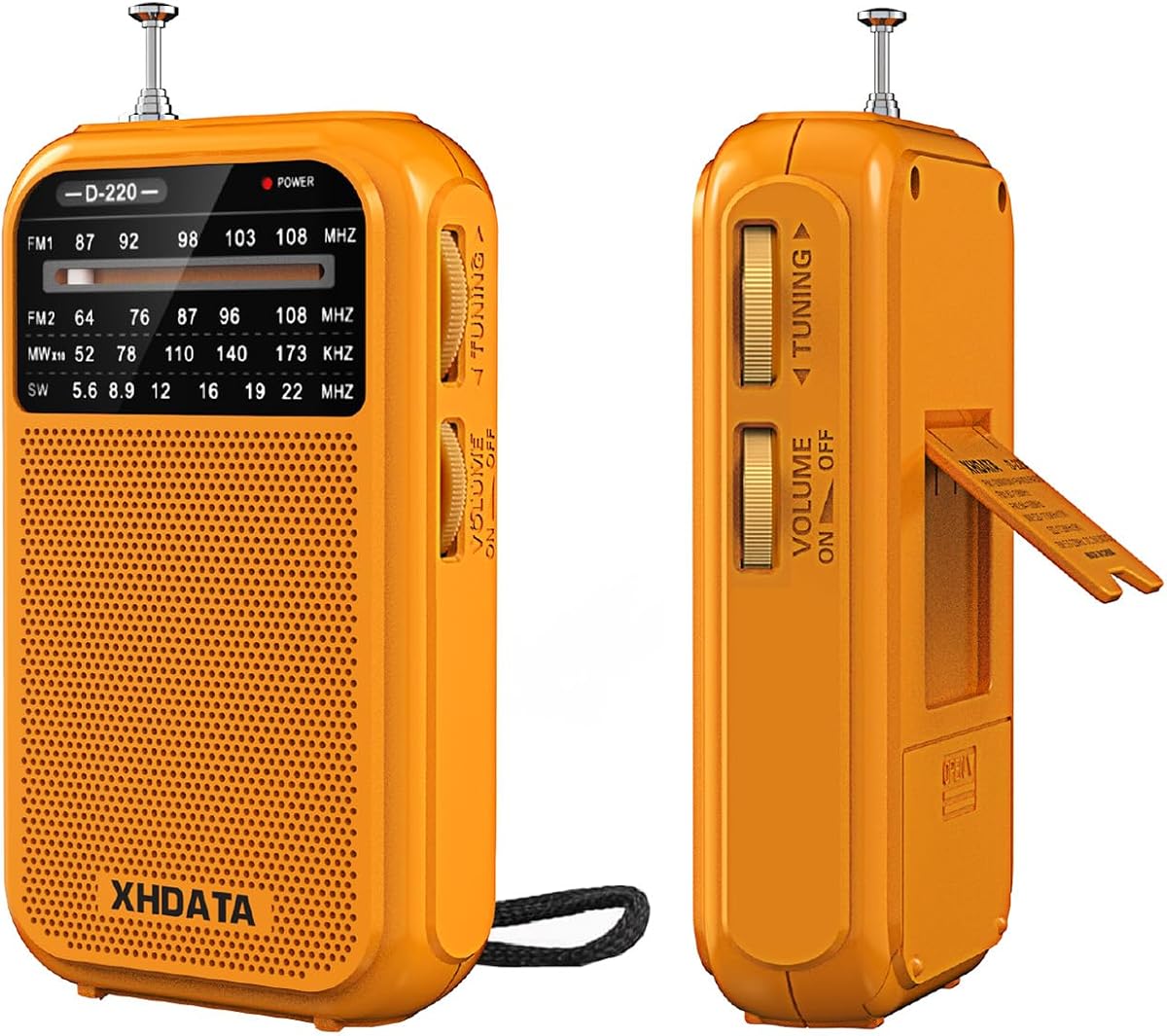
The XHDATA D220 delivers AM, FM, and shortwave reception in a genuinely pocketable body measuring 125 by 74 by 30 millimeters. Its 4.4 rating is especially notable because the model combines compact size, a DSP chip, a built-in speaker, and a headphone jack without attempting to be a full emergency device.
We may earn a commission when you buy through this link, at no additional cost to you.
Two FM ranges provide flexibility beyond the usual 87 to 108 megahertz band, while AM and shortwave cover local stations and international listening. Three main controls—a tuning knob, band switch, and volume or power button—keep operation manageable for adults, children, and older listeners who do not want a complicated interface.
The radio weighs 125 grams without batteries and runs on two AA cells, which are not included. That makes it easy to carry in a pocket or handbag, but it also means regular battery access is required. There is no listed NOAA band, rechargeable battery, USB charging, hand crank, or solar panel, so it should not be selected as a primary emergency radio.
The D220 is a strong pick for travelers, students, and casual shortwave listeners who prioritize affordability and pocketability. It is particularly useful for listening during walks, trips, or commutes without taking up much room. Dedicated emergency preparedness points to the R11, while serious hobbyists can move up to the PL330.
The compact 125-by-74-by-30-millimeter body and 125-gram weight make the D220 easy to carry for long periods. A pocket radio is more likely to accompany a trip when it takes up little space and needs only two familiar batteries.
Despite its modest dimensions, the radio includes two FM ranges, AM, and shortwave, along with DSP-assisted reception. A 3.5 mm headphone jack provides an easy option for private listening with compatible earphones.
We may earn a commission when you buy through this link, at no additional cost to you.
The XHDATA R108 is a compact five-band receiver that stands apart from ordinary pocket radios through its inclusion of longwave and aviation coverage. Its 4.2 rating reflects a capable modern design with 500 presets, useful signal information, dual power options, and a screen that displays more than the tuned frequency.
We may earn a commission when you buy through this link, at no additional cost to you.
The radio supports FM from 64 to 108 megahertz, AM from 520 to 1710 kilohertz, LW from 153 to 513 kilohertz, shortwave from 1711 to 29999 kilohertz, and the 118-to-137-megahertz airband. A DSP chip, 360-degree antenna, automatic station search, and 500 memory positions support practical reception and organization.
Temperature and signal-to-noise ratio readings help users compare reception in different locations. USB-C charging and replaceable battery operation add flexibility, while noise reduction, stereo FM, and a 3.5 mm headphone jack improve everyday listening. However, there is no NOAA weather band, flashlight, hand crank, or solar charging in the supplied specifications.
Choose the R108 when you want many bands, aviation monitoring, and advanced station storage in a relatively small 5-by-3-by-1.2-inch package. It suits travel and hobby listening more than emergency use, where the R11 or Solar Radio 12000mAh would provide a broader survival toolkit.
Longwave, aviation, and extended shortwave coverage make the R108 more versatile than most pocket models. Its 500 presets also help users move between favorite stations without repeatedly adjusting the tuning control.
Signal-to-noise ratio and temperature displays provide useful context while tuning. Comparing readings at different spots can help identify where a weak shortwave or local station receives a cleaner signal.
We may earn a commission when you buy through this link, at no additional cost to you.
The C. Crane CC Skywave 2 combines AM, FM, shortwave, NOAA weather with alerts, and VHF aviation reception in a travel-sized 4.75-by-3-by-1.1-inch package. Its 4.4 rating and included accessories make it an attractive all-purpose option for travelers who want broad coverage without a large desktop receiver.
We may earn a commission when you buy through this link, at no additional cost to you.
Multiple bandwidth settings, selectable fast or fine tuning, direct frequency entry, auto scan, and 400 memories give users a good balance between quick station finding and precise adjustment. The NOAA alert function is a notable advantage over several other models, while aviation memories can be scanned to follow nearby activity.
The fold-out back stand, illuminated display, stereo headphone jack, and supplied earphones make it convenient for travel and desk listening. A faux leather carry case adds protection. Its two AA batteries are not included, and there is no hand crank, solar panel, or rechargeable battery, although an optional AC adapter can be used where appropriate.
This radio is a strong recommendation for international travelers, aviation listeners, and people who want NOAA alerts with broad shortwave access. Those seeking USB-C charging or hand-crank resilience should choose a more emergency-focused alternative. For basic local listening without a need for aviation or weather channels, the smaller D220 is easier to carry.
The compact body, folding stand, illuminated screen, carry case, and included earphones cover several travel needs. A shortwave enthusiast can listen privately without disturbing others in a hotel room or shared accommodation.
NOAA weather alerts distinguish this model from basic shortwave sets, while the aviation band and dedicated memory positions support aircraft monitoring. These additions are useful for travel, neighborhood awareness, and outdoor listening.
We may earn a commission when you buy through this link, at no additional cost to you.
The Leaton Hand Crank Emergency Radio is built around preparedness rather than worldband listening, combining NOAA, AM, and FM with a 10000mAh battery and three charging options. Its 4.5 rating reflects a well-equipped emergency package designed for outages, storms, camping, vehicles, and household survival kits.
We may earn a commission when you buy through this link, at no additional cost to you.
A 5-volt, 1-amp USB output can provide backup charging for a phone, while the stated battery capacity offers a useful emergency reserve. The radio can be charged by USB-C, its solar panel, or the hand crank. The supplied information estimates that about one minute of steady cranking may support 15 to 20 minutes of listening, although actual results vary.
Its IPX6 rating covers water spray and splashing but not immersion, heavy rain, or underwater use. A three-mode flashlight, separate 1.3-watt reading lamp, compass, and large controls add utility. Importantly, the NOAA section is manually tuned and does not support SAME, automatic alerts, or location-based warnings. The radio also lacks shortwave and a headphone jack.
Choose the Leaton when emergency power, phone charging, lighting, and weather broadcasts matter more than international reception. Its 10000mAh capacity and broad power options make it compelling for a go-bag or vehicle kit, but travelers seeking shortwave should look to the R11, PL330, or another multiband model.
The 10000mAh cell and phone-charging output make the radio useful when ordinary outlets are unavailable. The manufacturer notes that conversion loss and device requirements affect real-world charging, so it should be treated as emergency support rather than a full power station.
Solar, hand-crank, and USB-C charging provide multiple ways to restore power. The flashlight, reading lamp, compass, and water-splash resistance further expand its usefulness outdoors.
We may earn a commission when you buy through this link, at no additional cost to you.
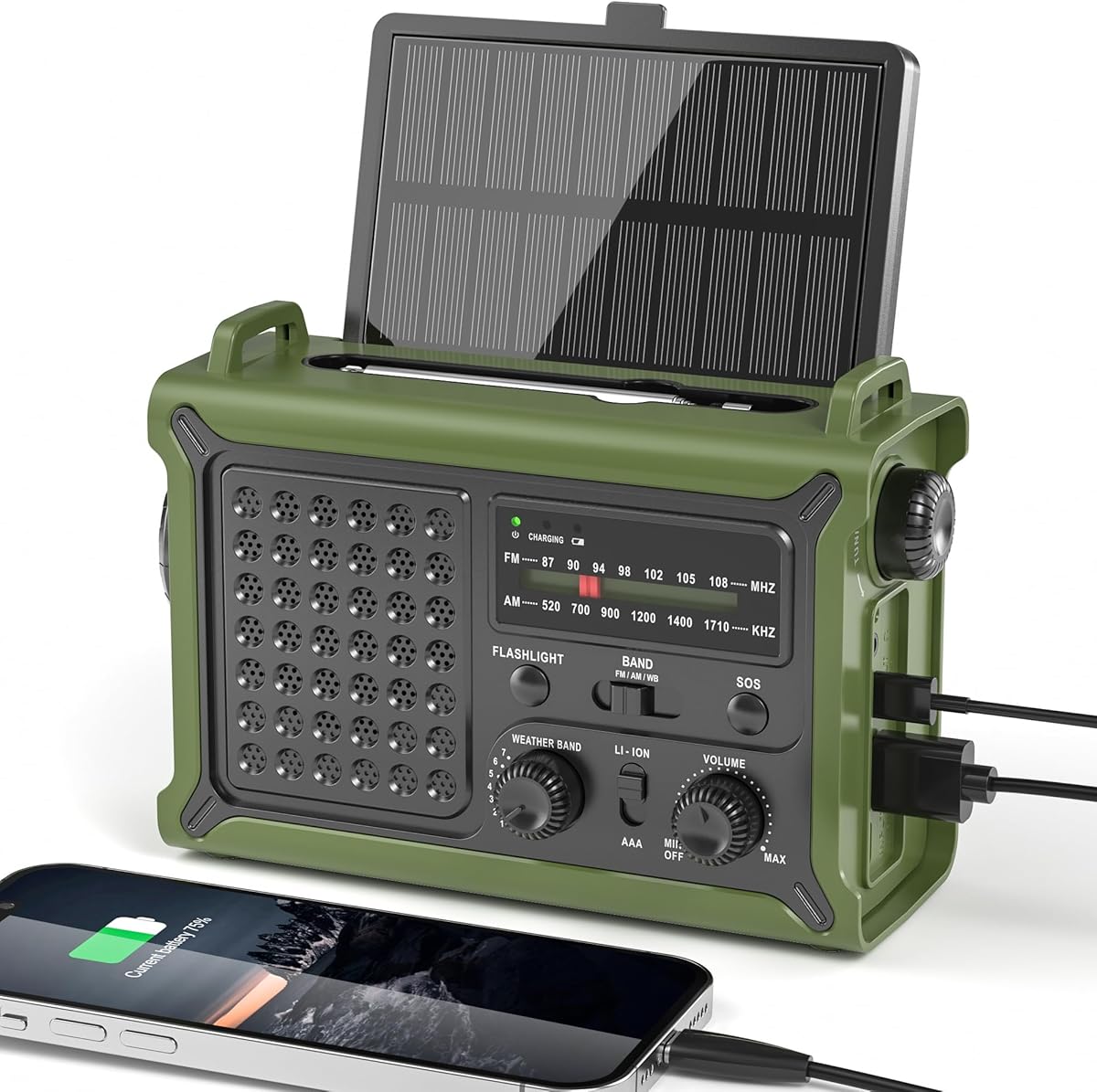
The Solar Radio 12000mAh is an emergency-focused NOAA, AM, and FM receiver with the highest listed rating in this guide. Its 4.8 rating is supported by a 12000mAh battery, an unusually large solar panel, an upgraded hand crank, a bright focused flashlight, and a separate soft reading lamp.
We may earn a commission when you buy through this link, at no additional cost to you.
The radio's 8500-square-millimeter monocrystalline panel is substantially larger than many decorative solar radios, allowing it to gather more energy for charging. An extended crank arm and upgraded generator are designed to provide faster charging, with the product information stating that a few minutes of cranking can power the radio or a phone when other sources fail.
A high-sensitivity chip, noise-reduction circuitry, and an extended antenna support clearer reception across the NOAA, FM, and AM bands. The flashlight reaches up to 260 feet and offers high, low, and reading-light options. Nevertheless, the radio lacks shortwave, and the supplied description does not identify automatic NOAA alert capability or SAME support.
This model is best for households, campers, and travelers seeking a large battery and substantial solar surface in one device. It should be fully charged before first use and its battery level checked on arrival. For users who specifically want international shortwave broadcasts, the R11 offers that band in a similarly preparedness-focused design.
The oversized monocrystalline panel is designed to charge more effectively than small decorative panels. It remains dependent on available sunlight, so the internal battery should be maintained before an emergency.
A focused 260-foot beam and a separate warm reading light cover different nighttime needs. The reading lamp is better suited to reading maps or instructions, while the main beam is intended for navigation and signaling.
We may earn a commission when you buy through this link, at no additional cost to you.
The XHDATA D221 adds NOAA weather reception to the compact formula of the D220, giving users a pocketable radio for AM, FM, shortwave, and weather broadcasts. Its 4.4 rating and 125-by-74-by-30-millimeter body make it an interesting middle ground between a basic transistor radio and a larger emergency device.
We may earn a commission when you buy through this link, at no additional cost to you.
DSP chips are intended to improve reception across FM from 87 to 108 megahertz, AM from 520 to 1730 kilohertz, shortwave from 5.6 to 22 megahertz, and the weather band from 162.40 to 162.55 megahertz. The description states that the radio can receive broadcasts from seven NOAA weather stations, though local coverage will determine which stations are available.
Two AA batteries, which are not included, keep the radio light at 125 grams without batteries. A built-in speaker and 3.5 mm headphone jack support both shared and private listening. Unlike dedicated emergency models, it has no flashlight, hand crank, solar panel, rechargeable cell, or emergency phone-charging output.
The D221 is a good fit for a traveler who wants shortwave and NOAA coverage without carrying a larger radio. It is simpler than the C. Crane and Tecsun models, and easier to wear or place in a bag than a full emergency kit. Users needing automated alerts or off-grid charging should choose a more specialized model.
Adding the NOAA band makes the D221 more useful for local weather awareness than the D220. Its pocket dimensions preserve portability, although reception still depends on proximity to broadcast stations and signal conditions.
The D221 combines AM, FM, shortwave, and NOAA reception in a simple battery-powered format. It is best suited to everyday portability rather than extended emergency operation without spare cells.
We may earn a commission when you buy through this link, at no additional cost to you.
The right portable world radio depends on the bands you want, where you will use it, and how much emergency capability you need. Compare reception, controls, power, size, audio, and included accessories before choosing.
AM and FM cover familiar local and regional stations, while shortwave opens access to international broadcasts and other distant services. Longwave is useful for specialized programming, and aviation or airband reception can support aircraft monitoring. NOAA weather channels add an emergency dimension, but a weather band does not automatically provide automatic or location-based alerts. Several radios in this guide are described as world radios but omit NOAA entirely, so confirm the exact bands rather than relying on a broad product name.
Reception quality depends on the receiver, DSP processing, tuning controls, bandwidth settings, and antenna design. A telescopic antenna is useful for local FM, while an external antenna connection can materially help shortwave listening in difficult locations. Digital scanning and station storage are convenient, but automated search effectiveness still depends on local signal conditions. Direct frequency entry and fine tuning can be more valuable to an experienced listener than a large number of automatic presets.
Power needs differ between casual listening and disaster use. Replaceable AA or D batteries are easy to find and ideal for a radio that may sit unused for months. Rechargeable models are convenient for regular use, while USB-C charging reduces cable clutter. A hand crank, solar panel, and large internal battery are more relevant to emergency kits, although solar charging can be slow and hand-cranking requires physical effort. A radio that operates while charging can be particularly useful during extended outages.
A pocket radio should fit comfortably in a pocket, handbag, or small pack without feeling flimsy. Larger emergency radios often include larger speakers, displays, solar panels, and battery compartments, so they are better suited to a campsite, desk, vehicle, or home kit. Weight and dimensions are especially important for frequent travelers. Water resistance can add confidence outdoors, but ratings such as IPX6 cover splashes rather than immersion. Always check whether batteries, cables, antennas, headphones, or cases are included.
A clear built-in speaker is essential for group listening, while a 3.5 mm headphone jack supports private listening in offices, bedrooms, and travel accommodation. Bluetooth, USB drive access, and TF card playback are useful additions, but they are not necessary for receiving live radio. Pay attention to the stated speaker wattage and included earphones without assuming they are equally suitable for every environment. For shortwave, speech intelligibility and a stable tuning method may matter more than maximum volume.
A flashlight, compass, reading lamp, SOS beacon, and phone-charging output can make an emergency radio useful beyond ordinary broadcasts. NOAA reception is only one part of preparedness, and manual tuning differs from automatic SAME alerts. Check whether the model provides official alert activation, how its battery is maintained during storage, and whether it can operate while charging. Shortwave may be interesting during emergencies, but it should complement rather than replace a dedicated weather and local communication device.
Large knobs and clear labels help in dim light, during outdoor use, and for listeners with limited vision or fine motor control. Simple radios with three or four main controls are excellent for casual users, while complex worldband receivers support hobbyists who want direct entry, memory groups, adjustable bandwidth, and finer tuning. Preset capacity is useful for favorite stations, but an organized interface matters more than a large number of locations. A clock, alarm, and sleep timer can make a radio more practical as a bedside device.
Before first use, install the correct batteries or fully charge the radio according to its manual, and confirm that the included antenna is extended. Select the desired band, use fast scanning to locate strong stations, then switch to fine tuning when a signal is difficult to separate. Store useful stations in the preset system if the model supports memory. If reception is weak, reposition the radio, rotate a telescopic antenna, or try a better outdoor position rather than immediately increasing volume.
For NOAA listening, check whether the radio supports automatic alerts or requires manual tuning, as the distinction is important during severe weather. For shortwave reception, move the radio away from computers, chargers, and large metal objects, and experiment with antenna orientation. The Tecsun PL330 and XHDATA R108 accept external antennas, which can help when a weak signal requires additional sensitivity. Use headphones in shared or quiet settings and adjust the volume to a comfortable level before switching bands.
Charge emergency-capable radios fully before storing them and use the manufacturer's recommended battery-care schedule. The Leaton radio advises recharging every three to six months during long-term storage. Keep solar panels clean and dry, avoid immersing splash-resistant radios, and inspect cables and crank mechanisms before an emergency. Store batteries separately when traveling if the manufacturer permits, and keep a spare set of the correct size for radio models that use replaceable cells.
A portable world radio includes one or more additional bands, most commonly shortwave and sometimes longwave or aviation. Those bands allow reception of distant and specialized stations that a standard AM/FM set cannot access. NOAA reception is also common in emergency-oriented portable radios, but it is a weather band rather than part of the definition of a world radio.
No. A radio must support the relevant frequency range, and even compatible sets depend heavily on propagation, antenna performance, local interference, and time of day. Shortwave signals can vary by location and atmospheric conditions. Models with external antenna connections and finer tuning generally offer more control, but no portable receiver guarantees every broadcast under every condition.
No. Some models support automatic SAME or location-based alerts, while others only receive weather broadcasts after the user tunes to a station. The Leaton radio, for example, requires manual NOAA tuning and does not support automatic alerts. Check the specifications for alert technology rather than assuming that the word NOAA is sufficient.
It can be a useful backup, but it is not an unlimited substitute for electricity. Solar charging depends on sunlight and may take time, while hand cranking requires effort and provides energy more slowly than wall charging. A large rechargeable battery, regular charging, and fresh backup batteries offer a more dependable combination for prolonged emergencies.
The XHDATA D220 and D221 are the smallest options in this guide, each measuring 125 by 74 by 30 millimeters and weighing 125 grams without batteries. The D220 covers AM, FM, and shortwave, while the D221 adds NOAA. The larger R11 and C. Crane models offer broader features but take up more room in luggage.
Replaceable batteries are convenient because they can remain in a radio for a long time without losing charge and can be replenished with fresh cells. Rechargeable radios are better for frequent use and often include USB, solar, or crank options. The best choice depends on how regularly the radio is used and how important immediate power availability seems to be.
No. A built-in speaker can provide satisfactory audio for many stations, although headphones often make speech easier to understand in noisy surroundings. Headphones can also reduce disturbance to others. Several models include a 3.5 mm jack, but the Leaton emergency radio explicitly does not support headphones.
Buy a world radio if your main interest is international shortwave, aviation, or broad multiband listening. Choose an emergency radio if NOAA broadcasts, hand-crank charging, solar charging, lighting, and phone backup are the priorities. The R11 is the clearest all-in-one choice here because it includes shortwave, NOAA alerts, automatic scanning, media playback, and three charging methods.
The R11 NOAA Shortwave Radio is the strongest all-round selection because it combines worldband reception, NOAA alerts, automatic station storage, media playback, and three charging methods. The Tecsun PL330 stands apart as the premium option for serious shortwave and aviation-style reception, while the XHDATA D220 provides the best balance of portability, simplicity, and affordability for everyday listening.
Prioritize the features you will actually use. A pocket radio is more useful if it fits comfortably in your bag, an emergency radio should have the correct power reserve and backup charging, and a worldband listener benefits from external antenna access and precise tuning. NOAA alerts, headphone support, preset capacity, and solar capability can all influence the decision, but none compensates for poor fit or an unsuitable power system.
Ratings, product availability, promotions, and pricing can change, so confirm the current listing and included accessories before buying. Use the comparison table to shortlist the right radio, then check the detailed reviews for limitations that could affect your particular travel, home, hobby, or emergency plan.