
Acer Aspire 14 AI Copilot+ PC
4.3Editor score
Up to 47 NPU TOPS
16GB LPDDR5X memory
WUXGA 1920×1200 display
AI laptops with NPUs place dedicated processors for artificial intelligence directly beside the CPU and GPU, making on-device features faster, more responsive, and more private. The best examples pair that hardware with enough memory, capable displays, dependable battery life, and a processor balanced for more than AI demonstrations. A good NPU should support the applications you use every day without dominating the rest of the system.
This guide compares ten AI laptops with NPUs from Acer, ASUS, Dell, HP, and NIMO. We considered the stated NPU output, processor architecture, memory, storage, display quality, portability, connectivity, battery claims, and practical features such as webcams, privacy controls, and Copilot+ PC support. The list covers lightweight models, larger touchscreen workstations, premium OLED systems, and high-memory machines aimed at local AI development.
Each review identifies a different kind of strength: the Acer Aspire 14 AI stands out as a balanced everyday option, the ASUS Zenbook A16 combines an advanced NPU with a premium OLED display, and the HP OmniBook 3 14 emphasizes efficiency and mobility. Other picks serve heavier creative, development, and productivity needs. Product availability, software updates, and configurations can change, so confirm the current listing before buying.
4.3Editor score

4.6Editor score

5.0Editor score
As an Amazon Associate we earn from qualifying purchases.
The comparison highlights the processors, stated NPU performance, memory, displays, and major productivity features of all ten laptops, making it easier to identify the model that best matches your workflow.



The Acer Aspire 14 AI is a balanced Copilot+ PC for people who want meaningful hardware-accelerated AI without moving to a specialized workstation. Its Intel Core Ultra 7 256V processor is listed with an NPU capable of up to 47 TOPS and an Intel Arc 140V GPU rated at up to 64 TOPS. The 4.3 rating reflects a generally strong foundation, although the 16GB of LPDDR5X memory limits its headroom for demanding multitasking and large local models.
We may earn a commission when you buy through this link, at no additional cost to you.
The most compelling features are the combination of 1TB storage, Wi-Fi 6E, an up-to-22-hour stated battery life, and an aluminum chassis. Its 14-inch WUXGA panel has a 1920-by-1200 resolution, which is sharp enough for documents, browsing, and media. AcerSense adds dedicated access to settings and video-related assistance, while the 180-degree hinge allows the notebook to lie flat for sharing or different working positions.
The main trade-off is memory. Sixteen gigabytes is sufficient for Windows 11, office work, communication, and ordinary creative applications, but it is less suitable for running large AI models, extensive virtual machines, or demanding creative timelines. The display also lacks the high refresh rate or OLED contrast found on more premium alternatives. Neither limitation prevents the Aspire from being a strong general-purpose AI laptop, though it makes it less future-proof for specialist workloads.
This model is best for students, office workers, and everyday creators who value a capable NPU, practical storage, portability, and a familiar Acer feature set. It is a particularly sensible selection when you want a Copilot+ PC without moving into the largest or most specialized configurations. For most users, the Aspire 14 AI provides a more compelling balance than simply choosing the model with the largest headline NPU number.
The combination of a 47-TOPS NPU and a 64-TOPS integrated GPU gives the Aspire 14 several routes for accelerating compatible software. Copilot+ PC functions can run locally, while the CPU, GPU, and NPU share responsibility for normal productivity and creative tasks.
Its aluminum body, 180-degree hinge, AcerSense key, and 1TB SSD make the laptop convenient for school, office, and travel. The WUXGA display provides useful detail without requiring a large, energy-intensive panel.
We may earn a commission when you buy through this link, at no additional cost to you.
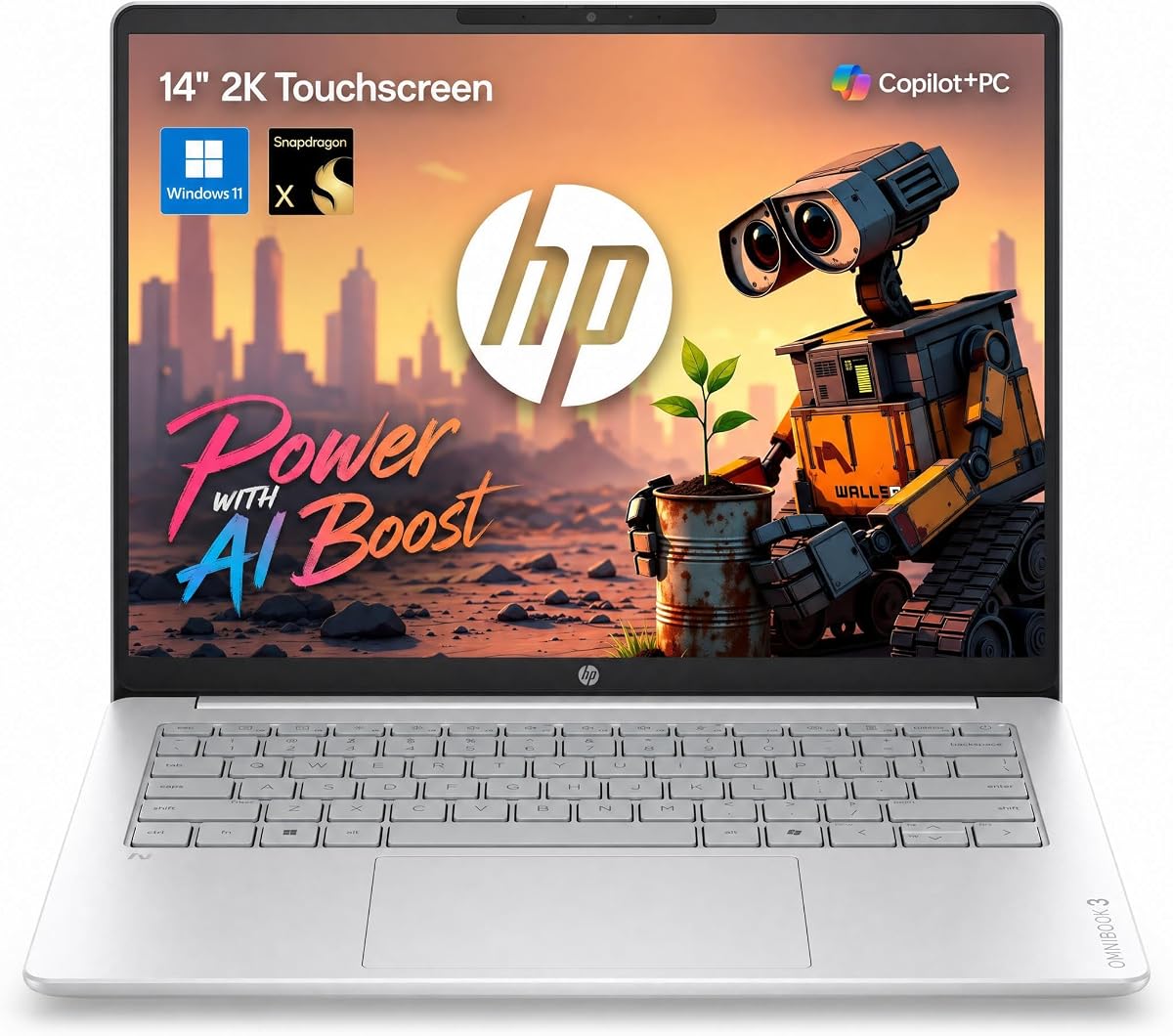
The HP OmniBook 3 14 is an efficient, travel-friendly AI PC built around the Snapdragon X 8-core X1-26-100 processor. Its dedicated NPU is rated at 45 TOPS, giving it a clear hardware foundation for local Copilot+ features such as summaries, searches, and generative content tasks. The listed 4.6 rating reflects a favorable balance of battery life, portability, display quality, and practical connectivity.
We may earn a commission when you buy through this link, at no additional cost to you.
Its 2K IPS touchscreen uses a 1920-by-1200 resolution, 16:10 aspect ratio, 300-nit brightness, and an 88% screen-to-body ratio. The laptop weighs only 3.13 pounds, making it easy to carry, while the 60Wh battery is claimed to deliver up to 30 hours of local video playback. A 65W USB-C GaN adapter can restore approximately 50% of the charge in 45 minutes.
The 16GB of LPDDR5X and 1TB PCIe Gen4 SSD provide a workable but not expansive platform. Onboard memory cannot be upgraded, so demanding development workloads may require more capacity than this configuration offers. Software compatibility is another consideration for buyers of a Snapdragon-based notebook, particularly if they depend on specialized x86 applications, drivers, or peripherals. Otherwise, the port selection is solid, including two 10Gbps USB-C ports with power delivery and DisplayPort 1.4, two USB-A ports, and HDMI 2.1.
The OmniBook 3 14 is ideal for commuters, students, and hybrid workers who prioritize endurance, portability, and useful on-device AI. It is also a good choice for users attracted to the 2K touch display and physical privacy controls. It may not be the right machine for memory-heavy engineering or legacy software, but for a mobile Copilot+ experience it is unusually well balanced.
The stated 30-hour local video playback figure highlights the efficiency of the Snapdragon platform. Combined with fast charging and a 3.13-pound chassis, it makes the OmniBook well suited to workdays away from an outlet.
The 2K IPS panel offers more vertical workspace than a traditional 16:9 screen, while touch controls can aid navigation and presentations. Its 300-nit rating is reasonable for indoor productivity, though it is not intended to compete with the brightest premium OLED models.
We may earn a commission when you buy through this link, at no additional cost to you.
The ASUS Vivobook S16 stands out as a polished general-purpose AI laptop, earning a perfect 5.0 rating in the supplied data. It combines an AMD Ryzen AI 9 465 processor with up to 50 NPU TOPS, 32GB of memory, and 1TB of storage. That balance is particularly attractive for users who want faster multitasking and meaningful local AI capacity without moving to a large workstation.
We may earn a commission when you buy through this link, at no additional cost to you.
Its 16-inch WUXGA OLED display has a 1920-by-1200 resolution and a 16:10 aspect ratio. The narrow-bezel design maximizes the viewing area, while OLED technology delivers the deep contrast and vivid detail associated with the display category. Dolby Atmos, ASUS Audio Booster, built-in speakers, and an array microphone round out the media and communication experience.
The notebook weighs 3.75 pounds and measures 0.7 inches thick, so it remains reasonably portable despite the roomy screen. A 70Wh battery is listed with up to 23 hours of use, and fast charging is claimed to reach 60% in 49 minutes. Its 32GB of memory gives it more flexibility than the 16GB picks, while the full set of USB-A, USB-C, HDMI 2.1, and audio ports reduces the need for an everyday adapter.
This Vivobook is well suited to professionals, students, and content consumers who prioritize the screen and balanced specifications. Windows 11 Home, a physical camera shutter, IR camera, and quick Windows Hello sign-ins cover the core productivity and privacy needs. It is less compelling for buyers who need maximum gaming performance, but for an OLED-based Copilot+ PC, its combination of memory, portability, and refinement is highly appealing.
The 16:10 OLED panel provides generous workspace and strong visual contrast for media review, design, and general content creation. Its large size is especially useful when several documents or application windows need to remain visible.
With 32GB of memory, the Vivobook has substantially more room for browser workloads, office applications, and creative software than the 16GB configurations in this list. That makes it a more adaptable choice for users who do not want to replace or upgrade memory later.
We may earn a commission when you buy through this link, at no additional cost to you.
The Acer Aspire 16 AI combines a 45-TOPS Qualcomm Hexagon NPU with a large, color-focused display. Its Snapdragon X X1-26-100 processor includes eight Oryon cores, an integrated Adreno GPU rated at up to 1.7 TFLOPs, and Windows Studio Effects support. The 4.2 rating indicates a capable package, with display quality, wireless connectivity, and practical features standing out most.
We may earn a commission when you buy through this link, at no additional cost to you.
The 16-inch WUXGA display runs at 120Hz and covers 100% of the sRGB color space, making it attractive for media and color-sensitive work. Acer PurifiedView 2.0 adds automatic framing, background blur, and gaze correction to the 1440p QHD webcam, while PurifiedVoice 2.0 and a third microphone support clearer conversations. AcerSense provides a shortcut for settings and video optimization.
The main limitations are the 16GB of onboard LPDDR5X memory and 512GB SSD. Both specifications are adequate for general use but may feel modest for large datasets, local language models, extensive project libraries, or heavy multitasking. Because the memory is onboard, upgrading requires replacing the system rather than adding a module. The stated battery figures of up to 27 hours for video playback and 18 hours for browsing are useful, but real results vary with settings and workloads.
The Aspire 16 AI is a strong match for students and professionals who want a roomy screen, modern wireless standards, and capable local AI in a thin chassis. Its 180-degree hinge, dual USB4 ports, HDMI 2.1, and camera privacy shutter make it convenient for presentations and travel. Choose it for display-driven productivity; look elsewhere if storage capacity is a higher priority.
The combination of 100% sRGB coverage and a 120Hz refresh rate makes the display more engaging for media and general interaction. It also offers enough vertical space for split-screen work without the bulk of a much larger workstation.
Wi-Fi 7 supports modern multi-link and high-bandwidth wireless standards, while dual USB4 ports allow high-speed external devices. Together they make the notebook more adaptable to a changing office or mobile workspace.
We may earn a commission when you buy through this link, at no additional cost to you.
The NIMO 16 AI Laptop is the most explicitly workstation-oriented machine in this guide. Its AMD Ryzen AI Max+ 395 processor provides 16 Zen 5 cores, 32 threads, and up to 160W performance, while the supplied configuration includes 128GB of 256-bit LPDDR5X unified memory. The 4.6 rating reflects strong performance, but the specification is designed for demanding local AI, compilation, virtualization, and creative tasks rather than routine browsing.
We may earn a commission when you buy through this link, at no additional cost to you.
The 50-TOPS XDNA 2 NPU works alongside Radeon 8060S graphics with 40 compute units. Unified memory allows graphics and CPU workloads to access the same large memory pool, which can reduce the constraints imposed by conventional discrete graphics memory. The listed capabilities target large language models, Stable Diffusion, engineering simulation, and 8K timelines, although software optimization determines real-world results.
Its 16-inch 2560-by-1600 display runs at 165Hz, giving it a clear advantage for smooth motion and detailed visual work. The port selection is equally serious: native Oculink, USB4 with 100W power delivery, HDMI 2.1, 2.5Gb Ethernet, and a UHS-II card reader. Two M.2 2280 PCIe 4.0 slots support additional storage, while a 99Wh battery and 230W adapter are sized for sustained performance away from an outlet.
This is the pick for AI developers, engineers, 3D artists, and video professionals who need unusually high memory capacity in a relatively compact 16-inch machine. The 128GB figure makes it substantially more suitable for local model experimentation than conventional 16GB or 32GB notebooks. It is less compelling for light users, and the substantial charger reduces the convenience of its portability, but the hardware is unusually focused on demanding professional work.
The 128GB unified-memory configuration gives CPU, GPU, and supported AI workflows access to a much larger shared memory pool. That is especially valuable when a project cannot be divided into smaller workloads or when conventional dedicated graphics memory would otherwise become a bottleneck.
Native Oculink, dual M.2 slots, 2.5Gb Ethernet, and USB4 provide practical routes for external storage, displays, and accessories. A physical webcam-and-microphone power switch also gives creators and developers direct control over capture hardware.
We may earn a commission when you buy through this link, at no additional cost to you.
The ASUS Zenbook A16 is the strongest premium expression of the AI-laptop category in this group. Its Snapdragon X2 Elite Extreme processor is listed with up to 80 NPU TOPS, the highest stated figure among the ten models, and it pairs that capability with 48GB of LPDDR5X memory and 2TB of storage. The supplied 5.0 rating reflects an exceptional balance of display quality, mobility, and advanced AI hardware.
We may earn a commission when you buy through this link, at no additional cost to you.
The 16-inch ASUS Lumina 3K OLED touchscreen supports a 120Hz refresh rate and up to 1,100 nits peak brightness. Its 90% screen-to-body ratio keeps the large display visually compact, while six super-linear speakers support an entertainment-oriented experience. Dolby-level audio is not specified here, but the six-speaker arrangement clearly places media quality high in the design.
Despite the large screen, the Zenbook weighs 2.87 pounds and measures 0.65 inches thick. A 70Wh battery and a stated 50% charge in 30 minutes support mobile use. The 48GB of high-speed LPDDR5X-9600 memory is a major advantage over typical entry configurations, while 2TB of storage reduces the need for immediate external-drive management.
The Zenbook A16 is best for mobile professionals, creators, and enthusiasts who want leading NPU performance in a premium, exceptionally light enclosure. Windows 11 Pro adds business-oriented functionality, and the 3K OLED panel is excellent for media and visual work. As with other Snapdragon systems, buyers should verify application and accessory compatibility. For supported workloads, however, this is one of the most compelling all-around AI laptops listed.
An NPU rated at up to 80 TOPS gives the Zenbook substantial capacity for supported Copilot+ features and local AI applications. The advantage is most meaningful when software is optimized to use the dedicated NPU rather than relying entirely on the CPU or cloud services.
The 3K OLED touchscreen combines fine detail, a high refresh rate, and exceptional peak brightness in a 2.87-pound body. It offers an unusually convincing balance between large-screen enjoyment and travel-friendly construction.
We may earn a commission when you buy through this link, at no additional cost to you.
The NIMO 17.3 Copilot+ combines AMD's Ryzen AI 9 HX 370 and 50-TOPS NPU with unusually flexible upgrade options. It has dual DDR5 SO-DIMM slots supporting up to 64GB and dual M.2 PCIe 4.0 storage slots, making it more adaptable than laptops with soldered memory. The 4.5 rating indicates a capable all-rounder with particular appeal to creators, developers, and gamers.
We may earn a commission when you buy through this link, at no additional cost to you.
Integrated Radeon 890M graphics use RDNA 3.5 architecture and are positioned for AAA gaming, 4K video editing, and 3D rendering without the bulk of a discrete GPU. The 17.3-inch Full HD display has a 144Hz refresh rate, providing smooth motion and generous space for split-screen work. Its 180-degree hinge makes it easier to share presentations, plans, or mockups.
Connectivity is more complete than on many compact laptops. USB4 supports up to 40Gbps, DisplayPort 1.4, and docking, while HDMI 2.1, multiple USB-A ports, a 3.5mm jack, and an SD card reader cover common accessory needs. A backlit keyboard, numeric keypad, fingerprint reader, and camera shutter improve daily usability. The stated weight is under 4.6 pounds, with a thickness of 0.74 inches.
This laptop is best for buyers who want AI hardware but also value memory expansion, gaming capability, and a large screen. The 17.3-inch footprint is less convenient for travel than a 14-inch model, and Full HD is less detailed than the 2K or 3K alternatives. Even so, the combination of 50 TOPS, Radeon 890M graphics, and upgradeability makes it a compelling hybrid for work and play.
Dual memory sockets and two M.2 slots make it possible to scale the system as software demands increase. That flexibility is especially valuable for development, virtualization, large project files, and games with substantial storage requirements.
Radeon 890M graphics add a stronger entertainment and rendering proposition than basic integrated solutions. The 144Hz panel also makes everyday motion, menus, and supported games feel more fluid.
We may earn a commission when you buy through this link, at no additional cost to you.
The HP Omnibook 16 targets professionals who want a conventional x86 platform, generous memory and storage, and a 50-TOPS NPU without moving to a gaming-style chassis. Its AMD Ryzen AI 7 350 is described as an eight-core, 16-thread processor based on Zen 5 architecture. The 4.6 rating suggests a strong overall package, particularly for office work, content handling, and business-oriented AI applications.
We may earn a commission when you buy through this link, at no additional cost to you.
The 16-inch 1920-by-1200 IPS touchscreen offers a 16:10 workspace, 300-nit brightness, anti-glare treatment, micro-edge bezels, and AMD FreeSync support. That makes it useful for presentations, creative review, and general office productivity. A full-size backlit keyboard with numeric keypad supports data entry, while the 1080p IR camera and Windows Studio Effects improve remote collaboration.
The 32GB of LPDDR5X-7500 memory and 2TB Gen4 SSD are among the most generous conventional specifications in the guide. They offer room for large document libraries, browser sessions, media, and AI datasets without immediate storage pressure. Windows 11 Pro adds enterprise-oriented functionality, and the port suite includes two USB-C connections, HDMI 2.1, and two USB-A ports.
The Omnibook 16 is a sensible selection for office professionals, educators, and small-business users who need a large screen, 50 TOPS of stated NPU performance, and a conventional Windows platform. It lacks the discrete-GPU-class specification and ultra-high-resolution display of the NIMO 16 or Zenbook A16, but it offers a more conventional and potentially versatile daily setup.
A 2TB Gen4 SSD provides ample room for project files, media, and application libraries. Combined with 32GB of memory, it is a practical configuration for offices that manage substantial data without frequent drive upgrades.
Windows 11 Pro is valuable for organizations that depend on built-in management, security, and business features. The backlit numeric keyboard, IR camera, and hardware-assisted authentication also suit professional desk setups.
We may earn a commission when you buy through this link, at no additional cost to you.
The Dell 16 Plus Touchscreen offers a restrained business-laptop approach to the Copilot+ PC category. Its Intel Core Ultra 9 288V vPro processor has 12 cores, a listed NPU capability of 12 TOPS in the processor description, and support for up to 48 TOPS in the separate specifications. The 4.5 rating indicates a capable and well-connected system for professional use.
We may earn a commission when you buy through this link, at no additional cost to you.
The 16-inch 1920-by-1200 WVA touch display uses ComfortView technology and narrow bezels to create a roomy 16:10 workspace. Intel Arc 140V graphics support AI-accelerated digital content and video editing, while the FHD+ webcam and AI noise cancellation help during calls. A backlit Copilot key, numeric keypad, and fingerprint reader support everyday office tasks.
The 32GB of 8533MT/s LPDDR5X and 1TB PCIe NVMe SSD provide enough capacity for demanding productivity applications. Connectivity is particularly strong, with Wi-Fi 7, Bluetooth 5.3, a 10Gbps USB-C port, Thunderbolt 4 with DisplayPort 2.1, HDMI 2.1, and USB-A. The Intel vPro platform adds remote manageability, stability, and layered security options for IT-managed environments.
This model is best for business users who want modern AI features, strong connectivity, and a professional 16-inch form. It is also a good fit for organizations that understand the vPro platform. The supplied operating system is Windows 11 Home, so buyers whose organization requires particular Windows editions or management policies should verify licensing and deployment needs before purchasing.
The Intel vPro platform is the distinguishing feature for managed business deployments. It supports remote management and enterprise-oriented stability controls while retaining the local processing benefits of a Copilot+ PC.
Thunderbolt 4, DisplayPort 2.1, HDMI 2.1, and Wi-Fi 7 make the Dell easier to connect to multiple displays, docks, storage, and fast networks. The 32GB memory configuration also provides ample room for business applications and concurrent communication tools.
We may earn a commission when you buy through this link, at no additional cost to you.
The HP 16 Touchscreen AI is unusual because its product title lists 96GB of memory and 8TB of storage, while the supplied description refers to 32GB of DDR5 memory and a 1TB PCIe Gen4 SSD. That discrepancy should be verified directly with the seller before purchase. Assuming the title reflects the actual configuration, the laptop offers exceptional capacity for data-heavy professional use.
We may earn a commission when you buy through this link, at no additional cost to you.
The Intel Core Ultra 7 255U processor includes a dedicated Intel AI Boost NPU intended to accelerate compatible on-device functions. The 16-inch 1920-by-1200 IPS touchscreen has a 16:10 ratio, micro-edge design, anti-glare coating, and 300-nit brightness. A 1080p FHD camera, dual microphones, AI noise reduction, physical camera shutter, and microphone mute key make it suitable for professional communication.
The stated connectivity includes Wi-Fi 7, Bluetooth 6.0, two 10Gbps USB-C ports with DisplayPort 1.4 and Power Delivery 3.1, two USB-A ports, and HDMI 2.1. The 3.61-pound chassis and 0.74-inch profile are manageable for a 16-inch notebook, while a 41Wh battery and 45W GaN adapter support mobile productivity. HP Fast Charge is listed at approximately 50% in 45 minutes.
The HP 16 Touchscreen AI could be ideal for users who need enormous memory or storage in a conventional business notebook, but only if the title-listed configuration is confirmed. It is less compelling for buyers who prioritize gaming, high-resolution displays, or workstation-class graphics. The 5.0 rating is encouraging, but configuration clarity is essential before making a final decision.
If the 96GB and 8TB title specifications are accurate, this configuration can accommodate unusually large datasets, project collections, and memory-intensive workflows. The integrated AI Boost NPU adds a hardware route for supported local AI tasks.
The supplied title and description disagree about both memory and storage, and the description also uses different wording for the display and connectivity. Buyers should confirm the exact processor, memory, storage, and included software directly on the current product page.
We may earn a commission when you buy through this link, at no additional cost to you.
Choosing an AI laptop requires balancing dedicated NPU capability with the processor, graphics, memory, display, battery, and connectivity that determine everyday performance. The most important rule is to prioritize the complete configuration rather than choosing solely by the highest TOPS figure.
TOPS, or trillions of operations per second, is a rough indicator of a neural processing unit's theoretical throughput. It is useful for comparing headline AI capabilities, but it is not a direct measure of application speed. Performance also depends on software support, memory bandwidth, data precision, thermals, and how effectively a program distributes work among the CPU, GPU, and NPU.
An AI PC still needs a capable central processor for ordinary applications, compilation, browsing, and software that has not yet been optimized for NPUs. This guide includes Intel Core Ultra, AMD Ryzen AI, and Qualcomm Snapdragon platforms. Intel and AMD offer conventional x86 compatibility, while Snapdragon systems can provide excellent efficiency and AI capability but may require verification of specialized applications, games, and accessory drivers.
The NPU does not operate in isolation; it needs system memory to hold models, application data, and intermediate results. Sixteen gigabytes is adequate for light productivity and many Copilot+ features, while 32GB provides a safer margin for heavy browsing, creative software, and development. The NIMO 16 takes the concept much further with 128GB of unified memory for unusually demanding local AI workloads.
A 2K or 3K panel provides enough resolution for documents, design work, and media, while a 16:10 ratio offers more vertical space than 16:9. High refresh rates make scrolling and motion feel smoother, and OLED adds deeper contrast and vivid color. Touch input can improve navigation and presentation flexibility, but it is not essential for every workflow.
Efficient processors and NPUs can support long battery life, but manufacturer figures usually describe controlled video or browsing tests. A large screen, gaming-grade graphics, sustained workloads, and fast charging requirements all affect real-world endurance. Weight matters too: several 16-inch models remain portable, while larger batteries and power adapters can undermine the benefit of a roomy display.
Integrated graphics are sufficient for productivity, media, and many AI applications, but some 3D, gaming, and video workloads benefit from stronger hardware. A discrete GPU is uncommon in this group, so buyers should look closely at graphics architecture and available memory. Expansion options such as USB4, Oculink, card readers, and multiple M.2 slots can extend a system's usefulness significantly.
A Copilot+ PC label indicates a platform capable of local AI features, but individual applications and features may vary by device, market, and update status. Windows Studio Effects, Recall, Click to Do, and other tools can change over time. Privacy features such as IR cameras, fingerprint readers, physical shutters, microphone mute keys, and dedicated hardware power switches deserve attention in professional or shared environments.
A model name can refer to several processors, memory options, storage capacities, and displays. This is especially important when a listing highlights a large memory or storage figure but its description lists different specifications. Review the processor package, NPU rating, memory, storage, screen, operating system, and included accessories together to avoid mismatched expectations.
After setup, update Windows and the applications you plan to use so they can detect the NPU and the latest supported acceleration paths. Confirm that local AI features are enabled within the relevant application settings, and avoid assuming that every Copilot+ function will run on-device immediately. Some features may require software updates, regional availability, or specific hardware support.
For demanding creative or development tasks, let the laptop select a balanced performance mode and ensure that vents remain unobstructed. NPU, CPU, and GPU workloads can all generate heat, particularly during sustained rendering or local model inference. Use a cooling pad when appropriate, clean vents gently, and avoid placing the notebook on soft surfaces that could block airflow.
Protect the machine with routine updates, a reputable backup strategy, and sensible account security. Keep liquids away from the display and ports, use a padded case for transport, and clean the touchscreen with a soft microfiber cloth. If privacy is important, use the available camera shutters, microphone controls, or hardware switches, and verify their status before recording or joining a call.
An NPU is a processor optimized for artificial intelligence workloads such as speech recognition, image analysis, and language-related tasks. It can handle compatible operations more efficiently than the general-purpose CPU, potentially reducing latency and supporting on-device processing. Actual performance depends on the software, memory system, thermal design, and NPU capabilities of the particular laptop.
A higher TOPS rating indicates greater theoretical AI throughput, but it does not guarantee a proportional improvement in every application. Memory bandwidth, software optimization, power limits, and CPU and GPU support also influence results. Choose primarily based on workload, display, memory, battery life, and compatibility, then treat TOPS as a helpful secondary comparison.
No. Many useful AI features run on the NPU, CPU, or integrated GPU, and the laptops in this guide use integrated graphics to remain thin and efficient. A discrete GPU can help with specialized rendering, gaming, or very large creative projects, but it adds weight, heat, and power demands. Integrated graphics are sufficient for productivity and many optimized AI applications.
It depends on the model size, quantization, available memory, software, and whether the application is optimized for the platform. A system with 16GB of memory has limited headroom, while 32GB is more flexible and 128GB can support substantially larger workloads. The NPU may accelerate compatible operations, but some local models rely more heavily on the CPU and GPU.
Sixteen gigabytes is generally sufficient for Windows, browsing, communication, office work, and many standard Copilot+ functions. It can become restrictive when running many browser tabs, creative applications, virtual machines, or local AI models. If the memory is soldered, 32GB is the safer long-term choice for a system expected to handle expanding workloads.
No. Feature availability can depend on the processor, device configuration, software version, market, and update schedule. The supplied Acer descriptions specifically note changing feature availability and rollout timing. Check the current Microsoft and manufacturer feature lists, and confirm that the exact applications you plan to use support the selected NPU and processor.
They can be, but compatibility should be checked before purchase. Standard web, office, communication, and many mainstream applications work well, while specialized engineering tools, games, virtual machines, plugins, and peripheral drivers may be less consistent than on Intel or AMD systems. Review each required application, extension, and accessory before choosing an Arm-based Snapdragon model.
Compare the same type of activity and treat the published figure as a controlled result rather than a guarantee. Video playback and web-browsing tests emphasize different tasks, while screen brightness, network conditions, power mode, and battery health can change the result. For heavy use, consider charger size, fast-charging support, and whether the laptop can sustain its performance away from an outlet.
The Acer Aspire 14 AI is the most balanced selection for everyday users, combining up to 47 NPU TOPS, 16GB of memory, 1TB of storage, and a portable aluminum design. The HP OmniBook 3 14 stands out for efficiency, its 45-TOPS NPU, 2K touchscreen, and stated 30-hour video playback, while the ASUS Zenbook A16 is the premium option with up to 80 TOPS, 48GB of memory, and a 3K OLED display.
Prioritize the parts of the computer you will use every day: sufficient memory, a comfortable display, dependable battery life, compatible software, and a chassis that suits your mobility. The NIMO 16 is the clearest specialist choice for local AI, large datasets, and advanced creative work, while the NIMO 17.3 offers upgradeability and gaming-oriented Radeon 890M graphics. The Vivobook S16, Dell 16 Plus, and HP Omnibook 16 make strong all-round alternatives for different office, media, and business priorities.
Before ordering, verify the exact processor, NPU rating, memory, storage, display, operating system, and accessory support on the current listing. AI features and driver support continue to evolve, and configurations can change, so checking the latest product details will help ensure the laptop you choose actually matches the role you need it to perform.