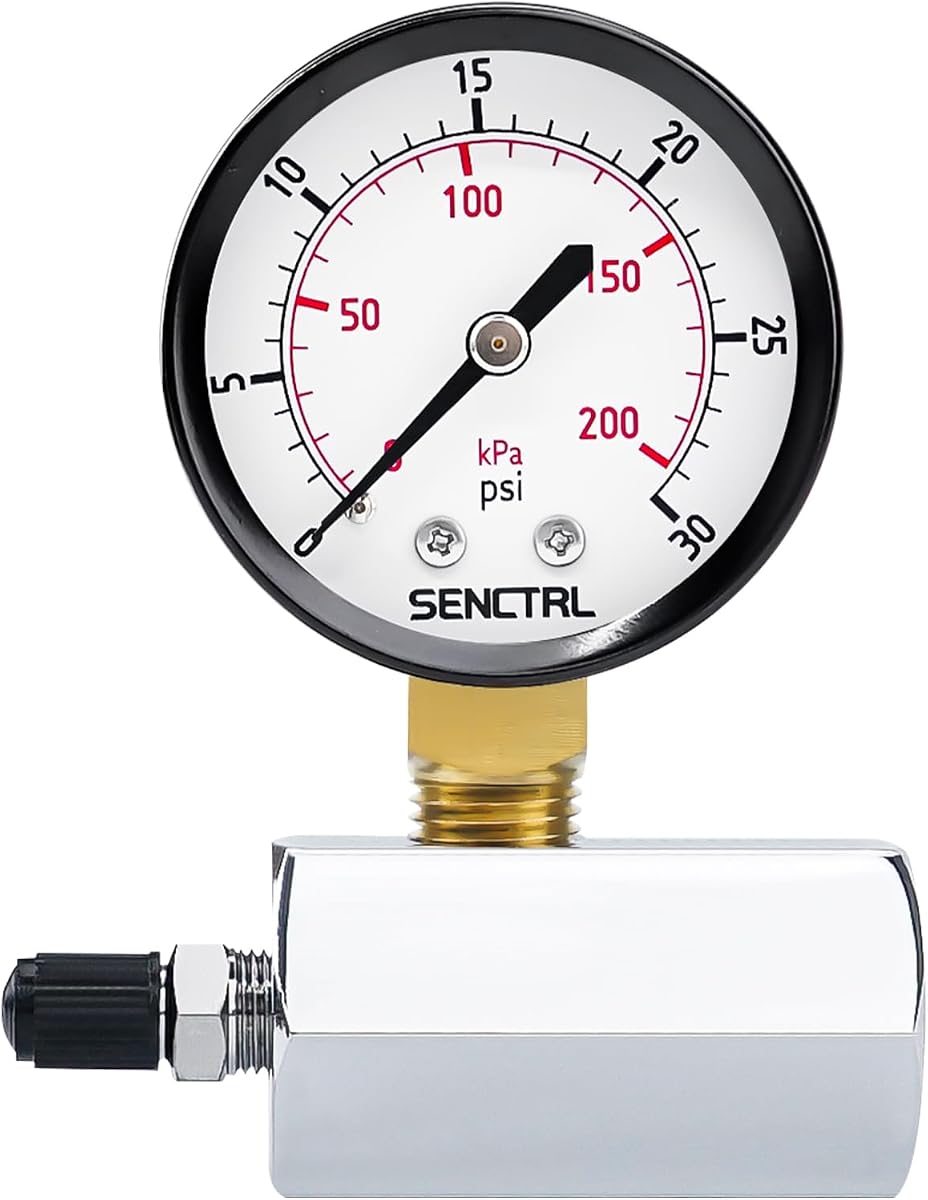
SENCTRL 0-30 PSI Gauge
4.5Editor score
0–30 psi dual scale
3/4-inch female NPT
Chrome-plated steel body
Protective steel case
A gas line pressure gauge helps reveal whether a fuel or gas system is holding the expected pressure, but the right model depends on the fluid, connection size, and type of test. Useful instruments may feature direct threaded connections, flexible hoses, dual scales, or inline monitoring for automotive fuel systems.
The products in this guide cover three distinct applications: direct natural gas and LP line testing, low-pressure manifold testing with a hose, and fuel-system diagnosis. We compared the available pressure ranges, dial scales, connection types, accuracy claims, body materials, included components, and intended uses to clarify which option fits each job.
Each review identifies the most useful feature of its gauge, explains the important trade-offs, and explains who should consider it. The selections include budget direct-connect assemblies, hose-equipped manifold kits, and more comprehensive fuel-pressure sets, while product availability and market conditions can change over time.
4.5Editor score

4.7Editor score

4.5Editor score
As an Amazon Associate we earn from qualifying purchases.
The table below compares all ten selections by application, pressure range, connection method, and key construction details, making it easier to separate household gas gauges from low-pressure manifold kits and automotive fuel-pressure instruments.


The SENCTRL 0-30 PSI Gas Pressure Test Gauge is a direct-connect instrument for checking pressure in a gas line or tank. It carries a 4.5 rating and stands out for combining a readable dual scale, a 3/4-inch female NPT connection, and a metal valve body in one compact assembly. It is especially relevant when the test point already has a compatible threaded outlet.
We may earn a commission when you buy through this link, at no additional cost to you.
The gauge is designed around a 0–30 psi and 0–200 kPa scale, allowing the same dial to serve users who work in either pressure units. Its chrome-plated steel body is paired with a black steel case intended to resist corrosion, while the stated accuracy is plus or minus 3/2/3% across the range. These features make it a straightforward choice for line-pressure checks rather than a permanently installed instrument.
The main limitation is its fixed 30 psi ceiling. It cannot cover higher-pressure systems, and it offers no long hose for reaching a distant appliance or service point. The direct 3/4-inch female NPT fitting also requires exact thread and compatibility verification before purchase. Unlike a manifold kit, this model provides no listed manifold hose or collection of reducing bushings.
This SENCTRL assembly is best for a homeowner, technician, or DIY user who has a suitable 3/4-inch NPT gas-line test point and needs a simple direct-reading gauge. It is a compelling budget pick when portability, compactness, and a clear psi/kPa display matter more than hose flexibility or a broader pressure range.
The 3/4-inch female NPT connection lets the assembly attach directly to a compatible gas line, minimizing the number of intermediary parts. That makes it useful for quick checks at a fixed test point where a hose would add unnecessary length.
The 0–30 psi and 0–200 kPa scales provide useful flexibility for different measurement conventions. A two-inch dial also keeps the assembly compact enough for a confined service area.
We may earn a commission when you buy through this link, at no additional cost to you.
The Uharbour 30psi Brass Gas Line Pressure Tester is a forged-brass assembly intended for low-pressure gas measurements. Its 4.3 rating reflects a practical design that combines a 0–30 psi range, a 3/4-inch NPT inlet, and a separate 1/4-inch NPT tank valve. The result is a versatile direct-connect tester for compatible household gas lines and other suitable gas or air applications.
We may earn a commission when you buy through this link, at no additional cost to you.
Forged brass is the defining construction feature, and the manufacturer describes it as corrosion resistant. The transparent cover protects the two-inch dial while preserving visibility, and the dual bar/psi scale makes the reading more approachable for users accustomed to different units. The stated measurement accuracy is in accordance with ASME B40.100, giving the product a clear standards-based positioning.
Its two different female NPT openings are useful when connecting to more than one kind of access point, but they also require extra attention during setup. The product description specifically recommends PTFE tape and tightening all parts before use to help avoid leakage. As with other fixed assemblies, the gauge is best suited to locations where it can be supported comfortably rather than used from a distance.
Choose this Uharbour tester if you need a durable brass body, a 0–30 psi range, and both a main inlet and a smaller tank-valve connection. It is a practical option for direct natural gas or air pressure checks, although those needing a long hose for manifold work should consider a dedicated hose-equipped kit.
The forged brass construction is suited to regular exposure to gas-line environments. Its cup-shaped body also combines the valve and gauge assembly in a single, compact instrument.
With a 3/4-inch NPT inlet and a 1/4-inch NPT tank valve, the tester can accommodate different compatible access points. Thread seal tape and careful tightening remain essential parts of a leak-conscious setup.
We may earn a commission when you buy through this link, at no additional cost to you.
The 60 Pound Gas Test Pressure Gauge Assembly provides a higher ceiling than the common 0–30 psi direct-connect gauges in this roundup. It combines a 60 psi and 400 kPa range with a 3/4-inch female NPT connection, a brass valve, and a forged steel body. The 4.3 rating is supported by a specification set that appears well suited to fixed gas-line test points.
We may earn a commission when you buy through this link, at no additional cost to you.
A two-inch dial displays both psi and kPa, making the gauge more accommodating for users who work with metric values. The listed 3-2-3% accuracy specification describes the precision across the scale, while the non-fading glass lens is intended to preserve dial legibility. A sturdy steel case and forged steel body add protection around the working assembly.
This is not a manifold-pressure instrument with a flexible hose, so its use depends on getting a compatible threaded connection close to the test location. The 60 psi maximum also needs to be matched to the system being evaluated. As with any mechanical gauge, the reading should be interpreted with attention to its stated tolerance and the condition of the system.
This assembly is a good consideration for technicians who need more headroom than a 30 psi model but prefer a compact, direct-connection design. It is particularly relevant where the test point has a 3/4-inch female NPT outlet and a two-inch dual-scale dial is large enough for the available space.
The 60 psi and 400 kPa scale allows readings beyond the common 30 psi limit. It gives a technician more room to observe a system that may not remain below the lower range of a smaller gauge.
The assembly uses a brass valve alongside a forged steel body and sturdy gauge case. That combination provides a balance of functional strength and resistance to ordinary service wear.
We may earn a commission when you buy through this link, at no additional cost to you.
The MEASUREMAN Brass Gas Pressure Test Gauge Assembly is a compact direct-connect gauge designed for pressure testing on gas lines. It has a 4.3 rating and a 0–30 psi double scale, paired with a 3/4-inch NPT female adapter that attaches directly to a compatible line. The product description identifies brass wetted parts and a black steel case as central construction features.
We may earn a commission when you buy through this link, at no additional cost to you.
The assembly is built around a 2-1/2-inch dial, offering a larger readable face than some compact alternatives. Its stated accuracy of plus or minus 3-2-3% gives users a useful tolerance reference, and the black steel case provides structural protection around the movement. The brass components contacting the measured medium are also relevant when selecting a gauge for routine gas-line service.
This option is limited by its 30 psi maximum and by the absence of a long hose. A direct adapter can also be restrictive when the test point is difficult to reach or when a technician needs to observe several appliances in sequence. The information describes a dry gauge assembly, so it should not be assumed to include any liquid-filled stabilization feature.
The MEASUREMAN is worth considering for a technician who prioritizes a large dial, brass wetted components, and direct 3/4-inch NPT attachment. It works best for compatible low-pressure lines where the measurement point is easily accessible and a simple fixed assembly is preferable to a hose kit.
The 2-1/2-inch face provides a practical balance of visibility and compactness. Dual psi and kPa markings let the operator read the measurement in the preferred unit.
Brass wetted parts place this model in the category of instruments intended for routine gas-line pressure measurement. The protective black steel case helps shield the gauge assembly from everyday handling.
We may earn a commission when you buy through this link, at no additional cost to you.
4.4Editor scoreThe BETOOLL Fuel Pressure Test Kit is designed for gasoline fuel-system diagnosis rather than household natural gas or LP testing. It has a 4.4 rating and covers 0–100 psi and 0–7 bar on a double-scale gauge. Three adapter sizes—6.30 mm, 7.89 mm, and 9.49 mm, identified as SAE 1/4, 5/16, and 3/8—give it broad fitment across many fuel lines.
We may earn a commission when you buy through this link, at no additional cost to you.
The kit can help identify low fuel pressure, a faulty pressure regulator, leaking injectors, fuel leaks, and clogged filters. Brass connectors and a corrosion-resistant rubber hose support regular use, while the broad pressure range covers many common automotive applications. Its multi-adapter approach is the standout feature for technicians who encounter several line sizes.
The manufacturer explicitly warns not to use this fuel pressure tester on diesel engines. It should therefore be kept within the gasoline-system application for which it was designed. It also measures fuel pressure rather than household gas pressure, so choosing it for a natural gas line would be a category error despite the general usefulness of the word pressure in the product name.
This BETOOLL kit is a good choice for automotive diagnosis where several SAE-style line sizes may be encountered. It is less relevant to a technician searching for an inches-of-water-column manifold gauge, but it is a practical, adaptable package for common gasoline fuel-pressure troubleshooting.
The three included SAE sizes help reduce the need to locate separate adapters for different fuel lines. That makes the kit useful for comparative pressure testing across a mixed fleet of compatible vehicles.
A 0–100 psi range is useful for many gasoline systems, and the 0–7 bar scale provides a second unit. The kit is expressly unsuitable for diesel engines and should be matched accordingly.
The MEASUREMAN Natural Gas and LP Gas Manifold Pressure Test Kit is purpose-built for measuring low manifold pressure rather than line pressure in psi. It carries a 4.5 rating, a 0–35 inch W.C. scale, a 40-inch rubber hose, and a 1/8-inch NPT male brass fitting. The included moulded plastic case adds a practical storage solution.
We may earn a commission when you buy through this link, at no additional cost to you.
The dial identifies typical operating zones of 2.5 to 4 inches W.C. for natural gas and 10 to 12 inches W.C. for LP gas, making the instrument useful for a quick visual comparison against expected manifold readings. A 2-1/2-inch dial, snap-on acrylic window, beryllium diaphragm capsule, and brass movement and connection support clear, service-oriented construction.
The stated accuracy is plus or minus 3-2-3%, and the lower mount makes the gauge practical to position during an appliance test. The included hose provides more reach than a direct-connect assembly, although the 40-inch length may still be insufficient in some large installations. The nominal 1/8-inch NPT thread should also be checked against the appliance or manifold connection before use.
Choose this kit when diagnosing an appliance manifold on natural gas or LP and you need a dedicated low-pressure gauge, hose, and storage case. It is not the appropriate instrument for a 30 psi line-pressure test or an automotive fuel system, but it is one of the most focused manifold options in the group.
The 0–35 inches W.C. range is tailored to the much lower pressures found at many appliance manifolds. Marked natural gas and LP reference zones make it easier to interpret a reading quickly.
A 40-inch rubber hose gives the operator reach beyond a fixed test point, while the moulded plastic case protects the assembly during storage and transport. The dial window also provides everyday handling protection.
We may earn a commission when you buy through this link, at no additional cost to you.
The DANCO Gas Test Gauge is a low-range instrument intended to test tank pressure up to 15 psi. Its distinguishing feature is a dial marked in one-tenth-psi increments, allowing finer observation than a gauge with only whole-number divisions. The product has a 4.2 rating and uses a chrome-plated body, brass material, and sturdy steel case.
We may earn a commission when you buy through this link, at no additional cost to you.
A durable plastic face helps resist breakage while the clear facing supports easy reading. The gauge is designed to fit three-quarter-inch MPT threads, which makes it especially relevant to compatible tank or gas-testing connections. Its compact format focuses on lower-pressure readings rather than the broader ranges offered by many of the line gauges in this guide.
The 15 psi ceiling is the clearest constraint. It should never be used where the system may exceed that limit, and a more suitable gauge should be selected for higher line pressures. The MPT designation is also important because it differs from the NPT thread used by most other direct-connect picks, and nominal pipe size should not be treated as an exact physical diameter.
This DANCO model is best for a compatible tank connection and users who need finer resolution in a low-pressure range. Its clear face, compact construction, and one-tenth-psi markings make it distinct from the more general 0–30 psi assemblies, provided the connection and maximum system pressure are suitable.
One-tenth-psi increments can reveal small changes that a gauge marked only in whole pounds may obscure. This is useful when monitoring a stable but slightly varying tank pressure.
The plastic face is designed to resist breaking, while the clear covering makes the reading easy to see. A chrome-plated body and steel case provide additional physical protection.
We may earn a commission when you buy through this link, at no additional cost to you.
The MEANLIN MEASURE 0-35 inch WC Manifold Gas Pressure Test Kit is the strongest all-around choice in this collection for household manifold testing. It has the highest listed rating at 4.7 and includes a 40-inch hose, a barbed 1/8-inch NPT connection, and multiple hex bushings. These details make it adaptable to different appliance and manifold arrangements.
We may earn a commission when you buy through this link, at no additional cost to you.
The 0–35 inches W.C. dial is designed for the low pressures found at many natural gas and LP appliance manifolds, and the zero-adjust setting gives users a way to compensate for ambient position or installation orientation. The 2-1/4-inch dial provides a compact reading surface, while the extended hose improves reach to appliances that are not directly beside the service point.
The included fittings expand connection options: a barbed connector, a 1/8-by-1/4-inch NPT bushing, and a 1/8-by-3/8-inch NPT bushing can accommodate different compatible gas-system connections. The listed operating temperature range is 32–131 degrees Fahrenheit, or 0–55 degrees Celsius. As the product notice correctly notes, nominal NPT size does not represent the actual physical diameter, so users should confirm fit before assembly.
This kit is the most compelling choice for a technician or homeowner diagnosing natural gas or LP manifold pressure, particularly when a longer hose and multiple adapters are valuable. Its limitation is intentional category specialization: it is designed for inches-of-water-column manifold pressure, not 30 or 60 psi line pressure or automotive fuel pressure.
The barbed connector and two reducing hex bushings provide several ways to reach compatible manifold fittings. Confirming the actual connection dimensions and thread type before assembly helps avoid leaks or mismatched parts.
The adjustable zero provides a practical way to set the instrument before taking a reading. It can be especially helpful when the gauge is mounted at an angle or used across multiple appliance positions.
We may earn a commission when you buy through this link, at no additional cost to you.
The Boltigen Fuel Pressure Gauge is an inline monitoring kit designed to remain connected to a fuel line while the system operates. It has a 4.4 rating, a glycerin-filled 0–15 psi gauge, and a 1/8-inch NPT connection. Unlike a temporary hose-based tester, this design is intended to be plumbed into a compatible fuel system for visibility during operation.
We may earn a commission when you buy through this link, at no additional cost to you.
Glycerin filling is the standout feature because it helps stabilize the movement against vibration and rapid pressure changes. The included 3/8-inch and 5/16-inch brass barb fittings accommodate common fuel-system configurations, while attached clamps support convenient installation. The center-back mount makes the gauge accessible for viewing without requiring it to sit in an awkward orientation.
The assembly uses high-quality stainless steel and brass components, described as durable and corrosion resistant. It is marketed for automotive, marine, and industrial fuel-system applications, but fitting remains configuration-specific. A 0–15 psi range suits many systems but will not cover every diesel or high-pressure application, and the inline installation requires careful sealing and supported plumbing.
Choose the Boltigen kit when ongoing monitoring of fuel pressure is more useful than a single spot measurement. It is a good fit for a compatible gasoline fuel system that can accept the included 1/8-inch NPT connection and barb adapters, especially when vibration makes an unstabilized gauge less dependable.
The glycerin-filled movement is designed to provide more stable readings in environments where engine or equipment vibration could affect a conventional gauge. That makes it useful for continuous or repeated observation.
The center-back mount and barb fittings are intended for installation within a fuel line. Unlike a temporary test kit, this setup can remain connected to provide a visible pressure reference during operation.
We may earn a commission when you buy through this link, at no additional cost to you.
The OTC 5630 Fuel Pressure Test Kit is a comprehensive automotive diagnostic package built around a 0–100 psi and 0–700 kPa gauge. Its 4.5 rating and large, easy-to-read dial make it a strong choice for technicians who regularly diagnose fuel pumps, filters, regulators, and lines. The impact-resistant rubber-encased housing adds protection in demanding service environments.
We may earn a commission when you buy through this link, at no additional cost to you.
The kit is designed to locate a malfunctioning fuel-system component without requiring its removal from the vehicle. Solid brass fittings, hose, and tubing are included to support durable connections, while the broad pressure range accommodates many common gasoline fuel systems. The gauge housing is intended to withstand regular workshop handling and tool-bag use.
A pressure relief valve is the feature that distinguishes it from simpler hose-and-adapter sets. It allows the technician to release trapped pressure more conveniently during a test, supporting a cleaner setup and removal process. That said, the kit remains specialized for automotive fuel diagnosis and should not be mistaken for a natural gas or LP manifold gauge.
The OTC 5630 is best for professional or experienced automotive users who want a complete, protected set rather than a basic gauge-and-hose combination. Its larger range, substantial fittings, easy-read face, and relief valve make it the most complete premium option in this roundup.
The kit is intended to help identify faults in fuel filters, regulators, lines, and pumps without removing each component. That workflow makes it practical for systematic vehicle diagnosis.
The impact-resistant rubber housing is suited to frequent service use, while the large dial should be easier to read at a glance. Solid brass fittings and tubing add durability at the pressure connection points.
We may earn a commission when you buy through this link, at no additional cost to you.
Choosing the right pressure gauge starts with the system being measured. Natural gas lines, appliance manifolds, LP equipment, and automotive fuel systems use different pressure ranges, connection styles, and testing methods, so the most important step is matching the instrument to the application.
The gauge must cover the normal operating pressure of the system while providing enough resolution to reveal meaningful changes. A 0–15 psi model may be appropriate for a compatible low-pressure tank, while direct gas-line testers commonly extend to 30 or 60 psi. Low-pressure appliance manifolds usually require a scale in inches of water column, such as 0–35 inches W.C. Automotive fuel systems may use a broader 0–100 psi range. A gauge that is too small can be overextended, while one with an unnecessarily broad range may make small changes difficult to interpret.
Thread type and diameter determine whether the gauge can connect without an adapter. NPT and MPT are not interchangeable, even when their nominal sizes appear similar. A 3/4-inch NPT female inlet suits a specifically threaded line or test point, while 1/8-inch NPT is common on manifold-test accessories and compact fuel systems. The product information for the MEANLIN MEASURE kit appropriately notes that nominal NPT size does not represent the actual pipe diameter. Users should also distinguish female, male, straight-thread, and tapered-thread connections before ordering.
A direct-connect gauge is compact and straightforward when the test point is close and already has a matching threaded outlet. A hose-equipped manifold kit offers reach to appliances, regulators, or other remote points and often includes adapters for different connections. Inline gauges provide a third approach: they remain plumbed into a fuel system so pressure can be monitored during operation. Choose the arrangement that matches the access and duration of the test rather than simply selecting the lowest-cost adapter.
Gas pressure may be shown in psi, kPa, bar, or inches of water column. Dual-scale dials are convenient when different reference values are used, but the units must still correspond to the same measurement. Inches W.C. are used for low appliance-manifold pressure, while psi is more common for direct gas-line and automotive fuel testing. A dual scale is not a substitute for a suitable range. Make sure the scale markings remain legible in the intended lighting and that the preferred unit is prominent enough for routine interpretation.
Accuracy describes how closely a gauge approximates the true pressure, while resolution indicates how finely the dial can be read. Several products in this guide list 3-2-3% accuracy, a commonly used tolerance format that gives greater weight near the center of the scale. The DANCO gauge adds one-tenth-psi increments for finer observation within its 0–15 psi range. Neither feature should be interpreted as a guarantee of perfect readings, and the gauge must remain within its stated range for the stated tolerance to be applicable.
Brass is common in gas and fuel wetted components because of its useful combination of machinability and corrosion resistance. Steel bodies and cases add structural strength, while chrome plating can improve surface durability. A rubber-encased housing offers additional impact protection for workshop use. Plastic or acrylic windows help shield the dial, while glycerin filling can improve reading stability under vibration. Material choice should support the environment, but it does not replace correct sealing, proper support, and regular inspection.
Included fittings can determine whether a kit is ready for the intended system. The BETOOLL set includes three SAE-style fuel-line adapters, while the MEANLIN MEASURE manifold kit includes a barbed connector and two reducing hex bushings. By contrast, several direct-connect gauges include only the principal threaded body. Look for adapter coverage that matches the equipment you actually service rather than paying for a large collection of fittings you will never use. Confirm that every included component is genuinely compatible with the target line.
A gauge is only useful if the connection is secure. For tapered NPT threads, follow the manufacturer’s sealing guidance and use an appropriate thread seal where required. The Uharbour product specifically recommends PTFE tape and tightening all parts before use. Do not overtighten a gauge body, and avoid applying seal tape to any component where it is not appropriate. Test the assembled connection before placing the system under load, keep hands and tools away from pressurized lines, and follow the instructions of a qualified gas professional when working on household gas or LP equipment.
Before installation, identify the exact application, pressure range, and connection type. Confirm that the gauge rating covers the system, inspect the dial and connection for damage, and verify that the fitting matches the test point. If the system uses NPT threads, apply the specified sealant carefully and ensure the threads are clean and free of debris. For a manifold kit, attach the hose securely and check that the barbed connection is fully seated.
Open the gas or fuel system only in accordance with its normal operating procedure and the instructions supplied with the gauge. Place the instrument where it can be read without blocking a valve or creating a trip or mechanical hazard. A direct gauge should be firmly supported rather than hanging from a fitting, while an inline gauge should use properly sized clamps and supported hoses. Observe the reading on the appropriate scale and compare it with the equipment's specified operating range.
After the test, depressurize the system as required before disconnecting the gauge. Remove residue from the hose, fittings, and dial using a method appropriate for the application, and dry the components before storage. Inspect the hose for cracking, the seals for damage, and the threads for corrosion or deformation. Store a hose kit in its case when possible, keep a glycerin-filled gauge upright when recommended by the manufacturer, and replace any component that appears compromised.
A natural gas line test commonly uses a gauge with a psi or kPa range appropriate to the line pressure, often attached through a matching NPT connection. An appliance manifold is different because it usually requires a low-pressure inches-of-water-column gauge with a flexible hose. Confirm the line pressure and connection type before selecting an instrument, and have questionable gas connections inspected by a qualified professional.
Usually not, because appliance manifold pressure is commonly expressed in inches of water column rather than psi. A 0–35 inch W.C. manifold gauge provides a more appropriate scale and a hose for connecting to the appliance. Using a psi gauge on a manifold can make the reading difficult to interpret and may not provide adequate resolution.
No. NPT and MPT use different thread profiles, and a nominally similar male and female pair may not create a reliable seal. Check the connection designation on the equipment and the gauge, then match the thread type, gender, and nominal size exactly. When uncertain, have the connection identified before attempting installation.
A fuel pressure gauge should not be assumed to be suitable for natural gas or LP equipment. Automotive fuel gauges may use different pressure ranges, connection styles, seals, and materials from household gas instruments. Choose a gauge explicitly listed for the intended gas and pressure range, and use a manifold-specific instrument when checking appliance manifold pressure.
It is a tolerance format commonly used for pressure gauges, with a different percentage allowance at the lower, middle, and upper portions of the scale. The allowance is generally larger at zero and becomes tighter toward mid-scale before increasing again near full scale. The gauge should still be used within its specified range, and readings should not be treated as more precise than the tolerance allows.
Thread seal requirements depend on the product and the connection design. The Uharbour gauge specifically instructs users to wrap its NPT connections with PTFE tape and tighten all parts before use. For other products, follow the included instructions because some threads or seal surfaces must remain free of tape. Use only an approved sealant and avoid excessive tape or overtightening.
Glycerin filling can help stabilize readings against vibration, which is often helpful in automotive and marine applications. It is especially useful when the gauge remains installed while equipment operates. It does not change the basic requirement to use the correct pressure range and compatible fuel-system connections, and it does not make a gauge appropriate for a different type of gas system.
Inspection frequency depends on how the instrument is used, the environment, and any applicable workplace or service requirements. At minimum, check the dial for damage, confirm zero behavior, inspect the hose and fittings, and verify calibration status when required. A gauge that shows a suspect reading, damaged case, damaged lens, or unreliable zero should be removed from service and replaced or professionally calibrated.
The MEANLIN MEASURE manifold kit is the strongest general choice for household manifold work because it combines a 0–35 inch W.C. range, a long hose, multiple fittings, and adjustable zero. The SENCTRL 0-30 PSI gauge is a focused budget option for compatible direct gas-line connections, while the OTC 5630 stands out as the most complete automotive fuel-diagnostic package.
Prioritize the pressure range, units, thread type, and intended application before considering convenience features. A manifold kit should be selected for low appliance pressure, a direct assembly for a compatible line test, and an inline glycerin-filled gauge for monitoring an operating fuel system. Confirming every connection and following the included sealing and operating instructions is essential for a reliable result.
Product listings and market conditions can change, so confirm the current specifications, included components, and available options before purchasing. Also recheck the gauge’s maximum pressure, accuracy, thread designation, and compatibility with the equipment under test. Those details are more important than appearance and will determine whether the selected instrument is safe and useful for the job.