
Flair Smart Vent 6×10
3.8Editor score
Automatic room airflow control
App-guided setup process
No drilling or wiring
Smart and traditional thermostat support
Smart motorized HVAC register vents give central heating and cooling systems a more precise way to distribute conditioned air. The strongest options combine motorized airflow or dampers, temperature sensing, room-level scheduling, and enough flexibility to address uneven temperatures in bedrooms, offices, upstairs spaces, and other frequently used rooms.
We compared the available options by examining their stated control methods, vent-opening compatibility, airflow figures, noise levels, power requirements, installation needs, and smart-home features. The list covers both true room-control registers that open and close and booster fans that move air more forcefully through an existing duct opening.
Each pick reveals a different route to better comfort: multi-room Flair systems, sensor-driven BIOWIND boosters, a Wi-Fi-controlled fan, or a flexible register fan with an aroma feature. Ratings and configurations can change, and current prices vary, so confirm the dimensions, accessories, and compatibility details before purchasing.
3.8Editor score

3.8Editor score

4.3Editor score
As an Amazon Associate we earn from qualifying purchases.
The comparison highlights the important differences among these ten registers, from the Flair system's room-level scheduling and multi-device ecosystem to the BIOWIND models' booster airflow, thermostat behavior, remote controls, and fit-specific dimensions.


The Flair Smart Vent 4×12 is a genuine room-control register rather than a simple fan. It replaces a conventional floor, wall, or ceiling vent and uses information from a smart thermostat and temperature sensor to open or close the damper as the system works. Its 3.8 rating reflects a capable smart-home product, although the platform requires additional hardware to deliver its full feature set.
We may earn a commission when you buy through this link, at no additional cost to you.
The main appeal is precise, room-level control. Instead of relying on the entire central system to heat or cool every occupied space equally, the vent can respond to the conditions in an individual room. Flair's hvacOS supports seven-day schedules, separate room schedules, and the ability to mark rooms inactive when they are not being used. It also supports voice assistants, allowing compatible smart-home users to request room-by-room adjustments through an existing control setup.
Installation is comparatively approachable because the product does not require drilling or wiring. The stated process is to remove the old register and drop in the Flair unit, then follow the app's step-by-step connection instructions. That convenience is meaningful in a whole-home project because it avoids some of the electrical and construction work associated with adding powered equipment.
The important trade-off is the ecosystem requirement. A Flair Bridge is needed for operation and is sold separately. Every room with a Flair Smart Vent also needs a temperature sensor, such as a Flair Puck, an integrated smart thermostat, or another compatible room sensor. Homeowners who want broad room-to-room control should view the complete ecosystem cost as part of the decision. Within that framework, this is our Editor's Choice because it addresses uneven temperatures at their source rather than merely pushing more air into a room.
Separate seven-day schedules let occupied rooms follow different routines, while inactive-room settings can reduce unnecessary demand. The result is a more useful form of zoning than merely changing the temperature set point at one central thermostat.
The register-style installation avoids drilling and wiring, making the product accessible to homeowners who can remove an existing vent cover. The app then walks users through device pairing and room configuration.
We may earn a commission when you buy through this link, at no additional cost to you.
The Flair Smart Vent 6×10 brings the same intelligent room-control approach as the rest of the Flair lineup to a frequently used register size. It works with a central heating or cooling system and can open or close according to smart thermostat and temperature-sensor data. Its 3.8 rating is shared by the other Flair vents in this guide and reflects the platform's broader smart-home capability.
We may earn a commission when you buy through this link, at no additional cost to you.
Where this model differs from a conventional booster fan is in how it manages airflow. A booster creates a local stream of air, while the Flair vent modulates an opening in the duct system. That makes it a useful option for homes with rooms that receive uneven heating or cooling and where more precise room balancing is desired. The app's scheduling tools allow users to establish separate routines and deactivate rooms when they are not needed.
The 6×10 format is the key practical advantage for many homes, where a 6-by-10-inch opening can make a vent replacement more accessible than a less common size. Like the other Flair models, installation does not call for drilling or wiring. Users remove the old register, position the smart vent, and complete the guided setup through Flair's app.
This is our Best Budget pick within the room-level control category, not necessarily the lowest-cost option in the entire guide. The savings-oriented value comes from obtaining a capable motorized damper, seven-day automation, and compatibility with smart or traditional thermostats in a common size. Its limitation is clear: the Flair Bridge and a compatible room sensor remain necessary, so budget-conscious buyers should consider the entire operating ecosystem rather than this vent alone.
A 6-by-10-inch opening is a widely encountered register format, making this model easier to incorporate into a broader home-improvement plan. Measuring the actual opening before ordering remains essential.
Flair states that the vent can work with an existing smart or traditional thermostat. That makes the system more approachable for households that do not want to replace their central temperature control.
We may earn a commission when you buy through this link, at no additional cost to you.
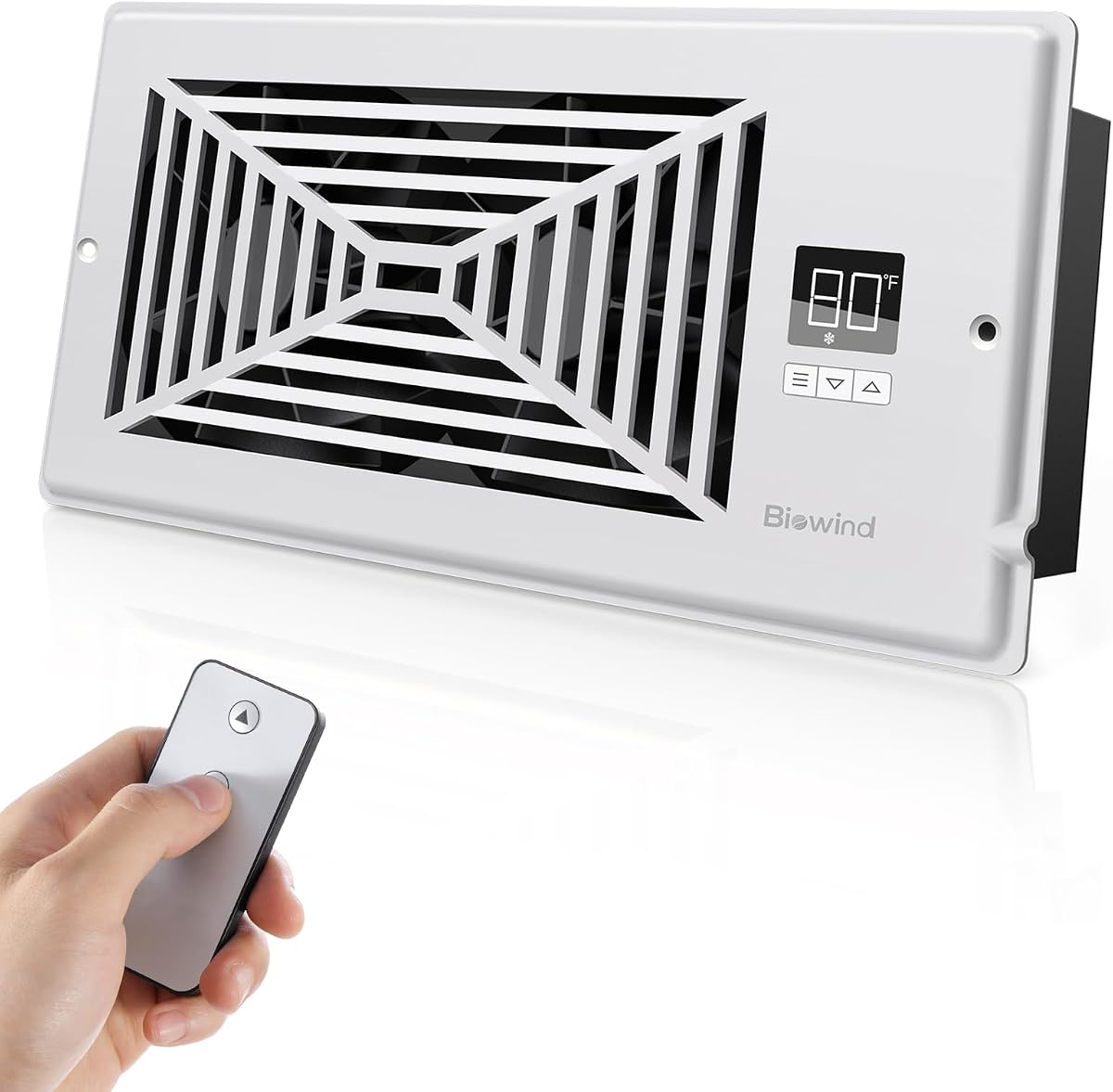
The BIOWIND Quiet Smart Register Booster Fan for a 6-by-10-inch opening is a feature-rich powered alternative to a basic register. It combines a fan, temperature sensor, programmable LED controller, and remote-controlled speed selection in a frame intended to improve circulation through an HVAC vent. Its 4.3 rating is the highest shared rating among the BIOWIND products in this roundup.
We may earn a commission when you buy through this link, at no additional cost to you.
The booster's strongest specifications include 200 CFM airflow, a six-watt rated power draw, and an indicated noise level of 18 dBA. Ten fan-speed levels let users move between gentle circulation and a stronger boost. The thermostat system can turn the fan on or off according to temperature conditions, while the continued operation after HVAC shutdown is intended to move remaining warm or cool air into the room.
Construction details suggest attention to both appearance and reliability. BIOWIND lists a 2026 stability upgrade involving dynamic fan balancing, motor start-up verification, and noise and vibration screening. The anodized aluminum frame and CNC-machined details give the unit a flush, modern appearance, while the included wall adapter and plug support a relatively accessible setup.
The main limitation is that this is a powered booster, so it needs access to an electrical outlet and a place for the adapter. It also fits only a 6-by-10-inch duct opening rather than every nominal register size. It earns our Best Premium designation because it combines strong stated airflow with temperature automation, quiet operation, remote speed control, and refined construction, making it a convincing option for a room that still feels under-aired after central HVAC has had time to equilibrate.
A 200 CFM booster can help push conditioned air farther into rooms with weak circulation. It is particularly relevant to upstairs bedrooms, lower levels, and open spaces where the central diffuser may not distribute air evenly.
The integrated sensor can cycle the fan according to room conditions, while the remote provides ten speed levels for manual adjustment. This gives users both automatic and direct control.
We may earn a commission when you buy through this link, at no additional cost to you.
This 4-by-12-inch BIOWIND register booster addresses long, narrow duct openings with a low-noise powered fan. It has the same 4.3 rating as the other BIOWIND boosters and shares their temperature sensor, programmable LED controller, remote control, and ten available fan speeds. The 4×12 format makes it a relevant alternative for homes whose vent openings have a distinctly rectangular profile.
We may earn a commission when you buy through this link, at no additional cost to you.
Its stated airflow is 140 CFM, which is lower than the 200 CFM figure listed for the 6-by-10 and 6-by-12 BIOWIND versions. That difference should be considered alongside the actual duct opening and the room's airflow needs. A smaller opening does not always mean the room needs less circulation, but buyers should avoid assuming that the nominal size alone determines performance. The fan's purpose is to move air through the connected duct, not create a complete room-to-room zoning network.
At an indicated 16 dBA, the unit is presented as quieter than the 18 dBA versions. That is attractive in bedrooms, offices, nurseries, and other areas where background noise matters. A six-watt rated power draw, 100-to-240-volt AC input, included wall adapter, and plug-and-play setup make the hardware less complicated than adding a new hardwired smart device.
This is a strong pick for a 4-by-12 opening that needs more circulation than a passive register can provide, particularly in a bedroom or quiet workspace. Its trade-offs are its lower listed airflow relative to the wider BIOWIND models, the need for a nearby outlet, and the importance of measuring the actual duct cutout rather than relying on the dimensions of the old cover. For the right opening, it combines useful automation with a low-noise profile.
The listed 16 dBA operating level targets spaces where fan noise could interfere with sleep or focused work. Low output is particularly useful when the unit must run for extended periods.
The 4-by-12 format suits long, narrow duct cutouts. BIOWIND provides separate neck, face, and insertion-depth measurements to help buyers understand how the unit will sit on the wall or floor.
We may earn a commission when you buy through this link, at no additional cost to you.
The Flair Smart Vent 4×10 is a compact option for adding room-level control to a 4-by-10-inch opening. Like the other Flair products, it uses smart thermostat and temperature-sensor information to manage the vent automatically. The result is a system designed to direct heating or cooling toward the right room at the appropriate time, which can be helpful where one central thermostat cannot keep every space equally comfortable.
We may earn a commission when you buy through this link, at no additional cost to you.
The vent supports individual seven-day schedules and allows rooms to be marked inactive. It also works with existing smart or traditional thermostats and is compatible with voice assistants. Those features make it more than a motorized cover: the value comes from the combination of hardware, Flair's hvacOS, and the room sensors that provide the information needed for automation.
Installation follows the same accessible replacement process as the rest of the lineup. There is no drilling or wiring; the old vent comes out and the Flair unit drops into its place. The app provides step-by-step instructions for connecting devices and completing setup. Dedicated support is also listed for users who need help during the configuration process.
The choice comes down to size and ecosystem commitment. Homeowners with a 4-by-10 opening can avoid modifying the ductwork or selecting an incorrect footprint, but they still need a Flair Bridge and a temperature sensor for each controlled room. This model is most attractive for households already using Flair or ready to build a consistent connected system. It offers the same intelligent damper concept as the larger registers in a more compact format.
The 4-by-10 footprint provides a useful room-control option for smaller standard openings. Motorized opening and closing enables more selective delivery of centrally conditioned air.
Flair's app, schedules, thermostat compatibility, and voice-assistant support create a broader control experience. The same interface can manage multiple vents when the necessary system components are present.
We may earn a commission when you buy through this link, at no additional cost to you.
The Flair Smart Vent 10×10 is designed around a larger square opening and is listed for wall and ceiling installations. It gives these locations the same room-by-room damper control offered by the smaller Flair registers. Its 3.8 rating is consistent with the other Flair products, and the central selling point remains automated airflow based on thermostat and room-sensor data.
We may earn a commission when you buy through this link, at no additional cost to you.
A larger register may be desirable in a room where a modest airflow opening is insufficient, or where the existing duct is already configured for 10-by-10-inch coverage. Replacing it with a motorized smart vent allows the central system to redirect conditioned air according to the room's actual needs rather than leaving the opening at a fixed position.
The installation process remains simple from a construction perspective. No drilling or wiring is required, and the app guides users through connecting the vent and finishing configuration. Once set up, hvacOS provides remote control, per-room schedules, inactive-room status, and voice-assistant compatibility. Existing smart or traditional thermostats can remain in place according to the stated compatibility information.
This pick is less versatile than the 4×12, 6×10, and 4×10 Flair vents because its listed applications are walls and ceilings rather than floors as well. It also demands the same additional Flair Bridge and room sensor. Buyers should therefore compare the existing opening carefully. If the dimensions match and the location is a wall or ceiling, the 10×10 model offers a practical way to bring intelligent damper control to a larger register.
The 10-by-10 format lets a larger room use motorized airflow management while retaining Flair's room-level software. It is a better fit for larger square duct openings than the narrow models.
Flair's white register design and controlled damper operation can be especially noticeable in living areas. Automating the opening helps avoid the static appearance and inconsistent output of a permanently open or closed cover.
We may earn a commission when you buy through this link, at no additional cost to you.
The BIOWIND 6-by-12-inch booster is the wide-opening member of the BIOWIND range and shares the stated 200 CFM airflow of the 6×10 version. It is intended for homes with weak airflow, uneven cooling, or a hot room that does not receive enough conditioned air through its central vent. Its 4.3 rating places it among the better-rated products in this guide.
We may earn a commission when you buy through this link, at no additional cost to you.
A high-precision temperature sensor and programmable LED controller allow the fan to switch on or off according to room conditions. The remote offers ten speed levels, giving users the ability to move from gentle circulation to a stronger boost. The fan can also continue briefly after the central HVAC shuts down, helping draw remaining warm or cool air into the room instead of leaving it stranded near the duct.
The product uses a six-watt rated power source, accepts 100-to-240-volt AC input, and includes a wall adapter and plug. Its listed noise level is 18 dBA, while the frame uses anodized aluminum and CNC-machined details. BIOWIND also describes a stability upgrade involving fan balancing, motor start-up verification, and noise and vibration screening.
This model is a good fit for a wide 6-by-12 cutout in a larger room, especially one where more aggressive circulation is desired. The 14.22-by-7.92-inch face is larger than the face of the 6×10 model, so wall clearance and visual placement should be checked. It also needs an accessible outlet and a practical route for the power adapter. Subject to those constraints, it delivers the strongest stated airflow among the BIOWIND choices.
The high stated airflow makes this version attractive for rooms where weak distribution contributes to uneven temperatures. It can help move centrally conditioned air beyond the immediate area of a vent.
The thermostat can manage operation automatically, while the ten-speed remote lets users override or tune airflow. This combination accommodates changing daily conditions without abandoning hands-on control.
We may earn a commission when you buy through this link, at no additional cost to you.
The AC Vent Booster Fan 6×12 is a versatile powered register for improving circulation in larger rooms with weak airflow. Its 3.9 rating places it slightly below the BIOWIND models but above the Flair products in the supplied ratings. It supports floor, wall, and ceiling registers, giving it broader placement flexibility than options limited to one opening type or room-control architecture.
We may earn a commission when you buy through this link, at no additional cost to you.
Its main controls are a remote, an LCD display, a thermostat, and two timer choices that cover two-hour and four-hour periods. Ten fan speeds allow users to select gentle circulation or a stronger boost. The stated 18 dBA operating level targets bedrooms, living rooms, nurseries, offices, and other areas where the fan should run without creating substantial noise.
One distinctive feature is the built-in aroma pad. Users can add essential oils, which are not included, to create a scented airflow experience. That feature is not essential to HVAC performance, but it differentiates the product from conventional boosters and may be useful in a bedroom or personal office.
Unlike a Wi-Fi-focused system, the product does not advertise app control. It depends on its remote, thermostat, display, and timer, while a nearby outlet and careful cable routing are required for installation. Buyers must also measure the duct opening and then verify that the unit's overall dimensions will cover the existing register area. For someone who values flexible speeds, timing, quiet operation, and aroma rather than remote app access, this is a capable alternative.
The speed range makes it possible to match circulation needs to the room and central system. Lower settings can support quiet background movement, while higher settings suit larger or poorly served spaces.
The built-in aroma pad adds optional fragrance as air circulates, and the timer offers scheduled operation. Neither feature replaces the core importance of correctly measuring the opening and planning power access.
We may earn a commission when you buy through this link, at no additional cost to you.
This smart register booster is designed for users who want remote app control and very quiet operation. It has a 4.0 rating and pairs a powered fan with dual intelligent thermostat functionality, button controls, and Wi-Fi app operation. The app allows users to adjust the fan from anywhere with a Wi-Fi connection, making it more suitable for people who want smartphone access without being near the register.
We may earn a commission when you buy through this link, at no additional cost to you.
The upgraded thermostat controller is described as actively monitoring temperature and adjusting fan speed in real time. It can switch the booster on or off at appropriate times, while the button panel offers a local alternative. Its PWM fan uses stator-blade and hydro-mechanical blade technology, and the stated low-setting noise level is under 16 dBA. Listed airflow is 140 CFM.
The panel is described as durable 2 mm steel with a stated support capacity of 300 pounds. A two-way airflow design is intended to widen distribution through the room. These specifications make the product look particularly suitable for bedrooms, quiet offices, and spaces where the fan may remain active for extended periods.
The most important caveat is fit. Although the listing title refers to 6-by-12-inch register holes, the supplied product description states that the unit fits only a 6-by-10-inch register vent. That inconsistency should be resolved with the seller before purchase, and the actual duct opening should be measured. This model is otherwise appealing for buyers who prioritize Wi-Fi control, dual thermostat intelligence, and quiet airflow over the ten-speed remote control found in the BIOWIND range.
Wi-Fi app access allows users to manage the fan while away from home. Local button controls ensure the register remains usable when a phone is not nearby.
Rather than only switching on and off, the intelligent controller is described as adjusting fan speed as it monitors temperature. This can align airflow more closely with changing room conditions.
We may earn a commission when you buy through this link, at no additional cost to you.
The BIOWIND 4-by-10-inch smart booster is a compact powered option for smaller long-side openings. It shares the BIOWIND feature set, including a 4.3 rating, temperature-driven operation, programmable LED controller, ten remote speed levels, and a six-watt rated power draw. Its stated airflow is 140 CFM and its indicated noise level is 16 dBA.
We may earn a commission when you buy through this link, at no additional cost to you.
The quiet operating level makes the unit particularly attractive for bedrooms and other low-distraction spaces. The automatic thermostat can turn the fan on or off as needed, while the remote provides direct control over ten speeds. Like the other BIOWIND boosters, it is designed with an anodized aluminum frame and CNC-machined details and includes a wall adapter and plug.
Fit is particularly important for this smaller model. The listed duct opening is 4 by 10 inches, the neck measures 9.72 by 3.93 inches, and the face measures 11.54 by 5.51 inches. The neck insertion depth is listed as 1.96 inches. Those details allow a more informed comparison than simply checking the old cover, which may have a different outer frame size.
This is a good option for a 4×10 room that needs more directed air than a passive register provides, especially when low noise matters. It does not offer the app-based remote access described for the Wi-Fi model, and it requires a nearby outlet. For a correctly sized opening, however, it delivers a useful balance of compact construction, automatic temperature response, adjustable fan output, and quiet operation.
The 16 dBA stated level and narrow face make this model friendly to smaller spaces. Its low-noise design is suitable where background fan operation could be distracting.
The temperature sensor can operate the fan automatically, and the remote lets users select from ten speeds. This balances unattended convenience with precise manual control.
We may earn a commission when you buy through this link, at no additional cost to you.
The right motorized register depends on your duct dimensions, the type of uneven-temperature problem, the power available near the vent, and the level of automation you want. Measure first, then compare control architecture, airflow, and installation requirements.
The most consequential measurement is the duct cutout in the wall or floor, not the outside dimensions of the existing vent cover. Powered boosters often have a narrow neck that enters the duct and a larger face that rests over the surface, so both opening and overall coverage must be checked. The BIOWIND listings provide separate neck, face, and insertion-depth figures for that reason.
Flair's motorized vents act as controllable dampers and are intended to manage which rooms receive centrally conditioned air. BIOWIND and the other booster fans add a powered fan to move more air through a selected opening. A damper-oriented system is better for coordinated room scheduling, while a booster can be more practical when one specific room consistently receives weak airflow.
A smart vent may require a hub, bridge, app, and compatible temperature sensor to deliver its advertised automation. The Flair models specifically require a Flair Bridge and a sensor in every room with a Flair Smart Vent. Buyers should verify that their existing thermostat is compatible and determine whether they already have the necessary networking and sensing equipment.
Stated airflow can help distinguish booster models, although real performance also depends on duct condition, static pressure, room layout, and how the central system operates. The BIOWIND 6×10 and 6×12 versions list 200 CFM, while several compact options list 140 CFM. Larger rooms or weak central distribution may justify a higher-output model, while smaller rooms may be adequately served by a quieter compact unit.
A register fan that sounds acceptable in a living room may be distracting in a bedroom or home office. Listed noise levels range from 16 dBA on several models to 18 dBA on others. Consider both the maximum setting and the lower speeds used during sleeping hours or quiet work periods, and consider whether motorized dampers create less continuous sound than boosters.
Unlike standard passive registers, powered boosters need a nearby outlet and room for the adapter. App-controlled models also depend on a reliable Wi-Fi connection. Plan cable routes before installation to avoid an untidy appearance, and confirm that the outlet can remain accessible. Flair's damper vents avoid in-register wiring, but their external ecosystem still needs networking and power.
Some systems rely on a remote, some emphasize thermostat automation, and others add app control, voice-assistant support, timers, or individual schedules. A household that wants whole-home coordination may value centralized software and per-room routines. A single-room installation may be better served by a straightforward remote, automatic thermostat response, and quiet operation.
Some models work on floors, walls, and ceilings, while others are restricted to wall and ceiling openings. Flair's 10×10 model is listed for walls and ceilings, whereas most other Flair sizes support all three. The BIOWIND units are described for wall and floor vents. Check the mounting location, surrounding trim, furniture placement, and access to the central duct before purchasing.
Begin by measuring the duct opening and confirming that the vent's neck, face, and insertion depth are appropriate. For a powered booster, identify a nearby outlet and plan the adapter cable before removing the existing register. For a Flair system, install the required Bridge and compatible room sensor, then use the app's guided instructions to pair the vent and assign it to the correct room.
After setup, begin with moderate fan speed or normal thermostat-based operation and allow the system to establish room conditions. Avoid changing schedules too frequently during the first few days, since stable temperature readings make automatic behavior easier to understand. For manually controlled boosters, use the remote to select a level that improves circulation without creating unnecessary drafts or noise. For app-controlled systems, test remote access, timers, notifications, and thermostat modes before relying on them throughout the day.
For care, keep the grille and surrounding surface free of dust, pet hair, and obstructions. Power down and unplug a booster before cleaning it, and never spray liquid directly into the fan or motor. Periodically confirm that the motorized vent still opens and closes freely and that the fan remains smooth and quiet. Update the associated app when prompted, and recheck sensor placement if automatic control seems inconsistent.
Usually, no. The Flair models are described as compatible with existing smart or traditional thermostats, using the central thermostat and room sensors to inform damper operation. Booster fans add localized airflow and can manage their own thermostat behavior, but they generally complement rather than fully replace central climate control.
A smart damper opens and closes to control how much centrally conditioned air enters a room. A register booster fan adds a powered fan that moves air more forcefully through a vent opening. Damping is better suited to coordinated room-by-room zoning, while boosting is useful for improving circulation in a specific weak or overheated room.
Measure the actual duct opening rather than the visible outer frame of the old register. For powered boosters, also compare the neck width, face dimensions, and insertion depth. If a listing gives conflicting dimensions, contact the seller and confirm the fit before ordering.
The powered BIOWIND boosters, the 6×12 AC Vent Booster Fan, and the Wi-Fi Smart Register Fan need electrical power and are listed with adapters or plugs. Flair Smart Vents themselves use a motorized damper and do not require drilling or wiring, but their Bridge and sensor ecosystem still requires power and network connectivity.
It can improve air distribution in rooms that receive weak airflow from the central HVAC system. A booster helps push conditioned air farther into the room, while a damper can redirect or limit airflow according to room needs. Neither replaces a properly sized, maintained, and balanced HVAC system.
They can be, provided noise and airflow are considered. Several booster models list 16 dBA, while others list 18 dBA, making low-output settings important in sleeping spaces. Flair's damper-based approach may also appeal because it does not require a continuously running fan.
It depends on the product. Flair vents use the Flair app, hvacOS, a Bridge, and compatible room sensors for their room-control features. The Wi-Fi Smart Register Fan includes app control alongside buttons, while the BIOWIND and 6×12 AC booster models primarily emphasize remote controls, timers, and thermostat-based operation.
Keep the grille clear of dust and debris, and unplug powered units before cleaning them. Do not spray cleaner directly onto the motor or electronics. Periodically check that the damper moves freely or that the fan sounds smooth, and keep the app or firmware updated when the manufacturer provides an update.
The Flair Smart Vent 4×12 stands out for coordinated room-level control, app scheduling, voice-assistant compatibility, and a straightforward register replacement. The 6×10 Flair model offers the same smart-zoning approach in another common size, while the BIOWIND 6×10 is the standout premium booster for users who want stronger directed airflow, ten speed levels, and temperature-driven operation.
Before choosing, prioritize the actual duct opening, the location of the vent, and the nature of the problem. Select a motorized damper for room scheduling and zoning, or a powered booster when one room needs stronger circulation. Also account for hub and sensor requirements, outlet access, Wi-Fi coverage, noise, and the importance of exact dimensions.
Finally, confirm the current listing details and price before purchasing because product configurations, ratings, and costs can change. Review the seller's fit guidance, included accessories, compatibility information, and return terms, and make sure the selected vent is appropriate for your HVAC layout and daily comfort goals.