
TopTes PT-990 Rechargeable Gas Leak Detector
4.7Editor score
Real-time PPM trend display
Data logging at alarm events
Audible, visual, vibration alerts
Rechargeable nine-hour battery
A combustible gas leak detector helps locate fuel-gas leaks that can create fire, explosion, health, and equipment risks. The most useful model combines reliable sensing, clear escalating alarms, a probe that reaches confined spaces, and straightforward startup calibration. Household users, RV owners, inspectors, and HVAC technicians all have different priorities.
The products in this guide were compared using the supplied specifications, including supported gases, detection range, warm-up procedures, alarm types, probe length, power options, calibration features, and physical design. The list covers compact battery-operated units, professional handheld instruments, and rechargeable models with displays, data logging, and advanced alert controls.
Each review explains the detector's strongest use case, practical advantages, and limitations based on the available product information. Ratings reflect the listed customer feedback rather than personal testing. Availability and pricing can change, so readers should confirm current product details, accessories, calibration requirements, and return terms before purchasing.
4.7Editor score

4.6Editor score

4.6Editor score
As an Amazon Associate we earn from qualifying purchases.
The table below compares all ten detectors by their most decision-relevant features, including sensor reach, supported gases, alert methods, power arrangements, and display capabilities. It makes it easier to separate compact consumer tools from professional and feature-rich diagnostic instruments.




The Klein Tools ET120 combines a broad stated detection range with an 18-inch flexible gooseneck, making it a balanced choice for homeowners, RV users, and trade professionals. It carries a 4.6 rating, and its most notable qualities are the 50–10,000 ppm methane range, two selectable sensitivity levels, and an 85 dB alert that becomes more intense as concentration rises.
We may earn a commission when you buy through this link, at no additional cost to you.
The gooseneck is the ET120's defining convenience feature. It can reach around appliances, into narrow gaps, and along pipes while remaining attached to the handheld body. Five red LEDs provide a visual warning for users who cannot hear the alarm or are working in a noisy environment. Automatic zero-point calibration at power-up reduces manual setup steps and helps establish a clean-air baseline.
The main limitation is the absence of a numerical PPM display. The instrument communicates through sound and escalating lights rather than showing a concentration, so it works best as a locator rather than a detailed measurement tool. Users must also select the appropriate sensitivity range themselves, and the listed specifications do not describe a rechargeable battery system.
Despite those limitations, the ET120 is the strongest general recommendation in this group. It combines a long probe, wide range, loud alarm, and automatic startup procedure without requiring advanced display interpretation. It suits anyone seeking a dependable, flexible detector for locating combustible gas around common household or service equipment.
The 18-inch gooseneck reaches awkward locations where a fixed sensor head cannot easily go. It also clips to the meter for storage, reducing the chance of leaving the probe extended during transport.
Five red LEDs and an 85 dB audible alert provide redundant ways to notice a developing leak. The intensifying response helps users distinguish a trace reading from a more serious concentration without needing to watch a numerical display.
We may earn a commission when you buy through this link, at no additional cost to you.
The TopTes PT520A offers an unusually complete feature set for a value-oriented detector. It has a 4.6 rating, a stated 50–10,000 ppm methane range, a 17-inch gooseneck, and support for natural gas, propane, LPG, butane, methane, and other combustible gases. That makes it suitable for home, RV, and outdoor access applications.
We may earn a commission when you buy through this link, at no additional cost to you.
Its alarm system combines seven colored bars with a 75 dB sound that rises as gas concentration increases. The stated response is 0.5 seconds, which is useful when tracing suspected leaks. A 30-second warm-up in clean air is required before use, and the probe should be moved within 1–5 centimeters of the suspected source for detailed checking.
The PT520A does not provide a numerical screen, and the supplied information does not describe a manual calibration control. Those points make it less attractive for diagnostic work requiring exact concentration values. Nevertheless, its long probe, broad stated range, included three AAA batteries, protective case, and adjustable auto power-off provide genuine utility.
This is a strong choice for RV owners, homeowners, and do-it-yourself users who need more reach than a simple pocket sniffer. The included accessories make it ready for a range of household checks, while its flexible probe and escalating indicator system help narrow down the likely source.
The PT520A supports several common fuel gases and includes a long probe for pipelines, storage tanks, gas fireplaces, and basements. Its stated indoor and outdoor applicability gives it broader utility than a detector designed only around appliance connections.
Seven colored indicator bars and a 75 dB escalating alarm provide quick feedback during a systematic search. The 0.5-second stated response helps users move the probe methodically rather than waiting around each access point.
We may earn a commission when you buy through this link, at no additional cost to you.
The UEi Test Instruments CD100A is designed for users who may encounter more than one type of combustible gas. Its 4.4 rating reflects a practical tool with a broad listed gas list that includes acetone, ammonia, butane, methane, natural gas, LPG, and jet fuel. It is positioned for residential, commercial, HVAC, and industrial environments.
We may earn a commission when you buy through this link, at no additional cost to you.
The 18-inch gooseneck reaches tight and inaccessible areas, while a tip light illuminates the sensing area in dark environments. Startup is straightforward: the detector warms up for 10 seconds in open air and is then directed toward suspect locations. Both audio and visual cues communicate the presence of gas, with the ticking rate increasing as the detector responds more strongly.
Users who need numerical readings or a permanent trend record may find the simple alert system limiting. The supplied specifications also do not detail adjustable sensitivity, battery life, or a numeric low-battery warning. Even so, the illuminated probe tip and long reach are meaningful advantages in mechanical rooms, cabinets, and poorly lit service areas.
The CD100A is best for HVAC professionals, facilities teams, and homeowners who want a straightforward, broad-gas handheld detector. It prioritizes rapid locating over laboratory-style analysis, making it a practical companion to routine gas-appliance and fuel-line inspections.
Support for multiple gases makes the CD100A useful where the exact fuel type may vary. It can be applied to residential, commercial, HVAC, and industrial checks without changing to a narrowly specialized device.
The light at the end of the 18-inch probe helps users see the sensing area. This is especially helpful inside dark cabinets, behind equipment, or in other spaces where the leak source is difficult to distinguish visually.
We may earn a commission when you buy through this link, at no additional cost to you.
The TopTes PT199 is a compact natural gas sniffer aimed at homeowners, RV owners, and do-it-yourself users. It has a 4.6 rating and supports natural gas, methane, propane, butane, LPG, and other combustible gases. Its stated methane-based range is 50–1,000 ppm, with a recommended detection distance of 1–5 centimeters.
We may earn a commission when you buy through this link, at no additional cost to you.
Visual and audio alarms trigger within 0.5 seconds according to the supplied information. The alarm intensifies with concentration, and the LCD turns red when gas levels are high. A 30-second warm-up, low-battery indication below 2.4 volts, and automatic power-off after five inactive minutes make it convenient for repeated household checks.
The main drawback is that it lacks the flexible probe offered by several higher-ranked models. Its short maximum range also places it below the PT520A, ET120, and PT-990 for broader coverage. Nevertheless, the pocket-sized body and included storage bag make the PT199 easy to keep near gas appliances and carry during an inspection.
Choose the PT199 when convenience and quick close-range checks matter more than extended reach. It is a practical compact option for a homeowner performing regular visual-and-auditory checks around standard fuel-gas equipment, especially when an unobtrusive, battery-powered tool is preferred.
The 1–5 centimeter working distance makes the PT199 appropriate for checking joints and connections directly. Holding the sensor near a suspected source helps users confirm a response before moving on to the next fitting.
Included AAA batteries eliminate the need for separate purchases at setup. The low-battery reminder and automatic five-minute shutdown help preserve usable power during intermittent inspections.
We may earn a commission when you buy through this link, at no additional cost to you.
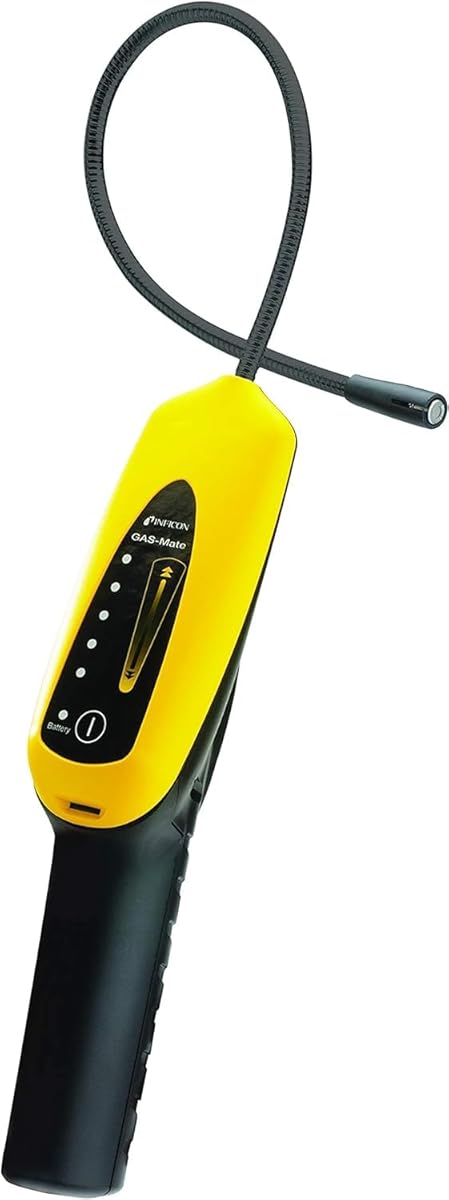
The Inficon 718-202-G1 is a handheld combustible gas detector from a specialist manufacturer of test instruments and gauges. It carries a 4.5 rating and is manufactured in the United States. Its appeal lies in a focused, professional-instrument identity rather than a long list of consumer-oriented convenience features.
We may earn a commission when you buy through this link, at no additional cost to you.
Because this category includes products with very different technical documentation, the limited supplied information deserves attention. The listing identifies it as test equipment from Inficon, provides package dimensions of 15 by 3.9 by 8.4 inches, and does not list detection range, probe length, alarm type, calibration method, or supported gases. Those omissions prevent a fully informed feature comparison.
Its compact package dimensions suggest a portable instrument rather than a large fixed analyzer. The Inficon name and specialized product category may appeal to technicians who already recognize the brand or need equipment intended for professional test-and-measurement workflows. However, buyers should confirm the manual and current listing for specifications not provided here.
This detector is best considered after verifying its exact technical specifications against a specific job. It is a premium option within this roundup, but the recommendation comes with a practical caveat: choose it when its documented capabilities match the intended gases, environment, and service process, not merely because of the product category.
The Inficon model is explicitly categorized as test equipment and gauges. That positioning is useful for users who want a dedicated combustible-gas instrument rather than a general-purpose alarm or consumer sniffer.
The supplied data does not establish the detector's gas range, alarm system, or probe configuration. Buyers should review the manufacturer documentation, sensor life information, calibration procedure, and warranty terms before committing to it.
We may earn a commission when you buy through this link, at no additional cost to you.
The Klein Tools ET190 combines a slim body, a 4.7 customer rating, and a stated detection range of 50–2,000 ppm. It is positioned for residential, commercial, and industrial users who need a portable detector that can move easily from a pocket to a service area without taking up much space.
We may earn a commission when you buy through this link, at no additional cost to you.
Two sensitivity modes support systematic leak location, while bright LEDs and escalating tones provide redundant visual and audible feedback. The startup process includes 30 seconds of automatic zeroing, intended to establish a reliable baseline without manual adjustment. A sturdy pen clip makes the instrument convenient to carry throughout an inspection.
The ET190's maximum stated range is below that of the ET120 and TopTes PT520A, both of which extend to 10,000 ppm for methane. The supplied data also does not identify a flexible probe or describe a numerical display, limiting its visibility into hard-to-reach spaces and concentration details. Those trade-offs matter when comparing it with the more elaborate instruments in this list.
It is a strong recommendation for technicians or consumers who prioritize portability, straightforward automatic setup, and a high customer rating. Choose it for routine pinpointing where compact size and dual sensitivity are more important than an extended probe or recorded concentration data.
The slim housing and pen clip make the ET190 easy to carry throughout a property. It can remain accessible during installation, maintenance, and service calls without requiring a separate storage arrangement.
Thirty seconds of automatic zeroing at startup helps prepare the instrument for use. This reduces setup work and gives users a consistent startup procedure in a clean-air location.
We may earn a commission when you buy through this link, at no additional cost to you.
The TopTes PT-990 is the most information-rich detector in the roundup. It has a 4.7 rating, a stated range of 0–10,000 ppm, a Figaro combustible-gas sensor, an 11-inch flexible probe, and a TFT display that shows both real-time PPM values and a dynamic trend line. It is designed for industrial and home use.
We may earn a commission when you buy through this link, at no additional cost to you.
A built-in fan draws ambient air toward the sensor to support the stated fast response and improved accuracy. The instrument can respond in as little as 0.5 seconds, and its logging function records alarm times and PPM readings when an event is triggered. Users can also mute alarms quickly or perform manual calibration for more controlled operation.
The triple-alert system includes a 90 dB buzzer, visual indicators, and vibration alerts, with each mode independently enabled or disabled. That flexibility is valuable in loud environments, quiet spaces, and situations where vibration is easier to notice than sound. A 4000mAh rechargeable battery supports more than nine hours of use and charges through a covered USB-C port.
The PT-990 is best for technicians, facility managers, and serious users who want recorded readings rather than only escalating alerts. Its complexity, charging requirement, and shorter probe than some rivals make it less ideal for occasional lightweight checks, but it offers the strongest data and customization in the group.
Real-time PPM values and a dynamic trend graph make it possible to observe how concentration changes while the probe moves. This information can help distinguish a persistent leak source from a brief pocket of gas encountered during a search.
Sound, lights, and vibration can be enabled independently, allowing users to suit the warning system to the site. The 90 dB buzzer is especially useful in noisy locations, while vibration offers a discreet alternative when necessary.
We may earn a commission when you buy through this link, at no additional cost to you.
The Forensics Gas Leak Detector is built around a Japanese sensor, a large color LCD, and an ABS housing that is described as passing a 10-foot drop test. Its 4.4 rating reflects a specialized instrument with an unusually broad list of detectable substances, including natural gas, methane, propane, butane, gasoline, diesel, LPG, LNG, and several alcohols.
We may earn a commission when you buy through this link, at no additional cost to you.
The screen also displays temperature, adding useful context during inspections of mechanical equipment and storage areas. A methane-calibrated sensor and a stated seven-year sensor life are meaningful for buyers considering long-term use. The one-year limited warranty adds another element of purchase confidence, although warranty terms should be confirmed at the time of purchase.
The supplied details do not describe the detection range, alarm behavior, warm-up routine, or probe configuration, so this model is harder to compare directly with the ET120 and PT-990. The color display and broad gas list are attractive, but the absence of stated range information may discourage users who need a clear numerical sensitivity specification.
This detector is best for inspectors, technicians, and engineers who work with varied substances and need a rugged instrument with a color display. Buyers should confirm the full operating specifications, accessories, and whether the intended use requires a particular probe or calibration accessory.
The listed gas compatibility extends beyond standard household fuel gases to alcohols, gasoline, diesel, and additional industrial substances. That versatility makes the model relevant to inspectors and engineers working across different environments.
The drop-tested ABS housing is designed to tolerate demanding field use. A large color LCD improves readability, while the added temperature display gives environmental context during a broader diagnostic inspection.
We may earn a commission when you buy through this link, at no additional cost to you.
The RIDGID 36163 CD-100 is a handheld diagnostic detector designed for combustible gases including methane, propane, butane, ethanol, ammonia, and hydrogen. It has a 4.5 rating and stands out for a 16-inch flexible probe, adjustable sensitivity, and Tri-Mode Detection that provides visual, audible, and vibration alerts.
We may earn a commission when you buy through this link, at no additional cost to you.
The probe gives users access to confined spaces and hard-to-reach components. Adjustable sensitivity is intended to help locate low-level gas quickly, while multiple alarm modes let technicians choose the most useful feedback for the environment. Vibration is particularly valuable when noise or distance makes an audible warning difficult to notice.
A field-replaceable sensor can reduce downtime when service is required, and the ergonomic housing is described as comfortable enough for extended use while remaining rugged. On the other hand, the supplied data does not provide a numerical detection range, display specifications, warm-up time, or battery details, so buyers cannot compare those aspects directly with the PT-990.
The CD-100 is a good fit for gas-line installers, maintenance teams, and contractors who want flexible reach with multiple alert styles. It is especially appropriate where vibration is useful and regular servicing makes a replaceable sensor a meaningful long-term advantage.
Visual, audible, and vibration alerts give the user several ways to recognize a response. This redundancy is useful around operating machinery, in poorly lit areas, and anywhere background noise could conceal a sound.
A field-replaceable sensor can help keep a heavily used instrument in service. Users should still follow the manufacturer's replacement, calibration, and test procedures when servicing the detector.
We may earn a commission when you buy through this link, at no additional cost to you.
The TopTes PT177 is an affordable, pocket-sized gas sniffer for homeowners, RV enthusiasts, and do-it-yourself users. It carries a 4.6 rating and supports LPG, methane, ethane, propane, butane, natural gas, coal gas, and other combustible sources. Its five red LEDs and 75 dB alarm intensify as concentration increases.
We may earn a commission when you buy through this link, at no additional cost to you.
A 30-second auto-calibration must be completed in a clean, gas-free environment before use. The detector can trigger within 0.5 to 3 seconds, depending on the listed response range. Its low-battery indicator flashes below 2.4 volts, and an automatic five-minute shutdown ends operation when the unit is inactive and no gas is detected.
The PT177 is deliberately simple, with no numerical concentration display and no long flexible probe. Those omissions make it less suitable for inaccessible spaces or precise concentration analysis. However, its pocket clip, included drawstring storage bag, two AAA batteries, and simple alarm interface make it convenient for routine checks around accessible gas appliances.
The PT177 is best for buyers seeking an inexpensive, uncomplicated introduction to combustible-gas locating. It offers more recognizable controls and clear startup guidance than a bare sensor-only device, while the escalating warning system helps users decide when to move closer or investigate the connection.
The required 30-second startup cycle in clean air helps establish the operating baseline. Following that instruction and working in a ventilated location helps avoid confusing ambient gas with a localized leak.
The pocket clip keeps the unit accessible, while the drawstring bag protects it during storage and travel. Included AAA batteries and a user manual make the package straightforward to prepare for use.
We may earn a commission when you buy through this link, at no additional cost to you.
Choosing a combustible gas leak detector means balancing detection range, probe access, warning strength, startup requirements, and portability. The right instrument depends on the gases involved, the spaces you need to inspect, and whether you require simple locating or recorded concentration data.
Detection range indicates the concentration band the sensor is designed to register, while sensitivity determines how readily the instrument responds to trace gas. Products in this roundup include stated methane-based ranges from 50–1,000 ppm to 0–10,000 ppm. A broader range can make a detector more versatile when the concentration may be low or unexpectedly high. Dual sensitivity modes can also help users move from broad searching to closer pinpointing. The range is not the only consideration, however; warm-up stability, calibration behavior, and the unit's ability to report readings should be reviewed as well.
A flexible gooseneck allows the sensor to reach behind appliances, around pipes, under cabinets, and into other confined spaces without forcing the user's hand into a tight area. The longest probes here measure 18 inches, while the RIDGID offers 16 inches and the PT-990 uses 11 inches. Flexible probes are especially valuable behind gas appliances, around valve boxes, and in vehicle or RV installations. A compact sniffer may be easier to carry, but it requires direct access to the suspected source and is less helpful when the connection is hidden.
Audible alarms are easy to notice during normal indoor work, but visual indicators and vibration can be safer in noisy, dark, or confined environments. Five or seven LEDs provide a visual escalation, while the strongest models add a 90 dB buzzer and haptic vibration. A detector that supports independently controlled alarm modes gives you flexibility to disable unnecessary notifications. Consider whether you wear hearing protection, work around loud machinery, or need to keep alerts discreet when selecting the warning system.
A numerical display can help distinguish a weak response from a rising concentration, while a trend graph shows how readings change as the probe moves. The PT-990 offers real-time PPM values, a dynamic graph, and event logging that records alarm times and readings. Most of the more compact detectors rely on escalating tones and lights instead. Numerical information is valuable for professional diagnostics, but a simpler alert-only device can be more convenient for quick household checks. Choose based on the sophistication of your inspection process rather than display size alone.
Automatic startup calibration or zeroing can make a detector more consistent and easier to deploy. The ET120 performs automatic zero-point calibration at power-up, the ET190 includes 30 seconds of automatic zeroing, and the PT177 uses a 30-second auto-calibration. The PT520A specifies a 30-second warm-up in clean air, while the UEi CD100A uses a ten-second open-air warm-up. Whatever the stated duration, startup should occur in a clean, well-ventilated area away from the suspected leak so the baseline is not distorted.
Disposable batteries are convenient for occasional inspections and simplify transport, while a rechargeable system can be more practical for regular professional work. The PT520A includes three AAA batteries, the PT199 and PT177 each include two, and the PT-990 uses a 4000mAh rechargeable lithium battery with a covered USB-C port. Low-battery warnings and automatic shutdown help prevent an unnoticed loss of power, but users should still check the indicator before beginning a job. Carry spare batteries or maintain a dependable charging routine according to the manufacturer's guidance.
A detector is more likely to be used when it is easy to carry and quick to retrieve. The PT199 and PT177 use pocket-sized formats, while the ET190 includes a sturdy pen clip. The PT520A supplies a protective case, and several models include a storage bag. Professional users may prefer a rugged housing, reinforced controls, and a probe that clips to the body. Household users may prioritize low weight and discreet storage. The best choice is one that fits the places you inspect and can be kept ready without being damaged.
Combustible gas detectors are not necessarily interchangeable across every fuel. Many products specifically cover methane, propane, butane, natural gas, and LPG, while the UEi CD100A and Forensics model list broader collections that include additional fuels and vapors. If you work with natural gas in one building and propane in an RV, verify that both are supported. For industrial work, confirm the complete gas list, sensor type, calibration method, and environmental limitations. A household gas appliance check is a more limited task than industrial process diagnostics.
Begin by reading the detector's manual and identifying the supported gases, warm-up period, calibration method, low-battery warning, and recommended operating conditions. Inspect the housing, probe, controls, and sensor openings for visible damage. Turn the unit on in clean, ventilated air—not directly beside a suspected leak—and allow the full stated warm-up or zeroing cycle to finish before moving toward the inspection area.
Approach the system methodically. Start near the expected gas source and move the probe slowly along pipes, joints, valves, appliance connections, and storage areas. Keep the sensing tip at the distance recommended by the manufacturer, commonly 1–5 centimeters for some compact models. Move away from the suspected source if the alarm becomes strong, improve ventilation, and avoid operating switches, flames, or ignition sources while investigating.
After the inspection, return to a clean-air area and power down according to the manual. Replace disposable batteries when the low-battery indicator appears, and recharge the PT-990 through its covered USB-C port when needed. Store the detector dry, away from excessive heat or impact, with the probe protected or clipped to the body. Follow the manufacturer's recommended sensor tests, calibration schedule, warranty terms, and replacement procedures rather than assuming the unit remains accurate indefinitely.
It can locate combustible gas within its stated detection range and operating limits. A broad range and selectable sensitivity help, but probe placement, clean-air calibration, and systematic movement are important. Very small leaks may also require soap solution, pressure testing, or a professional inspection.
No. A natural gas detector may be calibrated primarily for methane and may not respond reliably to propane or other hydrocarbons. Check the supported gas list and calibration information. The PT520A, PT199, ET120, and other models in this guide specifically list propane among their detectable gases.
Warm-up allows the sensor, electronics, and indicators to stabilize so the baseline and alarm response are dependable. Some models zero during this period, while others simply initialize. Always warm up in clean, well-ventilated air because gas near the sensor can distort the baseline.
An alarm-only sniffer tells you that combustible gas is present through sound, light, or vibration. A display-equipped model can show numerical concentration, a trend graph, and sometimes recorded event data. The latter is more useful for diagnostics, while the former can be simpler for quick household checks.
Follow the manufacturer's recommended distance, because sensor design and airflow affect readings. Some models in this roundup specify a 1–5 centimeter working distance. Move the probe slowly around joints and fittings without touching the sensor, and never rely on a handheld detector as the sole safety control.
Several models are specifically suitable for RVs, and the PT520A describes indoor and outdoor leak-detection use. Nevertheless, check the manual for weather resistance, temperature limits, and prohibited exposure. Outdoor wind can disperse gas and influence readings, so readings near a suspected source still need careful interpretation.
The appropriate schedule depends on the manufacturer, sensor type, and frequency of use. Perform the specified startup zeroing each time required, conduct the recommended functional tests, and follow official calibration instructions. A unit that behaves unusually, gives inconsistent readings, or has been dropped should be checked before further use.
Stop the search, move away from the suspected source, avoid flames and electrical switching, and ventilate the area if it is safe to do so. Keep people away from the suspected leak and contact the gas utility, a qualified gas fitter, emergency services, or another appropriate professional. Do not attempt repairs that could create an ignition source.
The Klein Tools ET120 is the best overall choice because it pairs a broad stated range, an 18-inch flexible probe, automatic startup zeroing, and an 85 dB escalating alarm. The TopTes PT-990 takes the lead for detailed work because it adds real-time PPM readings, trend graphs, event logging, independently controlled alarms, and a rechargeable battery. For straightforward, affordable pocket checks, the TopTes PT177 is a practical choice.
Prioritize the features that match your inspection environment. Long probe reach is valuable behind appliances, while numerical displays and logging suit technicians who need documented concentration behavior. A broader detection range, sensitivity controls, reliable warm-up procedure, and suitable gas compatibility can matter more than portability. For demanding or uncertain applications, professional advice remains important even with a capable handheld detector.
Before purchasing, confirm the current listing, supported gases, included accessories, calibration instructions, warranty, and return policy. Ratings and specifications can evolve over time, and availability changes. Compare the final selection with the type of space you need to inspect rather than relying only on the most advanced-looking display.