
3-Foot Coiled Extension
4.8Editor score
Stretchable 18AWG coiled design
Male and female flat connectors
Rubber dust cap protection
A 4 Pin Flat Trailer Extension Cable connects standard four-way trailer lighting systems while adding the reach needed for cleaner routing, easier sharp turns, or a replacement harness. The best cable depends on connector compatibility, usable length, wire gauge, environmental protection, and whether a straight or coiled design better suits your towing setup.
We compared ten extension cables using the specifications and feature descriptions provided for each product. The list covers straight cables, stretchable coils, short and long options, 16 AWG and 18 AWG wiring, protective sheaths, dust covers, and vehicle-side and trailer-side male-and-female connectors.
Each review explains the product's strongest qualities, practical trade-offs, and best use case. Ratings and product details reflect the supplied information, while current prices can change, so shoppers should compare today's offers and confirm their connector and length requirements before purchasing.
4.8Editor score

4.8Editor score

5.0Editor score
As an Amazon Associate we earn from qualifying purchases.
The comparison below highlights each cable's length, wire gauge, connector configuration, and most relevant construction feature, making it easier to identify the option that matches a particular trailer and routing arrangement.




This 48-inch four-way trailer extension is a strong all-around choice for tow vehicles that need extra cable between a standard trailer connector and the trailer's lighting system. Its supplied rating is 4.8, and its most convincing attributes are the generous four-foot length, 18 AWG pure copper wiring, and a heavy-duty outer sheath designed to withstand handling and abrasion.
We may earn a commission when you buy through this link, at no additional cost to you.
The male and female ends allow it to connect with compatible four-pin wiring without cutting or splicing factory-installed conductors. It can carry the signals needed for taillights, brake lights, and turn signals, while the vehicle-side and trailer-side labeling makes the intended connection arrangement easier to understand. Easy-grip connector handles and a dust cover on the female socket further improve usability.
The main trade-off is cable management. Four feet of straight cable offers useful reach but may need to be secured neatly when not in use, particularly around a hitch with limited clearance. It is also longer than a compact harness, so installers should verify that the extra reach will not create excess slack. Those considerations are minor for people seeking straightforward flexibility across different towing setups.
This is a particularly suitable choice for boat, utility, horse, motorcycle, and ATV trailers with standard four-way flat connections. It combines useful length with robust environmental protection and simple installation, making it a strong recommendation for anyone who wants a dependable general-purpose extension rather than a specialized short lead.
The 48-inch run provides enough slack to accommodate different hitch positions and sharp turns while preserving the simple plug-and-play design. It can also be useful when an existing trailer lead does not reach the tow vehicle's connector.
A weatherproof and abrasion-resistant PU sheath surrounds the wiring, while the female connector's dust cover helps shield terminals from moisture and dirt. These features are valuable for trailers stored outdoors or exposed to road grime.
We may earn a commission when you buy through this link, at no additional cost to you.
This Oyviny 12-inch extension is designed for close-range connections where a short, controlled lead is more practical than several feet of loose cable. It carries a supplied rating of 4.8 and uses 16 AWG pure copper conductors, a useful combination for users seeking a compact harness with relatively substantial wiring.
We may earn a commission when you buy through this link, at no additional cost to you.
The extension includes a male connector and a female connector compatible with standard four-way flat trailer wiring. Both ends have rubber dust covers, and nylon wire loom adds wear resistance around the conductors. Color-coded wires make each circuit easier to identify, while the plug-and-play format avoids cutting or splicing. The product can also be separated into vehicle-side and trailer-side sections according to the stated instructions.
Its chief limitation is length. At only 12 inches, it may not accommodate sharp articulation or a substantial gap between a vehicle socket and trailer receptacle. That makes it better suited to compact tow-behind equipment, LED light bars, tailgate lighting, or replacement-style use where the original connector already reaches. The nylon protection also adds another layer around a harness that has little slack to begin with.
Shoppers should choose this model when minimizing cable length and maintaining a neat installation matter more than maximum reach. It is a compelling compact option with color-coded wiring, protected connectors, and 16 AWG conductors, but longer designs offer greater flexibility during actual towing.
The short 12-inch length reduces the chance of a connector lead hanging near the hitch or ground. That makes the cable suitable for applications where the original leads already meet but an organized, protected connection is still desired.
Color coding reduces uncertainty when identifying circuits, while rubber covers protect both connectors from water and dust. A nylon loom adds resistance against abrasion around the wire bundle during repeated handling.
We may earn a commission when you buy through this link, at no additional cost to you.
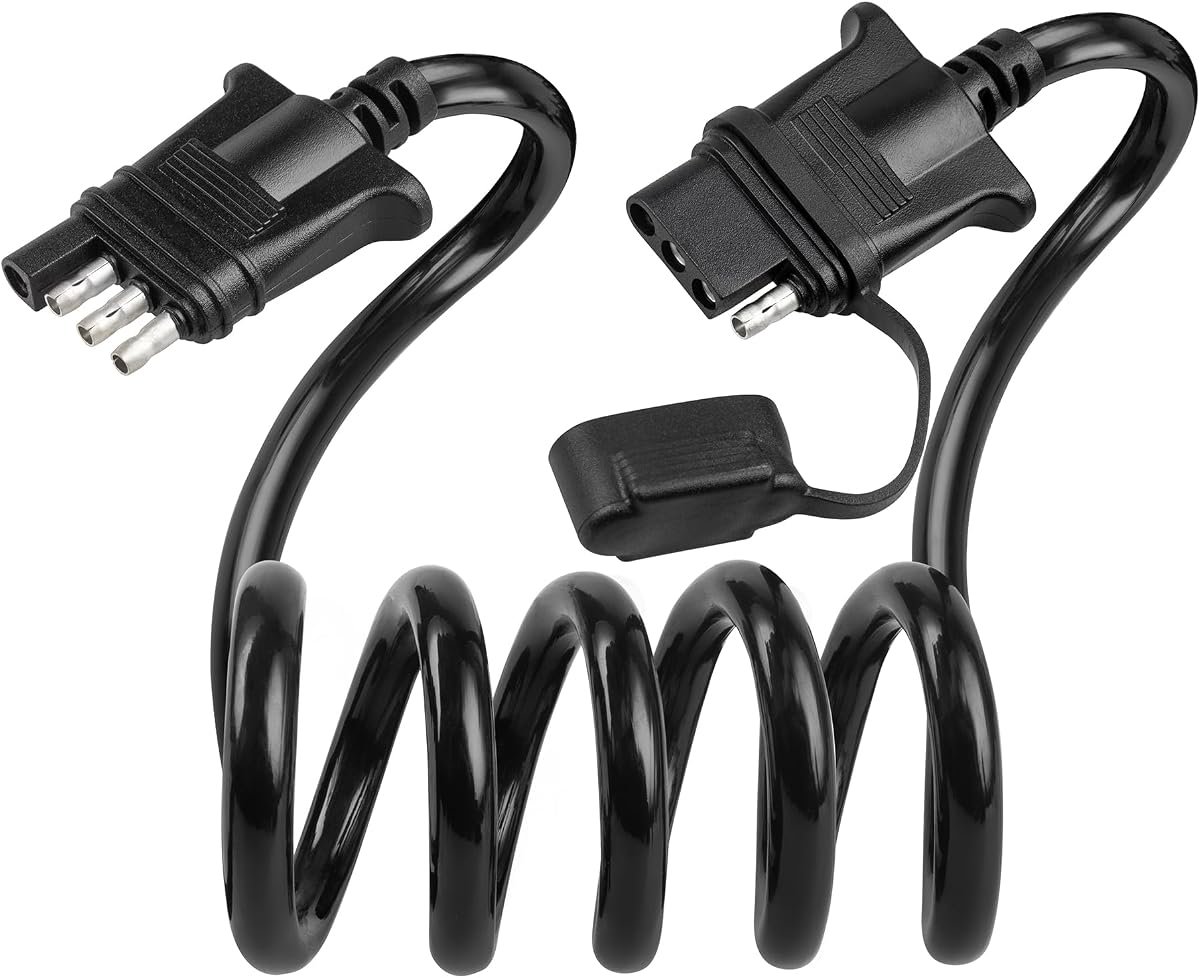
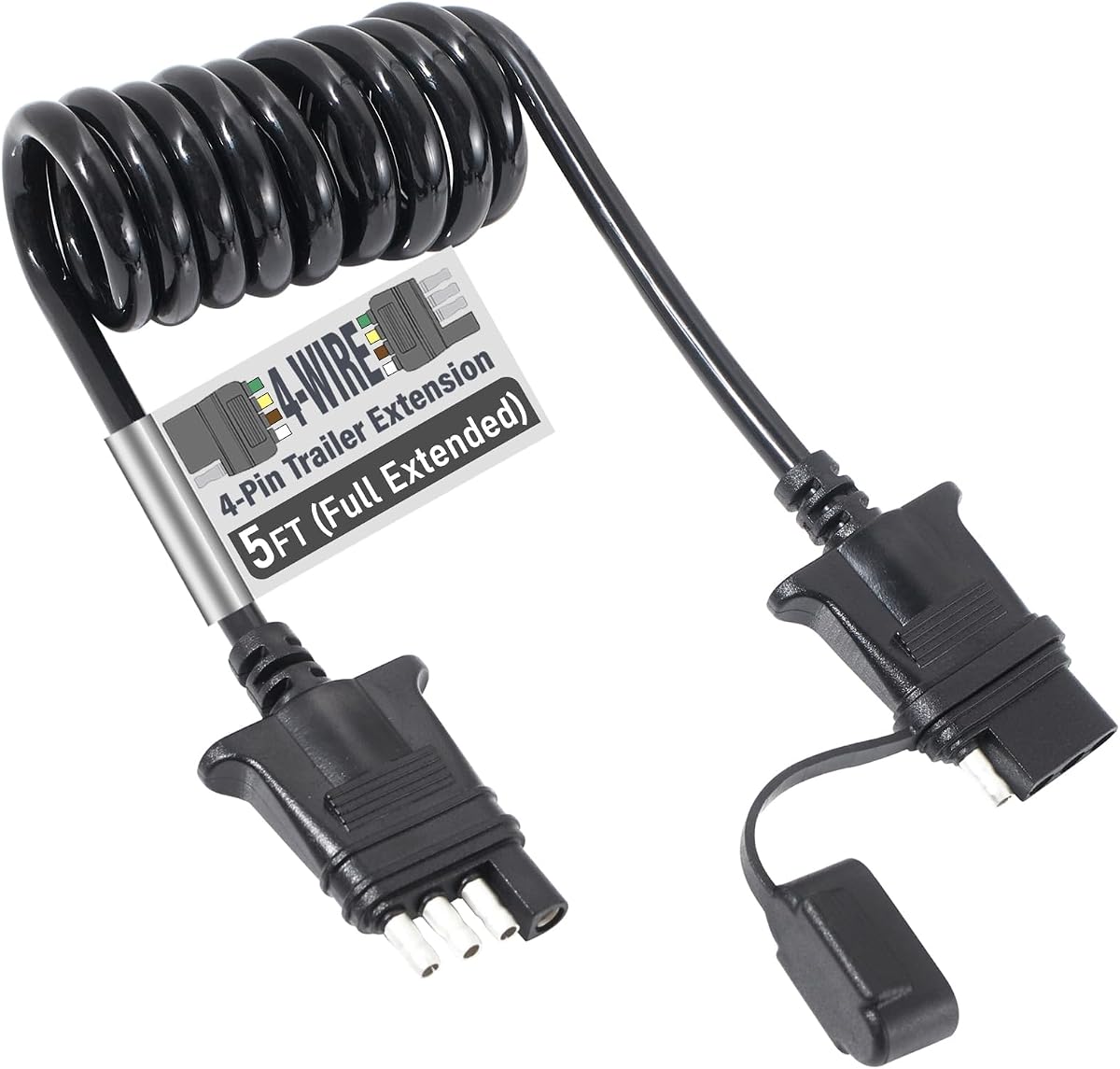
This coiled four-way extension combines compact storage with enough stretch for trailer movement. Its supplied rating is 4.8, and the core benefit is straightforward: the coiled body helps keep excess wiring from dragging on the ground while allowing additional length when the tow vehicle and trailer articulate.
We may earn a commission when you buy through this link, at no additional cost to you.
The cable uses 18 AWG wiring and includes male and female four-way flat connectors. According to the specifications, it measures about 39.4 inches when fully unfolded, with a normal working length of roughly 28 inches. A rubber dust cap helps protect the connection from water and dust, and no splicing is required for installation.
The trade-off is that a coiled design is not as useful as a straight cable in every installation. Its compact coil occupies a different amount of space, and the effective length may feel limited on trailers with unusually long overhangs or demanding turning requirements. Buyers should compare both the stretched length and the coil's physical dimensions with their hitch area.
This cable is a good fit for marine, horse-drawn, motorcycle, ATV, and general cargo trailers with four-way flat connectors. It offers an effective balance of manageable storage, flexible reach, and simple installation, making it an appealing choice for routine towing where avoiding a loose, dragging cable is important.
The coiled profile holds excess cable close to the hitch area and reduces the likelihood that it will drag, snag, or become tangled. It also retracts into a smaller package when the trailer is disconnected.
The flexible coil extends to accommodate movement between the tow vehicle and trailer. It is especially relevant during sharp turns, where a short, straight lead could become taut or limit steering movement.
We may earn a commission when you buy through this link, at no additional cost to you.
This 4.5-foot coiled extension emphasizes environmental protection and secure connections. Its supplied rating is 4.7, and the product description highlights a sealed cap, a heavy-duty insulated polymer sheath, bend protectors, and sturdy connector prongs designed to maintain a tight fit.
We may earn a commission when you buy through this link, at no additional cost to you.
The 18 AWG pure copper wiring supports the trailer lighting functions that a standard four-way harness carries. Its stretchable coil expands as the trailer articulates and compresses when disconnected, keeping excess wire from hanging down. The protected end can remain connected to the trailer, reducing the need to repeatedly place a connector on the ground.
Users should still confirm clearance around the hitch because the coiled body takes up space that a straight harness might not. The maximum length is 55 inches, but actual extension and working behavior depend on the coil's position and how much it is stretched. These are installation details rather than flaws, but they matter when clearance is tight.
This option suits owners who want more reach than a three-foot coil without carrying a long straight cable. Its sealed cap and weather- and UV-resistant construction are especially appealing for outdoor storage and exposed towing equipment. For those priorities, it is a well-balanced and secure coiled harness.
The cap and UV-resistant outer covering help protect the connection from environmental exposure. These features suit trailers that remain connected or are stored outside between trips.
Sturdy connector prongs and a close-fitting design reduce the likelihood of accidental separation. Bend protectors at each end also reduce stress concentration where the cable meets the connector housing.
We may earn a commission when you buy through this link, at no additional cost to you.
This Oyviny coiled extension is built around 18 AWG pure copper wiring and a high-temperature-resistant PU sheath. Its supplied rating is 4.6, and the strongest technical themes are conductivity, abrasion resistance, and dependable contact through brass and tin-plated terminals.
We may earn a commission when you buy through this link, at no additional cost to you.
The four-pin male and female connectors fit industry-standard four-way trailer connections and can be connected without splicing. The coil is listed as three feet, or 36 inches, at maximum extension, with a normal working length of about 28 inches. Side tabs on the connectors are intended to improve grip during plugging and unplugging.
As with other compact coils, reach is the central limitation. A 28-inch working length is sufficient for many standard arrangements, but some longer trailers or sharply turning combinations may need more cable. The high-temperature and abrasion resistance of the sheath help compensate for demanding conditions, yet they do not change the cable's physical reach.
This is a solid choice for boat, horse, and utility trailers where a compact, weather-conscious coil is preferred. It is especially relevant for users who need a more resilient outer jacket and good terminal construction without moving to a substantially longer straight cable.
The PU sheath is described as abrasion resistant and high-temperature resistant, helping the harness tolerate rough handling and changing conditions. It is a useful feature for exposed hitch areas and outdoor-use equipment.
The stated maximum of 36 inches offers enough movement for many standard towing arrangements while keeping the lead compact. Measuring the available hitch clearance and typical turning radius remains important before installation.
We may earn a commission when you buy through this link, at no additional cost to you.
This 24-inch extension occupies a useful middle ground between very short leads and long four-foot harnesses. It has a supplied rating of 4.8 and uses 18 AWG pure copper wiring with color-coded conductors for easier identification of the individual lighting circuits.
We may earn a commission when you buy through this link, at no additional cost to you.
Both vehicle-side and trailer-side connectors have rubber dust covers, and nylon wire tubing adds wear resistance. The plug-and-play configuration works with compatible existing trailer wiring, and the stated instructions note that the cable can be cut into separate vehicle-side and trailer-side sections when needed. It is listed for use with truck, pickup, motorcycle, ATV, and boat trailers.
Twenty-four inches will not offer the same freedom as a long or coiled cable during sharp turns. If the tow vehicle and trailer have a short connection distance, however, that limitation becomes less important and the compact harness may be easier to route. Users who plan to split the cable should also follow the included instructions carefully.
This extension is best for straightforward replacement, short-gap connections, or installations where cable excess would be undesirable. It combines protected ends, identifiable wiring, and pure copper conductors in a practical length for many common trailer-light applications.
At 24 inches, the harness provides additional reach for close-fitting installations without creating as much excess cable as a longer straight model. It is a sensible middle choice for common tow-behind configurations.
Rubber dust covers protect the connectors, while the nylon wire tubing helps resist wear around the conductors. Color-coded wires make the installation process more straightforward.
We may earn a commission when you buy through this link, at no additional cost to you.
This two-pack stands out with a supplied rating of 5.0 and a set of two complete 25-inch extensions. Each cable has male and female four-pin flat connectors, 16 AWG pure copper wiring, and tinned copper terminals intended to support conductivity and limit voltage loss.
We may earn a commission when you buy through this link, at no additional cost to you.
The two cables can serve separate trailers, provide immediate replacement options, or connect male to female for approximately 50 inches of combined extension. Anti-slip clips on the sides improve handling and help maintain a stable connection, while the dust cover helps resist dirt buildup around the connector.
Not every owner needs two harnesses, and the individual 25-inch cables may be too short for large articulation demands. Connecting them creates more reach but also produces a longer straight lead that may need routing. Even so, the bundled format adds flexibility that a single cable cannot offer.
For buyers who regularly tow more than one four-way trailer or value having a ready replacement, this is a particularly attractive package. The high rating, 16 AWG conductors, and two complete harnesses justify considering it for fleets, multi-trailer households, and organized towing setups.
One cable can serve a primary trailer while the second remains available for another vehicle or as a backup. The supplied descriptions also identify the male-to-female connection method for creating a longer combined run.
The 16 AWG pure copper conductors are among the heavier wire sizes in this comparison. Combined with tinned copper terminals, they are intended to maintain stable power delivery to trailer lighting signals.
We may earn a commission when you buy through this link, at no additional cost to you.
This 59-inch extension is among the longest straight options in the group, providing substantially more reach than a 24-inch or 36-inch harness. Its supplied rating is 4.7, and its construction emphasizes a flexible silicone housing, waterproof and dustproof plastic case, and color-coded 18 AWG conductors.
We may earn a commission when you buy through this link, at no additional cost to you.
The male and female four-flat connectors make it suitable for connecting compatible trailer lighting systems. Its listed uses include trailer LED lights, tailgate light bars, trucks, motorcycle trailers, and ATV trailers. The insulated housing is designed to support safe handling, while color coding helps identify the purpose of each wire.
Because the cable is close to five feet long, users with short-distance connections may end up with excess slack. Unlike a coiled model, it will not naturally compress into a small bundle, so proper securing may be necessary. Its excellent reach is nevertheless valuable when the tow vehicle's original connector is remote from the trailer receptacle.
This extension is a sensible option for longer installations, replacement lighting bars, or trailers that need extra slack during turns. Users should plan its routing carefully, but for applications that can use the full length, it provides flexibility without relying on spring-like stretching.
A 59-inch lead can bridge a larger gap than most straight alternatives in the comparison. This makes it useful when the original factory wiring does not reach the intended connection point.
The silicone housing is described as flexible and durable, while the plastic case is described as waterproof and dustproof. These qualities support regular connector handling in outdoor towing environments.
We may earn a commission when you buy through this link, at no additional cost to you.
This MECMO extension is a compact coiled harness designed to stretch when needed and return to a smaller shape afterward. Its supplied rating is 4.6, and the distinguishing feature is the soft PU cover around 18 AWG pure copper wiring, described as flexible, easy to stretch, and resistant to permanent deformation.
We may earn a commission when you buy through this link, at no additional cost to you.
The four-pin male-to-female design fits standard four-way flat trailer sockets and supports common lighting functions without splicing factory wiring. The cable reaches approximately three feet, or 36 inches, when fully extended, with a comfortable working stretch of one to two feet. That makes it most appropriate for standard tow-behind arrangements with moderate articulation.
The shorter working range means it may be less forgiving on trailers with long overhangs or a wide turning path. The coil must also have enough room around the hitch to expand without contacting the vehicle, hitch, or surrounding equipment. Buyers who require guaranteed reach beyond its stated maximum should choose a longer model.
For boat, utility, horse, motorcycle, and ATV trailers, this is a practical cable when compact storage and controlled stretch are priorities. Its easy installation and reliable rebound make it useful for everyday trailers that remain connected frequently but need less hanging cable.
The coil contracts to conserve space when disconnected and expands during towing. This reduces the loose cable that can otherwise drag, snag, or collect debris near the hitch.
The soft PU covering is designed to stretch and rebound without readily deforming. That flexibility helps the cable retain a useful shape across repeated connection cycles.
We may earn a commission when you buy through this link, at no additional cost to you.
This MECMO extension is the long-range member of the coiled group, reaching approximately 60 inches at full extension. Its supplied rating is 4.6, and it combines that reach with a soft PU outer cover and 18 AWG pure copper wiring designed to stretch and rebound without readily deforming.
We may earn a commission when you buy through this link, at no additional cost to you.
The male and female four-pin connectors fit industry-standard four-way trailer sockets and work with common boat, utility, horse, motorcycle, and ATV trailers. The product description identifies a comfortable working stretch of three to four feet, giving it more room during articulation than the three-foot coiled alternatives. Installation requires no cutting or splicing factory wiring.
Its greater size is the main trade-off. A five-foot maximum design requires more room around the hitch and may be more than needed for smaller trailers. The stretched length should also be checked against the clearance between the tow vehicle and trailer, since overextension can place stress on the connectors.
This is a strong option for trailers that require substantial movement during sharp turns while still benefiting from compact cable management when disconnected. It offers a useful middle ground between a long straight lead and a short coil, particularly for standard four-way tow-behind equipment with demanding articulation.
The five-foot maximum and three-to-four-foot comfortable working range provide additional movement during tight turns. At the same time, the coiled profile keeps the unused portion compact compared with a similarly long straight cable.
The PU cover is intended to flex readily, return toward its normal shape, and resist permanent deformation. This supports repeated use while maintaining a manageable stored size.
We may earn a commission when you buy through this link, at no additional cost to you.
The most suitable extension depends on connector compatibility, available hitch clearance, required articulation, and environmental exposure. Comparing cable format, working length, wire size, and protective construction prevents an otherwise plug-and-play product from becoming a routing compromise.
A four-pin flat extension must match the vehicle and trailer connection system in both physical form and circuit arrangement. The products in this guide use four-way male and female ends intended for compatible trailer-light connections, including vehicle-side and trailer-side roles. Before buying, inspect the existing connectors and confirm that the extension is being used to bridge like-for-like four-way systems rather than adapting a different electrical standard.
Choose a cable with clearly identified male and female ends so the connection sequence is intuitive. Also consider whether the product can be separated into individual vehicle-side and trailer-side leads when installation requires that flexibility.
Straight cables provide predictable reach and are simple to route along a frame or beneath a vehicle, but they can leave excess length hanging near the hitch. Coiled cables contract for storage and expand during towing, reducing dragging and tangling while still allowing articulation. They can take up more physical space around the hitch and may need more length to reach the same distance.
A straight cable favors simplicity and fixed reach, while a coil favors compact handling and flexibility. Measure the hitch area and consider how much the trailer turns before selecting either format.
Length should be judged by the usable extension during turns, not only the number printed on the package. The three-foot coiled options are listed with working lengths around 28 inches, while the five-foot coil offers a three-to-four-foot comfortable range. Straight products range from 12 inches to 59 inches, so there are meaningful differences in reach.
Choose the shortest option that comfortably supports normal articulation without leaving connectors under strain. Longer is not always better because excess slack can interfere with towing accessories or collect debris.
The list includes 16 AWG and 18 AWG options, with both using pure copper conductors according to the supplied descriptions. Thicker 16 AWG wiring is present on the compact 12-inch Oyviny and the 25-inch two-pack, while most other models use 18 AWG. The gauge contributes to electrical capacity and conductor durability, but connector compatibility and correct circuit mapping remain equally important.
Choose a well-constructed copper harness with clearly identified terminals. Avoid assuming that a longer or heavier-looking cable will solve an electrical problem if its connector or wiring configuration does not match the trailer.
Trailer wiring is exposed to rain, road spray, dirt, UV light, abrasion, and repeated flexing. Protective elements across the listed products include rubber dust covers, waterproof or dustproof connector cases, nylon wire looms, abrasion-resistant sheaths, and sealed caps. A coiled model adds another layer of physical separation from the ground, but it still needs connector protection.
Prioritize a covered connector and a durable outer sheath for outdoor or frequently exposed use. Keep covers closed when the connection is not in use, and inspect the sheath for cracks or abrasion before every trip.
Most of these extensions are designed for plug-and-play use without cutting or splicing factory wiring. That simplifies installation and reduces the need to modify vehicle or trailer conductors. Some products can be split into separate vehicle-side and trailer-side sections, which can help when the cable must follow a particular routing path or serve as a short replacement lead.
Confirm whether the cable must remain a complete male-to-female assembly before dividing it. Follow the product instructions, preserve the stated wire functions, and avoid creating a routing point where the cable can rub against the hitch.
A four-way extension is intended for compatible trailers and tow-behind equipment using standard flat trailer-light connectors. The supplied descriptions repeatedly mention boat, utility, cargo, horse, motorcycle, and ATV trailers, as well as LED light bars and tailgate lighting. This broad compatibility makes the cable format useful across many recreational and working applications.
Verify the actual connector on each vehicle or trailer and confirm that the required taillight, brake-light, and turn-signal functions are present. Additional lighting equipment may have separate power or control requirements.
Even a high-quality extension can perform poorly if it drags on the pavement, tangles around the hitch, or is pulled tight during a turn. Coiled cables naturally consolidate their length, while straight cables generally need secure points along the frame. Anti-slip connector clips and easy-grip tabs can improve handling, but correct routing remains the installer's responsibility.
Leave enough slack for articulation, then secure excess cable away from moving and sharp components. This prevents avoidable damage and keeps the connectors from carrying the load of a tight cable.
Begin by inspecting both the extension and the existing vehicle and trailer connectors. Confirm that all four contacts are clean, straight, and free of corrosion, and verify that the extension's male and female ends correspond to the vehicle-side and trailer-side connections. Route the cable before plugging it in so that it does not end up twisted or trapped beneath the hitch.
Connect the extension fully and securely, then check that the wiring retains the orientation expected for the vehicle and trailer. For a coiled model, let the coil expand naturally and confirm that it can extend through sharp turns without becoming taut. For a straight cable, secure excess slack to a suitable frame location with suitable ties or clips, keeping it clear of the hitch, moving suspension parts, and road surfaces.
After towing, disconnect the extension and replace any dust or weather covers. Wipe off dirt, inspect the sheath and loom for damage, and check that connector terminals remain straight. Replace a cable whose wires, seals, strain reliefs, or terminals show cracking, corrosion, exposed conductors, or intermittent operation, and always follow the manufacturer's instructions for the specific product.
It extends the wiring between a compatible four-way vehicle receptacle and a compatible four-way trailer connector. It allows taillights, brake lights, and turn signals to connect when the existing leads are too short or need additional routing flexibility. It is not intended to adapt unrelated connector systems or provide power beyond the circuits supported by the standard four-way connection.
They are universal only within the four-way flat connector category and when the vehicle and trailer wiring functions align. Buyers should inspect the physical connector and its pin arrangement before buying. An extension can fit physically while still being wired differently, so matching the original harness and intended lighting functions is essential.
Choose a straight cable for predictable reach, simple routing, and easy access along a frame. Choose a coiled cable when compact storage, reduced dragging, and added movement during sharp turns are more important. Coiled options require enough clearance around the hitch and should be checked for their stated working length as well as their maximum extension.
Choose a length that provides enough slack for the vehicle and trailer to articulate without putting strain on the connectors. Measure the distance from the vehicle receptacle to the trailer connector and account for turning radius, hitch clearance, and where the cable can be secured. A cable that is much longer than necessary can create excess slack, while one that is too short can pull loose or become damaged.
The 16 AWG models use thicker conductors than the 18 AWG products in this comparison. Thicker wire can be beneficial for conductivity and mechanical strength, but compatibility and installation quality are equally important. For most standard trailer-light connections, either gauge can be appropriate when the cable and connectors are correctly rated and securely installed.
Some listed products can be separated into vehicle-side and trailer-side sections according to their instructions. Other products are intended to remain complete male-to-female assemblies. Before cutting, check the product description and follow the manufacturer's guidance so the conductors are separated correctly and the connectors remain usable.
A coiled extension naturally contracts and limits loose slack, while a straight extension should be secured to a suitable frame location away from the hitch and moving components. Leave enough slack for turning and articulation, but do not allow the cable to contact the pavement. Check the routing after reconnecting the trailer because hitch movement can change cable position.
Use the included rubber, dust, or weather covers and keep them closed whenever practical. Wipe away moisture and debris before reconnecting, and inspect for corrosion, bent pins, trapped water, or damaged seals. Storing the cable in a dry, protected location also helps preserve the sheath and terminals between towing sessions.
The 48-inch 18 AWG extension is the most balanced overall choice because it combines useful reach, simple male-to-female installation, protected wiring, and broad trailer compatibility. For a compact and economical routing solution, the three-foot coiled cable offers controlled stretch without a long straight lead, while the two-pack of 25-inch 16 AWG cables provides the highest supplied rating and added backup versatility.
Prioritize exact connector compatibility first, followed by the amount of working length your towing setup actually needs. Then consider whether a straight or coiled format will route more cleanly, whether the wire gauge and terminals suit the installation, and whether the sheath and connector covers provide adequate outdoor protection. Measured fittings and properly secured routing matter more than simply choosing the longest cable.
Current prices and product availability can change, so review today's offers before making a final selection. Confirm the connector style, listed length, working range, and any instructions concerning separation of the cable before purchase.