
LISEN PD3.2 Super Fast Car Charger
4.7Editor score
Up to 100W laptop charging
136W three-port capacity
PD3.2 SPR AVS
Our Power Delivery Fast Charger for Car guide compares charging speed, port capacity, compatibility, safety, and value across ten models for drivers.
A power delivery fast charger for car must do more than fit into a 12-volt socket. It should deliver the right amount of power to phones, tablets, and laptops without generating excessive heat, while offering enough ports for passengers and a secure connection on uneven roads. The best models also include intelligent power allocation and broad charging-protocol support.
This guide compares ten car chargers using the specifications and feature information supplied for each product. It examines maximum output, USB-C and USB-A port counts, laptop support, charging protocols, safety protections, physical design, and practical factors such as retractable cables. It also distinguishes chargers intended for standard 12-volt sockets from those that can use higher-voltage vehicle outlets.
Each selection highlights the circumstances in which that charger makes the most sense, from a budget option for a single phone to a high-power model for a road-trip laptop. Product ratings provide an additional reference, but feature fit matters more than headline wattage alone. Prices and promotions can change, so readers should confirm current availability and terms before purchasing.
4.7Editor score

4.6Editor score

4.7Editor score
The table below compares all ten chargers by their most important characteristics: maximum output, port configuration, notable protocols, and best-supported use. Headline wattage is only one consideration, so vehicle socket voltage, cable support, and the number of connected devices should also guide your choice.
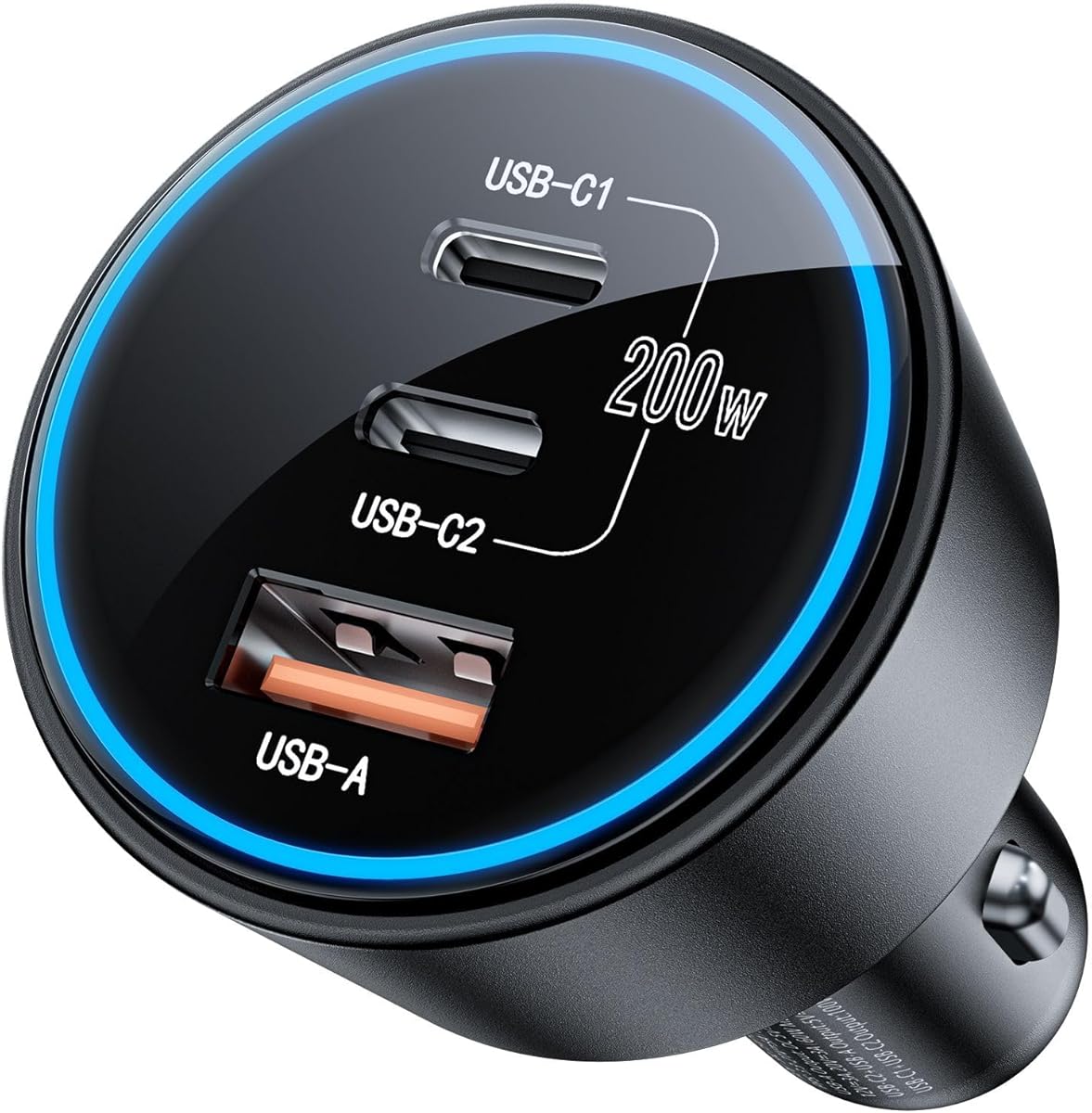


The LISEN 200W Car Charger stands out as the most versatile high-power option in this guide, earning a 4.6 rating from its listed customer feedback. Its defining feature is a three-port layout that combines a 140W-capable USB-C connection with a 30W USB-C port and a 30W USB-A port. That makes it suitable for more than ordinary phone charging, especially when a laptop, passenger phone, and accessory need power at the same time.
We may earn a commission when you buy through this link, at no additional cost to you.
The charger supports PD 3.1, QC 4.0+, PPS, and Apple Fast Charge, while intelligent device identification is intended to negotiate suitable output for connected hardware. Its dedicated Samsung fast-charging support is another strength, and the supplied information specifically references Galaxy S23 through S26 models as well as newer flagships. The included 240W USB-C cable is particularly useful because a basic cable may not support the charger's highest laptop output.
Thermal management is another area that distinguishes this model. GaN technology is described as improving efficiency and reducing heat compared with standard charger designs, while the full-metal housing promotes heat dissipation. Safety protections cover over-voltage, over-current, and short-circuit conditions, and the product is listed as UL, FCC, and CE certified. As with any multiport charger, maximum speeds depend on connected devices and negotiated charging requirements, so the printed 200W is a total ceiling rather than a promise to every port.
This is the strongest recommendation for drivers who regularly carry a USB-C laptop, travel with multiple passengers, or want one charger to cover phones, tablets, and smaller computers. It is less compelling for someone whose only need is a compact adapter for one phone, but for a broad and demanding device mix, its combination of output, port selection, included cable, and thermal design is especially persuasive.
The 140W primary USB-C port separates this charger from most compact vehicle adapters. It gives compatible USB-C laptops a meaningful power source during travel, while the remaining ports keep two smaller devices connected without requiring a second wall charger.
Three ports and intelligent allocation make this a practical centerpiece for family cars and business travel. A driver can connect a notebook while front- and rear-seat passengers charge phones, although each device will receive only the power its protocol and demand permit.
We may earn a commission when you buy through this link, at no additional cost to you.
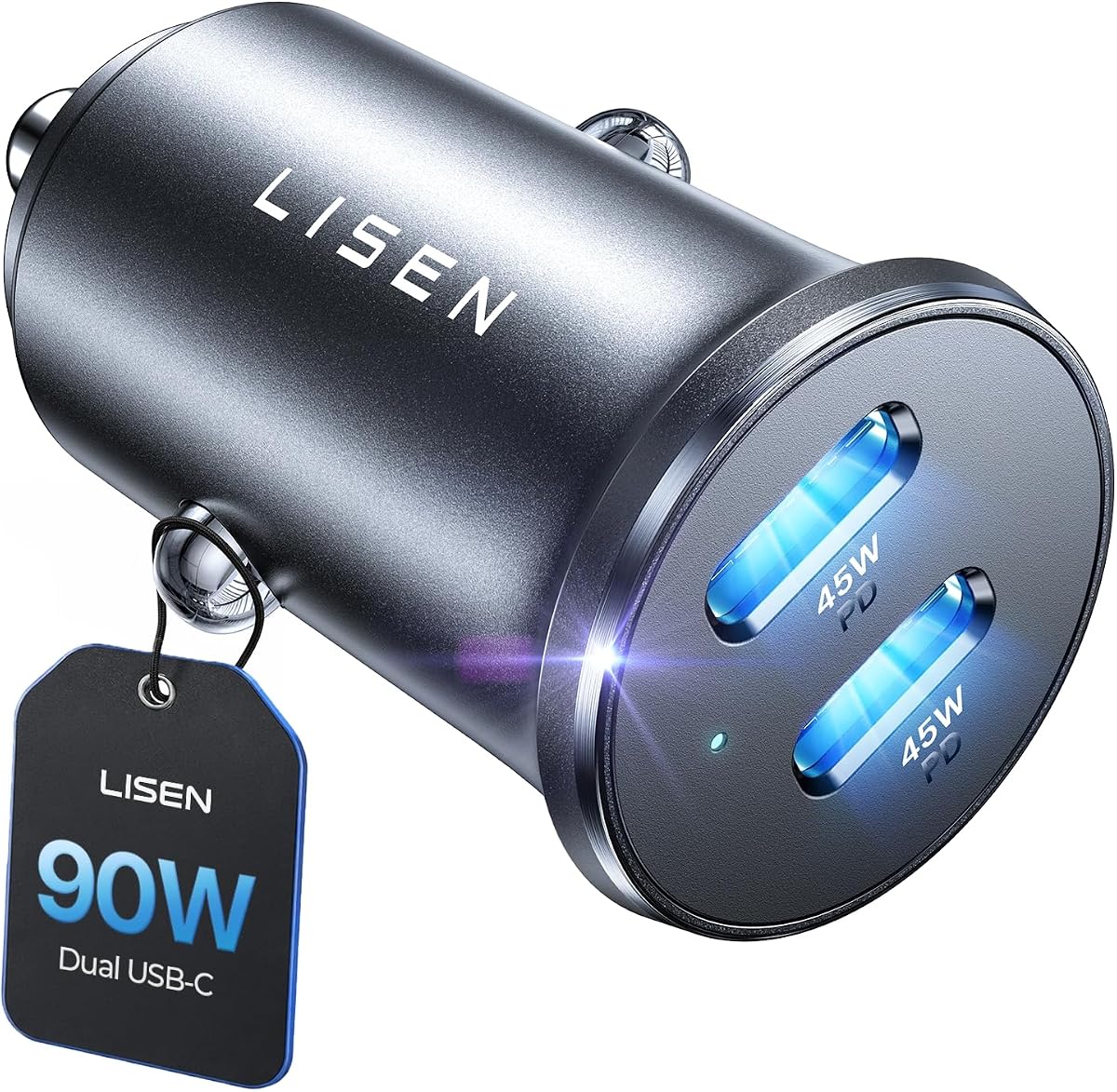
The LISEN 90W Dual USB-C is a focused solution for drivers who want fast charging for two modern devices without carrying a bulky adapter. It has a 4.6 rating and uses two USB-C ports, each listed as capable of delivering up to 45W. That format is well suited to a driver and passenger who both use USB-C phones, tablets, or other compatible accessories.
We may earn a commission when you buy through this link, at no additional cost to you.
Power Delivery 3.0 support is the core strength. The supplied product information states that an iPhone 18 Pro can charge from zero to 83% in approximately 30 minutes under the described conditions. It also supports QC3.0, making it broadly useful with compatible Android equipment. The metal-alloy shell is designed not only for appearance but also for better heat dissipation during simultaneous charging.
Its compact dimensions help it fit naturally into a crowded center console, and the product is listed as UL, CE, FCC, and RoHS certified. An intelligent power-management chip and V-0-rated PC fuel-barrier material add further layers of safety. The main limitation is obvious: there is no USB-A port, so drivers of older accessories or devices that rely exclusively on that connection would need an adapter or a different charger.
Choose this model when its two USB-C ports align with your devices and you value a small, affordable, multipurpose adapter. It is not the right choice for a high-power laptop, but it delivers a useful balance of compactness and charging performance for everyday travel.
The two-port configuration makes shared charging simple, while the stated 45W capability offers more headroom than basic phone adapters. Its small footprint helps reduce visual clutter around the socket and makes it easier to reach the connector.
PD 3.0 and QC3.0 cover the principal fast-charging needs of compatible modern devices. Actual results still depend on the phone or tablet, its charging limit, the cable, and whether two devices are drawing power simultaneously.
We may earn a commission when you buy through this link, at no additional cost to you.
The USB C Car Charger 200W offers an ambitious three-port design, with two USB-C connections listed at up to 100W each and a USB-A port at up to 60W. Its 4.6 rating reflects a broadly capable option for drivers who need to charge several kinds of equipment, including notebooks, tablets, phones, earbuds, and compatible handheld gaming devices.
We may earn a commission when you buy through this link, at no additional cost to you.
Protocol support is notably extensive. The specifications list QC4.0, QC3.0, PD3.0, PPS, SCP, FCP, and AFC, allowing the charger to negotiate with many Android ecosystems as well as USB-C devices. It also operates across 12V and 24V vehicle systems, which makes it relevant to cars, trucks, SUVs, and other vehicles using compatible cigarette-lighter sockets.
Heat management and protection are addressed through a newer heat-dissipation process and safeguards for over-current, over-voltage, and over-temperature conditions. The described trickle mode is intended to avoid continued unnecessary charging after a phone is full. An ice-blue ambient ring makes the ports easier to locate in darkness without requiring a separate light.
This is a capable all-round charger, but it comes with sensible expectations. High wattage is useful only with compatible devices and appropriate cables, and no cable is listed among the contents. It is best for a mixed device ecosystem or a road trip where several people need to charge at once.
Supporting PD, PPS, QC, SCP, FCP, and AFC makes the adapter less dependent on any one device brand. This is helpful for mixed households in which Android phones, tablets, and USB-C accessories may negotiate charging in different ways.
The charger's stated output is backed by listed protections and a heat-dissipation design. It remains important to use quality cables and confirm that the connected device and vehicle socket support the selected charging mode.
We may earn a commission when you buy through this link, at no additional cost to you.
The 67W 3-Port Super Fast Type C Car Charger is a balanced middle ground, combining a 4.7 rating with enough output for phones, tablets, and smaller USB-C devices. It includes two USB-C connections and one USB-A port. The USB-C side can deliver up to 37W, while the USB-A connection is listed at up to 30W, with 67W available across the charger under supported conditions.
We may earn a commission when you buy through this link, at no additional cost to you.
Its broad compatibility list includes current and recent iPhone models, Galaxy S-series devices, Google Pixel phones, iPads, and other Android products. The supplied information states that compatible phones can charge from zero to 50% in about 30 minutes, while MacBook Air and iPad charging is also supported at high speed. That makes it more useful than a basic phone-only adapter.
Safety is handled by an intelligent chip with protection against over-current, over-voltage, overheating, and short circuits. The ABS and PC shell is described as fireproof, and charging is said to stop automatically when a device reaches full capacity. A three-foot USB-C to USB-C cable is included, removing the need to source one for basic phone or tablet charging.
This is a compelling choice for a family vehicle where several people need ordinary fast charging. It lacks the output needed to charge a demanding notebook at full speed, and its allocated power falls as more devices connect. For phones and tablets, however, it balances capacity, port count, and convenience particularly well.
Thirty-seven watts on USB-C and 30 watts on USB-A provide useful headroom for contemporary phones and tablets. The 67W ceiling provides room for multiple smaller devices without suggesting that every connection can receive its maximum simultaneously.
The included three-foot USB-C cable is long enough for many console placements while remaining easy to store. Combined with the three-port body, it reduces the need to carry separate charging accessories for a routine family commute.
We may earn a commission when you buy through this link, at no additional cost to you.
The LISEN PD3.2 Super Fast Car Charger combines a 4.7 rating with one of the most technically advanced feature sets in the guide. Its primary USB-C port can deliver up to 100W, and the product's PD3.2 SPR AVS implementation supports precise voltage adjustment. The specification states that this can unlock 60W wired charging for the iPhone 18 Pro and reach 50% in roughly 15 minutes.
We may earn a commission when you buy through this link, at no additional cost to you.
The charger's three ports share 136W total output. USB-C1 is listed at up to 100W, while USB-C2 and USB-A can each provide up to 36W. Importantly, the product information emphasizes that these are measured per-port outputs rather than simple arithmetic added together, which gives shoppers a more useful understanding of what each connection can do.
Laptop support is a major advantage. The internal buck-boost function allows the USB-C1 output to reach up to 100W in both 12V and 24V vehicles, covering compatible MacBook, Dell, and other USB-C notebooks. A passive airflow vent works with the internal power chip to limit heat, while protection covers over-current, over-voltage, over-temperature, and short-circuit conditions.
A secure fit is another selling point. The product is designed to remain seated on rough roads and avoid flickering or dropouts. It is a premium choice for drivers who need both serious laptop power and room for two smaller devices. The main caveat is that output is allocated according to demand, and the highest levels still depend on the vehicle, device, and cable.
One hundred watts from the primary USB-C port can support a meaningful workflow for compatible notebooks. The buck-boost design is especially useful because it seeks to preserve that capability across both 12V and 24V vehicle systems.
Listing USB-C1 at up to 100W and the other connections at up to 36W is clearer than simply advertising the 136W total. This helps buyers understand which port should be connected to a laptop when the charger is handling several devices.
We may earn a commission when you buy through this link, at no additional cost to you.
The Scosche CPDCC60 PowerVolt 60W is a straightforward dual USB-C charger for drivers who want reliable Power Delivery without a complicated port array. It carries a 4.6 rating, and each of its two USB-C ports can supply up to 30W. That makes it a natural choice for two phones, a phone and tablet, or several smaller USB-C accessories.
We may earn a commission when you buy through this link, at no additional cost to you.
The charger supports Power Delivery 3.0 and PPS, allowing compatible devices to negotiate suitable charging voltages. The product information says compatible iPhones can reach 50% in as little as 30 minutes and describes charging as up to four times faster than a standard 5W USB charger. Those results depend on device limits, cables, and the number of devices connected.
A blue LED indicates when the adapter is receiving power from the vehicle's 12V outlet, which is a useful reassurance that the socket is active. Built-in protection circuitry is specified against overcharging and overheating, and the charger is described as tested and certified for safe, fast charging.
This model is best for a two-device, USB-C-centered routine. It does not have a USB-A port and cannot provide the substantial output required by many laptops. Even so, its simple design, 30W per-port capability, and certification make it an uncomplicated option for everyday commuting.
Two equal USB-C ports remove ambiguity about where to plug in a phone or tablet. Thirty watts per port is ample for many mobile charging scenarios while keeping the adapter easy to understand.
The blue LED provides an immediate visual indication that the vehicle outlet is supplying power. It is a small feature, but useful when plugging in at night or confirming that a cable is connected to a live port.
We may earn a commission when you buy through this link, at no additional cost to you.
The Anker 4-in-1 Bundle has the highest listed rating in the guide at 5.0 and is the only complete charging bundle. It includes a 67W three-port car charger, a 45W USB-C wall charger, a three-foot USB-C cable, and a six-foot USB-C cable. For a driver who wants one organized set for use at home, in the office, and in the car, that breadth is unusually useful.
We may earn a commission when you buy through this link, at no additional cost to you.
The car charger contains two USB-C ports and one USB-A port, with up to 45W available from USB-C1. That primary connection is suitable for laptops, tablets, and phones on longer journeys, while the other two ports support additional passengers. Both cables are USB-C to USB-C and are described as supporting fast charging and data transfer.
The three-foot cable is suited to desktop or front-console connections, while the six-foot cable can reach a rear seat or back bench. The wall charger likewise provides 45W USB-C Power Delivery for compatible devices such as phones, tablets, MacBook Air, AirPods, and Galaxy products. Together, the components reduce duplicated adapters and cables.
The tradeoff is obvious: shoppers interested only in a vehicle adapter may not need the wall charger or a spare cable. Even so, the bundle offers a particularly coherent travel system, a top listed rating, and a 67W car charger with enough output for meaningful multi-device use.
Including both a wall charger and a vehicle charger means a user can maintain the same charging setup beyond the car. It is especially convenient for travelers who want to minimize the number of adapters packed in a bag.
The shorter cable suits close connections, while the longer lead reaches passengers in the rear. Having both removes the common compromise of choosing a cable that is either too short for the cabin or unnecessarily long for every use.
We may earn a commission when you buy through this link, at no additional cost to you.
The LISEN Retractable 84W Charger is built around organization rather than extreme aggregate output. It combines a 45W PD USB-C connection, a 12W USB-A port, and two retractable cables to charge up to four devices. One retractable lead is USB-C and the other is described as an older iPhone charging cable, both extending as far as 31.5 inches.
We may earn a commission when you buy through this link, at no additional cost to you.
The retractable construction can keep a center console cleaner than several permanently draped cables. The product information also states that the 45W output can charge recent iPhone Pro Max models to 50% in about 15 minutes, although maximum performance depends on a 24V vehicle supply. On a standard 12V socket, the listed peak is reduced to 36W.
Its adjustable 180-degree design allows the charger to be angled toward the cabin, and the construction is intended to remain stable on rough roads. Smart power distribution manages simultaneous use, while a 24-month replacement promise provides additional reassurance. The product is designed strictly as a charging adapter and does not support CarPlay, Bluetooth, or data transfer.
This is a compelling choice for drivers who dislike cable clutter and need several connections. It is less suitable for anyone searching for a single-cable solution, requiring a data connection through the cigarette-lighter socket, or expecting full 45W output from every standard 12V vehicle socket.
Two cables that retract into the body reduce loose wires around the console. The 31.5-inch reach can also make rear-seat charging more practical than a fixed short lead would.
The swiveling body and retractable mechanism are useful in different vehicle layouts. Because this unit is charging-only and does not support data transfer or CarPlay, it should be treated as a dedicated power hub rather than a universal connection point.
We may earn a commission when you buy through this link, at no additional cost to you.
The Two-Pack 125W Fast Car Charger combines strong single-device performance with the practical benefit of including two adapters. Its 4.4 rating is the lowest listed among these selections, but the core specification set is well suited to modern phones, tablets, and laptops. One charger can be kept in a family vehicle while the other serves another car or a shared travel kit.
We may earn a commission when you buy through this link, at no additional cost to you.
Each adapter has a 65W USB-C PD port and a 60W USB-A QC port, with support for PD3.0, QC3.0, SCP, and FCP. The product information states that one connected phone can charge from zero to 90% in approximately 30 minutes when using a single port. It also lists compatibility with current iPhone, Samsung Galaxy, MacBook, and iPad models.
Its mini flush-fit design should sit neatly in many console sockets, and a foldable pull ring helps with removal from tight receptacles. The listed titanium-alloy body and carbon-fiber-style texture are intended to improve heat dissipation while giving the adapter a distinctive appearance. The two-pack format is particularly useful for households with multiple vehicles.
There are important operating constraints. The USB-A and USB-C ports cannot fast-charge simultaneously, power is distributed to standard speeds when both are used, and the stated maximum outputs are achievable only with a 20V car supply. A compatible fast-charging cable is also required but not included.
Receiving two adapters eliminates the need to move a single charger between vehicles. The pair can also serve as a spare, which is helpful when one adapter is already in use by another driver.
The flush profile reduces console clutter, while the pull ring addresses a common annoyance with tightly fitted accessories. The premium housing is also designed to manage heat as charging continues.
We may earn a commission when you buy through this link, at no additional cost to you.
The UGREEN 130W 3-Port USB C Car Charger is a versatile three-port option with a 4.6 rating. Its total output is listed at 130W, and the product is described as suitable for MacBook, iPad, Galaxy, iPhone, Steam Deck, Switch, and other devices. That range makes it a practical travel hub when the people in a vehicle use different types of electronics.
We may earn a commission when you buy through this link, at no additional cost to you.
A major feature is the USB-C2 port's support for up to 45W PPS charging, specifically highlighted for Samsung Galaxy S24 Ultra, S23 Ultra, and S22 Ultra models. The adapter also includes two USB-C connections and one USB-A connection, creating enough flexibility for a driver, a front passenger, and a rear passenger to use separate connections.
The product works with both 12V and 24V cigarette-lighter sockets. Its advanced chips provide protection against overheating, short circuits, over-voltage, and over-current. A scratch-resistant PC body and soft blue LED improve durability and nighttime port visibility without adding distracting brightness.
This charger is a good general-purpose choice for road trips and daily family use. It is not intended to deliver the very high laptop output offered by several 100W-plus single-port designs, and a cable is not included. Nevertheless, its 130W aggregate capacity and PPS support make it a well-rounded option for mixed Android, Apple, and accessory charging needs.
The 45W PPS connection is particularly relevant to compatible Galaxy flagships and other PPS devices. PPS allows charging levels to adjust more closely to a device's accepted range rather than relying on one fixed voltage profile.
Three ports accommodate several passengers and a broad mix of electronics. The stated 12V and 24V support makes the charger adaptable to a wider range of vehicles, although users should still verify their socket type and insert it fully.
We may earn a commission when you buy through this link, at no additional cost to you.
Choosing a car fast charger involves balancing device requirements, socket voltage, port count, protocol support, thermal design, and cable quality. A larger advertised wattage is not automatically more useful, so the best option is the one that can safely power your actual devices at the times you need them.
Car charger wattage has two dimensions: the aggregate maximum and the maximum available from an individual port. A 200W three-port adapter may provide 140W, 30W, and 30W, while another 136W model may offer 100W, 36W, and 36W. A laptop generally benefits from the highest-output USB-C port, while phones can often charge effectively at much lower levels. Multiport output is shared, so adding several phones may reduce the rate available to a notebook.
Prioritize the per-port output your largest device needs, then confirm whether the remaining ports can support the rest of your setup.
USB-C is essential for modern Power Delivery devices, but USB-A remains useful for older phones, accessories, flash drives, and other legacy equipment. A mixed two-USB-C-plus-one-USB-A layout offers the broadest compatibility. A dual-USB-C charger can be cleaner for modern devices, yet it may require an adapter for an older accessory. Count both the number of physical connections and the number of devices that can fast-charge at the same time.
Choose a mixed layout for broad compatibility, or prioritize two USB-C ports when every traveler uses modern cables.
Most passenger vehicles use a 12V accessory socket, while trucks, SUVs, and larger vehicles may use 24V. A charger compatible with both is more flexible, but some high outputs depend on the available voltage. The LISEN PD3.2 model specifically highlights buck-boost operation across 12V and 24V systems, while the retractable LISEN model notes that peak output is limited on a 12V socket. Buyers should check their vehicle's socket specification before relying on a maximum figure.
Confirm that the charger supports your vehicle's voltage, especially if maximum laptop output is a priority.
Power Delivery is central to the category, but major device families also use proprietary or vendor-specific fast-charge profiles. PPS is important for many compatible Samsung devices, while QC4.0, QC3.0, SCP, FCP, and AFC broaden support across Android products. Apple Fast Charge is also listed as support in one leading model. The more protocols a charger recognizes, the more likely it is to negotiate a suitable rate with a mixed collection of phones, tablets, and notebooks.
Match the listed protocols with your devices, paying particular attention to PPS or vendor-specific support when using premium Android phones.
Fast charging in a hot vehicle creates a demanding thermal environment. GaN components, metal housings, passive airflow, and improved heat-dissipation structures can help maintain stable performance. Electrical safety is equally important, so look for over-current, over-voltage, over-temperature, and short-circuit protection. A trickle or automatic-stop function may also help avoid unnecessary continued charging after a phone reaches full capacity. Certifications such as UL, FCC, CE, and RoHS add another layer of assurance, though they do not replace correct installation.
Choose a charger with both thermal engineering and documented fault protection, particularly for long journeys or repeated high-power use.
A device may support very fast charging but still receive only a basic rate if the cable is too thin, lacks the necessary controller, or is damaged. High-output laptop charging generally calls for a full-featured USB-C to USB-C cable. Two products in this guide include cables, while others expressly do not. A three-foot lead is convenient near the front console, and a six-foot lead is better for reaching rear passengers. Retractable cables can further reduce clutter in vehicles used by multiple people.
Verify that a suitable fast-charging cable is included or budget to purchase one separately before expecting the charger's maximum output.
A charger that advertises excellent power can still be frustrating if it does not fit the socket, blocks controls, or disconnects on rough roads. Full-metal bodies, flush-fit shapes, pull rings, and adjustable angles address different installation concerns. For passenger use, three or more ports may eliminate the need to pass cables around. For one-device use, a small two-port model can be less visually intrusive. A secure fit is especially important for retractable-cable designs that may be pulled during use.
Consider socket clearance, retention, indicator visibility, and passenger needs alongside electrical specifications.
Start by identifying your vehicle's accessory-socket voltage and inspecting the socket for dust, debris, or damage. Insert the charger firmly but without forcing it, and confirm that any LED indicator shows the adapter is receiving power. Connect one device first, then add additional devices gradually. This simple sequence helps you identify whether a slow result is related to the charger, the cable, the device's charging limit, or the vehicle socket.
Use cables that support the charging protocol and power level of the connected device. For the highest laptop output, choose a robust USB-C to USB-C cable and connect the notebook to the charger's highest-rated USB-C port. If several devices are connected, remember that total output is shared. A phone may also impose its own maximum, so a charger advertised above the phone's input rating will not make it charge beyond the phone's supported rate.
Keep the charger and socket area clear of direct sun and avoid placing objects that block heat dissipation. On long trips, periodically check that the adapter remains secure and that the connector is not unusually hot. Retractable cables should be pulled and held while extending them slightly before release for retraction. Do not use the adapter if the shell is cracked, a pin is bent, or the fit becomes unstable, and unplug devices before removing the charger.
Yes, when the laptop has USB-C Power Delivery and the charger supplies enough power on a single port. The LISEN 200W and LISEN PD3.2 models are highlighted for outputs up to 140W and 100W respectively, while the UGREEN 130W model is also described as compatible with MacBook devices. You will also need a suitable USB-C cable, and charging speed depends on the notebook's accepted input and the vehicle's available socket power.
No. Total wattage is generally shared across connected devices. A three-port charger might list 130W or 200W in total while assigning a much smaller maximum to each USB-C and USB-A connection. Review the per-port figures carefully, connect a laptop to the highest-output port, and avoid expecting every phone to receive the headline total while another device is charging.
USB Power Delivery is a broadly used standard for negotiating voltage and current with compatible devices. Programmable Power Supply, or PPS, is a more finely adjustable extension used by many compatible Android phones and tablets. Quick Charge, or QC, is a separate fast-charging system found across many Android products. A charger supporting several of these protocols can serve a wider device mix, but the connected device must support the relevant mode for its fastest result.
It depends on the charger's supported input range. Several products in this guide explicitly support both 12V and 24V vehicle sockets, but others do not state the same compatibility in their supplied information. Check the product listing and your vehicle manual before purchase. A charger designed for 24V may also require a higher-output vehicle socket to deliver its maximum performance.
Most multiport chargers share their available power and negotiate output according to each connected device. Adding a laptop or multiple phones can reduce the rate assigned to every port. The connected phone may also have a built-in charging limit, and the cable may not support its fastest protocol. Test with one device connected and a known compatible cable to identify whether the issue is allocation or a separate limitation.
A retractable charger can be convenient when it is designed for the purpose, with secure socket engagement, stable current, and appropriate electrical protections. The LISEN retractable model includes a 45W PD USB-C output, a 180-degree adjustable body, and a design intended to remain stable on rough roads. Pull the cable as instructed rather than yanking it, and stop using it if the socket fit or retraction mechanism becomes damaged.
A charging adapter and a data adapter are not automatically interchangeable. The LISEN retractable charger in this guide is explicitly designed for power only and does not support CarPlay, Bluetooth, or data transfer. The other chargers are also presented primarily as charging products. If connectivity is important, look for a separate, explicitly compatible data adapter rather than assuming a USB-C car charger will perform that role.
Yes, a suitable fast-charging cable is often necessary to reach the charger's rated output. This is especially important for high-watt USB-C laptop charging, where a basic cable may not support the required power and data negotiation. Two selections include a USB-C cable, while the two-pack 125W charger expressly requires a compatible cable that is not included. Use undamaged cables rated for the charging mode and device combination.
The LISEN 200W Car Charger is the most capable all-round selection, combining 140W of primary USB-C output with two additional ports, broad protocol support, a full-metal GaN design, and an included 240W cable. The LISEN PD3.2 model is the premium alternative for drivers who value measured per-port output, adjustable voltage, and secure retention, while the 67W three-port charger is a well-balanced budget recommendation for phones and tablets.
Start with the device that needs the most power, because that should determine the necessary single-port rating. Add the number of passengers and legacy accessories to estimate port count, then confirm protocol support, vehicle voltage, included cables, and safety features. Small chargers are adequate for one or two modern phones, whereas laptop users and families need a more substantial three-port design with intelligent allocation.
Ratings and feature details provide a solid starting point, but current prices, promotions, and availability can change. Review the latest listing details and customer feedback before buying, and verify that the cable and vehicle socket support the charging level you expect. With those checks complete, a well-matched charger can turn a car socket into a dependable power source for phones, tablets, notebooks, and travel accessories.