
PT177 Portable Gas Leak Detector
4.6Editor score
Pocket-sized portable design
Audible and visual alarms
Two AAA batteries included
30-second calibration
Explore the best RV propane leak detectors, comparing probe reach, %LEL readings, alarm strength, power options, and installation for safer RV travel.
RV propane leak detectors range from handheld gas sniffers to permanently mounted alarms, and choosing the right type depends on how you travel and where the risk is greatest. A good detector should identify combustible gas quickly, provide a clear warning, and remain practical in the confined spaces and changing temperatures found around an RV.
We compared all ten products by examining gas compatibility, detection method, alarm feedback, probe or sensor design, power requirements, installation needs, and intended RV use. The list includes portable units for point-by-point inspections, flush-mounted replacements, a surface-mounted RV alarm, and a combination carbon monoxide and gas alarm.
Each review explains the product's most useful features, limitations, and ideal owner. The top picks represent the strongest options for different priorities, while the full comparison shows how portable detectors and installed alarms differ. Product availability and pricing can change, so check the current listing before purchasing.
4.6Editor score

4.5Editor score

4.7Editor score
The table below compares the ten included detectors by format, gas readings, alarm style, and power source. It makes the distinction clear between portable inspection tools and permanently installed RV safety alarms, helping readers choose the approach that matches their travel and storage setup.




The PT520A earns the Editor's Choice position because it combines a long 17-inch gooseneck with a broad stated detection range of 50 to 10,000 ppm based on methane. Its 4.6 rating reflects a strong level of customer satisfaction, while the standout feature is the ability to inspect pipes, storage tanks, appliances, and other areas that are difficult to reach with a compact sniffer.
We may earn a commission when you buy through this link, at no additional cost to you.
Gas detection is advertised at 0.5 seconds, with seven colored bars and a 75dB audible alarm that intensify as concentration rises. The flexible probe is especially valuable in an RV because it can approach a suspected leak from a short distance without placing the user's face directly over a regulator, valve, or fitting. The detector can also be used indoors or outdoors and supports several combustible gases, including propane, methane, butane, and LPG.
The trade-off is that this is a handheld inspection instrument rather than a permanently installed safety alarm. It will not provide the same automatic coverage while the RV is unoccupied, and its long probe makes it less convenient for a quick scan than the smaller PT199, PT205, or PT177. The auto power-off setting, mute control, included batteries, and protective case nevertheless make it straightforward to store and deploy.
This is the strongest all-around choice for owners who want more probe reach and a larger visual alert than the simplest pocket detectors provide. Choose the PT520A when your priority is finding a suspected leak around RV plumbing and storage equipment, and pair it with a separately installed alarm if continuous protection is needed.
The 17-inch gooseneck is the PT520A's defining advantage. It helps reach behind cabinets, around storage tanks, alongside pipes, and into other confined spaces while keeping the instrument body at a practical distance from the suspected source.
Seven colored bars and an alarm that grows more intense provide several ways to judge a reading. This makes the device useful for both a quick sweep and a more careful point-to-point inspection near fittings and valves.
We may earn a commission when you buy through this link, at no additional cost to you.
The PT199 is a straightforward, budget-conscious gas sniffer for RV owners who want a compact tool for checking exposed fittings and nearby compartments. It carries a 4.6 rating and detects natural gas, methane, propane, butane, and LPG, making it more broadly useful than a detector designed for only one fuel type.
We may earn a commission when you buy through this link, at no additional cost to you.
Its strongest advantages are portability and clarity. The device fits into a pocket, comes with a storage bag, and uses a non-slip body for controlled movement around the RV. Visual and audio alarms activate within 0.5 seconds, the alarm intensifies as gas concentration rises, and the LCD turns red when levels are high. A low-battery indicator and automatic shutdown after inactivity help simplify maintenance.
Its stated methane-based detection range of 50 to 1,000 ppm is narrower than the PT520A's range, and the lack of a flexible probe makes it less suitable for checking deep inside cabinets or around awkward connections. It is a detector to move close to a suspected area rather than a substitute for a permanently installed alarm.
The PT199 is an appealing choice for new RV owners seeking a small, uncomplicated inspection tool. It works especially well for routine checks where the suspected source is accessible, while owners with more complex plumbing layouts may prefer a model with an extendable probe or higher LEL range.
The PT199 gives owners a simple way to check accessible RV gas components without carrying a larger instrument. Its pocket format makes it easy to keep in a utility drawer or take outside during a routine system check.
The combination of an escalating audible alarm, a visual warning, and a red screen at elevated readings helps users confirm a suspected leak quickly. That immediate feedback is useful when comparing one valve or fitting with the surrounding clear air.
We may earn a commission when you buy through this link, at no additional cost to you.
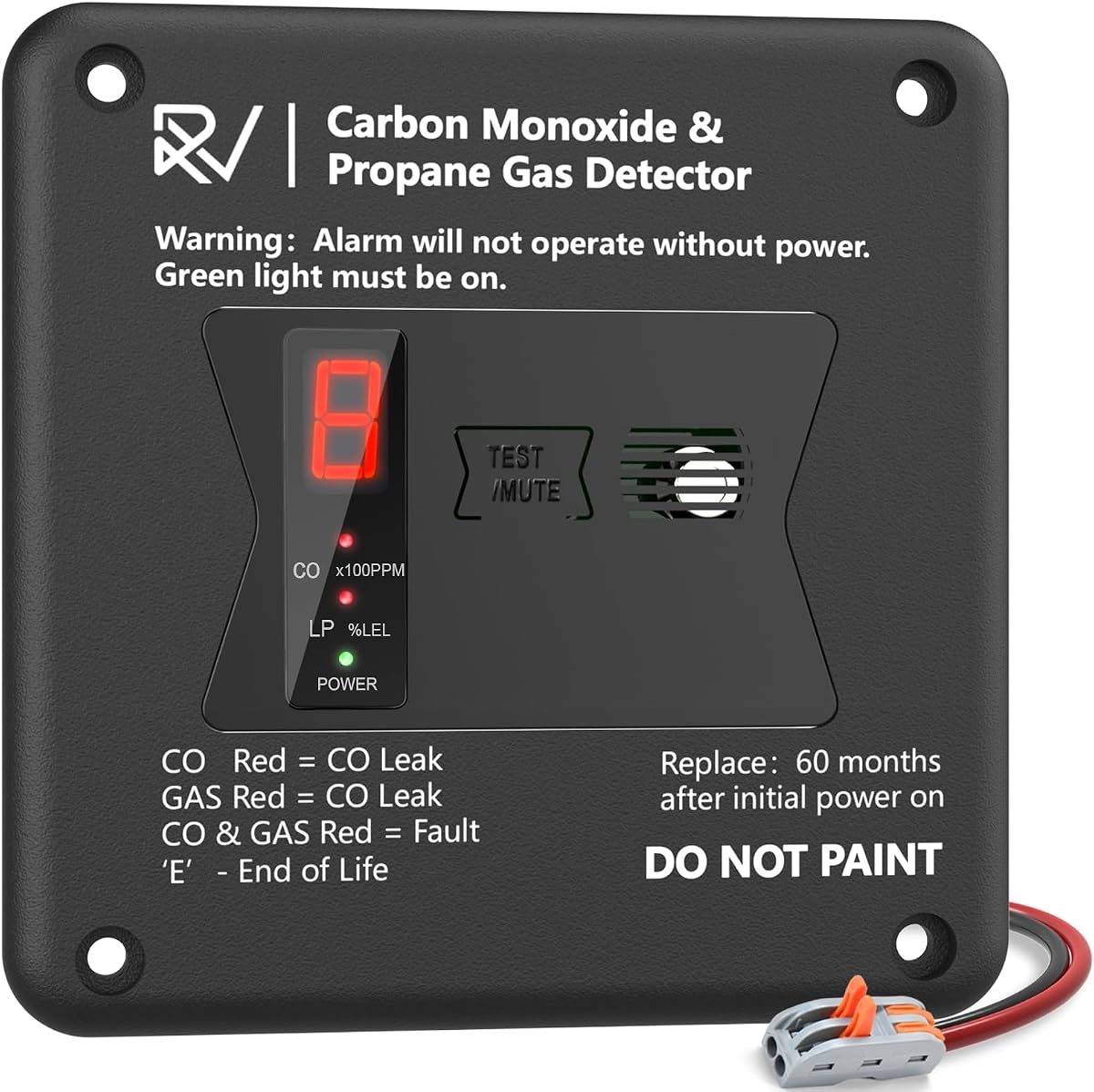
The R503 is the most installation-oriented option in this roundup and the best fit for owners replacing an existing flush-mounted RV detector. It holds a 4.6 rating and uses two independent, sensitive sensors intended to detect carbon monoxide and gas leaks in motorhomes, travel trailers, motor coaches, and truck campers.
We may earn a commission when you buy through this link, at no additional cost to you.
A digital LED display shows carbon monoxide levels and indicates when the carbon monoxide and gas sensors are active. The advertised 100dB alarm is designed to be difficult to miss, while lever-nut connectors simplify wiring compared with traditional electrical tape and wrapped butt connectors. The unit accepts 12V DC with a plus-or-minus 20% operating range.
The main compromise is installation. It requires an appropriate wall cutout, electrical connection, and physical mounting rather than simply being carried from compartment to compartment. The stated face-cover dimensions, cutout range, and 31011-compatible screw spacing should be checked carefully before purchase, especially in an older RV with a nonstandard opening.
Choose the R503 when continuous monitoring and a flush-mounted appearance matter more than handheld portability. It is a practical replacement for compatible RV systems, although it should not be selected on the assumption that it will fit every existing detector opening.
Unlike a portable sniffer, the R503 remains in the vehicle and monitors its chosen area whenever the RV's electrical system is active. That makes it better suited to ongoing protection than spot inspections.
Lever-nut connectors are a meaningful convenience for RV owners who are comfortable working with low-voltage wiring. They reduce the need for traditional wrapped connectors and can make an otherwise compact installation more manageable.
We may earn a commission when you buy through this link, at no additional cost to you.
The PT205 stands out for owners who want more than a simple alarm and a numeric %LEL reading. Its 4.6 rating is supported by a stated detection range of 1% to 10% LEL, equivalent to 100 to 5,000 ppm based on methane, and compatibility with propane, butane, methane, ethane, LPG, natural gas, and several other fuel gases.
We may earn a commission when you buy through this link, at no additional cost to you.
A bar graph rises as gas concentration increases, a beep provides audible feedback, and the LCD turns red at high concentrations. The 0.5-second response gives users fast confirmation near a suspected source. A warm-up countdown appears on the display, which helps users avoid beginning the inspection before the device is ready.
Compared with the PT177, the PT205 adds a clearer quantitative readout and a broader stated gas range. In exchange, it remains a compact unit without a probe, so difficult-to-reach points still require a different tool or careful positioning. The included two AAA batteries, low-battery warning, and automatic power-off add convenience for routine maintenance.
The PT205 is best for RV owners who want documented concentration information while checking accessible appliances, regulators, and lines. It is a strong middle ground between a basic warning sniffer and a larger instrument with a long flexible probe.
Showing %LEL gives the PT205 more diagnostic value than a unit that only sounds an alarm. Users can watch the bar graph and numeric reading change as the sensor approaches or moves away from the suspected leak.
The on-screen 30-second warm-up countdown removes much of the guesswork from the initial setup. It also encourages the detector to be powered in clean air before it is carried to a storage compartment or appliance.
We may earn a commission when you buy through this link, at no additional cost to you.
The PT177 is one of the simplest and most portable detectors in the guide, offering a practical way to inspect accessible propane and natural-gas connections in an RV. It has a 4.6 rating, a pocket clip, a non-slip body, and a drawstring storage bag, all of which make it easy to keep close at hand.
We may earn a commission when you buy through this link, at no additional cost to you.
Five red LEDs and a 75dB audible alarm provide visual and tactile warning cues. The alarm is designed to activate within approximately 0.5 to 3 seconds after exposure, depending on the conditions and concentration. A 30-second auto-calibration in clean air establishes the starting point, while a flashing power light appears when battery voltage drops below 2.4 volts.
The absence of a numeric display or probe makes it less informative than the PT205 and less capable of reaching deep into an enclosure. It is better viewed as a quick warning tool than a full diagnostic instrument. Automatic shutdown after five minutes of inactivity helps preserve the included batteries.
The PT177 is a compelling budget choice for RV owners who want a small detector for checking visible regulators, valves, and appliance areas. Choose it for simplicity and portability, and consider a probe-equipped model if your inspection routine routinely involves pipes behind cabinetry or other difficult-to-access equipment.
The pocket clip and compact body let the PT177 move with the user during an inspection. It can be set down quickly, retrieved without searching through a toolbox, and returned to its bag when the check is complete.
Five red indicators and a loud buzzer make the device easier to notice than a screen-only warning. The escalating alarm also helps guide the user toward the source while the visual indication provides a second way to recognize elevated gas levels.
We may earn a commission when you buy through this link, at no additional cost to you.
The PT210S combines a pen-shaped body, a four-inch probe, and a two-digit %LEL display. Its 4.6 rating reflects a well-rounded feature set for owners who need a little more access than a flat sensor can provide without carrying the bulk of a larger handheld detector.
We may earn a commission when you buy through this link, at no additional cost to you.
It detects propane, natural gas, methane, and butane over a stated range of 100 to 5,000 ppm, equivalent to 1% through 10% LEL. The screen turns red during a detection, bar graphs rise, and a 75dB buzzer sounds. The two sensitivity modes can help users choose between heightened responsiveness and less demanding scanning, depending on the task.
The four-inch probe is shorter than the 12-inch PT760 probe, the 17-inch PT520A gooseneck, and the extendable PT299 pole. It is still more useful in narrow gaps than a sensor-only unit. Battery power remains simple, while a low-battery indicator and five-minute inactivity shutdown help manage routine use.
Choose the PT210S when a compact body, direct %LEL display, and moderate probe reach are the most important needs. It is particularly convenient for checking around fittings and inside relatively shallow spaces where a flat sensor cannot be positioned accurately.
The four-inch probe lets users place the sensing end near gaps and fittings while keeping the display visible. That balance makes the PT210S a practical middle ground between pocket sniffers and long-probe models.
Dual-mode detection gives users flexibility when moving between a broad search area and a more focused inspection. The mode can be adjusted to suit the surrounding environment without changing the fundamental %LEL display.
We may earn a commission when you buy through this link, at no additional cost to you.
The PT760 is the strongest rechargeable portable detector in the group and one of the most versatile choices for RV maintenance. Its 4.5 rating is slightly lower than those of many competing models, but the feature set is unusually complete: a 12-inch telescopic stainless steel probe, a %LEL display, a built-in flashlight, and Type-C charging.
We may earn a commission when you buy through this link, at no additional cost to you.
The stated detection range extends from 1% to 20% LEL, or 100 to 10,000 ppm, and the audible and visual alarm is triggered within 0.5 seconds. The long probe reaches inside pipes, behind cabinets, and toward other locations that are difficult to inspect safely. When finished, the probe retracts so the unit can fit into its protective case more easily.
Rechargeable power is a meaningful convenience for owners who do not want to maintain a stock of AAA batteries. The tradeoff is that the detector depends on charging and cannot be assumed to work indefinitely in a remote location. The built-in flashlight is particularly helpful in dark storage compartments, while the preheat countdown and automatic power-off simplify operation.
The PT760 is an excellent top pick for an RV owner who wants a long-reach, rechargeable, quantitative inspection tool. It is less dependent on disposable batteries than most products in the guide and more capable in confined spaces than a simple pocket sniffer.
The extendable probe and built-in flashlight solve two common inspection problems at once. Users can reach into a compartment and illuminate it without craning their head into the area or carrying a separate light.
The Type-C port simplifies the charging routine and removes the need to carry spare disposable batteries. The included charging cable and protective case support a more permanent place in the RV's maintenance kit.
We may earn a commission when you buy through this link, at no additional cost to you.
The PT299 is a portable propane and natural-gas sniffer with an adjustable pole, making it well suited to RV compartments, storage areas, and plumbing spaces. It carries a 4.6 rating and supports propane, methane, natural gas, LPG, and gasoline vapor, along with a stated 1% to 10% LEL range.
We may earn a commission when you buy through this link, at no additional cost to you.
The pole extends from 2.20 to 6.30 inches, providing enough extra reach to inspect pipelines, storage tanks, fireplaces, basements, and RV fittings without moving the body of the detector too close to the suspected source. Nine analog bars rise with concentration, the display turns red, and a 75dB buzzer helps guide the user toward the affected area.
Compared with the PT760, the PT299 uses disposable batteries and has a shorter maximum extension, although its nine-bar display is easy to interpret at a glance. The 30-second preheat countdown, low-battery warning, non-slip grip, and optional automatic shutdown make it a practical maintenance tool.
Choose the PT299 for accessible but awkward RV gas components where a short adjustable probe adds useful reach. It is a good middle option for owners who want more than a flat sensor without the larger storage footprint of a long gooseneck or telescopic stainless steel unit.
The PT299's extension mechanism makes the sensing point more accessible in a confined compartment and retracts afterward. That makes it easier to keep the detector in a drawer or maintenance pouch between uses.
Nine bars provide a quick visual indication that gas is present and rising. Together with the red display and buzzer, the scale gives users several ways to recognize a problematic area during a point-to-point inspection.
We may earn a commission when you buy through this link, at no additional cost to you.
The Safe T Alert 20 Series Mini LP Gas Alarm is the most specialized RV product in the guide and earns the Premium pick. It has a 4.7 rating, the highest among the included products, and is engineered as a compact surface-mounted alarm for travel trailers, fifth wheels, truck campers, and folding campers.
We may earn a commission when you buy through this link, at no additional cost to you.
The alarm activates below 25% LEL of propane or methane. A mute button allows safe ventilation, while the rapid-recovery sensor reactivates the alarm if propane levels remain dangerous. This approach is designed to avoid leaving the unit silenced simply because a temporary alarm button was pressed.
Unlike the portable sniffers, it requires 12V DC power and a permanent mounting position. Its case measures 3.5 inches wide by 2.5 inches high by 1.25 inches deep, and the included bracket supports installation in tight spaces. The stated operating range from minus 40°F to 158°F is a major strength for RVs exposed to broad temperature changes.
This alarm is the best choice for owners who prioritize always-on monitoring and an RV-specific design. It should be installed according to its instructions and the relevant guidance for the RV's gas system, with care taken to place it in an appropriate location where it can detect gas effectively.
A permanently powered alarm remains active in an occupied or unoccupied RV, unlike a handheld detector that only works while someone is performing a check. That makes it valuable for overnight parking, storage, and travel between inspections.
The broad stated temperature range allows the alarm to remain in service in cold and hot environments. That durability is particularly relevant for RVs stored outdoors or used across widely different seasonal conditions.
We may earn a commission when you buy through this link, at no additional cost to you.
The Kidde combination alarm provides a simple installed solution for spaces that have access to a standard 120V outlet. It has a 4.5 rating and monitors both carbon monoxide and explosive natural gas or propane, making it broader than a dedicated RV LP alarm.
We may earn a commission when you buy through this link, at no additional cost to you.
Installation is straightforward: the unit plugs into a wall outlet, while a 9V backup battery maintains protection during a power interruption. Its digital display shows the carbon monoxide level being sensed or states GAS when explosive gas is present. An 85dB alarm, LED status indicators, and peak-level memory provide additional visibility and recordkeeping.
The main limitation is that a plug-in design may be less natural for an RV installation than a low-voltage surface-mounted alarm, depending on the vehicle's layout and the availability of an appropriate outlet. The listing also presents the product primarily as an easy home installation, so RV owners should confirm placement and power arrangements fit their specific vehicle.
Choose the Kidde alarm when a combined carbon monoxide and explosive-gas warning is the priority and a standard outlet is available. It is especially relevant to owners who want one display and alarm to cover two different combustion-related hazards.
Monitoring carbon monoxide alongside explosive gas is useful in locations where a combustion appliance or generator may create more than one risk. The display can show the carbon monoxide level or indicate the presence of gas.
The 9V backup battery gives the alarm a secondary source of power when the outlet is interrupted. LED status indicators and peak-level memory help users verify the unit's condition and review previous carbon monoxide activity.
We may earn a commission when you buy through this link, at no additional cost to you.
The right RV propane leak detector depends on whether you need continuous monitoring, a portable tool for locating a suspected source, or a combination device. Gas compatibility, probe access, power, alert visibility, and installation requirements should guide the decision.
A portable detector is best for routine maintenance, checking a suspected connection, and moving between the RV's gas appliances and storage areas. The PT199, PT177, PT205, PT210S, PT299, and PT760 provide different combinations of size, access, and readings. A permanently installed alarm, such as the Safe T Alert or the R503, is better suited to continuous monitoring and does not depend on the owner remembering to carry and operate a handheld device.
Choose a portable model for diagnostics and an installed model for ongoing protection. Many owners benefit from both.
A device's stated range indicates the concentration span it is designed to measure. Some products provide a broad ppm range, while others display %LEL, which expresses gas concentration relative to the lower explosive limit. The PT760 spans 1% to 20% LEL, while the PT205, PT210S, and PT299 cover 1% to 10% LEL. Lower-end models use methane-based ppm figures that are not directly interchangeable without checking the stated conditions.
Prioritize a clear numeric display if you want more than a warning. Treat the range as a guide rather than a substitute for safe operating procedures.
Probe length determines how precisely you can inspect valves, joints, pipes, and areas behind cabinetry. The PT520A has the longest stated probe at 17 inches, the PT760 extends to 12 inches, the PT299 reaches 6.30 inches, and the PT210S uses a four-inch probe. Flat sensors and pocket models are easiest to carry but require the body to be placed close to the suspected source.
Match the probe to the space. A longer tool is more useful for deep compartments, while a short probe may be sufficient for exposed fittings.
A good alarm should be noticeable in a noisy RV environment. Audible outputs in this group range from 75dB on several portable models to 85dB on the Kidde and an advertised 100dB on the R503. Visual feedback includes LED bars, red screens, color changes, and numerical readings. A mute control can be useful during controlled ventilation, but it should not be used as a substitute for resolving the source.
Look for both sound and visual cues. The visual warning is especially helpful when a person cannot immediately hear the alarm.
Portable detectors generally use replaceable AAA batteries, making it easy to keep a spare set available. The PT760 instead uses a rechargeable Type-C battery, which reduces disposable battery consumption but requires access to charging. Installed alarms usually rely on the RV's 12V electrical system, with the Kidde using a 120V plug and 9V battery backup. Low-battery indicators and automatic shutdown features help maintain readiness.
Choose power based on reliability, convenience, and how the detector will be stored. A portable tool should be checked before each trip, while an installed alarm depends on wiring and electrical-system condition.
Permanent detectors need enough room and suitable electrical connections. The Safe T Alert is a compact surface-mount unit intended for tight RV spaces. The R503 is a flush-mounted replacement with a stated cutout range and compatibility with 31011 screw spacing. The Kidde requires a standard outlet, which may or may not suit the desired location. Owners of older or modified RVs should measure openings and inspect their wiring before ordering an installed model.
Verify dimensions, mounting method, voltage, and connector type. A compatible power source alone does not guarantee that the physical installation will be straightforward.
An RV detector should be appropriate for the fuel system it is intended to inspect. Most of the TopTes portable models support propane along with methane, butane, LPG, natural gas, and other combustible gases. The Safe T Alert is designed around propane or methane detection for LP gas systems. The Kidde combines explosive natural-gas and propane sensing with carbon monoxide detection.
Check the gas list rather than assuming every combustible gas produces an identical response. Also confirm that the listed measurement range applies to the gas relevant to your RV.
Many semi-semiconductor gas detectors need time to stabilize in clean air before they can be used accurately. The PT520A, PT205, PT177, PT210S, PT760, and PT299 specify approximately 30 seconds of warm-up or preheating. Some also provide a visible countdown. Skipping this step or beginning the scan in a contaminated area can undermine the usefulness of the readings.
Plan each inspection with the startup period in mind. Power the unit in a clean area, wait for the readiness indication, and then move methodically toward the suspected source.
Begin by reading the detector's manual, identifying the supported gases and measurement range, and installing fresh batteries or fully charging the unit. For a portable model, power it on in clean, gas-free air and allow the full warm-up or calibration period to finish. Do not operate a detector in an obviously contaminated area, as that can prevent it from establishing an accurate clean-air baseline.
Inspect the likely system gradually, starting with accessible connections and moving toward the suspected source. Keep the sensor approximately 1 to 5 centimeters from the point being checked when following a point-to-point method. Move slowly, watch the sound and display, and note where the readings or bars increase. If the alarm activates, avoid flames, sparks, and electrical switches, ventilate the area if it can be done safely, and follow the RV manufacturer's emergency instructions.
After use, return portable detectors to clean, dry storage and remove the batteries if the manual recommends it. Installed alarms should remain powered in their approved location, and their surfaces should be kept clear of dust and obstructions. Test or check alarms according to the manufacturer and RV service schedule, replace batteries promptly, and never treat a detector as a substitute for professional service when a leak, damaged line, or faulty regulator is suspected.
Yes, when operated according to the manufacturer's instructions. Most portable detectors are designed for indoor inspection as well as outdoor use, but they should be powered on and calibrated in clean air before being moved near a suspected leak. Keep the device away from flames and follow all emergency guidance if a significant concentration is detected.
PPM expresses a gas concentration as parts per million, while %LEL expresses it as a percentage of the lower explosive limit. Products with a %LEL display give a more direct indication of how close the measured concentration is to the lower explosive limit, but the actual physical relationship depends on the gas being measured.
A permanent alarm is better for continuous monitoring, while a portable sniffer is better for locating a suspected leak during maintenance. Owning both can provide the strongest combination of unattended protection and targeted diagnostics. If choosing only one, an installed alarm is generally more valuable for continuous RV safety, while a portable model is more useful for detailed inspection.
The sensor may need time to stabilize and establish a clean-air baseline before it can display meaningful readings. Starting too soon can produce inconsistent results, and powering it on near a leak can interfere with calibration. Use the full warm-up period, preferably with the on-screen countdown where available.
A properly operated detector can alert you to combustible gas near a suspected connection, and a probe can help pinpoint the source. However, detector sensitivity, gas concentration, airflow, distance, and the size of the leak all affect the result. Persistent alarms or suspected leaks should be addressed using the RV service procedure rather than relying on the detector alone.
Follow the alarm manufacturer's test and maintenance instructions, along with the RV service schedule. Portable detectors should be checked for battery condition and operation before trips, while permanently installed alarms should be tested at the stated interval. Keep the sensor face unobstructed and confirm that the display and indicators remain normal.
A combination alarm can cover carbon monoxide and explosive gas in one installed device, but compatibility depends on the RV's power, layout, and gas system. Some RV-specific alarms are powered by 12V DC and designed to mount in specific locations. Confirm that the placement and power source follow the alarm instructions and applicable RV safety guidance.
Replacement may be straightforward when the new unit matches the existing cutout, screw spacing, and 12V DC connection, as the R503 is described. Otherwise, low-voltage wiring and RV-specific installation details can complicate the job. If you are uncertain, have a qualified RV technician inspect and install the replacement.
The PT520A is the strongest overall portable choice because its 17-inch gooseneck and broad detection range make it highly adaptable to RV inspections. The PT177 is the best budget pick for simple, compact warning capability, while the Safe T Alert 20 Series takes the Premium position for owners who want a permanently installed alarm designed specifically for RV environments.
Prioritize the use case before focusing on individual features. Long probe reach is valuable for hidden components, %LEL displays help quantify findings, rechargeable power reduces battery replacement, and installed alarms provide continuous monitoring. Whichever format you choose, confirm gas compatibility, warm-up requirements, power availability, and physical installation constraints before purchasing.
Also remember that detector readings support safe maintenance but do not replace sound RV procedures, emergency ventilation, or professional service. Availability, promotions, and product details can change over time, so review the current listing and manufacturer instructions before making a final decision.