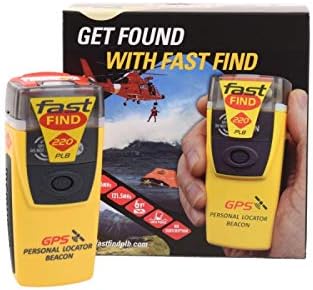
McMurdo FastFind 220
4.5Editor score
Simple one-hand activation
International satellite functionality
Compact personal locator design
US country-code programming
Compare 10 leading Personal Locator GPS Beacon options for emergency signaling, global coverage, battery life, durability, visibility, and ease of use outdoors.
A Personal Locator GPS Beacon is a compact emergency communication device designed to help search and rescue teams find people in locations without reliable cellular service. The right model should combine satellite distress signaling, accurate positioning, long battery life, intuitive activation, and enough durability for the environments where it will be carried.
This guide compares ten leading options based on the supplied product information, focusing on emergency signaling, satellite systems, positioning, operational life, visual visibility, water resistance, attachment options, and ease of use. It includes dedicated personal locator beacons, survival-kit bundles, and a satellite communicator whose broader communication features offer a different approach to remote-area safety.
Each pick highlights the characteristics that distinguish it within the category, including return-link confirmation, compact construction, global coverage, strobe visibility, and two-way messaging. Product listings and availability can change, so readers should verify current specifications, registration requirements, regional compatibility, and included accessories before making a final purchasing decision.
4.5Editor score

4.8Editor score

4.7Editor score
The comparison covers ten emergency communication options ranging from dedicated satellite beacons to a full-featured two-way communicator. Key differences include return-link confirmation, GNSS support, visual displays, battery life, water resistance, message capability, and whether the product is supplied alone or with survival accessories.



The ACR ResQLink View RLS PLB combines a dedicated satellite SOS beacon with a visual display, return-link confirmation, and multiple positioning systems. Its 4.8 rating reflects a strong combination of features for anyone who wants more confidence during an emergency. The RLS function confirms that search and rescue authorities have received the distress signal, providing feedback that the activation did not simply vanish into the satellite network.
We may earn a commission when you buy through this link, at no additional cost to you.
The beacon supports GPS and Galileo GNSS and is compatible with MEOSAR, while its stated operational life exceeds 28 hours. A five-year battery life reduces the need for frequent replacement planning. The digital display gives users information about the device, and the infrared strobe supplements the visible light to improve detection in emergency conditions. Built-in buoyancy and the multifunction clip system also make it well suited to marine and outdoor environments.
The principal trade-off is complexity relative to a basic personal locator beacon. Users still need to understand activation, registration, antenna deployment, and the meaning of status information. A return-link feature cannot guarantee the outcome of a rescue, and regulatory registration remains necessary wherever PLBs are legally controlled. Nevertheless, the additional confirmation, positioning support, and visibility features create a convincing advantage for serious travelers.
This is the strongest all-around recommendation for hikers, boaters, climbers, and international travelers who want a dedicated emergency beacon with visible status feedback. Choose it when confidence, low maintenance, and comprehensive signaling matter more than having routine two-way messaging. Register it correctly, carry it where it cannot be separated from your survival gear, and follow the manufacturer’s activation and maintenance instructions.
The Return Link Service confirms that search and rescue has received the distress signal and can alert the owner. That feedback adds useful reassurance without replacing the need for a complete emergency plan.
GPS and Galileo GNSS work together to support positioning, while visible and infrared strobes help rescuers detect the beacon under different conditions. The display adds another way to check status.
We may earn a commission when you buy through this link, at no additional cost to you.
The McMurdo FastFind 220 is a straightforward personal locator beacon for travelers who prioritize quick operation and practical physical design. Its 4.5 rating reflects a capable emergency device with a deliberately simple activation process. The antenna deploys, the anti-tamper seal is pulled, and the ON button is pressed, allowing the beacon to be activated with one hand.
We may earn a commission when you buy through this link, at no additional cost to you.
This particular listing is programmed with the US country code. It can still function around the world, but the initial emergency contact will be the US search and rescue authority with which it is registered. Buyers who require registration outside the United States should look for the rest-of-world-programmed alternative. Correct registration matters because it links the distress alert to the owner, emergency contacts, and potentially useful travel information.
Its compact format makes it easier to carry than many larger marine-oriented beacons. It is therefore well suited to hiking, camping, skiing, boating, and travel where space and weight are important. The trade-off is that the simple design does not offer the visual display, return-link confirmation, or multi-constellation positioning highlighted in more advanced models.
The FastFind 220 is a strong choice for budget-conscious buyers who value simplicity and fast activation without routine two-way messaging. Choose it if the supplied US programming matches your registration region and you are willing to follow the legal activation rules carefully. It should be used only for grave and imminent danger because false alerts can endanger lives and disrupt search and rescue resources.
Deploying the antenna, removing the anti-tamper seal, and pressing ON creates a clear activation sequence. The simple workflow is useful when an emergency occurs and the user is injured, cold, or otherwise impaired.
The US-programmed version is intended for US registration, while international travelers must select the appropriate programming variant. Registration gives rescuers the information needed to begin an effective response.
We may earn a commission when you buy through this link, at no additional cost to you.
The ACR ResQLink View PLB425 is a buoyant GPS personal locator beacon that pairs satellite distress signaling with a visual display. Its 4.6 rating reflects a well-rounded device for boaters, hikers, campers, climbers, and RV travelers. Once activated, it sends an SOS distress signal with a GPS position directly to search and rescue forces worldwide.
We may earn a commission when you buy through this link, at no additional cost to you.
Its 406 MHz emergency distress signal is paired with a 121.5 MHz homing signal, and the device supports the three COSPAS-SARSAT satellite constellations. The supplied information also describes optional 406Link testing functionality for sending pre-canned non-emergency test and GPS test messages by SMS or email to multiple contacts. Bright LED and infrared strobes provide visual signals that can help rescuers locate the user.
The beacon is small, rugged, lightweight, and buoyant, with a belt clip, oral inflation tube clip, straps, and lanyards for attachment. That makes it versatile, although users may need to choose the appropriate carry method for their activity. The optional testing subscription is the main limitation because core emergency operation does not require a subscription, but some non-emergency communication features do.
This model is a compelling option for users who want a readable interface and multiple attachment choices in a compact marine-capable beacon. It is particularly attractive for people traveling by boat or on mixed outdoor trips. Confirm regional registration requirements, inspect the included mounting hardware, and decide in advance how the beacon will remain attached during the conditions in which it may be needed.
Included belt, inflation-tube, strap, and lanyard attachments let users match the beacon to different activities. Consistent, accessible placement is important because the device cannot help if it remains in a pack that becomes separated from the user.
The beacon uses a 406 MHz distress signal, a 121.5 MHz homing signal, and COSPAS-SARSAT coverage. Optional 406Link service supports non-emergency GPS and self-test messages for selected contacts.
We may earn a commission when you buy through this link, at no additional cost to you.
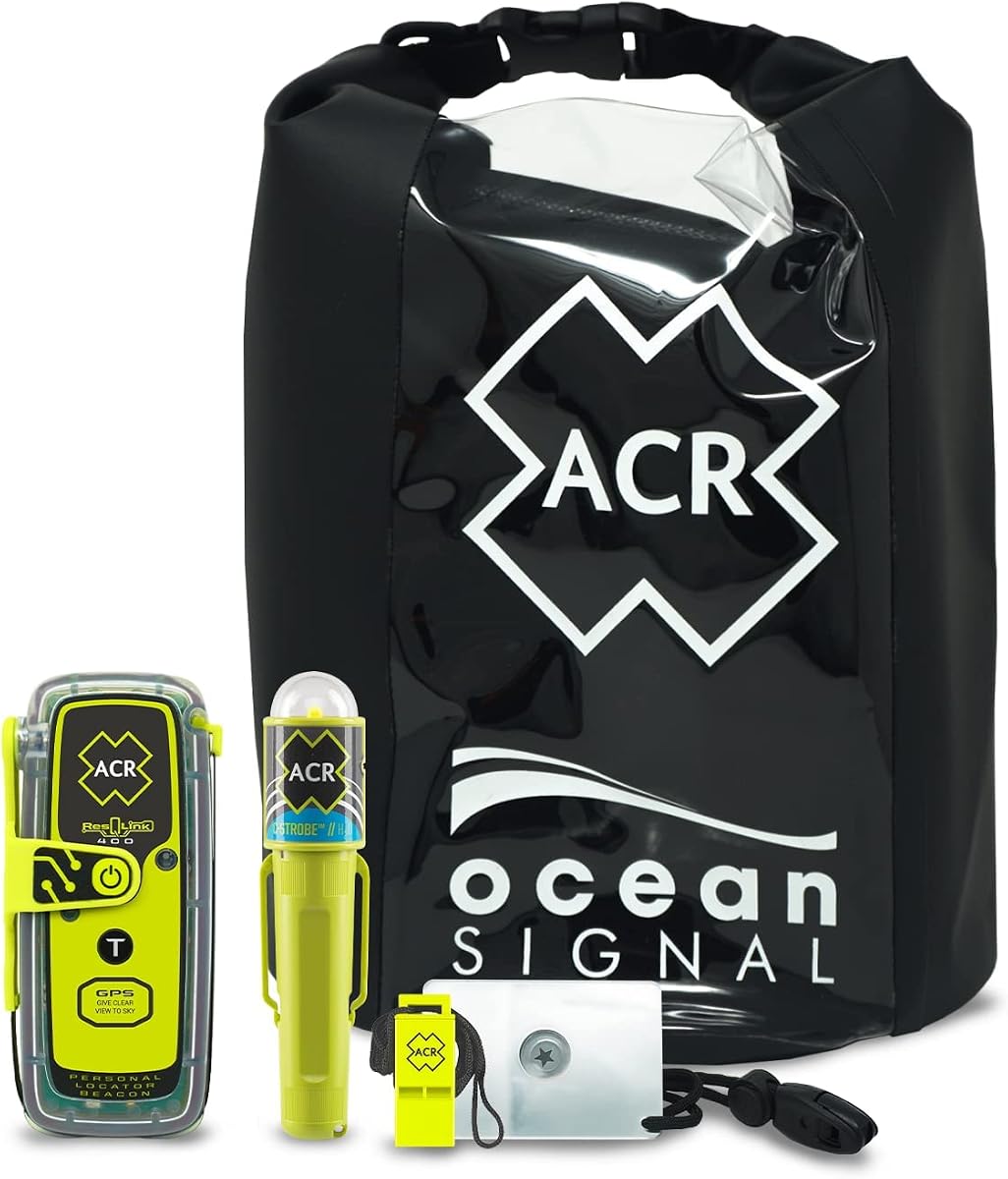
The ACR ResQLink 400 GPS Personal Locator Beacon SOS Survival Kit combines a dedicated GPS emergency beacon with several visual, audible, and protective accessories. Its 4.7 rating reflects a useful package for people building a broader remote-area emergency kit. The beacon supplies the satellite distress capability, while the surrounding tools improve local signaling and gear protection.
We may earn a commission when you buy through this link, at no additional cost to you.
Included items include a waterproof C-Strobe H2O rescue light with a high-visibility LED, a compact Res-Q whistle, a RapidDitch waterproof drybag, and a signal mirror. These items create several ways to attract attention, including at night, near water, or in an area where a satellite response may take time. The drybag also protects essentials from moisture and keeps emergency equipment accessible.
The drawback is that the bundle requires more storage and organization than a standalone beacon. Each accessory should remain easy to reach rather than being buried in a larger pack. Users must also distinguish between the beacon’s satellite emergency function and the local visibility tools, which serve complementary roles. A complete kit does not replace careful preparation or the need to follow registration and activation rules.
This kit is best for campers, hikers, paddlers, and travelers who want several emergency tools organized around a GPS personal locator beacon. It offers more immediate self-rescue options than the beacon alone, especially at night or when rescuers are still approaching. Check the contents against your existing equipment, then use the waterproof storage to keep the beacon and related essentials together and protected.
The strobe, whistle, and signal mirror provide different ways to gain attention. Combining them helps cover situations where one signal may be less effective than another.
The RapidDitch drybag protects survival equipment and offers straightforward access. Keeping critical gear together also reduces the chance that a required item will be left behind.
We may earn a commission when you buy through this link, at no additional cost to you.
The Ocean Signal rescueME PLB1 stands out for portability and straightforward operation. Its 4.6 rating reflects a capable beacon that weighs just four ounces and takes up minimal space, making it well suited to backpacks and lifejackets. The activation process is designed to be intuitive and usable with one hand, including in difficult conditions.
We may earn a commission when you buy through this link, at no additional cost to you.
A 66-channel GPS receiver supports positioning, and the high-intensity strobe provides visual visibility. The beacon is waterproof to 49 feet, a useful characteristic for boating, kayaking, and wet outdoor environments. It offers more than 24 hours of operational life and a seven-year battery, while core rescue service works through international government rescue satellites without a subscription.
Its primary limitation is the absence of a visual display or return-link confirmation. Users cannot rely on the same immediate feedback about message receipt that the RLS-equipped models provide. It is also more specialized than a satellite communicator because it focuses on SOS signaling rather than routine messaging, tracking, and media sharing.
The rescueME PLB1 is a strong recommendation for space-conscious travelers, paddlers, sailors, and hikers who prioritize low weight and easy activation. Its compact mounting clip makes it especially natural to attach to a lifejacket. Check the included hardware, register the beacon according to local requirements, and conduct a routine self-test so activation is familiar before it is needed.
At four ounces, the PLB1 minimizes the temptation to leave the device behind. Its small size and mounting clip make consistent daily or trip-level carry more practical.
Waterproofing to 49 feet and buoyant use cases make the beacon appropriate for marine travel. The lifejacket attachment option also helps keep it close to the user during an overboard incident.
We may earn a commission when you buy through this link, at no additional cost to you.
The ACR ResQLink 400 PLB is a focused satellite SOS beacon with a 4.7 rating and a broad set of search and rescue features. It does not require a subscription, reducing the chance of a service lapse when the device is needed. Its design centers on a 406 MHz distress signal, a 121.5 MHz homing signal, and GPS and Galileo GNSS positioning.
We may earn a commission when you buy through this link, at no additional cost to you.
Global rescue coverage comes through Cospas-Sarsat and MEOSAR compatibility. The device includes both an LED strobe and an infrared strobe, giving rescuers visual tools for daytime and low-light conditions. That combination of dedicated emergency signaling, multi-constellation positioning, and free-to-use rescue infrastructure makes it a strong choice for travelers who do not need routine messaging.
Compared with the View RLS, this model does not list a visual display or return-link confirmation. That removes useful confirmation features, but it also creates a simpler device with fewer controls and less potential confusion. Users still need to understand registration, activation, self-testing, battery care, and the serious consequences of false distress alerts.
This ResQLink 400 is well suited to hikers, climbers, campers, boaters, and international travelers seeking a straightforward PLB without a recurring service requirement. It should be selected over a communicator if emergency-only signaling matches the user’s needs. Carry it in a protected, accessible position, complete the recommended self-test, and keep the device away from accidental activation.
Cospas-Sarsat and MEOSAR compatibility support the device’s international rescue role. GPS and Galileo GNSS add positioning flexibility when every meter can help narrow a search area.
LED and infrared strobes improve visibility across different ambient conditions. The homing signal also provides rescuers with an additional directional aid when they are near the user.
We may earn a commission when you buy through this link, at no additional cost to you.
The ACR ResQLink View GPS Personal Locator Beacon SOS Survival Kit combines a display-equipped GPS beacon with tools for signaling, illumination, and protection. Its 4.7 rating reflects a package that offers more support than the beacon alone. The View interface provides status information, while the accompanying rescue light, whistle, drybag, and signal mirror broaden the range of immediate self-rescue options.
We may earn a commission when you buy through this link, at no additional cost to you.
The C-Strobe H2O is a waterproof LED rescue light intended to improve visibility in both daytime and nighttime emergencies. The compact Res-Q whistle produces a loud signal for attracting attention, and the RapidDitch drybag keeps emergency equipment dry and accessible. The signal mirror adds a passive daylight option for signaling rescuers in remote areas.
As with any combined survival package, organization is essential. Accessories that are difficult to find during a crisis may provide little practical value, and the bundle can take more space than a dedicated beacon. The View model’s display and strobe features also require familiarization. Owners should learn how to interpret the interface and where each supporting item is stored before traveling.
This kit is a good choice for families, campers, hikers, and wilderness travelers who want both a display-enabled locator beacon and a coordinated set of emergency tools. It is less appropriate for users who need the smallest possible device or extensive satellite messaging. Use the drybag for organization, keep the beacon accessible, and verify all accessories before every remote trip.
The beacon, light, whistle, mirror, and drybag each address a different part of an emergency response. Keeping them together supports faster access when conditions become stressful.
The display gives the user another way to check the beacon’s status. Learning its indicators in calm conditions is important so they can be understood quickly during a real emergency.
We may earn a commission when you buy through this link, at no additional cost to you.
The ACR ResQLink 410 RLS is a compact SOS personal locator beacon built around return-link confirmation and global rescue coverage. Its 4.5 rating reflects a capable emergency product with a useful combination of positioning, signaling, and battery features. Like the View RLS model, it confirms that search and rescue has received the distress signal and can alert the owner.
We may earn a commission when you buy through this link, at no additional cost to you.
GPS and Galileo GNSS positioning combine with MEOSAR compatibility for worldwide coverage. The stated operating life exceeds 24 hours, and the battery is advertised for five years. Built-in buoyancy, a lightweight form, and a multifunction clip system make the device appropriate for marine and outdoor use. Strobes and an infrared strobe improve visibility in different lighting conditions.
The listing does not mention a visual display, so this model lacks the status interface offered by the View variants. Its stated 24-plus-hour operating life is also shorter than the 28-plus hours advertised for the ACR ResQLink View RLS, although both provide substantial operating duration. As always, return-link confirmation should not be mistaken for a guarantee of rescue.
The ResQLink 410 RLS is best for users who value confirmation that a distress alert reached the rescue network without needing a screen. It is a good fit for travelers who prefer a compact dedicated beacon and understand that registration is part of the safety system. Select a suitable clip or carry method, test the unit on schedule, and keep it physically attached to the person or emergency equipment.
The Return Link Service confirms receipt of the distress signal and can notify the owner. This feedback is valuable during emergencies, but it does not replace continued compliance with emergency procedures.
GPS, Galileo GNSS, and MEOSAR compatibility support international use. The multifunction clip and built-in buoyancy broaden the ways the beacon can be carried.
We may earn a commission when you buy through this link, at no additional cost to you.
The display-free ACR ResQLink 400 offers a deliberately simple alternative within a well-known personal locator beacon family. Its 4.8 rating is among the strongest in the group, indicating a favorable reception among buyers. The listing identifies the product as Model 2921, sold by an authorized dealer, and focuses on a compact GPS beacon without a screen.
We may earn a commission when you buy through this link, at no additional cost to you.
Removing the display simplifies the device and may reduce the number of details a user has to interpret. That can be helpful for people who want an uncomplicated emergency tool rather than an interface-heavy satellite communicator. The ResQLink 400 family is associated with dedicated satellite distress signaling, and the no-display version is intended for users who do not require on-device status information.
The main drawback is the lack of visible confirmation or a screen on which to check information. The supplied listing also provides less technical detail than some competing product entries, so buyers should consult the current manufacturer documentation and confirm the final package contents. As with any PLB, registration and careful activation remain essential, and a false alert can disrupt rescue services.
This model is well suited to buyers who value a dedicated, uncomplicated GPS locator and want to reduce bulk. It may appeal to experienced users who already understand the ResQLink 400 platform or need a straightforward backup beacon for a vehicle, gear bag, or boating kit. Before purchase, verify the complete specifications, included accessories, and regional registration requirements.
The display-free layout keeps the focus on emergency signaling. For experienced users, fewer on-device controls can make the beacon quicker to understand and carry.
The listing identifies Model 2921 and an authorized dealer, but it contains fewer specifications than the other entries. Buyers should confirm current package details and technical requirements directly.
We may earn a commission when you buy through this link, at no additional cost to you.
The Garmin inReach Mini 3 Plus is not a conventional PLB, but it offers the most extensive communication capabilities in this guide. Its 4.7 rating reflects a rugged satellite communicator with a color touchscreen, interactive SOS, two-way messaging, and location sharing. For travelers who want more than an emergency distress signal, it provides a different and more connected form of protection.
We may earn a commission when you buy through this link, at no additional cost to you.
The device uses the Iridium satellite network for global messaging outside cellular coverage. Users can exchange texts, voice messages, and group messages, and compatible phone users can send photos through the Garmin Messenger app. An interactive SOS alert reaches Garmin Response, a 24/7 emergency coordination center that receives the user’s location and maintains two-way communication during a crisis.
The internal rechargeable battery can deliver up to 350 hours with 10-minute tracking or up to 95 hours in performance messaging mode. Its IP67-rated housing and scratch-resistant touchscreen are designed for demanding conditions. Compared with a basic PLB, however, it has more controls, requires charging, uses an associated satellite service, and may be less attractive to users who want a maintenance-free primary rescue beacon.
This is the best choice for hikers, travelers, field professionals, and expedition groups who value routine check-ins, weather, trip planning, LiveTrack, and emergency conversation. Pair it with the Garmin Messenger and Garmin Explore apps, configure emergency contacts before departure, and test both tracking and messaging functions. Buyers seeking a simple distress beacon should instead focus on one of the dedicated PLBs.
Two-way messages, group communication, weather information, trip planning, and LiveTrack expand the device beyond SOS use. This is particularly valuable for trips where regular updates are part of the safety plan.
The IP67-rated body and scratch-resistant color display suit demanding outdoor environments. Long advertised battery durations in tracking and messaging modes support multi-day use with appropriate power management.
We may earn a commission when you buy through this link, at no additional cost to you.
Choosing a personal locator GPS beacon means balancing emergency reliability with portability, battery maintenance, satellite coverage, and the type of communication required. The right choice depends on where the device will travel, how it will be carried, and whether a dedicated distress beacon is enough or routine messaging is worth the added complexity.
A dedicated PLB is designed primarily to send an emergency distress alert and position information to a search and rescue network. Models such as the ACR ResQLink View 2922 use a 406 MHz emergency distress signal with a 121.5 MHz homing signal, while the return-link-equipped models add confirmation that search and rescue received the alert. By comparison, a satellite communicator such as the Garmin inReach Mini 3 Plus supports interactive SOS and two-way communication through Garmin Response. Choose a dedicated PLB when simplicity, long unattended readiness, and emergency-only operation are priorities. Choose a communicator when routine messaging, weather, tracking, and direct conversation with a coordination center are important.
Registration is required by law in most countries and connects the beacon to the owner, emergency contacts, and relevant search and rescue authorities. The McMurdo FastFind 220 in this guide is programmed for the US country code and uses US search and rescue as the initial point of contact. International travelers should confirm that their selected model is programmed for the country where it will be registered. Travelers crossing borders should also investigate any registration restrictions that apply in their destination countries. Correct registration is not administrative busywork; it can provide rescuers with the context needed to begin an effective operation more quickly.
Global coverage should be evaluated through both the satellite system used for the distress alert and the positioning systems supported by the receiver. The ACR models described here include GPS and Galileo GNSS compatibility, while the PLB425 uses COSPAS-SARSAT coverage, and the Garmin communicator uses the Iridium satellite network. The FastFind 220 can operate internationally, but its initial emergency contact still depends on its US programming and registration. More positioning options can improve location accuracy, yet the rescue network behind the alert matters just as much. Buyers should match the beacon’s regional capabilities to their likely travel area rather than relying on a broad claim of global coverage.
Battery expectations differ sharply between sealed PLBs and rechargeable communicators. The ACR ResQLink View RLS and ResQLink 410 RLS list five-year battery lives, the Ocean Signal rescueME PLB1 lists seven years, and the FastFind 220 emphasizes dependable activation in remote conditions without a stated battery figure in the supplied data. The Garmin inReach Mini 3 Plus instead offers up to 350 hours in 10-minute tracking mode and up to 95 hours in performance messaging mode. A non-rechargeable PLB can sit in a pack for long periods with little maintenance, while a communicator needs a dependable charging routine. Choose the power model you will genuinely maintain before a trip.
The intended environment should guide durability decisions. The Ocean Signal rescueME PLB1 is waterproof to 49 feet and particularly appropriate for boating, kayaking, and other wet conditions. Several ACR models include built-in buoyancy, while the Garmin communicator carries an IP67 durability rating and a scratch-resistant touchscreen. Compactness and weight are also safety features: the rescueME PLB1 weighs four ounces, and smaller devices are less likely to be removed from a pack. Whatever the specifications suggest, the device must still be protected from impact, moisture beyond its rating, accidental button pressure, and antenna damage.
A beacon must remain understandable when the user is stressed, injured, cold, or otherwise impaired. The FastFind 220 uses a clear sequence: deploy the antenna, pull the anti-tamper seal, and press ON, all with one-hand operation. The rescueME PLB1 also emphasizes intuitive one-hand activation. Display-equipped models such as the ACR View variants provide status information, but those indicators must be learned before an emergency. Return Link Service adds confirmation after activation on supported ACR models. Buyers should favor a control layout they can practice rather than assuming a more complex interface will always be better.
Satellite alerting may not be the only useful signal when rescuers are nearby. LED and infrared strobes improve the chance of visual detection in daylight, darkness, or difficult conditions. The rescueME PLB1 includes a one-candela high-intensity strobe, while the ACR kits add a C-Strobe H2O light. Whistles and signal mirrors provide additional local signaling methods that require no satellite reception. These accessories do not replace a PLB, but they can support a layered self-rescue strategy. Travelers should assess which signaling methods suit their activities, especially at night, on water, or in dense terrain.
The best beacon is ineffective if it stays in a pack while the user is separated from that pack. Attachment options include the ACR multifunction clip, the FastFind’s compact form, the rescueME PLB1 lifejacket mounting clip, and the PLB425’s belt clip, oral inflation tube clip, straps, and lanyards. Waterproof drybags from the survival kits can organize a beacon with related essentials, although frequent-access items should not be sealed away unnecessarily. Consider how the device will be worn during hiking, boating, skiing, climbing, or work. Test the attachment in real conditions and confirm that it remains reachable after a fall, capsize, or gear shift.
Before the first trip, read the manufacturer’s instructions for the specific model and register the beacon in every required region. Record the device number in the account, confirm the owner and emergency-contact information, and make sure those contacts understand what to expect after an alert. Learn the activation sequence in a safe environment, paying particular attention to antenna deployment, the anti-tamper seal, and the distinction between test, self-test, and emergency modes. Never perform a real distress activation merely to see what happens.
Carry the beacon in the location recommended for the activity. On a lifejacket or PFD, confirm that the mounting clip remains secure and that the device is not buried under straps or clothing. On land, use a belt, lanyard, pocket, or clip that allows rapid access. Store survival-kit accessories together in a drybag, but keep the beacon itself easy to reach. Perform the manufacturer’s recommended self-test before remote travel and record the result. For a rechargeable communicator, fully charge the device and verify that the messaging, tracking, and SOS functions work with the relevant apps.
Service the beacon according to its battery and environmental requirements. Keep the contacts clean, protect the antenna, and inspect clips, straps, lanyards, seals, and waterproof storage for damage. Replace a non-rechargeable battery only as directed by the manufacturer, and use the correct battery type when one is required. Never open a sealed PLB unless the official instructions authorize it. After an activation, do not assume the emergency is over merely because a signal was sent; follow all instructions from search and rescue and preserve the device for inspection.
A personal locator beacon is designed mainly for emergency distress signaling and positioning, often using a long-lived or non-rechargeable battery. A satellite communicator adds routine two-way messages, tracking, weather, and often interactive emergency coordination through an associated service. A dedicated PLB is usually simpler for emergency-only use, while a communicator is more versatile for travel where regular check-ins are valuable.
The dedicated PLBs in this guide are described as operating without a subscription, including their core rescue functions. The Garmin inReach Mini 3 Plus is a satellite communicator that uses an associated service for messaging and interactive SOS features. Users should verify the current service terms separately from the physical device and confirm that the selected service works in their destination region.
Register the device according to the rules of the country where it will be used, and verify that the owner and emergency-contact details are accurate. The McMurdo FastFind 220 listed here is programmed for US registration, so international travelers need to confirm the appropriate version and local registration process. Registration gives rescuers information that may help them begin a response more quickly.
Use only the manufacturer’s designated self-test or test function and follow the model-specific instructions. Do not activate a genuine 406 MHz distress alert merely to test the device, because false alerts can endanger lives and divert search and rescue resources. A self-test can help confirm operation, but it does not replace reading the manual, completing registration, or checking the battery and physical condition.
Carry it where it remains attached to you or your essential gear and can be reached quickly. Lifejacket mounting suits many marine activities, while a belt clip, lanyard, strap, or secure pocket can work on land. Check the attachment under realistic movement, protect it from impact and moisture, and never bury it in a compartment where it could be forgotten during an evacuation or gear separation.
A PLB can send a distress signal and position information, but it generally does not support routine two-way conversation, group messages, weather forecasts, or detailed trip coordination. The Garmin inReach Mini 3 Plus fills many of those gaps. Travelers who need only emergency signaling may prefer the simpler dedicated beacon, while those who want check-ins and regular communication should consider the communicator.
Follow the battery replacement and testing schedule specified by the manufacturer. Sealed PLBs may use long-lived batteries, while rechargeable communicators need a consistent charging routine before remote travel. Users should also perform scheduled self-tests, inspect the contacts and antenna, and replace a non-rechargeable battery only as directed with the appropriate battery type.
Yes. Dedicated PLBs transmit distress signals through satellite systems rather than relying on cellular networks, and the Garmin communicator uses the Iridium satellite network for messaging. Actual performance still depends on correct registration, an unobstructed view of relevant satellites, a functioning antenna, and emergency services operating within the relevant regional system.
The ACR ResQLink View RLS is the strongest all-around personal locator GPS beacon in this group because it combines return-link confirmation, GPS and Galileo GNSS, infrared and visible signaling, buoyancy, long operational life, and a five-year battery specification. The McMurdo FastFind 220 is the best budget-oriented choice for buyers who prioritize simple one-hand activation, while the Garmin inReach Mini 3 Plus is the most feature-rich premium option for travelers who need two-way satellite communication and interactive emergency coordination.
Most buyers should begin with the communication model they actually need. Choose a dedicated PLB for dependable satellite distress signaling, minimal maintenance, and a simple emergency-only design. Choose the Garmin communicator when regular check-ins, weather, LiveTrack, group messages, and direct emergency conversation justify an associated service and rechargeable power routine. Whichever category you choose, registration, correct attachment, scheduled self-tests, and realistic carry practices are as important as the model itself.
Before ordering, verify the current product listing, complete specifications, regional programming, included accessories, and registration requirements. Product details and availability can change, so the information in this guide should be checked against the manufacturer’s latest guidance. A properly selected, registered, maintained, and consistently carried beacon can provide a vital final layer of protection when ordinary communication and navigation systems are unavailable.