
PRORECK DC21
5.0Editor score
Passive transformer design
Switchable ground lift
Thru and balanced outputs
Direct boxes for recording convert unbalanced instrument and line-level signals into balanced, microphone-level outputs that can travel cleanly into mixers, audio interfaces, and preamps. A well-designed model can reduce ground-loop interference, preserve tonal character, and make instrument capture more dependable in studios, rehearsal rooms, and live environments.
This guide compares ten passive and active direct boxes based on the supplied specifications, including transformer design, channel count, input and output options, attenuation, ground-lift or isolation controls, filtering, phase reversal, and recording-focused connectivity. The list covers single-channel, stereo, and USB-conversion designs for guitars, basses, keyboards, effects processors, and other unbalanced sources.
Each pick highlights a distinct use case, from a portable passive box to a two-channel active model and a stereo USB interface. Ratings and features are reproduced from the available product information, while practical trade-offs help identify the most appropriate option. Product details and availability can change, so confirm current specifications before purchasing.
5.0Editor score

5.0Editor score

4.8Editor score
As an Amazon Associate we earn from qualifying purchases.
The following table compares all ten direct boxes by format, channel count, signal-routing options, and noise-control features to clarify which model fits a particular recording setup.




The Radial Engineering ProDI Bundle is a passive mono direct box built around a custom-wound transformer with a high 140kΩ input impedance. Its 5.0 rating reflects a particularly strong reception among buyers, while the supplied information emphasizes clean output, simple operation, and suitability for both stage and studio work.
We may earn a commission when you buy through this link, at no additional cost to you.
The transformer-isolated output is the central benefit. It helps break the electrical connection that can produce ground-loop noise, allowing a guitar, bass, or other instrument-level source to feed a balanced recording input with less interference. A high input impedance also gives the connected instrument a suitable load, which can help preserve its character while the signal moves toward the mixer or interface.
The bundle adds a Pig Hog microphone cable and a Liquid Audio polishing cloth, making it more immediately useful for a basic recording session than a bare direct box. Its trade-offs are mainly about flexibility rather than performance: it handles one channel, and the supplied specification does not mention an input pad, filter, or phase-inversion control. Those conveniences are unnecessary for many basic direct-recording tasks.
This is the most balanced recommendation for someone who wants a straightforward passive DI with useful accessories. Choose it when one instrument needs a clean balanced recording path and simple operation matters more than stereo handling or extra switching. It is especially attractive for guitarists, bassists, and engineers who want transformer isolation without an active power requirement.
The transformer-isolated output helps reduce ground-loop interference, giving a recording engineer a cleaner starting point when instrument, amplifier, and computer equipment share power or create long cable paths.
The included Pig Hog cable and polishing cloth make the package practical for a new setup, allowing the user to connect the DI and maintain its enclosure without sourcing every accessory separately.
We may earn a commission when you buy through this link, at no additional cost to you.
The Radial Pro DI is a rugged, passive mono direct box with a custom transformer, and it carries a 4.7 rating. Its design is aimed at straightforward conversion of instrument-level output into a balanced recording signal, with the durable I-beam construction serving users who move equipment between studios, stages, and rehearsal spaces.
We may earn a commission when you buy through this link, at no additional cost to you.
Its custom transformer is the defining feature. Transformers are valuable in recording because they provide isolation and convert unbalanced input to a balanced, low-impedance microphone-level output. This design can improve signal compatibility with mixers and interfaces while reducing the likelihood that unwanted ground-loop noise will dominate a quiet instrument recording.
The main compromise is specialization. The Radial Pro DI is a mono unit, so it records one source at a time and offers no stereo channel count. The listed specifications also emphasize transformer quality and construction rather than multiple switching options, which may leave users wanting attenuation, phase reversal, or filtering looking elsewhere. Its virtue is focused execution rather than extensive control.
This direct box suits performers and engineers who prioritize a passive, durable mono solution. It is a particularly logical choice for a single guitar or bass being recorded directly, especially in a mobile or changing environment. For stereo keyboard rigs, simultaneous multi-instrument tracking, or USB computer recording, a dual-channel or active model will be more efficient.
The rugged I-beam enclosure is appropriate for users who regularly pack equipment into cases, move between rehearsal rooms, or use the same direct box in home and stage environments.
Because the design is passive, it does not require batteries or external power, reducing setup steps and making it convenient for spontaneous instrument capture.
We may earn a commission when you buy through this link, at no additional cost to you.
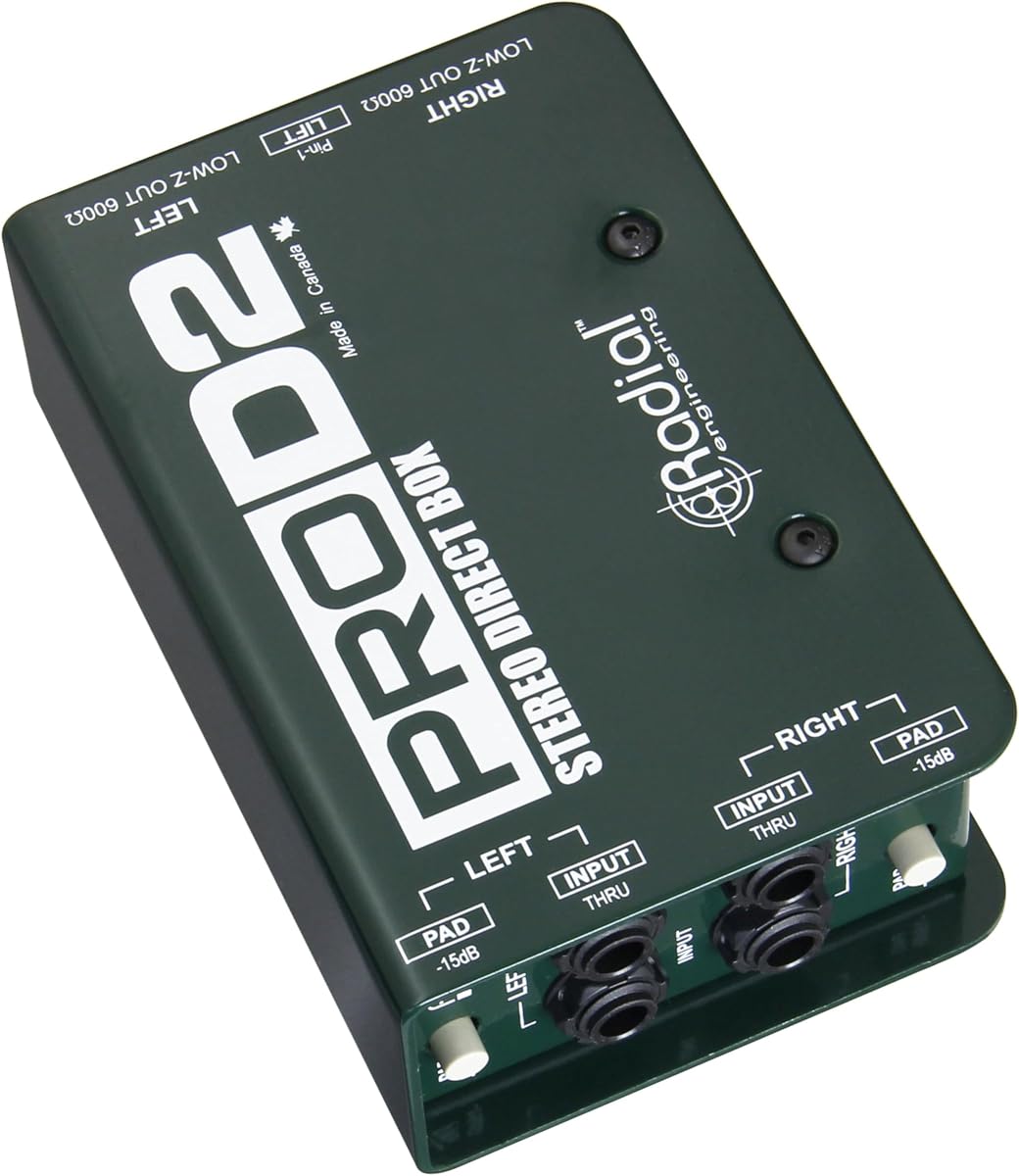
The Radial ProD2 is a passive two-channel direct box with a 4.8 rating, making it a strong choice for stereo recording, dual-output instruments, or capturing two sources with one enclosure. Its isolation transformer, lift switch, and 15dB pad provide a more versatile control set than a basic mono passive unit.
We may earn a commission when you buy through this link, at no additional cost to you.
Stereo operation is the model’s most immediately useful feature for recording. A keyboard, synthesizer, stereo pedalboard, or pair of instrument feeds can retain separate left and right channels instead of being reduced to one mono path. The isolation transformer helps manage ground-related interference, while the lift switch gives an engineer another means of addressing noise when troubleshooting a connected system.
The 15dB pad can also prevent stronger sources from driving a sensitive input too hard, although the available information does not state whether the pad applies to each channel independently or is a shared control. Another consideration is that the model remains passive, so it does not provide powered gain. Users needing substantial amplification or active signal conditioning may need an active DI.
The ProD2 is the premium choice in this group for a reason: it combines stereo routing with purposeful noise-control hardware in a passive format. It is best for recording two related channels or two instruments at once. A guitarist recording one guitar can use a simpler mono model, while a keyboardist or electronic performer with stereo outputs will appreciate the additional flexibility.
Two channels in one enclosure simplify recording for stereo keyboards, dual-output synths, stereo effect chains, or paired instrument sources without requiring separate mono devices.
Transformer isolation and the lift switch give engineers complementary ways to manage ground-related interference, which can be useful when a clean recording path is affected by a complicated electrical setup.
We may earn a commission when you buy through this link, at no additional cost to you.
The Whirlwind IMP 2 is a one-channel passive instrument direct box with a 4.8 rating. It converts a line- or instrument-level unbalanced signal into a low-impedance, balanced microphone-level signal, offering a focused and compact option for straightforward recording.
We may earn a commission when you buy through this link, at no additional cost to you.
Its defining construction choice is Whirlwind’s TRHL transformer, which is riveted to the chassis rather than glued into position. That method supports the product’s emphasis on durability. The small footprint also makes it convenient for crowded pedalboards, rehearsal spaces, and mobile recording kits where every piece of equipment must be compact enough to move easily.
The trade-off is that this is a specialized mono unit. It does not offer the two-channel routing of the ProD2 or DualZDirect, and the supplied feature list does not identify an attenuation pad, phase switch, or ground-lift control. It is therefore most appropriate when the priority is dependable signal conversion and portability rather than comprehensive routing options.
Users recording a single electric guitar, bass, or other instrument into a mixer or interface can appreciate the IMP 2’s simplicity and construction. It is a particularly practical box for a small home studio that needs a professional passive converter without power or a large control surface. Its 4.8 rating and rugged transformer mounting support its position as a dependable compact choice.
The compact footprint lets a small studio or mobile rig keep a dedicated transformer direct box close at hand without consuming much desk or pedalboard space.
Riveting the transformer to the chassis reduces reliance on adhesive alone, aligning with the model’s stated goal of professional durability in an economical instrument package.
We may earn a commission when you buy through this link, at no additional cost to you.
The Pyle Premium Direct Injection Audio Box is a compact passive DI rated 4.5 by buyers. It supports recording guitars, basses, keyboards, submixers, effects processors, and other unbalanced sources through a quarter-inch input and a balanced XLR output, giving it broad source compatibility.
We may earn a commission when you buy through this link, at no additional cost to you.
The included input attenuator is the standout feature for recording. It allows the user to reduce a stronger source before it reaches the next device, which can help protect sensitive inputs and improve signal matching. The transformer also provides buzz and hum cancellation, making the box useful when an instrument or consumer stereo is connected to a professional recording chain.
Its limits are largely defined by the simple mono format. There is no second channel, and the supplied information does not mention a phase-inversion switch, low-pass filter, or independent ground-lift control. The detachable power cord mentioned in the source information appears to apply to the detachable cable rather than a powered circuit, since the unit is explicitly passive and requires no electrical power.
This Pyle model is a practical choice for musicians who need a compact, inexpensive way to record a single instrument or line source while managing level and hum. It works particularly well for straightforward home-studio tracking, although users requiring dual-channel capture or more elaborate routing should move to a stereo or advanced mono model.
The input attenuator provides an extra level-control stage before the signal reaches a mixer, interface, or preamp, which can be valuable when the source output is unexpectedly strong.
Beyond guitars and basses, the box can accept keyboard, processor, submixer, boom-box, and consumer-stereo line outputs, expanding its role as a general recording adaptor.
We may earn a commission when you buy through this link, at no additional cost to you.
The PYLE-PRO Premium Direct Injection Audio Box is a passive mono unit with a 4.4 rating. Its all-steel chassis, transformer connection, and input attenuator provide a durable general-purpose option for recording instruments and line-level sources through a balanced XLR output.
We may earn a commission when you buy through this link, at no additional cost to you.
The box’s strongest appeal is its combination of physical construction and recording controls. Steel construction suits frequent transport, while the attenuation control offers level management that many basic passive boxes lack. Its hum-elimination function and impedance transformer make it suitable for guitars, basses, keyboards, outboard processors, sub-mixers, and even consumer stereo line outputs.
The one-channel format and relatively limited control set keep it below the more specialized models in this list. There is no listed stereo routing, phase inversion, filtering, or USB conversion. A 4.4 rating still places it among well-regarded products, but it indicates somewhat less universal satisfaction than the highest-rated transformer-based alternatives.
Choose the PYLE-PRO Premium DI for a durable, single-source recording box that offers more than a bare passive converter. It is well suited to home studios and rehearsal setups where an instrument needs a balanced path and occasional level adjustment. Users recording multiple sources simultaneously will gain more efficiency from a dual-channel model.
The input attenuator gives a recording engineer a useful degree of control over how strongly an instrument or line source reaches the next stage in the signal chain.
Its quarter-inch input and transformer-based connector support instruments and line-level equipment, making it a flexible adaptor for small, varied recording sessions.
We may earn a commission when you buy through this link, at no additional cost to you.
The Bolanle J22 is an active stereo DI box rated 4.6, designed to handle two channels while offering unusual power-source flexibility. It can run from 48V phantom power, a 9V battery, or 5V USB, giving performers options for studios, stages, and mobile setups.
We may earn a commission when you buy through this link, at no additional cost to you.
The three power methods address a common practical problem: a performer may reach a venue where phantom power is unavailable or a battery-powered mixer has no conventional outlet. A USB power bank adds another dependable route, and the included USB cable supports that option. The product is active, so unlike a passive transformer box it requires one of these supported power sources.
The signal controls are well suited to recording and live troubleshooting. Two unbalanced quarter-inch TRS inputs feed dual balanced XLR outputs, while a ground lift can help reduce hum caused by shared circuits and long cable runs. A 180-degree polarity reversal switch adds another useful phase-management feature, though the description positions both channels under one general control rather than documenting independent operation.
This is an attractive choice for keyboardists, electronic musicians, and working performers who need two channels and cannot count on one power source. It is less suitable for a user seeking a completely passive, no-power design. For stereo recording on a stage or in a location with uncertain power, its battery and USB flexibility may outweigh the added operational complexity.
Phantom power, a nine-volt battery, and five-volt USB operation make the J22 adaptable to rehearsal rooms, stages, studios, and setups where conventional power availability is uncertain.
Separate balanced outputs preserve stereo routing, while the ground-lift and polarity-reversal controls provide practical tools for diagnosing hum and phase-related problems.
We may earn a commission when you buy through this link, at no additional cost to you.
The PRORECK DC21 is a passive mono direct box with a 5.0 rating. It provides a 50kΩ input impedance, a ground-lift switch, an input attenuator, and both thru and balanced outputs, combining a broad feature set in a design aimed at guitars, basses, keyboards, and live or studio recording.
We may earn a commission when you buy through this link, at no additional cost to you.
The simultaneous thru and balanced outputs are especially practical. A musician can send the unbalanced thru output to an amplifier for stage monitoring while routing the balanced signal to a mixer or recording interface. That arrangement reduces the need for a separate splitter and makes the box useful for rehearsal, performance, and capture scenarios.
The isolation transformer and ground lift address common sources of hum and buzz, while the attenuator helps control mismatch between the source and destination. Passive operation means no battery or power supply is required. The trade-off is mono operation, so stereo instruments must be reduced elsewhere, and the available specifications do not mention phase inversion or filtering.
For an affordable, feature-rich mono recording box, the DC21 is a compelling recommendation. Its 5.0 rating indicates especially strong buyer satisfaction, and its balanced output, thru jack, attenuation, and ground lift cover many essentials. It is a strong pick for a guitarist or bassist building a first direct-recording setup or for a working player who wants reliable passive signal routing.
The thru output can feed an amplifier while the balanced XLR output travels to a mixer or interface, simplifying simultaneous monitoring and recording.
Combining a ground-lift switch, isolation transformer, and input attenuator gives users meaningful control over hum, grounding, and source level without requiring power.
We may earn a commission when you buy through this link, at no additional cost to you.
The Radial USB-Pro is a two-channel active instrument direct box with a 4.6 rating. It combines balanced outputs, USB connectivity, 24-bit/96k conversion, switchable isolation, and a built-in headphone amplifier, making it a more complete path from instrument to computer.
We may earn a commission when you buy through this link, at no additional cost to you.
Its defining advantage is integrated digital recording. Rather than sending a balanced analog signal through a DI into a separate interface, the USB-Pro can serve as the conversion endpoint for a computer-based session. The 24-bit/96k converters and dual balanced outputs support high-resolution capture, while the built-in headphone amplifier makes monitoring more convenient.
This is a specialized choice, not a direct replacement for every passive DI. It requires a compatible USB connection and appropriate computer setup, which may be less convenient than a simple XLR-to-input route. The headphone output is useful, but the headphone amplifier should not be confused with a fully independent monitoring system; its exact behavior depends on the product’s operating design and software requirements.
The USB-Pro makes sense for a home-studio owner who wants a streamlined instrument-to-computer workflow and values a high-resolution interface with integrated monitoring. It is less relevant to a live engineer who only needs transformer isolation and a balanced console feed. For dedicated computer recording, however, it removes several separate components and streamlines the workflow.
Integrated USB conversion lets an instrument travel directly into a computer-based recording system, reducing the number of separate analog-to-digital components in the signal chain.
The built-in headphone amplifier provides a convenient way to monitor the captured signal, helping performers stay informed without relying only on software meters.
We may earn a commission when you buy through this link, at no additional cost to you.
The ART DualZDirect is a professional passive direct box with a 4.6 rating. It records two channels, converts 50kΩ inputs into 600Ω balanced outputs, and includes switchable attenuation, a low-pass filter, phase inversion, and full ground isolation.
We may earn a commission when you buy through this link, at no additional cost to you.
The controls make it unusually versatile for a passive design. Attenuation choices of 0, -20, and -40dB allow users to match source levels, while the low-pass filter can shape unwanted high-frequency content. Phase inversion is valuable for corrective recording work, and the ground lift fully isolates inputs from the chassis and outputs to help control ground-related interference.
Its complexity is the principal trade-off. A user who only needs a simple transformer box may find several switches unnecessary, and the model does not provide digital recording through USB. Its passive operation is still an advantage because it requires no power and remains straightforward to integrate with conventional analog recording gear.
The DualZDirect is well suited to users who want two channels plus hands-on signal shaping. It is a strong choice for home studios, project rooms, and semi-professional setups recording guitars, basses, or stereo line sources. Users who value fine control and passive reliability will appreciate the feature set; those seeking a direct computer workflow should instead consider the USB-Pro.
The 0, -20, and -40dB settings provide meaningful range for matching different source levels to a preamp, mixer, or interface input before recording begins.
Switchable phase inversion and a low-pass filter expand the box beyond basic signal conversion, giving a recording engineer additional tools for tone and polarity management.
We may earn a commission when you buy through this link, at no additional cost to you.
Choosing a direct box for recording means balancing signal architecture, source type, noise control, routing needs, and portability. The right model should make the signal path easier to use rather than adding unnecessary complexity.
A mono direct box is ideal for one guitar, bass, microphone, or other single source. Stereo and dual-channel models make more sense for stereo keyboards, synthesizers, two separate instruments, or paired pedalboard outputs. Two-channel recording does not automatically guarantee a balanced stereo image, so the source itself must provide genuinely separate left and right signals for stereo workflows to be meaningful.
A passive direct box transforms the signal without external electrical power. It is simple, dependable, and often well suited to transformer-based isolation, but it cannot add gain. An active model includes circuitry that may provide gain or conversion and therefore needs a suitable power source. Compare what each design actually provides rather than assuming active is automatically better, because some active models focus on routing or USB recording instead of gain.
For analog recording, the transformer is central to signal integrity. Look for a stated isolation transformer, a transformer designed for instrument-level input, and a high input impedance where the source is passive, such as an electric guitar or bass. A model with a clearly described transformer may provide a more informed basis for comparison than one that only advertises a generic connector.
Ground-loop hum, buzz, and electrical interference can contaminate a recording before the signal even reaches the software. Ground lift, transformer isolation, and polarity reversal each address different troubleshooting situations. A box with several of these controls can be especially useful in rooms with complex power systems, shared circuits, long cable runs, or connected stage equipment.
Some instruments and line outputs deliver much stronger signals than others. An input attenuator or pad can help prevent overload and improve the match between the source and recording input. Switchable attenuation is especially useful for a box that must handle guitars, basses, keyboards, and other line-level equipment rather than one dedicated instrument.
A balanced XLR output is the most common route into a mixer, preamp, or interface with a microphone input. A quarter-inch output may be balanced or unbalanced depending on the model, so the labeling matters. A thru output can also be valuable by sending the original unbalanced signal to an amplifier while a balanced recording feed travels elsewhere.
A conventional direct box produces an analog signal and still requires an audio interface for digital recording. A USB direct box, such as a model with integrated converters, can connect directly to a computer and streamline the chain. Confirm the required USB standard, available software, channel routing, and headphone-monitoring needs before treating a USB model as a complete recording solution.
The best recording tool is one that fits the actual workspace. Compact boxes suit pedalboards, rehearsal rooms, and mobile rigs, while rugged metal construction can matter for repeated transport. Also consider whether the controls are understandable under pressure, whether outputs are protected, and whether the unit is likely to remain near the recording area or travel with the performer.
Begin by identifying the source output and the destination input. Connect the instrument, pedalboard, or line-level device to the direct box with the appropriate quarter-inch cable, then use the balanced XLR output to reach a mixer, preamp, or audio interface. If the direct box has a thru jack, it can send the original signal to an amplifier while the balanced path handles recording.
Set the source and downstream gain conservatively before enabling any attenuation, ground lift, filter, or phase setting. Listen for clipping, hum, and polarity differences in a controlled way. Make one change at a time, because the ground lift and phase inversion can affect the signal in ways that are easy to misdiagnose if several controls are altered simultaneously.
For passive units, no power routine is required. For an active model, use only a supported power method and observe the manufacturer’s polarity and voltage instructions. Keep inputs and outputs clean, avoid strain on the connectors, secure cables during transport, and store the unit in a dry environment. Periodic visual inspection and careful cleaning of the enclosure and connector surfaces will help preserve reliable operation.
Not always. An audio interface with suitable instrument inputs can record a guitar directly, but a direct box is useful when the interface has only microphone inputs, when the instrument outputs an unbalanced line-level signal, or when transformer isolation and a ground lift can improve the setup. A DI can also let the original instrument signal reach an amplifier while a separate balanced feed goes to the recorder.
A passive direct box converts and balances a signal without external power, usually through a transformer. An active direct box uses powered circuitry and may provide additional gain, routing, conversion, or monitoring features. Passive models are simple and dependable, while active models can be more flexible but require a compatible power source.
A direct box does not automatically make an instrument sound better. Its main benefit is reliable signal conversion, impedance matching, and sometimes noise isolation. A well-matched transformer and clean installation can help the original signal reach the recording chain without interference, but microphones, preamps, room acoustics, instrument quality, and mixing decisions remain central to the final recording.
Use it when troubleshooting hum that is likely caused by a ground loop, especially when the problem appears with a particular power system or cable path. Disable the ground lift and compare the noise level before and after changing it. If the hum does not change, the cause may be elsewhere, such as an unbalanced source, faulty cable, lighting equipment, or a poorly grounded amplifier.
A stereo model is useful when the keyboard can output separate left and right signals and the recording needs to preserve that stereo image. A mono direct box is sufficient for a single mono keyboard output, a summed feed, or a session focused on one part. Two-channel units are also helpful when recording two different instruments at the same time.
Yes. Connect the direct box’s balanced XLR output to an interface input that accepts a balanced line or microphone-level signal, depending on the direct box and interface specifications. The direct box converts the unbalanced source into a balanced microphone-level feed, while the interface handles analog-to-digital conversion and computer connectivity.
An input pad reduces the signal level before it reaches the output stage. This can help when a hot guitar or line output would otherwise drive a sensitive preamp too strongly. It also provides useful level matching when the same box is used with several instruments that produce different output levels.
It depends on the recording path. A USB model with integrated converters can be more convenient for direct computer recording and may include monitoring. A traditional passive DI is often more useful for feeding mixers, stage consoles, and analog recording chains because it requires no software or computer connection. The best choice depends on where the signal needs to go.
The PRORECK DC21 stands out as a value-focused passive option with a 5.0 rating, ground lift, attenuation, and simultaneous thru and balanced outputs. The Radial Engineering ProDI Bundle is the most balanced general recommendation, combining a high-impedance transformer, clean isolated output, and useful bundled accessories, while the Radial ProD2 is the premium choice for two-channel recording.
For more specialized needs, the Bolanle J22 provides active stereo routing with three power options, the Radial USB-Pro streamlines computer recording with integrated conversion, and the ART DualZDirect offers extensive passive controls. A single-instrument setup may be best served by a compact mono model, while stereo keyboards and dual-source sessions benefit from a two-channel box.
Before making a final selection, confirm the channel count, input and output connectors, attenuation range, power requirements, and recording destination. Read the current product documentation and confirm that the device fits the rest of the signal chain. Product specifications and availability can change, so the latest listing is the best final source of truth.