
KTC 24.5-inch 240Hz Fast IPS Monitor
4.0Editor score
240Hz gaming refresh rate
Fast IPS Full HD panel
1ms MPRT response time
Adaptive Sync support
DisplayPort and HDMI connectivity
A high-refresh gaming monitor can make competitive action feel more immediate, but a model number alone does not guarantee a superior experience. The most important considerations include actual refresh capability, pixel response, synchronization support, input options, color coverage, and a panel size suited to your desk and games.
This guide compares ten gaming monitors associated with the Best540hz Gaming Monitor category, including fast IPS, curved ultrawide, QHD, OLED, and 540Hz models. The evaluation focuses on stated specifications and practical buying trade-offs rather than assuming that every display suits the same player, budget, or PC configuration.
Each pick highlights the characteristics that distinguish it from the alternatives, from extreme refresh rates and low-latency panels to color depth, immersion, and flexible stands. Product features and availability can change, so check the current listing and your computer's capabilities before making a final decision.
4.0Editor score

4.2Editor score

4.1Editor score
As an Amazon Associate we earn from qualifying purchases.
The comparison below places all ten displays on a consistent set of buying criteria, including panel format, refresh rate, response time, resolution, color coverage, connectivity, and physical design.




The CRUA 27-inch FHD 540Hz IPS Gaming Monitor is the most direct answer for buyers who prioritize the highest stated refresh rate in this group. Its 540Hz mode and 1ms MPRT response time are designed for competitive shooters, fast-paced multiplayer games, and other situations where brief transitions and moving targets demand a responsive display. The monitor holds a 4.2 rating, reflecting a generally positive but not flawless customer history.
We may earn a commission when you buy through this link, at no additional cost to you.
Connectivity is a notable strength for a high-refresh display. HDMI 2.1, DisplayPort 1.4, and a 3.5mm audio output provide several ways to connect a gaming PC, laptop, or other source, while the built-in speaker adds a simple option for system audio. The IPS panel is specified at 1920×1080, 400cd/m² brightness, 1000:1 contrast, and 120% sRGB coverage, giving it a respectable combination of speed, brightness, and color for everyday gaming.
The stand separates this CRUA from many simpler gaming monitors. It supports 120mm of height adjustment, tilt from negative five to positive 15 degrees, swivel through a similar range, and a 90-degree pivot into portrait orientation. That makes it useful for coding, streaming layouts, document work, and narrow desks. The principal trade-off is that Full HD across 27 inches provides less spatial detail than a QHD or 4K panel, particularly when working with dense text or complex interfaces.
This is the strongest overall choice for competitive players who can drive an extremely high frame rate and genuinely benefit from the listed 540Hz capability. It also suits users who want a versatile IPS display with adjustable positioning rather than an ultrawide or premium OLED. Confirm that your graphics card, cable, game, and settings support the desired refresh rate, and treat the 540Hz figure as an upper capability rather than something every application will use.
A 540Hz panel can reveal substantially more visual information than a conventional 60Hz display when the source hardware generates enough frames. The benefit is most apparent in games with quick camera movement, small projectiles, and low-latency aiming, where even a fraction of a second can influence perception and input timing.
Height, tilt, swivel, and vertical pivot controls make the monitor easier to adapt to different seating positions and workflows. The 90-degree rotation is particularly useful when a taller document or a narrow portrait-oriented application is more comfortable to view.
We may earn a commission when you buy through this link, at no additional cost to you.
The KTC H25T7-A pairs a 240Hz refresh rate with a 24.5-inch Fast IPS panel, making it a practical alternative for competitive gamers who do not need the category's absolute maximum refresh rate. Its headline combination of 240Hz and 1ms MPRT should appeal to players who want smooth motion in shooters, racing games, and competitive multiplayer titles without moving to a larger, more specialized display.
We may earn a commission when you buy through this link, at no additional cost to you.
The Full HD panel is supported by adaptive synchronization, HDR10, and a stated color package of 114% sRGB with 1000:1 contrast. That is a useful specification set for gaming, streaming, and general desktop use. HDMI 2.0 and DisplayPort 1.4 provide flexibility across desktop PCs, gaming laptops, Nintendo Switch, Xbox, and PlayStation systems, although the exact maximum refresh rate available through each source and resolution should be confirmed.
Eye-care features include low-blue-light reduction and a flicker-free design, while the stand allows tilt adjustment and supports 100x100mm VESA mounting. That adjustment range is less generous than the CRUA or Acer Nitro, and the monitor's larger connectivity, resolution, and ergonomic benefits are not part of its feature set. The absence of a supplied customer rating also makes it harder to evaluate long-term consistency from the provided data alone.
For buyers seeking a straightforward 240Hz gaming monitor with a modern Fast IPS panel, the KTC is a sensible value-oriented choice. It is especially appealing for a dedicated gaming setup and for users whose graphics hardware can consistently produce strong frame rates. A three-year warranty and responsive support add reassurance, but buyers should inspect the exact panel behavior, warranty terms, and return provisions before committing.
A 240Hz refresh rate offers a major improvement over standard gaming displays and is easier for many midrange systems to approach than 310Hz or 540Hz. Combined with Fast IPS technology and 1ms MPRT, it creates a well-rounded foundation for responsive competitive play.
The stated 114% sRGB coverage gives games a somewhat broader color presentation than the basic sRGB standard. DisplayPort, HDMI, and compatibility with several console platforms also make this display adaptable to different gaming setups.
We may earn a commission when you buy through this link, at no additional cost to you.
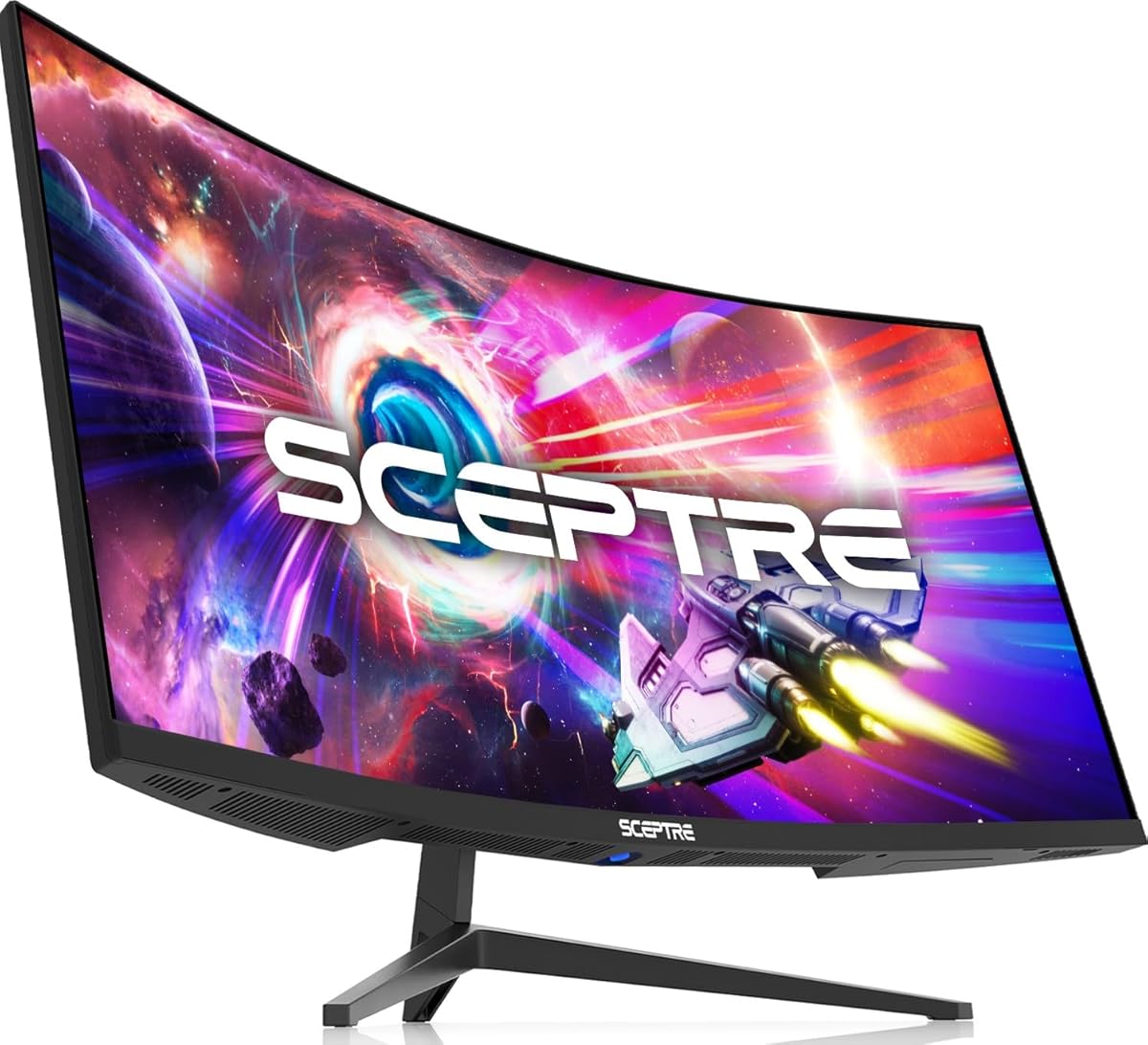
The Sceptre C345B-QU240T Series combines a 34-inch 1500R curved panel with 3440×1440 resolution and a maximum refresh rate of 240Hz. That blend makes it attractive for players who want both competitive speed and more visible information than a conventional Full HD screen. The 1ms response specification further supports clear motion during rapid gameplay.
We may earn a commission when you buy through this link, at no additional cost to you.
Its four video inputs—two HDMI ports and two DisplayPort connections—provide unusually broad connectivity for a gaming display. Built-in speakers and an audio output jack reduce the need for separate desktop speakers in casual setups. For image quality, Sceptre specifies 100% sRGB coverage, while Blue-Light Shift is included to reduce blue-light output during extended use.
The ultrawide format is the main consideration. A 3440×1440 canvas can show more of a game world, provide useful room for side-by-side applications, and make cockpit-style driving and strategy games more immersive. However, it occupies considerably more desk space than a 24.5-inch or 27-inch model, and older games without ultrawide support may show borders or stretched elements.
This Sceptre is best for competitive players who also value an expansive desktop and want a higher-resolution alternative to Full HD. Its 4.4 rating and strong combination of speed, resolution, and connectivity place it among the strongest all-around options here. Ensure your GPU can sustain the desired frame rate at 3440×1440, and check individual game support for the 21:9 format.
The 3440×1440 resolution supplies more horizontal room than 1920×1080 while retaining a familiar 16:9 pixel height. This balance supports immersive games, multitasking, and competitive play without requiring the extreme physical width of some larger ultrawide formats.
Two DisplayPort and two HDMI inputs reduce cable juggling when switching between a gaming PC, laptop, or console. Integrated speakers add convenient audio, although a headset or external speakers will usually provide a more competitive soundstage.
We may earn a commission when you buy through this link, at no additional cost to you.
The LG 32GS60QC-B is a 32-inch curved QHD gaming monitor aimed at players who want useful competitive features in a familiar UltraGear design. Its 180Hz refresh rate, 1ms GtG response time, and AMD FreeSync support provide a solid high-speed foundation, while the 2560×1440 resolution offers more clarity and workspace than a standard Full HD display.
We may earn a commission when you buy through this link, at no additional cost to you.
Gaming-oriented tools are a defining feature. Black Stabilizer can make dark areas more visible, Dynamic Action Sync is designed to reduce input lag, and the built-in FPS Counter provides real-time frame-rate information. Gamer, FPS, and RTS display modes let users tailor the presentation to different genres, while a crosshair option supports aiming precision in compatible shooters.
The 1000R curve is among the strongest in this list and is intended to surround the viewer with the action. The monitor also supports HDR10 and up to 99% sRGB color coverage, with two HDMI ports and DisplayPort connectivity. Its three-side virtually borderless design helps preserve a clean visual and can work well in a dual-monitor arrangement.
The listed stand is tilt adjustable, and there is no indication of height, swivel, or pivot adjustment. That is worth considering for users who need precise positioning. At 180Hz, the LG is not the fastest choice in the roundup, but its combination of QHD clarity, deep curvature, synchronization, and gaming overlays makes it a compelling option for a broad range of competitive and immersive games.
Black Stabilizer, Dynamic Action Sync, a crosshair, and a live FPS counter are practical features for shooters and other competitive genres. They provide useful information or visual adjustments without requiring a separate overlay application.
A 2560×1440 panel increases pixel density compared with Full HD, helping small interface text and distant details appear more defined. The 1000R curvature adds a strong sense of enclosure for racing, flight, and action games.
We may earn a commission when you buy through this link, at no additional cost to you.
The Sceptre E225W-FW144 Series offers a more compact route into high-refresh gaming with a 22-inch Full HD panel capable of running at up to 144Hz. That combination is well suited to competitive shooters, esports titles, and smaller gaming spaces where a 27-inch or ultrawide display would occupy too much of the desk.
We may earn a commission when you buy through this link, at no additional cost to you.
Its listed features emphasize practical everyday use. Integrated speakers provide a simple way to hear system audio without adding desktop speakers, while Blue-Light Shift is intended to reduce blue-light output during long sessions. The nearly bezel-free design keeps the visual footprint tidy and makes the monitor suitable for a dual-screen arrangement.
The supplied information is relatively concise, so buyers should confirm response-time specifications, adaptive synchronization, stand adjustment, and supported maximum refresh rates directly in the listing. A 144Hz display is a meaningful upgrade over a standard 60Hz model, but it sits well below the 180Hz, 240Hz, 310Hz, and 540Hz options elsewhere in this guide.
This Sceptre is a good candidate for a dedicated gaming PC in a compact room, a student setup, or a second display. Its 4.4 rating is encouraging, but the more important consideration is physical fit. If your desk can accommodate a larger panel and your graphics card supports higher frame rates, one of the QHD or ultrawide alternatives may offer a more future-proof experience.
A 144Hz refresh rate can make cursor movement and fast game action appear considerably smoother than a 60Hz display. Combining that speed with a 22-inch footprint offers a practical combination for limited spaces.
The slim bezel helps the display sit neatly beside another monitor. Full HD resolution at this size also avoids the scaling demands that can occur when a high-resolution desktop is placed on a physically smaller panel.
We may earn a commission when you buy through this link, at no additional cost to you.
The Sceptre C345B-QUT168 is a 34-inch 1500R curved ultrawide built around a 3440×1440 WQHD panel. Its main appeal is the combination of high resolution and a 21:9 format, which supplies substantially more horizontal workspace than a standard 16:9 display. That makes it useful for gaming, video editing timelines, spreadsheets, and other multitasking applications.
We may earn a commission when you buy through this link, at no additional cost to you.
The panel supports refresh rates of up to 180Hz or 165Hz and has a stated 1ms MPRT response time. It covers 99% sRGB and includes two DisplayPort connections and built-in speakers. These features make it a flexible all-rounder, particularly for users who want an ultrawide display without moving to the highest possible refresh rate.
The luminous back-cover lighting introduces a decorative element that is not central to performance but can make a gaming setup feel more distinctive. More important practical issues include desk depth, viewing distance, and the possibility that some older games will not fill the ultrawide canvas. Its 180Hz maximum rate also means a system prepared for 240Hz displays may not exploit its full potential.
The Sceptre is best suited to buyers who place equal value on screen area and gaming speed. Its 4.2 rating reflects a generally favorable response, while the high resolution and 1ms MPRT specification provide a compelling foundation for both work and play. Check the supported refresh rate for each input and ensure your applications can take advantage of the 21:9 aspect ratio.
The 21:9 format provides 30% more screen space than a conventional monitor according to Sceptre. That advantage is meaningful for arranging windows, reviewing wide timelines, or seeing a larger portion of a game world.
The 1ms MPRT rating, 3440×1440 resolution, and up-to-180Hz refresh create a capable middle ground between everyday QHD panels and very high-refresh 240Hz alternatives.
We may earn a commission when you buy through this link, at no additional cost to you.
The Samsung Odyssey G55C combines a 32-inch 1000R curved panel with QHD resolution and a 165Hz refresh rate. Its 1.7-times pixel density compared with Full HD helps produce finer detail, making it a capable all-purpose gaming display for players who value image clarity and immersion alongside responsive motion.
We may earn a commission when you buy through this link, at no additional cost to you.
A 1ms MPRT response time and AMD Radeon FreeSync are the main performance features. FreeSync synchronizes the display and graphics card refresh rates to reduce tearing, while HDR10 adds greater contrast and color range for supported content. The deep curvature is designed to pull peripheral game content toward the viewer, which can make racing, flight, and third-person action games feel more enveloping.
Samsung also includes Eye Saver Mode to limit blue light and a flicker-reduction feature intended to make extended gaming more comfortable. These settings do not replace a properly lit room or sensible viewing habits, but they add useful options for players who spend long sessions at the desk. The 4.4 customer rating places it among the better-reviewed products in this roundup.
This Odyssey is a strong all-round choice for a dedicated gaming system, especially when QHD detail and a pronounced curve matter more than reaching 240Hz. It is less suitable for buyers who specifically need the highest possible frame rate, and its 16:9 format provides less horizontal room than a 3440×1440 ultrawide. Confirm FreeSync compatibility and the maximum refresh rate available through your chosen connection.
The 2560×1440 panel packs substantially more information into the screen than 1920×1080. This can make interface text, weapon details, and distant objects look more distinct, particularly when sitting at a normal desktop viewing distance.
Eye Saver Mode and flicker reduction complement AMD FreeSync in different ways. The former targets viewing comfort, while the latter focuses on keeping motion synchronized with compatible graphics hardware.
We may earn a commission when you buy through this link, at no additional cost to you.
The ASUS TUF Gaming VG259QMRL5A stands out as a high-speed competitive option with a 24.5-inch Fast IPS panel that can be overclocked to 310Hz. Its stated 0.3ms minimum GtG response is among the quickest figures in this group, making it a compelling choice for players who want low latency and rapid visual transitions in competitive games.
We may earn a commission when you buy through this link, at no additional cost to you.
The display supports both G-SYNC compatibility and FreeSync Premium, giving it broad synchronization potential with different graphics hardware. ASUS Extreme Low Motion Blur Sync can operate with variable refresh rate to reduce ghosting and tearing. DisplayWidget Center provides mouse-based access to on-screen settings, while TUF Gaming A.I technology adds an additional layer of automated gaming features.
Color and viewing are also well considered for a speed-focused screen. The panel covers 99% sRGB and carries DisplayHDR400 certification. Its height-adjustable stand helps place the 24.5-inch display at a comfortable angle, and the package includes a DisplayPort cable, power cord, screwdriver, quick-start guide, and warranty card. A three-month Adobe Creative Cloud subscription is also included with the stated promotion.
This ASUS is best for competitive players who can drive exceptionally high frame rates and want flexibility across G-SYNC-compatible and FreeSync Premium systems. The 4.4 rating is a positive sign, but the Full HD resolution means it is less appropriate for detailed creative work than a QHD model. Because the headline rate is an overclocked figure, check graphics-card compatibility and the required signal and cable setup.
The 310Hz overclock mode places this display well beyond conventional 144Hz and 180Hz models. When the GPU can render at that level, the shorter frame interval can make rapidly moving objects and camera rotations appear exceptionally fluid.
Supporting both G-SYNC compatibility and FreeSync Premium is useful for buyers who may change graphics hardware. ELMB Sync adds another route to minimizing blur while retaining variable-refresh functionality.
We may earn a commission when you buy through this link, at no additional cost to you.
The Acer Nitro XV272U offers an unusually well-rounded combination of 27-inch QHD resolution, a 240Hz refresh rate, and a 1ms GtG response time. That makes it a strong candidate for competitive gamers who want more screen detail than Full HD without giving up the fast motion available from the best high-refresh panels.
We may earn a commission when you buy through this link, at no additional cost to you.
AMD FreeSync Premium is included, and the monitor can run at 240Hz through DisplayPort or 144Hz through HDMI. The port selection consists of one DisplayPort 1.4, two HDMI 2.0 connections, and an audio output. DisplayPort and HDMI cables are included, which is helpful for setup and reduces the need to purchase essential connection cables immediately.
Its stand is a major advantage over many competing gaming displays. The listed adjustments include a 4.7-inch height range, tilt from negative five to positive 15 degrees, 360-degree swivel, and plus-or-minus 90-degree pivot. VESA 100x100mm mounting support adds further flexibility. Two speakers rated at two watts each provide basic audio without taking up desk space.
The Nitro is best for gamers who want a 240Hz QHD experience and expect to rotate the display for different games, streams, or work. Its 4.2 rating is solid, though the provided information does not list brightness or color-gamut figures, so picture-quality comparisons should be made with those omissions in mind. A capable GPU and DisplayPort connection are important for reaching the full 240Hz rate.
Many high-refresh monitors use Full HD to reduce the load on graphics hardware. The XV272U instead combines 2560×1440 with 240Hz, offering a better balance of detail and speed for users with a suitably powerful system.
A 360-degree swivel and 90-degree pivot go beyond basic tilt-only support. These controls make the monitor easier to share between gaming, reading, and editing tasks, particularly on a compact desk.
We may earn a commission when you buy through this link, at no additional cost to you.
The Acer Predator X32 is the premium image-quality option in this roundup, combining a 31.5-inch 4K QD-OLED panel with a 240Hz refresh rate. Its true 10-bit presentation, 99% DCI-P3 gamut, and VESA DisplayHDR True Black 400 capability give it a substantial advantage for games with rich color, deep blacks, and high-contrast scenes.
We may earn a commission when you buy through this link, at no additional cost to you.
Motion performance is equally ambitious. A 0.03ms GtG response is dramatically faster than the 1ms figures common among many IPS gaming monitors, helping minimize ghosting and preserve detail during fast transitions. The 3840×2160 resolution delivers four times the pixel count of Full HD, but that additional workload means a capable graphics card is essential for consistently driving the display at its full refresh rate.
The 1700R curve and 16:9 format are designed to create an enveloping view without stretching into a 21:9 shape. Image-retention refresh is included to help prevent images from sticking, which is an important maintenance feature for an OLED display used with static desktop elements. Tilt, swivel, and height adjustments allow the user to optimize the viewing position.
This Predator is the best choice for buyers who can afford to prioritize the entire visual experience rather than merely the maximum refresh rate. It is particularly suitable for high-end gaming, cinematic titles, and content viewing where OLED contrast and color depth matter. Treat it as a premium display, use suitable OLED screen-care habits, and verify that your system can drive 4K at the desired frame rate.
QD-OLED technology can produce very deep blacks and strong highlight contrast, giving dark scenes more visual separation. True 10-bit color and 99% DCI-P3 coverage also benefit content with broad color palettes and subtle gradients.
The 240Hz refresh and 0.03ms response time ensure that an OLED panel does not need to sacrifice speed for image quality. Realizing that combination in demanding games requires a graphics system capable of producing high-resolution, high-frame-rate output.
We may earn a commission when you buy through this link, at no additional cost to you.
A good high-refresh monitor should fit your hardware, display space, and preferred genres. The most important decisions are refresh rate, response behavior, panel resolution, synchronization, color quality, and ergonomic flexibility.
Refresh rate is the number of times the display updates each second, and it determines the maximum frame rate it can show. The options here range from 144Hz on the compact Sceptre to 540Hz on the CRUA, with several 180Hz, 240Hz, and 310Hz choices in between. A higher ceiling can make motion look smoother, but the benefit depends on your graphics card, game settings, and display settings actually sustaining a high frame rate.
A 240Hz monitor is not automatically better than a 540Hz model if your system rarely reaches those frame rates. Conversely, a very high-refresh screen can be overkill for strategy games, simulators, and content consumption. Aim for a display that complements the performance of your system rather than one that leaves most of its potential unused.
Resolution determines how much information the screen can display and how much GPU power is required to render it. Full HD models are easier to drive at extreme refresh rates, making them logical for competitive 240Hz, 310Hz, and 540Hz use. QHD provides a better balance of detail and speed, while 4K delivers exceptional clarity but places the greatest demand on a graphics card.
Resolution also changes how a panel feels at a particular size. Full HD on 24.5 or 27 inches provides a familiar density, while QHD is a strong middle ground for 27- and 32-inch displays. The 4K OLED option is most compelling for players with high-end hardware who also value image quality.
Fast response helps objects remain distinct as they move, reducing visible blur and ghosting. The listed figures include 1ms MPRT, 1ms GtG, 0.3ms minimum GtG, and 0.03ms GtG, but these are not perfectly interchangeable measurements. GTG describes transitions between visible colors, while MPRT is a motion-oriented measurement, and manufacturers may test under different conditions.
A low published figure does not guarantee the same experience in every game or at every refresh rate. Pair the response specification with fast IPS technology, a high refresh ceiling, and compatible synchronization. For the most competitive use, look for technologies such as ELMB Sync or a panel with an exceptionally low GtG rating.
Adaptive synchronization coordinates the display's refresh with the graphics output to reduce tearing. AMD FreeSync appears across several selections, while the ASUS TUF supports G-SYNC compatibility and FreeSync Premium. Compatible synchronization is especially useful when a game briefly falls below its target frame rate and cannot maintain a perfectly smooth cadence.
Check the graphics card, game, monitor model, and the required version of Adaptive Sync. DisplayPort is commonly the preferred connection for high refresh rates, although the products here support different maximum rates through HDMI and DisplayPort. A compatible cable is also important because older cables may limit the available signal bandwidth.
Color coverage determines how accurately a display can reproduce the standardized sRGB range, which covers most desktop content. Several models reach 99% or slightly above 100% sRGB, while the Acer Predator offers 99% DCI-P3 coverage and true 10-bit color. Wider gamuts are particularly useful for HDR gaming, photography, video, and content with saturated color.
HDR support should be considered alongside brightness and contrast rather than in isolation. The LG, Samsung, and Acer OLED include HDR-related features, but the supplied data provides limited brightness information for some models. Look for a display that expresses the color range you care about while still delivering enough clarity for competitive play.
Screen size affects both immersion and desk practicality. A 22-inch display is easy to pair with another monitor, 24.5- and 27-inch panels are common competitive sizes, and 32-inch QHD screens offer a larger but still familiar 16:9 shape. A 34-inch ultrawide adds horizontal space, which is useful for racing and simulation games but requires more desk width.
Curvature is primarily a comfort and immersion feature. The 1000R and 1500R options wrap more strongly around the viewer, while the Acer OLED uses 1700R. A deeply curved monitor can feel immersive, but it is not automatically better and may be less comfortable for some users or desk layouts.
Ergonomic adjustment can make a large difference during long sessions. The CRUA supports height, tilt, swivel, and vertical pivot. The Acer Nitro offers height, tilt, 360-degree swivel, and pivot, while the Acer Predator supports tilt, swivel, and height. Some smaller and midrange models offer only tilt, so verify the stand before planning a multi-purpose setup.
Also consider the monitor's footprint, VESA compatibility, and cable routing. Ultrawide models need substantially more desk space than compact 22- or 24.5-inch displays. A narrow-bezel design may help with a dual-monitor arrangement, but room for the stand, power supply, and mouse movement still matters.
The number and type of ports determine how easily the monitor connects to a desktop, laptop, or console. DisplayPort is essential for reaching the highest refresh rates on many gaming systems, while HDMI offers broad device compatibility. Models with two DisplayPort and two HDMI inputs simplify switching, and some include audio output or integrated speakers for convenient everyday use.
Built-in speakers are usually a convenience rather than a replacement for a gaming headset. Check whether DisplayPort or HDMI cables are included, particularly for higher refresh modes, and confirm the presence of an audio connection if you plan to use external speakers or a headset with a separate USB audio adapter.
Start by connecting the monitor with a cable and interface capable of carrying your intended resolution and refresh rate. For most high-refresh gaming systems, DisplayPort is the safest choice. After connecting, update the graphics driver, select the correct input, and set the operating system's display resolution to the monitor's native resolution. Only then choose the highest refresh rate supported by the graphics card, game, and signal path.
In the monitor's on-screen menu, confirm that the target refresh mode is active and configure synchronization to match your graphics hardware. Use a test pattern or in-game frame-rate display to verify that the expected rate is being reached. Fine-tune brightness and contrast in a normally lit room, and avoid leaving a calibration image on an OLED display for long periods. For LCD and IPS models, use the provided eye-comfort or low-blue-light modes when appropriate.
For an OLED display, allow the built-in image-retention refresh to run on its recommended schedule and keep static interface elements from remaining on screen indefinitely. Handle all panels carefully, clean them with a soft microfiber cloth, and avoid liquid cleaners unless the manufacturer specifically approves them. Periodically check stand tension, cable connections, display settings, and the graphics card's frame-rate output to ensure the intended configuration remains active.
A 540Hz monitor can show twice as many refresh cycles per second as a 240Hz model, but the difference is only visible when the game and graphics hardware consistently produce more than 240 frames per second. At lower frame rates, a strong 240Hz or 310Hz display may provide a more practical and cost-effective experience. Resolution, pixel density, and GPU power also influence the better choice.
Yes, especially at QHD or 4K resolution. A monitor can accept a high refresh rate, but the graphics card must render frames quickly enough to use it. Full HD models place the least strain on a system, while the 4K OLED option benefits from a high-end graphics card. Consider both the target resolution and the most demanding games you play.
MPRT is a motion-perception measurement that considers how long a moving image appears visible, while GtG measures the transition time between colors. The two figures are not directly interchangeable, and testing methods can vary by manufacturer. A very low GtG figure is especially meaningful for fast IPS or OLED panels, but refresh rate and synchronization remain important too.
Yes, because adaptive synchronization helps align the graphics card's output with the monitor's refresh rate, reducing tearing when frame delivery fluctuates. The Acer Nitro, Samsung Odyssey, LG UltraGear, and CRUA list AMD FreeSync support. The ASUS TUF supports G-SYNC compatibility and FreeSync Premium. Check operating-system and game requirements before relying on synchronization.
Curvature does not inherently improve speed or accuracy. It can make an ultrawide game feel more immersive and keep peripheral content closer to the viewer, but straight 16:9 displays may be easier to position consistently. The deepest curves may also distort the perceived edges of the image. Choose based on desk space, game preference, and comfort rather than curvature alone.
You can connect the monitor to a compatible laptop, but the laptop's graphics output and connection must support the target resolution and refresh rate. Some portable GPUs and laptop ports are limited to lower rates. Verify the laptop's specifications, use a compatible cable, and avoid daisy-chained or unsuitable adapters that can reduce the available bandwidth.
It depends on your hardware and priorities. Full HD is considerably easier to drive at 310Hz or 540Hz, and competitive players often value smooth motion over fine detail. A 4K OLED can provide superior clarity, contrast, and color while still running at 240Hz, but it requires a much stronger graphics system. Both can be excellent with appropriate hardware.
Measure your desk and confirm that you are comfortable with the screen's distance and curvature. Check whether your favorite games support 21:9 resolution without letterboxing, and verify the refresh rates available through each video input. A high-refresh QHD ultrawide can demand considerable GPU power, so include resolution and frame-rate targets in your budget.
The CRUA 27-inch 540Hz IPS is the leading choice for buyers seeking the highest stated refresh rate, responsive motion, and flexible stand adjustment. The KTC 24.5-inch 240Hz Fast IPS offers a more approachable high-refresh configuration, while the Acer Predator X32 delivers the premium 4K QD-OLED experience with exceptional color, contrast, and 0.03ms GtG response.
Prioritize the feature that directly improves your experience. Competitive players should compare refresh rate, response behavior, synchronization, and the performance of their graphics hardware. Those wanting more detail should consider QHD, while ultrawide buyers should account for desk space and game support. OLED is ideal for image quality, and smaller displays work well in compact or dual-screen arrangements.
Before purchasing, verify the current specifications, supported resolution and refresh combinations, included cables, warranty details, and return policy. Product listings and promotional features can change over time, so check the live page and current price rather than relying solely on this guide. The right monitor is the one whose speed, resolution, visual characteristics, and physical design fit your setup.
