
T-685 High Precision Analyzer
2.2Editor score
Micro-ohm resistance range
AC and DC resistance modes
Laboratory-grade Kelvin probes
Compare the best battery internal resistance tester options for cars, lithium packs, household cells, and professional use, including accuracy, range, and
A battery internal resistance tester reveals how much opposition a cell presents under load, helping reveal age, imbalance, and deterioration that a voltage reading alone may miss. The right instrument should combine dependable measurement resolution with safe battery-type compatibility, clear results, and a practical interface for routine checks or advanced diagnostics.
We compared the ten available models by examining their measurement methods, voltage and resistance capabilities, battery compatibility, four-wire sensing, data functions, displays, portability, and intended uses. The list covers dedicated analyzers, compact universal battery meters, automotive diagnostic tools, and multifunction models that also operate as digital multimeters.
Each review highlights the features that distinguish the selected model, along with its limitations and ideal buyer. The top selections balance measurement capability, ease of use, and application range, while individual ratings and listing details may change over time, so readers should confirm current specifications before purchasing.
2.2Editor score

4.5Editor score

4.4Editor score
The comparison below shows how the ten models differ in measurement architecture, supported batteries, display design, and practical scope. The strongest all-around option combines battery analysis with multimeter functions, while dedicated and budget models serve narrower screening, field, or laboratory needs.




The ZOYI ZT-XR1 earns a 4.5 rating and stands out as the most versatile model in this guide. It combines a 25,000-count True RMS digital multimeter with a dedicated internal resistance analyzer, allowing the same unit to handle electrical troubleshooting, battery screening, voltage checks, frequency measurements, capacitance readings, diode tests, continuity checks, and temperature measurements.
We may earn a commission when you buy through this link, at no additional cost to you.
Its dedicated battery mode supports DC measurements from zero to 100 volts and resistance from 0.1 milliohms to 200 ohms. Four-wire Kelvin sensing is a particularly important feature for small cells because it reduces the influence of lead-wire and contact resistance. A dedicated aviation plug and separate test ports support cleaner battery work, while the stated resistance accuracy is ±0.5% and voltage accuracy is ±0.2%.
The instrument also has thoughtful features for extended use. Its 2.4-inch TFT screen provides adjustable brightness, the built-in rechargeable battery is rated for approximately six to ten hours depending on active functions and backlight use, and the Type-C charging interface simplifies replenishment. A low-battery reminder, configurable auto power-off, HOLD and relative measurement modes, data recording, waveform curves, and a bilingual menu add flexibility for technicians and advanced hobbyists.
The trade-off is complexity. A user who only wants a quick household battery check may find the menu and measurement breadth more than necessary, and the unit remains much larger than a pocket tester. Even so, it offers the strongest combination of battery analysis, general electrical testing, construction, and portable power in the group. It is the recommended choice for electricians, repair technicians, serious electronics hobbyists, and users who want one instrument for several diagnostic tasks.
The integrated multimeter mode eliminates the need to carry a separate meter for routine electrical work. AC and DC voltage, resistance, capacitance, frequency, diode, continuity, and thermocouple temperature functions broaden its value beyond battery analysis.
Four-wire Kelvin sensing, a 0.1-milliohm starting point, dedicated battery connections, and a 200-ohm range make the ZT-XR1 well suited to lithium, lead-acid, NiMH, alkaline, and supercapacitor testing when paired with an appropriate interface.
We may earn a commission when you buy through this link, at no additional cost to you.
The FNIRSI HRM-10 has a 4.4 rating and offers a focused combination of voltage measurement, internal resistance analysis, and record keeping. It is particularly attractive to users who regularly test several batteries and need to compare readings rather than merely check whether a cell still has a basic voltage reading.
We may earn a commission when you buy through this link, at no additional cost to you.
The meter reads voltage and internal resistance at the same time, while its customized Kelvin four-wire connection method is designed to reduce wire and contact resistance. Measurement capacity extends to 100 volts and 200 ohms, with automatic and manual range selection. A color TFT screen presents the results in a clear layout, and the unit can retain historical readings, export data tables, and display eight sets of voltage and resistance values for batch selection.
This combination makes it useful for automotive batteries, household cells, rechargeable packs, and other supported battery types. The ability to preserve records is especially valuable for fleet maintenance, workshop diagnostics, electronics repair, and battery-collector workflows. It also avoids the need to interpret a single isolated reading when a technician wants to see how a battery compares with predefined criteria or previous examples.
Its limitations are practical rather than fundamental. Four-wire measurements are most accurate when contact quality and probe placement are consistent, and a user with no experience with battery test leads may need a short learning period. The data-export feature also makes a computer part of the larger workflow. For anyone needing portable, readable, repeatable batch analysis rather than a broad multimeter, the HRM-10 is a strong and purpose-built choice.
Eight stored measurement sets allow users to establish reference points and compare multiple batteries consistently. This is particularly useful when screening matched cells, checking a group of vehicle batteries, or tracking changes over time.
Historical storage and data-table export reduce the need to write every result by hand. A technician can preserve results, review them later, or transfer them to a computer for more detailed analysis.
We may earn a commission when you buy through this link, at no additional cost to you.
The WESTOBIG Upgraded Tester carries a 4.3 rating and emphasizes accurate low-resistance measurement through Kelvin four-terminal sensing. The listing identifies it as a universal battery analyzer for automotive and other battery types, with a DC voltage range of zero to positive or negative 100 volts and a resistance range from zero to 200 ohms.
We may earn a commission when you buy through this link, at no additional cost to you.
Its most valuable feature is the ability to measure resistance below 0.1 ohm while reducing the inherent effect of the connecting lead wires. This makes the Kelvin clip line more useful for small cells and high-energy packs, where the resistance of a conventional two-wire connection could obscure the result. Voltage and resistance gear presets give the operator both automatic and manual control.
The data preset function supports eight sets of criteria, helping users determine whether batteries meet a selected standard and quickly identify problematic examples. Records are automatically saved and can be transferred to a computer through Excel. The supplied description also highlights compatibility with AA, AAA, button, lithium, and lead-acid batteries, although the tester must not be connected to DC voltage above 100 volts or any AC voltage.
Some users may want a simpler interface, and the PC transfer workflow is unnecessary for occasional checks. Kelvin connections also demand more care than placing a meter across generic battery terminals. Despite those constraints, the combination of low-resistance capability, preset comparisons, stored records, and a color display gives this model strong value for users who want precise battery comparison rather than a basic voltage check.
The four-terminal arrangement helps isolate the cell's resistance from much of the resistance introduced by the test leads. That makes it a better fit for pouch cells, lithium-ion packs, and other batteries whose healthy internal resistance is relatively small.
Configurable voltage and resistance presets turn the tester into a screening tool. Users can compare incoming or serviced batteries against saved limits, identify outliers, and maintain a more consistent inspection process.
We may earn a commission when you buy through this link, at no additional cost to you.
The Dlyfull Universal Battery Tester has a 4.4 rating and is the most approachable option for checking the many batteries found around a home, office, or workshop. Instead of requiring a specialized battery bay, it uses test leads and a rotary selector, making it practical for common AA, AAA, C, D, 9V, rechargeable, lithium-ion, and numerous button cells.
We may earn a commission when you buy through this link, at no additional cost to you.
Its large LCD display presents information about the battery under test, including voltage, estimated capacity percentage, and internal resistance. Those readings can help determine whether a cell is charged, weakened, or ready for replacement. The ability to distinguish a tired battery from a faulty device is particularly useful for toys, flashlights, controllers, and other everyday products that depend on replaceable cells.
Compatibility is unusually broad for a simple meter. The stated cell list includes A, AA, AAA, AAAA, C, SC, D, 9V, 26650, 21700, 18650, 16340, 10440, CR123, CR2, CRV3, 2CR5, CR-P2, A10, A13, LR621, and CR2032, along with other button cells. The package includes two preinstalled AAA batteries, a welcome guide, and an 18-month warranty with lifetime technical support.
Unlike the dedicated Kelvin analyzers in this list, it does not provide four-wire sensing, waveform analysis, or advanced resistance ranges. Its strength is accessibility rather than laboratory precision. It is best for consumers who need a dependable, straightforward way to screen many household and hobby batteries, and its capacity estimate makes it especially useful for prioritizing which cells to recharge or replace first.
The broad supported format list removes the need to own separate testers for cylindrical cells, rectangular lithium batteries, and coin cells. Users choose the relevant voltage through the rotary dial and connect the leads to the battery.
Voltage and capacity-percentage readings make the result easier to act on than a raw voltage number alone. A user can quickly identify weak cells that may be causing unreliable operation in a flashlight, toy, controller, or camera.
We may earn a commission when you buy through this link, at no additional cost to you.
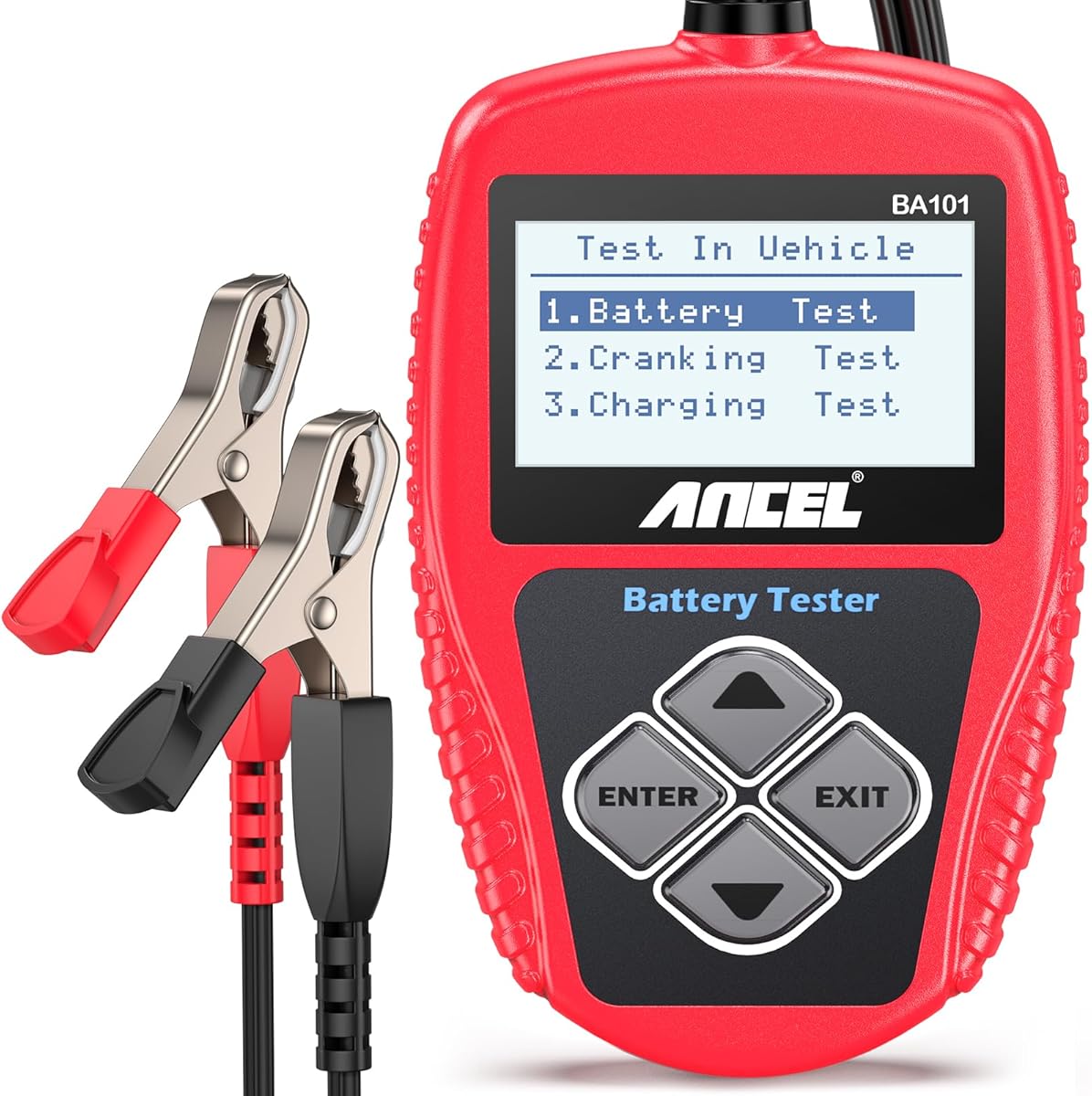
The ANCEL BA101 has a 4.5 rating and is built for a specific but common need: diagnosing 12-volt vehicle batteries and their associated charging and cranking systems. It reports state of health, state of charge, voltage, current, and cold-cranking amperes, then adds separate cranking and charging-system analysis rather than limiting itself to a basic battery reading.
We may earn a commission when you buy through this link, at no additional cost to you.
Its 100-to-2000-CCA range suits a broad collection of cars, trucks, boats, recreational vehicles, all-terrain vehicles, lawnmowers, golf carts, and motorcycles with compatible batteries above 30 amp-hours. It supports Flooded, AGM, GEL, and EFB chemistries and recognizes JIS, EN, DIN, SAE, BCI, GB, CA, MCA, and IEC standards. Entering the correct battery type, rating, and temperature helps the tool provide a more meaningful result.
Operation is straightforward in a vehicle environment. A high-contrast monochrome display has adjustable contrast and a white backlight, while one-handed use and direct power from the vehicle battery remove the need for internal batteries or a separate charging routine. Copper crocodile clips support secure attachment, while reverse-polarity, short-circuit, overcurrent, and overvoltage protection helps contain common connection errors. The reinforced ABS housing is designed for routine workshop handling.
This is not a universal internal resistance analyzer. It is expressly unsuitable for lithium batteries and for 6-, 8-, or 24-volt systems, and it excludes motorcycles below 30 amp-hours. Within that 12-volt automotive envelope, however, it offers more complete vehicle diagnosis than a generic cell meter. It is best for drivers, mechanics, and fleet users who want a fast assessment of battery condition, starting performance, and charging behavior.
State of health, state of charge, voltage, current, CCA, cranking, and charging results provide a broader view of the starting system. This helps separate a weak battery from an alternator or starting-system concern.
Support for Flooded, AGM, GEL, and EFB batteries makes the tool relevant to many modern vehicles. Correctly entering the battery label information and temperature remains essential for interpreting the displayed assessment.
We may earn a commission when you buy through this link, at no additional cost to you.
The ZOYI XR1 has a 3.9 rating and delivers the core concept of a two-in-one battery analyzer and digital multimeter. Its battery mode simultaneously displays internal resistance and voltage, allowing users to compare a cell's electrical condition more efficiently than with a device that must perform separate operations.
We may earn a commission when you buy through this link, at no additional cost to you.
A resistance range beginning at 0.1 milliohm and extending to 200 ohms gives it useful reach for small lithium cells, rechargeable packs, and lead-acid batteries. Four-wire Kelvin clips are intended to minimize lead and contact resistance, and the operator can adjust both voltage and resistance ranges manually. Maximum input voltage is specified at 100 volts, so the tester must not be used above that limit.
The multimeter portion adds AC and DC voltage, resistance, capacitance, frequency, temperature, diode testing, and continuity checking. A 25,000-count display is suitable for detailed readings, while a color TFT screen supports clear presentation and adjustable brightness. The auto-shutdown timer can be configured from five to 120 minutes, buzzer volume ranges from zero to 100 percent, and a Type-C interface provides a modern charging connection.
The main reason to hesitate is the 3.9 rating, which is lower than the scores recorded by most alternatives here. The supplied product information also provides fewer details about protection, battery runtime, and broader diagnostics than the ZT-XR1 listing. Even so, the XR1 covers the essential features sought by a technician: simultaneous readings, low-resistance capability, Kelvin sensing, and a conventional multimeter. It is a practical option for users who want broad functionality without moving to the more complex ZT-XR1.
Displaying voltage and internal resistance together provides a more complete view of battery condition. It can help reveal a cell that still registers voltage but has elevated resistance and diminished practical capacity.
The conventional measurement modes make the XR1 useful beyond battery maintenance. It can handle routine voltage, resistance, capacitance, frequency, temperature, diode, and continuity checks in a workshop or on an electronics bench.
We may earn a commission when you buy through this link, at no additional cost to you.
The RC3563 has a 4.9 rating, the highest in this guide, and occupies a useful middle ground between a basic household tester and a full multifunction workbench meter. It is a dedicated handheld analyzer for battery internal resistance and voltage, with a Kelvin four-wire clamp designed to reduce measurement errors from contact and wire resistance.
We may earn a commission when you buy through this link, at no additional cost to you.
Its intelligent control system uses a liquid crystal display and a Kalman filter mathematical algorithm to improve measurement consistency and efficiency. The combination is especially relevant when readings fluctuate due to small changes in contact pressure or when repeated measurements need to remain stable. The analyzer can also measure the AC resistance of low-resistance capacitors and resistors, giving it utility beyond routine battery screening.
A built-in 1000mAh lithium battery and five-volt charging support convenient cordless operation. The description notes that an Android phone charger can be used, which is helpful for technicians who may not carry a dedicated charging cable. Its target environments include battery production, maintenance, scientific research, and laboratory work, as well as field service where compactness matters.
The product information gives fewer details about exact voltage limits, memory, and data export than some competing models, so buyers should confirm those specifications before using it in a regulated or highly specialized workflow. It is also a dedicated analyzer rather than a general multimeter. Even with those qualifications, its exceptional rating, four-wire implementation, portable power, and extension into low-resistance component testing make it the most compelling dedicated premium model here.
The Kelvin clamp reduces the contribution of leads and contact points, while the filtering algorithm supports more consistent readings. Together they make the RC3563 useful for repeat comparisons and very low-resistance measurements.
The ability to measure AC resistance in low-resistance capacitors and resistors adds workshop value. It lets a technician retain one compact instrument for both battery diagnostics and selected component checks.
We may earn a commission when you buy through this link, at no additional cost to you.
The YR1035+ Digital Tester has a 5.0 rating and offers a compact, focused solution for battery performance testing, screening, and configuration. Its defining technical feature is a true four-wire system, which separates the current and voltage pathways to reduce the effect of lead and contact resistance on internal resistance readings.
We may earn a commission when you buy through this link, at no additional cost to you.
The analyzer measures internal resistance and voltage simultaneously, so a user can examine both values without repeatedly moving probes or changing modes. Results appear on a large liquid crystal display designed to keep voltage and resistance readings visible in field or bench environments. Its compact and lightweight construction supports mobile use without requiring a full-size instrument.
The combination package includes both probes and clips, giving the user options for different contact points. Probes can be useful when reaching a particular tab or terminal, while clips can simplify hands-free contact on exposed battery leads. The device is positioned for general performance testing and battery screening across multiple battery types, although the supplied listing does not enumerate every supported format.
Its 5.0 rating is encouraging, but it should not be mistaken for laboratory certification. The product data does not state a detailed measurement range, accuracy rating, memory capacity, safety category, or data-export function. Those details should be confirmed before the device is relied upon for formal quality control. For portable four-wire analysis, however, the YR1035+ is compact, understandable, and highly rated, making it a strong choice for field technicians and service-oriented hobbyists.
Keeping the current and voltage paths separate improves the integrity of low-resistance measurements. In practical terms, this reduces the chance that the test lead itself will make a healthy cell appear worse than it is.
The inclusion of probes and clips accommodates both delicate terminal access and hands-free testing. That versatility is useful across battery packs, individual cells, and service environments where contact geometry varies.
We may earn a commission when you buy through this link, at no additional cost to you.
The T-685 has a 2.2 rating, but its specifications distinguish it as the most specialized instrument in this roundup. It is designed for users who need to measure extremely low resistance with high precision, extending from one microohm to 200 ohms while covering voltages from one millivolt to positive or negative 100 volts DC.
We may earn a commission when you buy through this link, at no additional cost to you.
Unlike conventional battery testers that focus mainly on DC internal resistance, the T-685 can perform both AC and DC resistance measurements. Its automatic range switching, six resistance gears, and three voltage gears support efficient testing, while a stated test pace of five measurements per second can be useful for examining rapid changes. LCR Kelvin four-wire clamp probes are included for the most sensitive work.
The analyzer supports lithium, nickel-hydrogen, nickel-cadmium, alkaline, lithium iron phosphate, lead-acid, 18650, and supercapacitor ESR testing under low-current conditions. A balanced measurement input and USB port provide options for structured testing and computer connectivity. The bilingual interface accommodates Chinese and English users, while the automatic range system reduces the need to select values manually.
The low rating warrants caution. Its 2.43-pound, mains-powered format is less portable than the handheld models in the list, and the supplied information does not explain the rating's causes. Prospective buyers should investigate owner feedback and confirm exact operating conditions. For laboratories, battery-pack developers, and advanced researchers who genuinely need micro-ohm range, AC resistance, and a professional Kelvin interface, the T-685 offers capabilities that simpler meters cannot match.
A one-microohm starting point expands the instrument beyond ordinary battery screening. It is relevant to research cells, premium battery packs, supercapacitors, and other applications where very small resistance changes matter.
Automatic ranging, multiple manual gears, fast testing, balanced input, and USB connectivity support repeated laboratory analysis. The AC and DC resistance modes also make it more versatile than a battery-only instrument.
We may earn a commission when you buy through this link, at no additional cost to you.
The YR1035+ Accessories Set has a 5.0 rating and focuses on a practical problem: obtaining a reliable connection to batteries with terminals, tabs, or electrode lugs that are difficult to reach with standard probes. The supplied information describes a voltage range of zero to 99.999 volts and an internal resistance range of zero to 200 ohms.
We may earn a commission when you buy through this link, at no additional cost to you.
The key attachment is a Kelvin clamp that can hold positive and negative battery leads while freeing both hands. It is particularly suitable for lead ends, sheet-electrode lugs, and similar contact points. Supported batteries include lead-acid, lithium, nickel-metal hydride, nickel-cadmium, and button cells, with the listing also referencing lithium iron phosphate and square battery formats.
This combination is useful for users who already understand the YR1035+ platform or who need a specific set of interfaces for pack assembly and maintenance. A clamp can provide steadier contact than a hand-held probe, while a voltage and resistance display provides the essential measurements in one place. The Type-C charging port is convenient for routine recharging between jobs.
The product listing is less complete than those for full standalone meters, and users should verify exactly which meter, leads, and accessories are included with the selected combination. Battery chemistry, terminal design, and physical access should also be checked before ordering. Subject to that confirmation, it is an appealing option for pack builders and repair technicians who value a dedicated Kelvin clamp more than a broad collection of digital functions.
The Kelvin clamp maintains contact on exposed leads or electrode lugs while leaving the operator's hands free. This reduces the movement that can produce unstable readings on small or irregularly shaped batteries.
Lead-acid, lithium, iron-phosphate, NiMH, NiCd, and button-cell capability makes the accessory set relevant to mixed battery collections. The correct range and connection method still need to be selected for the specific source being evaluated.
We may earn a commission when you buy through this link, at no additional cost to you.
The best battery internal resistance tester depends on the cell chemistry, pack design, accuracy required, and whether you need a dedicated analyzer, an automotive diagnostic tool, or a multifunction meter. These factors help narrow the field before comparing displays, recording features, and accessories.
Start by matching the meter's voltage and resistance limits to the batteries you intend to test. A household-cell tool may cover AA, AAA, C, D, 9V, button, and common lithium-ion formats, while a dedicated automotive or laboratory analyzer may extend from 100 volts to micro-ohm resistance. Never assume that a broad compatibility label guarantees suitable accuracy for every chemistry or form factor.
Kelvin four-wire sensing separates the current path from the voltage measurement path. This reduces the influence of lead-wire and contact resistance, which is especially important for healthy lithium cells with very low internal resistance. If your work involves pouch cells, 18650 packs, battery tabs, or precision screening, a four-wire model is preferable to a basic two-lead voltage tester.
Some users only need a simple indication of whether a household cell is depleted, while others require state of health, state of charge, CCA, cranking analysis, or charging-system results. A combined digital multimeter and battery analyzer offers greater versatility, while an automotive tester provides more meaningful starting-system diagnostics. Select based on recurring tasks rather than the longest possible feature list.
A large, high-contrast display is important when readings must be interpreted in a vehicle, workshop, or field. Color TFT screens can present battery and multimeter modes clearly, while simple LCD displays remain effective for dedicated analyzers. For repeated testing, historical records, eight comparison presets, waveform curves, and computer export can be more valuable than a larger screen.
Handheld models with rechargeable batteries are convenient for field service and battery collections. A rechargeable internal battery avoids repeated disposable-cell purchases, while adjustable brightness and automatic shutdown help manage operating time. Mains-powered laboratory analyzers can support continuous work and specialized inputs but are less convenient for mobile diagnostics.
The supplied connection method can be as important as the meter itself. Kelvin clips provide steady hands-free contact on battery leads and lugs, while probes help reach recessed terminals or individual cells. Check whether the package includes both, whether the clip is designed for four-wire sensing, and whether its jaw size suits the battery or pack you intend to inspect.
Internal resistance testers operate across energized battery terminals, so their voltage ratings and warnings matter. Several products in this guide specify a 100-volt maximum and prohibit AC input. Automotive testers may instead be limited to a particular battery voltage and chemistry, while advanced models include formal safety categories. Do not exceed stated limits, and never connect the meter to an unknown or higher-voltage source.
Begin by confirming the battery chemistry, nominal voltage, terminal arrangement, and the meter's permitted input range. Inspect the leads, clips, or probes for damaged insulation and clean contacts before touching the battery. If the analyzer has a Kelvin connection, identify the correct positive and negative clamp paths and follow its instructions for pairing them with the cell or pack.
For a stable reading, connect the tester with the battery in the state appropriate to the selected test mode and the manufacturer's guidance. Avoid moving the clips while the value is settling. For repeated comparisons, use the same contact points, the same range, and a consistent resting period. Save preset criteria when available so that later batteries are judged against the same baseline rather than an improvised expectation.
After use, disconnect the tester before removing probes, wipe the contacts and housing, and store the instrument away from moisture, direct heat, and corrosive material. Charge a built-in lithium battery only with the intended interface, and use the configured auto power-off to preserve runtime. Periodic comparison against a known-good reference battery can reveal contact degradation, calibration drift, or an intermittent connection before a critical diagnostic task.
An internal resistance tester estimates the opposition a battery presents to current and usually displays the battery voltage at the same time. A rising resistance value can indicate aging, damage, poor balance, or another change in cell condition. It should be interpreted alongside voltage, load behavior, battery history, and the manufacturer's test procedure rather than treated as the only measure of remaining capacity.
A conventional two-wire measurement can include the resistance of the test leads and contact points, making a healthy low-resistance cell appear worse than it is. Four-wire sensing uses separate pathways for current and voltage, reducing that interference. The advantage becomes most significant for lithium-ion cells, pouch batteries, and other sources with very small internal resistance.
Only if the product documentation explicitly supports lithium batteries. The ANCEL BA101 in this guide is specifically limited to 12-volt automotive lead-acid types and is not intended for lithium packs. Dedicated universal analyzers may support several chemistries, but users should still verify compatibility, voltage limits, and correct connection methods before testing.
No. Very low resistance is generally favorable, but it does not prove that a battery has full usable capacity. Temperature, state of charge, cell chemistry, aging, and measurement method all influence resistance. A battery can also have a shorted or imbalanced cell, so voltage under load, cell consistency, and application-specific tests remain important.
Only when the instrument and battery manufacturer explicitly permit it. Charging current, changing voltage, and control electronics can make a reading unstable or misleading. For many battery types, a controlled resting period produces a more repeatable result. The correct sequence should follow the meter's documentation, especially for automotive, lithium, and high-capacity battery systems.
Internal resistance measurement evaluates how strongly the source opposes current, while a capacity test normally determines how much charge it can deliver under a defined load or method. Resistance is fast and useful for screening, but it does not directly reveal full capacity. A meter that estimates charge percentage may use a relationship between voltage, resistance, and known cell behavior rather than performing a complete capacity discharge test.
Some models support a broad range of common cylindrical, button, lithium, and lead-acid batteries, including automotive formats. Nevertheless, the voltage range, resistance resolution, and contact method must be suitable for the source. A large automotive terminal may require a different attachment than a tiny coin cell, so verify both electrical compatibility and physical probe access.
Use the same chemistry, temperature, state of charge, meter, range, and contact method whenever possible. For a batch, define acceptable voltage and resistance limits and record each result consistently. Remember that internal resistance naturally varies with temperature and charge level, and that a healthy battery type may have a different normal range from a chemistry with greater inherent resistance.
The ZOYI ZT-XR1 is the strongest overall choice because it combines a capable 25,000-count True RMS multimeter with a dedicated four-wire battery analyzer, broad measurement functions, a rechargeable battery, and a bright color display. The RC3563 stands out as the premium dedicated analyzer, while the Dlyfull tester offers the most approachable way to screen a broad collection of household and hobby batteries.
Your priorities should follow the work. Choose the T-685 when micro-ohm resolution, AC resistance, and laboratory-style analysis are essential; choose the ANCEL BA101 for complete 12-volt vehicle diagnosis; and choose a Kelvin-equipped universal analyzer when comparing small lithium cells or service packs. Simple voltage checkers are suitable for casual replacement decisions but should not be confused with precision resistance instrumentation.
Before ordering, confirm the supported battery chemistries, maximum voltage, resistance range, contact style, and included accessories against your actual batteries. Ratings, bundle contents, and listing details can change, so check the current product page and manufacturer instructions before making a final selection.