
TEMOLA Portable Car Jump Starter
4.0Editor score
150 PSI maximum pressure
Compact 6.97-inch length
Five inflation presets
Three-mode emergency light
USB device charging
Discover the best Portable Battery Jump Box options for 2026, comparing starting power, tire inflation, safety systems, portability, and emergency features in
A portable battery jump box can turn a dead vehicle battery from a major roadside setback into a manageable inconvenience. The best models add useful emergency functions, but peak amperage, engine compatibility, tire inflation, protection systems, and easy storage matter more than any single headline specification.
This guide compares ten jump boxes using the information supplied for each product, including starting capacity, supported engines, air pressure, airflow, safety systems, lighting, charging options, dimensions, and included accessories. It covers conventional battery-powered models, compact two-function units, heavy-duty inflation combos, and a supercapacitor design.
Each review explains who the product appears best suited for, along with meaningful limitations. The top selections demonstrate the strongest combinations of versatility, value, and specialized capability. Product availability and pricing can change, so confirm the current listing and specifications before purchasing.
A jump starter earns its place in a vehicle because it has to work when the vehicle battery does not. That means its starting output, cable design, clamp safeguards, and operating instructions deserve close attention, while secondary features such as air compressors, power banks, and LED lighting can add value without distracting from the core job.
4.0Editor score

4.5Editor score

4.2Editor score
The comparison below highlights the major differences among ten portable battery jump boxes, including their starting claims, engine coverage, inflation capabilities, emergency functions, and physical design.
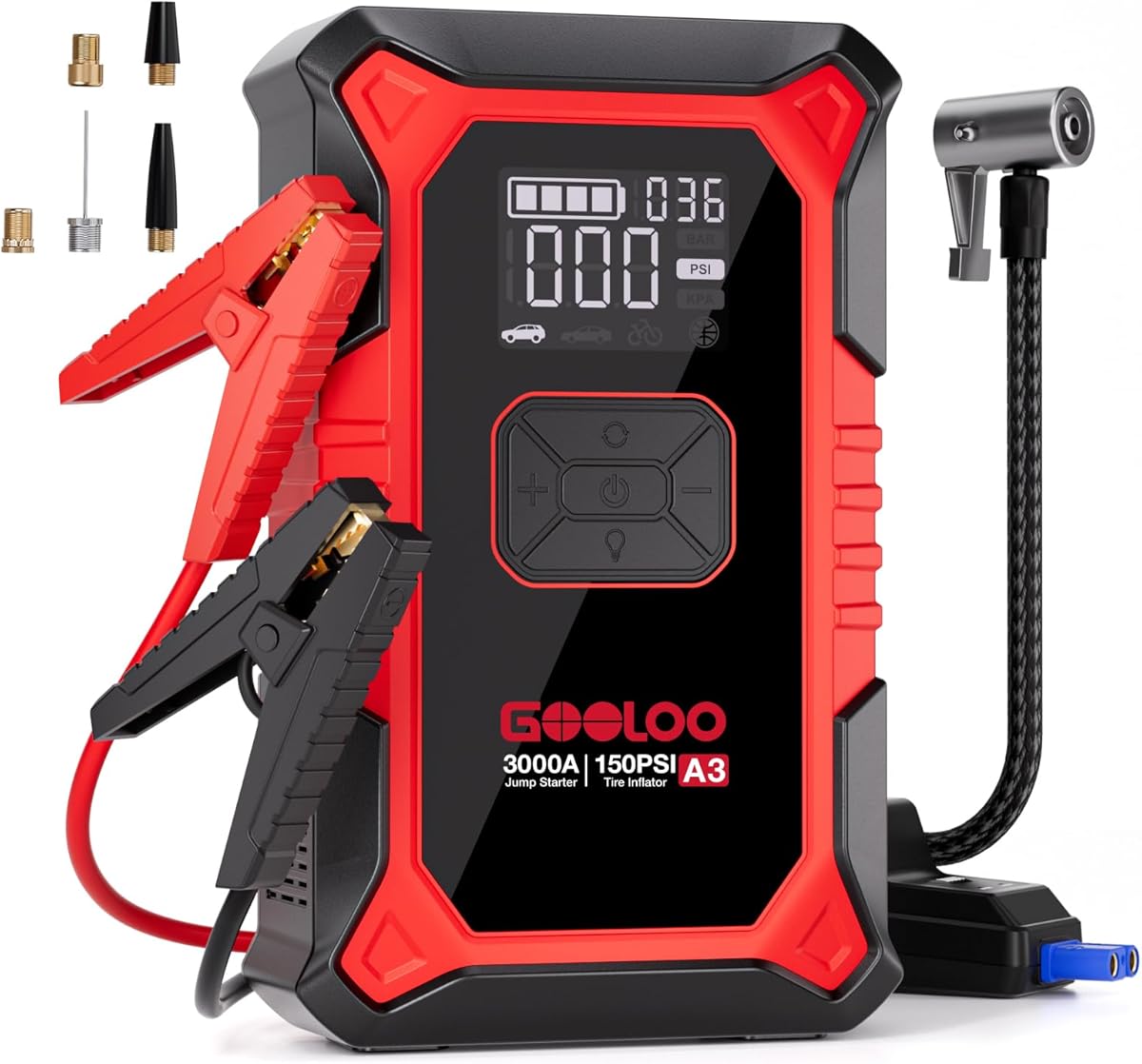


The GOOLOO A5 is the most complete conventional all-in-one jump box in this group, combining jump starting, inflation, a power bank, a pressure gauge, and LED lighting in one package. Its supplied rating is 4.5, and the practical appeal comes from the balance between a stated 4000A peak output, a 20,000mAh rated capacity, and a tire inflator capable of reaching 160 PSI. The listed 2026 design measures 8.98 by 5.55 by 2.40 inches, so it is portable enough for a trunk or large storage compartment without pretending to be pocket-sized.
We may earn a commission when you buy through this link, at no additional cost to you.
Starting performance is specified for 12V vehicles, including gasoline engines and diesel engines up to 10.0L. A boost function is provided for low-voltage situations, while the GOOLOO SUPERSAFE system is intended to support controlled jump starting. The real differentiator is how seamlessly the device handles the second common roadside problem: a low tire. Its 25mm motor is claimed to inflate a 285/70 R17 pickup tire from 30 to 36 PSI in two minutes and a 195/65 R15 sedan tire in 30 seconds, with five modes, five nozzles, and automatic shutoff.
The stated 20,000mAh capacity is accompanied by up to 50 engine starts, 50 minutes of continuous inflation, multiple device top-ups, and as many as 99 hours of light, although actual results vary by mode and use. The integrated USB-C cable supplies 45W and is described as output-only, while the color display has a 2000-nit brightness level and a rotating status ring. These details make it easier to monitor the device, but they also add complexity and bulk compared with a dedicated jump starter.
This is the strongest recommendation for drivers who want one credible emergency device for dead batteries, low tires, and depleted electronics. It is less attractive for someone who needs the smallest possible unit or a dedicated air vacuum, and the larger body may be less convenient for limited storage. Even so, the combination of starting capacity, inflation performance, honest capacity wording, and modern display makes the A5 a compelling all-purpose choice for a family vehicle, truck, or long-distance driver.
Before buying, verify the dimensions against the storage space in your vehicle and check the manual for the proper connection and charging sequence. The manufacturer advises fully charging the unit before first use and at least once every three months during long-term storage, while recommending an operating and storage range of -4°F to 140°F and a charging range of 14°F to 113°F.
The A5 adds more value through its genuine auxiliary functions. The integrated 45W USB-C output can charge compatible devices, while the 74Wh battery and stated runtime figures make the unit useful for lighting and electronics during an outage or extended roadside event.
The 25mm motor, 160 PSI maximum, and claimed pickup-tire inflation result distinguish the A5 from many compact jump boxes. Automatic shutoff and selectable presets reduce the likelihood of overinflating, while the included nozzles cover common vehicle and recreational uses.
We may earn a commission when you buy through this link, at no additional cost to you.
The TEMOLA 150 PSI is a compact jump starter and air compressor designed for straightforward roadside emergencies. It has a supplied rating of 4.0, and its appeal lies less in headline starting power than in portability, clear controls, and a useful set of inflation features. At 6.97 by 3.03 by 2.24 inches, it is small enough to consider for a glovebox, backpack, or center console, although actual fit should be checked before purchase.
We may earn a commission when you buy through this link, at no additional cost to you.
Its compressor reaches a maximum of 150 PSI with 32 L/min airflow. The supporting information says it can handle car and motorcycle tires, bicycle tires, sports balls, and inflatables. Four pressure units—PSI, BAR, KPA, and KG/CM²—give it more flexibility than a basic pump, while five presets cover car, motorcycle, bike, ball, and custom targets. A digital display and plus-and-minus adjustment make the target easy to set, and the seven-inch hose is intended to reach a range of tire valves.
The TEMOLA also works as a power bank through its USB-A port and includes a bright LED with steady, flashing, and SOS modes. It is designed for 12V vehicles, including cars, trucks, and SUVs, while the stated operating range is -4°F to 140°F. Overheating protection is explicitly included. However, the supplied details do not quote a peak amperage figure, diesel engine limit, battery capacity, or specific number of jump starts, making it harder to compare with high-output models on paper.
This unit makes the most sense for a driver who wants an affordable, compact solution for basic jump starting and tire inflation, particularly in a smaller car. It may be less appropriate for large diesel engines, professional use, or drivers who require a clearly stated reserve of starting attempts. For those needs, a higher-output model offers more transparent specifications. Within the compact two-function category, however, the TEMOLA combines thoughtful presets, readable controls, and a genuinely portable size.
Read the included instructions before use, especially the polarity and connection sequence for the smart jumper cables. The product information recommends a full Type-C charge, appropriate target-pressure selection, and operation within the stated temperature range. Confirm that the unit is sufficiently charged before relying on it for a roadside start.
The TEMOLA preserves practical features despite its small footprint. A digital display, adjustable target pressure, five presets, and four pressure units make it more versatile than a simple single-pressure pump for different tires and inflatables.
Because the product is described as a compact option for 12V vehicles, it is a natural candidate for owners of compact cars, crossovers, and motorcycles. Those needing broad heavy-duty coverage should look instead for a model with clearly stated peak output and large-engine support.
We may earn a commission when you buy through this link, at no additional cost to you.
The Povasee A30 combines a high stated starting output with a compact 2.2-pound body, making it a strong option for drivers who prioritize engine coverage and portability rather than a built-in air compressor. It has a supplied rating of 4.5 and is specified to start 10L gasoline and 8.0L diesel engines. According to the product information, an RST button can help when battery voltage is extremely low, and one charge is claimed to support about 60 quick starts.
We may earn a commission when you buy through this link, at no additional cost to you.
The A30 measures 6.61 by 3.37 by 1.7 inches, which is compact enough for a trunk, under-seat compartment, or large bag. Its protective carrying case helps guard against wear during storage. The smart clamps are designed not to provide output until they are correctly attached to the battery, adding a practical safeguard for users who may be connecting the unit for the first time in a stressful situation.
Beyond jump starting, the A30 carries a 74Wh battery, two USB outputs, and a 400-lumen LED. The charging outputs support a range of devices, including phones, cameras, and tablets, while the light provides flashlight, strobe, and SOS modes. Its protection system is described as covering reverse polarity, reverse charge, over-discharge, reverse connection, short circuit, overcharge, overcurrent, overheating, and spark resistance. The stated operating range is -22°F to 140°F.
The main compromise is the absence of a tire inflator. Owners who encounter both a dead battery and a low tire will need another device for inflation. The package also does not include an AC adapter, and the supplied information notes that a USB-A-to-C cable is included without an adapter. A buyer should therefore consider whether the existing charging setup meets the product's needs.
For a driver seeking a powerful, lightweight jump box with generous claimed engine support, the A30 is a strong contender. It is particularly attractive for owners of passenger cars, trucks, motorcycles, boats, and tractors who want a dedicated starting device and emergency lighting rather than a broad multipurpose toolkit. Verify all connection instructions and allow adequate charge before relying on it during an emergency.
A 5000A claim, support for 10L gasoline engines, and a 2.2-pound weight form the A30's central proposition. It offers substantial specified starting capability while remaining small enough for ordinary vehicle storage.
The 74Wh capacity, dual USB outputs, and 400-lumen multi-mode light extend the device beyond starting. These functions are particularly handy on camping trips, during roadside repairs at night, or when a vehicle battery failure leaves other devices low on power.
We may earn a commission when you buy through this link, at no additional cost to you.
The KeenPower 6000A is the most technically distinctive product in this roundup because it uses supercapacitors rather than the conventional battery arrangement found in most portable jump boxes. It carries a supplied rating of 4.4 and is advertised with a maximum current of 6285A. Because its capacity is based on immediate charge delivery, the manufacturer says it does not need to be precharged at home before an emergency.
We may earn a commission when you buy through this link, at no additional cost to you.
Instead, the user attaches the clamps to a weak 12V vehicle battery, allowing the capacitors to take a rapid charge before the starting attempt. The product information says the capacitors can fill in just a few minutes. A power-button hold is used to force-start a completely dead 12V vehicle. This workflow is different from conventional jump boxes, so owners should read the instructions carefully and avoid assuming the operating sequence is interchangeable.
The product is listed for cars, trucks, tractors, motorcycles, and RVs, all operating on 12V systems. Its stated temperature performance extends from -45°F to 158°F, making it an interesting choice for extreme cold or hot storage conditions. Six 3000F supercapacitors are specified, and the stated service life exceeds 1,000,000 cycles. Upgraded, larger clamps and a screen version are also listed.
The key limitation is that this is primarily a jump-starting device. It does not offer the air compressor, power bank, and multi-mode lighting functions found in many conventional alternatives. The immediate-charge approach also means it cannot simply sit in a vehicle indefinitely and provide the same stored-power use case as a battery-powered unit with auxiliary outputs. It is a specialized solution rather than a broad emergency kit.
The KeenPower makes sense for owners who want a jump box that does not require periodic charging and who understand that the unit is energized through the vehicle battery before use. It is also compelling for cold-weather locations because of the unusually broad stated temperature range. For drivers seeking a standalone air inflator or device-charging power bank, a conventional all-in-one model would be a better fit.
The instant-capacity approach addresses a common weakness of portable jump boxes: forgetting to recharge them. The KeenPower draws a short boost from the connected vehicle battery, making it especially relevant for owners who want storage without a monthly charging routine.
Its stated -45°F to 158°F operating range is a major point of differentiation. Supercapacitor technology is presented as less vulnerable to heat than traditional batteries, although safe charging practices and the manufacturer's instructions should still be followed.
We may earn a commission when you buy through this link, at no additional cost to you.
This 8000A jump starter and air compressor is aimed at owners of large vehicles who want broad engine coverage and serious inflation capability in one unit. It has a supplied rating of 4.4. The stated 8000A peak output is positioned for all 12V gasoline engines and diesel engines up to 12.0L, covering cars, trucks, SUVs, and motorcycles, with an operating range of -4°F to 140°F.
We may earn a commission when you buy through this link, at no additional cost to you.
Its air compressor reaches 160 PSI and includes tire-pressure monitoring, automatic shutoff, four presets, and selectable PSI, KPA, and BAR units. The LCD provides real-time pressure, battery level, and active mode information. A 25,000mAh power bank and Type-C charging port are included for recharging phones, tablets, and other compatible devices, with a recommendation to use a 5V/2A or higher Type-C adapter.
Safety is addressed through a stated 12-point protection system covering issues such as short circuits, overheating, reverse polarity, and overcharging. Spark-proof smart clamps offer connection alerts, and dual-side heat dissipation is included. The 600-lumen light has steady, strobe, and SOS modes and is listed with up to 24 hours of runtime, although that figure will vary with the selected mode and remaining battery level.
The box includes the power pack, smart jumper cables, a USB charging cable, an air hose, four versatile nozzles, and a manual. A two-year return policy and lifetime technical support are also listed. The principal concern is that an 8000A headline alone does not communicate the testing method or sustained output, so buyers should distinguish peak starting claims from realistic cranking requirements. The absence of a vacuum function also makes it less versatile than some competing all-in-ones.
This model is a logical candidate for owners of pickups, large SUVs, or work vehicles who want one device to cover both dead batteries and low tires. The high capacity, large-engine claim, and 160 PSI compressor support that use case, while the display and preset shutoff help simplify operation. Confirm connector compatibility, charge the unit regularly, and follow the supplied safety instructions before relying on it in an emergency.
The stated coverage for 12.0L diesel engines and all gasoline engines is among the broadest specifications in the guide. It makes this unit relevant to pickup, SUV, and commercial-vehicle owners who want more margin than a compact passenger-car jump box offers.
A 25,000mAh auxiliary battery, Type-C input, and 600-lumen light expand the device's usefulness during travel. These are useful backup features when a vehicle failure occurs away from a workshop or when other devices also need power.
We may earn a commission when you buy through this link, at no additional cost to you.
The 10-in-1 7000A is a broadly equipped emergency device that combines a jump starter, air compressor, tire inflator, power bank, and flashlight. It has a supplied rating of 4.3. Its 7000A peak-current claim is intended to cover cars, SUVs, trucks, and motorcycles, but the supplied product information does not provide a specific maximum gasoline or diesel engine size, so buyers should verify compatibility before purchase.
We may earn a commission when you buy through this link, at no additional cost to you.
Its compressor reaches 150 PSI and is designed for car tires, bicycles, motorcycles, and sports balls. The supplied information highlights strong airflow but does not provide a numerical flow rate or detailed inflation times. That makes the compressor difficult to compare directly with the 32, 35, or 45 L/min models in this guide, so the 150 PSI ceiling should not be treated as the only measure of inflation performance.
The emergency power bank function is another major selling point. The built-in battery is described as having long standby time and being able to hold its charge for months, allowing the device to remain available for phone charging while stored in a vehicle. A flashlight adds visibility during roadside work. Construction is described as rugged, with a reinforced shell and clamps intended to provide a secure grip and stable connection.
The wide feature count can be attractive for owners who want more than a dedicated battery booster. However, some competing models in this roundup provide more transparent details, including stated battery capacity, weight, dimensions, numerical airflow, and supported engine sizes. Those omissions do not make the 10-in-1 inherently weaker, but they make direct technical comparison more difficult. The supplied details also do not specify a detailed protection system or included accessory list.
This is a reasonable choice for a general-purpose vehicle emergency kit, particularly when the priority is having many tools in one device. It may be less attractive for a buyer who needs precise information about large-diesel compatibility, repeated starting reserve, or compressor speed. Review the product instructions and current listing details carefully, and verify that the included functions meet your specific roadside needs rather than choosing on the number of advertised features alone.
Jump starting, inflation, portable power, and illumination address common problems encountered on the road. Keeping these functions together can reduce the number of separate tools a driver needs to carry.
The claimed ability to hold charge for months supports the concept of keeping the unit in a vehicle year-round. As with any battery-based emergency device, periodic charging remains prudent to confirm that the pack and indicator system are still healthy.
We may earn a commission when you buy through this link, at no additional cost to you.
The 4000A Inflator stands out from conventional jump boxes because its air system can also function as a vacuum and blower. It has a supplied rating of 4.0 and supports 12V vehicles ranging from cars and pickups to motorcycles, ATVs, RVs, and tractors. Its stated 4000A output is specified for gasoline engines up to 9.0L and diesel engines up to 8.0L, with up to 20 starts per charge.
We may earn a commission when you buy through this link, at no additional cost to you.
The compressor reaches 150 PSI and delivers 35 L/min airflow. A standard car tire is claimed to rise from 30 to 35 PSI in 50 seconds. Six presets cover cars, motorcycles, bicycles, pickup trucks, sports balls, and inflatable toys, while automatic shutoff ends inflation at the selected target. The blower mode can clear leaves and debris, and the vacuum function is intended for dust, crumbs, and pet hair inside the vehicle.
Its safety system is unusually detailed, with protections for reverse polarity, overcurrent, short circuits, overvoltage, undervoltage, overtemperature, peak-current timeout, start timeout, reverse charge, output time limits, and loose-clamp disconnection. The stated output time limit is no more than 10 seconds, and loose clamps are designed to disconnect within three seconds. A power bank function and integrated LED work light add further utility.
The included kit is comprehensive, with a storage case, smart jumper cables, inflation hoses and nozzles, vacuum and blower attachments, two adapters, and a Type-C charging cable. The trade-off is the stated starting reserve of 20 attempts per charge. More critically, the instructions recommend ensuring power exceeds 50% before attempting a jump and starting the car within 30 seconds after connecting the clips. Drivers who allow the unit to sit unused for long periods should check it regularly.
This is an appealing option for drivers who want more than emergency inflation, especially those who value interior cleaning or wish to avoid carrying a separate vacuum. It is also suitable for a wide range of recreational and utility vehicles. For owners requiring the highest stated engine coverage, an 8000A alternative offers a broader claim, while this model is a better fit for accessibility, multiple inflation presets, and cleanup versatility.
The vacuum and blower modes give this device a clear advantage over jump boxes that only inflate. It can handle interior debris and exterior leaves, making it useful for campgrounds, family vehicles, and routine roadside cleanup.
The 11 protection systems include tight output and disconnection limits. These controls reinforce the importance of following the connection sequence, keeping the clamps secure, and monitoring the unit during a start attempt.
We may earn a commission when you buy through this link, at no additional cost to you.
The 8000A 160 PSI N5-A2 is a high-output jump box whose standout feature is fast inflation. It has a supplied rating of 4.4. The compressor is stated to reach 160 PSI, move 45 L/min, and sustain inflation for 30 minutes. A tire is claimed to reach 25 PSI in one minute, making this one of the most performance-focused inflation systems in the comparison.
We may earn a commission when you buy through this link, at no additional cost to you.
The inflation controls include five modes, including a maximum-pressure setting with parameter memory, four selectable units, and four nozzles. The large display is described as sunlight-viewable and accurate to plus or minus 1 PSI. A turbocharged design and automatic shutoff are intended to speed inflation while preventing overfilling. The same 45 L/min figure is also listed as a 30-minute duration, and the claims should be understood as operating under specified test conditions rather than universal results.
For jump starting, the unit claims 8000A peak output and support for all gasoline engines and 12L diesel engines. The operating range is -4°F to 140°F. Its 12-point protection system includes safeguards against short circuits, overheating, overcharging, overdischarging, and reverse polarity. Smart clamps detect connection status, while a dual-side heat-dissipation structure is designed to support safer operation and longevity.
The N5-A2 also includes a pressure gauge, portable power bank, fast charging, and four light modes: flashlight, strobe, and SOS are identified, with four modes stated overall. The supplied information does not list a precise battery capacity or a number of starts per charge, so those aspects are less transparent than the inflation specifications. A two-year return policy and lifetime technical support are listed.
This model is best suited to truck, SUV, off-road, and travel owners who value rapid inflation and broad engine claims. It should also appeal to anyone who wants a bright, readable display under direct sun. As with any high-output unit, safe use depends on correct polarity, secure clamp placement, a charged battery, and adherence to the manufacturer's instructions rather than relying on peak amperage alone.
A listed 45 L/min airflow and 160 PSI ceiling provide a strong basis for quickly inflating larger vehicle tires. The one-minute claim to 25 PSI is especially relevant to pickup, SUV, and off-road use.
The sunlight-viewable screen, stated plus-or-minus-one-PSI accuracy, automatic shutoff, and remembered parameters improve usability. These details help the inflation system remain practical for repeated use instead of forcing repeated manual adjustments.
We may earn a commission when you buy through this link, at no additional cost to you.
The Clore Automotive Jump-N-Carry JNCAIR takes a deliberately different approach from the compact all-in-one products. It has a supplied rating of 4.2, and its 22Ah PROformer battery technology is designed for high power output, extended cranking, and long service life. The stated peak output is 1700 amps, which is lower than the larger headline figures in this roundup, but cable reach and physical construction make this unit especially relevant to different kinds of vehicles.
We may earn a commission when you buy through this link, at no additional cost to you.
Its most distinctive physical feature is the pair of 68-inch, number 2 AWG welding cables. That reach allows an operator to place the power pack in one location while connecting to a battery positioned awkwardly inside a large vehicle, under a hood, near a trailer, or around an engine compartment. Industrial-grade PowerJaw clamps provide the connection, and the rubberized base adds stability when the unit is used outside a vehicle.
The jump box also includes an air compressor and a voltmeter that displays the onboard battery charge status. That combination keeps the core emergency tools together without adding a digital pressure display, USB power bank, or multiple lighting modes. This restraint is not necessarily a weakness: the product is focused on high-output starting, extended cable access, and the ability to inspect battery condition.
Buyers should consider the trade-off between rated peak output and usable design. A lower headline amp rating can still be appropriate for many passenger vehicles, while 68-inch cables offer practical advantages that a compact unit cannot duplicate. The absence of modern convenience features means this is less appealing for users who want one device to charge a phone, illuminate a campsite, or inflate sports equipment.
The Clore is a strong premium pick for owners of large, commercial, recreational, or unusual vehicles, as well as technicians who want a jump pack that can be positioned away from the battery. It is also a sensible choice for anyone who prioritizes a substantial 22Ah battery and rugged cable system over the highest advertised peak number. The appropriate vehicle and battery system should be confirmed before purchase, and the clamps and polarity should always be checked before starting.
The 68-inch welding cables are far longer than those on most portable jump boxes. That extra reach can be valuable in large vehicles, buses, trucks, boats, and installations where the battery is not easily accessible from the passenger compartment.
The 22Ah battery, industrial-grade clamps, and stable base form a rugged foundation. While the unit lacks many secondary features found elsewhere, its construction is aimed directly at repeated cranking and practical workshop-style use.
We may earn a commission when you buy through this link, at no additional cost to you.
The TEMOLA 150 PSI is a compact two-in-one emergency tool centered on jump starting and tire inflation. It has a supplied rating of 4.0. At 6.97 by 3.03 by 2.24 inches, the device is small enough for constrained storage spaces, while the 150 PSI compressor and 32 L/min airflow make it more capable than a minimal emergency pump.
We may earn a commission when you buy through this link, at no additional cost to you.
The inflation system supports four units—PSI, BAR, KPA, and KG/CM²—and includes five preset modes for cars, motorcycles, bikes, balls, and custom targets. Users can adjust the pressure with plus and minus buttons, and the seven-inch flexible hose is intended to reach tire valves easily. A clear LCD provides visual feedback, while the smart jumper cable supports the starting function for 12V cars, trucks, and SUVs.
A Type-C port is used to recharge the unit in approximately five hours, and a USB-A port can charge phones and tablets. The super-bright LED has steady, flashing, and SOS modes for roadside visibility and nighttime work. The stated operating range is -4°F to 140°F, with overheating protection built in. These features make the TEMOLA useful for trips, camping, and routine vehicle maintenance beyond emergencies.
The main limitation is the lack of a published peak-current figure and an explicit maximum engine size in the supplied details. That omission prevents a confident comparison with models that clearly state 4000A, 5000A, or 8000A. The compact unit may also be less suitable for heavy commercial vehicles or large diesels, even though the product is described as suitable for trucks and SUVs in general terms.
For a driver who prioritizes portability, straightforward inflation presets, and a useful emergency light, the TEMOLA remains a sensible option. It is especially attractive for small cars and crossover vehicles where storage space is limited. Those needing greater starting headroom, transparent output ratings, or additional power-bank functionality should choose a more fully specified conventional model. Users should fully charge the device and confirm the target pressure before use.
Five modes and four unit choices make the compressor adaptable without requiring repeated manual conversion. The combination of a readable display and straightforward plus-and-minus controls is useful for first-time users.
USB-A device charging and three LED modes add everyday value. These functions are modest compared with larger power banks, but they help the device serve as a compact backup during travel and roadside repairs.
We may earn a commission when you buy through this link, at no additional cost to you.
A useful jump box should match your vehicles, storage limits, and likely roadside problems. Comparing starting output, engine support, air performance, protection, charging, and physical design is more reliable than focusing on a single headline number.
Peak amperage indicates the maximum current a jump starter can deliver during a start, but it is not the only measure of performance. Check the stated engine coverage as well: this roundup ranges from the Clore's 1700 peak amps to several 8000A products, and the GOOLOO A5 lists support for gasoline engines and diesel engines up to 10.0L. A unit with lower output can still be suitable for a compact car, while large pickups, SUVs, and diesel equipment benefit from more generous specifications and longer or heavier cables.
Choose starting output by matching the unit to the vehicle you actually own. Avoid assuming the largest advertised number is automatically better, because clamp design, cable length, battery condition, and proper connection also influence the result. A transparent engine-size statement and clear instructions are valuable signs of a well-described product.
Most jump boxes use rechargeable batteries that store energy until needed. They can also provide power to devices and lighting, but they need periodic charging. The KeenPower uses supercapacitors, which charge rapidly from a connected weak vehicle battery and do not require the same kind of pre-charging routine. That design reduces stored-energy convenience but can be advantageous for immediate roadside use and extreme storage temperatures.
Think about whether you want a dedicated starting device or an all-purpose emergency battery. Supercapacitor models focus on instant boost capability, while battery-powered models often add USB charging, LED lights, and air compressors. Choose the architecture that matches how and where you plan to store the unit.
For a combined jump box and inflator, maximum PSI is only one specification. Airflow indicates how quickly air moves, which is especially important for large pickup, SUV, and off-road tires. The products here range from the TEMOLA's 32 L/min to the N5-A2's claimed 45 L/min. Presets, automatic shutoff, pressure displays, unit switching, and included nozzles further affect daily usability.
Match the compressor to the tire types you inflate most often. A small scooter or bicycle user may need little more than accurate pressure control, while a truck owner should prioritize airflow and sustained operation. Check whether a vacuum function is useful too, as only one featured model includes both inflation and vehicle cleanup modes.
A portable battery jump box connects directly to a vehicle battery and therefore should include safeguards against incorrect use. Common protections include reverse-polarity alerts, overcurrent, overcharging, overheating, short-circuit prevention, and low-voltage handling. Some models go further with automatic output limits, start timers, and loose-clamp disconnection. The 4000A Inflator lists 11 systems, while two 8000A models advertise 12-point protection.
Look for clear connection alerts and a clamp design that resists accidental contact. Protection features do not replace correct operation, however. Read the manual, identify positive and negative terminals, connect according to the stated sequence, and stop if the unit signals an error.
A good display removes guesswork from a stressful roadside event. The A5 uses a 2000-nit color screen, the N5-A2 claims a sunlight-viewable display with plus-or-minus-one-PSI accuracy, and the TEMOLA includes a clear digital readout with adjustable pressure. Real-time pressure, battery level, and active mode information are particularly useful when the unit performs several functions.
Lighting is another important emergency feature. The products provide LED flashlights with combinations of steady, strobe, and SOS modes, ranging from 400 to 600 lumens. A light is useful for inspecting a battery, signaling for assistance, or working safely after dark, but it should remain a supporting function rather than the main reason to choose a jump box.
Battery capacity determines how many starts and inflation cycles may be available, though real results depend on temperature, age, and use. The A5 states a 20,000mAh rated capacity, the 8000A 160 PSI Inflator lists 25,000mAh, the Povasee A30 provides a 74Wh battery, and the Clore uses a 22Ah PROformer battery. Transparent capacity information helps set expectations for auxiliary device charging and repeated starts.
Recharge the unit fully before first use and check it periodically. Several manufacturers advise recharging at least every three months during long-term storage. Follow the specified charging-temperature range, keep the unit away from prolonged heat and moisture, and store it where it will remain accessible during an emergency.
The best jump box is one that fits in the intended vehicle without creating a storage problem. Compact models such as the TEMOLA are easy to place in a glovebox or backpack, while the A5's 8.98-inch length and the Clore's cable system require more deliberate placement. Dimensions, weight, and included carrying cases all affect whether a driver will actually keep the unit accessible.
Cable reach is especially important for large or unusual vehicles. The Clore's 68-inch welding cables can reach batteries positioned far from the power pack, while compact clamps are easier to manage in crowded engine compartments. Balance reach against bulk, and make sure the clamp can hold securely on the battery terminals.
The package list can materially affect a purchase. Complete kits include smart jumper cables, a carrying case, charging cables, an air hose, and several nozzles. The Povasee A30 does not include an AC adapter, while the A5 includes both USB-A-to-C and USB-C-to-C cables plus an integrated 45W USB-C output cable. Warranty and support terms also vary, with several products listing 18 months or longer and two listing two-year return coverage.
Review the complete contents before buying so you know whether an additional charger, adapter, or nozzle is needed. Keep the manual and warranty information with the device, and confirm that the listed accessories fit the vehicles and tasks you have in mind.
Before relying on a jump box, charge it fully and inspect the power pack, cables, and clamps for visible damage. Read the included instructions because connection steps and warning indicators can differ between products. Identify the vehicle battery terminals, ensure the unit has adequate charge, and lay out enough clearance to work safely without loose clothing or metal tools near the clamps.
For a conventional jump start, follow the manufacturer's sequence: connect the positive clamp to the positive terminal, connect the negative clamp to the negative terminal, and connect the other clamp to a suitable ground point if the manual calls for one. Keep the unit and cables away from moving engine parts. Start the vehicle within the stated time window, then disconnect the clamps in the reverse sequence. For a supercapacitor model, allow the capacitors to charge from the weak vehicle battery before attempting the boost.
After use, recharge the unit and check its battery level. Store it in a dry, temperature-controlled place, away from direct sunlight and prolonged heat. Charge it at least every three months during long-term storage, as recommended by the GOOLOO products, and use only the specified charging-temperature range. For inflation, set the appropriate target pressure, inspect the hose and nozzle, and do not exceed the tire or inflatable manufacturer's pressure limit.
The right output depends on the vehicle and battery condition rather than one universal number. Compact cars may work with lower-output units, while trucks, large SUVs, and diesels benefit from higher starting claims and heavy-duty cables. Check the stated engine coverage, confirm that the unit is charged, and follow the connection instructions. Peak amperage alone does not reveal every performance detail.
A new jump box should be fully charged according to the manufacturer's instructions before its first use. Many products also recommend recharging at least once every three months during long-term storage. A complete charge helps ensure there is enough reserve for the start attempt, although the number of available starts varies with temperature, battery age, and use.
Each product has a specified operating range, and performance outside that range may be reduced. Most conventional models in this guide list -4°F to 140°F, while the KeenPower supercapacitor model lists -45°F to 158°F. Keep the device within its charging-temperature limits, avoid prolonged direct sun, and let a cold unit return toward the recommended operating range before use.
It depends on how often you handle low tires and what else you carry. A combined unit saves storage space and can handle both dead batteries and inflation. A dedicated jump box may be lighter, simpler, and better suited to professional battery work. If you choose a combo, compare airflow, preset controls, and automatic shutoff rather than considering maximum PSI alone.
Most listed products are intended for compatible 12V vehicle systems, but you should still identify the battery type and confirm engine compatibility. Follow the supplied polarity and connection sequence, watch for smart-clamp alerts, and stop if the unit reports a fault. Do not connect the product to unsupported batteries, and never bypass a warning indicator to force a start.
A conventional jump box stores energy in a rechargeable battery and can also provide auxiliary power for lights or devices. A supercapacitor model stores capacity temporarily and is designed to draw a rapid boost from a weak vehicle battery before starting. Supercapacitors require less routine pre-charging, while conventional batteries are generally more useful for powering electronics away from a vehicle.
Self-discharge, temperature exposure, and the age of the internal battery can reduce stored capacity. Periodic charging helps confirm that the pack remains ready, and the unit should be stored in a moderate, dry environment. If it continues to lose charge quickly or shows an error, stop relying on it for emergency starting and follow the manufacturer's troubleshooting or support instructions.
Longer cables provide access to batteries in large vehicles, trucks, boats, and awkward engine compartments. Shorter cables are easier to control and store for passenger cars. Match the reach to your vehicle, check that the clamp grips securely, and avoid routing cables near hot or moving engine components. The Clore's 68-inch cables illustrate how extra reach can solve difficult access problems.
The GOOLOO A5 is the strongest all-around choice because it combines 4000A starting output, a 160 PSI compressor, a stated 20,000mAh capacity, a bright display, and modern USB-C charging. The TEMOLA 150 PSI is the most compact practical option, while the Clore Jump-N-Carry stands out for its long cables, 22Ah battery, and heavy-duty physical design.
Prioritize the requirements that match your vehicles. Choose a higher-output and long-cable design for large trucks or difficult battery locations, a dedicated supercapacitor model when immediate charging and minimal maintenance are most important, and a conventional battery model when device charging and lighting are useful. For mixed driving, a combined jump starter and inflator offers the broadest roadside coverage.
Before making a final purchase, confirm the current listing, engine compatibility, package contents, warranty, and available charging accessories. Prices and promotions can change over time, so compare the current cost only after deciding which safety, capacity, and performance features matter most. Keep the chosen unit fully charged, store it within its recommended conditions, and review the operating instructions before the first emergency.