
Pyle Phono Turntable Preamp PP999
4.3Editor score
Magnetic cartridge support
Stereo RCA input output
Low-noise signal operation
Explore Phono Preamps for Record Players, comparing cartridge compatibility, gain options, RIAA performance, connections, noise control, and listening needs.
A phono preamp gives a turntable the signal path it needs to work with modern amplifiers, powered speakers, computers, and headphones. A good one applies RIAA equalization, raises the very low cartridge output to line level, and does so without adding distracting hum, hiss, or unwanted coloration. The right model depends heavily on cartridge type, gain requirements, and the equipment in your system.
This guide compares ten phono preamps for record players across cartridge compatibility, adjustable gain, equalization, low-noise design, output options, and practical features such as headphone amplification and tone controls. It includes compact plastic units, shielded metal enclosures, solid-state circuits, and tube-based designs, helping readers find a model that matches a turntable rather than choosing from specifications alone.
The list highlights where each preamp stands out, from straightforward RCA-to-RCA solutions for magnetic cartridges to versatile models supporting both MM and MC cartridges, selectable gain, dedicated headphone outputs, and user-replaceable tubes. Product specifications and ratings may change over time, and prices fluctuate frequently, so readers should verify current listings and compatibility before making a final purchase.
4.3Editor score

4.5Editor score

4.4Editor score
The comparison below places the ten preamps side by side, focusing on the factors that determine real-world usefulness: supported cartridges, gain control, equalization, connection options, noise management, and listening flexibility.


The Fosi Audio Box X5 earns the Editor's Choice position because it combines broad cartridge support with unusually clear gain selection. Its 4.5 rating reflects a strong reception among buyers, while its ability to work with both MM and MC cartridges makes it more adaptable than a basic magnetic-cartridge-only preamp. It is especially compelling for listeners who may change turntables, cartridges, or system configurations over time.
We may earn a commission when you buy through this link, at no additional cost to you.
The heart of the Box X5 is its four-level gain control, which offers 38, 48, 56, and 66 dB settings. A dedicated toggle selects MM or MC operation, and the grounding port helps establish a secure connection with the turntable. This flexibility is valuable because a cartridge producing too little output may be overwhelmed by a receiver's built-in phono stage, while excessive gain can make the noise floor more obvious.
Its component list is a major strength. The preamp uses 2% precision polyester film capacitors, green sleeve copper lead audio capacitors, 0.1% high-precision film resistors, an OPA1612 operational amplifier, and gold-plated RCA jacks. These details support accurate signal handling, while the all-aluminum alloy chassis gives the enclosure a more substantial feel than typical lightweight plastic boxes.
The trade-off is that a feature-rich preamp asks the user to understand a few settings. Incorrect gain or cartridge mode can produce a disappointing result, although the physical controls are clearly presented. The Box X5 is ideal for owners of MM or MC turntables who want one preamp to cover multiple systems, and it is our most versatile recommendation for attentive vinyl listeners.
Supporting both MM and MC cartridges makes the Box X5 a practical long-term choice. The cartridge switch and four gain levels provide room to optimize output for different turntables, while RCA connectivity keeps it straightforward to place between a record player and an amplifier or powered speakers.
The stated precision components, gold-plated RCA jacks, and metal chassis point to an emphasis on signal integrity and shielding. These specifications do not guarantee a particular sound, but they provide useful reassurance that the preamp was designed as a dedicated hi-fi component rather than a generic signal box.
We may earn a commission when you buy through this link, at no additional cost to you.
The Douk Audio T9 is the most feature-rich model in this guide and takes the Best Premium position. It combines MM and MC phono input, a tube-based signal path, RCA line input, a dedicated headphone amplifier, tone controls, and an illuminated signal-level display. That collection of functions gives it unusual flexibility for both turntable owners and listeners who want to compare other analog sources.
We may earn a commission when you buy through this link, at no additional cost to you.
Two 6E2 tubes provide a dynamic signal-level display, while two 6A2 tubes form part of the sound path. The preamp also accepts a 3.5mm AUX input, allowing a turntable, phone, tablet, computer, or portable music player to feed the same output stage. Users can experiment with alternative pluggable tubes, including the listed 6K4, EF93, 6BA6, and W727 options.
The 3.5mm headphone output has its own amplification circuit and is specified for headphones from 16 to 300 ohms. Separate treble and bass controls provide additional tonal adjustment. Those controls can help match records to different speakers or headphones, although a purist listener may prefer a flatter, more neutral presentation and leave them near the center positions.
This is not the simplest preamp, and the tube-based design requires more care and understanding than a basic RCA box. Its all-metal case, CNC aluminum panel, knurled knobs, and gold-plated interfaces are substantial, while pluggable tube sockets make experimentation accessible. The T9 suits enthusiasts who want MM and MC flexibility, headphone listening, and tube character within one compact component.
The independent headphone amplifier is a standout feature because it avoids relying on an amplifier's headphone circuit for vinyl playback. With support for 16–300 ohm headphones, the output is positioned for a broad range of personal listening equipment, while the tone controls provide room to adapt the presentation.
Replaceable tube sockets let listeners change signal-path tubes without replacing the entire preamp. This makes the T9 appealing for people who enjoy comparing component variations, while the illuminated level display adds both practical feedback and a strong visual centerpiece for a home audio setup.
We may earn a commission when you buy through this link, at no additional cost to you.
The Pyle PP999 is a practical choice for adding a turntable to equipment without a built-in phono input. It has a 4.3 rating, and its focus is direct: convert the phono signal from a magnetic pickup to line level, then send that signal through familiar stereo RCA connections. It is a straightforward option rather than a feature-heavy enthusiast component.
We may earn a commission when you buy through this link, at no additional cost to you.
Input sensitivity is specified at 3mV at 50K ohms, while maximum output reaches 2V peak-to-peak at 10K ohms. Low-noise audio operational amplifiers form the core of the signal path. The supplied guidance also recommends placing the preamp close to the turntable to reduce unwanted noise and interference, which is especially relevant in a compact stereo arrangement.
Its main limitation is the lack of adjustable gain and support for moving-coil cartridges. That makes the PP999 best suited to a common magnetic-cartridge turntable used with a receiver, amplifier, speakers, computer, or laptop. Setup involves connecting the turntable's RCA leads and ground, then linking the preamp's outputs to the destination device.
For listeners who want a simple, dedicated phono stage without navigating gain menus or mode switches, the PP999 remains a sensible recommendation. Its limitations are acceptable when the goal is to connect a compatible magnetic turntable cleanly to modern equipment. It is also a natural first preamp for a straightforward vinyl setup.
Stereo RCA inputs and outputs make the PP999 easy to integrate with a wide range of equipment. The included 12V DC adapter supplies power, and the turntable's ground lead connects to the preamp to complete the signal path without requiring a separate complex control interface.
The preamp's low-noise operational amplifiers are designed to raise the small cartridge signal cleanly. Placing the unit near the turntable can further reduce interference, helping preserve the quiet character that makes direct vinyl playback appealing.
We may earn a commission when you buy through this link, at no additional cost to you.
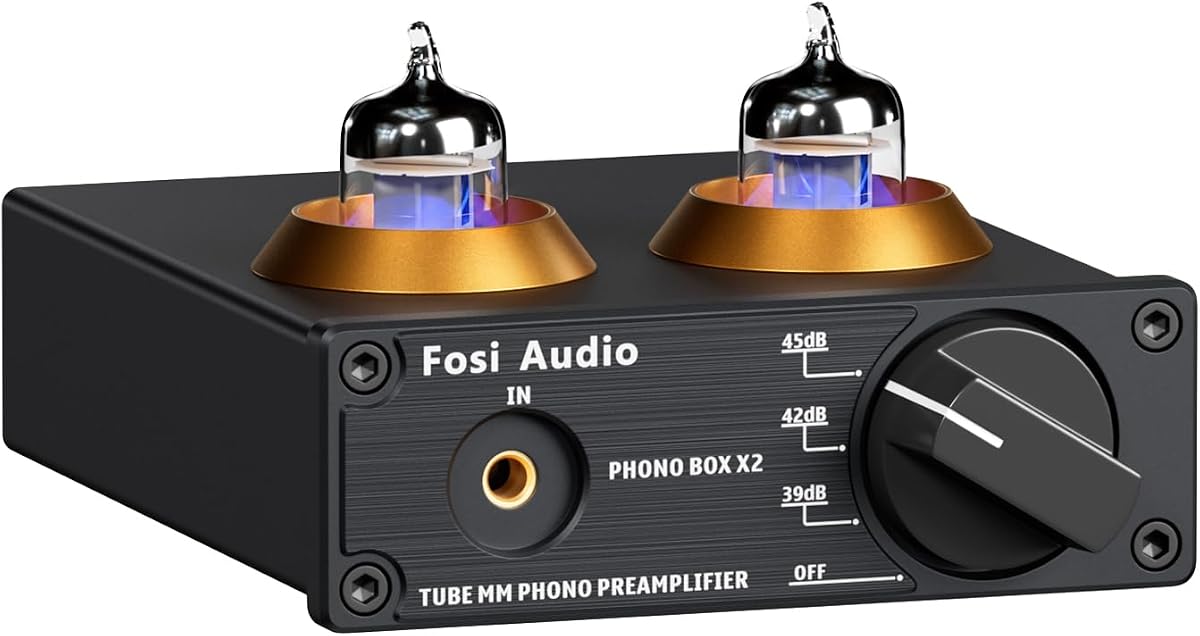
The Fosi Audio Box X2 combines a 4.5 rating with a compact tube preamp design aimed at MM turntables. It converts phono signals to line level, applies a gain control, and adds a 3.5mm AUX input. This makes it more versatile than a pure phono-only box while remaining much simpler than a full-featured MM and MC system.
We may earn a commission when you buy through this link, at no additional cost to you.
Three selectable gain modes are available at 39, 42, and 45 dB. That range gives MM users a way to match output more closely to different receivers and speakers. The unit includes a grounding post for the turntable connection, and its low-noise integrated circuitry is intended to provide a clear line-level output while removing problematic low-frequency noise.
The vacuum-tube aspect is the Box X2's defining character. It arrives with two tubes and a 12V power supply, and compatible tube types include 6K4, 6J1, 6J4, GE5654, 6AK5, and 66. Because different tubes can produce different tonal results, listeners can experiment with substitutions if they are comfortable handling the components.
The package includes the preamp, two vacuum tubes, an RCA cable, a power adapter, and a manual. It is a strong option for an MM turntable owner interested in tube sound and gain matching, although the lack of MC support makes it less versatile than the Box X5. For the right cartridge and system, it delivers a distinctive and engaging upgrade path.
The 39, 42, and 45 dB settings provide a practical starting point for matching an MM cartridge to the receiver or amplifier. This control is especially helpful when a system has a particularly sensitive or quiet phono stage and the user wants more control over level and noise.
The pluggable tube design gives the Box X2 a hobby-friendly element. Users can compare compatible vacuum tubes and explore changes in tone while retaining the same compact preamp chassis, power supply, controls, and connection layout.
We may earn a commission when you buy through this link, at no additional cost to you.
The Fluence PA10 has the highest rating among the ten products at 4.6, reflecting a favorable buyer response to its focused approach. It is designed for MM turntables and prioritizes accurate phono amplification, RIAA equalization, channel separation, and protection from electronic interference. It does not try to be an all-purpose preamp, and that restraint can be a strength.
We may earn a commission when you buy through this link, at no additional cost to you.
The stated circuitry converts the phono signal to line level with an emphasis on high-accuracy frequency response. Individual left and right channel operational amplifiers are used to optimize stereo separation and minimize crosstalk, while a low-impedance output stage and low-noise power supply support the overall signal path.
A selectable high-pass filter rolls off frequencies below 20Hz. According to the product information, this gentle filtering can reduce subsonic resonance and noise at higher listening levels. The internal metal shielding enclosure also serves a practical purpose by blocking electromagnetic interference that could otherwise add noise to the signal.
The PA10 does not list adjustable gain, MC compatibility, a headphone jack, or tone controls. That narrow feature set makes it most appropriate for listeners who own a magnetic-cartridge turntable, value accurate RIAA behavior, and want to connect to a conventional amplifier or powered speakers. Its focused design and strong rating make it a notable option in this category.
Separate operational amplifiers for the left and right channels are a meaningful design choice for stereo playback. The stated goal is better separation with virtually no crosstalk, helping each instrument remain distinct when it appears across the stereo field.
The selectable low-frequency filter targets subsonic energy rather than imposing a severe high-pass cutoff. Combined with the shielded enclosure, these features address two common sources of unwanted noise in a phono system: mechanical feedback and electronic interference.
We may earn a commission when you buy through this link, at no additional cost to you.
The Douk Audio T14-EQ is a compact, modern-looking preamp for listeners who want cartridge flexibility, headphone playback, and flexible power options. Its 4.2 rating is solid, though it does not lead this group. The unit supports both MM and MC cartridges and includes low-noise RIAA circuitry, making it a broader choice than preamps restricted to magnetic pickups.
We may earn a commission when you buy through this link, at no additional cost to you.
Stereo RCA outputs feed an amplifier or powered speakers, while a 3.5mm jack provides private listening. The headphone output is specified for 16–200 ohm models. Independent treble and bass knobs offer plus or minus 5dB of adjustment, giving the listener a way to compensate for speaker or headphone differences without reaching into the main system.
Power comes from a 5V USB source, which can be a wall charger, computer, or power bank. This is a convenient alternative to a conventional wall adapter and supports compact or portable listening arrangements. The aluminum shell offers shielding, while gold-plated PCB components and RCA terminals are intended to support a clean signal path.
The main trade-off is that the tone controls allow the output to move away from a strictly neutral RIAA presentation. Some listeners will value that flexibility, while others will want the equipment to remain out of the tonal decision. Overall, the T14-EQ is well suited to compact setups that need MM and MC support and USB-powered convenience.
The 5V USB power requirement makes the T14-EQ easy to deploy beyond a fixed stereo shelf. A compatible wall charger, computer, or power bank can supply power, while the small enclosure and RCA connections keep the signal path simple.
The preamp can feed stereo RCA equipment or a pair of headphones from the same source. That makes it useful for checking a turntable at a desk, auditioning records privately, or connecting to a compact system that does not include a phono input.
We may earn a commission when you buy through this link, at no additional cost to you.
The Pyle PP777 provides a familiar, uncomplicated route from a magnetic-cartridge turntable to modern audio equipment. Its 4.2 rating is competitive within the category, and the feature set centers on the essentials: phono-to-line conversion, low-noise operation, stereo RCA connections, and a supplied 12V DC adapter.
We may earn a commission when you buy through this link, at no additional cost to you.
Its input sensitivity is listed at 3mV at 50K ohms, with maximum output of 2V peak-to-peak at 10K ohms. Low-noise operational amplifiers handle amplification, and the product guidance recommends keeping the preamp close to the turntable to reduce noise and interference. The connection process follows the familiar RCA input, ground, and RCA output sequence.
Because there is no adjustable gain or MC compatibility, the PP777 is most appropriate for an MM turntable whose output pairs naturally with a basic preamp. It also lacks a headphone jack, so headphone listeners will need another approach unless their chosen amplifier or powered speakers provide that function.
The unit is a solid option for building a simple vinyl system, moving a record player to a new location, or replacing the phono stage of an older receiver. A one-year manufacturer guarantee and stated 30-day return policy add reassurance, although compatibility and system needs should be confirmed before ordering.
The included 12V DC adapter removes the need to source a separate supply. Once the turntable's RCA cables and ground are connected, the outputs can feed a receiver, amplifier, speakers, computer, or laptop with an appropriate input.
The PP777 is designed around the common magnetic-cartridge configuration rather than trying to accommodate every possible turntable. That narrow focus makes setup easier and can be a benefit for users who already know their turntable uses an MM pickup.
We may earn a commission when you buy through this link, at no additional cost to you.
The Jancane Phono Turntable Preamp stands out in the output department because it provides both RCA and TRS connections. Its 4.4 rating reflects a favorable response, and the design is aimed at listeners who want to connect a turntable to a receiver, amplifier, computer, or another modern audio device without a built-in phono stage.
We may earn a commission when you buy through this link, at no additional cost to you.
The preamp converts a phono signal to line level through low-noise audio operational amplifiers. Stereo RCA inputs accept the turntable, while stereo RCA and TRS outputs provide options for the destination. A 12V DC adapter is included, eliminating the need to choose a separate power supply before installation.
Its simplicity is also its main limitation. There is no listed gain control, MC mode, headphone amplifier, or tone adjustment, so it is best matched to a magnetic-cartridge turntable and an audio device with a compatible line-level input. The lack of controls keeps setup short, but offers less room for optimizing a demanding system.
For a basic vinyl installation, the Jancane unit is a strong recommendation, particularly for someone who appreciates the choice of TRS output. It also comes with a stated one-year manufacturer guarantee and 30-day return policy, offering added support if the unit is not compatible with the intended system.
The combination of stereo RCA and TRS outputs gives this preamp more connection flexibility than a basic RCA-only model. That can be useful with different receivers, computers, amplifiers, or compact desktop audio devices.
With the included power adapter, stereo RCA input, and straightforward output section, installation can be completed without navigating gain menus or mode switches. The unit is intended for users who want direct conversion and uncomplicated integration.
We may earn a commission when you buy through this link, at no additional cost to you.
The Pyle Mini Phono Preamp is a flexible entry-level option for connecting a turntable to several kinds of modern equipment. It carries a 4.2 rating, and its specification sheet emphasizes clear operation, low-noise amplification, and compatibility with turntables, receivers, speakers, laptops, and other audio destinations.
We may earn a commission when you buy through this link, at no additional cost to you.
Like the other Pyle magnetic-cartridge models in this roundup, it accepts signals from magnetic pickups with an input sensitivity of 3mV at 50K ohms. Maximum output is specified at 2V peak-to-peak at 10K ohms. The low-noise operational amplifiers are intended to keep background hiss and interference under control during the conversion to line level.
Stereo RCA inputs and outputs make the physical setup familiar. The turntable connects to the input section and its ground lead attaches to the preamp, while the output section connects to the amplifier or receiver. A 12V DC adapter is included, and the compact enclosure is easy to place near the turntable or within a small stereo system.
The trade-off is the absence of gain selection and MC support. This model is best for a compatible magnetic-cartridge record player and listeners who prioritize a simple installation. A one-year manufacturer warranty and stated 30-day money-back guarantee provide practical support, but confirming the turntable's cartridge type remains essential.
Stereo RCA input and output sections keep the preamp understandable from the start. There are no complicated menus or mode selections, making this a practical choice for first-time vinyl owners building a straightforward playback system.
The preamp's stated 3mV sensitivity and low-noise amplifier design target the very small output generated by a magnetic pickup. Positioning it close to the turntable can also help reduce the chance of picking up interference between separated components.
We may earn a commission when you buy through this link, at no additional cost to you.
The Pyle PP444 is included because its ultra-compact form addresses a specific need: fitting a phono stage into a small or crowded audio setup. It has a 4.3 rating and a straightforward set of RCA input and output connections for a record player, receiver, or amplifier. It is one of the simplest products in this guide.
We may earn a commission when you buy through this link, at no additional cost to you.
The available product information emphasizes the PP444's compact size, turntable preamp role, and RCA connection format. Its naming also identifies compatibility with audio equipment such as guitar and microphone sources, although the practical signal levels and impedance requirements of those devices may vary. Users should confirm that the source matches the preamp's intended operating range.
Because the supplied details do not list selectable gain, cartridge modes, headphone output, or specific electrical figures, the PP444 should be judged primarily on its simplicity and physical footprint. It is a more useful choice for a space-constrained installation than for a listener who needs precise gain matching or broad source support.
For someone wanting a small dedicated phono box and comfortable with a basic RCA setup, the PP444 is a reasonable option. It is less compelling for complex systems because the published feature set offers fewer visible adjustment points. Checking the current listing and manual before connection remains important, especially when pairing it with an unusual cartridge or source.
The defining benefit is physical compactness. A smaller preamp can sit closer to a turntable, reducing cable length and making it easier to integrate into a shelf system without creating a large gap between the record player and the main equipment.
RCA input and output connections provide a familiar route from the turntable to a receiver or amplifier. The design favors simplicity over a broad control panel, so the main attraction is an uncomplicated phono stage in a small footprint.
We may earn a commission when you buy through this link, at no additional cost to you.
The most important buying decision is matching the preamp to the cartridge and receiving equipment. After that, gain control, RIAA implementation, noise reduction, output connections, and useful listening features can determine which model fits your system and habits best.
A phono preamp must work with the cartridge installed in the turntable. Magnetic-moving or MM cartridges generally require a different input level and impedance from moving-coil or MC cartridges. Some models in this guide are designed specifically for MM pickups, while others include a switch for MM and MC operation. Choosing a preamp that does not support the cartridge can lead to weak output, excessive noise, or incorrect signal conditions.
The Box X5, Douk Audio T9, and Douk Audio T14-EQ support both MM and MC cartridges. The Box X2 and Fluence PA10 are listed for MM turntables, while the Pyle models focus on magnetic pickups. Check the cartridge specification before ordering and confirm whether the turntable's output is moving-magnet or moving-coil.
The cartridge creates a very small electrical signal, and the preamp raises it to a level a normal audio input can handle. If the gain is too low, the signal may be quiet and vulnerable to noise. If it is too high, the preamp can amplify its own noise floor and make adjustments feel less controlled. Adjustable gain is useful because turntables, cartridges, and receivers differ in output and sensitivity.
Models with explicit gain settings include the Box X5 at 38, 48, 56, and 66 dB, the Box X2 at 39, 42, and 45 dB, and the T14-EQ with selectable MM and MC modes. If possible, compare the recommended cartridge output with the preamp's gain range and begin with the setting that best matches the cartridge type.
Records are cut with a frequency response that compensates for the limitations of early playback technology. A proper phono preamp applies the inverse curve, known as RIAA equalization, so the record sounds balanced rather than overly bass-heavy or treble-heavy. Correct equalization matters more than many cosmetic features because it determines the fundamental tonal balance of vinyl playback.
The Fluance PA10 emphasizes high-accuracy RIAA performance, while the Box X5 specifies precise RIAA equalization and the T14-EQ includes a low-noise RIAA circuit. Other conventional phono stages are also designed for vinyl playback, but the supplied information provides fewer detailed measurements. Look for a clear RIAA claim and ensure the stage is intended for phono rather than general line-level signals.
A phono preamp amplifies a tiny signal, so electrical noise and hum can become audible. Low-noise operational amplifiers, a low-noise power supply, shielded enclosures, and short connection paths all help protect the signal. The Pyle PP999, PP777, and Mini Preamp use low-noise operational amplifiers, while the Fluance PA10 uses a metal shielding enclosure and a low-noise supply.
Positioning the preamp close to the turntable is also useful because long cable runs can capture interference. A ground connection helps control hum when the turntable, preamp, and amplifier share a power environment. The T14-EQ adds a power isolation module, while the T9 and Box X2 provide grounding posts. Always use the included power supply and keep connections secure.
Most turntables use stereo RCA connections, and most amplifiers and powered speakers accept stereo RCA line inputs. This common format makes the Pyle models, Box X2, Box X5, PA10, and Jancane preamp easy to integrate. The Jancane unit adds TRS outputs, which can be useful with compatible computer or desktop audio equipment. None of these should be treated as headphone outputs unless a dedicated jack is specifically listed.
The T9 and T14-EQ include 3.5mm headphone outputs. These are useful for private listening and avoid requiring a separate headphone amplifier, though their specified impedance ranges differ. The T9 supports 16–300 ohm headphones, while the T14-EQ supports 16–200 ohm models. Check the destination device's input type and do not confuse a general line output with a headphone amplifier.
A tube preamp can provide a different tonal presentation from a solid-state design, and replaceable tubes allow experimentation. The Box X2 includes two vacuum tubes, accepts several listed tube types, and also offers a 3.5mm AUX input. The Douk Audio T9 uses two 6E2 tubes and two 6A2 tubes, with an illuminated level display and sockets for other tube types.
Tube models are not automatically quieter or more accurate than solid-state designs. They may also require more care, particularly around tube replacement, heat, and correct operating conditions. Listeners who want a direct, controlled signal path may prefer the solid-state models, while enthusiasts interested in component swapping and the presentation associated with tube circuitry may favor the Box X2 or T9.
Headphone amplification, tone controls, displays, and multiple inputs can make a preamp more useful, but they are not essential for every system. The T9 offers a magic-eye level display, bass and treble controls, a headphone amplifier, a phono input, and an RCA input. The T14-EQ provides independent plus or minus 5dB tone controls and USB power. The Box X2 includes a 3.5mm AUX input for comparing other sources.
Extra controls can help a listener match imperfect speakers, compare equipment, or listen privately. They can also distract from accurate playback. A listener with a well-matched system may prefer the PA10's focused approach, while a new vinyl owner may appreciate the straightforward connection process of a basic RCA model.
The preamp should fit the available space and sit close enough to the turntable to minimize interference. The PP444 is explicitly ultra-compact, while the Box X5, PA10, and T9 use metal housings that may occupy more room. The T14-EQ uses 5V USB power, which can simplify placement near a computer or in a portable arrangement. Other models generally use an included 12V DC adapter.
Check connector clearance, ventilation, and the length of the turntable's cables. A small preamp that can sit beside the record player may be more useful than a feature-rich model that must be placed far away. Confirm the power supply included with the chosen unit rather than assuming every small box accepts the same adapter.
Begin by turning off and disconnecting the amplifier or powered speakers, then connect the turntable's left and right RCA outputs to the preamp's phono inputs. Attach the turntable's ground wire to the preamp's grounding post or terminal. If the preamp includes a 3.5mm AUX input, reserve it for a separate line-level source rather than connecting a turntable there.
Next, connect the preamp's line-level RCA outputs to the appropriate input on the amplifier, receiver, or powered speakers. Use a TRS connection only when the preamp provides a dedicated TRS output and the destination accepts that format. Turn on the preamp, select the correct cartridge mode if it has one, and choose a gain range appropriate for the cartridge and receiving equipment.
Set the amplifier or speakers to a moderate level, begin with the preamp's lowest suitable gain, and raise it gradually while listening for a clean, strong signal. Keep the turntable's dust cover closed during playback if the model permits it, and use the ground connection to control hum. For tube models, allow the unit to warm up before judging its sound, and follow the manual when replacing tubes.
A phono preamp converts the very small electrical signal produced by a turntable cartridge into a line-level signal suitable for an amplifier, receiver, powered speakers, or other audio device. It also applies RIAA equalization so vinyl has the correct tonal balance. Without this stage or an equivalent input, the music may be extremely quiet, distorted, or badly colored.
You do not need an external preamp when the receiving equipment already has a suitable phono input and a gain setting compatible with your cartridge. Connecting a separate preamp and then sending its output into that same phono input would apply gain and equalization twice. Use the external preamp with a line-level input instead, unless the receiver is designed for that arrangement.
MM cartridges generally produce a higher output than MC cartridges, while MC cartridges typically require more gain and different input impedance. A preamp that supports only MM should not be assumed to work correctly with an MC cartridge. Look for an explicit MM and MC mode, and follow the turntable or cartridge manufacturer's recommended impedance and gain settings.
Hum commonly results from an incomplete ground connection, loose RCA cables, or electrical interference between the turntable and amplifier. Make sure the turntable's ground wire is firmly attached and that all power supplies are functioning normally. Moving the preamp closer to the turntable can also reduce interference, while a shielded model may help in electrically noisy environments.
Only if the preamp includes a dedicated headphone output or headphone amplifier. The Douk Audio T9 has a 3.5mm output specified for 16–300 ohm headphones, and the T14-EQ includes one specified for 16–200 ohm headphones. A standard RCA line output should not be treated as a headphone connection, and the connected headphones should remain within the stated impedance range.
The built-in stage can be the simplest solution when it supports your cartridge and provides enough gain. An external preamp becomes worthwhile when the built-in circuit is incompatible, noisy, lacks the required gain, offers no headphone output, or when you want more control over the signal path. Compare cartridge requirements and input options before deciding.
A proper phono preamp improves usability by supplying the gain and RIAA equalization needed for accurate playback. Its impact on perceived sound quality depends on the preamp, the turntable's cartridge and cabling, the receiving equipment, and the listening environment. A well-matched stage should provide clean, balanced playback rather than dramatic changes unrelated to accurate vinyl reproduction.
Place it close to the turntable when practical, with short RCA cables, while leaving enough room for power and signal connections. Keeping the preamp near the source can reduce the chance of interference pickup. You also need clearance for controls, ventilation where required, and access to the grounding and output connections.
The Fosi Audio Box X5 is the most versatile overall recommendation because it supports MM and MC cartridges, provides four gain levels, and emphasizes precision RIAA equalization. The Douk Audio T9 takes the premium position with tube circuitry, a dedicated headphone amplifier, tone controls, multiple inputs, and a visual level display. For a simple magnetic-cartridge setup, the Pyle PP999 offers the clearest path to line-level output at a modest feature level.
Prioritize cartridge compatibility, correct gain, and a clean RIAA implementation before considering extras. Headphone output, tone controls, tube replacement, displays, and alternative inputs are useful only when they suit your system and listening habits. Basic models such as the Fluance PA10 can be excellent for focused MM playback, while compact and USB-powered designs can make desktop or portable arrangements easier.
Ratings, specifications, availability, and prices can change, so check the current product listing and manufacturer instructions before ordering. Confirm the cartridge type, available input on your amplifier or speakers, required gain, grounding arrangement, and power supply. That final compatibility check will help ensure the selected preamp integrates cleanly and delivers the vinyl performance you are looking for.