
NVX VADM4 v2
4.2Editor score
Exceptionally compact enclosure
Conformal-coated marine board
Flexible crossover selection
Our compact marine amplifier guide compares 10 waterproof, Bluetooth, multi-channel, and subwoofer models for boats, ATVs, and other outdoor audio systems.
A compact marine amplifier should deliver clean, reliable power without taking over valuable space on a boat or in an outdoor vehicle. The right model also needs suitable environmental protection, practical signal connections, and enough flexibility for the speakers, head unit, and listening habits that shape your system.
We compared the ten amplifiers in this guide by examining channel configuration, power ratings, marine protection, crossover controls, input options, installation features, and intended applications. The list includes traditional multi-channel units, sealed monoblock designs, ultra-compact Class D models, and Bluetooth-enabled systems for simpler installations.
Each review explains the amplifier's strongest benefits, practical limitations, and ideal buyer, while the comparison table provides a quick reference. Product selections and availability can change, and current prices vary, so verify specifications, connector requirements, and marine suitability before making a final purchase.
4.2Editor score
4.5Editor score

4.0Editor score
The table below compares all ten compact marine amplifiers by configuration, power class, weather protection, signal flexibility, and primary use, making it easier to identify the model that matches your boat or outdoor audio system.



The Pyle Hydra PLMRA402 is a compact four-channel marine amplifier with a 4.0 rating and a straightforward approach to boat-audio power. It offers 100 watts per channel at a maximum output of 400 watts, giving it enough capacity for a conventional multi-speaker installation while preserving a relatively small footprint.
We may earn a commission when you buy through this link, at no additional cost to you.
Its main strength is installation flexibility. Premium RCA stereo inputs work with standard marine head units, while high-level terminal inputs allow connection to a receiver's speaker outputs when RCA connections are unavailable. Dual adjustable gain controls help reduce unwanted noise, and support for both 4-ohm and 8-ohm speakers provides useful latitude when matching the amplifier to existing equipment.
The amplifier also includes an aluminum-alloy heatsink, thermal-overload protection, speaker-short protection, an LED status indicator, and gold-plated speaker terminals. Those details are particularly relevant in a damp marine environment, although the stated IP-01 rating is less comprehensive than the sealed or IPX67 designs elsewhere in this list. It should be installed with care and protected from standing water.
This is a sensible choice for a boat owner who wants four channels, broad input compatibility, and useful protection features without moving to a more specialized monoblock design. It is best for full-range speakers and a conventional head unit rather than a dedicated subwoofer system, and buyers seeking sealed waterproofing or wireless streaming should choose a different model.
RCA and high-level inputs make the PLMRA402 useful with different source units. This reduces adaptation work when your marine receiver offers one connection style or the other.
Thermal, overload, and short-circuit protection help the amplifier operate more safely. Gold-plated speaker connectors also resist corrosion better than untreated terminals over time.
We may earn a commission when you buy through this link, at no additional cost to you.
The Kenwood KAC-M5001 is a sealed monoblock Class D amplifier with a 4.0 rating, created specifically for subwoofers in boats, cars, and outdoor audio systems. It supplies up to 600 watts maximum, 300 watts RMS at 2 ohms, and 200 watts RMS at 4 ohms, giving it a useful combination of power and efficiency.
We may earn a commission when you buy through this link, at no additional cost to you.
Environmental protection is the model's defining feature. Its IP67 and IP66 ratings cover water and dust resistance, while the sealed design can withstand submersion up to 3.3 feet for 30 minutes and heavy spray. ASTM B117 salt-spray testing and a rugged die-cast aluminum chassis make it a compelling option where corrosion and exposure are major concerns.
Signal-sensing turn-on, speaker-level input, and a waterproof wired level control simplify integration. Polymer multilayer capacitors in the filter circuits are designed to reduce distortion, and magnetic shielding on the output coils limits radiated noise. Low-pass frequency adjustment and a bass-boost switch provide control over low-frequency output, although the amplifier is not intended to power full-range speakers.
Choose the KAC-M5001 when a compact, highly protected subwoofer amplifier is the priority. It is especially attractive for exposed installations where sealed construction and verified ingress ratings matter more than Bluetooth convenience or multi-channel flexibility.
The sealed chassis, dual IP ratings, salt-spray testing, and robust aluminum construction distinguish this amplifier in exposed marine locations. It offers stronger documented protection than a basic coated-board unit.
Speaker-level input, signal-sensing turn-on, and the included waterproof level control reduce setup work. The amplifier can wake automatically when an audio signal appears.
We may earn a commission when you buy through this link, at no additional cost to you.
The NVX VADM4 v2 combines a 4.2 rating with one of the most space-efficient designs in this guide. Measuring 6.49 by 3.3 by 1.48 inches, this four-channel Class D amplifier provides 80 watts RMS per channel at 4 ohms and 125 watts per channel at 2 ohms.
We may earn a commission when you buy through this link, at no additional cost to you.
Micro Class D technology keeps the amplifier small without abandoning the core benefits of a multi-channel marine system. A conformal-coated marine-grade circuit board helps it cope with moisture, while thermal, overload, speaker-short, and DC-offset protection improve reliability. Balanced differential inputs and low-level RCA connections support a clean connection to compatible marine electronics.
The controls are unusually flexible for such a compact unit. FULL, high-pass, and low-pass modes can be selected, while variable filters span 40 to 400 Hz across a 20 Hz to 20 kHz frequency range. That makes the amplifier suitable for a multi-zone boat or mixed speaker arrangement. As with many compact Class D units, however, its enclosure is protected by coating rather than a fully sealed marine housing.
This is our top all-around pick for buyers who have little installation space but do not want to compromise on channels or tuning flexibility. It is a particularly strong match for a four-zone boat system, powersports installation, or space-conscious build where full-range control is valuable.
The micro Class D enclosure is one of the clearest reasons to consider this amplifier. It can fit into smaller compartments without surrendering independent four-channel control.
Selectable FULL, HPF, and LPF modes support different speaker roles. Variable frequency controls let an installer balance full-range drivers and dedicated low-frequency outputs more precisely.
We may earn a commission when you buy through this link, at no additional cost to you.
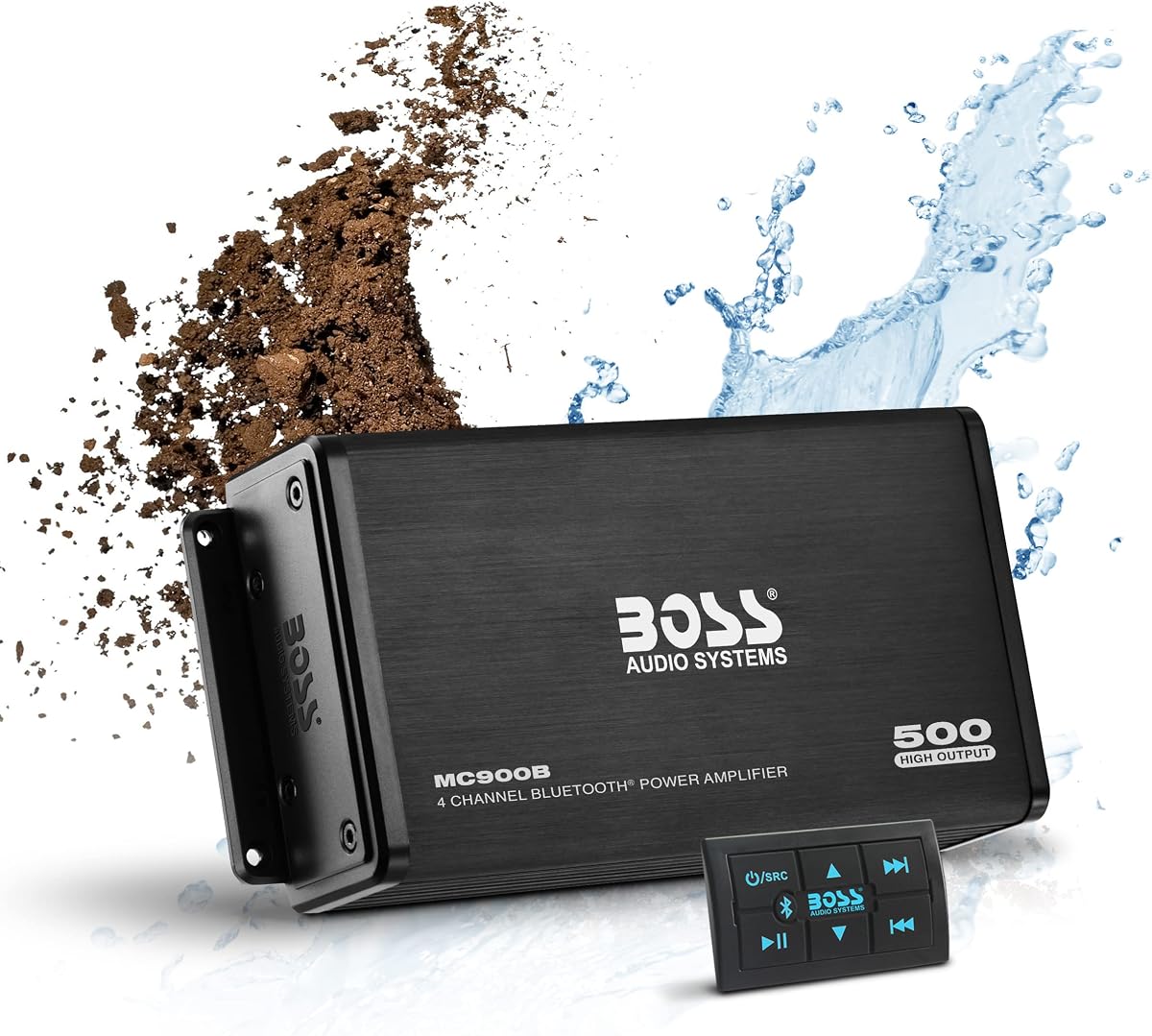
The BOSS Audio Systems MC900B is a 4.2-rated four-channel marine amplifier designed for boats, ATVs, and similar installations where a traditional marine head unit may be unnecessary. Its built-in Bluetooth receiver and included remote provide a direct path from a phone to the speakers.
We may earn a commission when you buy through this link, at no additional cost to you.
The amplifier delivers 125 watts maximum per channel at 4 ohms and 94 watts RMS per channel at 4 ohms. The included Bluetooth remote can stream from services such as Spotify and Pandora, while an auxiliary input accepts smartphone or MP3-player audio. A USB charging port adds another useful function for the installed system.
Weatherproofing is a relative strength, but the product is intended to handle light weather rather than severe exposure. The separate remote also needs suitable placement for a driver to reach it safely. Its Class AB design is also less efficient than a modern compact Class D amplifier, and the dimensions of 1.75 by 6.6 by 1.75 inches are larger than several micro Class D competitors.
The MC900B fits buyers who prioritize simple wireless control and a head-unit-free layout. It is a good match for pontoon boats, ATVs, and smaller outdoor systems where a four-channel unit is needed but full streaming functionality is the main convenience.
Built-in wireless streaming makes the MC900B useful where installing a full marine stereo would add unnecessary complexity. The remote handles source selection and basic control.
Bluetooth, auxiliary input, and USB charging create several convenient ways to play or manage personal devices. This is especially helpful for mobile installations.
We may earn a commission when you buy through this link, at no additional cost to you.
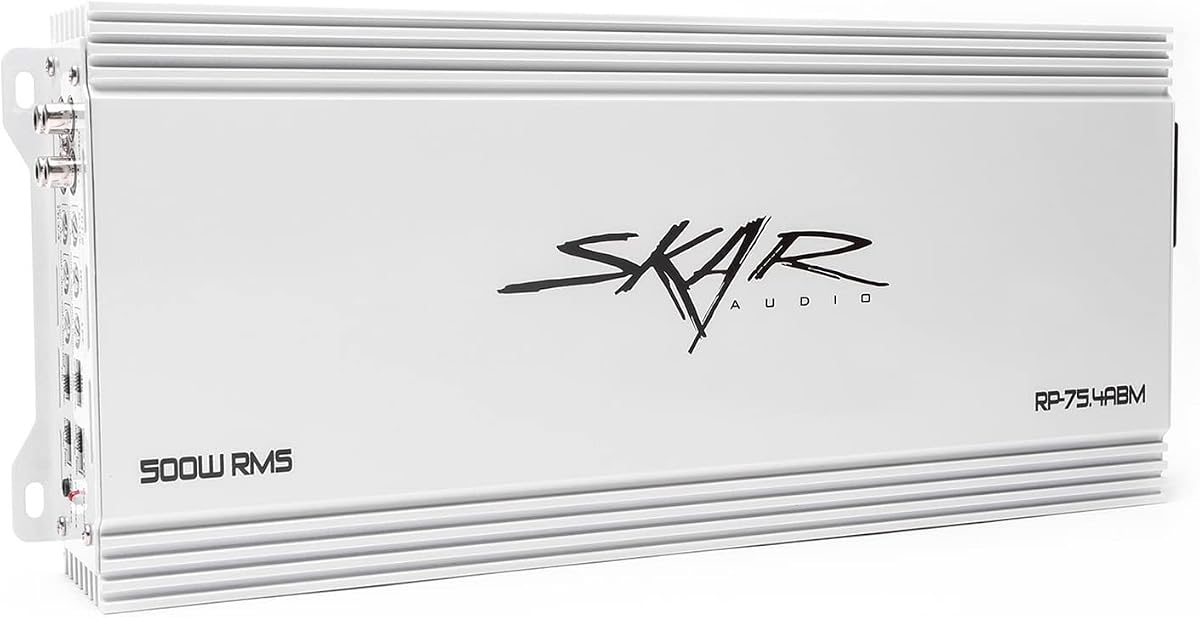
The Skar Audio RP-75.4ABM is a full-range Class A/B marine amplifier with a 4.5 rating, the highest customer rating among the products reviewed. It provides 125 watts RMS per channel at 2 ohms and 75 watts RMS per channel at 4 ohms in a conventional four-channel format.
We may earn a commission when you buy through this link, at no additional cost to you.
Its selling point is a combination of substantial output and user-adjustable sound control. Gain, variable low-pass and high-pass filters, and a three-position bass EQ switch give installers meaningful control over each channel. A 105 dB signal-to-noise ratio and four-way protection circuitry support clean, reliable operation.
Marine protection comes from a waterproof coating on the circuit board and rust-resistant paint on the mechanical case. The product description also mentions four-gauge power and ground input terminals, although it separately lists 8-gauge terminals, so installers should verify the hardware included with the exact unit. The Class A/B design also draws more power than Class D and may need more ventilation.
The RP-75.4ABM is an excellent choice for a serious full-range boat system where sound shaping and multi-channel control matter. It is best for installers who want four independently adjustable outputs and strong RMS performance rather than the smallest possible enclosure or built-in Bluetooth.
Variable filters and a selectable bass EQ make it easier to align different speaker types. This flexibility is valuable when a boat combines bow, cockpit, and other zones.
A coated circuit board and rust-resistant case address two common sources of marine-audio failure. The amplifier still benefits from a protected installation location and sound sealing.
We may earn a commission when you buy through this link, at no additional cost to you.
The Pyle PLMRMB4CB is a 3.9-rated compact four-channel marine amplifier whose strongest feature is independent zone control. Its 200-watt total output is distributed across four channels, making it possible to manage bow, stern, port, and starboard speakers separately rather than sharing paired channels.
We may earn a commission when you buy through this link, at no additional cost to you.
Bluetooth wireless audio streaming adds a convenient source option, while the brushed-aluminum housing is designed to resist heat, moisture, and vibration. A low-profile form factor helps it fit under consoles, inside storage compartments, or against a transom wall where larger amplifiers would be inconvenient.
Integration with an existing head unit is handled through a remote turn-on wire, allowing the amplifier to switch off with the source and avoid unnecessary battery drain. Color-coded wiring aids installation. A lower 3.9 rating suggests some mixed customer experiences, and the shared total wattage means each channel receives substantially less power than on the Pyle Hydra PLMRA402.
This amplifier is a good fit for boat owners prioritizing zone-level control, wireless convenience, and a small enclosure. It is less appropriate for high-volume installations where maximum per-channel power, advanced crossover tuning, or the strongest environmental sealing is required.
Four separate channels provide granular control over individual boat zones. That is valuable when different seating areas need different volume levels.
The low-profile enclosure and Bluetooth support make the unit practical for modern upgrades. Remote turn-on simplifies use with a conventional marine head unit.
We may earn a commission when you buy through this link, at no additional cost to you.
The Pyle Hydra PLMRA200 is a 4.0-rated two-channel marine amplifier rated for 400 watts maximum. It is a straightforward option for a stereo pair, particularly when a boat's existing speakers and receiver are already in place and the priority is uncomplicated power delivery.
We may earn a commission when you buy through this link, at no additional cost to you.
Premium RCA stereo inputs and high-level terminal inputs provide two ways to connect a source. The unit includes an aluminum-alloy heatsink, thermal-overload and speaker-short protection, an LED indicator, a dual MOSFET power supply, and gold-plated speaker output terminals designed to resist corrosion.
Its compact two-channel layout is easier to position than a large multi-channel amplifier, but buyers seeking independent control over four or more speakers will need a different model. The stated IP-01 marine rating indicates a basic level of environmental protection rather than the comprehensive sealing found in the Kenwood monoblock or DS18 two-channel unit. Installation practices remain important in exposed areas.
Choose the PLMRA200 for a simple two-speaker marine system with straightforward RCA or high-level integration. It is a practical match for a compact boat or vehicle where fewer channels, familiar controls, and a small enclosure are more important than extensive tuning options.
RCA and high-level inputs let the amplifier work with conventional receivers or simpler source units. This flexibility can simplify an upgrade without replacing existing marine electronics.
The two-channel format concentrates the amplifier's output on a conventional speaker pair. It is a practical option when independent multi-zone control is unnecessary.
We may earn a commission when you buy through this link, at no additional cost to you.
The DS18 NXL-N2 is a 4.1-rated ultra-compact Class D marine amplifier for boats, cars, ATVs, UTVs, and other outdoor systems. Its specified RMS output is 150 watts per channel at 2 ohms and 100 watts per channel at 4 ohms, while the listing also includes a 600-watt maximum description and a 900-watt maximum output claim.
We may earn a commission when you buy through this link, at no additional cost to you.
Those inconsistent maximum-power figures should be treated as a reason to verify the documentation before purchase. The continuous RMS figures are more useful for comparison because they better describe expected output under normal operation. The stated IPX67 rating, stable four-layer PCB layout, and rugged power-sports focus make environmental durability a central selling point.
HPF, LPF, and FULL crossover modes provide useful flexibility for pairing the amplifier with different speaker types. The two-channel design can also support a subwoofer and additional full-range speakers depending on wiring and system goals. Class D efficiency keeps heat and power demands more manageable than a comparable Class AB model.
The NXL-N2 is a strong candidate for a compact, all-weather two-channel system, especially in a powersports vehicle. It is best for buyers who value the documented IPX67 rating and low-frequency power, provided they confirm the exact power ratings, impedance limitations, and installation requirements with the manufacturer.
The IPX67 rating and stable four-layer board construction suit demanding outdoor installations. These features are especially relevant to ATVs, UTVs, and exposed boat electronics.
Class D operation supports a smaller enclosure and efficient delivery of substantial low-frequency power. It is a practical pairing for subwoofers and efficient marine speakers.
We may earn a commission when you buy through this link, at no additional cost to you.
The Marine Bluetooth Amplifier is a 4.2-rated four-channel Class D system designed for concealed installations in boats, golf carts, motorcycles, and similar vehicles. It supplies 60 watts per channel and includes a three-meter wired remote with an illuminated three-color source indicator.
We may earn a commission when you buy through this link, at no additional cost to you.
Its defining benefit is the ability to run a complete four-speaker audio setup without installing a traditional head unit. Bluetooth streaming handles wireless playback, while the included controller lets the driver select USB, auxiliary, or Bluetooth sources. A durable housing and hidden-installation orientation suit builds where visible dashboard equipment is undesirable.
The product information is less detailed than that of many established models, so the four-channel output is the most concrete performance figure to use for comparison. A 60-watt-per-channel rating is appropriate for modest speaker loads but not a substitute for a high-output stage driving demanding full-range or subwoofer systems. The controller's S-terminal connection must also remain tight for reliable operation.
This system makes sense for a simple, hidden, four-speaker installation where mobile-device playback is the priority. It is less compelling for large-boat audio, serious subwoofer power, or advanced crossover work, but it can deliver a clean, organized result for compact outdoor vehicles.
The illuminated wired controller shows the active source at a glance. Installing it within reach makes Bluetooth, USB, and auxiliary playback convenient without exposing the main amplifier.
Eliminating a separate head unit reduces dashboard clutter and simplifies some builds. The four-channel amplifier handles the speaker connections directly.
We may earn a commission when you buy through this link, at no additional cost to you.
The Pyle PLMRMP3B is a compact four-channel marine micro amplifier with a 3.7 rating. It is aimed at simple installations where a phone, MP3 player, or other personal device will supply the audio, and its included 3.5mm-to-RCA adapter makes that connection path more accessible.
We may earn a commission when you buy through this link, at no additional cost to you.
The amplifier offers RCA stereo input, adjustable gain controls, a remote volume control, and built-in power-protection circuitry with soft turn-on behavior. Its stated maximum output is 800 watts, but no continuous RMS figure is provided, so comparing its real power with the other models requires caution. The maximum rating should not be treated as the output available to every channel.
The micro format is the main appeal, particularly in a small boat where space is limited. The product is described as waterproof and marine grade, though no detailed IP rating is supplied. It also lacks modern conveniences such as Bluetooth, crossover selection, and multi-zone level controls found elsewhere in this guide.
Choose the PLMRMP3B for a basic, compact system using wired personal-device audio. It may suit a simple upgrade, but a newer model with verified RMS output, stronger environmental specifications, and wireless playback will usually provide a clearer path for a modern marine build.
The included 3.5mm-to-RCA adapter and remote volume control make the amplifier approachable for phone and MP3-player sources. It avoids the need for a more complex source unit.
The micro enclosure is useful in tight installations where every inch matters. Four channels still allow several compact speakers to operate from one central amplifier.
We may earn a commission when you buy through this link, at no additional cost to you.
Choosing a compact marine amplifier involves balancing enclosure size, continuous output, weather resistance, connectivity, speaker compatibility, and the number of zones in your audio system. The most important starting point is a clear map of your speakers, source unit, and installation environment.
Begin by counting the speakers and independent volume zones you actually need. A four-channel amplifier can power four full-range speakers or be configured for different combinations of drivers, but bridgeable and shared-channel layouts affect how much control you retain. A two-channel unit is sufficient for one stereo pair, while a dedicated monoblock is better when a subwoofer needs substantial clean power. For a typical multi-zone boat, four independently controlled channels offer more flexibility than a two-channel model.
Match the amplifier's channels to your wiring plan rather than simply choosing the highest available wattage. Also check whether the amplifier supports full-range speakers, subwoofers, or both through crossover controls.
Continuous RMS power is more useful than a dramatic maximum or peak number when comparing amplifiers. RMS describes the output available during sustained playback and provides a fairer indication of headroom, distortion behavior, and speaker compatibility. Match the amplifier's rating at the impedance of your actual speaker load, since output commonly increases at lower impedances, but only when the manufacturer supports that configuration.
Ignore specifications that cannot be reconciled. If a listing gives conflicting maximum claims or omits RMS figures, seek confirmation from the manual or manufacturer. Speakers still need suitable sensitivity and power handling to translate the amplifier's output into clean, satisfying sound.
Marine protection takes several forms. A conformal-coated circuit board helps resist moisture and contamination, while a fully sealed enclosure provides a stronger barrier against spray, dust, and temporary submersion. Check for clearly stated IP ratings and salt-spray or corrosion-testing information where possible. Even an IP-rated amplifier benefits from being mounted above standing water, away from drains, and in a ventilated or protected compartment.
Do not assume the word marine means every exposed location is safe. Sealed monoblock units are attractive for harsher environments, while coated compact amplifiers often work best in a dry compartment with secure wiring.
Class D amplifiers are generally compact, efficient, and well suited to modern vehicle and marine electrical systems. They produce less heat at idle and can be easier to install when space or power capacity is limited. Class AB amplifiers generally use a larger enclosure and consume more power, but they remain popular among listeners who prefer their established sound characteristics. Bluetooth-enabled Class D systems add convenience but may still require careful placement of the control module.
The best class is the one that fits your enclosure, speaker load, and thermal environment. Pay attention to heat dissipation as well as advertised output, especially in a closed storage compartment.
RCA inputs are standard for a head-unit-based system, while high-level or speaker-level inputs let an amplifier work with a source that lacks RCA jacks. Signal-sensing turn-on can automate operation when the correct trigger connection is unavailable, although a proper remote wire often provides more predictable behavior. Balanced or differential inputs can help reduce noise in longer cable runs, and the inclusion of a remote level control is useful for monoblock subwoofer systems.
Confirm that the amplifier can accept the source you already own. A compact design is less convenient if it requires replacing the head unit, adding an interface, or running unfamiliar cables.
Crossover controls determine whether an amplifier is appropriate for full-range speakers, subwoofers, or a mixed system. High-pass filters remove low frequencies that can damage small drivers, while low-pass filters focus the output on bass. Full-range mode simplifies a dedicated speaker installation. Gain controls are essential for setting the amplifier relative to the source, and a bass EQ or subwoofer level control provides additional refinement where needed.
More controls are not automatically better, but the correct controls can eliminate guesswork. A well-labeled interface and an included remote are especially useful in installations where the amplifier is mounted out of reach.
Bluetooth is convenient for a modern boat because it can reduce the need for a visible head unit and simplify phone-based playback. However, a Bluetooth-enabled amplifier still needs dependable power, mounting, and a reachable control panel. It may also have fewer tuning options than a dedicated analog amplifier. Systems built around an existing marine receiver should prioritize RCA, speaker-level, and remote-trigger compatibility over wireless convenience.
Think about how your music will actually be controlled while underway. A wired remote, illuminated source display, and accessible volume adjustment can matter more than maximum amplifier power in a simple recreational setup.
Measure the intended compartment before selecting an amplifier, including space required for cables and connectors. A micro Class D unit may fit easily where a four-channel Class AB model will not, but heat management and access for gain or crossover adjustments still matter. Leave enough clearance around the enclosure and avoid sealing it against an insulating surface unless the manufacturer specifically permits that arrangement.
Plan cable routes before installation, because long, poorly protected power and signal cables can introduce noise. Use the specified power and ground terminals, secure every connection, and position the amplifier where moisture and accidental impact are least likely.
Begin by identifying every speaker's impedance and confirming that it falls within the amplifier's supported load. Connect the amplifier using appropriately sized power, ground, remote, and speaker cables, following the manual's polarity and terminal instructions. If using high-level inputs, keep them separate from RCA inputs as directed, and set gain and crossover controls to neutral positions before powering the system.
When the amplifier is installed, set the head unit or source volume low before enabling the system. Raise the source gradually, then adjust amplifier gain so speech is clear without strain. Use the crossover controls to protect small speakers and keep bass from overlapping with full-range drivers. For a monoblock, adjust the low-pass range and included level control according to the subwoofer manufacturer's recommendations.
Maintain the installation by checking terminals for corrosion, confirming that mounting points remain secure, and keeping the enclosure dry and clear of debris. Do not expose a non-sealed amplifier to standing water. Periodically listen for distortion, clipping, unusual heat, or intermittent channels, and disconnect power before inspecting wiring. Consult the manual before changing loads or operating the amplifier beyond its stated limits.
The most important specifications are continuous RMS output, supported speaker impedance, and channel configuration. They determine whether the amplifier can power your chosen speakers without strain. Environmental ratings and correct signal connections are equally important in a boat, but maximum wattage alone does not indicate usable performance.
Class D is usually better for a compact installation because it is efficient and typically generates less heat. Class AB remains a valid choice when a larger enclosure is acceptable and the listener prefers its operating characteristics. The deciding factors should be available space, cooling, speaker load, and system design rather than class alone.
Marine-oriented construction is strongly recommended even when the amplifier is installed inside a protected console. Salt, humidity, spray, and condensation can damage unprotected electronics. A sealed or clearly IP-rated model provides the best margin of safety, while a coated model is best kept in a dry, well-ventilated compartment.
Count the speakers and the number of places that need independent volume control. One stereo pair generally requires two channels, while several boat zones usually call for four. If a subwoofer is included, you may need a four-channel amplifier for the full-range speakers plus a separate monoblock, or a multi-channel amplifier with appropriate crossover controls.
Only within the amplifier's stated limits. Using a lower impedance than allowed can increase heat, trigger protection, or damage the amplifier. Check both the speaker's nominal impedance and the manufacturer's supported configurations, and never assume that a bridge connection permits any speaker load.
Not always. A Bluetooth-enabled amplifier can receive audio directly from a phone or other compatible device and may include a control module. If you want a traditional marine radio, navigation display, AM or FM reception, or a cleaner dash arrangement, verify the amplifier's inputs and system compatibility before deciding.
Set the head unit to a low level, raise it gradually, and then increase amplifier gain until the desired volume is reached without distortion. Avoid setting gain so low that you must turn the source to maximum, because that can introduce noise. The manual's recommended procedure should take priority over general guidance.
It depends on the model, speaker impedance, and required output. The Kenwood KAC-M5001 is a dedicated high-output subwoofer amplifier, while some multi-channel models can power bass through their low-pass sections. For demanding bass, a dedicated monoblock generally provides better control and headroom than a small full-range amplifier.
The NVX VADM4 v2 stands out as the strongest all-around choice for its remarkably small enclosure, four-channel flexibility, and useful crossover controls. The Skar RP-75.4ABM is the top-rated option and offers extensive sound shaping, while the Pyle Hydra PLMRA402 delivers balanced four-channel power and flexible source connections at an accessible position in the market.
For a dedicated subwoofer, the Kenwood KAC-M5001 is the clearest specialist because its sealed enclosure and IP67/IP66 protection stand apart from the general-purpose marine amplifiers. DS18 buyers should verify the listing's conflicting maximum-power claims, and those prioritizing wireless convenience should examine the BOSS MC900B or the compact four-channel Bluetooth system.
Before ordering, measure the available space, map every speaker and connection, confirm continuous RMS output at the intended impedance, and consider where spray or standing water may reach the amplifier. Current prices, product availability, and included accessories can change, so check the latest listing and manufacturer documentation before completing your purchase.