
SUNLU High Toughness 3D Printer Resin
4.7Editor score
Fivefold elongation increase
Low-shrinkage formulation
Broad printer compatibility
Our expert guide compares 10 flexible resin for 3D printing options, comparing flexibility, toughness, precision, compatibility, finish, and ideal prototype
Flexible resin for 3D printing is designed to bend, compress, and rebound without cracking like conventional rigid photopolymer. It is especially useful for gaskets, grips, articulated figures, protective parts, wearable prototypes, and other objects that need a rubber-like feel. The best choice balances softness, durability, detail, and printer compatibility.
We compared the supplied resin formulas using their stated hardness, elongation, impact resistance, curing behavior, surface quality, and intended applications. The guide includes dedicated flexible elastomers, highly toughened blends, and versatile resins that can soften functional prototypes or strengthen another formulation, giving makers several practical paths to consider.
Each review explains the standout qualities, reasonable trade-offs, and most suitable projects for every resin in the list. Top picks are highlighted by category, while the comparison table helps narrow the field quickly. Product availability and marketplace details can change, so confirm the current listing and technical specifications before ordering.
4.7Editor score
4.7Editor score
4.2Editor score
This side-by-side comparison organizes all ten resins by material behavior, stated hardness, elongation, curing compatibility, and practical use, making it easier to select the right formulation for flexible prototypes.



Superflex is an 80A Shore flexible resin built for rapid production of rubber-like prototypes, cushioning parts, dampers, and shock-absorbing components. Its 4.4 rating reflects a useful balance of softness and structural strength. The formula offers 100% elongation at break and is described as a practical alternative to rubber or TPU for hard flexible prototypes.
We may earn a commission when you buy through this link, at no additional cost to you.
Its most compelling advantage is speed. According to the supplied information, a 50-micron layer can cure in 1.7 seconds with monochrome LCD printers, and the manufacturer claims productivity gains of at least 40% in suitable farm or batch setups. That performance makes Superflex attractive for makers producing multiple gaskets, grips, vibration isolators, or repeated prototype variants rather than a single decorative object.
Flexibility does not come at the expense of every useful property. The resin is described as resilient enough for cushioning, damping, and impact absorption, while its stated ISO 10993-5 result applies to properly cleaned and fully post-cured prints. The trade-off is that the 80A hardness is firmer than dedicated low-hardness elastomers, and the claimed compliance result depends on following the complete cleaning and curing process.
Choose Superflex when speed, repeatable production, and a moderately soft 80A response matter most. It is less compelling for projects that require extremely soft tactile surfaces, but it is well suited to functional prototypes, wearable components, and repeated batches of rubber-like parts. Among the products evaluated, it stands out as the fastest-curing dedicated flexible formulation in the list.
The stated 1.7-second curing time for 50-micron layers can streamline high-volume flexible-part workflows. This is especially relevant to batch production where each saved layer cycle adds up across many parts.
An 80A Shore rating and 100% elongation at break place Superflex between soft consumer materials and harder functional prototypes. It is a practical middle ground for gaskets, cushions, and damped components.
We may earn a commission when you buy through this link, at no additional cost to you.
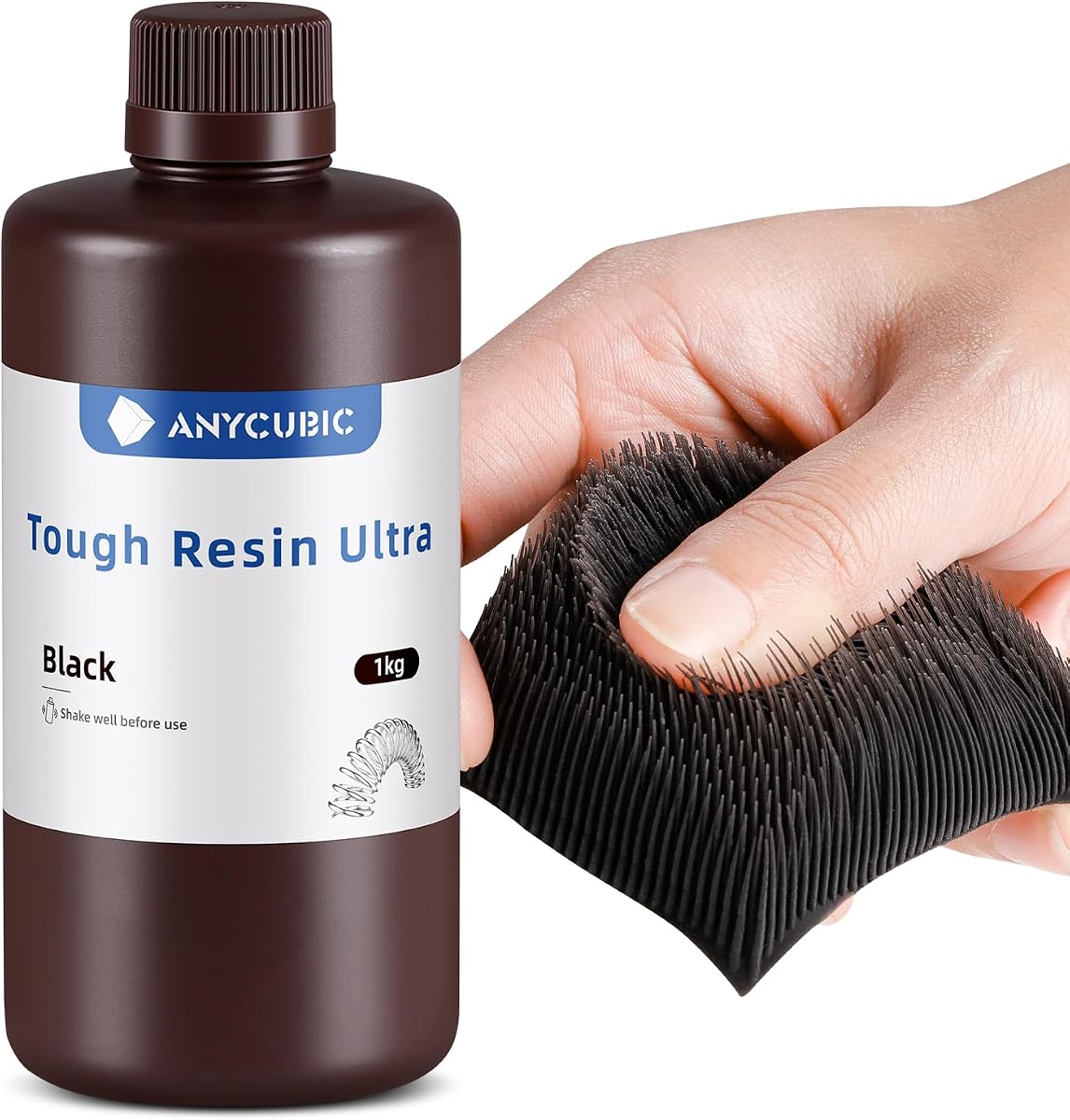
ANYCUBIC Ultra Tough is a highly flexible, impact-resistant photopolymer that can be printed directly or blended with other resins. It carries a 4.7 rating and targets articulated models, wearables, grips, and functional prototypes. Its defining feature is the ability to deform under force and recover its original shape without the brittle behavior associated with conventional resin.
We may earn a commission when you buy through this link, at no additional cost to you.
The material appears particularly well matched to articulated figures and interchangeable parts because it combines flexibility with clarity of fine, hair-like textures. It can also serve as an additive for tougher or more flexible base resins. When mixed with differently colored resins, though, the addition may affect the final color; using the same color avoids that stated issue.
Cured parts are described as gentle against the skin, making the resin relevant to wearable earphone covers, costume accessories, and other touch-oriented designs. It is also presented as resistant to brittleness, softening, and corrosion in humid conditions, while retaining elasticity across different temperatures. These broad claims make it useful for applications where a fully soft elastomer could be too delicate.
This is the most versatile choice in the guide for makers who want one resin to handle several flexible or toughened jobs. It suits articulated models, wearable prototypes, repeatedly handled parts, and as an enhancing blend. Those seeking the softest possible touch should consider a lower-durometer elastomer, but for broad utility and shape recovery, Ultra Tough is difficult to dismiss.
Using Ultra Tough as an additive gives makers a way to tune another resin toward greater toughness and flexibility. Matching the colors is advisable when preserving the intended appearance is important.
The stated ability to preserve detailed textures and withstand repeated deformation makes the formula well suited to articulated figures, flexible costume parts, and frequently handled accessories.
We may earn a commission when you buy through this link, at no additional cost to you.
SUNLU Flexible 70A is a soft, bendable resin intended for prototypes that need to withstand impact without becoming brittle. Its 3.5 rating is the lowest among the selected products, but the underlying attributes cover many important needs: a 70A Shore hardness, 135% elongation at break, impact resistance, low shrinkage, and a smooth finished surface.
We may earn a commission when you buy through this link, at no additional cost to you.
The material is compatible with 365-405nm LCD, DLP, and SLA printers, giving it broad applicability across common resin-printing setups. It cures quickly, and the low-viscosity behavior implied by the product description helps parts form cleanly. After cleaning, the printed surface is described as dry and non-sticky, an important characteristic for flexible objects that will be handled or assembled.
Potential drawbacks should not be overlooked. The supplied information mentions an aromatic odor that is not pungent but remains present, so ventilation remains appropriate during printing. More broadly, its lower customer rating suggests that some users may have found the balance of softness, finish, or handling less consistent than the leading options. It also offers less explicit flexibility information than products with stated elongation and rebound figures.
SUNLU Flexible 70A remains a sensible choice for makers who want an accessible balance of softness and strength. It suits grip-like prototypes, bendable models, cushioning concepts, and drop-tested components. Buy it when the 70A durometer, smooth finish, and broad curing compatibility match the project, rather than choosing it solely on its rating.
Support for 365-405nm curing makes the resin relevant to many LCD, DLP, and SLA systems. Users should still verify their printer's wavelength and supported material settings before beginning a print.
A dry, non-sticky finish after cleaning improves the experience of handling soft prints. This matters for grips, wearable forms, and articulated components that cannot tolerate a persistent tacky surface.
We may earn a commission when you buy through this link, at no additional cost to you.
Siraya Tech Tenacious Flex Black is a significantly softer and more rubber-like version of the classic Tenacious formulation. Its 4.7 rating places it among the strongest customer-rated options in this guide. The resin emphasizes fast rebound, high elasticity, and resistance to cracking, making it relevant for soft grips, gaskets, shock absorbers, and other pliable prototypes.
We may earn a commission when you buy through this link, at no additional cost to you.
Its key distinction is dynamic recovery. The product is described as able to withstand extreme bending and compression before quickly returning to its original shape. That rebound is more useful for active parts than simple softness alone: a flexible model that folds easily but remains permanently misshapen may not perform well in a real assembly, whereas an elastic resin can repeatedly move and recover.
Tenacious Flex also maintains impact resistance, so softness does not automatically translate to fragile prints. It can be mixed with other resins, including tough formulations, to increase impact resistance and flexibility. The manufacturer notes that it may not suit every application traditionally served by the original Tenacious resin, which is an important distinction for buyers who expect a one-for-one substitute.
Choose this resin when repeated bending, compression, and rapid recovery are central to the prototype. It is a strong candidate for gaskets, dampers, grips, and resilient artistic parts. The black-only formulation reduces color options, but the material behavior and strong customer rating make it a compelling dedicated flex choice.
Fast recovery after bending or compression helps a printed part maintain its intended geometry. That makes Tenacious Flex more suitable for moving components than a resin that merely bends and stays deformed.
A small addition to another resin can improve flexibility and impact resistance. Builders can use this option to create a custom compromise without treating the material as a fully dedicated elastomer.
We may earn a commission when you buy through this link, at no additional cost to you.
ANYCUBIC Tough Resin 2.0 is a toughened photopolymer for thin models, functional parts, and prototypes that need more flexibility than a standard resin without becoming a loose, floppy elastomer. Its 4.6 rating reflects a favorable balance of durability, precision, and printing convenience. The upgraded formula is specifically designed to resist fracture, peeling, cracking, and stress marks.
We may earn a commission when you buy through this link, at no additional cost to you.
Cyclic loading is another area of emphasis. The resin is presented as capable of withstanding repeated vibrations without developing the cracks and stress marks common in more brittle materials. This makes it useful for models that will be assembled, moved, transported, or subjected to vibration even if they do not need to bend like a true soft rubber.
The material also prioritizes a smooth, detailed finish. Low shrinkage helps preserve the intended dimensions and reduce visible distortion, while compatibility from 365nm to 405nm covers a broad range of LCD, DLP, and SLA devices. The low-odor formulation is also beneficial for a more comfortable workspace, although proper ventilation remains necessary when working with photopolymer resin.
This resin is best for functional prototypes that need toughness more than an extremely soft touch, including miniature components, thin structural pieces, industrial-style models, and durable household parts. It is not the top choice for highly compressible gaskets, but its balance of strength, elongation, precision, and broad compatibility makes it a versatile everyday option.
Enhanced flexural strength makes the formulation more forgiving for delicate geometries and miniature components. This is valuable when a print must survive assembly or handling without developing visible stress cracks.
Low shrinkage and smooth finishes help preserve crisp detail. The result is a more practical tough resin for projects where appearance and mechanical durability need to coexist.
We may earn a commission when you buy through this link, at no additional cost to you.
SUNLU High Toughness is designed for makers who want bendable, durable prints without giving up accurate detail. Its 4.7 rating reflects strong customer reception, while the supplied information states that elongation is five times higher than standard resin. It is positioned for structural parts, solid models, and other applications where ordinary resin would be too brittle.
We may earn a commission when you buy through this link, at no additional cost to you.
Low viscosity and high flowability are central to the printing behavior. These properties can shorten curing time, help the resin fill fine geometry, and make model formation more consistent. The formulation also undergoes reduced volume shrinkage, reducing the chance of distorted parts or cracking after washing and curing. That combination of flow and stability is especially helpful for complex prototypes.
The material offers a low-odor printing experience and is easy to clean with alcohol or ethanol. It is intended for most LCD, DLP, and SLA resin printers, although its listed curing wavelength is 405nm. Users should therefore confirm that their printer exposes 405nm UV light before treating it as universally compatible.
Choose SUNLU High Toughness for bendable structural concepts, robust miniatures, jigs, and detailed parts that may experience ordinary workshop handling. It delivers a versatile compromise between dedicated flexible resins and conventional tough formulations. Its gray color and 405nm emphasis are limitations, but the material balance makes it one of the strongest general-purpose picks in this guide.
Low viscosity supports faster curing and smoother material movement through fine details. It is a useful characteristic for prototypes with intricate surfaces, recessed areas, or multiple small features.
Reduced volume shrinkage helps limit distortion and post-wash cracking. Accurate parts are easier to assemble, test, and compare with their intended dimensions.
We may earn a commission when you buy through this link, at no additional cost to you.
ELEGOO Tough Resin is a semi-flexible, high-resilience photopolymer intended for structural parts, tools, jigs, fixtures, movable components, and everyday functional models. Its 4.5 rating indicates solid customer reception. With a stated cured Shore hardness of 84.7D, it sits on the firmer end of this guide and offers more shape retention than a soft rubber-like resin.
We may earn a commission when you buy through this link, at no additional cost to you.
The defining benefit is recovery after deformation. The resin is described as easy to bend, resistant to breaking, and able to return toward its original shape after external stress. It also maintains impact resistance and can be drilled after curing without cracking, which makes it more practical for parts that will be physically modified during assembly.
Environmental resistance is another strength. The material is presented as resistant to brittleness, softening, and corrosion in humid conditions, while retaining elasticity and flexibility across different temperatures. The cured parts have a fine texture, and the liquid formulation has low odor and is described as non-irritating, although standard resin safety and ventilation practices remain necessary.
Choose ELEGOO Tough for functional prototypes that need durability, drilling, handling, and moderate flexibility. It is less appropriate for a gasket that must be very soft or compressible, but it is well suited to tool-like components, articulated elements, fixtures, and end-use-style prototypes that need more mechanical substance.
The ability to drill cured parts without cracking makes the resin useful for prototypes that need holes, fasteners, or fitted components. Makers should still use suitable tools and support the part correctly during drilling.
Resistance to humidity, softening, and brittleness supports use in environments where rigid resin might fail. The material retains useful elasticity while providing a firmer structural profile.
We may earn a commission when you buy through this link, at no additional cost to you.
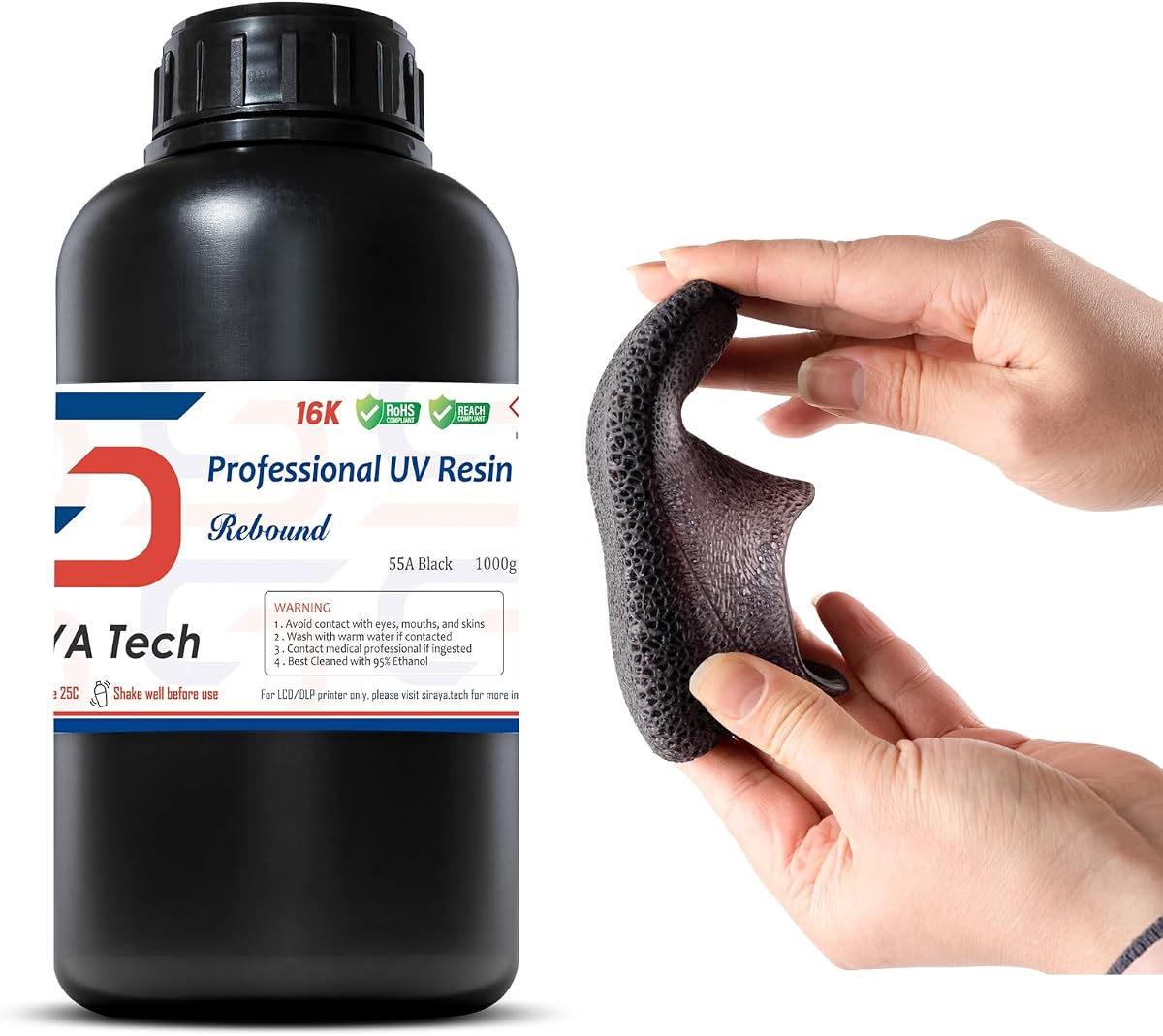
Siraya Tech Rebound 55A is a high-elasticity resin for prototypes that must compress and recover quickly. Its 4.2 rating is moderate compared with the rest of the field, but the material targets a distinct need: a soft 55A Shore formulation without complicated elastomer mixing or special processing. It is formulated to work on standard 405nm LCD and DLP resin printers.
We may earn a commission when you buy through this link, at no additional cost to you.
Rebound behavior is its primary advantage. The supplied information says the resin recovers significantly faster than standard elastic resins, making it attractive for shock-absorbing parts, personal protective equipment concepts, gaskets, seals, and consumer products. A 55A rating provides a notably soft feel while preserving enough structural integrity for functional prototyping.
The simpler workflow is equally important. Unlike elastomers that require A and B components to be combined, Rebound 55A is a ready-to-use resin and can be cleaned using standard isopropyl alcohol methods. Initial testing shows promising compression-cycle resilience, although the manufacturer notes that long-term performance testing is still ongoing. That caveat matters for buyers evaluating repeated-use applications.
This resin is best for soft, compressible prototypes where rapid recovery and simple handling are priorities. It is less compelling for highly detailed rigid parts or applications demanding extensive long-term cycle data, but it offers a clear processing advantage over two-part elastomers. The 55A hardness and no-mixing workflow make it a distinctive premium choice for specialized soft prototyping.
Using a single resin container removes the need to measure and combine A and B elastomer components. That convenience can reduce setup errors and make iterative prototyping more straightforward.
Rapid rebound is valuable in cushioning and shock-absorption concepts. It allows a deformed prototype to recover quickly instead of remaining compressed between tests.
We may earn a commission when you buy through this link, at no additional cost to you.
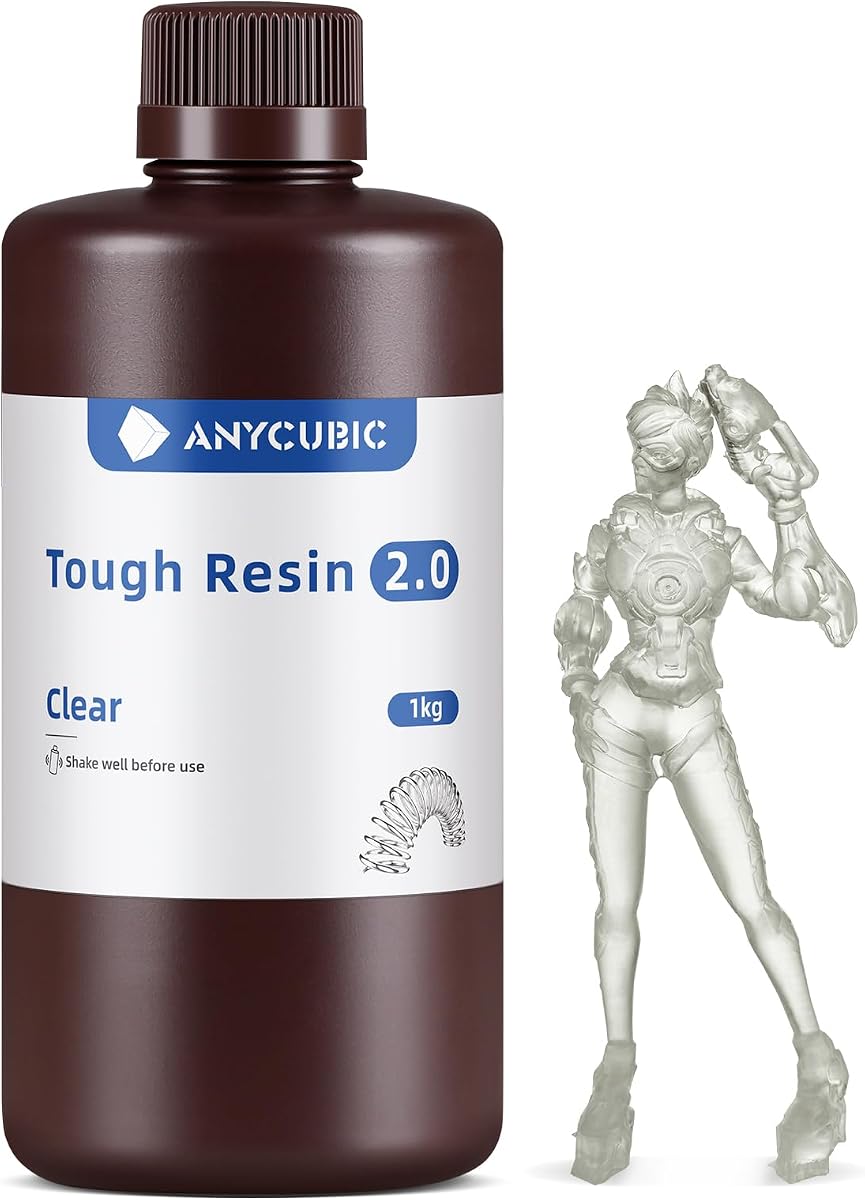
This clear version of ANYCUBIC Tough Resin 2.0 combines improved mechanical strength with high-resolution printing. Its 4.6 rating and compatibility across 4K, 8K, 12K, and 16K LCD, DLP, and SLA systems make it a credible choice for makers working at different resolution levels. The transparent formulation also gives finished prototypes a cleaner display-oriented appearance.
We may earn a commission when you buy through this link, at no additional cost to you.
Mechanical performance is the central improvement. The resin has greater flexural strength than earlier formulations, reducing the chance of thin or delicate components breaking. It also offers strong stretch and flexibility, helping prints resist damage caused by cyclic vibration. This makes it useful for decorative pieces, functional shells, and parts that will be moved repeatedly after printing.
Low odor and reduced volatile organic compounds are presented as benefits for the printing environment. Low shrinkage supports accuracy, while the clear formulation helps reveal surface quality and internal detail. It is still a tough resin rather than a truly soft elastomer, so it cannot be expected to match the compression of a 55A or 70A formulation.
Choose this version when you want toughness, precision, and a clear finish in one material. It is well suited to detailed miniatures, display models, durable prototypes, and thin parts that require more resilience than standard resin. Complete curing remains essential because the mechanical benefits of the formula depend on a properly finished part.
The transparent formulation highlights crisp details and makes cracks or surface defects easier to notice. This is useful for presentation models and prototype inspection.
Broad stated support for 4K through 16K systems gives makers flexibility across different resin printers. Actual settings and results still depend on the individual machine and model.
We may earn a commission when you buy through this link, at no additional cost to you.
FUNCECOL 90A Flexible Resin is a firm, rubber-like photopolymer for parts that need to flex repeatedly without tearing apart. Its 4.4 rating reflects a useful combination of softness, strength, and detail. The stated 90A Shore hardness is firmer than most dedicated flexible resins, giving printed objects a substantial feel while preserving bendability.
We may earn a commission when you buy through this link, at no additional cost to you.
Its mechanical story centers on tear and bending resistance. The formula is described as tolerating repeated folding with strong elongation and reduced tendency to crack. That makes it relevant for gaskets, protective cases, toy tires, shoe-sole concepts, ergonomic grips, and other components exposed to repeated stress. A harder durometer can be an advantage for wear resistance in these applications.
The material also supports high-precision work and uses a low-odor formulation. It cures at 405nm and is stated to work with MSLA, DLP, and LCD printers, covering most common resin-printing technologies. Although flexibility is the priority, crisp details and accurate surfaces mean that the resin is not limited to rough functional forms; it can also support props, cosplay pieces, toys, wearables, and medical models.
Choose FUNCECOL 90A when the part needs rubber-like movement but must remain relatively firm and wear-resistant. It is less suitable for extremely soft cushioning than a 55A or 70A product. For gaskets, grips, tires, soles, and protective pieces that need both flex and toughness, however, it is a well-matched and versatile option.
The 90A rating provides a firmer rubber-like profile than softer elastomers. That combination of flex, elongation, and tear resistance suits grips, soles, tires, and protective cases.
High precision and a smooth surface make the resin useful for visible products as well as functional parts. Makers can prototype cosmetic wearables, costume elements, or detailed soft components without abandoning crisp definition.
We may earn a commission when you buy through this link, at no additional cost to you.
The right flexible resin depends on how much softness, recovery, stretch, detail, and durability the finished part requires. Consider the material behavior, printer setup, and post-processing demands before choosing a formulation.
In short, select hardness based on compression, grip, and wear requirements rather than softness alone.
In short, test both maximum stretch and permanent deformation for parts expected to move repeatedly.
In short, prioritize crack and tear resistance whenever the part will be dropped, assembled, or repeatedly flexed.
In short, confirm wavelength, printer type, vat type, and software settings before ordering a flexible formulation.
In short, choose a formula that retains crisp details and stable dimensions if appearance and assembly accuracy matter.
In short, follow the complete wash and cure sequence because unfinished prints do not represent final material performance.
In short, define the part's movement, load, surface, and handling demands before choosing a resin.
In short, use a premixed resin for consistency and consider additives only when custom material behavior is worth the added process.
Prepare the printer according to the resin and machine instructions, including the correct build platform, vat configuration, film inspection, and wavelength-compatible settings. Stir the container thoroughly before filling the vat, but avoid introducing bubbles. Set the layer height and exposure profile recommended for the material, then run a small calibration or test coupon before committing to a detailed model. Flexible parts often benefit from gradual layer bonding because aggressive bonding can create an overly rigid skin.
After printing, support the part carefully and remove it from the build platform without twisting thin features. Wash the item in isopropyl alcohol using the cleaning method specified for the formula, then complete the recommended UV post-cure. Pay attention to recessed areas and trapped supports, since uncured resin can remain inside joints. Allow the finished component to cool and fully harden before repeatedly bending it, because early flexing can affect the final shape or leave stress marks.
For care and storage, keep the bottle tightly closed, clean the vat and tools separately, and prevent cured debris from returning to the resin. Store containers away from direct heat and light, and follow safety guidance for liquid photopolymer, including gloves, eye protection, and ventilated handling. Clean spills promptly using the resin manufacturer's recommended method. Inspect printed parts for cracks, tackiness, or weak joints before putting them into repeated service.
Choose a lower Shore rating for softer cushioning and greater compression, or a higher rating for firmer grip and wear resistance. The 55A Rebound option is among the softest choices, while 70A, 80A, 84.7D, and 90A provide progressively firmer behavior. Consider the complete part, including its wall thickness, print orientation, and cleaning requirements, rather than relying on hardness alone.
No. The resin must match the printer's curing wavelength, commonly 365nm or 405nm, and the machine must be able to handle a liquid photopolymer safely. Most selections list compatibility with common LCD, DLP, SLA, or MSLA systems, but individual specifications vary. Confirm the wavelength, vat type, software profile, and build-volume requirements before printing.
A tacky surface commonly means uncured resin remains on the part. Wash the print thoroughly, paying special attention to recesses, joints, and areas beneath supports, and then complete the recommended UV post-curing. Follow the exact procedure for the selected resin because curing times and surface-finishing methods can differ between formulations.
No. Elongation describes how far a cured part can stretch before breaking, while flexibility concerns how easily it bends and rebounds. A durable functional part should combine stretch with impact resistance, shape recovery, and tear resistance. Products such as Tenacious Flex and Rebound 55A place particular emphasis on fast rebound.
Ultra Tough and Tenacious Flex are specifically described as usable as additives that can increase flexibility and impact resistance. Mixing changes the final material behavior, so start with a controlled ratio and test a small coupon. Different colors can also affect the appearance of the blend, which makes matching colors advisable.
Flexible resin is best suited to gaskets, grips, bumpers, protective cases, cushioning, dampers, articulated figures, wearable components, and prototypes that must repeatedly bend or compress. It is less necessary for rigid structural parts that never flex. A toughened resin may be a better compromise when a part needs detail and durability but only moderate elasticity.
No blanket skin-safety claim should be made for every flexible resin. Ultra Tough is described as having a gentle skin sensation after curing, while Superflex is described as passing ISO 10993-5 when properly cleaned and fully post-cured. Individual certification conditions matter, so users should review the current manufacturer information and follow all handling precautions.
Use the cleaning method specified for the exact resin and printer combination. Several products can be washed with alcohol or isopropyl alcohol, but support removal and post-curing still require care. Rinse or clean hidden cavities thoroughly, remove residue from the vat, and fully cure the print before repeated bending. Avoid handling liquid resin directly without suitable gloves and ventilation.
ANYCUBIC Ultra Tough is the strongest all-around recommendation because it combines impact resistance, shape recovery, detailed printing, wearable applications, and additive versatility. SUNLU High Toughness offers an equally well-rated general-purpose compromise for bendable, accurate parts, while Siraya Tech Rebound 55A stands out for very soft compression, fast rebound, and a simple one-container workflow.
The right choice depends on the job. Choose a low-durometer resin for soft cushions, seals, and shock absorbers; a midrange formulation for grips and articulated models; or a firmer tough resin for thin structural parts, tools, and detailed shells. Always balance softness against tear resistance, surface finish, cleaning difficulty, printer compatibility, and the amount of rebound the finished part actually requires.
Before ordering, verify the current product listing, curing wavelength, printer compatibility, package details, and manufacturer instructions. Resin formulations and marketplace listings can change, and current technical information is more useful than old settings or assumptions. With the right material selected and a controlled test print completed first, flexible resin can produce convincing prototypes that bend, compress, and perform as intended.