
Camco Tastepure RV Water Filter 2-Pack
4.7Editor score
Two filters in one package
Six-step GAC and KDF filtration
NSF 42 and 53 listed
Wide-body high-flow housing
This expert guide compares 10 of the best inline RV water filters, covering filtration, certifications, flow, capacity, durability, and RV compatibility for
An inline RV water filter connects directly between an outdoor water source and your RV plumbing, making it a convenient way to improve drinking, cooking, and household water. The best model should balance contaminant reduction, reliable flow, durable fittings, simple installation, and a service life that suits regular travel.
The filters in this guide were compared using the specifications and claims supplied by each manufacturer. We compared filtration media, certification standards, sediment ratings, flow rates, capacity, construction, hose compatibility, included accessories, intended applications, and the practical value offered by multipack configurations.
Each review identifies the filter’s strongest use case and any limitations suggested by its specifications. The Camco models stand out for documented six-stage treatment, while other options emphasize finer sediment filtration, replaceable cores, four-pack convenience, or specialized scale protection. Product availability and pricing change over time.
4.7Editor score

4.7Editor score

4.6Editor score
The comparison below highlights the major differences among ten inline RV water filters, including filtration precision, certification coverage, pack size, housing design, and the accessories or replacement systems available.


The Camco Tastepure RV Water Filter is the strongest all-around choice in this guide, combining a 4.7 rating with extensive filtration claims and independent listing to NSF/ANSI 42 and NSF/ANSI 53. Its six-step process uses granular activated carbon and KDF media, while the internal 20-micron sediment stage is intended to stop silt and other suspended particles before they reach RV plumbing.
We may earn a commission when you buy through this link, at no additional cost to you.
Camco describes the wide-body housing as a high-flow design, which makes the filter more practical for users who do not want drinking-water filtration to noticeably restrict everyday RV use. The included flexible hose protector reduces strain at the connection and helps prevent kinks, a small feature that can make setup more orderly and reduce the chance of a sharp hose bend near the filter.
The principal trade-off is that this is a single-filter package, so buyers who want an immediate spare or plan to keep one unit at home will need another configuration. It is also a disposable inline cartridge rather than a system with a separately replaceable internal core. Despite that limitation, the certification information, material choice, flow-conscious design, and six-stage approach offer a well-rounded feature set.
This is the most suitable choice for RV owners who want a recognized brand, substantial filtration documentation, and one filter that can serve drinking, cooking, pet-washing, gardening, car-washing, and marine tasks. It is particularly compelling for campers who connect to varied municipal or campground water sources and want a single inline component that can move between several hose-based applications.
The six-stage system is the Camco’s main advantage because it combines activated carbon and KDF functions with mechanical sediment protection. The stated capabilities include reducing chlorine, bad tastes, odors, and sediment, while KDF is used to help control bacterial and mold growth during periods when the filter is not being used.
The flexible hose protector, broad connection compatibility, and wide-body housing make this filter easy to incorporate into a temporary RV hookup. Its listed applications extend beyond potable use, which adds value for pet bowls, garden hoses, boats, car washes, and other tasks where cleaner water may be helpful.
We may earn a commission when you buy through this link, at no additional cost to you.
The Camco Tastepure 2-Pack shares the flagship model’s 4.7 rating and six-stage filtration design but includes two complete filters. This configuration is especially attractive to RV travelers who want a ready replacement, use more than one vehicle or hose, or simply prefer keeping a spare unit on hand between service intervals.
We may earn a commission when you buy through this link, at no additional cost to you.
The filters are independently tested and listed to NSF/ANSI 42 and NSF/ANSI 53, and their lead-free construction is certified to NSF/ANSI 372. GAC and KDF media target chlorine, tastes, odors, and sediment-related concerns, while the 20-micron internal screen provides the final mechanical protection described by the manufacturer.
Compared with buying a single filter, the main disadvantage is storage: two housings take more room in an RV storage bay. As with other cartridge-style inline filters, the entire unit must be replaced according to the service schedule rather than only swapping an internal core. Nevertheless, the duplicate filter provides convenience and resilience that a single model cannot offer.
This is a strong choice for campers who value the Camco filtration platform but want redundancy. It works especially well for families traveling together, owners of both an RV and boat, and users who maintain filters at more than one property. The two-pack also makes it easier to change the filter without a delay when a replacement is already available.
Both units use Camco’s Hex-Flow six-step approach, so the multipack does not sacrifice filtration features for convenience. The wide-body design and 20-micron sediment screen are the same core features found in the single-filter version, making this a straightforward way to maintain a spare without changing your setup habits.
Inline filters depend on regular replacement, and a spare prevents an avoidable interruption during a trip. Two units are also useful for separate freshwater tasks, allowing one to remain connected to the RV while another is used with a garden hose, pet area, washing equipment, or boat.
We may earn a commission when you buy through this link, at no additional cost to you.
The Advanced RV Inline Water Filter 2-Pack pairs a 4.7 rating with a generous stated capacity of 1,350 gallons and a three-month durability window. It uses selected granular activated carbon and KDF materials, with claims covering chlorine, taste, odor, rust, debris, suspended solids, large particles, and heavy metals.
We may earn a commission when you buy through this link, at no additional cost to you.
Installation is designed to be tool-free and reportedly takes less than five minutes. Each unit fits a standard garden or drinking hose, and the package includes a flexible hose protector to reduce kinks and connection strain. That combination makes the filters practical for RVs, boats, camping, pet care, pools, spas, gardening, and household chores.
The key drawback is the lack of a specific NSF certification statement in the supplied product information. Buyers who place greater weight on independent certification may prefer one of the models explicitly listed or certified to NSF/ANSI 42 and 53. The long capacity claim also should not be confused with permission to ignore time-based replacement guidance.
This multipack is a sensible option for buyers who want two flexible-hose filters and a large stated filtration capacity. It is well suited to owners who split their water use across an RV and a boat, compare filters for multiple properties, or appreciate having a replacement ready before the recommended three-month interval arrives.
A stated capacity of 1,350 gallons gives this model a practical advantage for trips with substantial drinking, cooking, and washing demand. The two-pack provides additional redundancy, although users should still observe the supplied three-month replacement guidance and avoid treating maximum capacity as a reason to postpone maintenance indefinitely.
Its straightforward hose connections and included protectors minimize setup complexity. Because the housing attaches to standard hoses, the filters can move between an RV, boat, garden, pool, or pet-care application rather than being dedicated to a single permanent connection point.
We may earn a commission when you buy through this link, at no additional cost to you.
The Kohree 4-Pack is built around convenience and coverage, giving buyers four inline filters with a 4.6 rating. Each filter uses a five-layer system, a 20-micron sediment rating, GAC and KDF media, and a stated capacity of 1,057 gallons at a flow rate of 0.5 gallons per minute.
We may earn a commission when you buy through this link, at no additional cost to you.
Its thick food-grade plastic housing is described as having passed a standard blasting test, which addresses the concern that thin housings may split during travel. The product information also states NSF and BPA-free certification, while the inline arrangement is intended to promote steady water delivery with less delay than a storage-tank filter.
The obvious issue is bulk. Four complete filters are more challenging to store than a single unit or two-pack, and buying extras has little value for someone who camps only occasionally. The stated seasonal service life is also tempered by advice to replace each filter every three to six months, so the correct interval should reflect actual use and the manufacturer’s guidance.
This package is best for households with multiple water systems, owners of several RVs or boats, or travelers who prefer to stock replacements. Its combination of a stated NSF certification, thick housing, and moderate flow rate makes it attractive for extended camping seasons where reliable inline performance and replacement readiness are priorities.
The four-filter configuration can serve different RVs, boats, cabins, or hose-fed household tasks without requiring repeated purchases. It also solves the common travel problem of discovering that a stored filter is aging or already used, provided the owner has room to keep unused units dry and organized.
The stated 0.5-gallon-per-minute flow and reinforced food-grade housing target dependable everyday use. This balance is especially relevant for users who want filtration without routing all water through a bulky tank-based system or using a delicate housing that may crack under travel conditions.
We may earn a commission when you buy through this link, at no additional cost to you.
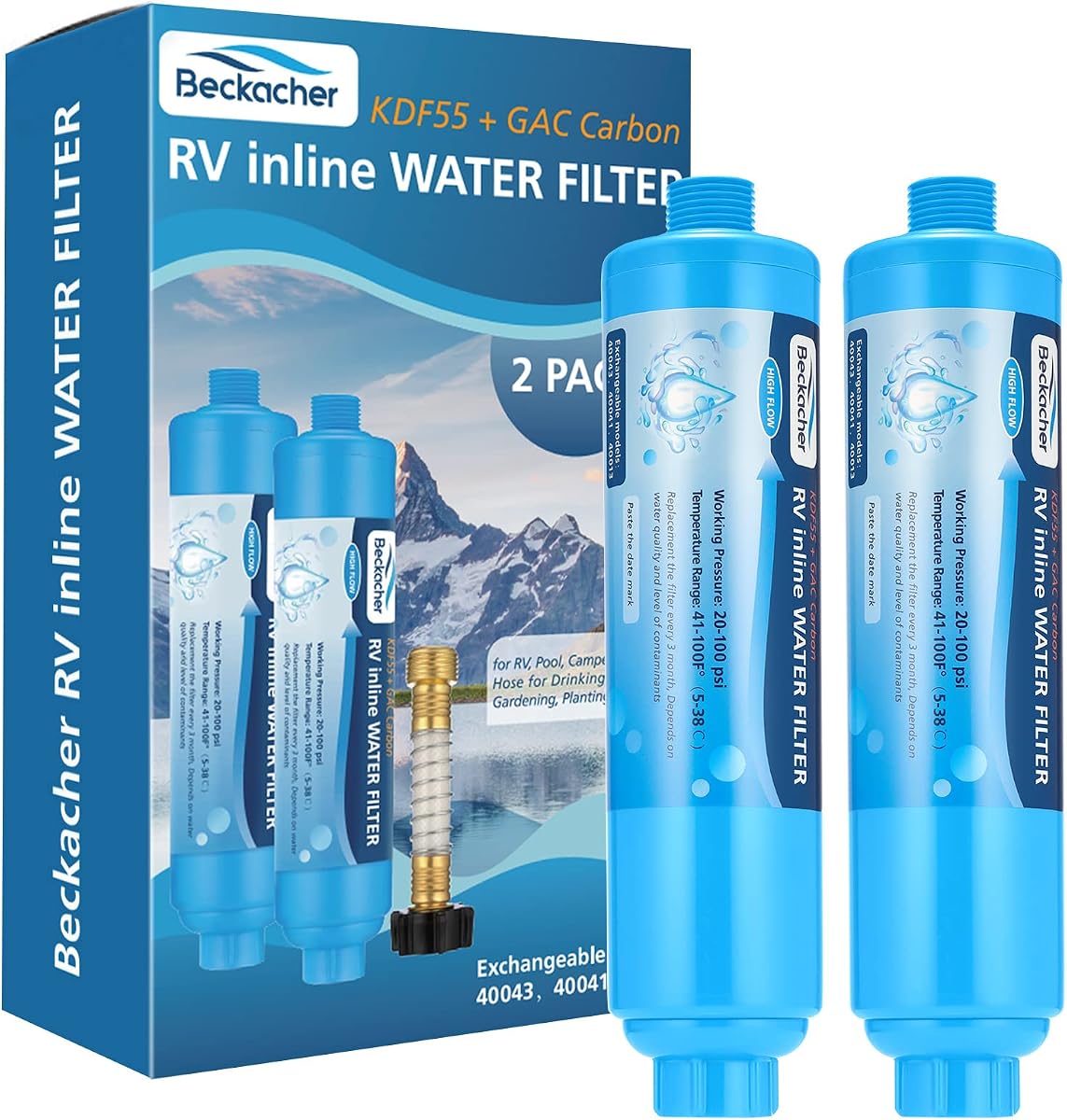
The Hourleey 2-Pack is a flexible, multipurpose option with a 4.6 rating. Each filter combines GAC and KDF media with a 20-micron rating, targeting undesirable tastes, odors, chlorine, sediment, and rust while also providing the stated ability to regulate bacteria and mold growth while inactive.
We may earn a commission when you buy through this link, at no additional cost to you.
Its food-grade plastic housing is reinforced to resist rupture, and the two included flexible hose protectors reduce pressure on the connections and help minimize kinking. Installation follows a simple flow direction: the incoming hose connects to the inlet, and the outgoing hose runs to the RV or watercraft.
Its 20-micron sediment stage is less fine than the half-micron carbon block in the Frizzlife MV99 or the one-micron stage in the SpiroPure. The supplied information also does not identify a specific NSF certification, so buyers prioritizing documented independent standards may favor a certified alternative. It remains suitable for general RV, marine, and household tasks where broad contaminant reduction and simple installation are the main goals.
This is a good match for campers and boaters who want two complete filters with protectors at an accessible two-pack configuration. It is especially useful for pet water, gardens, pools, spas, and chores in addition to drinking and cooking water, making it a broader utility filter than a model designed only for a single potable outlet.
The flexible hose sections are a meaningful addition because RV water lines are often moved, bent, and connected in confined spaces. By easing strain and reducing sharp bends, they support a cleaner installation and can make routine use less frustrating than working with a bare rigid connection.
The RV and marine focus does not prevent use around a home, boat, pool, spa, pet station, or garden. That flexibility gives the multipack more year-round utility than a filter stored exclusively for the travel season.
We may earn a commission when you buy through this link, at no additional cost to you.
The Glacier Fresh RV/Marine Water Filter 2-Pack offers a 4.5 rating and a clearly stated chlorine-reduction figure of 97.9 percent based on independent laboratory testing described by the manufacturer. Its 20-micron sediment rating, lead-free and BPA-free materials, and use of GAC and KDF media make it a conventional but versatile inline filtration option.
We may earn a commission when you buy through this link, at no additional cost to you.
A reinforced food-grade housing is intended to resist bursting, while the included flexible hose protectors reduce strain and kinking. The stated service duration is one camping season of approximately three months. The two filters can be used across RVs, boats, campers, pools, spas, gardens, pet-care tasks, and general household chores.
Compared with higher-rated models, its 4.5 rating is modest, and the product information does not provide a specific NSF certification listing. The stated chlorine percentage is useful but should be considered alongside the filter’s broader range of stated reduction claims. As a disposable inline cartridge, it also requires full-unit replacement when service life ends.
This package is appropriate for users whose primary concern is improving chlorine taste and odor in RV or marine water. The second unit and flexible connections make it convenient for owners who alternate between two vehicles or need a spare, while the broad application list extends its usefulness beyond the camping season.
The independently tested 97.9 percent chlorine-reduction claim gives the product a clear purpose. For travelers connecting to heavily chlorinated municipal water, activated carbon offers practical value for taste and odor, while the KDF layer and sediment screen broaden the overall treatment package.
Although designed around RV and marine use, the standard-hose connection makes the filters adaptable to pools, spas, pets, gardening, and chores. A spare filter is especially helpful for boaters or campers who move between sites and want to avoid a last-minute supply problem.
We may earn a commission when you buy through this link, at no additional cost to you.
The RVGUARD Inline RV Water Filter 4-Pack distinguishes itself with unusually specific operating data. It has a 4.5 rating, a service flow of 0.5 gallons per minute, a stated capacity of up to 15,000 gallons, a 60 psi working pressure, a 34 to 100-degree Fahrenheit operating range, and a three-month lifespan per filter.
We may earn a commission when you buy through this link, at no additional cost to you.
Its material safety and aesthetic chlorine reduction are certified by IAPMO R&T against NSF/ANSI 42. GAC and KDF treatment is used for the broader filtration process, and the filter has a 20-micron diameter rating. Standard garden hoses, faucets, RVs, marine systems, camping gear, gardens, planting areas, and farms are among the listed uses.
Buyers should expect some carbon to leave the filter during the first use. The manufacturer advises running the faucet until the water clears, which is a normal commissioning step rather than a reason to reject the filter, but it does require an active initial flush. The four-pack also creates a substantial storage commitment, and the large capacity claim should be balanced against the stated three-month service interval.
This filter is a good option for buyers who prioritize published operating limits and a recognized certification body. It is particularly relevant to users who want measured flow information, a specified pressure range, and four ready filters for multiple hookups or extended replacement planning.
Published pressure, temperature, flow, capacity, and service-life information makes this product easier to evaluate against RV plumbing requirements. The 0.5-gallon-per-minute flow should be considered when running multiple fixtures, while the stated temperature range helps define where the filter can reasonably be installed.
The manufacturer explicitly warns that carbon can appear during initial operation. Running the faucet until it clears helps remove loose particles from the filtration system and should be completed before the water is used for drinking, cooking, or other routine RV tasks.
We may earn a commission when you buy through this link, at no additional cost to you.
The SpiroPure SP-RV100 is the most specialized option in the guide, with a 4.4 rating and a multi-stage design aimed at both water quality and RV plumbing protection. Its one-micron sediment filter is considerably finer than the 10- and 20-micron ratings used by most of the other products in the comparison.
We may earn a commission when you buy through this link, at no additional cost to you.
German-made catalytic carbon is used to reduce chlorine, chloramine, and sulfur odors, while the fine filtration stage is described as capturing heavy metals, lead, mercury, PFOA, and PFAS. The filter also functions as a salt-free water softener and descaler, helping reduce mineral buildup in plumbing and appliances without requiring salt.
This scale-protection function is the principal distinction, and it comes with trade-offs. The supplied information does not list an NSF certification, the rating is the lowest in this comparison, and the broad contaminant claims should be evaluated against the manufacturer’s documentation rather than treated as independent testing summaries. It is also a single-filter purchase, so owners seeking redundancy must purchase another unit.
This model is most compelling for RVs with hard-water issues, aging plumbing, or occupants who want both drinking-water treatment and scale reduction. It also suits marine use and households that want one inline filter to support drinking, cooking, and showering. For campers, the scale function may add more long-term value than a conventional disposable cartridge.
A one-micron sediment rating can capture finer suspended material than the 10- and 20-micron filters included in this guide. That makes the SP-RV100 relevant where the water source has a history of fine sediment, although the entire cartridge remains a maintenance item.
The salt-free descaling function targets mineral deposits inside RV plumbing and connected appliances. This system-level focus distinguishes the SpiroPure from conventional taste, chlorine, and sediment filters and may be especially useful for owners who want to protect an entire RV water system.
We may earn a commission when you buy through this link, at no additional cost to you.
The FRIZZLIFE MV99 is the premium pick in this guide, pairing a 4.6 rating with a half-micron composite activated-carbon block and IAPMO R&T certification to NSF/ANSI 42 and 53. Its stated reduction targets include chlorine, sediment, lead, other heavy metals, bad taste, and odors, while essential minerals are intended to remain in the water.
We may earn a commission when you buy through this link, at no additional cost to you.
Lead-free brass fittings add durability at the connections and are compatible with standard 3/4-inch garden hoses. The included filter holder helps keep the housing upright, reduce kinking, and can be mounted to a wall. An auto shutoff design is intended to make cartridge changes more convenient, while the twist-in construction allows the inner core to be replaced quickly.
The primary disadvantage is the more specialized system. Only the internal filter core is replaced, which reduces ongoing plastic waste but requires the correct MV99 replacement cartridge and compatible FZ-2 search reference described by the manufacturer. It also carries a higher category cost than the conventional multipacks, making efficiency and long-term housing reuse the justification for the premium.
This filter is best for owners who want finer filtration, stronger connection components, independent certification, and a reusable housing. It is an excellent choice for RVs, marine systems, campsites with inconsistent water quality, and households using filtered water for drinking, dishwashing, cooking, cleaning, vehicle rinsing, pools, and gardens.
The holder, wall-mounting option, brass fittings, and reusable plastic housing create an installation that can remain in place longer than a disposable inline setup. That makes the MV99 suitable for owners who want a central RV or household filter rather than a temporary camping attachment.
The half-micron carbon block is the most detailed filtration rating among the listed products and is backed by certification to both major NSF drinking-water standards. It is intended to handle fine sediment and taste-and-odor concerns with a larger surface area than a simple mesh screen alone.
We may earn a commission when you buy through this link, at no additional cost to you.
The Stokk RV Water Filter 2-Pack is a strong lower-cost contender with a 4.7 rating, NSF/ANSI 42 certification, and a 10-micron internal sediment filter. That sediment rating is finer than the 20-micron rating used by many competing models, potentially making it better suited to catching small silt and suspended impurities.
We may earn a commission when you buy through this link, at no additional cost to you.
The filters use lead-free, BPA-free, food-grade plastic with selected GAC and KDF media. Stated reduction targets include chlorine, heavy metals, odors, sediment, and fluoride. Rust-resistant copper fittings, a silicone washer, and a 360-degree swivel are designed to support dependable connections and reduce the kinking that often occurs around an inline RV filter.
The product information cites NSF/ANSI 42 but not NSF/ANSI 53, so buyers focused specifically on certified lead reduction should examine the available certification documentation. No explicit replacement capacity or lifetime is provided, making it important to follow the manufacturer’s maintenance instructions and avoid judging remaining performance only by water appearance. As a multipack, it also requires more storage than a single filter.
This package is a good fit for travelers who want finer sediment protection than a 20-micron model, along with a 4.7 rating and a two-filter configuration. The swivel, copper fittings, and hose protectors make it particularly attractive for RV and boat hookups where a rigid or sharply bent hose connection could be troublesome.
The 10-micron screen offers a useful middle ground between coarse 20-micron models and the much finer SpiroPure stage. It can intercept small sediment while preserving the high-flow approach and simple disposable design associated with most standard RV inline filters.
The 360-degree swivel, flexible hose protector, copper fittings, and silicone washer work together to ease installation and routing. These details are particularly useful in the limited spaces around RV water connections and help reduce strain at the filter’s most vulnerable point.
We may earn a commission when you buy through this link, at no additional cost to you.
Choosing an inline RV water filter involves balancing contaminant reduction, connection quality, flow, maintenance, certification, and the environments in which the filter will be used. The most important step is to match the filter’s capabilities to the source water and the demands of your RV plumbing.
Most inline filters combine granular activated carbon, commonly called GAC, with KDF media and a mechanical sediment screen. Activated carbon is primarily associated with reducing chlorine, unpleasant tastes, and odors, while KDF adds further treatment for certain metals and water quality concerns. A fine carbon block, such as the half-micron block in the Frizzlife MV99, can offer a different balance because it combines carbon treatment with finer physical filtration. The SpiroPure also adds a one-micron stage and scale-protection functionality.
Certification gives buyers more information than broad contaminant-reduction language alone. NSF/ANSI 42 addresses aesthetic effects such as chlorine, taste, and odor, while NSF/ANSI 53 covers health-related contaminants including lead. The Camco filters are independently tested and listed to both standards, the Frizzlife MV99 is certified by IAPMO R&T against both, and the Stokk is NSF/ANSI 42 certified. Claims about fluoride, heavy metals, PFAS, or other contaminants should always be checked against the exact certification or test scope.
The micron rating indicates the nominal size of particles a filter is designed to intercept, but it does not describe every aspect of performance. The Camco, Kohree, Hourleey, Glacier Fresh, and RVGUARD models use 20-micron ratings, while Stokk uses 10 microns and SpiroPure uses 1 micron. Finer is not automatically better for every application because no inline screen eliminates all contaminants. Consider whether the RV typically receives clear municipal water or is exposed to sand, rust, silt, and debris from wells, surface sources, or older infrastructure.
An inline filter sits directly in the supply line, so excessive restriction can affect showers, sinks, and simultaneous household use. The Kohree and RVGUARD products list a flow rate of 0.5 gallons per minute, and several conventional models emphasize wide-body high-flow construction. If your RV has multiple fixtures or you regularly shower while another person uses the kitchen, prioritize a clear flow specification and avoid choosing a fine multi-stage system without understanding its effect on demand.
Most RV water connections use standard garden-hose sizing, and the filters in this guide are designed for that general format. The SpiroPure explicitly states compatibility with 3/4-inch hoses, while the Frizzlife uses lead-free brass fittings for standard 3/4-inch garden hoses. A flexible hose protector and swivel are valuable because hoses attached to a vehicle often need to bend around awkward bodywork. A good fit should avoid sharp kinks, stress the connection, or require improvised adapters.
Service life depends on water volume, source quality, and how frequently the filter is used, so capacity alone should not determine replacement timing. Several products cite a three-month camping-season interval, while the Kohree advises replacement every three to six months. The Frizzlife takes a different approach: its reusable outer housing remains installed and the inner core is changed quickly. This can reduce plastic waste, but it creates a dependency on obtaining the correct replacement core.
A single filter is simplest to carry, but a spare prevents interruptions when the installed unit reaches the end of its service interval. Two-packs balance redundancy and storage, while four-packs suit owners of multiple RVs, boats, or water systems. Storage is a meaningful concern in compact travel trailers, and unused filters should be kept sealed and dry. Purchasing extra units only makes sense if they will be used before the cartridge life expires.
Some filters are designed only to improve water at a point of use, while others also address scale and sediment that can affect the broader plumbing system. The SpiroPure includes a salt-free descaling function, making it relevant for hard-water areas and RV plumbing maintenance. The Frizzlife’s holder and wall-mount capability support a more permanent installation. For casual users, the Camco, Hourleey, Glacier Fresh, and Stokk filters are versatile enough to move between potable, pet, garden, pool, and washing tasks.
Begin by identifying the correct flow direction. Most inline filters have clearly marked inlet and outlet connections, with the inlet receiving water from the campground, municipal source, or garden hose and the outlet feeding the RV or another water-consuming device. Turn off the source before connecting, dry both ends as appropriate, and secure the hose to the filter without over-tightening the fittings.
After attaching the filter, restore the water slowly and check every connection for leaks. RVGUARD specifically advises running the faucet until initial carbon discharge clears. For filters with a mounting holder, position the housing upright and route the hose through a broad curve rather than a sharp bend. A flexible protector or swivel should sit at the point most likely to flex, helping prevent kinks and connection strain.
Use the filter according to the manufacturer’s replacement schedule and avoid assuming that clear water means the media is still effective. Store unused cartridges in a clean, dry place, and keep a replacement available for longer trips. Clean the exterior hose connections, avoid using abrasive cleaners on the housing, and consult the product instructions for any model-specific shutdown, mounting, or replacement procedure.
Not all of them do, and buyers should not assume that a taste-and-odor filter is a complete purifier. The filters in this guide primarily emphasize activated carbon, KDF, sediment filtration, taste and odor reduction, and selected contaminant claims. If protection from microorganisms is essential, verify the exact certification, test report, and use conditions before relying on a model for that purpose.
The standards cover different categories. NSF/ANSI 42 is associated with aesthetic effects such as chlorine, taste, and odor, while NSF/ANSI 53 addresses health-related contaminants, including lead. A filter certified to both offers broader documented coverage, but buyers should still confirm that the specific product model carries the certification and review the manufacturer’s claims.
Replacement depends on the manufacturer’s guidance, water volume, source quality, and frequency of use. Several products specify a three-month camping-season interval, while the Kohree recommends replacement every three to six months. Treat time and condition as important because a cartridge can stop performing before it looks visibly dirty.
Yes. Every product in this comparison is intended to attach to a standard garden or drinking hose. Some products specify 3/4-inch compatibility, and the Frizzlife uses lead-free brass fittings. Check the exact dimensions and flow direction before connection, especially if you are using an unusual adapter or a pressure-regulated source.
Some restriction is possible because the water must pass through filtration media and a sediment screen. Models such as the Kohree and RVGUARD list a flow rate of 0.5 gallons per minute, while wide-body models are designed to support efficient flow. Households running multiple fixtures at once should compare the rated flow with their RV’s typical demand.
Small amounts of loose carbon can leave some new filters during the initial flush, as RVGUARD specifically notes. Run the faucet until the water clears before drinking or cooking. If discoloration persists, check the installation and follow the manufacturer’s flushing instructions rather than continuing to use the filter without investigating.
A two-pack is usually the most practical balance because it provides one installed filter and one spare while using limited storage space. A four-pack makes more sense for owners of several RVs, boats, or hose-fed tasks. Extra filters are only worthwhile if they will be used within their service life or stored properly for a later trip.
Yes. The Camco, Hourleey, Glacier Fresh, and Stokk filters are listed for applications including pets, gardening, pools, spas, washing, and car care. Check the individual manufacturer instructions and local requirements, especially if the water will be used with food, animals, or equipment.
The Camco Tastepure single filter is the best overall choice because it combines six-stage GAC and KDF treatment, listings to NSF/ANSI 42 and 53, a 20-micron sediment stage, and a high-flow housing. Its two-pack version is the best value option for travelers who want a spare, while the FRIZZLIFE MV99 is the premium choice for fine carbon-block filtration, brass fittings, and a replaceable inner core.
Your priority should match your actual hookup. Look for stronger certification when lead or other health-related claims matter, a fine sediment rating when the source contains small particles, a descaling function when hard water affects the RV, and adequate flow when multiple fixtures are used. A hose protector, swivel, or mounting holder can make a substantial difference in everyday convenience.
Finally, check the current product details, replacement availability, and pricing before purchasing. Filters, fittings, and manufacturer instructions can change, so confirm that the current listing matches the model described in this guide and choose a service interval that fits how often the RV is used.