
DREO 7-in-1 Countertop RO
4.4Editor score
Seven-stage filtration system
Real-time TDS monitoring
Three-to-one water efficiency
Compare the best countertop reverse osmosis systems by filtration, efficiency, capacity, ease of use, water quality, and maintenance in this expert guide for
Countertop reverse osmosis systems bring advanced drinking-water filtration to homes without requiring permanent plumbing or a faucet connection. A strong model should combine meaningful contaminant reduction, convenient dispensing, manageable water waste, and filter monitoring. The best units also suit small kitchens, apartments, offices, and other spaces where under-sink installation may be inconvenient.
We compared all ten systems using the supplied specifications and product descriptions, focusing on filtration stages, certifications, pure-to-drain ratios, reservoir size, dispensing controls, maintenance routines, and everyday usability. The list covers compact pitcher-based designs, larger glass-carafe systems, and feature-rich models with displays, voice alerts, UV treatment, or multiple volume settings.
Each review explains the strongest reasons to consider a system, along with its practical trade-offs and ideal household. Ratings reflect the supplied customer feedback, while technical claims reflect the information provided by each manufacturer. Prices and promotions can change, so compare the current listing, warranty terms, and replacement-filter availability before purchasing.
4.4Editor score

4.6Editor score

4.5Editor score
The comparison below highlights each system's filtration approach, water-use ratio, reservoir or serving configuration, monitoring features, and intended household size. Use it to identify the most convenient balance of purification, capacity, and maintenance for your space.



The DREO 7-in-1 is an appealing all-around countertop reverse osmosis system for households that want meaningful filtration without a complex installation process. Its supplied rating is 4.4 out of 5, placing it among the stronger customer-rated models in this guide. The system combines a 3L reservoir, a 1.1L pitcher, a real-time TDS display, and a filter-change reminder, covering both purification and routine monitoring in one compact appliance.
We may earn a commission when you buy through this link, at no additional cost to you.
DREO states that the seven-stage system removes 99.9% of possible contaminants, including PFOA, PFOS, chlorine, and fluoride, and that it was tested by SGS against NSF/ANSI 58 standards. The three-to-one pure-to-drain ratio also makes it more water-conscious than many conventional reverse osmosis layouts. An auto-fill sensor simplifies pitcher refilling, while the self-cleaning system flushes internal tubes to support consistent water quality and reduce manual upkeep.
The trade-off is that the 3L tank and 1.1L pitcher are primarily suited to one or two people, so a larger household may refill more frequently. The unit also does not offer temperature control, and the stated filter life of 265 gallons means replacement supplies should be considered as part of the ownership commitment. Even so, the combination of monitoring, automatic features, and a relatively compact footprint makes these limitations manageable for the target user.
Choose this DREO if you want a feature-rich system for a couple, apartment, office, or smaller household and value clear maintenance feedback over a large glass carafe. It is particularly appealing for users who dislike plumbing changes but still want the water efficiency and purification stage count associated with modern countertop RO equipment. For most people in that group, it offers a practical balance of capability, convenience, and footprint.
The display tracks raw-water and purified-water TDS while also surfacing filter-change reminders. That visibility makes it easier to understand how the system is performing and when maintenance deserves attention.
The pitcher has a hands-free refill sensor, and the self-cleaning cycle flushes internal tubing. Together, these features reduce repeated manual steps without changing the basic top-fill operating method.
We may earn a commission when you buy through this link, at no additional cost to you.
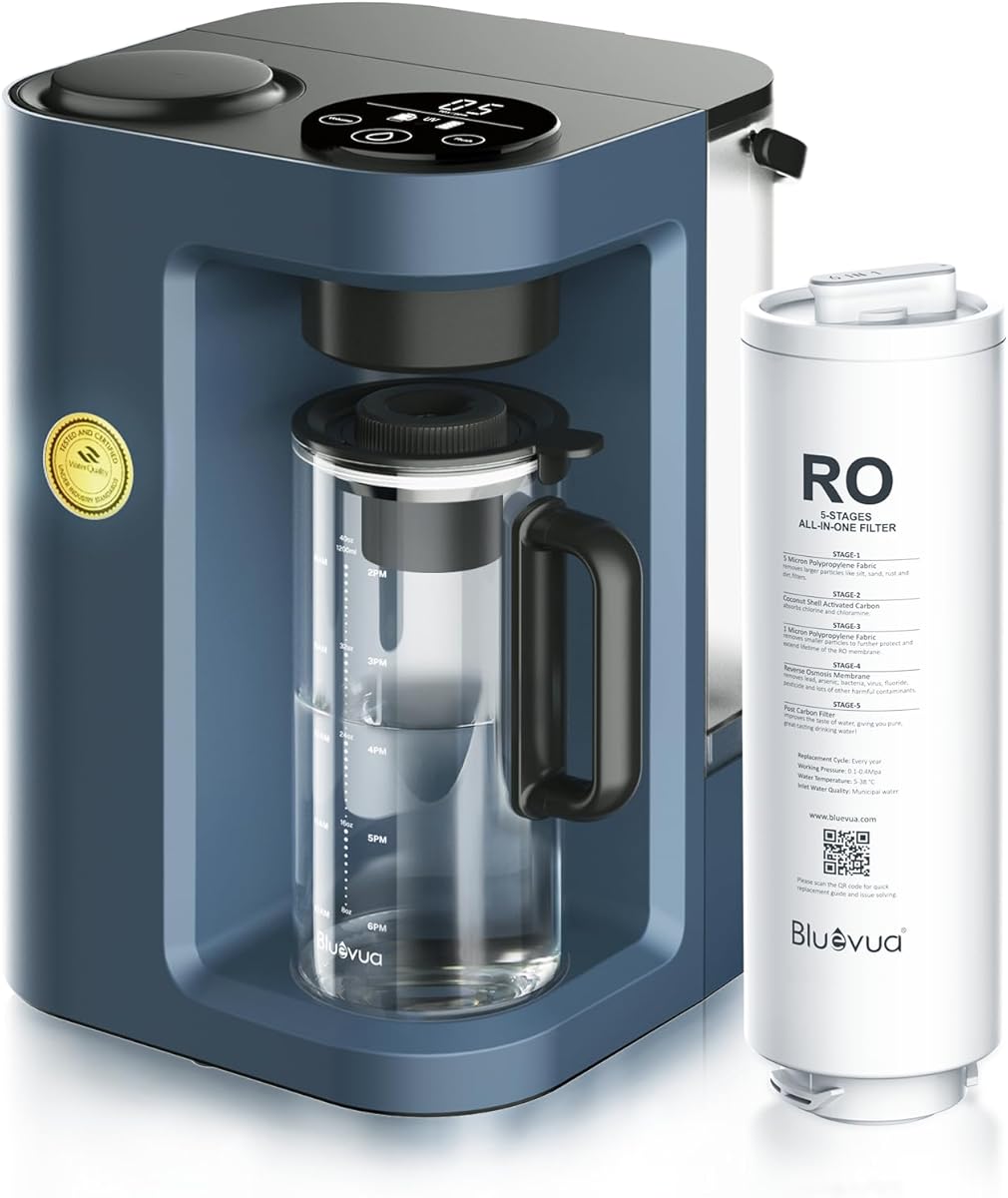
The Bluevua RO100ROPOT stands out as the strongest overall choice in this roundup, supported by the highest supplied customer rating at 4.6 out of 5. It combines five-stage reverse osmosis filtration, a high borosilicate glass carafe, and a monitor that displays both filter life and water quality. Its countertop format requires only a power source and a filled reservoir, making it accessible to renters and homeowners who do not want a permanent installation.
We may earn a commission when you buy through this link, at no additional cost to you.
The system claims 99.9% removal of possible contaminants and includes a remineralization filter intended to balance taste after reverse osmosis. This is a meaningful advantage for buyers who find completely flat-tasting water unappealing. A two-to-one pure-to-drain ratio provides a reasonable balance between purified output and rejected water, while the automatic standby mode reduces unnecessary power use when the appliance is idle.
Its main limitation is that the two-to-one ratio is less efficient than the three-to-one or four-to-one figures offered by several competitors. The carafe design also means users are storing purified water in a vessel rather than receiving it directly in a drinking glass, which may not suit someone wanting an instant single-serve dispense. Nevertheless, the glass construction, mineral stage, monitoring, and simple setup create a well-rounded package.
This Bluevua model is best for users who prioritize taste, attractive countertop presentation, and a high customer rating. It works well for daily drinking, cooking, tea, and coffee in a home with one or two people. The one-year limited manufacturer warranty is included upon registration, so buyers should complete that step. Overall, it is an easy recommendation for anyone wanting a polished glass-carafe RO system with minimal setup.
The included mineral stage is intended to enrich the purified water and improve balance. That makes this model more attractive for daily drinking than a unit that strips flavor along with dissolved contaminants.
The high borosilicate carafe can move between the counter and refrigerator as needed. It also avoids relying on a conventional plastic container for the primary storage vessel.
We may earn a commission when you buy through this link, at no additional cost to you.
This second DREO countertop RO model is a versatile option for users who want multiple serving vessels and efficient water use. Its supplied rating is 4.4 out of 5, and its title highlights a three-to-one pure-to-drain ratio, real-time TDS and filter-life information, two autofill pitchers, installation-free operation, and a self-cleaning function. Those features suggest a system designed to reduce both household friction and routine maintenance.
We may earn a commission when you buy through this link, at no additional cost to you.
The manufacturer states that the seven-in-one filtration design removes 99.9% of possible contaminants, including PFOA, PFOS, chlorine, and fluoride. It was tested by SGS and meets NSF/ANSI 58 standards according to the product information. The three-to-one efficiency ratio is a meaningful improvement over the two-to-one design in the preceding Bluevua model, helping conserve water while producing a useful amount of purified output.
The supplied description provides less detail about the exact reservoir size, physical dimensions, and filter lifespan than the information available for the first DREO system. As a result, buyers should consult the current listing and manuals before assuming that its capacity matches the other model. It also offers no hot or cold water, which is normal for this category but relevant for households seeking temperature control.
This system is a good fit for people who want several containers of purified water available in different parts of the home, such as a refrigerator pitcher and a counter pitcher. Its combination of efficient filtration, self-cleaning behavior, and autofill convenience is especially attractive to busy users. Choose it over the other DREO if having two pitchers is a higher priority than knowing the published tank capacity.
The included autofill pitchers make it easier to keep purified water in more than one location. That convenience can be especially useful for shared kitchens, offices, or homes with more than one drinking area.
The three-to-one pure-to-drain specification produces one part rejected water for every three parts purified water. That is a stronger efficiency figure than systems operating at two-to-one.
We may earn a commission when you buy through this link, at no additional cost to you.
The Bluevua RO100ROPOT-UV expands on the standard RO100ROPOT with a six-stage design that includes UV light and an added remineralization filter. Its supplied customer rating is 4.4 out of 5. For buyers who value an added purification stage and want a glass carafe, this model delivers a more comprehensive specification set than the five-stage version.
We may earn a commission when you buy through this link, at no additional cost to you.
The supplied information says the system is certified by WQA against NSF/ANSI/CAN 372 for lead-free materials and tested by SGS. It is described as reducing TDS, PFOA, PFOS, chlorine, fluoride, arsenic, lead, and other contaminants. A 0.0001-micron RO membrane forms part of the process, while the remineralization stage is intended to support a more balanced taste after purification.
Like the original Bluevua, this unit uses a two-to-one pure-to-drain ratio, so it is not the most water-efficient option here. The glass carafe and automatic standby mode remain strong convenience features, and the display assists with filter-life and water-quality monitoring. Buyers should also consider that UV and remineralization add components whose upkeep or replacement behavior may differ from a basic RO cartridge.
Choose this model for a countertop appliance that emphasizes multiple treatment stages, glass storage, and useful status monitoring. It is particularly compelling for users who want more than a basic membrane system but do not need the seven-stage and three-to-one configuration of the DREO options. For households that value a broad contaminant-reduction claim and enhanced taste profile, it is a well-specified alternative.
The UV stage supplements the membrane process, creating a six-stage system rather than relying on filtration alone. That gives users seeking layered treatment a clear reason to consider this model.
WQA certification against NSF/ANSI/CAN 372 addresses lead-free materials, while the stated SGS testing adds another layer of documented evaluation. Buyers should still review the complete certification scope in the listing.
We may earn a commission when you buy through this link, at no additional cost to you.
The AquaTru Glass Carafe is a straightforward four-stage countertop reverse osmosis system built around clear filter replacement intervals. Its supplied rating is 4.1 out of 5, the lowest in this group, but its published specification gives buyers unusually concrete maintenance guidance. The unit is certified to NSF standards by IAPMO according to the supplied product information.
We may earn a commission when you buy through this link, at no additional cost to you.
AquaTru states that its filtration can remove microplastics, fluoride, chromium-6, arsenic, PFOA, PFOS, lead, and other contaminants that ordinary carbon pitchers may leave behind. The included pre/carbon filter lasts six months or 300 gallons, the reverse osmosis filter lasts one year or 600 gallons, and the VOC carbon filter lasts one year or 300 gallons. Those gallon and time limits make routine planning easier.
Its four-stage configuration is less elaborate than the seven- and eight-stage systems in the roundup, and there is no mention of a real-time TDS display. It also has the lowest supplied customer rating, which is worth considering alongside its clear certification and maintenance details. Nevertheless, the removable glass carafe, plug-in setup, one-year warranty, and 30-day money-back guarantee create a reassuring ownership package.
This model fits buyers who value simple stages, published replacement intervals, and a glass serving vessel more than advanced displays or voice prompts. It is suitable for drinking, coffee, tea, ice, cooking, formula preparation, and pet bowls, making it adaptable beyond a single use. For users who prefer predictable upkeep over a more feature-dense control panel, AquaTru is a practical selection.
Each major filter has a stated gallon and time limit. Those measurable targets make it easier to estimate replacement timing and compare long-term maintenance with competing systems.
The unit dispenses into a removable glass carafe with a lid and needs no drilling, tools, or permanent plumbing. That keeps the setup approachable for renters and temporary living arrangements.
We may earn a commission when you buy through this link, at no additional cost to you.
The Waterdrop C2SL is designed to make countertop reverse osmosis approachable, particularly for first-time users. Its supplied rating is 4.2 out of 5. The defining convenience is guided operation: voice instructions assist with first-time rinsing and filter setup, while alerts notify users when the feed tank is low or a filter requires replacement.
We may earn a commission when you buy through this link, at no additional cost to you.
Waterdrop states that the seven-stage system uses a 0.0001-micron RO membrane and was tested by SGS under laboratory conditions. The listed reductions include PFOA, PFOS, microplastics, lead, chlorine, and fluoride. A mineral filter adds calcium, magnesium, potassium, and sodium to the finished water, addressing the flat taste sometimes associated with reverse osmosis.
The 108-ounce feed tank is refilled at the top, and purified water transfers automatically to a detachable 40-ounce Maxblue glass pitcher. A three-to-one pure-to-drain ratio balances output and efficiency, while the system is designed for one or two people. The manufacturer states that it can filter up to 528 gallons or last up to 12 months, with actual life depending on source-water quality and use.
Choose the C2SL when user guidance and refrigerator-friendly storage matter as much as filtration breadth. It is a strong fit for new RO users, households wanting mineral-enhanced taste, and anyone who appreciates a clear display without constant menu navigation. The voice prompts are a design choice rather than a universal benefit, but for many buyers they reduce installation uncertainty and maintenance mistakes.
Voice-assisted rinsing and setup give new users a defined sequence for initial operation. Status alerts also make low-water and filter conditions easier to notice at a glance.
The detachable 40-ounce glass pitcher is sized for convenient refrigerated storage. It provides a clean serving vessel without requiring a connection to the refrigerator's water line.
We may earn a commission when you buy through this link, at no additional cost to you.
The CT910 distinguishes itself with five dispensing volumes, ranging from 4 ounces to unlimited output, and a user-friendly LED touch screen. It has a supplied rating of 4.2 out of 5 and combines a seven-stage reverse osmosis configuration with a three-to-one pure-to-drain ratio. The removable 1.2L pitcher and no-installation format suit homes, offices, RVs, and other flexible locations.
We may earn a commission when you buy through this link, at no additional cost to you.
The system uses an all-in-one filter certified to NSF/ANSI 372, 53, 42, and 58 standards. Its stated filtration can reduce TDS, PFOA, PFOS, fluoride, lead, chromium, iron, nitrates, chlorides, and larger particles. The display reports real-time TDS and filter-life status, while automatic water production starts once the system is plugged in and the feed reservoir is filled.
The supplied data mentions separate filter and extra-pitcher ASINs, so the core purchase may not include every possible serving accessory. It also does not describe separate UV or contact-time controls, distinguishing it from systems that emphasize those features. A larger reservoir capacity and available volume choices would be useful to verify on the current listing, particularly for households expecting frequent use.
This CT910 is a good choice for users who want precise serving sizes, touch-screen visibility, and quick filter changes. The five volume options make it adaptable to coffee, tea, cooking, and different glass sizes without a one-size dispense. It is also appealing for seniors, renters, and travelers who value installation-free operation. For those priorities, the system's broad certification set and efficiency ratio provide a solid foundation.
Users can select 4-ounce, 8-ounce, 12-ounce, 17-ounce, or unlimited dispensing. This flexibility helps reduce waste when preparing different drinks or quantities of filtered water.
The twist-and-lock design is advertised for replacement in about three seconds. Consolidating filtration into one cartridge also means fewer separate pieces to service at each change.
We may earn a commission when you buy through this link, at no additional cost to you.
The Bluevua RO100ROPOT-Lite combines seven-stage reverse osmosis, UV treatment, and a fruit-infuser carafe in a compact package. Its supplied rating is 4.2 out of 5. The model targets one or two people and emphasizes a three-to-one pure-to-drain ratio, one-touch LED operation, real-time water-quality monitoring, and relatively infrequent filter replacement.
We may earn a commission when you buy through this link, at no additional cost to you.
The filtration system includes UV light and remineralization, while the carafe includes a timeline feature intended to encourage regular hydration. A removable glass infuser allows users to prepare fruit-infused water after the purified water has been dispensed. This makes the system more versatile than conventional purifier-and-pitcher designs focused solely on plain drinking water.
The manufacturer states that the unit is certified by WQA against NSF/ANSI/CAN 372 for lead-free materials and tested by SGS. It advertises annual filter replacement and a three-second twist installation. The improved design is described as 375% more effective than traditional models, though that comparison should be interpreted within the context of the manufacturer's own product literature rather than as a universal laboratory result.
Choose the Lite if fruit-infused water, UV treatment, and a compact glass system matter to you. The one-touch panel and status display should appeal to users who want visible feedback without complicated menus. It is best treated as a dedicated drinking-water appliance for one or two people, and the included infuser adds a lifestyle benefit that most competing systems do not provide.
The fitted glass infuser turns the purified carafe into a vessel for fruit-infused water. That creates a convenient alternative to buying flavored drinks or preparing separate infusion containers.
The three-to-one ratio and compact seven-stage design are targeted at one or two people. It offers a smaller-footprint alternative to units built around a larger internal reservoir.
We may earn a commission when you buy through this link, at no additional cost to you.
The SimPure Y7P-BW UV is built around speed and water efficiency, with a supplied rating of 4.2 out of 5. It combines a four-stage, 0.0001-micron RO process with UV purification, and the manufacturer states that a cup of purified water can be dispensed in approximately 15 seconds. At 418 GPD, it is one of the most flow-focused systems in the comparison.
We may earn a commission when you buy through this link, at no additional cost to you.
SimPure says the system was tested by SGS against NSF/ANSI 58 and can remove 99.99% of more than 1,000 contaminants, including PFAS, PFOA, PFOS, lead, arsenic, chlorine, fluoride, and nitrates. A four-to-one pure-to-drain ratio provides a strong efficiency figure, and the supplied information credits a recycling multi-filtration technology for conserving water compared with under-sink RO systems.
The included twist cartridges provide 528 gallons of purified water, and the system requires only power and a suitable water source. Its important limitation is that it dispenses room-temperature water only. The product information also specifies well water with TDS below 500 ppm, so owners using a well should confirm compatibility with their actual source before installation.
Choose the Y7P-BW UV when speed, efficient water use, and quick cartridge changes are the main priorities. It is well suited to households that want a generous amount of filtered water without a lengthy dispensing wait. Its four-to-one ratio, 418 GPD rate, and 528-gallon cartridge capacity make it a particularly compelling premium option for regular coffee, tea, cooking, and family hydration.
The stated 418 GPD rate and roughly 15-second cup delivery make this system responsive for common kitchen tasks. Faster output is especially useful when preparing multiple drinks or cooking.
A four-to-one pure-to-drain ratio means more purified water is produced for each unit of rejected water. The manufacturer also attributes savings to its recycling multi-filtration technology.
We may earn a commission when you buy through this link, at no additional cost to you.
The NU Aqua 8-Stage RO is a feature-rich choice for households that prioritize capacity, customization, and efficient water use. Its supplied rating is 4.5 out of 5. An eight-stage filtration path, built-in UV-C treatment, a four-to-one pure-to-drain ratio, and a large internal tank make it a strong candidate for families and shared workspaces.
We may earn a commission when you buy through this link, at no additional cost to you.
The touch panel can monitor water levels, select multiple cup sizes, and provide automatic filter-replacement reminders. The advanced filters are described as removing sediment, chlorine, and heavy metals, while UV-C treatment addresses dissolved solids. Tool-free filter replacement and a self-flushing feature are intended to simplify maintenance, while the compact countertop format avoids the need for permanent plumbing.
The product description provides fewer laboratory-specific contaminant figures and certification details than the DREO, Bluevua, AquaTru, CT910, and SimPure entries. It also does not state the exact internal tank capacity, even though the large reservoir is a central selling point. Prospective buyers should therefore review the current dimensions, certification documents, and replacement schedule before ordering.
Choose this model for family use, offices, or apartments where a larger reservoir and several cup-size options are useful. Its four-to-one efficiency ratio helps control water consumption, and the touch interface makes status and serving choices easy to manage. It is also a practical choice for RVs or other locations needing a portable appliance. The combination of strong supplied feedback and broad feature coverage makes it an appealing top-ten choice.
The larger internal tank is designed to maintain a ready supply for family use, cooking, and refills. That makes the appliance more relevant to shared spaces than systems with very small reservoirs.
The internal self-flushing feature and tool-free cartridge replacement are intended to streamline upkeep. Automatic reminders further help users avoid carrying a filter beyond its intended service interval.
We may earn a commission when you buy through this link, at no additional cost to you.
The right countertop reverse osmosis system depends on filtration goals, water-use efficiency, reservoir capacity, available space, and how much maintenance you want to manage. Compare verified specifications rather than relying on stage count alone.
Begin with the contaminants you care about and then look for specific test data covering them. The strongest listings identify standards such as NSF/ANSI 58, NSF/ANSI 53, NSF/ANSI 42, and NSF/ANSI/CAN 372, along with the laboratory that performed testing. Named reduction percentages for PFOA, PFOS, lead, fluoride, chlorine, microplastics, arsenic, and TDS can provide useful context. Certification scope still matters because a product may be certified for specific claims rather than every contaminant mentioned in its marketing.
The pure-to-drain ratio shows how much purified water is produced for each part of rejected water. Systems in this guide range from two-to-one to four-to-one, so a higher figure generally reduces water consumed per gallon served. Consider how much water your household drinks, cooks with, and uses for coffee or tea. A more efficient ratio may justify a higher initial investment when daily use is substantial, although household behavior and source-water conditions also affect actual consumption.
Reservoir capacity determines how often the feed tank must be refilled, while pitcher or carafe volume affects serving convenience. One or two people can generally work with smaller configurations, whereas families and offices benefit from a larger internal tank or multiple pitchers. Check the physical footprint as well as the stated capacity, especially if the unit must share a counter with small appliances. A model that fits the available space but is inconvenient to refill is less useful than a slightly larger system with easy access.
A higher stage count can indicate more treatment steps, but the actual sequence matters more than the number alone. Look for a carbon or pre-filter, an RO membrane, and a post-treatment stage appropriate to your preferences. Remineralization can make the finished water taste smoother by adding selected minerals after reverse osmosis. UV stages may appeal to users seeking an additional purification method. Understand that stage count does not replace certification or verified contaminant-specific testing.
A simple LED panel can be enough for basic operation, while a full touch display may also show TDS, filter life, water level, and dispensing choices. Voice prompts are useful during initial setup and filter replacement, although some users may prefer silent operation. Compare how the system communicates maintenance needs and whether it offers volume presets, automatic production, or an auto-fill sensor. The best interface is the one that makes correct use and timely service intuitive.
Countertop RO systems require ongoing filter replacement even when they are not plumbed into a home. Review the stated gallon and time limits, the number of replaceable elements, whether the cartridge is all-in-one, and how frequently models require service. Replacement availability is particularly important for less familiar brands. A clear display or reminder can help, but a convenient twist-lock cartridge and realistic published schedule make maintenance easier to plan.
Every product in this roundup is designed to avoid permanent plumbing, but placement requirements still vary. Check dimensions, weight, reservoir refill access, and proximity to a suitable outlet. A carafe that stores water in the refrigerator must fit comfortably, while a pitcher-based unit may be moved between the counter and fridge. Offices, RVs, apartments, and temporary homes should also consider ventilation, electrical access, and how the appliance will be transported.
Some products include a one-year limited manufacturer warranty, and the Bluevua models specify that registration is required. Review what the warranty covers, whether registration is necessary, and how replacement parts or filters are handled. A return guarantee can also provide reassurance when trying a new countertop format. Warranty terms can change, so the current listing and official support information should take priority over a general product description.
Start by placing the system on a level, clean surface near a suitable electrical outlet. Wash the included pitcher or carafe, fill the feed reservoir with the recommended source water, and install the filter cartridges exactly as directed. Several models provide voice guidance, printed instructions, or automatic rinse cycles. Complete the initial rinse before drinking the first batch, because flushing removes loose media and verifies that every housing is seated correctly.
Use the display, alerts, and volume controls to choose the amount of purified water you need. Add source water when prompted and avoid operating the unit with an empty feed reservoir. Clean the pitcher or carafe on a regular schedule and use only recommended cleaning methods, especially with the glass infuser and any removable seals. Wipe the exterior with a damp cloth, and keep vents and electronic surfaces dry.
Follow the supplied gallon and time limits for replacement, paying particular attention when source water has high TDS, well water, or unusually heavy usage. Replace the pitcher or carafe if it develops cracks or damage. Do not modify the appliance, and do not assume that a UV stage removes the need for routine filter changes. Periodic cleaning, correct cartridge replacement, and timely service preserve both water quality and the usefulness of the monitoring features.
No. The systems in this guide are designed for plug-and-play countertop use. You typically fill a feed reservoir, install the filter cartridges, connect the unit to power, and let it dispense into a pitcher or carafe. They do not need a faucet connection or permanent plumbing, which makes them useful for renters, offices, RVs, and other flexible locations. Check the manual if you are unsure whether your particular source-water or electrical setup is compatible.
A properly maintained reverse osmosis system can provide purified drinking water, but performance depends on filter condition, source-water quality, and correct installation. Review the system's certification and contaminant-specific test results, and replace filters on schedule. Some models also include remineralization to improve taste. If you have specialized medical or dietary requirements, or concern about a contaminant not addressed in the product documentation, consult a qualified water professional.
The ratio compares purified water with the water sent to the drain during filtration. A three-to-one system produces about three parts purified water for every one part rejected water, while a four-to-one system wastes less per gallon served. Actual performance varies with feed-water conditions and usage, but a higher ratio generally means better water efficiency. It is one of several factors to consider alongside filtration quality, capacity, and maintenance.
Replacement timing depends on the model, cartridge type, usage, and source-water quality. Published schedules in this guide range from specific gallon and time targets to approximate annual replacement periods. The safest approach is to follow the manufacturer's instructions and use the system's filter-life display or alerts as reminders. Remember that UV components, prefilters, carbon stages, and RO cartridges can have different service schedules, so replacing only one element may not be sufficient.
None of the listed systems includes built-in hot or cold dispensing, and the SimPure model is specifically described as room-temperature only. You can chill purified water by placing the compatible pitcher or carafe in a refrigerator, but cooling is separate from the filtration process. If instant hot water is important, you will need a separate appliance and should ensure the container and setup are appropriate for that use.
UV is not universally required, but it provides an additional purification stage for buyers who want layered treatment. The Bluevua UV models, SimPure Y7P-BW UV, and NU Aqua 8-Stage RO all include UV-related features. Certification and contaminant-specific testing remain more important than stage count alone. Consider UV alongside recognized standards, membrane performance, filter longevity, taste, water efficiency, and the ongoing cost of replacement components.
A glass vessel is preferred by many buyers because it is less associated with retaining odors or flavors and can be moved easily into a refrigerator. It is also less likely to contribute a plastic taste during repeated use. Glass does not change the underlying purification performance, however, and it requires careful handling because it can break. Choose a vessel shape and weight that suit your serving routine and available refrigerator space.
It depends on the model and the well's water quality. The SimPure Y7P-BW UV is specifically described for tap water or well water with TDS below 500 ppm. Other systems may also have feed-water limits or recommendations not fully listed here. Because well conditions can change, have the source tested and confirm compatibility with the manufacturer before use. A high-TDS or untreated well may require additional pretreatment beyond a standard countertop RO cartridge.
The DREO 7-in-1 stands out as the best balanced pick for its seven-stage filtration, useful TDS display, automatic features, and three-to-one efficiency. The Bluevua RO100ROPOT earns the editor's choice for its high customer rating, glass carafe, remineralization, and polished overall design, while the NU Aqua 8-Stage RO is the premium option for families seeking UV-C treatment, a large reservoir, and four-to-one efficiency.
Prioritize verified contaminant reduction and recognized certifications before stage count, because the number of components does not tell the whole filtration story. Then match pure-to-drain efficiency, reservoir size, serving vessel, controls, and filter costs to your household. A small system with convenient reminders may serve one person better than a feature-heavy appliance that is difficult to refill or maintain.
Before buying, verify the current listing, dimensions, certification scope, warranty registration terms, and replacement-filter availability. Prices, promotions, and included accessories can change over time, and a countertop system's ongoing filter needs should be considered alongside the initial purchase. The right model is the one that consistently provides the capacity, convenience, and purification performance your household needs.
