
REDTIGER F7N TOUCH
4.3Editor score
4K front, 1080P rear
STARVIS 2 front sensor
Touchscreen and voice control
Included 128GB memory card
5.8GHz Wi-Fi with GPS
Our expert guide compares 10 dash cams with STARVIS 2 night vision, covering image quality, channel coverage, parking features, GPS, and storage options.
A dash cam with STARVIS 2 night vision is designed to preserve useful detail when conventional cameras struggle with darkness, tunnels, glare, and rapidly changing exposure. The sensor’s stronger light sensitivity can improve license plate visibility, road signs, and the clarity of surrounding vehicles. That makes it especially relevant for commuters, rideshare drivers, and anyone seeking dependable evidence after dark.
This guide compares ten STARVIS 2 models across sensor configuration, front, rear, and cabin channels, recording resolution, field of view, HDR performance, storage support, parking surveillance, wireless connectivity, and navigation data. We considered the practical details that affect installation and daily use, including included memory cards, hardwire requirements, supercapacitors, app control, GPS, voice commands, and thermal design. It is a specification-led comparison rather than a claim of personal testing.
The list reveals distinct ways to approach nighttime recording: compact single-camera setups, balanced front-and-rear systems, and extensive three-channel rigs for complete coverage. The REDTIGER F7N TOUCH stands out as the value-focused option, while the Vantrue N4 Pro S targets buyers seeking premium three-channel recording and the VIOFO A229 Pro emphasizes dual-sensor front-and-rear performance. Available configurations and product details can change, so confirm current specifications before purchasing.
4.3Editor score

4.4Editor score
4.2Editor score
The comparison below highlights the most important differences in channel coverage, sensor setup, nighttime features, connectivity, and parking support. These specifications help explain why the ten models suit different vehicles, budgets, and recording priorities.


The REDTIGER F7N TOUCH is a well-balanced front-and-rear dash cam with a 4.3 rating, and it stands out for pairing native 4K front capture with a STARVIS 2 IMX675 sensor. Its front camera uses a 170-degree lens, while the rear records at 1080P through a 140-degree lens. For buyers seeking an adaptable STARVIS 2 system without moving into the complexity of a three-channel premium rig, this is a compelling all-around configuration.
We may earn a commission when you buy through this link, at no additional cost to you.
Low-light performance benefits from the sensor’s higher light sensitivity, WDR, HDR, and the front camera’s night-vision processing. The result is designed to retain more useful information when headlights, streetlights, and reflective signs create difficult exposure conditions. Daily operation is convenient because the camera supports voice commands, a smart touchscreen, built-in GPS, and 5.8GHz Wi-Fi with app-based transfer speeds stated at up to 20MB/s.
There are some sensible compromises to understand. The rear camera does not use the same STARVIS 2 specification as the front, so nighttime evidence behind the vehicle will not necessarily match the front channel. Parking surveillance also requires a separately installed hardwire kit. These limitations make the F7N TOUCH less attractive than some rivals for cabin monitoring or seamless parked-vehicle coverage, but they remain reasonable for a front-and-rear system with strong resolution and convenient controls.
The F7N TOUCH is best for commuters, couples sharing a vehicle, and general drivers who want reliable nighttime road coverage, a large included memory card, GPS information, and modern controls. It earns the Best Overall designation in this guide because it balances high-resolution recording, useful parking options, and day-to-day convenience particularly well. Choose it when you want a capable STARVIS 2 front camera and rear coverage without the complexity of a full three-camera dashboard system.
The STARVIS 2 IMX675 front sensor is the model’s most important asset. Its light sensitivity, paired with HDR and WDR, helps balance bright headlights against darker roads while preserving more detail than many conventional compact sensors.
The touchscreen, voice commands, built-in GPS, and 5.8GHz Wi-Fi reduce the need to handle the camera while driving. GPS stamps also add location, speed, and route information that can make saved clips more useful during an incident review.
We may earn a commission when you buy through this link, at no additional cost to you.
The ROVE R2-4K Dual carries a 4.5 rating, the highest among the ten products in this guide, and combines a front-and-rear system with a broad feature set. Its front camera uses the Sony STARVIS 2 IMX675 sensor with an F1.5 aperture, while the rear camera uses an F1.8 aperture. The result is a strong option for drivers who want sensitive low-light capture, useful parking modes, and more control features than a basic two-camera model.
We may earn a commission when you buy through this link, at no additional cost to you.
An important distinction is that the advertised 4K front output is upscaled rather than native. The camera records at 2.5K QHD and upscales that footage to a 2160P presentation for playback. The product information describes this as a way to provide sharper everyday detail than standard 1080P dash cams. Buyers who prioritize true native 4K should pay close attention, while those wanting a refined dual-camera package may find the tradeoff acceptable.
Connectivity is a major strength. Dual-band 5.8GHz and 2.4GHz Wi-Fi supports app-based viewing and transfers stated at up to 20MB per second. Built-in GPS records routes and speed, the 3-inch IPS screen displays speed and compass information, and a built-in supercapacitor supports heat management. The ROVE also includes a 128GB card and supports memory cards up to 1TB. Its three parking options cover time-lapse, motion, and collision detection, although a hardwire kit is required.
This model is well suited to daily drivers who want front-and-rear evidence, fast wireless access to files, GPS data, and flexible parking surveillance without moving to a three-channel premium design. It may be less compelling for buyers who insist on native 4K, and the external hardwire requirement adds an installation step. Even so, the sensitive STARVIS 2 front sensor, wide F1.5 aperture, strong rating, and included storage make it one of the most complete dual-camera options available.
The STARVIS 2 IMX675 sensor and F1.5 aperture give the front camera a strong foundation for nighttime evidence. HDR processing further helps preserve detail when the scene transitions quickly between illuminated and shadowed areas.
Time-lapse, motion-detection, and collision-detection modes cover different parked-vehicle priorities. The system can save a one-minute event clip and alert the driver when the vehicle is started again, although permanent power requires a separate hardwire kit.
We may earn a commission when you buy through this link, at no additional cost to you.
The REDTIGER F17 is a three-channel dash cam built around a STARVIS 2 IMX675 front sensor, with 1080P cabin and rear cameras. Its 4.4 rating reflects a strong overall proposition for drivers who want to record the road, passenger compartment, and traffic behind the vehicle. A 150-degree front lens, 160-degree cabin lens, and 155-degree rear lens create broad coverage without the extreme focal lengths found on some compact cameras.
We may earn a commission when you buy through this link, at no additional cost to you.
Image processing includes WDR and HDR, which are particularly useful for dim roads and bright headlights. The front camera can operate at 4K with the rear recording at 1080P when the cabin channel is disabled, or it can use 2.5K dual-channel recording for a more balanced configuration. That flexibility lets buyers prioritize maximum road detail, all-around coverage, or a combination suited to their storage capacity.
The main trade-off is that true 4K front recording and full three-channel use are not simultaneous. Storage demand is another consideration, particularly for drivers relying on loop recording. The supplied 64GB card gives buyers a usable starting point, but extended high-resolution recording may call for additional capacity. Parking protection includes time-lapse and collision-detection modes, and the supercapacitor is designed for stability in extreme temperatures, but both require the appropriate hardwire setup.
The F17 is best for rideshare drivers, families frequently transporting passengers, and anyone who values cabin evidence alongside front and rear footage. Its flexible recording modes, GPS, dual-band Wi-Fi, and three-camera installation make it more versatile than a conventional dual-channel model. For shoppers who do not need the highest-resolution rear channel or the elaborate controls of premium flagship alternatives, it represents an effective balance.
Recording the cabin can reveal more than road footage alone, particularly in rideshare work, family travel, or incidents involving interior behavior. The F17 also allows the cabin camera to be switched off when maximum front resolution becomes the priority.
The choice between 4K front-and-rear capture and 2.5K multi-channel recording allows owners to balance detail with storage consumption. That control is useful for drivers who leave the dash cam recording continuously while also expecting the included card to last longer between overwrites.
We may earn a commission when you buy through this link, at no additional cost to you.
The Vantrue N4S distinguishes itself with STARVIS 2 sensors across all three channels, a feature that separates it from systems that reserve the most capable sensor for the front camera. It records at 2.7K in front, 1440P inside, and 1440P behind the vehicle. Its 4.3 rating and extensive low-light feature set make it particularly compelling for professional drivers, heavy nighttime commuters, and owners who want consistent sensor quality in every direction.
We may earn a commission when you buy through this link, at no additional cost to you.
Night Vision 4.0, triple HDR, and PlatePix processing work together to improve visibility in dim conditions and sharpen license plates. The product information claims a two-times improvement in plate sharpness, while wide lenses provide 158 degrees in front, 165 degrees inside, and 160 degrees at the rear. Magnetic mounting and a 360-degree rotating rear camera add installation flexibility, allowing the rear unit to monitor traffic or turn inward toward cargo or passengers.
The main caveat is storage: unlike several REDTIGER models, the N4S does not include a memory card. It supports cards up to 1TB, so buyers can choose capacity according to their recording habits. Its supercapacitor is specified for operation from minus 4 to 140 degrees Fahrenheit, and the parking system includes buffered motion, collision, low-bitrate, and time-lapse options. This is a comprehensive platform, but also a more substantial setup than a compact front-only camera.
The N4S is an excellent choice when cabin and rear channels matter and you prefer not to compromise their sensors. It suits rideshare operators, driving instructors, families, and drivers who regularly travel through poorly lit areas. The adjustable rear camera and high-capacity storage support make it especially versatile. It is not the simplest model, but for consistent three-channel STARVIS 2 performance, it offers one of the strongest configurations in this comparison.
Using STARVIS 2 sensors across the front, cabin, and rear channels creates a more uniform recording system. This is useful when the interior or traffic behind the vehicle becomes important evidence rather than merely supplementary context.
The 360-degree rear camera can face the road or rotate inward. That makes the N4S adaptable to changing needs, such as monitoring cargo, pets, luggage, or the passenger area while retaining a three-channel installation.
We may earn a commission when you buy through this link, at no additional cost to you.
The REDTIGER F7NP is a two-camera system centered on a STARVIS 2 front sensor, 4K front recording, and a 1080P rear channel. It has a 4.1 rating, which places it slightly behind the stronger-rated models in this list, but its core specifications remain relevant for anyone who wants high-resolution road evidence and rear coverage in a straightforward package.
We may earn a commission when you buy through this link, at no additional cost to you.
Nighttime image quality is supported by an F1.5 aperture, a six-layer optical lens, WDR, and HDR. The front camera offers a broad 170-degree field of view, while the rear uses a 140-degree lens. Built-in 5.8GHz Wi-Fi enables app previewing, downloads stated at up to 20MB per second, GPS data review, and settings management. Loop recording protects event clips automatically, and a memory card is included for immediate use.
Its main limitations mirror those of many capable but cost-conscious dual-camera systems. Only the front camera is specified with STARVIS 2, so buyers should not assume comparable nighttime sensitivity at the rear. Parking mode requires a hardwire kit, and the rear camera records at 1080P rather than a higher resolution. These are reasonable compromises if the forward view is the priority and the goal is dependable evidence without a more complex three-channel installation.
The F7NP suits commuters, road-trip drivers, new motorists, and anyone seeking a familiar front-and-rear setup with strong forward resolution. It is especially useful for buyers who want the STARVIS 2 sensor, GPS, quick app transfers, and included storage without moving to a premium flagship. Choose it when front-facing night clarity matters most and a simpler two-camera layout better fits your vehicle and recording habits.
The combination of a 170-degree field of view, F1.5 aperture, and six-layer lens gives the front channel broad road coverage and a strong low-light foundation. HDR and WDR then help maintain balance when bright and dark regions appear together.
The REDTIGER Cam app provides access to recordings, settings, GPS information, and route data through 5.8GHz Wi-Fi. A higher storage class card should be used for demanding continuous recording, and the included card provides a convenient starting point.
We may earn a commission when you buy through this link, at no additional cost to you.
The BOTSLAB G300H Plus is a straightforward front-and-rear system offering 4K recording at the front, 1080P at the rear, and a STARVIS 2 sensor for improved low-light capture. Its 4.2 rating reflects a balanced feature set, while the 170-degree front and 150-degree rear lenses provide broad coverage across multiple lanes and the road behind.
We may earn a commission when you buy through this link, at no additional cost to you.
The front camera has an F1.5 aperture, while the rear uses F2.0. Voice commands can start recording, take photos, and reduce physical interaction with the device. Installation is presented as uncomplicated, with peel-and-stick wiring designed for a clean appearance. The automotive-grade supercapacitor is rated for temperatures from minus 20 to 70 degrees Celsius, which supports stable operation in varying climates and avoids reliance on a conventional lithium battery.
Compared with the more specialized systems in this list, the G300H Plus offers a narrower selection of advanced features. Its supplied information does not highlight built-in GPS, wireless app transfers, a supplied memory card, or detailed parking-mode configuration. That makes it easier to understand as a core road-recording product but less attractive for buyers who want route metadata, rapid phone access, or formal parked-vehicle surveillance.
The G300H Plus is a good fit for drivers seeking a capable STARVIS 2 front camera, broad field of view, voice control, and simple wiring without a premium feature bill. It is especially attractive for people replacing an older dual-camera system or prioritizing forward road evidence. Buyers should confirm the need for a separate high-endurance memory card and verify their preferred parking features before finalizing the purchase.
The STARVIS 2 sensor, F1.5 front aperture, and stated night-vision processing are the core attractions. They help the camera retain more road detail when ambient lighting is limited, while HDR-style color rendering is intended to keep nighttime scenes natural.
Voice commands allow common actions without reaching for the unit. Combined with a straightforward adhesive installation, this makes the G300H Plus easy to recommend for drivers who value simplicity and reduced distraction.
We may earn a commission when you buy through this link, at no additional cost to you.
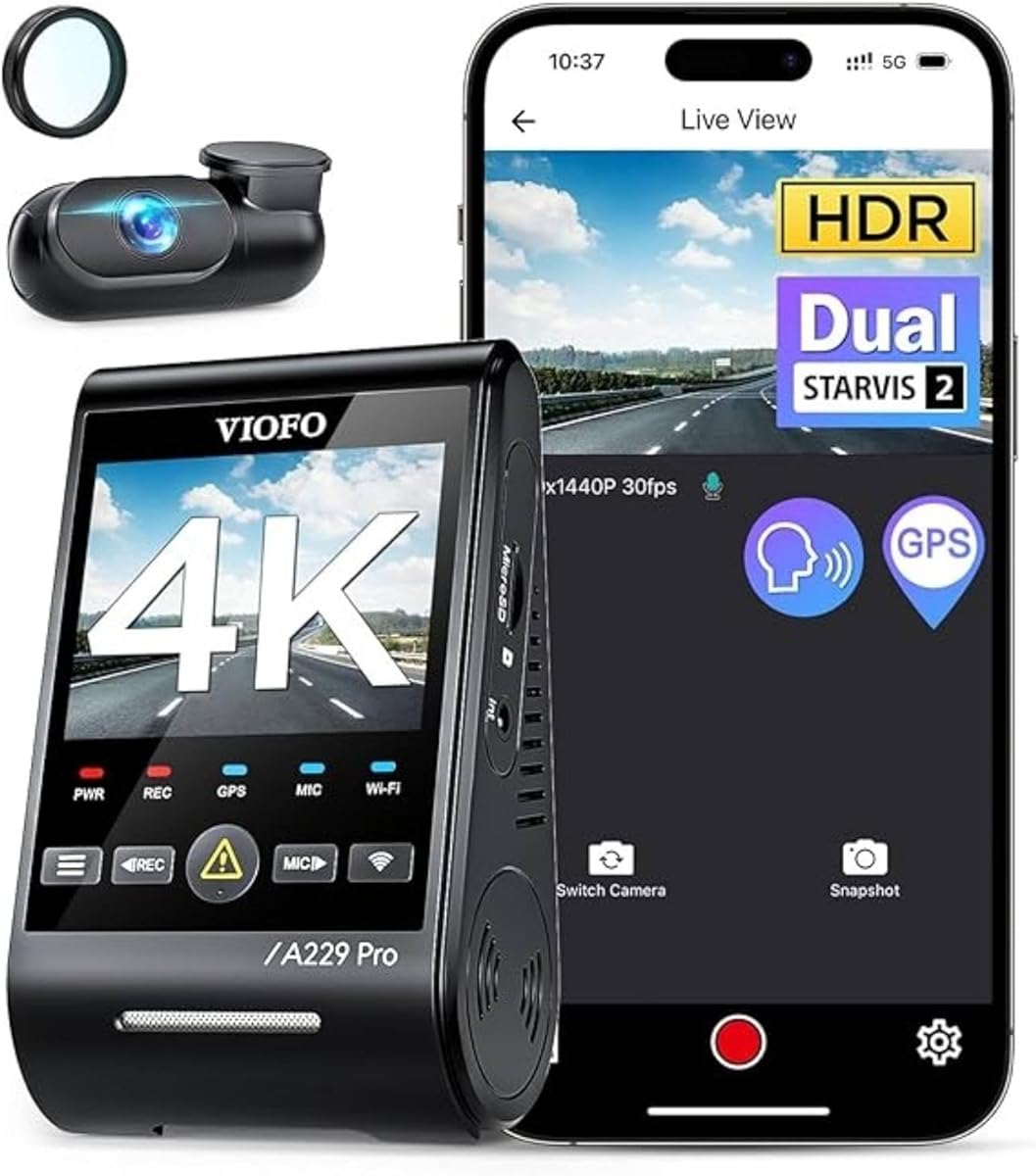
The VIOFO A229 Pro is a premium front-and-rear system with dual STARVIS 2 sensors: IMX678 for 4K front recording and IMX675 for 2K rear recording. Its 4.2 rating understates some of the specification advantages, particularly the resolution achieved in both directions. The model is aimed at drivers who want a high-detail road record and a stronger rear image than ordinary 1080P rear cameras provide.
We may earn a commission when you buy through this link, at no additional cost to you.
Night Vision 2.0 and HDR processing are designed to preserve detail in challenging light. The product information highlights license plate recognition during high-speed scenarios and the recovery of fine detail in dark recordings. A circular polarizing filter is included on the front lens to reduce glare and reflections from glass and road surfaces, which can improve contrast in bright daylight. Voice control provides twelve commands, while 5GHz Wi-Fi supports app configuration, previews, and sharing.
The A229 Pro also includes sophisticated parking logic. Buffered event detection can retain 15 seconds before and 30 seconds after motion, while auto event, low-bitrate, and time-lapse modes offer alternatives for prolonged surveillance. Quad-mode GPS combines GPS, BeiDou, Galileo, and GLONASS for route, speed, and timestamp data. Buyers must account for two accessories that are not supplied: a compatible memory card and the optional hardwire kit needed for parking modes.
This is the premium choice for drivers who insist on STARVIS 2 quality in both the front and rear channels. Its dual sensors, 2K rear recording, anti-glare filter, and buffered parking capture give it a mature feature set, while the supercapacitor is specified for operation from 5 to 149 degrees Fahrenheit. It is best for high-mileage drivers, safety-conscious motorists, and anyone willing to purchase a suitable high-endurance card for dependable continuous recording.
The IMX678 front sensor and IMX675 rear sensor create a stronger dual-camera foundation than systems using the same STARVIS 2 generation only at the front. Combined with HDR, this helps both views retain detail under difficult lighting.
The included circular polarizing filter helps reduce reflections and improve contrast. Quad-mode GPS adds route, speed, and timestamp information, making the recordings easier to organize and potentially more useful when documenting an incident.
We may earn a commission when you buy through this link, at no additional cost to you.
The REDTIGER F17 Elite is one of the most technically complete models in the guide, combining an 8MP IMX678 front sensor, a 4MP IMX675 rear sensor, and a 1080P cabin channel. It records at true 4K in front, 2.5K at the rear, and 1080P inside. Its 4.2 rating is solid, but the resolution mix and full-color night capability distinguish it from most three-channel competitors.
We may earn a commission when you buy through this link, at no additional cost to you.
Full-color night vision is the headline feature. Rather than relying on the grainy or monochrome appearance associated with conventional infrared cabin recording, the F17 Elite is designed to preserve color and sharpness in low light. HDR balances bright and dark regions, and the higher-resolution front sensor targets license plates and road signs. This makes the system attractive for rideshare drivers, families, and anyone who wants recognizable facial or vehicle detail after dark.
The model includes a 128GB card, built-in GPS, 5.8GHz Wi-Fi 6, and transfer speeds stated at up to 30MB per second. Voice commands and a touchscreen provide quick access to settings, while a privacy toggle for the cabin camera is useful for drivers who do not want continuous interior recording. It supports time-lapse and G-sensor event parking modes with the front and cabin cameras. As with other parking-capable models, permanent power requires a separate hardwire kit.
The F17 Elite is best for owners who want high-resolution three-channel evidence, full-color night footage, fast wireless transfers, and detailed sensor hardware in one system. Storage is the principal practical consideration because three channels and high-resolution front capture consume more capacity, although expansion up to 512GB is supported. It is an excellent premium pick for professional drivers and evidence-focused users who value color information and flexible camera control.
The front and cabin cameras are designed to retain visible color in dark conditions. That makes nighttime clips more useful for identifying clothing, vehicle paint, and illuminated signs while improving the overall realism of the record.
Wi-Fi 6 and stated transfers up to 30MB per second make it easier to retrieve an important clip without constantly removing the memory card. The touchscreen, voice commands, app preview, and cabin privacy toggle also provide several ways to manage the system.
We may earn a commission when you buy through this link, at no additional cost to you.
The Vantrue N4 Pro S is the flagship choice in this guide, combining a 4.4 rating with true 4K front recording, 2.5K rear capture, and a 1080P cabin channel. Each of the three cameras uses a STARVIS 2 sensor, providing a more consistent foundation than systems that reserve the best sensor for the forward view. It is built for drivers who consider cabin and rear footage essential rather than optional.
We may earn a commission when you buy through this link, at no additional cost to you.
PlatePix technology and triple HDR are designed to improve license plate recognition in dim conditions and under strong backlighting. The product information states up to two-times higher plate accuracy and readability of vehicles traveling as fast as 31 mph on lit streets at night. Coverage is broad, with 155-degree front, 160-degree cabin, and 165-degree rear lenses. The rear camera rotates 360 degrees, allowing it to face traffic or turn toward the cabin and cargo area.
This model also provides a thoughtful front-and-rear mode that records at 4K and 2.5K while disabling the third channel. According to the product information, that mode reduces heat by 30 percent and lowers power use compared with continuous triple recording, which is meaningful for summer reliability. Buffered parking capture preserves ten seconds before an event, while all three cameras can remain active in parking mode. Storage extends to 1TB, though no card is included.
The N4 Pro S is best for high-mileage drivers, rideshare operators, families, and anyone wanting a premium three-channel system with high-resolution front and rear capture. It earns the Editor’s Choice position because it combines strong hardware, adaptable recording, useful parking logic, and storage capacity without asking buyers to accept a major functional compromise. Its installation and memory requirements are more involved than a compact dual-camera setup, but the resulting coverage is exceptionally comprehensive.
PlatePix processing, STARVIS 2 sensors, and triple HDR work together to improve plate readability in dim streets and under backlighting. This is particularly valuable where identifying a vehicle matters more than capturing a broad scenic view.
The front-and-rear mode disables the cabin channel and is stated to reduce heat by 30 percent relative to triple recording. That option gives drivers a practical way to prioritize road evidence and improve sustained operation in warm weather.
We may earn a commission when you buy through this link, at no additional cost to you.
The VIOFO A119 Mini 2 is a compact, front-only dash cam for drivers who value a discreet installation and smooth high-frame-rate video. It uses the STARVIS 2 IMX675 sensor to record at 2560 by 1440 resolution and 60 frames per second, or up to 2592 by 1944 at 30fps. With a 4.3 rating, it performs well within this guide while serving a clearly different need from the multi-camera models.
We may earn a commission when you buy through this link, at no additional cost to you.
Its 140-degree field of view balances road coverage with a smaller physical design that is easier to place near the rear-view mirror. A seven-glass F1.6 lens and DOL-HDR work with the sensor to preserve detail around license plates during abrupt brightness changes, such as entering tunnels or passing illuminated vehicles. The camera also supports voice control, voice notifications, built-in GPS, and 5GHz Wi-Fi for viewing and downloading files through the VIOFO app.
The essential limitation is that this is a one-channel front camera and does not support a rear camera. That makes it unsuitable for buyers who need complete vehicle coverage or interior evidence. A memory card is also sold separately, and buffered parking mode requires the optional hardwire kit. With HDR enabled, the frame rate falls from 60fps to 30fps, so buyers should understand that smoother motion and HDR operation involve a trade-off.
The A119 Mini 2 is best for drivers seeking a clean, low-profile dash cam with sensitive STARVIS 2 night recording and smooth 60fps daytime footage. It works especially well in vehicles where windshield space is limited or visual obstruction is a concern. Choose it when the forward road view is the priority, but choose a front-and-rear or three-channel system if evidence from behind or inside the cabin is equally important.
Recording at 2K and 60fps can make moving vehicles and road surfaces look smoother than footage captured at 30fps. This is useful in fast-moving traffic, although enabling HDR changes the frame rate to 30fps.
The mini form factor is designed to fit more easily beside or behind a rear-view mirror. That helps preserve visibility while keeping the camera and its wiring less conspicuous in the cabin.
We may earn a commission when you buy through this link, at no additional cost to you.
Choosing a STARVIS 2 dash cam involves balancing low-light image quality against coverage, resolution, storage, installation complexity, and the parking features you actually need. The most capable sensor will not fix an unsuitable channel layout or inadequate storage, so buyers should assess the complete system rather than focusing on a single specification.
A STARVIS 2 sensor in the front camera is the minimum sensible starting point for this category because the forward view usually contains the most important road evidence. However, models differ substantially in where STARVIS 2 is applied. The ROVE R2-4K Dual and REDTIGER F7NP place it in front, while the Vantrue N4S and N4 Pro S use it across all three channels. The VIOFO A229 Pro uses separate STARVIS 2 sensors for its front and rear cameras. A three-channel system is valuable for rideshare work, families, and interior monitoring, but it consumes more storage and adds wiring complexity.
Resolution should be separated from sensor output because a high playback number does not always mean native detail. The REDTIGER F7N TOUCH, F17, F7NP, F17 Elite, and BOTSLAB G300H Plus specify native 4K front recording, while the Vantrue N4 Pro S also records true 4K in front. By contrast, the ROVE R2-4K Dual records at 2.5K and upscales the front image to a 4K presentation. Upscaling can make playback look more detailed than standard 1080P, but it cannot recreate detail that was never captured. Compare native recording, sensor pixel structure, and aperture rather than relying on the advertised resolution alone.
STARVIS 2 improves light sensitivity, but the lens and processing pipeline still shape nighttime results. An F1.5 aperture provides a strong foundation for low light, while F1.6, F1.8, and F2.0 openings offer different compromises. HDR, WDR, DOL-HDR, Night Vision 4.0, and PlatePix can help balance headlights against dark roads or improve plate recognition. Full-color night systems such as the REDTIGER F17 Elite are especially useful when identifying clothing, faces, or paint colors matters. Reviewers should also consider whether the rear and cabin channels have equivalent low-light capability rather than assuming every angle matches the front.
Wide lenses help capture adjacent lanes, but extreme coverage can distort the edges of the image and make objects appear smaller. The guide includes front lenses ranging from 140 to 170 degrees, with the VIOFO A119 Mini 2 using the narrowest listed field and the REDTIGER F7N TOUCH, F7NP, and BOTSLAB G300H Plus using the widest. Look for balanced coverage rather than treating the largest angle as automatically best. Drivers should also account for the rear and cabin angles, as well as any physical obstruction created by the dashboard mount, windshield tint, or rear-view mirror.
Continuous high-resolution recording places substantial demands on a memory card. Several products include 64GB or 128GB cards, which is convenient for immediate use, while the Vantrue N4S, N4 Pro S, VIOFO A229 Pro, and A119 Mini 2 require separate storage. Capacity support ranges up to 512GB on the REDTIGER F17 Elite and 1TB on the Vantrue models and ROVE. For uninterrupted recording, use a high-endurance card designed for dash cams rather than a general-purpose card. Continuous 4K triple-channel capture will consume space faster than dual-channel recording, so storage capacity and overwrite behavior are as important as resolution.
Parking surveillance can provide evidence of impacts, movement, or suspicious activity while the vehicle is unattended. Common approaches include collision detection, buffered motion recording, low-bitrate capture, and time-lapse. Buffered modes are especially useful because they preserve footage from before an event, not only what happens afterward. Most of the systems listed require a hardwire kit for constant power, and the kits are generally separate. Consider fuse selection, cable routing, battery draw, and parking duration before enabling a high-activity mode. A model without advertised parking modes may still suit drivers whose priority is ordinary driving footage.
Wi-Fi makes it easier to preview, download, and share clips without removing the memory card. Most models support 5GHz, with the REDTIGER F7N TOUCH, F7, F7NP, F17 Elite, and ROVE R2-4K Dual using 5.8GHz connectivity. The F17 Elite specifies Wi-Fi 6 and transfer speeds up to 30MB per second, while several other systems list speeds up to 20MB per second. Built-in GPS adds route, speed, location, and timing information. Voice control provides another safe way to lock clips or take photographs without touching the camera, but app quality, file compatibility, and storage-management tools remain important during actual ownership.
Dash cams operate in vehicles that can become extremely hot, making the power-storage design important. Many models in this guide use a supercapacitor rather than a lithium battery, including the REDTIGER F17, F7NP, F17 Elite, the BOTSLAB G300H Plus, the VIOFO A229 Pro and A119 Mini 2, and the ROVE R2-4K Dual. The Vantrue N4S also specifies a temperature range of minus 4 to 140 degrees Fahrenheit. Installation style varies from suction mounts to magnetic mounts and adhesive cable routing. Longer rear cables, trim clips, a rear camera, and permanent wiring all influence how cleanly the installation can be hidden.
Begin by reading the model-specific manual, checking the supplied cables, and inspecting the memory card for damage. Format a compatible high-endurance microSD card in the dash cam before relying on it for important recordings, and confirm that the card appears correctly in the app. Mount the front camera high enough to avoid blocking the driver’s view, then position the rear camera without creating an obstructed license plate or distracting reflection. Route cables along the headliner and A-pillar or window trim, taking care not to interfere with airbags or heated window elements.
Before regular use, test all channels by driving a short distance during daylight and again after dark. Check that the image is upright, the date and time are correct, GPS data appears where expected, and the front and rear footage are synchronized sufficiently for your needs. Exercise voice commands while parked, download a clip through the app, and verify that the microphone, speaker, and recording indicators behave as expected. If using parking mode, install the compatible hardwire kit, test the parking trigger, and confirm that the system resumes normal recording after the vehicle starts.
For ongoing care, review the memory card and cables periodically, especially after a collision, cabin heat event, or installation change. Keep the lens clean with a soft microfiber cloth, avoid leaving the camera exposed to prolonged direct heat when the vehicle is parked, and check that windshield mounts remain secure. Use the app to review storage status and preserve important clips before loop recording replaces them. Update firmware when offered, but follow the manufacturer’s instructions and keep a copy of any critical footage outside the dash cam’s normal storage.
STARVIS 2 is designed to provide higher light sensitivity and improved dynamic range than earlier sensor generations. In a dash cam, that can help retain license plates, signs, and vehicle details in dark streets, tunnels, and scenes with harsh headlight contrast. Actual results also depend on the lens aperture, HDR processing, recording resolution, and the quality of the installed memory card.
No. Several dual-camera models place STARVIS 2 in the front channel but use a different sensor in the rear. The Vantrue N4S and N4 Pro S specify STARVIS 2 across all three channels, while the VIOFO A229 Pro uses separate STARVIS 2 IMX678 and IMX675 sensors for the front and rear. Check each channel’s specification when nighttime rear or cabin evidence is important.
Not automatically. A native 4K recording can preserve more detail, but sensor quality, aperture, HDR, motion, and storage write speed also affect nighttime clarity. A well-tuned 2K camera with STARVIS 2 may outperform a 4K model with weaker low-light characteristics. It is also important to distinguish native 4K from upscaled 4K output.
Most of the parking-capable models in this guide require a compatible hardwire kit because they need continuous power while the vehicle is parked. The kit is generally sold separately, even when a memory card is included. Choose the correct fuse, route the cable safely, and test the parking trigger before relying on unattended surveillance.
It depends on capacity, endurance, and write performance. Continuous 4K front-and-rear or three-channel recording can fill a smaller card quickly, while low-bitrate parking modes use less space. Use a high-endurance dash cam card of a supported capacity and check the camera’s format and speed requirements before formatting it.
No, but it can be highly useful. A front-only model is simpler and less distracting, while a front-and-rear system captures what happens behind the vehicle. A third cabin channel adds useful context for rideshare driving, families, and passengers, but also increases installation work and storage consumption.
On the VIOFO A119 Mini 2, enabling HDR reduces the frame rate from 60fps to 30fps. This trade-off is clearly stated in the product information. For buyers deciding between smoother motion and wider dynamic range, the intended recording conditions should guide the choice.
Compare clips from the same locations and lighting conditions whenever possible. Look for readable plates without excessive sharpening, balanced headlights and shadows, stable road markings, minimal motion blur, and a rear or cabin image that remains useful rather than becoming nearly black. Also review parking footage, app downloads, and timestamp accuracy because those everyday functions are as important as a brief night-drive sample.
The REDTIGER F7N TOUCH is the strongest overall value in this guide, combining native 4K front recording, a STARVIS 2 sensor, a touchscreen, GPS, 5.8GHz Wi-Fi, and an included 128GB card. The Vantrue N4 Pro S represents the most comprehensive option, with STARVIS 2 sensors across three channels, true 4K front footage, a 2.5K rotating rear camera, buffered parking detection, and support for substantial storage. For premium two-camera performance, the VIOFO A229 Pro pairs a 4K IMX678 front sensor with a 2K IMX675 rear sensor and adds a useful circular polarizing filter.
Prioritize the channel layout and sensor placement before focusing on headline resolution. A single front camera may be sufficient for simplicity, but a driver who regularly travels at night or uses a vehicle for paid rides may benefit from sensitive rear and cabin channels. Also account for storage endurance, hardwire requirements, heat management, and the inconvenience of routing multiple cables. Those practical details often influence long-term satisfaction more than a small difference in advertised pixel counts.
Current configurations, accessory bundles, and product details may change, so verify the camera specifications, memory-card support, parking hardware, and installation requirements before ordering. Comparing the current model with the supplied manufacturer guidance will help ensure that the selected STARVIS 2 dash cam fits the vehicle, driving patterns, and evidence priorities of its owner.