
Yamaha R-S202BL
4.4Editor score
Brushed aluminum vintage styling
Two-speaker A/B switching
Bluetooth and FM/AM radio
Simple analog control layout
Discover the best Stereo Receivers from the 70s Style, comparing vintage-inspired designs, power, connectivity, features, and audio performance.
Stereo Receivers from the 70s Style bring the warmth and purposeful simplicity of classic hi-fi equipment into modern homes. A strong choice should combine an appealing vintage aesthetic with useful contemporary conveniences such as streaming, Bluetooth, HDMI, room correction, and flexible speaker switching rather than merely copying a dated appearance.
We compared the ten featured receivers by examining amplifier configuration, power, supported audio and video formats, wireless functions, analog connections, speaker flexibility, dimensions, and intended room use. The list includes dedicated two-channel receivers, slim lifestyle models, surround-capable home theater receivers, and an integrated amplifier that can anchor a serious analog system.
Each entry explains where the receiver is strongest, what trade-offs buyers should consider, and which listeners it best serves. Ratings reflect the supplied customer feedback, while technical details come from the published product information. Product prices and availability can change, so compare current listings, features, and room requirements before purchasing.
4.4Editor score

4.4Editor score

4.9Editor score
The comparison below highlights the major differences in channel configuration, power, streaming, and connectivity so buyers can distinguish a focused two-channel system from a flexible home theater center.




The Marantz STEREO 70s is a compelling answer for buyers who want a receiver that visually evokes the refined character of classic Marantz components without surrendering modern connectivity. Its supplied rating is 4.4 out of 5, and its defining combination is a 75-watt discrete Class A/B amplifier, a cabinet only 4.1 inches tall, and a feature set that extends well beyond traditional stereo.
We may earn a commission when you buy through this link, at no additional cost to you.
The strongest attraction is the balance between proportions and capability. It can sit neatly beside a television or in a conventional media cabinet while providing six HDMI inputs, including 8K support, and one ARC output. That makes it suitable for connecting game consoles, streaming devices, and disc players without requiring a full-size surround receiver. It also supports Dolby Atmos and DTS Virtual:X according to the supplied feature set, giving two-channel and compatible virtual-height presentations more atmosphere than a conventional stereo-only amplifier.
Music functionality is equally notable. HEOS, Spotify Connect, AirPlay 2, Bluetooth, Tidal, TuneIn, and high-resolution playback up to 192 kHz/24-bit are listed, along with DSD support. A phono input appeals to vinyl listeners, while wired and Bluetooth headphone outputs, Zone 2 audio, and Speaker A+B switching make the unit more flexible than many traditional two-channel receivers. Marantz also emphasizes tuning by its Sound Master in Japan.
The trade-offs are intentional. This is primarily a two-speaker receiver, and its virtual or generated surround effects cannot reproduce the dedicated channel presence of a full home theater system. Buyers seeking Atmos, DTS:X, more physical speakers, and advanced room correction should examine the Yamaha RX300A or the Denon surround receivers. Even so, the Marantz STEREO 70s offers an unusually complete combination of vintage-inspired design, slim styling, serious music features, and modern HDMI flexibility.
Its low-profile enclosure makes this model much easier to integrate beside a television than a full-size AV receiver. The result is a center component that can visually complement retro furniture while still handling contemporary consoles, streaming boxes, and high-resolution television signals.
HEOS, AirPlay 2, Bluetooth, and broad service support make it easy to move beyond physical media. The included virtual surround processing can also create a fuller presentation for compatible content, although a dedicated multichannel receiver remains preferable for true theatrical immersion.
We may earn a commission when you buy through this link, at no additional cost to you.
The Sony STRDH190 is a versatile two-channel receiver built around music playback, straightforward connectivity, and useful speaker flexibility. Its supplied customer rating is 4.5 out of 5. While it does not adopt the conspicuous vintage styling of some alternatives, its restrained black appearance and low-profile chassis allow it to function comfortably within a traditional or modern entertainment setup.
We may earn a commission when you buy through this link, at no additional cost to you.
Sony specifies 100 watts per channel into 8 ohms at 1 kHz, and the receiver supports speaker impedances from 6 to 16 ohms. Its most unusual strength is the ability to connect as many as four speakers. A and B switching allows all four to operate together or lets two pairs play in separate zones, an uncommon feature for a compact stereo receiver and useful in homes where music needs to follow occupants from one area to another.
Connectivity is well suited to a two-speaker system. There is a phono input for turntables, four stereo RCA audio inputs, a 3.5 mm input, a stereo RCA output, a full-size quarter-inch headphone jack, and built-in Bluetooth. An FM radio includes 30 station presets, while high-resolution audio support targets listeners who want more detail from compatible sources. The supplied remote and FM antenna are included in the box.
Its main limitations are the absence of HDMI switching and no documented automated room correction. It is designed to amplify and control sources rather than serve as a complete video hub. Buyers who want a television-centered component with 8K HDMI and surround processing should look farther down the list. For a compact music system with turntable support, four-speaker flexibility, and traditional radio, however, the Sony STRDH190 remains a compelling and highly rated choice.
A/B switching can turn the receiver into a practical two-zone music hub. This is especially attractive for apartments and open-plan homes where the same source should not be restricted to a single pair of speakers.
The dedicated phono input preserves a convenient path for turntables, while Bluetooth removes the need for a separate streamer. The 3.5 mm input and headphone jack add further options for personal listening and simple source connection.
We may earn a commission when you buy through this link, at no additional cost to you.
The Yamaha RX300A serves a different purpose from the classic-looking two-channel models in this roundup. It is a 5.2-channel home theater receiver with Dolby Atmos, DTS Virtual:X, room correction, modern HDMI capabilities, and Bluetooth Multipoint. Its supplied rating is 4.0 out of 5, making it a feature-rich alternative for buyers who want a compact AV hub with a conventional two-speaker heritage.
We may earn a commission when you buy through this link, at no additional cost to you.
The amplifier section provides 70 watts per channel and supports flexible layouts, including 3.1.2 configurations with up-firing or in-ceiling height speakers. This makes it useful for a genuine home theater rather than a purely music-focused system. Dolby Atmos and DTS Virtual:X can produce dimensional effects, while the included setup microphone measures room acoustics and speaker characteristics to help optimize performance.
Video support includes 4K at 120 Hz and 8K at 60 Hz, Dolby Vision, HDR10+, HDMI eARC and ARC, ALLM, and VRR. These features are particularly relevant to current televisions and gaming consoles. High-performance HDMI switching also allows several source devices to be connected, while a Quick Guide and on-screen Settings menu simplify initial configuration.
Bluetooth Multipoint is a useful lifestyle feature, allowing two source devices to remain paired so music can switch easily between them. Four customizable scene presets provide one-touch access to preferred sound modes. The main drawback is that the product information does not highlight a phono input, so vinyl listeners should verify connections before buying. It is also not as understated in purpose as a dedicated analog receiver, but for a smaller theater or mixed music-and-movie room, it offers impressive flexibility.
The included measurement microphone and automatic optimization are major advantages for buyers who cannot fine-tune placement by ear. This can make a more consistent result possible in rooms with challenging dimensions or reflective surfaces.
Support for 3.1.2 layouts, Dolby Atmos, DTS Virtual:X, VRR, and ALLM expands the receiver beyond basic surround playback. It is a strong match for a modern television and current game console, particularly in a compact theater installation.
We may earn a commission when you buy through this link, at no additional cost to you.
The Denon AVR-X1700H is a high-performance 7.2-channel AV receiver for listeners who want the traditional center of a home theater with extensive modern integration. Its supplied rating is 4.4 out of 5. The amplifier is rated at 80 watts per channel and supports major immersive audio formats, including Dolby Atmos, DTS:X, and DTS Virtual:X.
We may earn a commission when you buy through this link, at no additional cost to you.
Its HDMI section includes three dedicated 8K inputs and one output. The receiver supports 8K at 60 Hz and 4K at 120 Hz pass-through, plus 8K upscaling on all six HDMI inputs. HDR10, HDR10+, Dolby Vision, HLG, 4:4:4 pure color sampling, and HDCP 2.3 are listed, making it a practical center for an advanced display and several source devices.
Beyond HDMI, the AVR-X1700H has two digital audio inputs, two analog inputs, one coaxial input, and one phono input. Two pre-outs allow the addition of subwoofers, while the seven-channel amplifier can support surround configurations. The color-coded back panel and on-screen Quick Setup Guide make installation easier, and Dolby Atmos Height Virtualization can create height effects even when physical height speakers are unavailable.
Network features are extensive. HEOS supports services including Spotify, Pandora, and Amazon Music HD, alongside Wi-Fi, AirPlay 2, and Bluetooth. The receiver can play a movie in one room while another user streams music in another, and external control, IP control, remote monitoring, Alexa, and Siri compatibility broaden its smart-home potential. The trade-off is size and complexity: it is a substantial home theater component rather than a simple two-channel centerpiece, and its advanced features offer less value if the listener will use only a pair of speakers.
Seven powered channels allow a proper 7.2 layout, while DTS:X, Dolby Atmos, and DTS Virtual:X provide several paths to dimensional sound. Height virtualization makes the receiver useful even before dedicated overhead speakers are installed.
HEOS multi-room streaming, AirPlay 2, voice assistants, and external control make this more than an isolated theater receiver. It can act as the central entertainment and audio hub when other connected speakers are part of the home.
We may earn a commission when you buy through this link, at no additional cost to you.
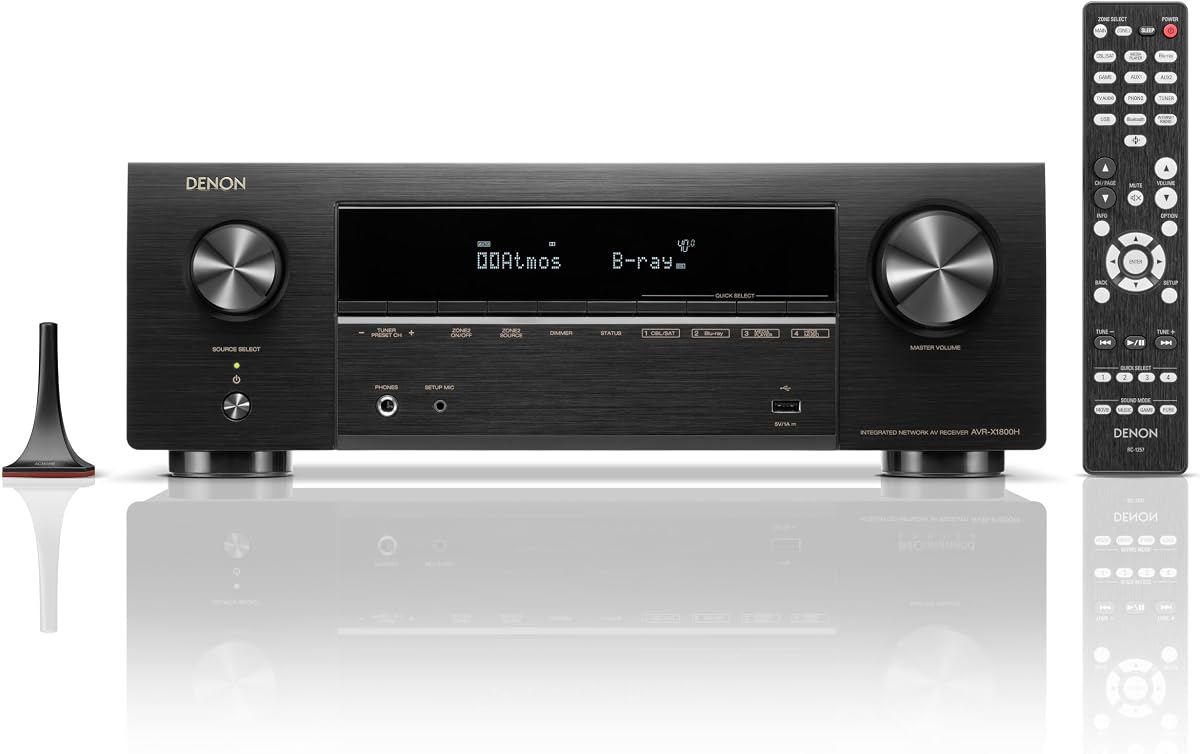
The Denon AVR-X1800H is a substantial 7.2-channel receiver aimed at small-to-medium home theater rooms that want powerful amplification and advanced video handling. Its supplied rating is 4.2 out of 5. Like the AVR-X1700H, it offers 80 watts per channel, but it is positioned as a higher-tier AV receiver with a strong emphasis on home theater performance.
We may earn a commission when you buy through this link, at no additional cost to you.
The HDMI section supports 8K at 60 Hz and 4K at 120 Hz pass-through through three dedicated 8K inputs and one output. Dolby Vision, HLG, HDR10+, and Dynamic HDR pass-through are included, along with 40 Gbps bandwidth support for demanding gaming and viewing. The receiver can also use HEOS speakers with 8K and HDCP 2.3, extending its role beyond a single room.
Immersive audio support includes Dolby Atmos, DTS:X, and DTS Virtual:X. Height Virtualization provides an option for creating overhead effects when actual height channels are not present, while a 7.2 configuration supports two subwoofers and the full range of main surround channels. The Quick Setup Guide and color-coded rear connections help simplify setup.
Wireless music includes HEOS, Wi-Fi, AirPlay 2, and Bluetooth, with services such as Spotify, Tidal, and Amazon Music HD. Its disadvantages are practical rather than fundamental. It needs more shelf or cabinet space than a dedicated stereo receiver, requires a more complex speaker arrangement to justify its channel count, and offers less specialized simplicity than the Marantz STEREO 70s. For buyers building a modern theater rather than a purely traditional two-speaker system, it is an attractive high-performance option.
The combination of 8K60, 4K120, high-bandwidth HDMI, and major HDR formats keeps the receiver relevant for current televisions and consoles. The three dedicated 8K inputs also reduce pressure on a crowded HDMI lineup.
Seven rated channels and support for 7.2, 5.2.2, and virtual-height configurations make the AVR-X1800H well suited to an established theater. It is designed to drive a complete speaker plan rather than merely act as a stereo control center.
We may earn a commission when you buy through this link, at no additional cost to you.
The Denon AVR-S570BT offers a practical middle ground between a traditional two-channel receiver and a large multichannel model. Its supplied rating is 4.2 out of 5. It uses a 5.2-channel configuration with 70 watts per channel, giving buyers two powered surround channels and subwoofer support without requiring the space and complexity of a seven-channel system.
We may earn a commission when you buy through this link, at no additional cost to you.
Its HDMI capabilities are unusually modern for the category. Four HDMI 2.1 8K inputs and one HDMI output support 4K and 8K content, while eARC is rated for 40 Gbps bandwidth. HDR, HLG, Dolby Vision, HDR10+, and Dynamic HDR support improve picture performance, and VRR and Quick Frame Transport are included for responsive gaming.
Audio formats include DTS HD Master, Dolby TrueHD, and 5.1 surround sound. The on-screen HD Setup Assistant walks through TV and source connections, while specific equalization settings are intended to optimize the result for movies, music, television, and games. A smart television remote can operate the receiver, and the Denon Remote App provides iOS and Android control.
For music, the built-in Bluetooth receiver supports direct wireless playback, while HEOS and Wi-Fi provide access to services such as Spotify, Tidal, and Pandora. The trade-offs are that only five channels are powered, the supplied information does not list height virtualization, and the receiver is still a full AV unit rather than a space-saving stereo model. It is a sensible choice for a compact theater with a 5.1 or 5.2 layout and a modern television.
Four 8K-ready inputs are enough for most living-room source combinations, including a game console, streaming device, disc player, and television return channel. eARC simplifies the audio connection while retaining advanced video capability.
The HD Setup Assistant and dedicated equalization options reduce the intimidation associated with surround receivers. App and smart-TV remote support also make everyday source and volume control less dependent on the supplied handheld remote.
We may earn a commission when you buy through this link, at no additional cost to you.
The Denon AVR-S670H is a 5.2-channel receiver that brings high-resolution video, mainstream surround audio, and multi-room streaming to a relatively conventional theater layout. Its supplied rating is 4.3 out of 5. With 75 watts per channel, it provides modest power increases over the AVR-S570BT while preserving the approachable five-channel format.
We may earn a commission when you buy through this link, at no additional cost to you.
The HDMI section supports 8K at 60 Hz and 4K at 120 Hz pass-through, along with 8K upscaling of 4K content. HDR10+, HLG, HDR, Dolby Vision, and Dynamic HDR are supported. VRR, ALLM, and Quick Frame Transport make the receiver well suited to compatible gaming consoles, while ARC and eARC provide convenient television audio return over HDMI.
For sound, Dolby TrueHD, Dolby Pro Logic II, and DTS Neo:6 Upmixer provide flexible playback and upmixing. The 5.1 configuration is less elaborate than a true 5.2.2 or 7.2 system, but it remains a practical step up from two speakers. HEOS, Wi-Fi, and Bluetooth allow music services such as Spotify and Tidal to be integrated, including multi-room playback across compatible speakers.
The receiver also supports hands-free control with Alexa and other major voice agents, allowing volume adjustment, track changes, and input switching. The main limitations are the lack of a larger powered-speaker count and its physical size relative to a slim stereo receiver. It is best suited to buyers who want a modern television, console, and conventional surround system in one box, while listeners devoted to vinyl or two-speaker music can find a more focused option elsewhere.
Dolby Pro Logic II and DTS Neo:6 Upmixer can create a more enveloping presentation from compatible stereo and surround content. The approach works well for viewers who want more dimensionality without installing overhead speakers.
HEOS multi-room support allows compatible Denon speakers to join a broader wireless audio setup. This makes the AVR-S670H useful as both a theater centerpiece and a connected-home audio controller.
We may earn a commission when you buy through this link, at no additional cost to you.
The Yamaha R-S202BL delivers one of the clearest interpretations of the classic 1970s-style stereo receiver: a simple brushed-aluminum component designed around music rather than television. Its supplied rating is 4.4 out of 5. The minimalist face, restrained controls, and analog presentation provide the requested retro character while Bluetooth adds a modern convenience.
We may earn a commission when you buy through this link, at no additional cost to you.
At the core is a straightforward two-channel amplifier with an input sensitivity of 500 mV/47 kOhms for CD. Speaker terminals and a selector permit two speaker systems, making it possible to move between pairs of speakers without unplugging equipment. A headphone terminal is also provided, and an automatic power-standby function is included for convenience.
Radio and wireless functions are simple but effective. The tuner provides 40 FM and AM presets, while Bluetooth can stream from compatible phones and tablets. The published frequency response is 10 Hz to 100 kHz, with separate tolerance figures for different ranges. These specifications support the receiver's focus on a broad musical range, although actual performance will also depend on the connected speakers, source, and room.
Its limitations are equally clear. There is no HDMI, surround processing, room correction, network streaming service integration, or documented phono input. The Yamaha R-S202BL is therefore best for listeners who want a clean two-speaker setup, value simple operation, and appreciate vintage-inspired styling. It is an especially approachable way to begin building a traditional hi-fi system around a CD player, tuner, computer, phone, or other line-level source.
The brushed aluminum finish and uncomplicated layout give the receiver an unmistakable period-inspired character. It can sit confidently beside vintage speakers without pretending to recreate every detail of a 1970s component.
The front-panel speaker selector controls two connected speaker systems. This is a simple feature, but one that can be highly useful for comparing speakers, separating listening areas, or choosing between main and secondary pairs.
We may earn a commission when you buy through this link, at no additional cost to you.
The Marantz MODEL 50 is an integrated stereo amplifier rather than a receiver, but it is an essential inclusion for anyone serious about the classic two-channel hi-fi experience. Its supplied rating of 4.9 out of 5 is the highest in the group. The appeal rests on a pure analog signal path, premium amplifier modules, and a design intended to make physical music sources feel direct and musical.
We may earn a commission when you buy through this link, at no additional cost to you.
Marantz describes the MODEL 50 as the result of 70 years of development, tuned by its Sound Master and built around a high-current Class A/B architecture. HDAM SA-3 discrete modules form the foundation of the amplification section, replacing standard integrated operational amplifiers with proprietary discrete designs intended to improve speed, bandwidth, and distortion behavior. Output is rated at 70 watts.
The built-in MM phono stage uses HDAM technology with JFET input circuitry, reducing the need for an external phono preamplifier for many turntables. Six analog inputs include dedicated CD and phono connections, while the front panel likely provides the familiar Marantz level meter and source controls. This is a focused analog component rather than a modern video hub.
Its expansion options are unusually useful. Stereo preamp outputs allow a separate power amplifier to be added, a subwoofer output supports low-frequency reinforcement, a power-amp input supports advanced configurations, and Speaker A/B switching serves two pairs of speakers. The trade-offs are obvious: no HDMI, surround processing, Bluetooth, Wi-Fi, HEOS, or radio. It also requires a separate streamer for digital services. For a serious analog music system, those limitations are less important than the purity, phono capability, and expandability it provides.
The absence of digital circuitry keeps the signal path direct and avoids the interference that Marantz says digital circuitry can introduce. That makes the MODEL 50 particularly relevant to listeners who value component simplicity and analog source quality.
Preamp outputs, power-amp input, subwoofer output, and A/B speaker switching allow the amplifier to evolve with the system. It can remain the centerpiece of a two-speaker setup or become part of a larger, more ambitious installation.
We may earn a commission when you buy through this link, at no additional cost to you.
This Sony STRDH190 bundle pairs the two-channel receiver with a Deco Essentials 12-month enhanced protection plan. The protection coverage includes accidental-damage and burn-in protection, making the package distinct from a standard receiver listing. No customer rating was supplied for this particular bundle, so the available feedback associated with the standard Sony STRDH190 should not automatically be treated as a rating for this package.
We may earn a commission when you buy through this link, at no additional cost to you.
The receiver itself follows a familiar modern-classic approach. It includes a phono input for turntable use, Bluetooth for wireless connection with mobile devices, and A/B speaker switching for flexible installation. The supplied information also notes that it is sound-matched to the Sony PS-HX500 and PS-LX300USB, which provides useful guidance for Sony speaker owners considering a coordinated system.
As a two-channel unit, it is best suited to music, radio, and a straightforward analog or wireless setup. The phono input removes a common obstacle for vinyl listeners, while Bluetooth provides a convenient path for content stored on a phone or tablet. A/B switching allows two pairs of speakers to be connected and selected as needed.
The trade-off is that the protection bundle is the main distinction from the regular receiver. It does not add an HDMI switch, surround processing, room correction, or advanced wireless music services. Buyers should compare the package with the standard listing and the protection terms to determine whether the added coverage is worthwhile for their installation and usage patterns. If the protection package offers meaningful peace of mind, the core receiver remains a capable stereo choice.
The 12-month plan includes accidental-damage and burn-in coverage according to the supplied information. This can make the bundle more attractive to owners who want added protection for a component they intend to keep connected for long periods.
The stated sound matching with the PS-HX500 and PS-LX300USB offers a straightforward starting point for Sony speakers. It is particularly relevant to buyers who want a visually and functionally coordinated two-channel system.
We may earn a commission when you buy through this link, at no additional cost to you.
The right receiver depends on whether the priority is a focused two-speaker music system, a compact television hub, or a full surround theater. Consider the source components, speaker plan, room size, video needs, and desired level of setup complexity before choosing.
A dedicated two-channel receiver is the purer choice for music, often produces a simpler setup, and may suit a smaller cabinet or listening area. The Marantz STEREO 70s, Sony STRDH190, Yamaha R-S202BL, and Marantz MODEL 50 all focus on stereo performance, although they differ in connectivity. A 5.2- or 7.2-channel receiver is the better choice when a television, game console, and multiple surround speakers are central to the household.
In short, choose two channels for music and simplicity; choose surround for movies and games.
Published wattage is most useful as a general indicator of capability rather than a promise of identical performance among products. Pay attention to impedance, test conditions, and the number of driven channels. The Sony STRDH190 is rated at 100 watts per channel, while the Marantz STEREO 70s and MODEL 50 are rated at 75 and 70 watts respectively. Room size and speaker sensitivity can matter as much as the headline figure.
Match the amplifier to the speaker's practical impedance and listening level rather than choosing by wattage alone.
A modern entertainment system may require several HDMI inputs, 8K support, eARC, and gaming features. The Denon and Yamaha surround receivers cover those needs, while the Marantz STEREO 70s also provides six HDMI inputs. Dedicated two-channel models such as the Yamaha R-S202BL and Marantz MODEL 50 focus on analog sources and do not serve as video switchers. Verify the inputs required by every source before buying.
Choose modern HDMI switching for a television hub, or prioritize analog inputs for a dedicated music system.
Bluetooth is common across the list, but platform streaming changes the experience. HEOS, Wi-Fi, AirPlay 2, Spotify Connect, Tidal, TuneIn, and related services offer access to online music libraries and multi-room playback. The Marantz STEREO 70s, Yamaha RX300A, and Denon AVR-X1700H, AVR-X1800H, AVR-S570BT, and AVR-S670H support connected streaming. The MODEL 50, by contrast, needs a separate streamer.
Check the streaming platform and ecosystem used by the household before relying on network features.
Turntable users should look for a correctly implemented phono input rather than assuming every analog input performs the same job. The Sony STRDH190 and Marantz STEREO 70s include phono connections, and the MODEL 50 offers a built-in MM stage with JFET input circuitry. The Marantz STEREO 70s and Denon AVR-X1700H also provide dedicated phono inputs. Yamaha R-S202BL documentation does not list one, so vinyl owners should confirm compatibility before purchase.
Verify phono-stage support, cartridge type, and included connections whenever a turntable is part of the plan.
A receiver may look modest in product photography but still occupy substantial shelf space. The Marantz STEREO 70s is only 4.1 inches tall, and the Sony STRDH190 is listed at 5.25 inches, making them easier to place in conventional media furniture. Full-size AV receivers are generally larger and require more airflow around their ventilation openings. Leave room for connections, remote signal access, and heat dissipation rather than measuring only the front panel.
Measure the cabinet and verify clearance before ordering, especially for full-size seven-channel models.
Automatic room correction can improve consistency in difficult acoustic spaces, and the Yamaha RX300A includes a setup microphone that measures room and speaker characteristics. Gaming-focused buyers should examine VRR, ALLM, Quick Frame Transport, 4K120, and 8K60 support, which are particularly relevant among the Yamaha and Denon surround receivers. These features may matter less in a pure music setup.
Prioritize room correction for difficult acoustics and current gaming formats for an entertainment-centered installation.
A receiver generally includes source selection, wireless connectivity, radio, and sometimes integrated streaming. An integrated amplifier may provide a purer analog path and better preamp flexibility without adding unnecessary circuitry. The Marantz MODEL 50 is the clearest example in this roundup, offering six analog inputs, a premium phono stage, preamp outputs, and expansion connections, but requiring external streamers and other source devices.
Choose a receiver for convenience; choose an integrated amplifier when analog purity and future control are the priorities.
Begin by placing the receiver on a stable, level surface with adequate ventilation. Connect speakers while the unit is powered off, observing polarity and the receiver's supported impedance. For turntables, select the phono input and confirm that the cartridge is compatible with the built-in MM stage before lowering the volume. With HDMI models, connect the television through ARC or eARC and attach game consoles, streamers, and disc players to the appropriate 8K or conventional inputs.
Run the initial setup procedure before making detailed sound adjustments. Multichannel receivers benefit from the included microphone or guided calibration process, while two-channel systems should start with modest volume and carefully matched speaker placement. Bluetooth and network sources may require pairing, account sign-in, or firmware updates. Use source-specific modes for movies, games, and music, but avoid excessive processing when a direct presentation is preferred.
Allow the receiver to operate at moderate levels, particularly during initial use, and keep vents unobstructed. Clean the cabinet with a soft, dry cloth rather than spraying cleaner directly onto controls or openings. Protect the unit from moisture, direct sunlight, unstable furniture, and power surges. For analog components, allow some warm-up time before judging subtle sound differences, and store unused cables carefully to avoid pin damage and connector wear.
Yes, as long as their connection format matches the rest of the system. Models such as the Yamaha R-S202BL and Marantz MODEL 50 focus on analog sources, while the Marantz STEREO 70s and the Yamaha and Denon AV receivers add HDMI, streaming, or surround functions. A buyer with only a turntable and powered speakers may prefer the simpler design, whereas a television-based system benefits from HDMI switching and game features.
A stereo receiver primarily controls two speakers and prioritizes music-oriented functions such as source selection, phono support, and sometimes radio or wireless streaming. An AV receiver adds powered surround channels, HDMI switching, video processing, gaming features, and room calibration. The distinction is important because a two-channel receiver can be more appropriate for a dedicated music system, while an AV receiver is built to manage a complete home theater.
The Marantz MODEL 50 stands out for its built-in MM phono stage, JFET input circuitry, and dedicated analog focus. The Sony STRDH190 and Marantz STEREO 70s also provide phono inputs and may suit buyers who need more source flexibility. The correct choice depends on the cartridge, required outputs, and whether the system needs HDMI or wireless streaming in addition to vinyl playback.
Not necessarily. It matters most when using an 8K television, compatible source devices, or a current game console that benefits from the latest bandwidth and gaming features. For a music-only system, the Yamaha R-S202BL, Sony STRDH190, or Marantz MODEL 50 may be more appropriate. For a television hub intended to remain relevant for years, the HDMI capabilities of the Marantz STEREO 70s and the Yamaha and Denon AV receivers are worth considering.
The Marantz STEREO 70s supports Dolby Atmos and DTS Virtual:X according to the supplied information, allowing compatible content to gain virtual surround and height effects. The Denon models also provide Height Virtualization Technology. These processing modes can create a fuller presentation, but they do not reproduce the exact experience of physical surround and height speakers routed through a dedicated AV receiver.
A/B switching allows two pairs of speakers to remain connected while the receiver selects which pair plays. This can make it easy to compare speakers, use separate pairs in different rooms, or keep secondary speakers available without reconnecting them. The Sony STRDH190, Yamaha R-S202BL, Marantz STEREO 70s, and Marantz MODEL 50 all include some form of multi-pair speaker selection.
Bluetooth is convenient for quick phone and tablet playback and appears on many models in this guide. Network streaming offers a broader service catalog, higher-resolution sources on compatible hardware, and multi-room control when supported. The Marantz STEREO 70s and the Denon and Yamaha network models are better for a connected household, while the Marantz MODEL 50 is designed to work with a separate streamer.
Receivers generate heat during use, particularly when driving several channels at higher levels. Leave the top and rear ventilation areas unobstructed, avoid placing the unit inside a fully closed shelf, and leave enough clearance for cables and service access. The slim Marantz STEREO 70s may fit more easily into compact furniture, but every model still needs room for airflow.
The Yamaha R-S202BL is the clearest budget choice for a simple, vintage-inspired two-speaker system. The Marantz STEREO 70s is the most versatile overall option, combining a slim profile, modern HDMI, streaming, and a traditional stereo focus. For a premium analog installation, the Marantz MODEL 50 stands apart with its pure signal path, MM phono stage, and unusually strong expansion options.
Start by deciding whether the receiver is primarily a music component or the center of a home theater. Choose dedicated two-channel models for focused listening and compact simplicity; consider the Yamaha RX300A or a Denon 5.2- or 7.2-channel receiver for surround sound, room calibration, gaming, and advanced video. Next, verify speaker compatibility, source inputs, streaming services, and cabinet dimensions before narrowing the final choice.
Ratings, configurations, and product listings can change as new models arrive, and current prices and availability should be checked at the time of purchase. The most satisfying result comes from matching the receiver's strengths, room requirements, and controls to the equipment and content you already enjoy rather than selecting on vintage appearance or headline specifications alone.