
Dura Heat EUH1465
4.3Editor score
Portable 1500W forced-air heating
Thermostat and overheat protection
Six-foot grounded power cord
Explore the best 110v garage heater options, comparing voltage, heating capacity, controls, mounting options, safety features, and garage coverage.
A 110v garage heater can provide convenient warmth without requiring a 240-volt branch circuit, but its output, installation needs, and suitability vary considerably. The most useful units combine efficient forced-air or radiant heating with rugged construction, simple controls, and protection against overheating.
This guide compares ten heaters for home garages, workshops, shops, and related spaces, focusing on voltage, power, heating capacity, airflow, installation, control options, and safety features. It also distinguishes true 120-volt products from hard-wired 240-volt models frequently marketed as garage heaters.
Each entry reveals which setup a heater favors, from portable indoor spaces to wall- and ceiling-mounted commercial equipment. Ratings reflect the supplied customer feedback, while availability and prices can change, so readers should verify current listings, electrical requirements, and local safety codes before purchasing.
4.3Editor score

4.0Editor score

4.3Editor score
The table below compares power, voltage, installation style, controls, and practical capacity across the complete selection. Pay particular attention to voltage because only a limited number of these products are appropriate for a standard 120-volt garage receptacle.



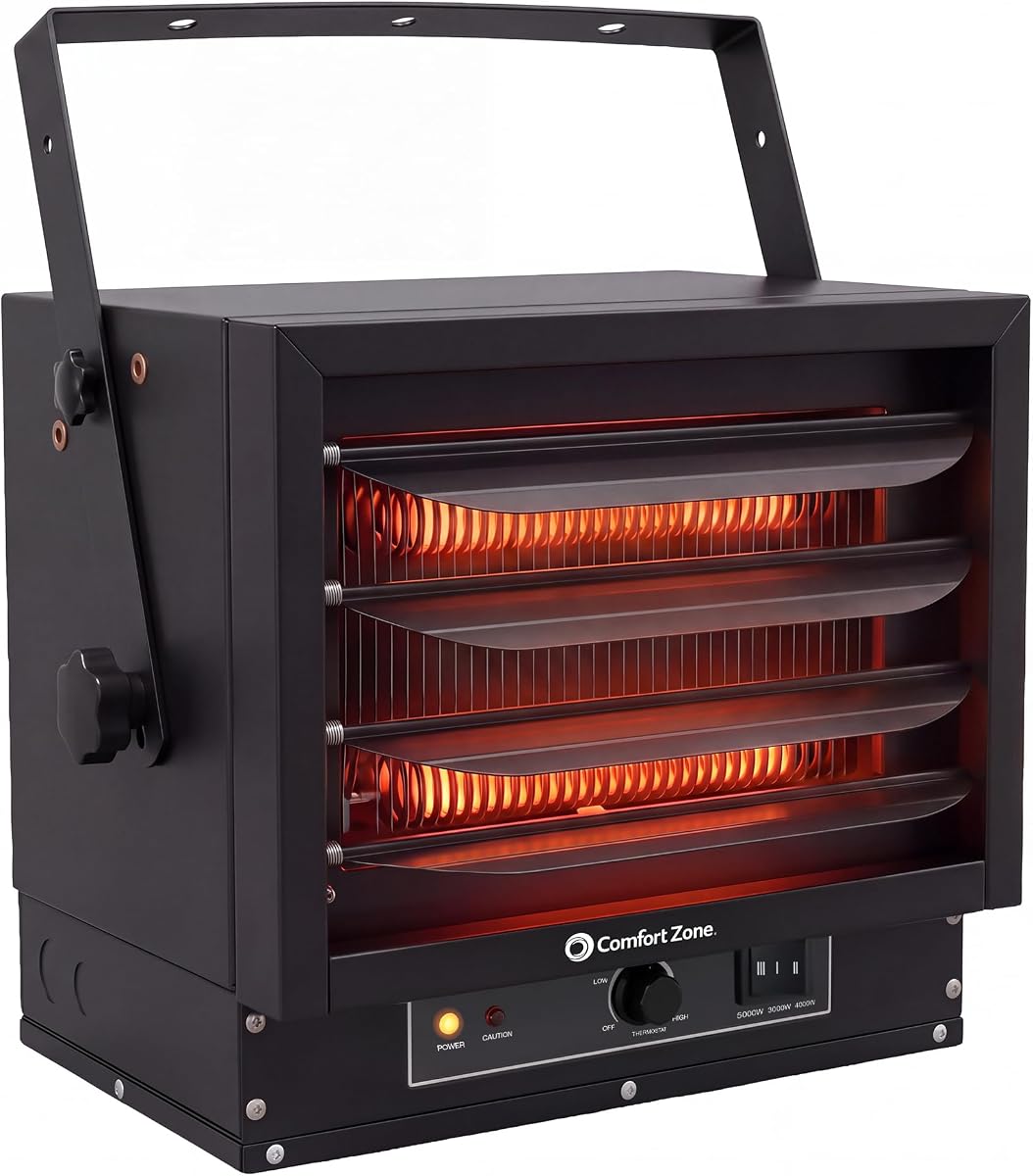


The Comfort Zone CZ230ERBK is a 7,500-watt, 240-volt hard-wired fan-forced heater built for garages, workshops, warehouses, and storage areas. Its 4.4 rating reflects a strong balance of useful controls and space-saving installation. It is particularly attractive for users who want overhead heating without occupying valuable floor or workbench space.
We may earn a commission when you buy through this link, at no additional cost to you.
The ceiling-mounted steel body is designed for demanding indoor environments, while adjustable louvers and an adjustable mounting angle let the installer direct airflow toward a work area or spread warmth across the room. A digital thermostat, remote control, 12-hour timer, power indicator, and overheating sensor make daily operation more convenient than a basic manual garage heater.
The important limitation is electrical rather than functional: it requires hard-wired 240-volt installation and is not a 110-volt appliance. That means it may need a dedicated circuit and professional electrical work, and it should not be connected to a normal garage receptacle. The stated coverage of up to 1,250 square feet also should be treated as a product claim rather than a guarantee for every open or poorly insulated garage.
This is a strong overall recommendation for a homeowner with suitable 240-volt service who wants remote control, scheduling, and ceiling-mounted forced-air heating. Buyers focused specifically on the keyword should consider it a high-output alternative rather than a true 110-volt match.
Mounting the unit overhead leaves more usable floor area for vehicles, tools, benches, and stored materials. The fan-forced design moves warm air through the space while adjustable louvers help focus the discharge direction.
The digital thermostat and remote make it easier to manage a garage that may not be occupied continuously. A 12-hour timer adds scheduling flexibility, while the power light and thermal sensor improve visibility and protection.
We may earn a commission when you buy through this link, at no additional cost to you.
The GiveBest Smart Wall Heater is a 1,500-watt wall-mounted unit rated for indoor rooms up to 200 square feet. Its 4.3 rating reflects a versatile combination of WiFi, remote, and touch-panel control. Although not designed as a rugged commercial garage heater, it can provide supplemental warmth in a suitably enclosed garage, basement, office, or workshop.
We may earn a commission when you buy through this link, at no additional cost to you.
The wall-mounted format keeps the heater off the floor, and the included drilling guide helps position the unit. A precision thermostat and ECO mode allow the heating output to adjust according to the selected temperature. The LED panel displays room temperature, while WiFi scheduling allows the heater to preheat before the space is needed.
Its most significant limitation is space size. The manufacturer specifically advises that it is not intended for long-distance heating in rooms larger than 200 square feet or in unobstructed spaces. That makes it better for an enclosed garage bay, small office, bathroom, bedroom, or basement than for a cold, open two-car garage with constant heat loss.
The heater also needs the correct electrical connection and suitable indoor mounting conditions. It is a compelling pick for buyers who value smart-home convenience more than raw output. For a true 110-volt garage-heater search, it is more relevant than the 240-volt industrial models, but it should be chosen based on garage size and insulation.
WiFi app access lets users preheat a space before arrival and change settings from another room. The included remote and illuminated touch panel provide useful alternatives when reaching the phone is inconvenient.
Tip-over and overheat protection support safer everyday operation, and the listed flame-retardant materials add another layer of consideration. These features make the unit more practical for occupied indoor spaces than a bare radiant heater.
We may earn a commission when you buy through this link, at no additional cost to you.
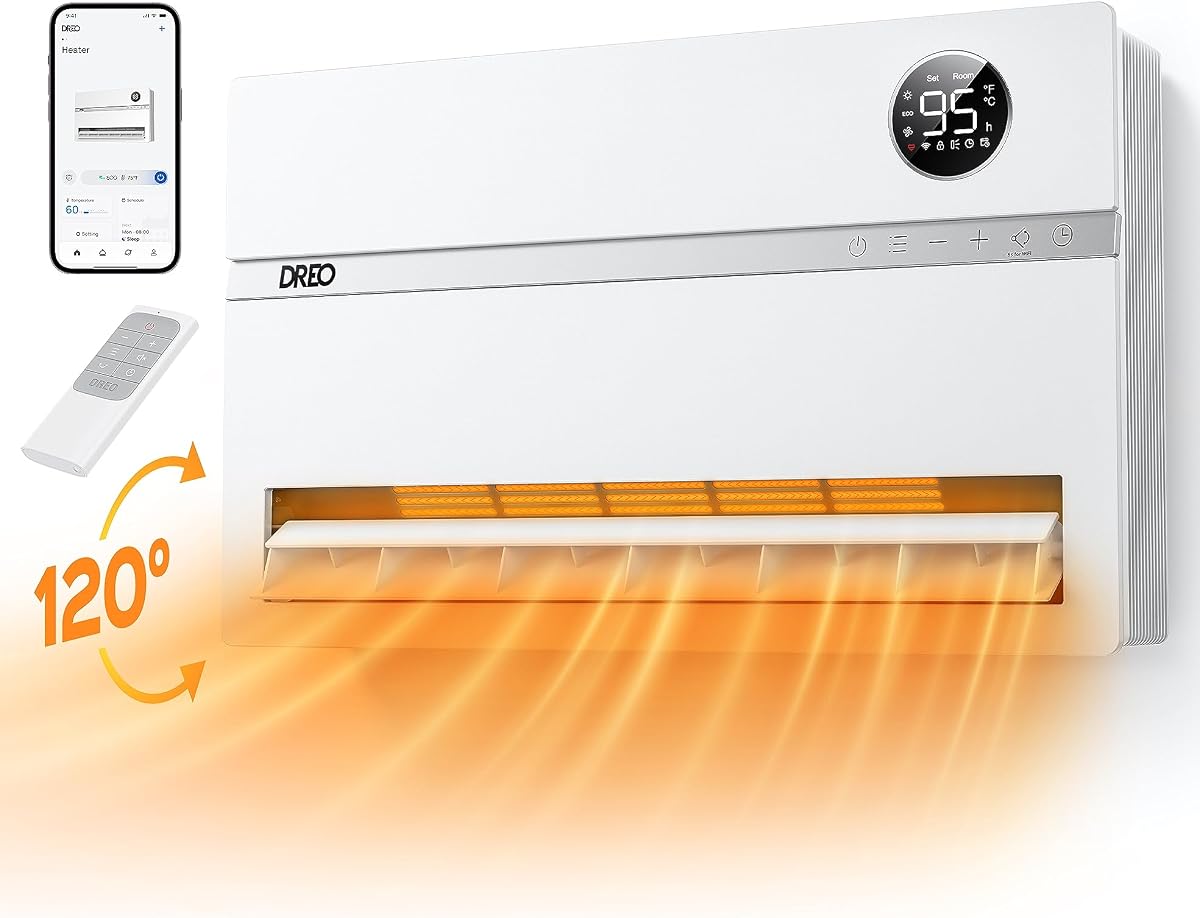
The DREO Smart Wall Heater is a 1,500-watt PTC ceramic wall heater with a 4.4 rating. Its primary design target is bedrooms and smaller indoor rooms, but that makes it more relevant than many industrial units to someone seeking a connected 120-volt heater for a compact, insulated garage office or project room.
We may earn a commission when you buy through this link, at no additional cost to you.
Its 120-degree oscillation is designed to distribute warm air from top to bottom and across more of the room than a conventional fixed wall heater. The temperature range extends from 41 to 95 degrees Fahrenheit with one-degree increments, while the app, scheduling, Alexa, and Google Home compatibility offer flexible control. The LED panel automatically dims under low-light conditions, and the unit is described as operating at lower noise.
Because this is a bedroom-focused heater, users should not assume it can heat a typical open garage. The supplied information does not define it as a heavy-duty shop heater, and the absence of a stated broad garage coverage figure reinforces the need to use it only in a compact, well-insulated location. Wall installation also requires the included drilling guide and suitable mounting conditions.
Choose the DREO when smart controls, quiet bedroom operation, and precise temperature adjustment matter most. It is a practical secondary option for a garage, workshop office, or converted room rather than the strongest answer for warming an entire open garage bay.
The broad oscillation helps move warm air beyond the small zone immediately in front of the wall unit. This improves comfort in compact rooms where a narrow, fixed airflow pattern would leave cool areas around the edges.
Automatic display dimming makes the unit less disruptive at night. App-based scheduling and voice control also allow heating to be adjusted without repeated physical interaction.
We may earn a commission when you buy through this link, at no additional cost to you.
The VEVOR 10,000W Garage Heater is the highest-output model in this group, pairing a 240-volt hard-wired connection with digital temperature control, remote operation, and a nine-hour timer. Its 4.5 rating makes it a strong option for a large garage or working shop where rapid, sustained heating is more important than simple plug-in convenience.
We may earn a commission when you buy through this link, at no additional cost to you.
The fan-forced design circulates air throughout the space, and two power levels let users match output to changing conditions. Digital control is described as maintaining a temperature difference of only two degrees Fahrenheit, while adjustable louvers and installation-angle adjustment allow the warm-air discharge to be directed toward the desired work zone.
The electrical specification is substantial: the product requires a breaker rating of at least 42 amps. That requirement makes it unsuitable for most standard 120-volt garage outlets, and professional installation should be considered. The stated 90-square-meter coverage is also dependent on insulation, door openings, and layout, so heating losses should be evaluated before purchase.
This heater is best for workshops, larger commercial bays, and garages already equipped for heavy 240-volt service. It is not a literal 110-volt recommendation, but it delivers the strongest cold-weather heating capability among the products reviewed here.
The 10,000-watt rating provides considerably more heating capacity than portable or small wall heaters. That makes it better suited to open floors and frequently opened garage doors where lower-output units would struggle to maintain comfortable temperatures.
Wall or hanging placement keeps the heater out of the working area. Adjustable louvers, remote operation, two power levels, and the timer make it adaptable to different schedules and heat-distribution needs.
We may earn a commission when you buy through this link, at no additional cost to you.
The Dura Heat EUH1465 is a compact 1,500-watt forced-air heater that delivers 5,120 BTUs and is listed for spaces up to 250 square feet. Its 4.3 rating and portable design make it a practical budget pick for a small garage bay, workbench area, greenhouse, or indoor workspace.
We may earn a commission when you buy through this link, at no additional cost to you.
PTC ceramic heating and a high-velocity fan provide quick air movement, while the pivoting base lets the user redirect discharge toward a chair, workbench, or doorway. Heat and fan-only settings offer more than one way to use it. The thermostat, steel body, overheat shutoff, and six-foot power cord support practical everyday operation.
Its portable format comes with obvious limits. A 1,500-watt heater is unlikely to keep a drafty, open garage uniformly warm, especially when the garage door opens regularly. It also needs a suitable outlet, unobstructed airflow, and stable placement. Users should follow all clearance instructions and avoid placing it where it can be knocked over.
The Dura Heat is best for supplemental heat in a compact area where portability matters more than whole-garage uniformity. Among genuine 120-volt options, it offers a strong balance of useful features, compact dimensions, and straightforward operation.
The pivoting base and integrated handle make it easy to move the heater as work or activity changes. This is valuable in a garage where one area may need warmth while another remains unused.
An adjustable thermostat lets the user select a target temperature, and fan-only mode provides useful air circulation without heat. Overheat protection adds a basic safety layer during prolonged use.
We may earn a commission when you buy through this link, at no additional cost to you.
The Comfort Zone 5,000W is a 240-volt hard-wired ceiling heater intended for garages, warehouses, storage rooms, and other indoor commercial spaces. Its 4.4 rating reflects a straightforward design with durable construction, fan-forced heat distribution, and overhead placement.
We may earn a commission when you buy through this link, at no additional cost to you.
The heavy-gauge steel body is intended to withstand temperature fluctuations in poorly insulated environments. Louvers and an adjustable mounting angle help direct airflow, while a fan moves warmth away from the unit. The dual-knob thermostat and quick on-and-off function keep operation uncomplicated, and the built-in sensor shuts the heater down if overheating is detected.
Although this is a lower-capacity option than the 7,500-watt and 10,000-watt models, it may still provide excessive heat for a small enclosed room. The hard-wired 240-volt requirement also places it outside a normal 110-volt shopping search. Installation should follow electrical codes and the product's specified clearances.
This is a good fit for a medium garage or shop where floor space is limited and simple manual controls are preferred. Buyers wanting plug-in convenience should instead focus on the Dura Heat or other 120-volt products in this guide.
Heavy-gauge steel is suited to indoor workspaces where temperature changes are common. Ceiling placement also reduces the risk of a floor heater occupying vehicle space or being bumped during daily work.
The dual knobs provide a familiar way to set heat and power. Adjustable louvers and mounting angle make it possible to focus airflow toward benches, vehicles, or the center of the room.
We may earn a commission when you buy through this link, at no additional cost to you.
The Comfort Zone CZ220BK is another 5,000-watt, 240-volt ceiling-mounted heater in this roundup, with a 4.4 rating. It offers a more traditional approach based on fan-forced heat, manual thermostat control, adjustable louvers, and a thermal cut-out switch.
We may earn a commission when you buy through this link, at no additional cost to you.
Its heavy-gauge steel construction is intended to tolerate the temperature fluctuations common in garages, workshops, warehouses, and storage areas. The ceiling position preserves floor space, while the adjustable mounting angle and louvers help distribute warm air toward the area where people are working. A dual-knob thermostat and quick on-and-off control keep operation direct.
There are no advanced connectivity features, so scheduling and remote adjustment are not part of the listed design. The 240-volt hard-wired installation remains the main reason it does not satisfy a literal 110-volt requirement. Buyers should also confirm that the structure can support the unit and maintain the required clearance around it.
Choose the CZ220BK for a workshop user who values robust construction, basic mechanical controls, and floor space over smart features. It is a dependable alternative within the Comfort Zone ceiling-mounted lineup, particularly for medium-sized indoor work areas.
The steel enclosure and fan-forced layout align with the demands of workshops and storage areas. Overhead mounting keeps the heater away from tools, vehicles, and frequently traveled floor zones.
A built-in sensor and thermal cut-out switch help stop operation when overheating is detected. A power indicator provides a visible confirmation that the heater is active.
We may earn a commission when you buy through this link, at no additional cost to you.
The InoKraft 7,500W combines 240-volt output with digital controls, flexible mounting, and a 4.6 customer rating. It is one of the strongest all-around choices in the group for a garage or workshop that can support the appropriate high-voltage connection.
We may earn a commission when you buy through this link, at no additional cost to you.
Its digital thermostat covers 40 to 99 degrees Fahrenheit, and a programmable timer can run from one to 24 hours. High and low modes provide direct output choices, while ECO mode adjusts heating according to ambient conditions and may shut off power when heat is unnecessary. The supplied design includes a long 8.2-foot cord with a NEMA 14-50P plug rather than a conventional household plug.
Five angle adjustments, flexible louvers, and wall or ceiling mounting give users control over airflow direction and floor-space use. An automatic fan delay supports more effective heat transfer and energy conservation. The stated capacity reaches 750 square feet, although real performance still depends heavily on insulation, garage size, and door use.
This heater is a premium feature pick rather than a 110-volt match. It is well suited to owners with a suitable 240-volt outlet or circuit who want more precise control than basic knob-operated models provide. Professional electrical installation is advised by the manufacturer.
The digital thermostat, one-degree adjustment range, and long timer provide more control than basic mechanical models. ECO mode can reduce unnecessary output when the garage reaches its selected temperature.
Multiple installation angles and adjustable louvers let the owner target a workbench, vehicle, or central area. Wall and hanging options preserve floor space in busy garages and workshops.
We may earn a commission when you buy through this link, at no additional cost to you.
The Shinic 2-Pack is one of the few selections explicitly designed around a 120-volt connection. It includes two ceiling-mounted radiant heaters, each capable of 1,500 watts or 750 watts, making it a distinctive choice among a list dominated by 240-volt shop equipment.
We may earn a commission when you buy through this link, at no additional cost to you.
Dual quartz tubes deliver radiant heat directly to people and objects in front of the unit, which can be useful over a workstation or nearby a vehicle. Each heater also has an integrated halogen work light. The mounting bracket rotates up to 90 degrees, helping direct both the radiant heat and light toward the desired area.
A five-setting pull-string control permits low heat, high heat, two combinations that add the work light, and off. The units use a grounded three-prong plug, include metal housings and overheat automatic shutoff, and are ETL listed. The package contains two heaters, two adjustable brackets, accessories, and a user manual.
Because the heat is radiant rather than fan-forced, comfort depends heavily on line of sight and position. Two units can serve separate work zones, but neither is equivalent to a 240-volt forced-air heater for uniformly warming a large garage. The rating of 4.0 is the lowest among the listed products, so buyers should pay close attention to placement and expected coverage.
Two separate units can heat or illuminate different work areas without requiring a second purchase. This is useful when a garage has a bench at one end and a vehicle or packing zone at another.
Quartz tubes warm nearby people and objects rather than rapidly circulating all room air. The built-in halogen light adds visibility, making the heater useful for nighttime shop tasks.
We may earn a commission when you buy through this link, at no additional cost to you.
The VEVOR 5,000W Garage Heater offers a 4.6 rating and a useful combination of digital temperature control, remote operation, and flexible mounting. It is designed for medium indoor garages and workspaces that need fan-forced heat but do not require the output of the 10,000-watt version.
We may earn a commission when you buy through this link, at no additional cost to you.
Two adjustable power levels allow users to tailor output as conditions change. The digital control is described as maintaining a two-degree Fahrenheit difference, while flexible louvers and adjustable installation angles help distribute warm air evenly. Wall or hanging installation preserves working space, and an automatic fan delay supports efficient heat transfer.
The heater is hard-wired for 240-volt service, so it cannot be connected to a standard garage receptacle. The listed coverage of 50 square meters may fit a medium garage, but doors, insulation, and layout can significantly change real-world results. It should be installed according to applicable electrical requirements and manufacturer clearances.
This model is a strong fit for a garage already equipped with the necessary high-voltage connection. Its remote, timer, and selectable output offer more convenience than basic 5,000-watt ceiling heaters, although it remains outside the strict 110-volt category.
Remote control makes it easier to change the setting without walking to the mounted heater. The nine-hour timer adds useful scheduling for regular workshop routines.
SPCC cold-rolled steel supports long-term durability, while wall and ceiling choices let owners position the unit around the room. Adjustable louvers and mounting angles help direct the airflow toward active work areas.
We may earn a commission when you buy through this link, at no additional cost to you.
The most important choice is electrical compatibility, followed by garage size and heat-loss conditions. Review voltage, connection type, heater technology, controls, mounting needs, and safety features before choosing a model.
A 110-volt heater can generally use a standard 120-volt household-style receptacle, although circuit capacity and plug compatibility still need confirmation. Several highly rated garage heaters in this guide are actually 240-volt hard-wired units, and one 7,500-watt model uses a 240-volt NEMA 14-50P plug. Buyers should check the product listing, nameplate, and instructions rather than assuming that every garage heater can run from a normal outlet.
Choose a genuine 120-volt model when avoiding electrical upgrades is the priority. Choose a 240-volt unit only after confirming service, circuit capacity, breaker requirements, and the willingness to have installation completed safely.
Portable 1,500-watt heaters are most realistic in small, enclosed areas where users need localized warmth. Higher-output forced-air heaters are better suited to medium and large garages, while radiant units can provide useful comfort at a specific workstation without promising uniform room temperature.
Ignore coverage claims without context. Garage dimensions, insulation, ceiling height, open doors, and heat loss can make a published square-foot figure misleading. Choose the heater for the area you actually want to occupy rather than the entire structure.
Fan-forced heaters circulate air throughout a room and are generally better for maintaining a more even temperature. Radiant quartz heaters warm people and objects directly and may feel effective over a workbench, but they do not rapidly heat all of the air in a garage.
Select forced air for broad room comfort and radiant heat for a localized work zone. If the goal is warming a parked vehicle or a person at a bench, radiant direction and mounting height may matter more than total room coverage.
A detached garage with thin walls, an uninsulated ceiling, and frequent door openings can lose heat quickly. In such a space, a thermostat, timer, ECO mode, and selectable output can improve control, but no heater can eliminate the energy required to replace heat entering from outside.
For poorly insulated spaces, prioritize high-output forced-air models and consider insulation or weatherproofing as a long-term investment. In a small, enclosed garage, a lower-cost portable heater may provide sufficient comfort for occasional use.
Wall- and ceiling-mounted heaters preserve valuable floor area for vehicles, storage, and workbenches. Portable models offer flexibility and can move between zones, but they occupy floor or bench space and may be exposed to bumps, dust, or accidental contact.
Measure the mounting area, verify clearance requirements, and confirm whether the structure can support a ceiling unit. Include cord reach and outlet location when choosing a portable model, and plan professional mounting for hard-wired products.
Mechanical knobs are easy to understand and can remain useful when connectivity is unreliable. Digital thermostats offer finer control, while remotes, timers, ECO modes, and WiFi scheduling are valuable when the garage is used at predictable times or needs warming before arrival.
Choose controls based on routine rather than novelty. A frequently occupied workshop may benefit from remote and timer functions, while a seldom-used garage may only need a straightforward thermostat and overheat protection.
Overheat protection is a fundamental feature for electric space heaters, especially in dusty or unattended workshop environments. Tip-over protection is particularly relevant for portable products, while hard-wired units should also be evaluated for thermal cut-out behavior, power indication, and listed or certified construction.
Safety features do not replace correct installation, clearance, and electrical work. Always follow the included manual, keep combustible materials away from the discharge area, and consult a qualified electrician when wiring or circuit changes are involved.
Fan-forced heaters trade some audible airflow for faster and more even heat distribution. A unit designed for bedrooms may emphasize lower noise and refined controls, while a shop heater may prioritize high airflow and rugged construction. These priorities are not identical.
For a garage office or shared workspace, lower-noise operation and a dimmable display may be important. For a shop where machinery already creates noise, airflow capacity and heat reach may matter more.
Before installation, read the manual, identify the heater's voltage and required circuit, inspect the cord and plug, and verify that the mounting surface and surrounding clearances are suitable. Plug portable models directly into an appropriate outlet, and have hard-wired units installed according to electrical codes and the manufacturer's requirements.
Position the heater where airflow or radiant heat reaches the intended work area without creating a trip hazard. For wall or ceiling models, use the specified brackets and fasteners, keep the discharge unobstructed, and preserve clearance from wood, plastic, clothing, vehicles, and other combustible materials.
During operation, set the thermostat or smart schedule appropriately and avoid repeated unnecessary adjustments. Clean dust from vents and louvers when the unit is cool and disconnected, inspect cords periodically, and never operate a heater with damage, an unstable base, blocked airflow, or a wet enclosure. Test overheat or tip-over protection only as described in the manual.
A 110-volt heater is best suited to a small, enclosed garage or a localized work area. Its ability to heat an entire garage depends on dimensions, insulation, ceiling height, and how often the door opens, but lower-voltage units generally lack the output of 240-volt forced-air models.
No. Several strong shop heaters listed here require hard-wired 240-volt service, and the InoKraft model uses a 240-volt NEMA 14-50P plug. Always check the voltage, amperage, connector type, and circuit requirements before buying or installing any heater.
Radiant heaters use infrared heat that warms nearby people and objects, making them useful over a workstation. Fan-forced heaters move air across a heating element and distribute warmth through a larger space, which is usually better for overall garage comfort.
A licensed electrician is strongly recommended for hard-wired or dedicated-circuit installations, particularly 240-volt models and any circuit requiring a new breaker. Local electrical codes and the heater manual determine the exact requirements, so do not assume an ordinary extension cord is a suitable substitute.
A smart wall heater may work in a small, well-insulated garage or garage office if its indoor-use instructions and electrical requirements are met. Its stated room limits still apply, and it is not the best choice for a large, drafty, open garage.
Clearance depends on the specific model and its certification, so follow the manual rather than using a generic rule. Keep all listed air intakes and discharge openings unobstructed and maintain the stated distance from walls, ceilings, vehicles, tools, and combustible materials.
Yes, especially because garages can heat up quickly when the door is closed and cool down quickly when it opens. A thermostat, timer, or ECO mode helps reduce unnecessary cycling and gives the user more consistent control over comfort.
A fan-forced wall or ceiling heater with adequate output and adjustable louvers is generally more suitable for maintaining an even temperature. A 120-volt portable unit is better when the goal is heating one corner, and radiant heaters are most effective when focused on a particular person or work surface.
The Shinic 2-Pack stands out as the clearest match for a genuine 120-volt garage-heating search because it includes two ceiling-mounted radiant units, a grounded plug, work lights, and overheat protection. The Dura Heat EUH1465 is a simpler portable option for small spaces, while the GiveBest Smart Wall Heater adds connectivity to compact indoor areas.
For larger garages, the higher-output VEVOR, Comfort Zone, and InoKraft models provide stronger forced-air heating, but they use 240-volt connections. Prioritize voltage and electrical requirements first, then match output to garage size, insulation, heat-loss conditions, and the need for portability or fixed mounting.
Before ordering, verify the current product listing, outlet or circuit requirements, mounting clearance, safety certification, and current price. Ratings and product details can change over time, and the most suitable heater is the one that matches both the electrical service and the space you intend to heat.