
Vogzone MCX4121A-ACAT
4.7Editor score
Dual 25GbE SFP28 ports
Mellanox ConnectX-4 Lx
PCIe 3.0 x8 interface
RDMA and SR-IOV
Low-profile bracket included
Explore the best 25GbE network cards, comparing ports, controllers, PCIe lanes, RDMA support, operating systems, and ideal workstation or server use cases.
A 25GbE network card can transform how quickly a compatible computer moves large files, streams high-resolution media, backs up storage, or communicates across modern data centers. The right adapter must match your interface, operating system, chassis, cabling, and workload rather than merely offer a headline connection speed.
This guide compares ten dual-port 25GbE adapters based on controller technology, PCIe generation and lane width, SFP28 connectivity, offload capabilities, operating-system support, physical format, and intended use. It covers conventional PCIe server cards, a QNAP-focused expansion card, an OCP mezzanine, and external Thunderbolt options.
Each review explains the strongest reasons to consider a model and any meaningful limitations. Ratings and specifications come from the supplied product information, while current prices and availability can change. The top selections include budget-oriented PCIe choices, a feature-rich Mellanox-based adapter, and a premium Thunderbolt solution.
4.7Editor score
4.9Editor score

5.0Editor score
The comparison below places all ten adapters by interface, controller, port arrangement, and major capabilities. It makes clear which options are conventional PCIe cards, which target NAS systems or specialized server form factors, and which are designed to bring 25GbE to Thunderbolt-based computers.


The QXG-25G2SF-E810 is a dual-port 25GbE expansion card built around the Intel E810-XXVAM2 controller. Its principal appeal is the combination of two SFP28 connections, Forward Error Correction, and port trunking in a card designed for QNAP environments. No customer rating is supplied, so the strongest evaluation comes from its documented specifications rather than review volume.
We may earn a commission when you buy through this link, at no additional cost to you.
The two ports can operate at 25GbE and support 10Gbps connectivity, giving administrators options when connecting the card to a mix of high-speed and existing infrastructure. Trunking can combine both connections for an advertised aggregate capability of up to 50Gbps, useful for intensive file sharing and storage transfers. FEC adds a meaningful layer of link reliability by helping the system correct transmission errors.
Its PCIe Gen 3 x8 interface fits servers and NAS appliances with suitable expansion slots, although a PCIe x4 slot is recommended and compatibility down to x1 is noted. The low-profile bracket arrives preinstalled, while a full-height bracket and a specialized bracket for selected QNAP NAS models are included. That makes it easier to fit the card into different chassis without sourcing another bracket.
This is the strongest overall choice for someone adding dense network performance to a compatible QNAP system, especially when reliability and flexible port use matter. It is less suitable as a universal desktop card because support is explicitly centered on QNAP QTS, QuTS hero, Windows, and Linux environments. Buyers should confirm their exact QNAP model and slot layout before ordering.
Forward Error Correction is particularly valuable in storage and enterprise networks where a corrupted packet can trigger a retransmission or disruption. The card's trunking option also allows administrators to consolidate two physical links for demanding file-sharing and intensive transfer workloads.
The included low-profile, full-height, and selected-model QNAP brackets reduce installation friction. Buyers should still verify physical clearance, airflow, slot width, and operating-system compatibility for the specific NAS model.
We may earn a commission when you buy through this link, at no additional cost to you.
The Synology E25G30-F2 is a purpose-built 2-port 25GbE SFP28 PCIe adapter for compatible Synology systems. It has a published rating of 3.6, making it a specialized rather than broadly appealing choice. Its appeal lies in supporting demanding storage applications with simultaneous throughput, failover, and load-balancing capabilities.
We may earn a commission when you buy through this link, at no additional cost to you.
Dual ports give a Synology installation a way to increase aggregate network performance and maintain service continuity if one link fails. Load balancing can distribute traffic across both connections, while higher simultaneous throughput is valuable for NAS access, file services, and other storage-oriented activity. The adapter is also backed by a five-year warranty, which provides some reassurance for long-term NAS deployments.
The important caveat is that this is not a generic PCIe Ethernet card intended for every workstation or server. It is purpose-built for Synology hardware, and Synology advises checking the compatibility list. It also requires DSM 7.1.1-42962 Update 5 or later, so an older installation would need the necessary firmware path before the adapter can be expected to work correctly.
For a Synology owner with a compatible model, this adapter offers the most direct path to a two-port 25GbE upgrade. The limited rating does not outweigh that focused value if the card is officially supported. For a PC, generic server, or unsupported NAS, one of the broader-purpose PCIe or Thunderbolt cards in this guide will be a safer purchase.
The adapter is designed to raise throughput for high-performance storage applications without requiring a complete NAS replacement. Two independent ports can increase practical responsiveness for simultaneous users and storage services.
Compatibility is the decisive consideration. Confirm the NAS model, available PCIe slot, DSM version, and any required update before purchase to avoid a card that cannot be recognized or configured as intended.
We may earn a commission when you buy through this link, at no additional cost to you.
The Vogzone MCX4121A-ACAT is a dual-SFP28 network card based on the original Mellanox ConnectX-4 Lx controller. Its 4.7 rating is among the strongest in this group, and the adapter combines a PCIe 3.0 x8 interface with data-center features such as RDMA, SR-IOV, jumbo frames, and ASAP2. It stands out as a cost-conscious route into a capable 25GbE platform.
We may earn a commission when you buy through this link, at no additional cost to you.
Both ports support 1GbE, 10GbE, and 25GbE, giving the card useful flexibility when integrating with different switches and storage systems. The listed feature set includes iPXE, DPDK, iSCSI, TCP/IP, UDP/IP, RDMA over RoCE, VMDq, SR-IOV, RSS, and IPsec. These capabilities make it relevant to virtualization clusters, storage servers, and infrastructure where CPU efficiency matters.
The adapter is compatible with a wide range of systems, including Windows, Windows Server, Linux, Ubuntu, VMware ESXi, Citrix XenServer, RHEL, CentOS, FreeBSD, Debian, and other listed operating systems. That breadth is a major advantage over cards tied closely to one NAS ecosystem. Its PCIe 3.0 x8 link is suitable for data-center use, although it does not use the newer generation offered by some competing Intel adapters.
This is the best budget-oriented selection for a technically capable buyer who wants more than basic dual-port connectivity. It is especially attractive for virtualization, storage, and RDMA experimentation. Users must supply compatible SFP28 modules or cables and should ensure the chassis, operating system, and switch configuration support the intended features.
SR-IOV, VMDq, RDMA, and ASAP2 can reduce the processing burden associated with virtualized networking and data movement. These features are most useful when the host, switch, and workload are configured to exploit them.
The extensive operating-system list makes this card more approachable than models designed for a single appliance vendor. Confirm the exact driver path for your chosen platform and verify that the physical x8 slot or downgraded lane width suits the system.
We may earn a commission when you buy through this link, at no additional cost to you.
The 10Gtek Intel E810 offers two 25GbE SFP28 ports, an Intel E810-XXVDA2 controller, and a PCIe 4.0 x8 interface. Its published rating is 5.0, and the specifications include support for Windows, several Linux distributions, VMware ESXi, iSCSI, NFS, RDMA, RoCEv2, PXE, and jumbo frames. It is a versatile adapter for a modern server or compatible Windows workstation.
We may earn a commission when you buy through this link, at no additional cost to you.
Each port can operate at 25, 10, or 1GbE, so a mixed infrastructure can be connected without limiting the card to one speed. The PCIe 4.0 interface provides a 16GT/s link and eight lanes, offering additional headroom over older PCIe 3.0 cards. RDMA, iWARP, and RoCEv2 support also make the card useful for storage and low-latency virtualized workloads.
Operating-system coverage is extensive, spanning multiple generations of Windows, VMware ESXi versions, several RHEL, CentOS, and Ubuntu releases, SUSE, Asianux, and Chinese Linux distributions. However, the product title explicitly notes that Mac systems are not supported. Low-profile and full-height brackets are included, but SFP28 optics, DAC cables, and AOC cables are not listed as included.
The card suits users who want a modern Intel controller and a newer host interface without moving to a specialized NAS adapter. It is particularly compelling for virtual machines, shared storage, and Windows or Linux servers. Buyers should check the selected operating-system version against the compatibility list and make sure suitable SFP28 hardware is available.
The PCIe 4.0 x8 interface distinguishes this model from many dual-port alternatives based on PCIe 3.0. It offers useful platform headroom in compatible servers and high-performance workstations.
Support for iSCSI, NFS, RDMA, iWARP, and RoCEv2 expands the card's usefulness beyond ordinary file copying. The included PXE support is also valuable for operating-system deployment and network-boot workflows.
We may earn a commission when you buy through this link, at no additional cost to you.
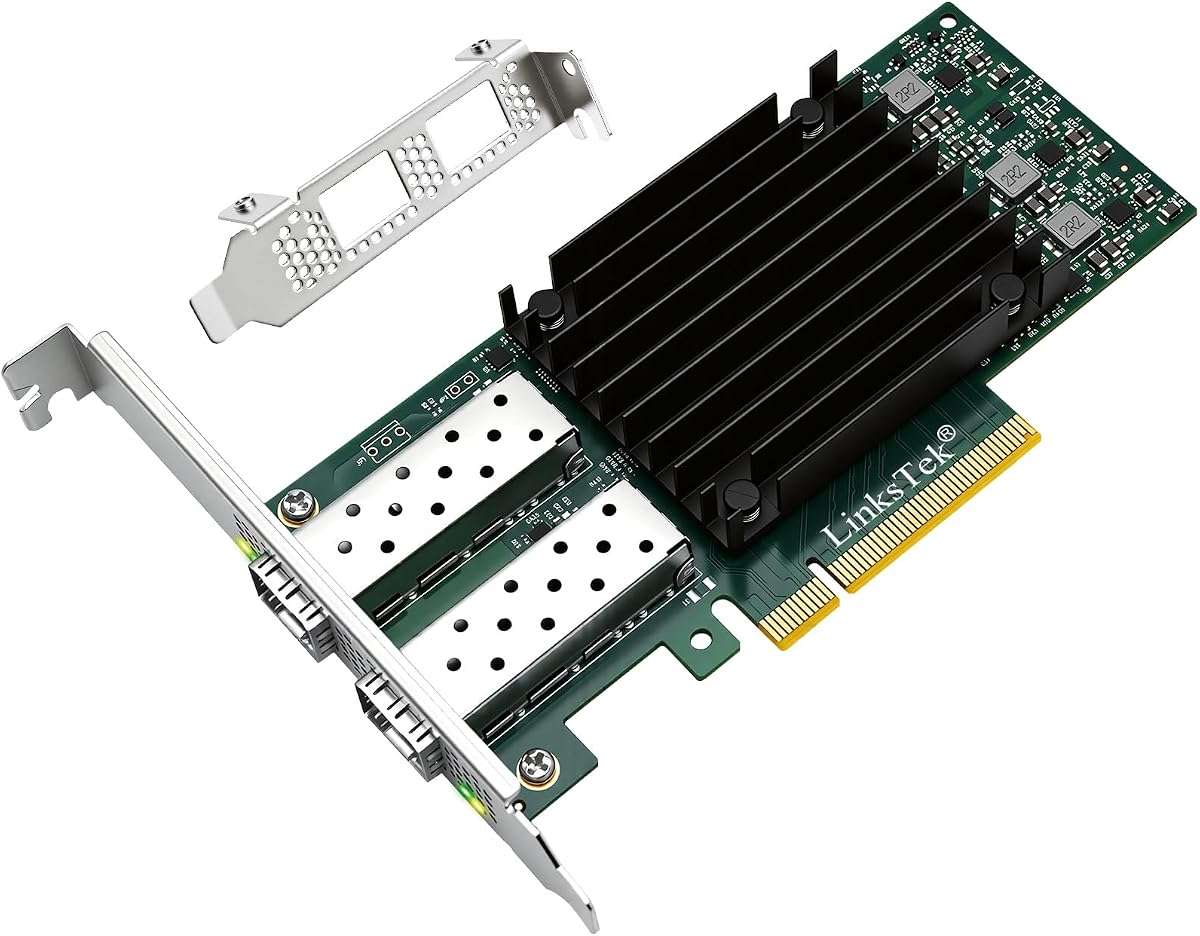
The LinksTek CX4121A is a dual-port 25GbE SFP28 adapter based on the Mellanox ConnectX-4 Lx EN MT27711A0 controller. Its 4.9 rating makes it one of the strongest-reviewed products here, and the specification list emphasizes RDMA over RoCE, I/O virtualization, SR-IOV, overlay networks, and a comprehensive set of network standards.
We may earn a commission when you buy through this link, at no additional cost to you.
The card's PCIe 3.0 x8 interface can carry the demands of both 25GbE ports, while its IEEE feature set includes Energy Efficient Ethernet, link aggregation, VLAN tagging, priority, flow control, timing, and jumbo frames up to 9.6KB. NVGRE, VXLAN, and GENEVE support helps it fit modern virtualized and container-oriented network architectures.
It offers broad host compatibility, including Windows 11, Windows 10, several Windows Server releases, RHEL, CentOS, FreeBSD, VMware, and other Linux-based systems. OFED and WinOF-2 are also supported. Compatible SFP28 transceivers, DAC cables, and AOC cables can be used with PAM4 Ethernet links, giving administrators flexibility in how the ports are connected.
The LinksTek is a particularly strong recommendation for storage servers, virtualization hosts, and engineers working with RDMA. It functions as a drop-in alternative to the MCX4121A-ACAT for server applications, according to the supplied information. Buyers should still validate the exact server layout, drivers, transceiver compatibility, and peer-network support for the RDMA protocol they intend to use.
RDMA over RoCE can reduce CPU involvement and latency when moving data between compatible systems. This makes the adapter well suited to storage aggregation, high-throughput compute, and tightly integrated virtualized workloads.
The extensive IEEE and overlay-network support makes the card more than a basic two-port Ethernet upgrade. The right configuration can support link aggregation, segmentation offload, virtualization, and modern tunneled networks.
We may earn a commission when you buy through this link, at no additional cost to you.
The Intel Ethernet Network Adapter XXV710-DA2 is a 25GbE PCIe adapter built for infrastructure-oriented workloads. It carries a 5.0 published rating and a PCIe 3.0 x8 interface, with compliance against the IEEE 802.3by and 25GbE specifications. Its standout characteristics are hardware offloads for virtualization, packet processing, and traffic steering.
We may earn a commission when you buy through this link, at no additional cost to you.
Intel Ethernet Flow Director provides hardware-based application traffic steering, while network virtualization offloads cover VXLAN, GENEVE, NVGRE, MPLS, and VXLAN-GPE with Network Service Headers. Dynamic Device Personalization is intended to improve packet-processing efficiency in network function virtualization and cloud deployments. DPDK optimization and strong small-packet performance are especially relevant to software routers and network appliances.
I/O virtualization innovations and intelligent offloads are designed to improve performance on servers using Intel Xeon processors. Adaptive link establishment is also included to support interoperability with other 25GbE switches and host controllers. Together, these features point toward a card selected for network infrastructure rather than a simple desktop upgrade.
This adapter is a good fit for administrators building high-throughput server or appliance-class systems where hardware steering and virtualization efficiency are priorities. The supplied information does not state the exact port arrangement, so buyers should confirm connector details and physical requirements from the complete product listing or manufacturer documentation before purchase.
Ethernet Flow Director can classify and steer traffic in hardware, reducing the processing burden on the host and helping maintain consistent performance under demanding traffic patterns.
DPDK optimization, small-packet performance, and I/O virtualization make the adapter relevant to NFV, cloud, and appliance workloads. The host platform and software stack must be prepared to take advantage of those capabilities.
We may earn a commission when you buy through this link, at no additional cost to you.
The GLOTRENDS ST7400 is an OCP 3.0 SFF 4C+ mezzanine adapter built for compatible servers and NAS platforms. It uses an original Intel E810-XXVAM2 controller and a PCIe 4.0 x8 connection, while providing two SFP28 ports with 25, 10, and 1GbE auto-negotiation. No customer rating is supplied, so its documented platform capabilities are the main basis for evaluation.
We may earn a commission when you buy through this link, at no additional cost to you.
Its OCP 3.0 form factor distinguishes it from standard full-height or low-profile PCIe cards. This is advantageous in compatible density-oriented servers, but it makes the card unsuitable for a typical desktop without the correct carrier and slot arrangement. The two ports can deliver up to 50Gbps aggregate bandwidth and work with MSA-compliant SFP28 modules, DAC cables, and AOC cables.
Advanced capabilities include IEEE 1588 PTP, iWARP, RDMA, RoCEv2, Intel Data Direct I/O, intelligent offloads, Storage over Ethernet, VMDq, PXE boot, DPDK, and 9.5KB jumbo frames. The controller also offers on-chip quality of service, traffic management, Flexible Port Partitioning, and PCI-SIG SR-IOV for cloud, NFV, and virtualization workloads.
The ST7400 is an excellent choice for an OCP-compatible server builder who wants current Intel E810 features and avoids vendor-locked transceiver choices. Its listed operating-system support includes major Windows, Windows Server, RHEL, SLES, Ubuntu, Debian, and FreeBSD releases, while macOS is excluded. Confirm chassis support, carrier requirements, cooling, and driver availability before ordering.
The SFF 4C+ mezzanine design is intended for servers and storage appliances that support the OCP 3.0 ecosystem. That specialization can be a major advantage in dense systems where a standard PCI card would be inconvenient or impossible to use.
Supporting MSA-compliant modules, DAC cables, and AOC cables avoids tying the adapter to one transceiver supplier. SFP28 modules are not included, so the complete deployment still requires suitable media and matching switch hardware.
We may earn a commission when you buy through this link, at no additional cost to you.
The Sonnet Twin25G T5 is a premium desktop adapter that brings two 25GbE connections to computers through Thunderbolt 5 rather than requiring an internal PCIe slot. It has a 5.0 published rating, supports Thunderbolt 5, Thunderbolt 4, Thunderbolt 3, and USB4 hosts, and includes two 25GBASE-SR SFP28 optical transceivers. That bundle makes it unusually ready for immediate deployment.
We may earn a commission when you buy through this link, at no additional cost to you.
The adapter is aimed at shared storage, media production, post-production, AI workflows, and other high-performance environments. It supports both 25GbE and 10GbE, allowing it to connect with existing 10GbE switches, servers, and NAS equipment before a complete 25GbE upgrade. Two Thunderbolt 5 ports are included, with the second able to support a peripheral and up to 15W of power delivery or a 6K display.
Its host compatibility is broad. It works with USB4 and Thunderbolt 5 and 4 computers, as well as Macs with Thunderbolt 3. The compact, nearly noiseless design is appropriate for offices, studios, editing suites, and other noise-sensitive spaces where a rack-oriented server adapter would be impractical.
This is the most complete premium choice for a creator, editor, or AI workstation that lacks accessible PCIe expansion. Including two transceivers and a Thunderbolt cable simplifies deployment, although users still need compatible fiber infrastructure and switches. It is less suitable for a server needing a conventional PCIe connection, and the host interface must support the necessary bandwidth for simultaneous 25GbE operation.
The Thunderbolt connection avoids the need to open a desktop or rely on a limited motherboard slot. That makes the adapter practical for compact workstations and for computers where the network upgrade needs to remain external.
Two 25GBASE-SR transceivers and a Thunderbolt 5 cable are included, reducing the number of separate accessories required for a basic deployment. The transceivers are designed for compatible fiber infrastructure rather than standard copper Ethernet.
We may earn a commission when you buy through this link, at no additional cost to you.
The Sonnet Twin25G PCIe adds two optical 25GbE connections to a computer with conventional expansion slots. Unlike the external Thunderbolt model, it is intended for installation inside a Mac, Windows, or Linux workstation. Two 25GBASE-SR SFP28 transceivers are included, and the adapter can also operate with 10GbE infrastructure.
We may earn a commission when you buy through this link, at no additional cost to you.
Its internal format is useful for systems with an available PCIe slot and enough physical clearance for the card and optical connectors. The included transceivers make it easier to begin with a compatible fiber network, while 10GbE support provides a path for gradual upgrades. The product is also suitable for use in Sonnet Thunderbolt expansion systems when a computer lacks internal card slots.
Compatibility needs careful attention. The supplied information states that the card supports Mac, Windows, and Linux, but it is not compatible with macOS 15.3.1 or 15.4, with an Apple update pending. That limitation makes operating-system version checking essential. No customer rating is supplied, so buyers should judge the product primarily on its documented hardware and current system support.
The Sonnet Twin25G PCIe is a strong option for creative or technical workstations that need dual optical 25GbE and can host an internal adapter. It is also useful in a Thunderbolt expansion chassis. Confirm the chassis dimensions, slot arrangement, driver support, and current macOS status before purchasing, particularly if the system is part of an active media workflow.
A conventional PCIe card can deliver a more integrated workstation configuration than an external adapter. It is especially attractive when shared storage or production infrastructure already uses SFP28 fiber.
Supporting 10GbE allows the card to work with existing switches and storage systems during a staged upgrade. The included 25GBASE-SR transceivers provide the path to full-speed fiber connectivity when the network side is ready.
We may earn a commission when you buy through this link, at no additional cost to you.
The Mellanox MCX512A-ACAT is a dual-port 25GbE SFP28 network interface card built on the ConnectX-5 EN platform. It carries a 4.0 rating and is described as an intelligent RDMA-enabled adapter with advanced application offload capabilities. Its intended use includes Web 2.0, cloud, storage, and telecommunications platforms.
We may earn a commission when you buy through this link, at no additional cost to you.
The combination of two SFP28 ports and a PCIe 3.0 x8 interface is appropriate for established data-center systems that need high-speed Ethernet without moving to a newer physical card format. RDMA support and intelligent offloads are the central advantages for storage, cloud, and application environments where efficient data movement and lower processor involvement are valuable.
The supplied product information is abbreviated, so the physical and protocol details should be verified before installation. The title identifies a tall bracket, which is important for chassis clearance. Older servers may have limited room around full-height cards, and buyers should check airflow, slot spacing, port accessibility, and the host's supported driver stack.
The MCX512A-ACAT remains a relevant choice for builders who specifically want the Mellanox ConnectX-5 platform and already understand its deployment requirements. It is less attractive for a simple desktop or workstation where easy installation, broad accessory availability, or a lower-complexity configuration would be the priority. A current compatibility check with the server vendor is essential.
The ConnectX-5 EN platform emphasizes intelligent offloading and RDMA-enabled operation. Those characteristics suit cloud, storage, and telecom systems in which network efficiency directly affects application performance.
A tall-bracket server card may conflict with compact chassis or tightly packed neighboring components. Check the server's supported adapter list and available clearance before ordering.
We may earn a commission when you buy through this link, at no additional cost to you.
The right 25GbE network card depends on more than link speed. Host interface, controller, physical format, transceiver arrangement, operating-system support, and intended traffic pattern all influence whether the adapter will work well.
The PCIe interface determines how much host bandwidth is available to the adapter and how much the card can benefit from a newer motherboard or server. Most dual-port cards in this guide use PCIe x8, which provides a sensible balance between two 25GbE links and compatibility with a range of systems. The 10Gtek and GLOTRENDS options specify PCIe 4.0 x8, while several Mellanox-based and Synology products use PCIe 3.0 x8. Check whether the computer offers the physical slot, whether the lane width is electrically x8, and whether the operating system can install the required driver.
In short, prioritize a card whose PCIe specification matches your host and workload rather than choosing by generation alone.
The controller determines more than maximum throughput. Intel E810, Mellanox ConnectX-4 Lx, and ConnectX-5 platforms provide hardware offloads intended to improve efficiency in storage, virtualization, and network function virtualization environments. Features such as Flow Director, SR-IOV, VMDq, DPDK optimization, RDMA, and application-specific offloads can materially reduce processor overhead. Conversely, a basic user transferring files to a NAS may gain little from those capabilities and need only a stable, compatible driver.
Choose the controller that aligns with the protocols and workloads your systems will actually use, including Windows, Linux, or virtualization software.
Two SFP28 ports offer more than a simple second connection. Depending on the card and system configuration, administrators can use them for failover, separate network paths, load balancing, or link aggregation. The QXG-25G2SF-E810 explicitly supports trunking and lists combined transfer speeds of up to 50Gbps. The Synology card also supports port failover and load balancing. Note that the two ports do not automatically double application throughput; the switch, operating system, workload, protocol, and configuration all influence the result.
Favor dual-port models when resilience or multiple network paths matter, but plan the switch and software configuration before expecting an immediate performance increase.
Most conventional server cards use SFP28 cages and do not include transceivers. Compatible equipment can include 25GBASE-SR optical modules, direct attach copper cables, or active optical cables, but each must match the port, distance, and standards of the connected switch. The Sonnet cards include two 25GBASE-SR SFP28 transceivers, while the GLOTRENDS card explicitly states that modules are not included. Confirm whether your existing infrastructure uses fiber or copper and whether it supports 25GbE per port.
Include compatible media in the total deployment plan; a fast adapter cannot deliver full 25GbE service without matching ports, cabling, and switches.
Hardware compatibility is only half the installation. The card's driver, firmware, and protocol support must work with the intended operating system and applications. Windows, Windows Server, Ubuntu, RHEL, CentOS, Debian, FreeBSD, VMware ESXi, and other environments are represented across the products here, but the exact versions can matter. The Synology adapter requires a specified DSM update, and the Sonnet PCIe card lists a current macOS limitation. The GLOTRENDS model notes that drivers are available from Intel's official site and excludes Mac OS.
Verify the exact OS release, driver source, management utilities, and virtualization platform before purchasing or installing any adapter.
A card that is electrically suitable can still be mechanically impossible to install. Standard PCIe options may have low-profile or full-height brackets, while the GLOTRENDS ST7400 uses the specialized OCP 3.0 SFF 4C+ mezzanine format. The MCX512A-ACAT is identified as using a tall bracket, and the QNAP card includes low-profile, full-height, and selected-model QNAP brackets. Measure chassis clearance, adjacent expansion cards, port access, and airflow. Thunderbolt and USB4 adapters avoid internal slot constraints but require a compatible external host connection.
Match the form factor to the chassis first, then confirm slot width, bracket type, connector placement, and cooling clearance.
RDMA and storage-related offloads can be decisive in high-performance environments. Cards based on Mellanox controllers commonly support RDMA over RoCE, while the 10Gtek and GLOTRENDS options list iWARP, RDMA, and RoCEv2. iSCSI, NFS, Storage over Ethernet, jumbo frames, and PTP can also matter for NAS and clustered storage. These protocols require compatible software, peer systems, and switches; installing a capable card alone does not activate the benefits. For standard office file transfer, a simpler card may be sufficient.
Prioritize advanced networking protocols when the entire path is RDMA-ready, and keep basic needs in mind when the card will only accelerate ordinary storage traffic.
A network card is only one part of a 25GbE system. The cost and effort of compatible switches, SFP28 media, cabling, host configuration, cooling, and driver support can exceed the adapter itself. Some products bundle transceivers and a Thunderbolt cable, while most require separate accessories. The Vogzone and LinksTek cards offer capable controller platforms at the lower end of this list, whereas the Sonnet options provide a more complete package for specific workstation formats. Evaluate the entire system rather than the adapter in isolation.
Build a complete compatibility list before buying, including the host, switch, media, operating system, and any management or RDMA software.
Before installation, power the computer down completely, disconnect the power cable, and use appropriate electrostatic-discharge precautions. Open the chassis, locate a compatible PCIe slot, remove the relevant rear-panel covers, and attach the correct bracket. Connect the card without forcing it into the slot, then restore power and enter the system firmware to confirm that the adapter and both network ports are detected.
Install the appropriate driver and management software from the controller vendor or operating-system source. Connect each SFP28 port to a compatible switch or peer using an approved 25GBASE-SR module, DAC cable, or AOC cable. Configure the expected link speed, verify that both ports appear in the operating system's network tools, and enable only the offloads, RDMA mode, VLAN, jumbo-frame, failover, or aggregation settings required by the network.
For ongoing care, keep the card and transceivers protected from dust, moisture, excessive heat, and direct physical damage. Check the system's airflow and ensure the port brackets do not obstruct neighboring components. After firmware, operating-system, or switch changes, retest throughput and link stability, and keep a record of compatible driver versions and transceiver models for troubleshooting.
Yes, for sustained 25GbE connectivity, the other end of the connection must support 25GbE. A 10GbE switch or server may permit the card to negotiate at a lower speed, depending on the network configuration. For a complete 25GbE path, use compatible switches, adapters, and SFP28 media throughout the connection.
It depends on the model. The two Sonnet products include 25GBASE-SR SFP28 transceivers, and the Sonnet Thunderbolt model also includes a Thunderbolt 5 cable. Most conventional server cards do not include transceivers, while the GLOTRENDS product explicitly notes that SFP28 modules are excluded. Check the included-accessories list before budgeting for optics and cables.
In many cases, yes, because the listed cards support 25, 10, and 1GbE operation per port. The card and switch must negotiate a common speed, and the resulting performance will be limited by the slower side. This makes 10GbE compatibility useful for a gradual upgrade path, but it does not create 25GbE performance on a 10GbE link.
A PCIe card installs in an internal expansion slot and may have broader integration with a workstation or server. A Thunderbolt adapter connects through an external Thunderbolt or USB4 port, making it more convenient for computers without accessible internal slots. The host connection, physical arrangement, included accessories, and intended computer category are the main practical differences.
No. RDMA support is a hardware capability, but usable RDMA also requires compatible drivers, host software, peer systems, and a properly configured RoCE or iWARP network. Switch support, quality of service, congestion behavior, and the relevant protocol must all be considered before expecting the performance benefits.
Not necessarily. Two ports can support failover, separate traffic paths, load balancing, or aggregation, but an application may remain limited by a single protocol flow, the host, the storage device, or switch configuration. A combined link also requires proper aggregation setup on both sides and compatible network infrastructure.
The Sonnet products are explicitly designed with Mac compatibility in mind, but the PCIe model's supplied information notes that it is not compatible with macOS 15.3.1 or 15.4, with an update pending. Other cards emphasize Windows, Linux, or NAS systems, and some do not support macOS at all. Check the current product support list and operating-system version before ordering.
Choose an OCP 3.0 adapter only when the server or NAS chassis provides a compatible SFF 4C+ mezzanine slot and mounting arrangement. Standard PCIe cards suit conventional desktop and server expansion slots but require the right bracket and physical clearance. Confirm chassis support rather than assuming that either format can be adapted to the other.
The QXG-25G2SF-E810 is the leading overall option for compatible QNAP systems because it combines dual SFP28 ports, Forward Error Correction, trunking, broad operating-system support, and multiple brackets. The Vogzone MCX4121A-ACAT offers the best budget-oriented balance for general server and virtualization use, while the LinksTek CX4121A stands out for its extensive RDMA, overlay, and standards support.
For workstation builders, the choice depends on hardware access. The Sonnet Twin25G T5 provides a premium external Thunderbolt route with transceivers included, while the Sonnet Twin25G PCIe card suits compatible Mac, Windows, and Linux systems with internal expansion slots. The GLOTRENDS ST7400 is purpose-built for OCP 3.0 platforms, and the Intel XXV710-DA2 emphasizes infrastructure-oriented hardware offloads.
Before purchasing, verify the complete 25GbE path rather than focusing only on the card: host slot or Thunderbolt support, current operating-system compatibility, switch ports, SFP28 media, intended offloads, and physical clearance. Prices and availability change over time, so compare current listings and confirm the latest manufacturer compatibility information before completing the purchase.
