
Denon AVR-S570BT
4.2Editor score
Five powered channels
Four HDMI 2.1 inputs
Bluetooth wireless streaming
Onscreen setup assistant
Explore the best 3 Zone AV Receiver picks comparing multi-room audio, immersive video, smart-home control, speaker layouts, and setup features for modern homes.
A 3 Zone AV Receiver is built for households that want more than one listening area to benefit from a central entertainment system. The best models combine powerful main-room amplification, flexible second- and third-zone connections, modern HDMI support, and convenient control. A capable three-zone design can serve a theater, living area, kitchen, or office without requiring several unrelated components.
The products in this guide were compared using the supplied specifications, ratings, channel configurations, zone capabilities, HDMI features, streaming functions, room calibration, and connectivity options. The list includes dedicated home theater receivers, a premium integration-focused model, and a two-channel stereo receiver whose A/B switching can operate speakers in separate areas. It also distinguishes receivers with explicit multi-zone support from models intended primarily for one main entertainment space.
Each review explains what stands out, where trade-offs appear, and which type of home setup may benefit most. The top picks emphasize the strongest balance of features, value, and dedicated multi-zone capability. Product availability and pricing can change, so readers should confirm current specifications, room requirements, and speaker compatibility before purchasing.
4.2Editor score

4.1Editor score
4.2Editor score
This side-by-side comparison highlights channel power, immersive audio, HDMI capability, zone support, wireless features, and setup conveniences. Because only some models explicitly provide dedicated second- and third-zone distribution, buyers should match the receiver to their actual room plan rather than relying on channel count alone.


The Onkyo TX-NR6100 is the most practical all-around recommendation in this guide for a home that needs a serious main room and at least one secondary listening or viewing area. Its 4.1 rating reflects a capable feature set rather than an across-the-board premium specification list. The 7.2-channel amplifier, 210 watts per channel under the stated THX Certified Select Dynamic Audio Amplification specification, and support for 5.2.2-channel Dolby Atmos and DTS:X make it a natural center for modern home theater use.
We may earn a commission when you buy through this link, at no additional cost to you.
Its most important feature for this keyword is the discrete Zone 2 audio and video output. That allows the main theater and another room to receive content simultaneously without requiring the secondary area to share the main room's speaker set. The main room can also use an object-based surround configuration, while the separate zone benefits from its own source and speaker arrangement. This is a more relevant distinction for multi-room living than simply finding a receiver with a large speaker-terminal count.
Video support is equally forward-looking. Three HDMI 2.1 inputs provide 40 Gbps bandwidth, and the receiver supports 8K video. That makes the Onkyo a sensible hub for a television, game console, media player, and streaming device, although actual picture features depend on the television, source, cable, and selected input. THX Select certification adds a clear quality marker, while Dolby Atmos and DTS:X cover the two major object-based audio ecosystems represented in the supplied specifications.
The main compromise is that the TX-NR6100 does not explicitly offer a third zone. Buyers whose plan requires three independently controlled areas may need to look at the Sony STR-AN1000 instead. For most people seeking a capable main theater with one additional media area, however, the balance of amplification, Zone 2 video, 8K HDMI, and immersive decoding is difficult to dismiss. It is the strongest general-purpose choice for the stated category.
Discrete Zone 2 audio and video make this receiver useful when the main room and a secondary room need different content. The main zone retains the full 7.2-channel configuration, while the additional area can operate as a separate entertainment space.
Three HDMI 2.1 inputs with 40 Gbps bandwidth support an 8K-oriented setup and leave room for multiple source devices. It is especially relevant for buyers building a television and game system around current high-resolution standards.
We may earn a commission when you buy through this link, at no additional cost to you.
The Yamaha RX300A is an approachable home theater receiver for users who want modern cinematic sound and flexible speaker placement without moving to a high-end model. Its 4.0 rating reflects a straightforward 5.2-channel design that expands to supported 3.1.2 layouts using up-firing or in-ceiling height speakers. The supplied specifications describe 70 watts of authoritative power, Dolby Atmos, and DTS Virtual:X, giving the receiver useful immersion options in a comparatively simple package.
We may earn a commission when you buy through this link, at no additional cost to you.
Its speaker-layout flexibility is one of its most attractive qualities. The main system can begin with five powered channels and a subwoofer, then add compatible height channels to create a 3.1.2 configuration. That gives a buyer an incremental path to Dolby Atmos rather than requiring the entire layout to be selected on day one. The inclusion of a setup microphone is also important because it allows the receiver to measure room acoustics and speaker characteristics before optimizing playback.
Video and convenience features are competitive for this class. The receiver supports 4K at 120 Hz and 8K at 60 Hz, along with Dolby Vision, HDR10+, HDMI eARC, ALLM, and VRR. Bluetooth Multipoint can maintain connections to two source devices, making it easier to move between music, podcast, or audiobook playback. An intuitive guide, onscreen settings, and four custom scene presets reduce the learning curve for a new owner.
This is not the most literal answer to a strict three-zone requirement because no dedicated second- or third-zone outputs are listed. It is better viewed as an excellent single-room receiver that can be paired with separate wireless or powered audio equipment in other areas. Buyers seeking one central receiver for immersive home cinema should consider it a strong value-oriented choice, while literal multi-room integrators should prioritize one of the models with explicit zone distribution.
The ability to configure up to 3.1.2 channels with up-firing or in-ceiling heights gives owners flexibility as their room or speaker plan evolves. It is a practical alternative to paying for more amplification channels before every planned speaker position is ready.
The included setup microphone measures the listening environment and speaker characteristics, then optimizes sound performance. That makes the receiver more approachable for installers and first-time home theater owners.
We may earn a commission when you buy through this link, at no additional cost to you.
The JBL MA310 offers a simple, uncluttered approach to 5.2-channel home theater and music playback. Its 4.0 rating, five powered channels, and stated 60 watts per channel place it squarely in the straightforward surround-sound category. The receiver decodes Dolby and DTS formats natively, which covers the core surround experience for movies, television, and gaming without introducing a more complex object-based speaker arrangement.
We may earn a commission when you buy through this link, at no additional cost to you.
Connectivity is the MA310's most important strength. Four HDMI inputs and one HDMI output provide enough switching for several common source devices, and ARC is included for television connectivity. Bluetooth 5.1 with Low Energy enables convenient wireless music streaming. Rather than emphasizing a broad collection of network services, the model concentrates on the essentials most often needed in a conventional living-room or secondary media setup.
The design also gives JBL room to focus on its established strengths in music and home audio. The supplied description says the receiver was designed to bring both music and movies to life with high fidelity. That makes it appealing to buyers who want a home theater component that can also serve casual listening and connected audio without requiring a separate amplifier for every basic use.
Its limitation for this guide is obvious: no dedicated second- or third-zone output is identified. The MA310 is therefore better viewed as the core of a single-room system than as a complete three-zone solution. A household that wants one receiver to manage several wired areas should look for explicit zone support. For a compact 5.2 setup, the JBL remains a tidy and approachable option with ample HDMI switching.
The five-channel amplifier and native surround decoding cover the essential home theater arrangement without requiring height-speaker planning. It is a straightforward option for a living room with a television, game console, and media player.
Four HDMI inputs make it easier to connect a television, game console, streaming box, and disc source. ARC adds a convenient return path for compatible television audio and reduces the need for extra cabling.
We may earn a commission when you buy through this link, at no additional cost to you.
The Denon AVR-S570BT is a compelling budget-focused receiver for buyers who want current video standards, wireless music, and a familiar guided setup without paying for a large high-end amplifier. Its 4.2 rating makes it one of the better-rated products in the comparison. The receiver offers 70 watts per channel across five channels and provides four HDMI 2.1 inputs, one HDMI output, and eARC support up to 40 Gbps.
We may earn a commission when you buy through this link, at no additional cost to you.
Its HDMI section is the standout feature for a value-oriented model. The supplied specifications describe 8K/60 and 4K/120 passthrough, while support for Dolby Vision, HDR10+, Dynamic HDR, HLG, VRR, and Quick Frame Transport targets modern televisions and gaming. The receiver also decodes Dolby TrueHD, DTS-HD Master, Dolby Atmos, and 5.1 surround audio, allowing it to serve as the central hub for a broad range of entertainment sources.
Setup and control are designed to reduce complexity. An onscreen HD Setup Assistant guides users through connections, while specific EQ settings help optimize the sound for movies, music, television, or gaming. The receiver can work with a compatible Smart TV remote, and the Denon Remote App provides iOS and Android control. Bluetooth and wireless music services such as Spotify, TIDAL, and Pandora add value beyond the main theater.
Although it is presented as a 5.2-channel receiver with only two main powered channels, the preamp can support additional connected speakers through suitable output connections, although the supplied data does not specify those details. It also lacks explicit dedicated Zone 2 or Zone 3 outputs. Its budget badge therefore reflects value and core capability rather than literal three-zone distribution. For a polished main room, it is a strong starting point.
Four HDMI 2.1 inputs and support for 8K/60 and 4K/120 passthrough give the receiver useful modern video headroom. It can accommodate several high-resolution source devices without settling for a single upgraded input.
The onscreen HD Setup Assistant simplifies initial configuration, while TV-remote integration and the Denon app make everyday operation convenient. These details can matter as much as raw specifications for a receiver that multiple household members may use.
We may earn a commission when you buy through this link, at no additional cost to you.
The Yamaha RX-A2A AVENTAGE combines a 7.2-channel main-room amplifier with dedicated Zone 2 support, making it a strong choice for buyers who want Yamaha's premium receiver design and extensive music ecosystem. Its 4.3 rating is the second-highest in this group. The receiver supports Dolby Atmos and DTS:X, while YPAO R.S.C. multipoint measurement and Surround:AI provide a more refined approach to setup and real-time sound optimization.
We may earn a commission when you buy through this link, at no additional cost to you.
Its HDMI configuration is generous. Seven inputs and one output support HDCP 2.3 and eARC, with all inputs supporting 4K60. Three inputs specifically support 8K60B and 4K120AB, and ALLM and VRR cover important current gaming functions. Dolby Vision, HDR10+, HLG, and BT.2020 support make it a capable video centerpiece, particularly for households with a recent television and multiple high-bandwidth sources.
Network features are another major attraction. Wi-Fi, Bluetooth, AirPlay 2, Spotify Connect, and MusicCast are joined by broad service support including Apple Music through AirPlay 2, Amazon Music HD, SiriusXM, TIDAL, Pandora, Deezer, and Qobuz. Roon Tested support and compatibility with a separately sold Sonos Port extend its integration possibilities. A phono input also makes it easier to combine the receiver with a turntable.
For a literal three-area installation, the lack of an explicit third zone keeps it behind the Sony STR-AN1000. Even so, the RX-A2A is a premium and flexible choice for a main theater plus one additional area. It is best suited to buyers who value calibration, music services, premium construction, and a larger switching platform more than the highest possible channel count.
YPAO R.S.C. with multipoint measurement analyzes the room from multiple positions and helps optimize the output. Surround:AI is designed to adjust sound and effects in real time as content changes.
MusicCast, AirPlay 2, Spotify Connect, and numerous streaming services make the receiver useful beyond movies. The included phono input also supports a direct turntable connection for music-focused listeners.
We may earn a commission when you buy through this link, at no additional cost to you.
The Sony STRDH190 is the highest-rated product in this comparison and serves a different purpose from the home theater receivers around it. It is a two-channel stereo receiver designed primarily for music, traditional hi-fi listening, and a practical multi-room speaker arrangement. Its 4.5 rating reflects a well-regarded approach to straightforward amplification, connectivity, and usability rather than an attempt to provide cinematic surround processing.
We may earn a commission when you buy through this link, at no additional cost to you.
The receiver delivers 100 watts per channel at 8 ohms and 1 kHz under the stated conditions, with a supported speaker impedance of 6 to 16 ohms. It includes a phono input, four stereo RCA audio inputs, a 3.5 mm input, and an RCA output. Those connections make it a natural central amplifier for a turntable, CD player, television, game console, or other analog and digital source.
Its closest relationship to the three-zone theme comes through A/B speaker switching. The receiver can connect up to four speakers and play all of them together or assign them to separate zones. This is not equivalent to a modern AV receiver with independently processed surround channels, but it can support a main stereo area and a secondary stereo area with the right speaker arrangement and amplifier limitations. For many homes, that level of distribution is enough.
Bluetooth music streaming, an FM radio with 30 presets, a headphone jack, and a low-profile enclosure add everyday convenience. The trade-off is substantial: there is no listed Dolby Atmos, DTS:X, 8K HDMI, gaming, or advanced room calibration. Buyers who need cinematic object-based audio should choose a home theater model. Those who primarily want music, turntable support, and two stereo areas will find this focused receiver unusually versatile.
A/B switching allows up to four connected speakers to operate together or in separate zones. It is a simple solution for a main music area and another stereo space when independent surround processing is unnecessary.
The phono input, four stereo RCA inputs, 3.5 mm connection, and RCA output provide flexible paths for turntables and other traditional audio equipment. The 100-watt-per-channel specification adds useful power for a dedicated stereo setup.
We may earn a commission when you buy through this link, at no additional cost to you.
The Yamaha RX-V4A delivers a well-rounded mix of modern video, connected music features, and automatic room calibration in a 5.2-channel receiver. Its 3.8 rating is the lowest among the listed products, so buyers should not interpret it as a flawless all-purpose choice. It remains a capable option for a main room, particularly when MusicCast, AirPlay 2, voice control, and current HDMI standards are priorities.
We may earn a commission when you buy through this link, at no additional cost to you.
Its four-input, one-output HDMI configuration supports HDCP 2.3, eARC, 4K60, 4K120AB, and 8K60B with HDMI 2.1. Dolby Vision, Hybrid-Log Gamma, and BT.2020 are included for compatible television use. Audio decoding covers Dolby TrueHD, Dolby Digital, and DTS-HD Master Audio, providing the essential lossless and surround formats expected in a home theater receiver.
Music and smart-home integration are particularly strong. The receiver supports dual-band Wi-Fi, AirPlay 2, MusicPlay for iOS and Android, and Spotify Connect. It lists Pandora, Spotify, Napster, SiriusXM, TIDAL, Deezer, Qobuz, and Amazon Music HD. Alexa, Google Assistant, and Siri through AirPlay 2 provide additional ways to control playback, while YPAO automatically calibrates the system for the room.
The main limitation is the lack of explicit zone outputs. It is designed as a conventional 5.2-channel main-room receiver rather than a wired multi-area hub. A household wanting a dedicated second or third area should consider the Onkyo or Sony alternatives. For a straightforward home theater with extensive streaming services, however, the RX-V4A delivers a familiar and capable feature package.
MusicCast, AirPlay 2, MusicPlay, Spotify Connect, and a broad service list give the receiver flexibility for everyday listening. Voice-control compatibility adds another convenient layer for compatible household devices.
YPAO automatic room calibration is intended to create a more accurate sound field for the installed speakers and room. It simplifies setup for owners who may not be comfortable adjusting surround parameters manually.
We may earn a commission when you buy through this link, at no additional cost to you.
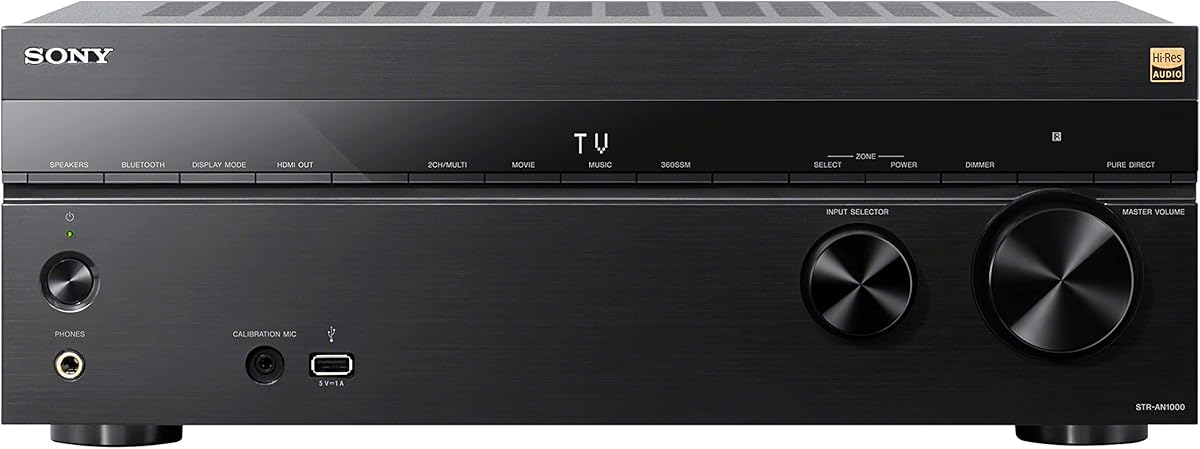
The Sony STR-AN1000 is the clearest literal match for the 3 Zone AV Receiver concept in this comparison. Its supplied specifications explicitly identify both Zone 2 and Zone 3, giving it the strongest dedicated multi-room distribution of the ten products. The main theater receives a 7.2-channel amplifier, while the additional zones can serve separate areas with their own source choices.
We may earn a commission when you buy through this link, at no additional cost to you.
Its 4.2 rating reflects a capable combination of home theater and connected features. Power is listed at 165 watts at 6 ohms, 1 kHz, and 1-channel THD of 0.9%. Dolby Atmos and DTS:X decoding bring object-based sound to the main room, while Digital Cinema Auto Calibration IX and 360 Spatial Sound Mapping handle room correction and spatial effects.
Video connectivity is among the best in the guide. Six HDMI 2.1 inputs and two outputs support 8K and 4K/120 content, while Dolby Vision, HDR10, Hybrid Log Gamma, and IMAX Enhanced cover major HDR formats. The two-output configuration can also help organize more complicated television arrangements, depending on the equipment and installation.
Streaming and smart-home features are comprehensive. Bluetooth, Wi-Fi, built-in Chromecast, Spotify Connect, and Apple AirPlay provide convenient access to music and network services. Works with Sonos adds integration with an existing system, and Google Assistant compatibility is listed. Two HDMI outputs should not automatically be read as two dedicated zone video feeds, because the supplied data does not state that Zone 3 includes video. Even so, the explicit Zone 2 and Zone 3 audio distribution makes this the most literal premium answer to the keyword.
Unlike receivers that merely offer a main surround system, the STR-AN1000 explicitly supports Zone 2 and Zone 3. It is the strongest option here when independently controlled audio in three areas is the central requirement.
A 7.2-channel main amplifier, Dolby Atmos, DTS:X, automatic calibration, and spatial sound mapping create a capable foundation for the primary viewing room. The additional zones allow that theater-level experience to coexist with background listening elsewhere.
We may earn a commission when you buy through this link, at no additional cost to you.
The Denon AVR-X1700H combines a 7.2-channel amplifier, advanced video processing, HEOS streaming, and home-automation support in a well-rounded receiver. Its 4.4 rating is the second-highest in the guide. The main amplifier is rated at 80 watts per channel, and the receiver supports Dolby Atmos, DTS:X, DTS Virtual:X, and Dolby Atmos Height Virtualization for listeners who do not yet have physical height channels.
We may earn a commission when you buy through this link, at no additional cost to you.
Its HDMI section is especially flexible. There are six inputs and one output, with three dedicated 8K inputs. The specification supports 8K/60 and 4K/120 passthrough, 8K upscaling on all six inputs, 4:4:4 Pure Color Sub Sampling, HDR10, HDR10+, Dolby Vision, and HLG. That combination makes it well suited to a modern television, game console, and mixed source library.
Multi-room and smart-home functions make the AVR-X1700H particularly relevant to a connected household. HEOS, Wi-Fi, AirPlay 2, and Bluetooth allow music to be played in a different zone while a movie continues in the main room. External control and IP control capabilities support integration with home automation systems, while remote monitoring adds another layer of system management.
The AVR-X1700H does not explicitly list dedicated Zone 2 and Zone 3 outputs, so buyers should not equate its multi-room streaming description with the Sony's hardwired three-zone distribution. Two pre-outs allow connection to additional subwoofers when required, but that is a bass-extension feature rather than a full extra-zone amplifier. Within those boundaries, it is an excellent connected receiver for a sophisticated main theater and background music.
Built-in HEOS, Wi-Fi, AirPlay 2, and Bluetooth support background listening in another zone while the main room remains occupied with a film. This is ideal for households where the theater and common living areas need different audio.
Three dedicated 8K inputs, 4K/120 passthrough, and upscaling across all six inputs provide useful headroom for current displays and game consoles. The broad HDR support improves compatibility with premium televisions.
We may earn a commission when you buy through this link, at no additional cost to you.
The Sony STRAZ3000ES is a premium ES receiver aimed primarily at custom home installations and owners who want extensive amplification, sophisticated control, and a large-scale main theater. Its 4.0 rating reflects a specialized product rather than a simple all-purpose bargain. The 9.2-channel configuration and stated 120 watts per channel into 8 ohms for two channels provide substantial headroom for a demanding system.
We may earn a commission when you buy through this link, at no additional cost to you.
Immersive sound is a central focus. Dolby Atmos and DTS:X decoding are supported, while Digital Cinema Auto Calibration IX and 360 Spatial Sound Mapping are designed to optimize the main theater. Video support includes six HDMI 2.1 inputs, two outputs, 8K and 4K/120 connectivity, Dolby Vision, HDR10, Hybrid Log Gamma, and IMAX Enhanced. The input count is particularly useful for a heavily equipped media rack.
Its defining strength is installation flexibility. Seamless IP Control integration with leading control systems makes the receiver easier to incorporate into a professionally programmed home. The built-in graphical user interface and front-panel display support both guided setup and direct operation. Works with Sonos, Google Assistant, Wi-Fi, Bluetooth, built-in Chromecast, Spotify Connect, and Apple AirPlay broaden the connected ecosystem.
Although the specification refers to a 9.2-channel amplifier, it does not explicitly identify dedicated Zone 2 and Zone 3 outputs. Buyers requiring three independently wired listening areas should examine the STR-AN1000 more closely. The STRAZ3000ES is best for a premium main room paired with broader connected audio solutions. Its strengths make it a serious choice for custom integrators and technically confident enthusiasts who prioritize control, channel capacity, and video flexibility.
Seamless IP Control support allows the receiver to participate in a professionally configured home-automation system. The graphical interface and front-panel display make both initial setup and direct control accessible.
A 9.2-channel configuration, substantial stated power, object-based decoding, automatic calibration, and spatial mapping target large or highly immersive home theaters. Two HDMI outputs and six inputs also offer flexibility for a source-heavy installation.
We may earn a commission when you buy through this link, at no additional cost to you.
The right receiver depends on how many areas need independent audio, how many speakers each area can support, which video standards matter, and how much control the rest of the home requires. Reviewing those needs before comparing models prevents a costly mismatch between a powerful theater receiver and a limited room plan.
A receiver marketed for multiple rooms should specify how the extra areas are powered and controlled. The Sony STR-AN1000 explicitly lists Zone 2 and Zone 3, the Yamaha RX-A2A includes Zone 2, and the Onkyo TX-NR6100 provides discrete Zone 2 audio and video. Other models support multi-room music streaming, but that does not necessarily mean they contain dedicated amplified zone outputs. A buyer expecting three sets of wired speakers should require at least two independently controlled secondary zones or plan to add external amplification.
Choose explicit zone outputs when each room needs its own volume control and source. Multi-room streaming features are sufficient when secondary areas are primarily for music and can rely on wireless or separately powered speakers.
The main room usually deserves the largest speaker investment, so its amplifier should match the intended layout. A 7.2-channel receiver can drive five surround speakers, two additional channels, and a subwoofer in a typical configuration, while supporting height channels for object-based sound where appropriate. The Denon AVR-X1700H, Onkyo TX-NR6100, Yamaha RX-A2A, and Sony STR-AN1000 all use 7.2-channel main-room designs. The Sony STRAZ3000ES offers 9.2 channels for buyers who need even greater main-room capacity.
Do not buy a larger channel count merely for the number alone. Speaker placement, room dimensions, and usable amplification matter more than a headline specification. Confirm that the receiver can support the exact layout and the secondary-zone arrangement you intend to install.
Current home theaters may include an 8K television, high-refresh-rate gaming, HDR video, and several source devices. Receivers with HDMI 2.1, 40 Gbps bandwidth, 4K/120, VRR, and ALLM are better aligned with that equipment. The Denon AVR-S570BT provides four HDMI 2.1 inputs, the AVR-X1700H provides six total inputs with three dedicated 8K inputs, and the two premium Sony models use six-input, two-output HDMI arrangements. eARC support can also simplify television audio return.
Match the number of inputs to the number of sources you actually own or plan to own. A receiver with enough current bandwidth but too few inputs can still create inconvenient switching, while excessive unused inputs add cost without improving the installation.
Dolby Atmos and DTS:X are the key immersive audio formats in this category, but decoding alone is only part of the equation. The receiver must also support the number and placement of channels in the room, and the included calibration system should be capable of adjusting the result. The Onkyo supports 5.2.2-channel playback, the Yamaha RX300A supports flexible 3.1.2 layouts, and the Denon AVR-X1700H adds Dolby Atmos Height Virtualization for rooms that do not yet have physical height speakers.
For a new installation, physical height speakers generally provide a more direct route to object-based immersion. Virtualization can be useful when speaker placement is limited, but buyers should understand the difference before treating it as equivalent to a full height-channel layout.
Room correction can materially improve clarity, imaging, and bass integration because furniture, dimensions, and speaker placement affect every installation. Yamaha models use YPAO, with the RX-A2A offering multipoint measurement, while Sony's premium receivers use Digital Cinema Auto Calibration IX. The Yamaha RX300A includes a setup microphone and automatic optimization, and the Denon receivers provide guided EQ setup. These systems reduce the need to rely entirely on manual trial and error.
Look for a calibration process that is clear and appropriate to your skill level. A well-guided system can produce a more convincing result, while color-coded rear connections and onscreen instructions make installation easier to verify.
A receiver used for whole-home entertainment should do more than process movie sound. Bluetooth is standard across much of this list, while the Yamaha RX-A2A, Yamaha RX-V4A, Denon AVR-X1700H, and Sony receivers provide Wi-Fi and major streaming services. AirPlay 2, MusicCast, HEOS, Spotify Connect, Chromecast built in, and voice-control support can make daily use more convenient. The Sony STRDH190 focuses on traditional stereo sources and adds a phono input instead of a broad network platform.
Choose the control ecosystem that matches the devices already in the home. A feature is only useful when the relevant speaker, display, automation controller, or voice service can communicate with the receiver. Confirm compatibility before finalizing a multi-room plan.
Custom-installed systems may require more than the standard remote or phone app. The Denon AVR-X1700H supports external control, IP control, and remote monitoring, while the Sony STRAZ3000ES is specifically optimized for IP control integration with leading control systems. The Yamaha RX-A2A supports a separately sold Sonos Port, and the Sony STR-AN1000 and STRAZ3000ES also list Works with Sonos capability. These functions can be decisive for builders coordinating lighting, shades, televisions, and audio.
Simple households will rarely need to manage all of these functions. Consult an installer when the receiver must control or coordinate with a broader automation system, and ensure that the chosen control platform supports the required commands.
The receiver is only one part of a functional multi-room system. Zone speakers, speaker wire, cables, an HDMI switch if needed, and external amplification for additional areas may be required. A compact five-channel receiver may be sufficient for a modest living room, while a 7.2- or 9.2-channel model offers more flexibility for a dedicated theater. Powered or wireless speakers can simplify secondary areas, but they may not support the same format and switching options as wired zone outputs.
Create a complete equipment list before purchasing the receiver. Include the intended channels in every room, television connections, source devices, control system, and any required amplifiers. This prevents choosing a technically capable receiver that cannot feed the planned speaker layout.
Begin by identifying the receiver's main room, secondary zone, and optional third zone, then connect the appropriate speakers to the labeled outputs. Follow the onscreen setup guide, select the correct channel configuration, and run the included room calibration microphone from the primary listening position. This is especially important for Dolby Atmos, DTS:X, and surround layouts because incorrect channel mapping or level balance can reduce the intended effect.
Assign sources deliberately rather than changing inputs constantly. Use the receiver's source controls, included remote, supported TV remote integration, or manufacturer app to select television, game console, streaming device, and music services. When using multiple zones, confirm that the main room and each secondary area have their intended content, volume, and playback status. Grouping or naming functions, where available, can make everyday operation easier for multiple household members.
Protect the receiver and connected equipment by allowing ventilation around its enclosure, keeping it away from moisture and excessive heat, and avoiding paper or other material covering the ventilation openings. Use the supplied or appropriately specified power and signal cables, and check that speaker impedance matches the receiver requirements. Firmware and software updates can improve compatibility and fix issues, so the manufacturer's support pages should be checked periodically and any zone configuration should be reconfirmed after a major update.
A multi-room receiver can distribute audio beyond the main room, but it may rely on wireless speakers, separate streaming devices, or network-based playback rather than dedicated zone outputs. A 3 Zone AV Receiver is expected to manage three distinct areas with independent source and volume control. Confirm whether each extra zone is amplified, supports video, and accepts the formats required by that room.
The Sony STR-AN1000 explicitly lists both Zone 2 and Zone 3 for flexible multi-zone distribution. The Onkyo TX-NR6100 provides discrete Zone 2 audio and video, while the Yamaha RX-A2A has Zone 2 support. Other products may support multi-room music streaming without providing equivalent dedicated second- and third-zone amplifier sections.
No. The primary theater benefits most from a full immersive layout, while secondary zones often use two speakers and do not require height channels. Some receivers, including the Yamaha RX300A and Denon AVR-X1700H, offer flexible layouts or height virtualization, but the best result depends on speaker placement, room size, and the formats played in each area.
That depends on the receiver's zone controls and the equipment connected to each area. A receiver with explicit Zone 2 and Zone 3 outputs can assign different sources to the additional rooms. Wireless speakers, separate amplifiers, and compatible streaming systems may provide alternatives when the receiver lacks dedicated outputs, but installation complexity and control convenience vary.
It means the receiver's video section can accept the specified 8K signals and pass them to a compatible display, subject to the input, bandwidth, source, and television. It does not mean every source produces 8K content, nor does it guarantee a visible improvement. A native 8K source, suitable cable, capable display, and room viewing distance all influence the result.
Room calibration is highly useful because furniture, room dimensions, reflections, and speaker placement affect sound in every listening area. It can improve channel balance and overall coherence in the main theater. Secondary zones still need their levels checked after installation, and calibration should be repeated if speakers, furnishings, or room use changes significantly.
A 5.2-channel receiver is suitable for a straightforward system with five main speakers and a subwoofer. A 7.2-channel model offers greater flexibility for height effects, additional surround playback, and premium theater layouts. The best choice depends on your actual speaker plan rather than on the number of channels alone.
Verify that the receiver has the required number of zone outputs, check the supported speaker impedance, and confirm whether the zone carries video as well as audio. Also plan cable routing, independent volume control, source availability, and any need for an external amplifier. Installing the receiver and speakers before finalizing these details can lead to unnecessary rework.
The Onkyo TX-NR6100 is the most well-rounded recommendation for a 7.2-channel main room with discrete second-zone audio and video, while the Denon AVR-S570BT stands out as the budget-minded route to modern HDMI and convenient setup. The Sony STR-AN1000 is the strongest literal three-zone option because it explicitly supports Zone 2 and Zone 3 while preserving a capable main theater.
Prioritize actual zone outputs over the broad idea of multi-room support, then match the main amplifier to the speaker layout, television standards, gaming features, room calibration, and control ecosystem. A simple household may need only one additional amplified area, while a custom installation may require two. The right receiver is the one that supports the intended rooms without forcing unnecessary complexity or extra equipment.
Product specifications, availability, and pricing can change, so check the current listing and manufacturer documentation before buying. Confirm zone assignments, speaker impedance, HDMI requirements, room calibration options, and the availability of every intended source. Those final checks will make the chosen 3 Zone AV Receiver easier to install and more useful every day.