
Bambu Lab P1S
4.5Editor score
Fully enclosed print chamber
Capable with PC and PA
Automatic bed leveling
Our guide compares 10 of the best 3D printer for high temperature filaments, including hotends, heated chambers, speed, and multi-tool features for makers.
A 3D printer for high temperature filaments must do more than reach a high nozzle temperature. It also needs a stable hot end, strong bed heating, effective enclosure control, and a filament path that can handle demanding polymers. The right combination improves layer bonding, reduces warping, and makes materials such as ABS, ASA, PC, PA, and reinforced filament more practical.
This guide compares ten FDM printers using the specifications and features supplied for each model. We focus on hot-end temperatures, heated-bed and chamber support, enclosure design, extrusion systems, motion systems, multi-material capability, automatic functions, and build volume. Because material compatibility varies by brand, filament, and machine configuration, each review also notes important limitations rather than treating a maximum temperature as a blanket guarantee.
The list shows how different approaches serve different needs, from compact beginner-friendly machines to enclosed four-toolhead systems designed for engineering workflows. The top selections emphasize the strongest balance of heat management, reliability, and usability, while the remaining reviews cover worthwhile alternatives. Product specifications and availability can change, so readers should confirm the current configuration and filament requirements before purchasing.
4.5Editor score

4.7Editor score

4.4Editor score
The comparison below highlights the major hardware differences that matter for high-temperature printing: thermal capability, enclosure control, motion performance, build volume, and multi-material flexibility.


The Bambu Lab P2S Combo earns the leading position because it combines enclosure-based printing, adaptive heat management, automatic setup, fast motion, and integrated filament drying in one polished package. Its supplied rating is 4.7, reflecting strong customer reception. The important point for this category is not simply whether the machine can heat; it is whether the entire system can keep temperature stable while protecting the print and the surrounding air.
We may earn a commission when you buy through this link, at no additional cost to you.
Its standout feature is the Adaptive Airflow System, which balances cooling against heat retention. According to the supplied information, it can maintain a 50°C chamber for engineering-grade materials while still directing cool airflow toward overhangs. The AMS 2 Pro adds built-in filament drying up to 65°C, a meaningful advantage when moisture-sensitive polymers must be prepared before printing. Four-color capability is also included through the combo configuration, although the printer itself does not perform multicolor printing without it.
The P2S reaches up to 600 mm/s and uses a PMSM Servo Extruder with Active Flowrate Compensation to preserve layer accuracy. Setup is designed to take about 15 minutes, while AI failure detection, quick-swap nozzles, and automatic calibration reduce setup friction. The trade-off is that the product data does not state a specific maximum nozzle temperature, so buyers needing a published figure for a particular polymer should verify the current technical specifications and filament guide before ordering.
This is the most balanced recommendation for makers who want high-temperature capability without managing a complex industrial machine. It is particularly attractive for ABS, ASA, and compatible engineering-grade workflows that benefit from chamber heat and filtration. The combo package is more involved than a single-tool starter printer, but it offers the strongest all-around combination of thermal control, speed, convenience, and material flexibility in this roundup.
High-temperature materials are most reliable when the chamber, bed, and nozzle work together. The P2S's adaptive airflow and 50°C chamber capability help reduce temperature swings, which is especially valuable when warping would otherwise compromise small details or larger surfaces.
The AMS 2 Pro is especially relevant to demanding filaments because its built-in drying reaches 65°C. It also enables seamless multicolor and multimaterial prints, allowing a single machine to handle color changes without manually replacing filament throughout the build.
We may earn a commission when you buy through this link, at no additional cost to you.
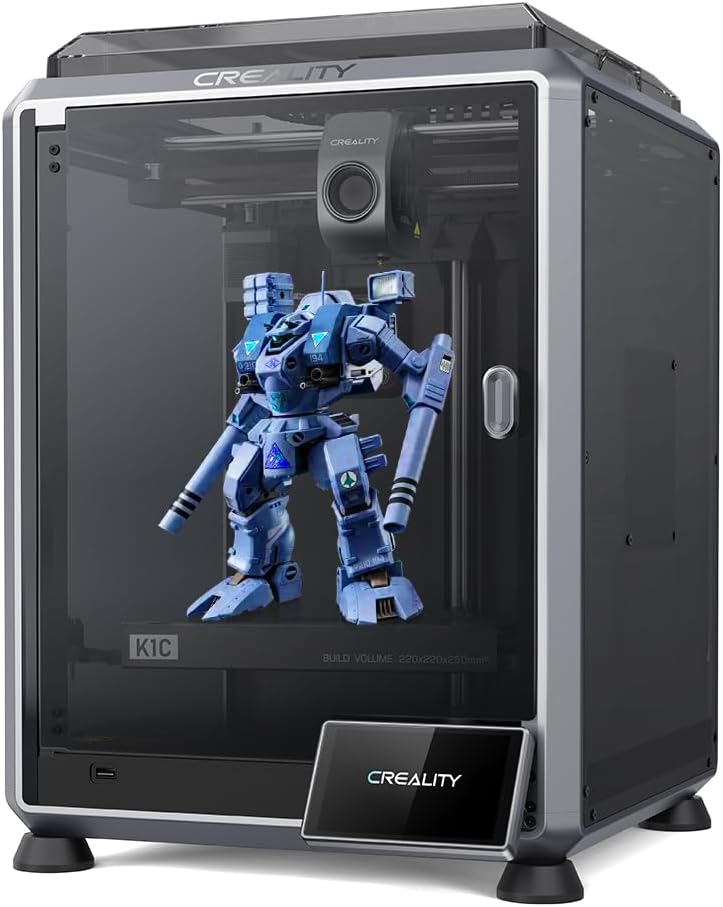
The Creality K1C is a strong value-focused option for makers who need a 300°C-capable direct-drive system and want the K1C's emphasis on fast, largely automatic operation. It carries a supplied rating of 4.3 and a build volume of 8.66 by 8.66 by 9.84 inches. Its principal appeal is the combination of carbon-fiber filament support, a direct extruder, and a 600 mm/s maximum print speed.
We may earn a commission when you buy through this link, at no additional cost to you.
The extruder is designed to grip filament firmly while resisting heat creep. A durable steel-tipped copper nozzle is paired with a titanium-alloy heat break, and the supplied data states that the extruder supports printing up to 300°C. A three-part cooling arrangement addresses heat creep, part solidification, and overall chamber cooling, which can improve bridges, overhangs, and layer bonding when each stage receives suitable airflow.
The trade-off is that a higher nozzle rating does not make every carbon-fiber formulation equally easy to print. Reinforced filaments remain abrasive, and correct nozzle selection, drying, feed speed, and enclosure conditions remain important. The K1C should therefore be considered a capable platform rather than a guarantee of flawless reinforced prints, and buyers should follow the filament manufacturer's recommendations.
It fits users who want high-speed output, direct extrusion, and fewer manual adjustments without moving to a four-toolhead professional machine. The AI camera can identify spaghetti failures, foreign material, and debris, while auto leveling, auto Z-offset, and input-shaping tests simplify setup. For a maker prioritizing practical high-temperature capability and direct drive over multicolor automation, the K1C is a compelling choice.
A direct-drive system places the drive mechanism close to the hot end, improving control over filament delivery and reducing the distance that softened material must travel. That design is particularly valuable when moving between flexible filament and tougher engineering polymers.
The K1C combines a 600 mm/s maximum speed with 20,000 mm/s² acceleration and automatic input shaping. These systems reduce some common sources of vibration, while camera monitoring and automatic calibration help make fast operation more approachable.
We may earn a commission when you buy through this link, at no additional cost to you.
The Bambu Lab P1S is one of the most approachable enclosed FDM printers for users who want to work with advanced polymers without starting with a large industrial system. It has a supplied rating of 4.5, reaches up to 500 mm/s, and offers a fully enclosed body. The enclosure is important because it helps maintain a more consistent thermal environment for materials that benefit from reduced drafts and controlled cooling.
We may earn a commission when you buy through this link, at no additional cost to you.
Bambu Lab lists PLA, PETG, TPU, PVA, PET, ABS, and ASA as ideal materials, with PA and PC listed as capable. The product data explicitly says that carbon- and glass-fiber-reinforced polymers are not recommended, making the P1S more suitable for neat engineering polymers than heavily reinforced composites. Its automatic bed leveling and claimed 15-minute setup also reduce the barrier for first-time users.
Multicolor capability is possible through Bambu Lab AMS, but it is not included as part of the standard feature set described here. That is the main compromise for buyers who want one machine to combine high-temperature materials with automatic color changes. The P1S also does not advertise a numeric chamber target in the supplied information, so its specific thermal performance should be evaluated against the filament being used.
The P1S is best for makers seeking a convenient enclosed printer for ABS, ASA, PA, or PC projects where reinforcement is not essential. It balances speed, enclosure benefits, automatic leveling, and straightforward setup. For most high-temperature users, it delivers the core advantages of an enclosed machine without the footprint and complexity of a four-toolhead system.
An enclosure is often the first feature to look for when moving beyond PLA. It limits the effect of room drafts and contains heat, creating a more repeatable environment for ABS, ASA, PC, and PA prints.
Automatic bed leveling and a setup target of about 15 minutes make the P1S accessible to newcomers. High print speeds of 500 mm/s can shorten project cycles, although actual results still depend on model geometry, slicer settings, and material.
We may earn a commission when you buy through this link, at no additional cost to you.
The Bambu Lab A1 is included as a fast, approachable general-purpose alternative rather than a dedicated high-temperature recommendation. It has a supplied rating of 4.7, impressive 10,000 mm/s² acceleration, full automatic calibration, and Active Flow Rate Compensation. Those qualities make it excellent for everyday PLA, PETG, and TPU work, but its open-frame construction is not a match for enclosed high-temperature printing.
We may earn a commission when you buy through this link, at no additional cost to you.
The A1's simplified touchscreen, quick-swap nozzle, quiet motor behavior, and calibration automation reduce the learning curve for beginners and younger users. Multicolor printing can be added through AMS lite, either by choosing a combo package or purchasing the unit separately. Its workflow tools and automatic functions are useful for anyone who values fast results more than advanced chamber control.
The decisive limitation is thermal. The supplied data does not identify the A1 as capable with ABS, ASA, PC, PA, or reinforced polymers. Its open design also exposes the print to environmental movement, which can contribute to cracking or warping in materials that need a warm, stable chamber. A high hot-end setting alone cannot compensate for the absence of enclosure and chamber heating.
Accordingly, the A1 makes sense for a household maker who primarily prints common thermoplastics but wants speed, reliability, and simple multicolor expansion. It is not the right choice for the central purpose of this guide. Its strong rating and automation are appealing, but a buyer who truly needs high-temperature materials should choose an enclosed model with explicit compatibility and chamber support.
The A1 combines high acceleration with automatic bed leveling, Z-offset adjustment, and flow compensation. These features reduce intervention and make it easier for new users to achieve consistent results from common filaments.
High-temperature polymers often need stable surroundings to limit contraction and cracking. An open-frame printer can still use a high nozzle temperature, but it lacks the environmental control available in an enclosed machine, making it less predictable for demanding materials.
We may earn a commission when you buy through this link, at no additional cost to you.
The FLASHFORGE AD5X combines a 300°C nozzle, 600 mm/s maximum speed, automatic leveling, and a four-color Independent Filament System. It is aimed at users who want productive motion and convenient color changes alongside broader filament compatibility. Its 220 by 220 by 220 mm build volume also allows multiple smaller objects or moderately sized parts in one print.
We may earn a commission when you buy through this link, at no additional cost to you.
The IFS system can use up to four colors at once, making the AD5X attractive for decorative models, prototypes, and segmented functional parts. Fully automatic leveling reduces setup work, while the high print speed and acceleration-oriented platform can shorten cycle time for suitable geometry. A 300°C hot end expands the potential material list beyond typical PLA settings.
Thermal control remains the important caveat. The supplied information for this listing does not state a heated-chamber temperature, and another related FLASHFORGE listing notes that carbon-fiber printing requires an enclosed chamber kit. That makes the AD5X a reasonable high-nozzle-temperature option, but buyers should not assume it provides the same stable warm chamber as a machine with active heating. ABS, ASA, nylon, and reinforced filament still require careful configuration and material-specific settings.
The AD5X is a strong choice for a maker who values color, speed, and a relatively large build volume. It is particularly useful when a project needs several colors without adding a large multi-toolhead system. For difficult polymers that demand a heated chamber, a dedicated enclosed platform would be a safer choice, but for many demanding prints the AD5X offers a versatile and productive balance.
IFS technology automatically manages up to four filament paths. That is valuable for prototypes requiring distinct colors or material segments and removes much of the intervention associated with manual filament changes.
A 600 mm/s maximum speed and 220 mm cube volume support a productive workflow. The practical benefit is not simply a fast headline figure, but more opportunities to batch parts and reduce idle time between projects.
We may earn a commission when you buy through this link, at no additional cost to you.
The FLASHFORGE Creator 5 Pro is the most technically ambitious option in the roundup. Its supplied rating is 4.4, but the decisive advantage is the complete thermal package: a fully sealed enclosure, an active chamber maintained up to 65°C, adaptive air circulation, and HEPA13 filtration. This combination directly addresses the environmental stability and fumes associated with demanding engineering polymers.
We may earn a commission when you buy through this link, at no additional cost to you.
Four independent toolheads make it possible to use separate nozzles for color or material without purging one filament through a shared nozzle. The manufacturer positions this as a way to improve efficiency and preserve material purity. A 256 mm build volume, 600 mm/s maximum speed, 30,000 mm/s² acceleration, all-metal frame, and CoreXY architecture make the machine more suitable for professional throughput than a typical entry-level enclosed printer.
The costs are size, complexity, and investment. Four heated and prepositioned toolheads add mechanical and operational complexity, while an industrial-style filtration and chamber system requires space. The enclosed design is useful for ABS, ASA, PC, and Nylon, but each filament still needs its own temperature profile, adhesion strategy, and chamber settings. The system also requires appropriate ventilation and safe handling of any material that emits fumes.
This Creator 5 Pro configuration is ideal for workshops, educational labs, and small businesses that need true multicolor or multimaterial output alongside serious heat management. It is less compelling for someone printing one material in small batches, but for organizations that value independence, throughput, and reduced purge waste, the four-toolhead design can justify its larger footprint and premium positioning.
Maintaining the chamber up to 65°C can improve interlayer adhesion and reduce warping in ABS, ASA, PC, and Nylon. The sealed enclosure and outside-in cooling mode also help prevent drafts from disturbing the heated environment.
Four separate toolheads eliminate repeated purging through a single nozzle. Dedicated nozzles can reduce transition delays and material waste, making multicolor and multimaterial jobs more efficient for continuous production.
The HEPA13 recirculation filter works with the enclosed air system to capture particles and odors. This is a meaningful benefit when using engineering polymers, although a suitable room ventilation plan remains important.
We may earn a commission when you buy through this link, at no additional cost to you.
The Anycubic Kobra S1 Max stands out for its combination of a 350°C hot end, 120°C heated bed, 65°C heated chamber, and enormous 350 mm cubic build volume. Those are among the strongest thermal and dimensional figures in this list. The CoreXY structure supports 600 mm/s printing, while vibration compensation is intended to preserve precision during fast moves.
We may earn a commission when you buy through this link, at no additional cost to you.
The enclosure and high-temperature system are designed for advanced polymers including ABS, ASA, PC, PA, PA6-CF, PC-CF/GF, and PET-CF. A titanium-alloy throat tube provides thermal insulation to help prevent clogging, and a hardened steel nozzle adds durability for abrasive filaments. This makes the Kobra S1 Max a natural fit for large functional prototypes, tooling, and reinforced components that benefit from a stable heated environment.
The supplied product data does not provide a customer rating, so this review does not assign a meaningful star score. That is not necessarily a quality judgment; it simply means there is no rating value available to report. Multicolor functionality also requires an ACE 2 Pro unit, with one providing four colors and additional units expanding the system up to 16 colors. Buyers should account for that extra cost and space when comparing it with bundled multicolor systems.
The Kobra S1 Max is best for makers who prioritize a large build volume and high-temperature engineering capability over an all-in-one color package. Its 720P camera and AI vision can detect spaghetti failures and foreign objects during long jobs. For large functional prints, particularly reinforced polymers, its chamber, bed, nozzle, and durable extrusion components create a notably well-rounded specification set.
A 350°C hot end provides additional headroom for demanding polymers and reinforced formulations. Maximum temperature is only one part of success, so users should still match the extrusion system, nozzle, and filament manufacturer to the material.
The 350 mm cubic build volume reduces the need to split oversized parts. A 65°C chamber and 120°C bed help manage heat loss and adhesion on those larger, often heavier components.
A 720P camera and AI vision algorithm monitor for common failures in real time. This is especially useful when a large print or long-duration reinforced-material job would be expensive to restart.
We may earn a commission when you buy through this link, at no additional cost to you.
This FLASHFORGE AD5X listing emphasizes connected operation, four-color IFS printing, and a 300°C all-metal hot end. It has a supplied rating of 4.2, supports up to 600 mm/s through a CoreXY platform, and provides a 220 by 220 by 220 mm build volume. The automatic leveling system, flexible PEI spring-steel plate, and filament runout sensor make it convenient for ongoing use.
We may earn a commission when you buy through this link, at no additional cost to you.
The IFS system automatically swaps among PLA, PETG, TPU, and metal-fill filaments for four-color output. Dual-band Wi-Fi and the Flashforge app allow remote monitoring, while the camera supports real-time streaming and time-lapse creation. A 30-second nozzle-change procedure and vibration compensation help keep maintenance and high-speed results manageable.
The enclosure note is crucial. The supplied information states that carbon-fiber printing requires an enclosed chamber kit, so the listed standard configuration should not be treated as a complete high-temperature composite setup. It can print ABS and Nylon according to the product description, but a published heated-chamber figure is absent. Buyers should verify the current enclosure configuration and confirm that the chosen filament is approved for every machine component.
The AD5X Multicolor is a good fit for users who want connected monitoring, quick filament changes, and four-color output in a 220 mm cube machine. It is especially attractive for visual prototypes, signs, colorful models, and segmented parts. For continuous reinforced-material production, however, an already enclosed and actively heated platform would offer greater predictability and less uncertainty about accessory requirements.
Dual-band Wi-Fi and app-based monitoring make it easy to check progress without remaining beside the printer. The camera also supports time-lapse sharing, which is useful for documenting prototypes and production runs.
The PEI spring-steel build plate supports easy part removal, while the runout sensor pauses a job if filament stops feeding. Both features help protect long jobs and reduce the need for constant attendance.
We may earn a commission when you buy through this link, at no additional cost to you.
The Snapmaker U1 is a four-toolhead printer built around rapid material switching rather than conventional filament purging. Its supplied rating is 4.5, and the SnapSwap system can change between preloaded, preheated toolheads in approximately five seconds. The design is intended to reduce both change time and material waste while supporting true multicolor and multimaterial builds.
We may earn a commission when you buy through this link, at no additional cost to you.
The machine can combine rigid and flexible materials, water-soluble supports, and engineering polymers in a single print. Its listed compatible materials include PLA, PVA, TPU, PETG, PCTG, ABS, ASA, PA, and PC. A 270 mm cubic build volume, rigid CoreXY motion system, lightweight carbon-fiber X-axis rails, and 500 mm/s maximum speed support both functional prototypes and finished models.
The product data does not state a maximum hot-end or chamber temperature, so it is not possible to verify precise thermal limits from the supplied information alone. That makes this model less straightforward to recommend for a guide centered on high-temperature filaments. Its multi-material design is compelling, but buyers should confirm the current nozzle rating, chamber configuration, and material-specific approval before assuming it will handle every engineering polymer.
The U1 is best for creators who need several materials in one build, such as a rigid body with flexible inserts, a multi-color articulated model, or a print requiring soluble supports. Automatic toolhead-offset calibration, vibration compensation, filament management, and AI print monitoring make the system approachable. It also includes a one-year warranty and the Snapmaker Orca slicing software with a built-in model library.
Preloaded and preheated independent toolheads make the change process much faster than unloading, loading, and purging one shared nozzle. The supplied data also claims a locking mechanism validated through more than one million swaps.
Avoiding repeated purging can reduce waste substantially. The four-toolhead arrangement is therefore useful for multi-color models, different Shore-hardness TPU parts, and prints that combine supports with a finished material.
Snapmaker Orca provides custom open-source slicing software, automatic filament management, and a model library. These tools reduce setup barriers for beginners while retaining calibration and monitoring features useful to professionals.
We may earn a commission when you buy through this link, at no additional cost to you.
This FLASHFORGE Creator 5 Pro four-toolhead configuration is aimed at industrial multicolor and multimaterial production. It has a supplied rating of 4.0 and builds on the strengths of an enclosed CoreXY platform: a 65°C active chamber, four independent toolheads, 600 mm/s maximum printing, and a rigid integrated frame. The distinction from a standard single-toolhead high-temperature printer is the ability to keep multiple materials prepared simultaneously.
We may earn a commission when you buy through this link, at no additional cost to you.
The seven-second FlashSwap changer moves between nozzles without flushing filament. This near-zero-waste approach is intended to reduce transition delays and material consumption while maintaining separate nozzles for different colors or polymers. The design is useful for ABS, PC, and PA, where a stable heated chamber and direct material control are more relevant than decorative color switching alone.
A dual HEPA13 and activated-carbon filtration system works with continuous airflow to capture particles and fumes. Automated toolhead-offset calibration, vibration compensation, dynamic flow calibration, and an HD chamber camera add production-oriented controls. The main trade-offs are the lowest rating among the listed products, the substantial physical footprint, and the learning curve associated with managing four toolheads and multiple materials.
This is the most suitable choice for a small production environment that repeatedly uses several engineering materials and values low purge waste. It is less logical for an occasional hobbyist who mostly prints one polymer. Buyers should also provide adequate room ventilation and follow the recommended handling procedures for every filament, even though the machine includes a strong internal filtration system.
Each toolhead can have its own filament loaded and preheated, allowing the machine to switch without a conventional purge. This keeps material changes brief and reduces contamination between different polymers or colors.
The rigid integrated architecture, CoreXY system, linear rails, and high-torque timing belts are designed to control vibration at 600 mm/s. Dynamic flow and offset calibration further support consistent results across changing tools.
HEPA13 filtration targets fine particles, while activated carbon helps with odors and certain fumes. Continuous airflow supports a thermally stable chamber, making the system more appropriate to professional environments than a basic open printer.
We may earn a commission when you buy through this link, at no additional cost to you.
The most important decision is not simply choosing the highest published nozzle temperature. A reliable high-temperature printer combines the hot end, heated bed, chamber, enclosure, extrusion path, cooling, and filament preparation into a system that can repeatably produce strong, dimensionally accurate parts.
Nozzle temperature determines the maximum heat available to melt a filament, but the usable limit is normally lower than the hardware rating. Filament suppliers publish recommended ranges, and reinforced materials often need a higher setting than standard versions. Look for a stated hot-end capability and avoid assuming that any 300°C machine will accept every carbon-fiber or polycarbonate formulation. The nozzle, heat break, heater block, sensor, and filament path must all tolerate the chosen operating temperature.
A heated chamber reduces temperature changes that can cause layers to contract at different rates. This is particularly important for ABS, ASA, PC, nylon, and many reinforced filaments because they benefit from a consistently warm environment. Active chamber heating is generally more controllable than relying on an enclosure to trap printer heat. A larger chamber can also introduce more thermal mass, so heating speed and insulation matter as much as the maximum target. Compare the stated chamber temperature against the demands of your filament rather than treating the number as a universal score.
An enclosed printer protects the print from room-temperature drafts and reduces heat loss. This is a major advantage over open-frame models, which may still melt a high-temperature filament but often deliver weaker dimensional consistency and more warping. A quality enclosure should have a reasonably sealed door and controlled or filtered airflow. Software that adjusts cooling for overhangs while preserving chamber heat can further improve results, particularly when the machine balances cooling zones intelligently.
A high bed temperature helps the first layer remain above the glass transition behavior of the chosen polymer and reduces separation caused by cooling. Heated beds near 100°C or higher offer more margin for demanding materials, but surface choice is equally important. PEI spring-steel plates generally provide a balance of grip and easy part removal, while textured PEI can help delicate surfaces. Some engineering polymers also benefit from an adhesive or release agent, so verify that the supplied plate and filament instructions are appropriate.
High-temperature filaments place greater stress on the hot end and drive components than ordinary PLA. Direct-drive systems offer strong control over feed and retraction and are useful for flexible or reinforced material. Hardened steel nozzles and durable heat breaks resist abrasion and heat creep, while an insulated throat can protect the cold end from premature softening. Check whether a carbon-fiber or glass-fiber filament requires a hardened nozzle and whether the machine's extruder is approved for that material. A higher temperature rating cannot compensate for an incompatible wear component.
Engineering polymers and many reinforced filaments absorb moisture from the environment. Wet material may bubble, string, weaken layers, or produce rough surfaces even when the nozzle is correctly heated. Drying must match the material's requirements, and a printer with integrated drying or a compatible multi-material unit can simplify preparation. Dedicated filament dryers remain useful when a machine does not include drying. A closed, dry storage container is also important between prints, especially in humid rooms or when material will sit for an extended period.
Fast motion can improve productivity, but speed is useful only when the printer maintains accuracy and thermal stability. CoreXY systems and input shaping are common in modern machines because they help control moving mass and reduce ringing. Acceleration matters for short, sharp movements, while maximum print speed benefits long travel segments. A rigid frame, linear rails, automatic leveling, and compensation for vibration are valuable for demanding materials because those prints often reveal mechanical inconsistencies. Evaluate geometry, reliable acceleration, and repeatability together rather than relying on the headline speed alone.
A four-toolhead system can use separate filaments for color, flexible inserts, rigid shells, or dissolvable supports. Independent nozzles avoid repeated purging through a shared hot end and can reduce transition waste. IFS-style systems may provide a simpler alternative with four filament paths but a shared nozzle. Consider whether the machine can keep tools preheated, whether each tool supports the intended temperature, and whether the available build volume leaves enough room for the extra mechanics. Multi-tool systems add cost and complexity, so they are most valuable when several material types are part of the regular workflow.
Begin by identifying the exact filament, including any reinforcement, colorants, or manufacturer-specific additives. Read its recommended nozzle range, bed temperature, chamber recommendation, drying procedure, and ventilation guidance. Confirm that the printer's hot end, nozzle material, heated bed, build surface, and extrusion system are approved for that product. Calibrate the machine using the appropriate profile, clean the plate, and inspect the filament path before beginning a demanding job.
Dry the filament using the supplier's recommended method and store it sealed immediately afterward. Load it directly into the hot end or into a compatible multi-material system, allowing the machine to preheat before feeding. Start with a small test model that includes a base, vertical wall, overhang, and bridging feature. This test reveals bed adhesion, layer bonding, corner quality, and stringing before a large component is committed to the build.
For maintenance, follow the printer's cleaning instructions and avoid pulling hardened residue from a hot nozzle with hard tools. Keep the chamber, vents, filters, and heat-creep components clear, and replace consumable nozzles when wear affects dimensional quality. When a print fails, inspect the material and machine systematically rather than immediately increasing every temperature. Allow hot components to cool before servicing, ventilate the workspace when required, and store filament in a clean, dry container between sessions.
The correct setting depends on the exact filament and its formulation, not just its material family. Standard ABS and ASA may work around lower ranges than some PC, PA, or reinforced formulations, but manufacturers can specify different values. Always follow the filament supplier's printed or digital guide, then fine-tune within the printer's supported range. Raising the temperature beyond the recommended window can degrade the polymer rather than improve bonding.
A heated chamber is strongly beneficial for ABS, ASA, PC, nylon, and many reinforced filaments because it reduces warping and layer separation. An enclosure alone provides some insulation, but active heating offers more consistent control. If the chamber cannot reach the temperature recommended for the filament, verify that the enclosure and printer configuration are approved for that material before starting a long print.
No. The 300°C rating only confirms that the hot end can reach that temperature; it does not guarantee compatibility with every reinforced filament. Carbon-fiber and glass-fiber materials are abrasive and usually require a hardened nozzle. The machine must also have a compatible feed system, enough thermal support, and an approved enclosure or chamber configuration. Follow the specific filament and printer manufacturer guidance.
Direct drive often makes engineering and reinforced filament more predictable because the drive mechanism sits near the hot end and controls the material over a shorter distance. It can also make flexible filament easier to feed. The hot end still needs a heat-creep-resistant design, and the nozzle must be appropriate for the material's abrasiveness. Direct drive is helpful but does not replace correct temperature, drying, or adhesion settings.
Many engineering polymers, particularly nylon-family and some reinforced materials, can absorb enough moisture to cause bubbling, stringing, and weak layers. Drying requirements vary by filament, so follow the supplier's recommended temperature and duration. Store the spool in an airtight container after drying and avoid leaving it exposed in a humid environment. Integrated filament drying is convenient, but a separate dryer can provide more control.
An enclosed printer with a HEPA-rated or equivalent particulate filter can reduce airborne particles, while activated carbon can help manage odors and some fumes. Filtration is not a substitute for ventilation. Work in a well-ventilated area, follow the material supplier's safety guidance, and avoid directing emissions into a closed room. If a specific filament is known to emit hazardous fumes, use the precautions required for that material.
No. Four toolheads are valuable for frequent color changes, mixed rigid and flexible parts, and different polymers that need separate temperature conditions. They also reduce purge waste because each tool can retain its own filament. A simpler IFS system may handle several colors, while a single-extruder machine can still use manual changes for occasional work. The best choice depends on how often and how many materials the project requires.
First check filament condition, moisture, and the manufacturer's recommended profile. Then verify bed adhesion, nozzle temperature, chamber condition, and whether the build surface is clean and appropriate for the material. Inspect the sliced preview for unsupported features and look for signs of underextrusion, heat creep, or contamination. Change one variable at a time and begin with a small test model before repeating a long job.
The Bambu Lab P2S Combo stands out as the most balanced overall choice because adaptive airflow, a 50°C chamber, automatic preparation, fast motion, and integrated drying work together as one system. The Bambu Lab P1S offers a simpler and less complex enclosed alternative for makers who need clean handling of advanced polymers without requiring a multicolor package. For the most demanding professional workflow, the FLASHFORGE Creator 5 Pro's 65°C active chamber and four independent toolheads provide the strongest thermal and material control.
Prioritize the complete thermal system rather than the largest nozzle number. A capable hot end, controlled chamber, sufficiently heated bed, durable extrusion path, and correct filament preparation determine whether a high-temperature material prints reliably. Match the machine to the filament, confirm the chamber and enclosure requirements, and avoid adding multi-tool complexity unless mixed materials are a regular requirement. Large-format users should also compare build volume against the size of the parts they actually intend to make.
Specifications, bundle contents, ratings, and product availability can change over time, and current pricing is equally important when comparing configurations. Before buying, verify the exact model, nozzle rating, heated-chamber limit, filtration accessories, and filament approval in the current listing. That final check ensures the chosen 3D printer for high temperature filaments matches both the material and the intended workflow.