
Entina Tina2C 3D Printer
4.4Editor score
Guided eight-minute initial setup
3000+ model digital library
Compact 3.9-inch build volume
Our 3D Printer for Kids guide compares ten beginner-friendly models for safety, print speed, ease of use, creative tools, and learning value for families.
A 3D printer can give children a creative outlet that is more interactive than drawing on a screen, yet the right machine must remain easy to operate, safe around hot components, and engaging enough to hold a child’s attention. The best options combine approachable software, useful model libraries, quick setup, and dependable results.
We compared ten printers designed for kids, beginners, families, classrooms, and small creative workspaces. Our evaluation focused on setup difficulty, enclosure design, automatic features, app support, model choice, print speed, build volume, maintenance, and the extent to which each printer encourages design and STEM learning.
Each review below explains the printer’s strongest features, practical limitations, and ideal user. Ratings and specifications reflect the supplied product information, while availability and prices change frequently, so readers should confirm current details before making a purchase.
4.4Editor score

4.5Editor score

5.0Editor score
This side-by-side overview highlights the differences in enclosure safety, creative software, model libraries, speed, build volume, and setup support across the ten shortlisted printers.


The AOSEED AI 3D Printer for Kids earns a 4.5 rating and stands out as the most complete all-around option in this guide. It combines an enclosed design, 8,000-plus printable models, AI-assisted creation, real-time camera monitoring, and speeds that may reach 400 mm/s. That combination makes it particularly appealing to families seeking a polished, guided creative experience.
We may earn a commission when you buy through this link, at no additional cost to you.
Its strongest feature is the depth of the child-focused ecosystem. Children can browse toys, accessories, decorations, characters, and STEM projects across 17 themed modules. AI Doodle turns voice, text, or image prompts into models, while AI MiniMe creates cartoon-style figures from photos and MINIMAKIE supports personalized avatars. Automatic time-lapse generation adds enjoyment without requiring separate editing software.
The enclosed, pinch-resistant construction is more reassuring than an open-frame mini printer, and the leveling-free platform reduces one common source of beginner frustration. Runout detection pauses the print when filament runs out, and a quick-release nozzle simplifies changes. However, the printer supports only single-color printing, so children who want mixed-color objects must print the pieces separately and assemble them.
This is the strongest choice for a child who wants guided design tools immediately, particularly if the family values a large model catalog and a safer enclosed format. The included eight rolls of PLA, tools, magnetic build plate, and stickers also reduce the amount of extra setup required. It is our top overall recommendation for kids who are new to 3D printing.
The app-based design flow lets children begin with a model, a sketch, a written prompt, or even a photograph. This lowers the barrier to entry for younger users while giving more experienced children room to import and modify suitable files.
The enclosed chamber, pinch-resistant construction, quiet operation, and TÜV Rheinland ISO 16000-tested PLA create a more child-oriented setup. Adult supervision is still essential around any operating 3D printer, particularly during filament changes and model removal.
We may earn a commission when you buy through this link, at no additional cost to you.
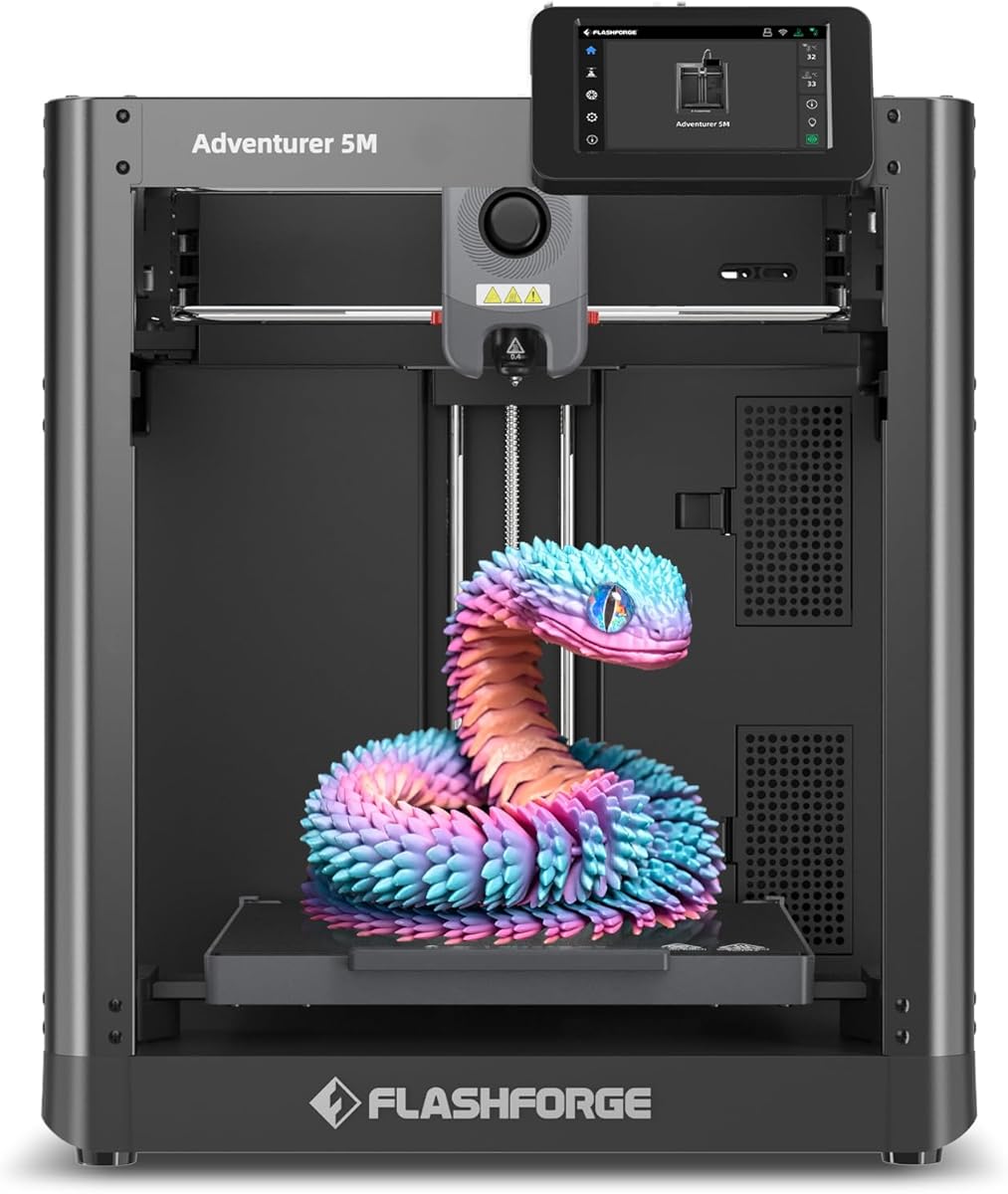
The FLASHFORGE Adventurer 5M has a 3.9 rating and is the performance-oriented selection here. Its CoreXY all-metal structure, 600 mm/s travel speed, 20,000 mm/s² acceleration, and 220 mm cubic build volume make it better suited to larger models, rapid prototyping, and families that already have some 3D-printing knowledge.
We may earn a commission when you buy through this link, at no additional cost to you.
Automatic bed leveling eliminates routine manual adjustments, while the 280°C direct-drive extruder and dual-fan cooling support stable material handling. The quick three-second nozzle-change system and high-flow 32 mm³/s nozzle reduce downtime. A standard 0.4 mm nozzle is included, and optional sizes from 0.25 to 0.8 mm can suit different layers, materials, and project demands.
Its main disadvantage for a child is not speed or reliability but simplicity. The product information focuses on advanced hardware and remote operation rather than a child-oriented curriculum, AI design assistant, or curated toy library. Younger users may need more help understanding model preparation, slicing settings, and the distinction between the maximum travel speed and actual print speed.
The Adventurer 5M is a compelling choice for a motivated teen, family workshop, or classroom that wants speed and a relatively large build area. It can support everything from small toys to detailed prototypes, but beginners seeking guided one-tap creativity will likely find a kid-focused model easier to use.
The CoreXY motion system and rapid travel speed can shorten production cycles when models require many short movements. The roomy build volume also gives children more room to print components that would be too large for the smallest mini printers.
Flash Studio app monitoring allows adults to check progress and adjust settings remotely. That visibility is useful in a classroom or shared workspace where children need to stay focused on design while an adult supervises the machine.
We may earn a commission when you buy through this link, at no additional cost to you.
The Entina Tina2C receives a 4.4 rating and is the best budget-oriented option for children who want a structured, approachable introduction to 3D printing. It arrives fully assembled, offers guided setup through the Poloprint Cloud app, and can reportedly begin a first print in as little as eight minutes.
We may earn a commission when you buy through this link, at no additional cost to you.
The creative library is a major strength. More than 3,000 models and over 20 modules are available alongside AI-powered search, photo-to-print features, and regularly updated STEM courses. The printer supports 2.4 GHz WiFi and TF-card offline printing, so a family can work through the app or continue without a network connection. It also works with Windows, macOS, Linux, Chromebook, Cura, and Simplify3D.
Its 3.9 × 3.9 × 3.9 inch build volume is the main constraint. That space is suitable for small toys, classroom objects, organizers, and other compact creations, but it will not accommodate the larger designs possible with a full-size printer. A flexible magnetic plate, self-cleaning nozzle, automatic leveling, and power-loss recovery help make the limited workspace more manageable.
This model is well suited to a child’s bedroom desk, a family making center, or a classroom demonstration. Its rounded, low-noise housing, integrated LED lighting, guided application, and STEM content make it a strong budget pick for structured learning. For families willing to manage more technical setup, the FLASHFORGE offers a much larger build area.
The app combines creative modules with STEM lessons, making the printer a tool for guided projects rather than simply an output device. That structure is especially helpful for children who need prompts and goals to stay engaged.
The compact body, low-noise operation, and built-in illumination work well on a desk or in a classroom. Its small build area is less convenient for oversized projects, but it makes the printer easier to supervise and store.
We may earn a commission when you buy through this link, at no additional cost to you.
The Magic Jimmy AI 3D Printer for Kids holds a 4.6 rating and is among the most approachable options for independent use. It arrives fully assembled, needs no tools, and can begin operating after connecting to WiFi and loading the included white PLA filament. Children can then browse designs, create custom models, and print through a simplified app.
We may earn a commission when you buy through this link, at no additional cost to you.
Four AI tools broaden the creative experience. AI Craft turns sketches or text into printable models, AI Doodle supports free-form creation, AI MiniMe converts photographs into cartoon figures, and MiniMakie supports personalized avatars. The model library includes more than 8,000 toys, animals, vehicles, and STEM projects, while compatibility with STL files from sources such as Thingiverse and Printables adds further flexibility.
The enclosed chamber separates hot components and moving parts from the child, and the product information describes a cool-touch exterior and magnetic build plate for convenient model removal. It also supports printing on iOS, Android, and Windows. A potential drawback is print duration: although small models may finish in 20 minutes and peak speed reaches 400 mm/s, many library models take one to three hours.
This printer is a strong choice for a child who wants to begin quickly and create without navigating a conventional slicer. The camera and automatic time-lapse recording make the process visibly rewarding. Parents should still supervise operation and confirm that imported models are appropriate and properly prepared.
The AI tools let children begin with simple sketches, written ideas, or photographs instead of navigating technical software. This makes the first stages of creating a print feel more like a creative activity than a computer lesson.
The integrated camera can show printing in real time and create a time-lapse of the finished model. That feature adds anticipation for children and gives families a simple way to document completed projects.
We may earn a commission when you buy through this link, at no additional cost to you.
The AOSEED X-MAKER AI+ is the premium selection and carries the highest supplied rating in the group at 5.0. It is designed for children roughly nine to 16 years old who want a balance of advanced AI creation, quiet operation, a physical touchscreen, and an enclosed form suited to the home or classroom.
We may earn a commission when you buy through this link, at no additional cost to you.
The creative platform includes a 1,500-plus digital toy catalog, a customizer, more than 15 mini modules, two premium modules, and creator course access. AI Doodle creates models from voice, text, or images; AI MiniMe transforms photos into cartoons; MINIMAKIE produces custom avatars; and a built-in assistant guides the process. The included courses add a learning layer beyond immediate model selection.
Its 3.5-inch touchscreen, power-loss recovery, magnetic build plate, one-touch nozzle replacement, WiFi, SD card, and USB support create a well-equipped machine. It operates below 50 dB, making it suitable for study sessions and shared spaces. Although the catalog is smaller than that of the rank-one AOSEED, the combination of a touchscreen, creator tools, and quiet operation gives this model a distinctive premium feature set.
This is the best option for an older child who wants more sophisticated design tools, maker-style courses, and an experience that can progress beyond simple model selection. It is less ideal for very young children or large models, but for its intended age group it offers a notably complete and polished creative environment.
The built-in touchscreen gives children a direct way to navigate printer functions without relying entirely on a phone or tablet. That can make the creative process feel more self-contained and reduce interruptions during long projects.
Operation under 50 dB is a meaningful advantage for bedrooms, study areas, and classrooms. Quiet movement also makes it easier for children to work alongside adults without the printer dominating the environment.
We may earn a commission when you buy through this link, at no additional cost to you.
This fully assembled mini 3D printer has a 4.4 rating and is a practical choice for a family seeking a simple starter package. It includes the machine, one roll of test PLA filament, an SD card, and accessories, removing the need to assemble the printer or immediately source basic materials.
We may earn a commission when you buy through this link, at no additional cost to you.
Its feature set is designed to reduce common beginner obstacles. One-button automatic leveling handles bed alignment, automatic nozzle cleaning supports consistent extrusion, and one-touch filament loading simplifies material changes. A PEI heated bed helps finished models release more easily. The stated precision reaches 0.01 mm, while the top speed is listed at 250 mm/s.
Unlike several dedicated kid systems in this roundup, it does not prominently feature a large AI library, curated curriculum, or enclosed chamber. Children will therefore need suitable model files and more direct guidance, and the machine’s appeal depends more on its approachable hardware than on a child-specific software ecosystem. Only one filament roll is included, although the SD card also contains a spool-holder model.
This printer suits a straightforward introduction to making tangible objects, especially for families who already have a computer and can assist with file selection. It is less exciting for a child who wants an immediate library of characters, but its assembled design, included supplies, and automatic setup can make the first successful print easier to achieve.
Automatic leveling, nozzle cleaning, and one-touch loading address three routine setup tasks in a single machine. These functions cannot prevent every error, but they reduce the amount of troubleshooting a beginner must handle.
The supplied filament, SD card, and accessories provide a more complete initial package than buying only a bare printer. The pre-sliced spool-holder file on the card also gives users an immediate project that is already prepared for printing.
We may earn a commission when you buy through this link, at no additional cost to you.
This Magic Jimmy listing has a 4.6 rating and presents another strong version of the kid-focused AI concept. The defining combination is an enclosed printer, a library of more than 8,000 models, several approachable design tools, and a fully assembled design that can be connected to WiFi without tools or mechanical setup.
We may earn a commission when you buy through this link, at no additional cost to you.
AI Craft, AI Doodle, AI MiniMe, and MiniMakie support drawing, text prompts, photo conversion, and personalized avatars. The product also supports STL imports from established model communities, which gives a child familiar templates while leaving more ambitious projects open to customization. One-tap printing handles library content, and the camera can record the progress of each object.
The enclosure keeps hot and moving components away from users, while the cool-touch exterior and magnetic build plate improve the overall home-use experience. As with other fast printers, the headline speed should not be confused with the time needed for every design. Most library projects reportedly take one to three hours, and imported files must be printable, correctly scaled, and prepared appropriately.
This option is best for a child who wants a large selection of recognizable toys and vehicles alongside AI experimentation. It also works for families that want a child to operate the machine independently after setup, since the app handles a significant amount of the process. Compared with a conventional printer, it places more emphasis on guided creativity and less on open-ended slicer configuration.
An 8,000-plus model catalog gives children immediate access to animals, vehicles, toys, and STEM projects. New models and creative tools can extend the useful life of the system beyond the first few weeks.
Children can use sketches, text, or photographs as starting points, which makes the technology relevant to their own interests. Adults should still review personal images and generated models before allowing any project to be printed.
We may earn a commission when you buy through this link, at no additional cost to you.
The Entina Tina2C Bundle is a 4.4-rated bundle for families that want a child-friendly printer with multiple filament colors ready from the beginning. It includes approximately one kilogram of PLA across four colors, allowing children to begin with visually varied models without purchasing individual spools first.
We may earn a commission when you buy through this link, at no additional cost to you.
The underlying Tina2C platform is fully assembled and guided through the Poloprint app, making it relatively easy to introduce to a first-time user. WiFi and offline modes support flexible workflows, while more than 3,000 models and 20-plus DIY modules offer ready-made projects. Smart search and photo-to-print features add a creative dimension beyond simple file downloading.
Its principal limitation remains the 3.9 × 3.9 × 3.9 inch build volume. That is adequate for compact toys, school projects, prototypes, and small decorations, but it limits larger assemblies. The four filament colors do not create automatic multicolor objects, so switching colors still requires separate print jobs or careful manual coordination. A flexible magnetic build plate and quick-swap printhead simplify maintenance.
This bundle is a compelling choice for a child who loves color and wants to start printing immediately. It combines the same guided app experience and creative structure as the standard Tina2C with the practical advantage of several filament colors. For families primarily concerned with the lowest purchase cost, the standard Tina2C may be more economical, while color-loving beginners will find this package more satisfying.
The four included colors make it easy for children to test different visual styles and create multi-part projects. This encourages experimentation and helps a new user understand that filament color is a design choice.
The app’s model discovery, smart search, and photo-to-print features reduce the need for a child to navigate technical software at first. More experienced users can still explore more advanced workflows as their skills develop.
We may earn a commission when you buy through this link, at no additional cost to you.
The third Magic Jimmy listing in the top ten also carries a 4.6 rating and reinforces why this design is one of the strongest child-specific choices. It combines a fully assembled format with an enclosed chamber, one-tap printing, AI tools, and more than 8,000 models designed to make creativity accessible to children without advanced design skills.
We may earn a commission when you buy through this link, at no additional cost to you.
The enclosed printing chamber is especially important in a family setting because it separates hot components and moving mechanisms from the user. A cool-touch exterior and magnetic plate add further convenience. The built-in camera records a time-lapse, allowing children to follow their model as it develops and giving parents a way to monitor progress remotely.
The library covers toys, animals, vehicles, and STEM projects, with new models added regularly. AI Craft turns a child’s sketch or text into a design, AI MiniMe creates a cartoon figure from a photo, and the remaining tools support doodling and avatars. The tradeoff is that the headline 400 mm/s speed does not mean every project finishes quickly; many models take several hours.
This listing is ideal for a child who wants immediate access to a broad range of subjects and enjoys a visible, app-centered creative process. It is less suitable for families seeking a large build volume or a fully open selection of advanced materials. For supervised projects and colorful small objects, it offers an engaging balance of guidance, safety, and creative flexibility.
Unlike entertainment content that ends when the device is closed, every design has a physical outcome. Watching a model take shape can motivate children to refine ideas, retry designs, and connect digital creativity with hands-on learning.
The mixture of characters, vehicles, decorations, and STEM challenges helps the printer serve different interests. Regular additions can also give returning users new reasons to print beyond the initial starter models.
We may earn a commission when you buy through this link, at no additional cost to you.
The Bambu Lab A1 mini with LED Lamp Kit has a 4.4 rating and is a thoughtful choice for a beginner who wants practical projects rather than a highly specialized children’s curriculum. Automatic calibration, simple setup, and the Bambu Handy app reduce the initial barrier, while the compact format suits a home desk, studio, or classroom.
We may earn a commission when you buy through this link, at no additional cost to you.
The included LED Lamp Kit gives the printer an immediate purpose beyond downloading models. Children can print compatible lamp components, assemble them, and create a functional light for room decoration or a personalized gift. This provides a satisfying path from digital design to an object that can be used, which can be more motivating than printing a small test shape.
MakerWorld supplies a broad library of ready-to-print models, and the connected ecosystem supports print management through the app. The printer is described as fast, quiet, and suitable for everyday creativity, including toys, décor, tools, and gifts. Its main limitation is that the product information emphasizes general beginner use more strongly than child-specific AI tools, guided courses, or an enclosed safety chamber.
This option works best for a parent and child who want to grow into practical 3D-printing together. The LED project creates an immediate shared activity, while MakerWorld and the app provide room for independent exploration. It is a strong alternative for users who value a polished general-purpose ecosystem, though a dedicated enclosed model may be more reassuring for a very young child.
The LED Lamp Kit demonstrates how printed parts can become a useful household object. A child can personalize the design, assemble the components, and see a direct connection between a digital plan and a working light.
The Bambu Handy app and MakerWorld library make it convenient to find, manage, and monitor projects. Although the interface is not presented as a dedicated teaching course, it provides a manageable way for children to progress from prepared models toward more independent creation.
We may earn a commission when you buy through this link, at no additional cost to you.
The right choice depends on the child’s age, interests, space, and tolerance for supervision. Safety, software simplicity, model selection, build volume, and maintenance are more important to a successful experience than headline speed alone.
A fully enclosed printer keeps the hot nozzle, heated bed, belts, rails, and other moving components behind a barrier. That design is generally more reassuring for families with young children, although no printer should be treated as a toy that can be touched while operating. Look for pinch-resistant construction, cool-touch exteriors, rounded edges, and secure filament handling. An enclosure does not eliminate the need for adult supervision, but it can reduce accidental contact and make the machine more suitable for a shared family space.
A child-friendly app should make the path from an idea to a model clear. Guided model libraries, one-tap printing, photo conversion, text prompts, and drawing tools can replace the need to learn a conventional slicer immediately. AI-assisted features are useful when they support a child’s original idea rather than simply generating random objects. Also consider whether the platform offers structured STEM courses, guided exercises, and age-appropriate content, since these can make the printer an educational tool rather than only a novelty.
A large library is valuable because it gives children immediate projects without requiring an adult to source and slice every file. The best libraries include toys, animals, vehicles, educational models, decorations, and practical objects. Import support for STL files and compatibility with established model communities are also useful, provided users understand that imported files may require scaling, support, orientation, and slicing. Check whether the advertised library is child-reviewed, regularly updated, and genuinely different from a generic collection of test objects.
Build volume determines the largest object a printer can make in one job. Compact printers around 3.9 inches on each side are well suited to small toys, classroom pieces, organizers, and articulated miniatures, but they can limit larger projects. A 220 mm cubic printer offers much more room for props, model kits, and practical household items. Children are often more interested in a finished project they can hold than in maximum dimensions, so consider whether the library contains projects appropriate for the available workspace.
Automatic leveling, nozzle cleaning, filament runout detection, and power-loss recovery can make a large difference in a child’s success rate. These features reduce manual intervention and help avoid wasting filament after a simple mistake. A flexible magnetic build plate makes finished models easier to remove, while a quick-swap nozzle or one-touch filament system simplifies routine care. Parents should still consider how easily the filament path can be accessed and whether the manufacturer provides understandable maintenance guidance.
Fast speeds help maintain a child’s interest, but they should be considered alongside build volume, layer quality, and the complexity of the selected model. A small project may finish in about 20 minutes on a high-speed machine, while many library models can take one to three hours. Noise is equally important for a bedroom or classroom: models that operate under 50 dB are better suited to shared spaces. Compact dimensions also make it easier to supervise the printer, keep the work area orderly, and move the machine when it is not in use.
Children usually value a successful, recognizable model more than laboratory-level precision. Still, stated resolution, nozzle options, heated-bed capability, cooling, and direct-drive or geared extrusion systems influence consistency. PLA is the most relevant material for many family and classroom applications because it is simple to handle and widely supported. Be cautious about selecting a machine primarily for exotic materials unless an adult is prepared to handle material changes, storage, ventilation, and troubleshooting safely.
Reliable documentation and responsive technical support are particularly valuable when a child is frustrated by a failed print. Check the operating systems supported by the app, whether setup and slicing work with the family’s existing devices, and whether print monitoring is available remotely. A clear return or repair policy can reduce risk, while support for standard workflows such as WiFi, SD cards, USB, and established slicing software provides flexibility as the child becomes more advanced.
Start in a ventilated, supervised area and place the printer on a stable, level surface with enough clearance around it. Read the manufacturer’s instructions, assemble any remaining packaging components, and make sure the bed and nozzle are clear. Load the recommended PLA filament using the supplied procedure, confirm the filament is seated correctly, and run the machine’s leveling, cleaning, or calibration sequence before the first project.
For a first print, choose a small, simple model from the official library and follow its material and orientation instructions. Keep children from touching the printer while it is moving, and explain that the nozzle becomes hot even when the exterior feels cool. Use the camera or app to monitor progress, but avoid opening an enclosed chamber unless the manual specifically calls for it during a required procedure.
Remove a finished model only after the printer indicates that the job is complete. Detach it carefully from the magnetic build plate, clean the nozzle if residue is visible, and remove scraps from the area beneath the nozzle. Store filament in a dry, sealed location away from moisture and direct heat, and follow the manufacturer’s cleaning schedule for the extruder, build plate, and motion rails.
The right age depends on the printer’s software, enclosure, and supervision requirements. A fully assembled model with one-tap printing and a child-oriented library can suit younger children, while a more technical printer may require an older child or adult assistance. Any operating 3D printer should remain under adult supervision because the nozzle and heated bed can cause burns.
An enclosed printer generally reduces direct access to hot and moving components, making it more suitable for a family environment. Features such as pinch-resistant construction, rounded edges, and cool-touch exteriors add further protection. However, enclosure does not make the machine completely safe, so children should not touch it while it is operating and adults should supervise filament changes and model removal.
Many child-focused printers provide a phone or tablet app for selecting models, designing projects, monitoring prints, and changing settings. Some also work with desktop operating systems or accept files through an SD card, while certain advanced workflows use standard slicing software. Buyers should verify the exact operating-system requirements and whether a separate device is needed for every stage.
The easiest choice is usually one that arrives assembled, supports automatic leveling, includes a clear app, and offers one-tap printing. A broad model library helps children start without needing technical file preparation. The Entina Tina2C, AOSEED AI 3D Printer, and Magic Jimmy options are particularly relevant because they combine guided setup with child-oriented creative tools.
A small, simple model may finish in around 20 minutes on a fast printer, while many detailed library models take one to three hours. The printer’s maximum speed does not determine the entire print duration because layer height, model geometry, infill, and travel moves also affect the result. Beginners should select a compact starter model rather than beginning with a large or detailed object.
PLA is commonly used for beginner and home printers because it is straightforward to print and is available in many colors. Several products in this guide specifically describe their PLA as non-toxic or TÜV tested, but buyers should still use the material supplied or recommended by the manufacturer. Children should not handle filament before washing their hands, and prints should not be used for food unless the model and material are specifically approved for that purpose.
Several listed printers offer photo-to-3D features, including AI MiniMe and the Entina Tina2C photo-to-print option. These tools can convert an image into a stylized figure or printable model, making them engaging for children. Parents should review uploaded photographs, generated results, and any privacy terms before using personal images.
Parents should check the enclosure, age guidance, model library, app compatibility, build volume, filament requirements, and support policy. The machine should be appropriate for the available space, and the child should have enough interest in design and making to benefit from the activity. It is also useful to compare automatic leveling, print recovery, and model-removal features because these affect how often adult intervention is needed.
The AOSEED AI 3D Printer for Kids is the most complete overall recommendation because it combines an enclosed design, 8,000-plus models, AI creation tools, camera monitoring, and a substantial starter kit. The Entina Tina2C is the best value-oriented choice for structured learning and quick setup, while the AOSEED X-MAKER AI+ offers the most premium combination of touchscreen controls, creator courses, and quiet operation.
The most important selection criteria are not simply the highest speed or largest catalog. Parents should prioritize a secure enclosure, a comfortable app, age-appropriate content, reliable automatic features, and a build area that matches the child’s projects. The enclosed Magic Jimmy listings may be especially attractive for creative freedom, the FlashForge is better for technically capable older users, and the Bambu Lab A1 mini is ideal for practical shared projects.
Ratings, bundle contents, software libraries, and prices can change, so readers should verify the current product listing and included accessories before purchasing. Checking compatibility and the manufacturer’s safety guidance will also help ensure that the chosen machine provides a satisfying and productive introduction to 3D printing.