
Trail Camera 4G Cellular 2K 48MP
4.8Editor score
Removable SIM flexibility
48MP and 2K capture
32GB card included
Explore the best 4G trail cameras under 200, comparing cellular coverage, image quality, solar power, night vision, alerts, and remote app control tools.
A good 4G trail camera should capture wildlife quickly, deliver clear images after dark, and remain remotely accessible where Wi-Fi and electrical power are unavailable. The best models add useful solar charging, fast motion detection, flexible recording modes, and dependable smartphone alerts, making them practical for farms, hunting properties, and remote monitoring.
This guide compares ten trail cameras using the supplied specifications, with particular attention to cellular support, trigger speed, image resolution, night-vision range, weather resistance, storage, power options, and app features. Nine models include 4G connectivity, while one non-cellular camera is included as a useful offline reference for buyers who may not need remote viewing.
Each review explains the strongest reasons to consider the camera, along with subscriptions, network limitations, and other trade-offs worth understanding. Rankings reflect the information available for this guide, not hands-on testing, while prices and promotional offers can change at any time. Always confirm the current listing and cellular terms before buying.
4.8Editor score

4.9Editor score

4.8Editor score
This side-by-side overview highlights the major differences in connectivity, capture speed, night vision, solar capability, storage, and remote-control features across all ten cameras, including one non-cellular model.



This 4G LTE Cellular Trail Camera combines 2.5K recording, a 360-degree live feed, and a solar panel in a package aimed at buyers who want flexible remote monitoring. Its 4.3 rating reflects a generally capable feature set, particularly for users who value the ability to pan across a large area rather than being limited to a fixed directional view.
We may earn a commission when you buy through this link, at no additional cost to you.
The included SIM card comes with 100MB of complimentary data, allowing an initial test without immediately arranging a broader cellular subscription. Motion detection produces phone notifications, while HD and SD modes let the user balance recording quality against cellular consumption. A built-in microphone and speaker support two-way communication, and the camera can share access with several users for coordinated monitoring.
Night monitoring combines six infrared LEDs with full-color night-vision capability, while the solar panel helps reduce routine battery servicing. The main trade-offs are that no memory card is included, each camera needs its own data top-up, and the advertised AI species and behavior detection requires a paid subscription. These are manageable for users who understand the difference between the basic cellular service and optional enhanced features.
This is a strong choice for hunters, farmers, and property owners who want remote control over a broad outdoor area. Choose it when live viewing, selectable recording quality, and solar-assisted operation outweigh the need for a removable SIM or fully local wildlife identification. It is a well-rounded general-purpose cellular camera for locations beyond Wi-Fi range.
The panoramic live feed and remote orientation make this camera useful when animals may approach from different directions. It reduces the need to reposition a conventional fixed-view trail camera whenever activity changes direction.
HD and SD recording options help manage the balance between image detail and data use, while the included SIM and complimentary allowance provide a convenient starting point. A separate plan is required for continued remote service on each unit.
We may earn a commission when you buy through this link, at no additional cost to you.
The TKENPRO 4G LTE Cellular Trail Cameras is an ambitious premium option with 2K live streaming, 360-degree viewing, two-way audio, and a 5W solar panel. Its 4.8 rating and broad control set distinguish it from simpler cameras that only send still images or provide a fixed live view.
We may earn a commission when you buy through this link, at no additional cost to you.
Remote controls include 355 degrees of pan, 120 degrees of tilt, and 4x digital zoom, allowing a user to inspect particular areas without physically visiting the camera. The PIR trigger responds in 0.2 seconds, while low-light infrared technology reaches up to 85 feet. IP65 weatherproofing and an operating range of -20°C to 50°C make it suitable for farms, forests, cabins, and other exposed installations.
The built-in SIM automatically seeks a strong 4G network, and seven days of unlimited data are provided following activation. The limitation is that this SIM cannot be removed, exchanged, or used across regions; it is intended for United States operation. Wi-Fi is also unsupported. Buyers should therefore treat cellular coverage and carrier terms as central parts of the purchase decision rather than minor details.
Choose this camera when remote control, panoramic coverage, live communication, and substantial night-vision performance are priorities. It is especially attractive for users who want to monitor a remote cabin, ranch, farm, or hunting area from a phone. The extra capability makes it a premium pick within this under-200 category, provided its cellular restrictions suit the intended location.
The 355-degree pan, 120-degree tilt, and 4x zoom provide unusually precise control for a trail camera. This makes the model more useful where movement can occur around a broad clearing, feeder, gate, or property access point.
An 85-foot infrared range supports nocturnal wildlife recording, and the integrated microphone and speaker add two-way communication. The silent night operation avoids disturbing wary animals while still allowing remote observation.
We may earn a commission when you buy through this link, at no additional cost to you.
The Solar Trail Camera 4G LTE Game Camera offers the strongest overall balance in this list, earning a 4.9 rating based on the supplied customer feedback. It supports Verizon, T-Mobile, and AT&T, includes a prepaid SIM, and provides a seven-day unlimited-data trial to make initial setup straightforward.
We may earn a commission when you buy through this link, at no additional cost to you.
Its app adds AI species recognition and analyzes environmental data to predict animal activity for the next seven days. Those tools can help hunters and wildlife observers focus their scouting efforts. A 0.2-second PIR trigger captures quick movement, and photos or videos can be saved to a memory card up to 128GB or placed in cloud storage.
The 4W solar panel is designed to reduce charging interruptions and, under sufficient sunlight, can support operation for up to 365 days according to the supplied information. IP66 waterproofing adds outdoor protection. Cloud features require a subscription after the new-user trial, and the memory card is not included, so buyers should budget for the accessories their chosen storage method requires.
This is the most balanced recommendation for users who want reliable carrier flexibility, intelligent activity information, and low-maintenance solar power without moving into the most feature-heavy panoramic tier. It suits hunting grounds, farms, and rural properties where 4G service is dependable and species identification would add real value.
Species recognition and seven-day activity predictions can make a trail camera more useful than a simple motion recorder. Cloud-based AI features require an appropriate subscription, which should be considered part of the long-term ownership cost.
Support for three major networks gives hunters and landowners more placement flexibility than a camera tied to a single carrier. Signal quality still depends on the terrain, tower coverage, and camera location.
We may earn a commission when you buy through this link, at no additional cost to you.
The SEHMUA Trail Camera is an accessible cellular option for users who want 2K live streaming, AI animal detection, and solar charging in one device. Its 4.2 rating indicates a solid feature set, with the appeal coming primarily from the combination of real-time phone access and broad cellular support.
We may earn a commission when you buy through this link, at no additional cost to you.
The camera supports Verizon, T-Mobile, and AT&T and includes a prepaid SIM with a seven-day unlimited-data trial. After that period, the user adds a plan through the app. Its adjustable PIR sensor triggers in 0.2 seconds, and the 850nm low-glow infrared system reaches up to 82 feet across a 120-degree field of view. Footage can be kept on a memory card up to 128GB or in cloud storage.
The important limitation is that the bundled SIM is non-detachable and restricted to local United States use. Users also need a separate subscription for each camera, while cloud storage and AI recognition are optional paid features. A memory card is not included, so setup is not completely accessory-free even though the camera itself is solar equipped.
Choose this model for backyard, farm, and hunting use where live viewing is desired but a simpler design is preferable to a full panoramic camera. It offers a useful 120-degree field, prompt motion response, and remote sharing, making it a practical choice for users comfortable managing cellular plans through the app.
The Ucon app provides real-time 2K viewing, remote setup, and easy sharing with friends or family. These functions make the camera useful for monitoring livestock, wildlife, and property activity without visiting the installation site.
The 850nm infrared illumination and 82-foot stated range provide useful nocturnal coverage with reduced visible glow. A wide 120-degree lens helps capture more of a trail or open monitoring area.
We may earn a commission when you buy through this link, at no additional cost to you.
The SPYPOINT Flex-M Twin differentiates itself with a free photo-transmission plan and a straightforward activation process. Its 3.9 rating is the lowest among the cellular models listed, but the appeal lies in a potentially economical service structure for users who mainly need photos rather than continuous video.
We may earn a commission when you buy through this link, at no additional cost to you.
Up to 100 photos can be transmitted each month without a paid plan. Users who need more can choose paid photo or unlimited options, while the app provides maps, weather information, remote settings, firmware updates, and BUCK TRACKER AI species filtering. The camera automatically connects to an available network, reducing the need to compare or manually select carriers.
Capture options include Photo, Video, Time-Lapse, and Time-Lapse+, and Constant Capture allows the camera to capture and send images simultaneously. On-camera buttons simplify formatting and testing. The trade-off is that compatible solar panels are separate, and the supplied information does not specify video or live-streaming allowances comparable to the camera's free photo plan.
This model makes sense for hunters or property monitors who want occasional image transmission and flexible capture schedules without committing immediately to a larger cellular package. Confirm current service options, particularly if live viewing or frequent video downloads are central to your workflow. For those priorities, one of the cameras with unlimited trial data may be more appropriate.
The 100-photo monthly allowance is the distinguishing feature. It may suit users who need periodic wildlife or property checks but do not want continuous video transmission.
Time-Lapse+ combines scheduled images with detection-triggered captures, while Constant Capture supports simultaneous recording and transmission. These options are useful for both changing seasonal conditions and security monitoring.
We may earn a commission when you buy through this link, at no additional cost to you.
The Misstech 4G LTE Cellular Trail Camera stands out for its 0.1-second trigger speed and built-in two-inch display. Its 4.3 rating reflects a capable package for farms and remote properties, particularly for users who sometimes need to review footage without cellular service.
We may earn a commission when you buy through this link, at no additional cost to you.
The camera captures FHD photos and videos, supports real-time 2K live streaming, and sends push notifications through a smartphone app. Standard-definition previews can be viewed in the app before downloading the HD file, helping users manage mobile-data use. A map pin records the camera's location, which is especially helpful across large pastures, orchards, and timberland.
The built-in screen allows local playback when the camera is being used without a subscription, although the supplied information states that an active cellular plan is needed afterward for app connectivity, live feeds, and alerts. Fully user-provided SIM cards are not supported. The 4W solar panel helps limit battery changes, while 940nm no-glow LEDs provide discreet nighttime monitoring.
Choose the Misstech when quick response, live feeds, local playback, and team-based monitoring are important. It is especially useful for farms, ranches, and households that want several authorized users to check the same property remotely. The inability to use a personal SIM is a clear limitation, so verify service availability before installing it in a remote area.
The built-in color display provides a useful fallback for checking recent recordings directly at the camera. This is especially helpful during setup or in areas where cellular service is temporarily unreliable.
A stated 0.1-second trigger is among the quickest responses in this roundup. It improves the chance of capturing brief movements, although final image quality also depends on subject distance and lighting.
We may earn a commission when you buy through this link, at no additional cost to you.
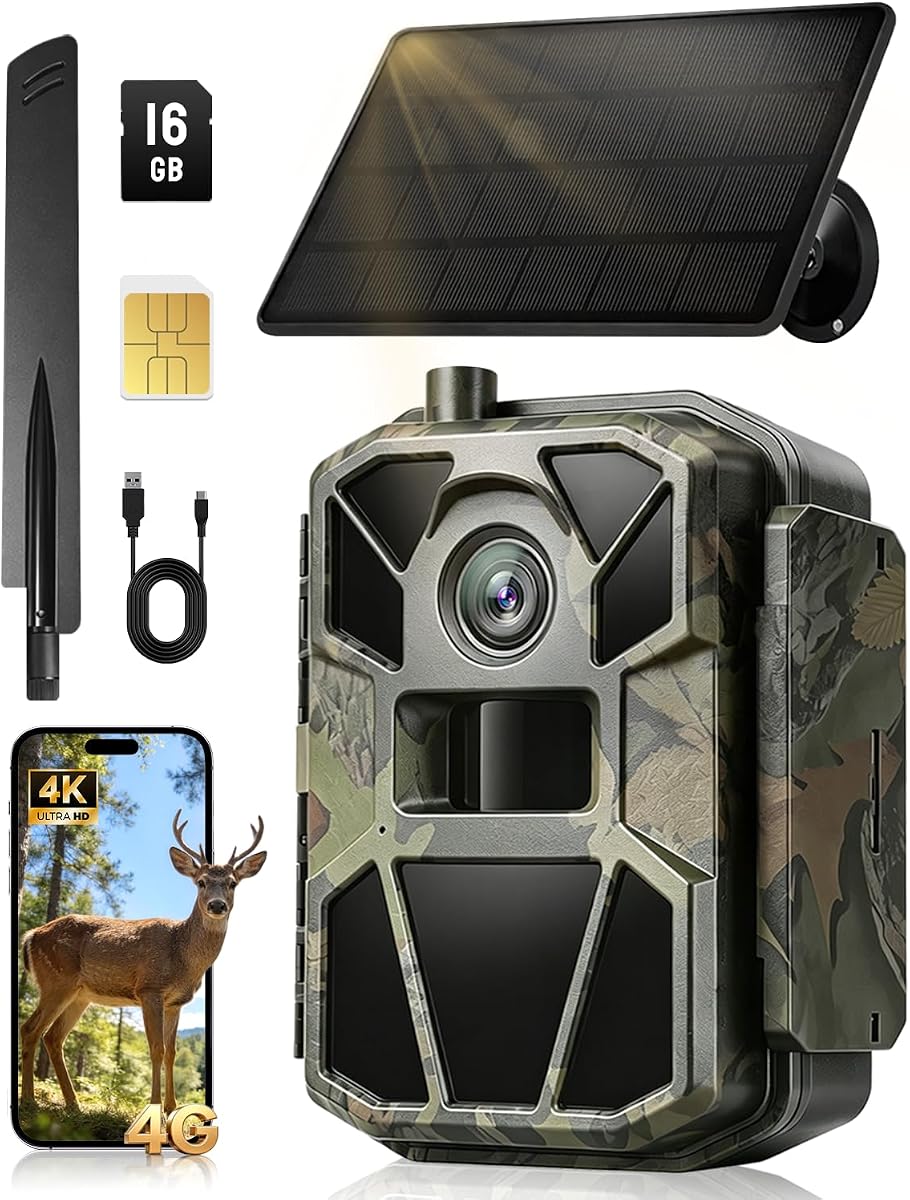
This Trail Camera 4G Cellular 2K 48MP is the strongest budget-oriented option in the list, with a 4.8 rating and an unusually flexible cellular design. Its removable SIM can be used with the included service or a user-supplied card, and it can continue functioning as a regular trail camera when no data plan is active.
We may earn a commission when you buy through this link, at no additional cost to you.
The camera records 48MP still images and 2K video through a 120-degree lens, while 850nm low-glow infrared LEDs provide a stated night-vision range of up to 65 feet. A 32GB memory card and eight AA batteries are included, and the built-in two-inch LCD allows quick on-device review. That inclusion reduces the need for immediate extra purchases.
The main compromise is its stated 0.4-second trigger speed, which is slower than the 0.1- and 0.2-second models elsewhere in the guide. That difference may matter for fast or distant targets, though it remains suitable for general wildlife and backyard monitoring. Users choosing the included cellular service should also verify ongoing plan costs and coverage.
Choose this camera for value-conscious buyers who want optional connectivity rather than a permanent cellular requirement. It is particularly practical for backyard observation or sites where the user may sometimes operate the camera locally. The removable SIM, included storage, and local screen make it a flexible entry point into 4G trail-camera use.
The removable SIM gives this camera more freedom than models restricted to a non-detachable card. It can operate locally, use the included service, or support a compatible user-supplied SIM according to the supplied details.
A 32GB memory card, eight AA batteries, and an integrated screen make the package practical out of the box. Format the memory card in the camera before its first use to avoid compatibility or recording issues.
We may earn a commission when you buy through this link, at no additional cost to you.
The SEHMUA Trail Camera 2 Packs provides two cellular cameras for monitoring separate entry points, trails, or sections of a property. It carries a perfect 5.0 rating in the supplied data, and its two-camera format makes it appealing to buyers who want broader coverage than one unit can provide.
We may earn a commission when you buy through this link, at no additional cost to you.
Each camera supports Verizon, T-Mobile, and AT&T, has a 0.2-second trigger speed, and provides an 82-foot low-glow night-vision range across a 120-degree field of view. App alerts support remote monitoring, and a 4W solar panel works with a 7800mAh rechargeable battery to reduce charging demands. IP66 weatherproofing helps protect the cameras in exposed outdoor locations.
The package includes 300MB of trial data for first use rather than the larger trial allowances described for some other models. Each camera requires its own data plan, and neither a memory card nor the optional cloud subscription is included. Users should therefore account for both devices when estimating cellular and storage expenses.
Choose this bundle when one camera cannot adequately cover a ranch, hunting property, or large yard. Separate units can monitor different approaches, giving better spatial awareness than a single panoramic view. It is also a sensible choice for securing two related locations when the total per-camera service cost remains acceptable.
Placing one unit near a primary trail and another at a separate gate or field entrance gives a more complete view of property activity. The bundle also provides a spare unit for later relocation.
Each camera combines a rechargeable battery with a 4W panel, while IP66 construction supports outdoor placement. Remember that cellular plans are charged per camera rather than shared across the pair.
We may earn a commission when you buy through this link, at no additional cost to you.
The 4G LTE Cellular Trail Camera with 1-Year Free Data combines high-resolution capture, automatic network switching, GPS tracking, and a large rechargeable battery. Its specifications are ambitious, but its 3.0 rating is the lowest in the roundup, making it important to weigh the feature list against mixed customer feedback.
We may earn a commission when you buy through this link, at no additional cost to you.
The camera records 64MP photos and 4K video with a 0.1-second trigger speed. Its no-glow night vision has a stated range of up to 98 feet, while IP66 waterproofing supports operation in rain, dust, and other outdoor conditions. The app allows remote settings, photo access, GPS location checks, and selected media management.
One year of free photo transmission is the key service advantage. Live viewing and video transfer or downloads are not included and require optional paid app services. A SIM and 16GB memory card are included, and the 12,000mAh rechargeable battery works with the integrated solar panel to reduce maintenance. The free allowance concerns photos only, so users expecting full 4K streaming should budget accordingly.
Choose this model when high resolution, long night-vision reach, GPS features, and a year of photo transmission are more important than the highest customer rating. It may appeal to technically comfortable users who will read current app-plan details carefully. For a steadier balance of rating, support clarity, and features, the higher-rated cellular alternatives may be safer choices.
The advertised 64MP photos and 4K video provide high-resolution source material for close inspection. Actual transmitted files may depend on the selected app service and cellular connection.
Automatic network switching can improve connectivity in variable terrain, while GPS helps users find a camera on a large property. Neither feature can replace a reliable local cellular signal.
We may earn a commission when you buy through this link, at no additional cost to you.
The WOSPORTS Trail Camera is not a 4G model, and its inclusion is intentional as a useful comparison for buyers who do not need cellular connectivity. It offers local recording, a 4.3 rating, and many of the same imaging priorities found in the cellular cameras at a lower general cost.
We may earn a commission when you buy through this link, at no additional cost to you.
Adjustable photo settings range from 5MP to 64MP, and video can be recorded in 4K or 2K through a 120-degree lens. The camera triggers in 0.2 seconds and supports one-to-three-frame bursts. Thirty-two 940nm infrared LEDs provide no-glow night illumination, while a two-inch color screen allows direct playback without removing the memory card.
Its main limitation is obvious but important: it has no cellular or Wi-Fi connectivity, so it cannot send alerts, stream live footage, or be checked remotely. It also requires eight AA batteries, a compatible WOSPORTS lithium battery, or a supported solar panel, and none of those power accessories are included. A 16GB card is included according to the supplied description, with support stated up to 256GB.
Choose this camera for conventional wildlife scouting, backyard surveillance, or locations where visiting the camera is acceptable and no monthly service is desired. It is not a substitute for a 4G model when immediate smartphone alerts are the priority. For buyers committed to remote cellular monitoring, the nine connected cameras in this guide are the more relevant shortlist.
The camera records directly to a memory card without a cellular plan, making it a straightforward option for standard wildlife and property observation. Users retrieve footage by visiting the camera or removing the card.
Photo resolution can be adjusted to suit storage and image needs, while AA batteries, compatible lithium packs, and supported solar panels offer several power paths. Accessories must be purchased separately.
We may earn a commission when you buy through this link, at no additional cost to you.
The right cellular trail camera depends on network coverage, the speed of wildlife you need to capture, remote-viewing expectations, and the ongoing service model. Comparing these factors before ordering can prevent frustration caused by weak signals, hidden subscription costs, or inadequate night coverage.
A 4G camera is only as useful as the cellular coverage at its installation site. Several models support Verizon, T-Mobile, and AT&T, which gives the buyer more placement options, while others automatically search for the strongest available network. Check coverage at the exact planned location, not just in the nearest town, because forests, valleys, ridges, and metal farm buildings can weaken signals. Also determine whether the bundled SIM is removable, restricted to the United States, or tied permanently to one provider.
Prioritize a multi-carrier camera when network conditions are uncertain. If you already know a carrier provides reliable service at the site, a model that automatically connects may still be convenient. Confirm that the camera supports 4G LTE and does not require Wi-Fi, which is particularly important for remote cabins, hunting properties, and isolated farms.
The hardware cost is only one part of a cellular camera's ownership experience. Some cameras include complimentary data, a seven-day unlimited trial, or a free monthly photo allowance, while others provide only a small introductory balance. Review the requirements for live streaming, video downloads, cloud storage, AI recognition, and alerts because basic photo transmission may be included while advanced functions require separate app services.
Look for a flexible plan that matches your monitoring pattern. Occasional wildlife checks may need only a limited photo allowance, while continuous livestock monitoring or frequent live viewing consumes more data. Check whether each camera requires a separate plan, whether cloud storage is optional, and whether annual billing is available. A removable SIM can also provide more freedom than a permanently installed provider card.
Trigger speed indicates how quickly the camera can begin recording after its passive infrared sensor detects movement. The models here range from 0.1 to 0.4 seconds. Faster response is helpful for fast birds, small animals, vehicles, or subjects crossing the frame at a distance, but it does not guarantee a clear image if the animal is too far away or moving too quickly for the exposure.
An adjustable PIR sensor is valuable because temperature changes, moving vegetation, and direct sunlight can create unwanted triggers. Pair the response time with a selective detection zone and appropriate sensitivity. If the goal is mostly scheduled monitoring, time-lapse modes can reduce irrelevant recordings and cellular usage.
Resolution options across the list range from 2K live video to advertised 4K recordings and photos of 48MP, 56MP, or 64MP. Higher numbers can reveal more detail when the subject is reasonably close, but they also create larger files, demand more storage, and may require a stronger cellular connection. A 120-degree wide lens is useful for covering a trail or yard but can make distant subjects occupy fewer pixels.
Consider the output you actually need. Wildlife identification and license-plate-level property checks benefit from high resolution, while standard scouting can be handled effectively at lower settings. SD-card capacity, removable storage, and optional cloud storage should be considered alongside the camera's stated resolution.
Night-vision range is most useful when compared under similar conditions, but the supplied specifications do not provide a standardized laboratory test for every model. The listed cameras offer stated ranges from 65 to 98 feet. Consider the angle of the target, vegetation density, moon phase, and infrared reflectance, since leaves, branches, and distant animals can reduce effective clarity.
Low-glow and no-glow infrared systems are attractive for wildlife because less visible red light may reduce disturbance. They are also useful for discreet property monitoring. A wider field of view can improve coverage but may not deliver the same detail as a narrower optical view, so choose based on the layout of the monitored area rather than range alone.
Solar panels reduce the frequency of battery replacements in locations that receive adequate sunlight, but they do not guarantee year-round operation in every climate. The list includes 4W and 5W panels, as well as a model with a 12,000mAh rechargeable battery. A larger battery provides more reserve during cloudy weather, while good panel placement and an unobstructed sun-facing surface are critical.
For cameras that support AA batteries, lithium cells may be preferable where the manufacturer permits them because of their longer storage characteristics and lower self-discharge. Verify battery compatibility, charging behavior, and whether a panel is included. If the panel is sold separately, include its cost and installation effort when comparing complete setups.
Local memory-card storage is valuable because it continues to work without a cellular plan, while cloud storage makes footage easier to access from several devices. Some packages include a card, while others require one to be purchased separately. Cards up to 128GB or 256GB are supported depending on the model. Format a newly purchased card in the camera before the first recording session.
The app is equally important because it controls activation, alerts, live viewing, settings, and sometimes species recognition. Check whether the app supports shared users, remote orientation, maps, and firmware updates. A built-in screen can be valuable for local review, especially when service is unavailable or the camera is being configured for the first time.
IP65 and IP66 ratings indicate resistance to dust and water under their respective test conditions, but they are not permission to submerge the camera or ignore the limits of the rating. The TKENPRO also states an operating range of -20°C to 50°C. Think about seasonal heat, cold, wind-driven rain, direct sunlight, and condensation inside the housing when choosing a location.
Mount the camera securely and keep the solar panel clear of shade. Avoid placing it directly under branches that may fall or rub against the housing, and ensure the camera is positioned at a useful height and angle. Test cellular reception and the app connection before relying on the camera for an important hunting or security period.
Begin by activating the camera through its specified app and inserting or confirming the included SIM before mounting it. If the product supports a user-supplied card, verify compatibility and regional restrictions. Download the relevant firmware, connect the camera to the app, test a live view, and test a motion clip before taking the unit into the field. For a new memory card, format it in the camera rather than only on a computer.
Choose a location with a clear line of sight, solid support, and dependable cellular reception. Position the camera according to the size and habits of the target wildlife, and aim the lens slightly downward where that improves ground-level images. Keep the solar panel unobstructed and facing open sky. Adjust PIR sensitivity and the detection zone to reduce false movement triggers, then confirm that alerts arrive on the user's phone.
Review the footage regularly and download anything important before removing or replacing storage. Check battery levels, panel alignment, lens cleanliness, and the security of the mounting strap or lock. Clean the housing with a soft, dry cloth and avoid directing water into ports. Review current data, cloud, and app-plan terms before the trial or free allowance ends, and test the camera again before hunting season or an extended monitoring period.
Yes, the connected models in this guide are designed to operate through 4G LTE and do not require Wi-Fi. They still require cellular signal coverage for live viewing, alerts, and most app functions. Local recording may remain available on some cameras when a service plan is inactive, but buyers should verify the exact offline behavior before installation.
That depends on the model. The Trail Camera 4G Cellular 2K 48MP supports a removable SIM and can accept a user-supplied card, while several other models use a non-removable, provider-specific SIM restricted to United States use. Always check compatibility, activation rules, and whether the camera's app still works with a personal plan.
Most require service after an introductory allowance or free photo tier ends. Some models include a free photo plan, while others provide several days of unlimited data or a small trial balance. Live video, cloud storage, downloads, and AI recognition may have separate requirements, so compare the ongoing service terms rather than focusing only on the initial trial.
A solar panel can help maintain a battery, but its contribution depends on sunlight, panel angle, weather, battery condition, and camera activity. None of the supplied specifications guarantees continuous operation in every climate. A charged battery, lithium backup, or conservative recording schedule can provide additional protection during prolonged poor weather.
Use a compatible microSD card within the manufacturer's stated capacity, and format it in the camera before first use. Several models support cards up to 128GB, while the WOSPORTS states support up to 256GB. High-resolution photos and 4K video can fill cards quickly, so regular review and download of important clips are advisable.
It can improve the chance of recording quick-moving subjects, but image quality also depends on subject distance, angle, lighting, and motion speed. A faster trigger may also capture more irrelevant movement. Adjustable PIR sensitivity and a suitable detection zone remain important for making a trail camera both responsive and selective.
Several models support multiple users or multiple cameras, but the supplied details often specify that each camera needs a separate data plan. A two-pack may be convenient for covering separate gates or trails, yet it can also double the cellular subscription cost. Confirm both app and per-device service requirements before installing a multi-camera system.
Yes. The included WOSPORTS model records locally without a subscription and is useful when you only need wildlife or property footage and can visit the camera to retrieve it. It cannot provide live remote viewing or phone alerts, so it does not replace a true 4G model when immediate remote access is the main requirement.
The Solar Trail Camera 4G LTE is the most balanced overall choice, combining three-carrier support, a 4.9 rating, AI features, and a 4W solar panel. TKENPRO stands out as the premium option with 2K panoramic control, two-way audio, and an 85-foot night range, while the Trail Camera 4G Cellular 2K 48MP provides the best budget approach and unusual SIM flexibility.
Prioritize cellular signal at the exact installation site, then compare trigger speed, effective night coverage, power needs, and the service model. The SEHMUA two-pack may be more useful for broader property coverage, and SPYPOINT may appeal to users whose needs center on a limited number of transmitted photos. A completely offline camera is appropriate only when remote alerts are unnecessary.
Product prices, introductory data allowances, app features, and plan structures can change, and they may differ by date or region. Before buying, verify the current listing, compatibility, included accessories, and ongoing cellular terms. This guide is designed to narrow the field and make the final comparison easier, not to replace checking the latest seller information.