
HW Rechargeable AAA Lithium Batteries 4-Pack
4.2Editor score
Four 1300mWh batteries
Four-in-one USB-C cable
Constant 1.5V output
Six-month product care
Aaa Lithium Rechargeable Batteries compared by capacity, voltage, charger design, cycle life, compatibility, and convenience for everyday devices.
Aaa Lithium Rechargeable Batteries combine the familiar size of a standard AAA cell with rechargeable lithium-ion technology, making them useful for game controllers, remote controls, flashlights, wireless mice, cameras, and other everyday electronics. The right battery should provide steady voltage, practical capacity, safe charging, and enough endurance to avoid frequent replacements.
The products in this guide were compared using the information supplied by each manufacturer, including battery count, energy capacity, rated voltage, recharge-cycle claims, charger features, safety protections, and stated device compatibility. The list also distinguishes true rechargeable lithium cells from one-time-use lithium batteries and highlights charger requirements that shoppers should confirm before ordering.
Each review explains the most useful strengths and limitations, helping you match a battery system to your devices and routine. Ratings reflect the supplied marketplace feedback, while technical claims come from the product descriptions. Availability and prices change over time, so compare the current listing details before making a final purchase.
4.2Editor score
4.3Editor score

4.3Editor score
This side-by-side comparison highlights each rechargeable AAA system's capacity, voltage, charging setup, cycle-life claim, and intended use, helping you identify the most suitable option for your devices.





The Dracutum 8-Pack AAA Rechargeable Batteries Lithium 1.5V 1300mWh Triple A Battery offers a combination of high stated energy capacity, constant-voltage performance, and a pack size suited to households or teams of device users. Its supplied marketplace rating is 4.1, placing it among the more moderately rated products in this guide. The defining specification is the claimed 1300mWh capacity, equivalent to approximately 860mAh in the product information.
We may earn a commission when you buy through this link, at no additional cost to you.
Each cell is described as maintaining a working 1.5-volt output, which can be advantageous in equipment designed around alkaline or disposable-lithium AAA voltage rather than the declining output of a conventional 1.2-volt NiMH cell. The set is also presented as suitable for both high-drain and lower-power devices. A claimed recharge life of up to 1000 cycles and the absence of a memory effect make it a potentially economical choice for frequently used controllers, flashlights, mice, and similar products.
The important limitation is charger compatibility. The manufacturer specifically warns that a standard 1.2V NiMH charger is not suitable and recommends a charger designed for 1.5V AAA lithium-ion cells. The product description also notes that runtime per charge may be shorter than that of disposable lithium batteries, even though repeated reuse can still reduce waste over time. A separate compatible charger is therefore an essential part of the ownership calculation.
This set makes the most sense for shoppers who want at least eight cells, recognize the importance of stable 1.5V output, and already have a suitable 1.5V lithium charger. It is less convenient for beginners who expect a standard NiMH charger or USB charger to work without qualification. Confirm the charger's compatibility and your device's voltage requirements before ordering, especially for security equipment or other specialized electronics.
The stated 1300mWh capacity is a meaningful selling point for flashlights, cameras, game controllers, and other equipment that draws power quickly. Actual runtime depends on device demand, cutoff behavior, temperature, and battery age, so capacity should be treated as a comparative specification rather than a guaranteed duration.
Because these cells require a dedicated 1.5V lithium charger, buyers should treat the charger as part of the system rather than an optional accessory. Using an incompatible NiMH charger can prevent proper charging and may create avoidable safety concerns.
We may earn a commission when you buy through this link, at no additional cost to you.
The Rechargeable 8AA and 8AAA Lithium Batteries with 16 Slot Li-ion Charger is the broadest mixed-format system in the guide, supplying eight AA batteries, eight AAA batteries, and a 16-slot charger. Its supplied rating is 4.8, tied for the highest rating among the listed products. It is especially useful for households that use both formats across flashlights, remote controls, toys, and general household electronics.
We may earn a commission when you buy through this link, at no additional cost to you.
The AAA cells are stated to deliver 1100mWh, while the AA cells have a stated capacity of 3400mWh. Both formats provide constant 1.5V output until depletion, avoiding the gradual voltage decline associated with ordinary NiMH batteries. The charging case uses a magnetic, full-cover design, with a honeycomb mesh shell intended to dissipate heat. Solid red and green indicators communicate charging and completion, while a flashing red warning identifies an incompatible or damaged battery.
There are trade-offs. This is a larger and more specialized package than a straightforward AAA-only set, so it may be unnecessary for someone who owns only one or two battery-powered devices. The charger is designed specifically for the included rechargeable AA and AAA lithium batteries; it should not be assumed to accept standard NiMH cells or disposable batteries. Buyers must also respect the manufacturer's polarity, charging, and battery-handling instructions.
For people who want a single charging ecosystem for both AA and AAA devices, this package is especially attractive. The high 4.8 rating, generous quantity, clear status indicators, and claimed ability to recharge each cell more than 2,000 times make it a compelling choice. It is less ideal for a minimal setup, but it offers flexibility that narrower bundles cannot match.
The 16-slot magnetic case is the feature that distinguishes this bundle. It allows AA and AAA lithium cells to be charged and stored together, reducing the need for separate chargers and making mixed-format households easier to organize.
Red, green, and flashing-red signals provide a simple visual guide to charging progress and potential incompatibility. The warning state is particularly useful because inserting the wrong battery type into a lithium charger can be unsafe.
We may earn a commission when you buy through this link, at no additional cost to you.
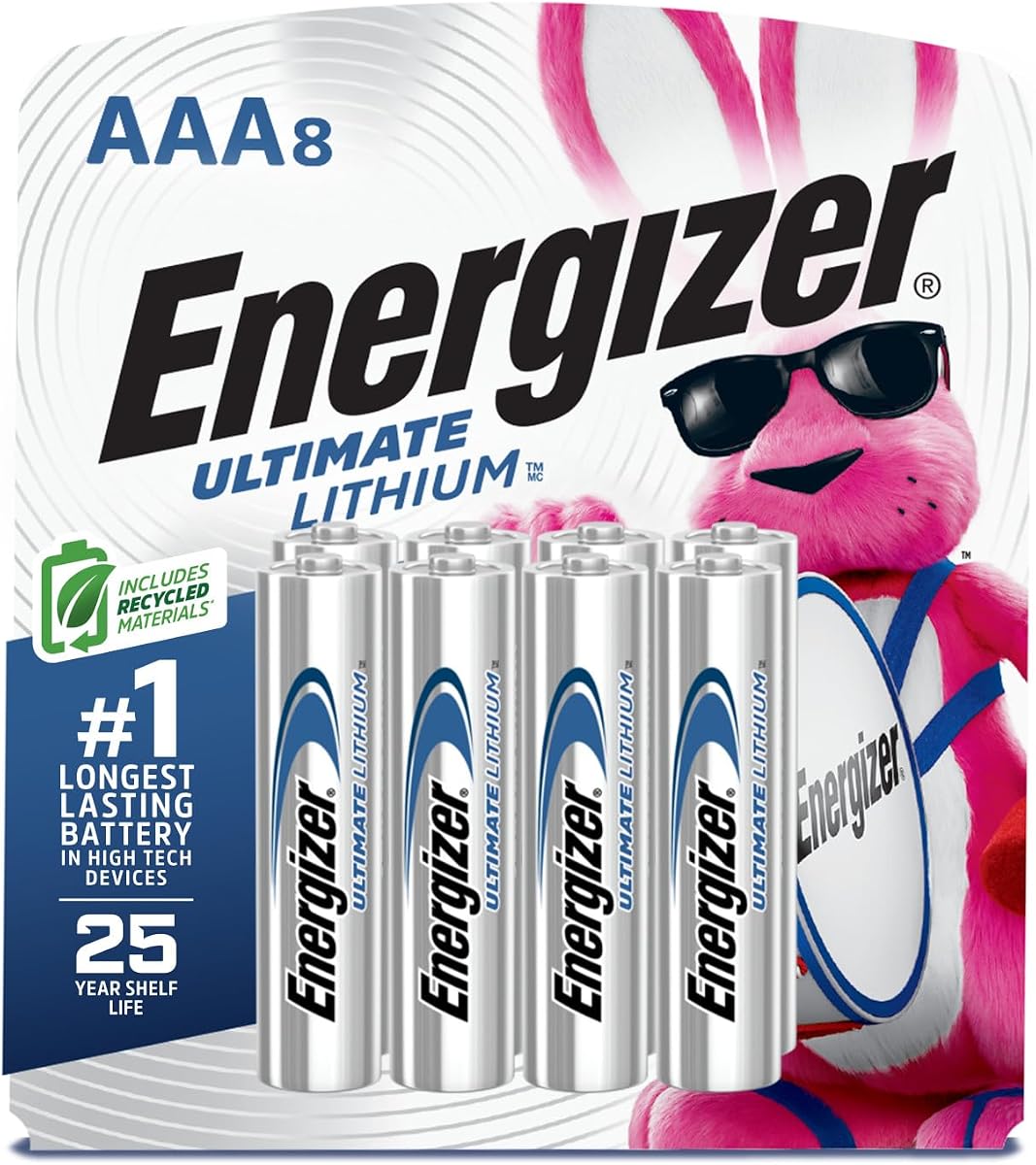
The Energizer Ultimate Lithium AAA Batteries (8 Pack), Lithium Triple A Batteries is not a rechargeable product, despite the keyword focus of this guide. It earns a place because it is a relevant benchmark for shoppers comparing lithium AAA cells on runtime, storage, and environmental resilience. Its supplied rating is 4.8, matching the highest rating in the selection.
We may earn a commission when you buy through this link, at no additional cost to you.
The product information emphasizes strong performance in high-tech devices and a stated operating range from minus 40 to 140 degrees Fahrenheit. It is also described as leak-proof based on standard use and as retaining useful backup capability for up to 25 years in storage. Suggested applications include digital cameras, game controllers, flashlights, toys, and games, making it a familiar and versatile option.
The decisive distinction is that these are single-use lithium batteries. They cannot be recharged, and using a lithium battery charger on them would be incorrect. This makes the product better suited to emergency kits, seasonal equipment, seldom-used devices, or consumers who want exceptionally long storage without maintaining a charger. It is not the environmentally responsible choice for a device that consumes batteries every week.
Although this set does not answer the rechargeable part of the search directly, it provides a useful point of comparison. Shoppers can use it to judge disposable lithium performance against reusable cells, while still understanding that the trade-off is convenience and storage longevity in exchange for no rechargeability. View it as a complementary option, not a substitute for a rechargeable AAA system.
The stated minus 40 to 140 degrees Fahrenheit range is a major advantage for outdoor equipment, emergency supplies, and vehicles exposed to seasonal temperature swings. Rechargeable buyers should not assume every competing lithium system offers the same environmental range.
A claimed 25-year storage life makes disposable lithium cells convenient for emergency kits and backup devices that may remain idle. For high-consumption electronics, however, the inability to recharge can outweigh the long shelf life.
We may earn a commission when you buy through this link, at no additional cost to you.
The 12-Pack 1100mWh Rechargeable Lithium AAA Batteries with 12 Slot Charger combines eight 1100mWh AAA lithium cells with a larger charging station. Its supplied rating is 4.4. Although the product title refers to a 12-pack, the supplied details state that eight batteries are included, with the charger offering 12 independent positions. That distinction matters when comparing the complete package with products that include more cells.
We may earn a commission when you buy through this link, at no additional cost to you.
One of the charger's most useful features is independent slot operation. It can charge from one to 12 cells in any combination, allowing a user to top up a single battery without waiting for a full set. The USB-C charger uses an MCU-controlled 350mA pulse current, then switches to trickle mode. Red and green LEDs identify charging and completed states, while alerts are provided for non-rechargeable or damaged cells and temperature-related issues.
The magnetic, fully wrapped storage station is intended to protect batteries from dust, moisture, and dirt when they are not being used. Its footprint is designed for home or office organization rather than portable travel. The product description positions the set for game controllers, flashlights, and digital cameras and includes a one-year warranty. The charger is also described as compatible with 1.5V rechargeable AAA lithium cells from other brands, but only when those cells meet its stated requirements.
This is a strong choice for a growing collection of devices or for anyone who wants charging flexibility without replacing the entire station. The unused initial slots may feel inefficient, yet they make later expansion straightforward. Confirm the number of batteries actually received before buying, and use only with compatible rechargeable 1.5V lithium-ion AAA cells.
Independent slots are valuable for mixed daily use because a single depleted battery can be replenished without waiting for every cell in the set. This flexibility also helps the charger remain useful as the number of devices grows.
Automatic rejection of disposable or damaged cells reduces the risk of misuse. Temperature warnings and controlled charge transitions add further protection, though buyers should still use the supplied cable and manufacturer instructions.
We may earn a commission when you buy through this link, at no additional cost to you.
The 16 Pack 1100mWh Rechargeable AAA Batteries, 1.5V Constant Output is designed for people who have many battery-powered products or want enough cells to rotate between several devices. Its supplied rating is 4.3. The large quantity distinguishes it from smaller kits, while the claimed 1.5V constant output and 1100mWh capacity target modern high-drain electronics.
We may earn a commission when you buy through this link, at no additional cost to you.
The product description cites ProCyco technology, no memory effect, low self-discharge, and the ability to recharge each cell more than 2,000 times. It is presented as compatible with more than 200 device types, including wireless mice, flashlights, game controllers, smart-home sensors, and toys. A smart chip and explosion-proof module are also listed as safety-oriented features, while the cells are said to retain their charge for months in storage.
A major practical consideration is the charger. The description clearly states that these 1.5V lithium cells require a dedicated 1.5V lithium battery charger and are not compatible with standard 1.2V NiMH chargers. A charger is not listed among the supplied contents, so shoppers should plan to purchase one separately unless they already own a compatible unit. This makes the set less convenient for a first-time rechargeable AAA buyer.
For a family with numerous controllers, remotes, sensors, or other low-to-moderate draw devices, sixteen cells offer valuable flexibility. The 1.5V output and strong cycle-life claim make it attractive for frequent use. The better buyer is therefore someone who values quantity and long-term reuse over a complete, ready-to-use charging bundle.
Having sixteen cells makes it easier to keep a fresh set charged while another is in use. That is especially helpful for households where several controllers, remotes, or sensors are active throughout the day.
The stated low self-discharge rate and ability to hold charge for months are useful for seasonal equipment. Actual retention changes with temperature, age, and charge state, so long-unused cells should still be checked before deployment.
We may earn a commission when you buy through this link, at no additional cost to you.
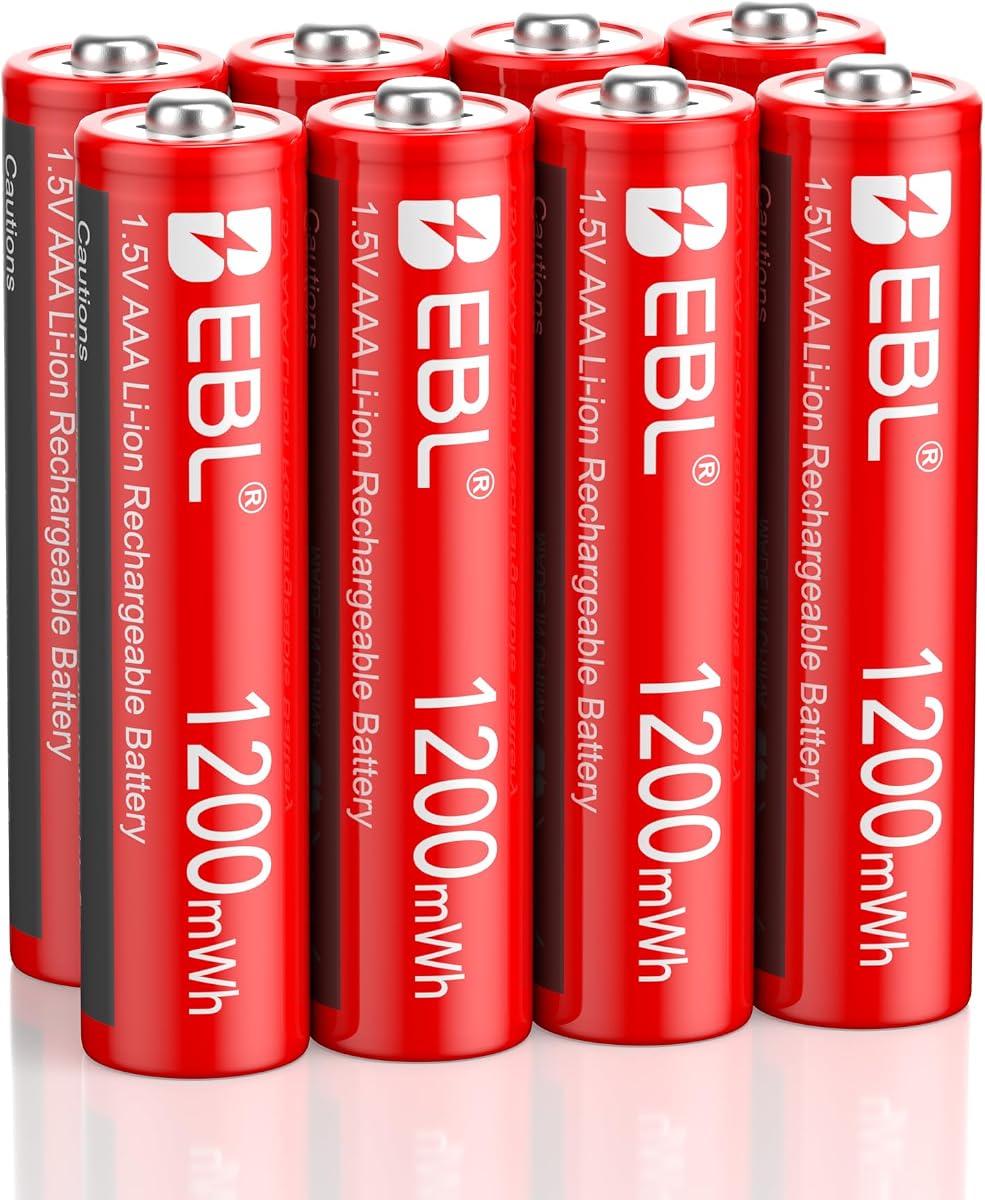
The EBL Rechargeable Lithium AAA Batteries, 1.5V Constant 1200mWh for Remote offers a middle-ground capacity of 1200mWh, making it a versatile option for remote controls, wireless mice, digital cameras, toys, smart locks, and flashlights. Its supplied rating is 4.2. The set is described as using high-density lithium-ion technology to balance energy density with a relatively lightweight format.
We may earn a commission when you buy through this link, at no additional cost to you.
Its primary selling point is constant 1.5V output from full charge through discharge. That behavior is relevant for devices that may be designed around the voltage of alkaline cells or disposable lithium cells. EBL states that its batteries can be recharged more than 1,200 times, have no memory effect, and exhibit low self-discharge. Those characteristics make the cells suitable for routine use without frequent full-set replacements.
The supplied product information is less complete in two practical areas. It does not clearly state the number of AAA cells included, and it gives limited detail about an included charger. Since a rechargeable 1.5V lithium system needs the correct charger, shoppers should examine the package contents carefully before ordering. The absence of a clearly stated quantity also makes it difficult to compare this option with bundles that clearly provide four, eight, twelve, or sixteen cells.
EBL is most suitable for a buyer who already knows that constant 1.5V output and roughly 1,200 recharge cycles meet their needs. Its claimed 1200mWh capacity sits above the 1100mWh options but below the 1300mWh leaders, offering a potentially balanced middle ground. Confirm pack quantity, charger inclusion, and device compatibility in the current listing before purchase.
Maintaining 1.5V throughout discharge can help devices that behave inconsistently when fed the gradually falling voltage of a standard NiMH cell. Device design still matters, so confirm manufacturer guidance when replacing a battery type.
The claimed low weight and high energy density can benefit small controllers, mice, and portable electronics. The effect is more noticeable when several cells are carried together or where battery weight influences handling.
We may earn a commission when you buy through this link, at no additional cost to you.
The PHILIPS Rechargeable AAA Lithium Battery 8 Pack combines eight 1300mWh cells with a dedicated eight-slot USB-C charging station. Its supplied rating is 4.3. The package is polished and well defined, making it a premium-oriented choice for households that want high stated capacity, coordinated charging, and a broad selection of compatible everyday electronics.
We may earn a commission when you buy through this link, at no additional cost to you.
The charger supports 5V at up to 2A and is claimed to charge all eight cells within 2.5 hours. Each position operates independently, while clear LEDs report charging status and flag problems such as abnormal temperature, unstable voltage, or mismatched battery models. The battery set provides constant 1.5V output, claims 30% longer service life than traditional NiMH rechargeable batteries, and supports recovery after a deep zero-volt discharge.
Safety is a major focus. The charger has overcharge, over-discharge, short-circuit, and overheating protection, while its ABS and polycarbonate housing is described as flame retardant and tested against a one-meter drop. The cells have no memory effect and are said to lose less than 5% power per month. Despite these strengths, the manufacturer explicitly says the set is not compatible with 3V smoke-alarm batteries, doorbell cameras, and other special-voltage security devices.
This PHILIPS set is a strong all-around recommendation for remotes, wireless keyboards and mice, smart locks, toys, clocks, scales, flashlights, and temperature or humidity sensors. It is particularly attractive when a full eight-cell rotation and a rapid, independent charger matter. The exclusions for security devices are important, so check device requirements before buying a large set for mixed equipment.
A 5V, 2A USB-C station with independent positions is convenient for replenishing a full set quickly. The stated full-charge time of 2.5 hours keeps downtime manageable for frequently used controllers and household electronics.
Protection against overcharging, over-discharge, short circuits, and overheating addresses common battery-management risks. These safeguards do not make careless charging acceptable, so the correct charger and matched cells remain essential.
We may earn a commission when you buy through this link, at no additional cost to you.
The HW Rechargeable AAA Lithium Batteries 4-Pack is a compact way to begin using rechargeable AAA lithium cells without buying a large set immediately. Its supplied rating is 4.2. Four 1300mWh batteries provide a high stated capacity, while the included four-in-one USB to USB-C cable allows all four cells to charge together from a laptop, power bank, wall charger, or car charger.
We may earn a commission when you buy through this link, at no additional cost to you.
The cells maintain a constant 1.5V output from full to empty, according to the product description, and are positioned for high-drain devices. The manufacturer claims a full charge in 1.5 hours and protection against overcharge, over-discharge, over-voltage, over-current, short circuits, and overheating. A claimed service life of more than 1,000 recharge cycles suggests the set is intended for regular use rather than occasional emergencies.
The small quantity is both its main advantage and its main limitation. Four cells are enough for one remote, a two-battery device, or a small controller setup without tying up a larger collection. They are less suitable for households that need a complete rotation across many devices. The product also does not offer a dedicated enclosed charging case, so the four cells and cable need to be stored together separately.
HW is a sensible entry-level option for anyone who owns a few compatible devices and wants to test rechargeable lithium AAA technology. The included cable removes the need to search for a proprietary charger connection, while USB power gives flexibility about where charging occurs. The set includes a six-month product care service. For heavier household use, however, a larger bundle may offer better convenience.
Four cells let a new user identify compatible devices and establish a charging routine without committing to a large collection. If the results suit the household, additional sets can be added later if needed.
The included four-in-one cable can be connected to several common power sources. That makes the set useful at a desk, in a travel bag, or wherever a suitable USB charger or power bank is available.
We may earn a commission when you buy through this link, at no additional cost to you.
The Rechargeable AAA Lithium Batteries, 16 Pack, 1300mWh, 1.5V is built for extensive rotation, offering twice as many cells as an eight-battery set. Its supplied rating is 4.5, the highest rating among the rechargeable products in this guide. Each cell has a stated capacity of 1300mWh and is designed to maintain constant 1.5V output until depleted.
We may earn a commission when you buy through this link, at no additional cost to you.
The set claims more than 1,200 recharge cycles, no memory effect, and very low self-discharge. This makes it attractive for a household with several gamepads, cameras, flashlights, door locks, microphones, radios, toys, scales, blood-pressure monitors, and similar products. The listed compatibility also includes blink cameras, although any device with specialized voltage or battery requirements should be checked before replacing its factory cells.
The major issue is the limited charging information. A compatible 1.5V lithium AAA charger is necessary, but the supplied description does not clearly establish that one is included. Sixteen cells also demand more charging capacity and storage than smaller kits. A capable multi-slot charger is therefore an important addition, and the buyer must not attempt to charge these lithium-ion cells with a standard 1.2V NiMH charger.
The product's safety warnings deserve attention. Users should not disassemble, crush, or puncture the cells, should install them with correct polarity, and must keep them away from children. With those precautions understood, the 16-pack is an excellent choice for high-volume users who want substantial capacity and a long service life. It is less economical in convenience terms for someone with only one or two compatible devices.
Sixteen high-capacity cells let users keep multiple devices powered or maintain a substantial reserve. This is especially useful when one device requires several cells or when several products are used throughout the day.
Correct polarity is critical, and damaged cells should never be placed in a charger. The warnings about crushing, puncturing, and child access are not formalities; physical damage or incorrect installation can lead to overheating, leakage, fire, or explosion.
We may earn a commission when you buy through this link, at no additional cost to you.
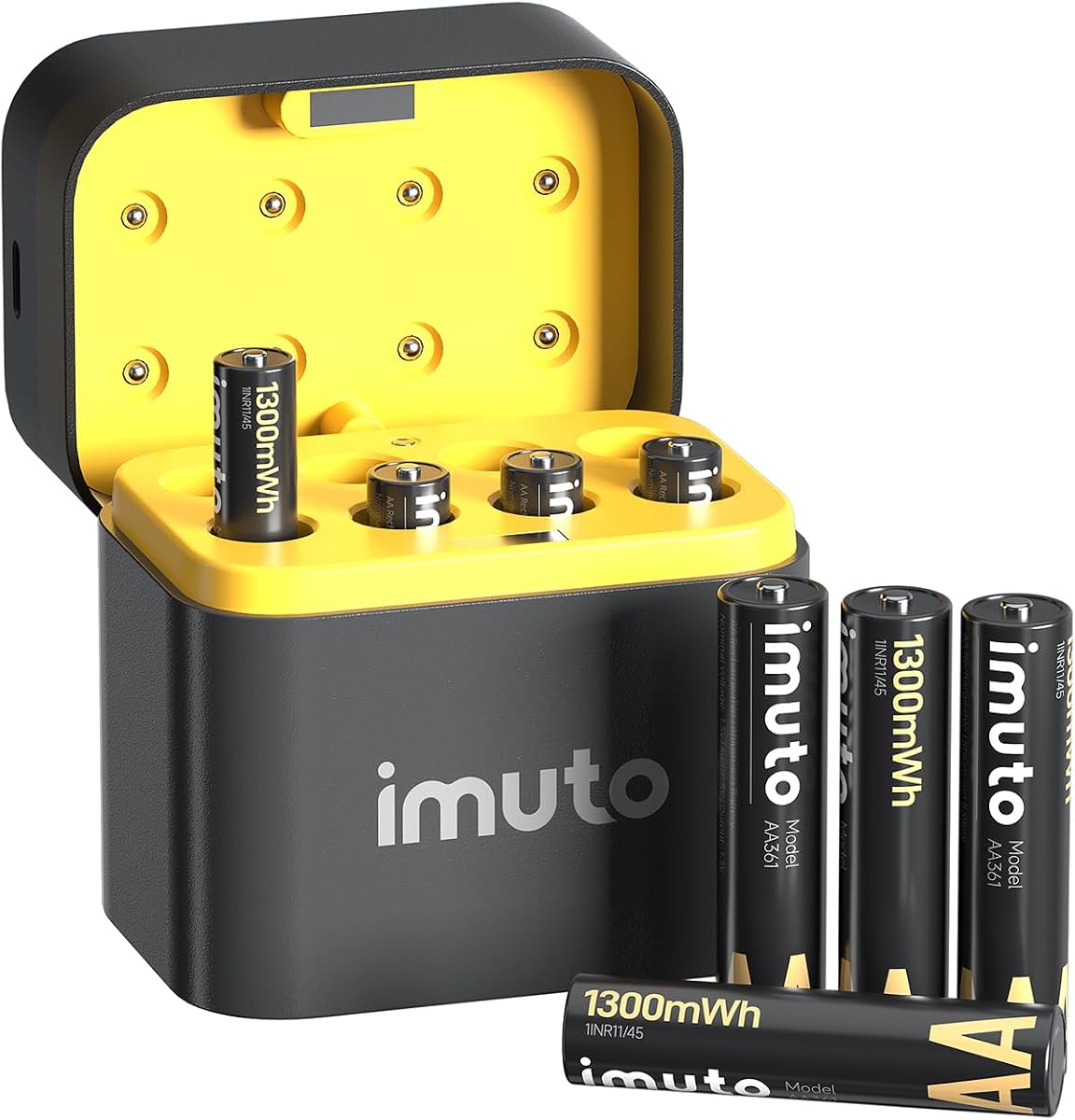
The imuto AAA Lithium Rechargeable Batteries Fast Charger 8 Pack 1.5V 1300mWh is the most complete overall package in the guide. It includes eight high-capacity cells, a smart charging case, a Type-C to Type-C cable, a user manual, and a 12-month warranty. Its supplied rating is 4.3, while the combination of features makes it the strongest general recommendation for buyers who want a ready-to-use system.
We may earn a commission when you buy through this link, at no additional cost to you.
The cells provide a stated 1300mWh capacity and constant 1.5V output. The charger uses eight independent slots, allowing any combination from one to eight cells to recharge, and the manufacturer states a full charge in 2.2 hours. It can draw power from a laptop, power bank, car charger, or USB-C adapter. The enclosure serves double duty as a protected storage case, reducing the loose-battery clutter common in drawers and travel bags.
The set claims 1,600 recharge cycles per battery, no memory effect, low self-discharge, and a 12-year shelf life. Built-in protection circuits are said to guard against overcharging and short circuits. Suggested applications include wireless mice, keyboards, remote controls, scales, clocks, radios, toys, and household electronics. These are sensible use cases for cells that maintain a working 1.5-volt output throughout discharge.
This is a strong all-around choice for anyone who wants a balance of capacity, charging speed, organization, and warranty coverage. Eight cells are enough to rotate across several common devices without the storage burden of a 16-battery inventory, and the integrated case makes the system easier to manage. As with all rechargeable lithium cells, use only the supplied or manufacturer-approved charger, observe correct polarity, and buy from a reputable seller.
The batteries, charging case, cable, manual, and warranty are included, reducing the chance that a buyer will discover a missing charger after delivery. That completeness is a meaningful advantage over large battery packs sold without a clearly identified charger.
Charging only the cells that need power is convenient and can reduce unnecessary wait time. The protective case also gives every battery a dedicated home, which helps prevent contact damage, dirt, and accidental mixing with loose cells.
We may earn a commission when you buy through this link, at no additional cost to you.
Choosing rechargeable AAA lithium batteries requires balancing chemistry, voltage, capacity, charger compatibility, cell quantity, and the demands of your devices. The most important first step is confirming that your equipment accepts rechargeable 1.5V AAA lithium-ion cells.
Rechargeable 1.5V AAA lithium cells are not interchangeable with ordinary 1.2V NiMH batteries, and their charging requirements are also different. Several products in this guide explicitly warn against using a standard NiMH charger. A conventional USB port does not automatically make a set compatible, because the voltage, current, cell chemistry, and charge protocol must all be supported. Look for a dedicated 1.5V lithium charger or a manufacturer-approved charging case. If the listing does not identify a compatible charger, contact the seller before ordering. The same applies to batteries sold in larger quantities: a large collection of cells has little value if they cannot be charged safely and correctly.
Capacity is commonly expressed in milliwatt-hours, abbreviated mWh. The rechargeable sets in this guide range from 1100mWh to 1300mWh for their AAA cells, while one mixed-format option also includes higher-capacity AA cells. A larger rating is desirable for high-drain equipment such as cameras, flashlights, and game controllers, but it does not guarantee a specific runtime. Device power draw, battery age, temperature, cutoff thresholds, and conversion efficiency all affect real performance. A higher capacity can also take longer to recharge. Compare capacity as a relative indicator, then use user feedback and device requirements to judge whether a cell is suitable. For occasional remote-control use, the difference between 1100mWh and 1300mWh may be less important than the convenience of the charger and storage case.
Many electronics were designed around the approximately 1.5V output of alkaline or disposable-lithium AAA cells. Rechargeable lithium-ion AAA products that maintain a stable 1.5V can therefore be a closer match than ordinary 1.2V NiMH rechargeables, whose voltage gradually falls as they discharge. This characteristic may help with low-battery warnings, remote controls, wireless peripherals, and other sensitive equipment. It does not guarantee universal compatibility. Some devices use battery packs with internal protection circuits, while others require exact cell chemistry or reserve voltage. Check the device manual and the battery manufacturer's approved list whenever replacing a specialized or security-related battery.
The stated cycle-life figures range from 1,000 to more than 2,000 recharges. A higher claim suggests better long-term value because each cell can replace many disposable batteries, but cycle count is a maximum under controlled conditions rather than a guarantee. Actual longevity depends on charge depth, temperature, charging equipment, discharge rate, and storage practices. Rechargeable lithium cells generally have no memory effect, so partial charging does not need to be avoided for that reason. Still, following the manufacturer's charging instructions helps preserve performance. Treat cycle life as a comparative signal and also consider the stated warranty or after-sales support.
Battery count determines how easily you can rotate cells between devices. A four-pack is compact and appropriate for one or two compatible products, while an eight-pack covers multiple remotes, controllers, or mice. A 16-pack can serve a busy household or provide a substantial reserve, but it requires more charging capacity and organized storage. A charger with more slots than supplied batteries can be useful for future expansion, while a kit with exactly enough slots is simpler. Count the batteries required by each device, including accessories, and allow for charging one set while another remains in service.
Charging times in the guide range from a stated 1.5 hours for the four-cell HW set to 2.5 hours for the eight-cell PHILIPS station. Imuto states a 2.2-hour full charge, while larger or more elaborate systems may take longer depending on charge current and capacity. USB-C input makes charging more flexible because a suitable wall adapter, laptop, power bank, or car charger can serve as a power source. The output rating of that source also matters: a high-current phone or laptop port may not deliver the same charging speed as a proper wall adapter. Check the charger specification and use a reliable source compatible with its stated input.
Rechargeable lithium cells benefit from managed charging and physical protection. Look for built-in safeguards against overcharge, over-discharge, over-current, short circuits, and overheating, along with a charger that rejects disposable or damaged batteries. Magnetic closures and individual slots help prevent contamination and accidental contact. A full-wrap case also makes the system easier to transport. Safety features do not excuse incorrect use: insert cells in the proper direction, do not mix lithium and NiMH cells in one charger, and never charge visibly swollen, punctured, corroded, or damaged batteries. Children should not have access to loose cells because of the choking and ingestion risk.
The broad device lists in this guide cover game controllers, wireless mice, keyboards, remotes, flashlights, digital cameras, toys, clocks, scales, radios, sensors, and similar products. Compatibility depends on voltage, dimensions, discharge behavior, and sometimes the presence of a protected battery pack. The PHILIPS set explicitly excludes 3V smoke-alarm batteries, doorbell cameras, and other special-voltage security devices. The 16-pack description mentions blink cameras, yet other devices may still have unique requirements. Always check the equipment manual, look for warnings in the listing, and test a rechargeable cell in a less critical device before replacing every original battery.
Before first use, confirm that every device accepts rechargeable 1.5V AAA lithium-ion batteries. Read the charger's instructions, inspect the cells and contacts, and verify the correct polarity. Do not mix these cells with disposable alkaline batteries, disposable lithium cells, or NiMH rechargeable AAA batteries in the same device or charger. Use only a charger explicitly compatible with 1.5V rechargeable lithium AAA cells.
Place the cells into the charger with their positive and negative terminals aligned according to the markings. Close the magnetic or protective cover if the charger has one, connect the specified power cable, and allow the stated charging time. Status lights may indicate charging, completion, or an incompatible cell. Remove the batteries when charging is complete, and never leave a damaged, swollen, hot, or leaking cell in a charger.
Store charged cells in their case, away from children, extreme heat, moisture, metal objects, and direct physical damage. Rotate sets if you own multiple batteries, and periodically check for leakage, corrosion, swelling, or impact damage. Do not disassemble or puncture a cell. If a battery becomes unusually hot, leaks, or appears damaged, stop using it and follow the manufacturer's safety and disposal guidance. Using the correct charger and maintaining reasonable charging habits will help preserve runtime, capacity, and a long service life.
No, not unless the charger manufacturer explicitly states that it supports 1.5V rechargeable lithium AAA cells. Most standard NiMH chargers are designed for 1.2V cells and use a different charge profile. The products reviewed here repeatedly specify that a dedicated 1.5V lithium charger is required. Using the wrong charger may fail to charge the cells properly and can create safety risks.
They can be better for devices designed around 1.5V cells because they maintain a steadier operating voltage. Rechargeable NiMH cells often decline from roughly 1.2V as they discharge, which may trigger low-battery warnings or affect sensitive electronics. Rechargeable lithium cells can also offer a longer service life and a higher energy rating, but their charger requirements differ. Device guidance remains the deciding factor.
Runtime varies with capacity, device power draw, temperature, battery age, and the device's low-battery cutoff. The sets in this guide offer stated AAA capacities from 1100mWh to 1300mWh, and one mixed set supplies higher-capacity AA cells. A high-drain flashlight or camera will naturally use a charge faster than a remote control. For the most useful comparison, review current owner feedback about runtime in similar devices.
Do not assume they are compatible. The PHILIPS set in this guide explicitly says it is not compatible with 3V smoke-alarm batteries, doorbell cameras, or other special-voltage security devices. Some cameras may accept only a specific rechargeable battery model because of their built-in charging systems. Check the original battery marking, device manual, and manufacturer support before replacing a safety-critical or security-related cell.
Milliwatt-hours measure stored energy, while milliampere-hours measure charge capacity. For a given voltage, a higher energy figure generally indicates more total available power. The 1300mWh batteries here are described as approximately 860mAh in one product listing because the cells operate at about 1.5V. When comparing products, use the same unit so the ratings remain meaningful.
The rechargeable lithium AAA products in this guide are specifically described as having no memory effect. That means you do not need to fully discharge a cell before recharging it, and partial top-ups are generally convenient. Nevertheless, following the charger's instructions and avoiding damaged or incompatible cells is still important. Charging practices, temperature, and storage conditions can affect long-term capacity.
A four-pack is appropriate for one or two compatible devices and offers a compact way to test rechargeable AAA lithium technology. An eight-pack provides a more useful household rotation, while a sixteen-pack is best for many devices, frequent use, or maintaining spare charged cells. Larger sets require a charger with enough independent slots and more organized storage. Count your device battery requirements before choosing.
Store them in their charging or protective case, away from children, heat, moisture, conductive metal, and physical damage. Keep the terminals from contacting loose coins, keys, or other metal objects. The products describe low self-discharge and multi-month or longer retention, but storage temperature still affects long-term performance. Periodically inspect cells for swelling, corrosion, leakage, or impact damage and discontinue use if any problem appears.
The imuto 8-Pack stands out as the best overall option because it combines 1300mWh cells, constant 1.5V output, eight independent charging positions, a 2.2-hour stated charging time, a protective case, and a 12-month warranty. The HW 4-Pack is the best budget starting point for a small number of devices, while the PHILIPS 8-Pack earns the premium designation for its fast USB-C station, fourfold protection, and broad household compatibility.
Prioritize charger compatibility before comparing capacity or cycle count. Confirm that your devices accept rechargeable 1.5V lithium AAA cells, obtain the correct charger, and check any exclusions for security equipment. From there, choose the cell quantity that matches your rotation needs, consider constant-voltage performance and charging convenience, and favor a protective design with clear safety features. High cycle-life claims are useful, but they should be considered alongside proper care and current owner feedback.
Product availability, package contents, ratings, and prices can change, and marketplace information may not always reflect the exact version received. Before purchasing, review the current listing, manufacturer instructions, charger compatibility, warranty terms, and device requirements. Comparing the live details will help ensure that the chosen rechargeable AAA lithium battery system fits both your equipment and your routine.