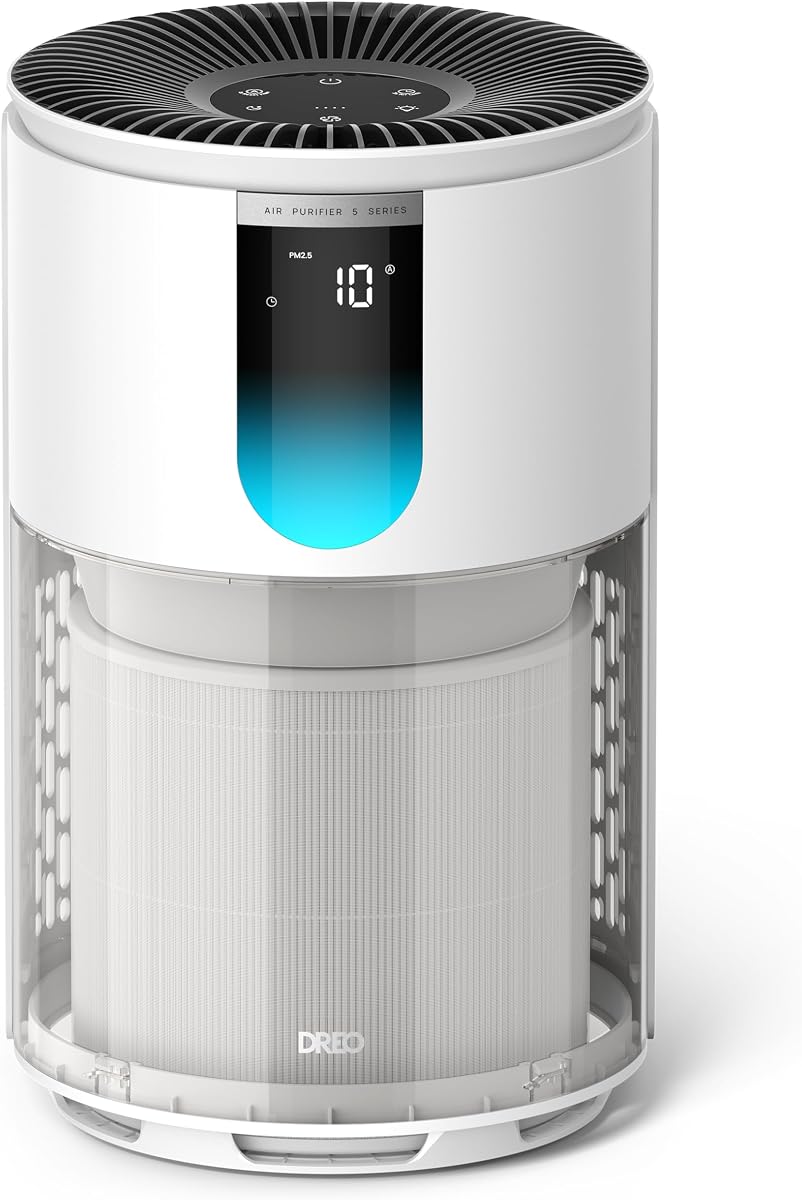
DREO 539
4.5Editor score
Real-time PM2.5 monitoring
AHAM-verified 158 CFM CADR
Turbo mode for smoke
Quiet bedroom operation
City smog can carry fine particles, dust, pollen, smoke, and odors into homes where they collect on surfaces and remain airborne. An effective air purifier for smog in the city combines strong particle filtration, adequate room coverage, responsive sensors, and manageable operating noise, especially during nights when windows may need to remain closed.
This guide compares ten air purifiers using the specifications and feature details supplied for each model. We examine stated filtration performance, clean air delivery rates, coverage estimates, filtration stages, sensing, controls, sleep-mode acoustics, and maintenance design. The list includes compact bedroom units, large-room models, app-connected options, and premium high-output purifiers.
Each review explains the product's strongest qualities, practical trade-offs, and ideal home or apartment use. Coverage claims can also depend on room conditions and how quickly air changes occur, so compare the units with your own space in mind. Product prices and promotions change frequently, so check the current listing before making a final purchase.
4.5Editor score
4.8Editor score

4.7Editor score
As an Amazon Associate we earn from qualifying purchases.
The comparison below organizes all ten models by their most useful specifications, including stated coverage, particle handling, sensing, airflow design, and sleep-mode noise.



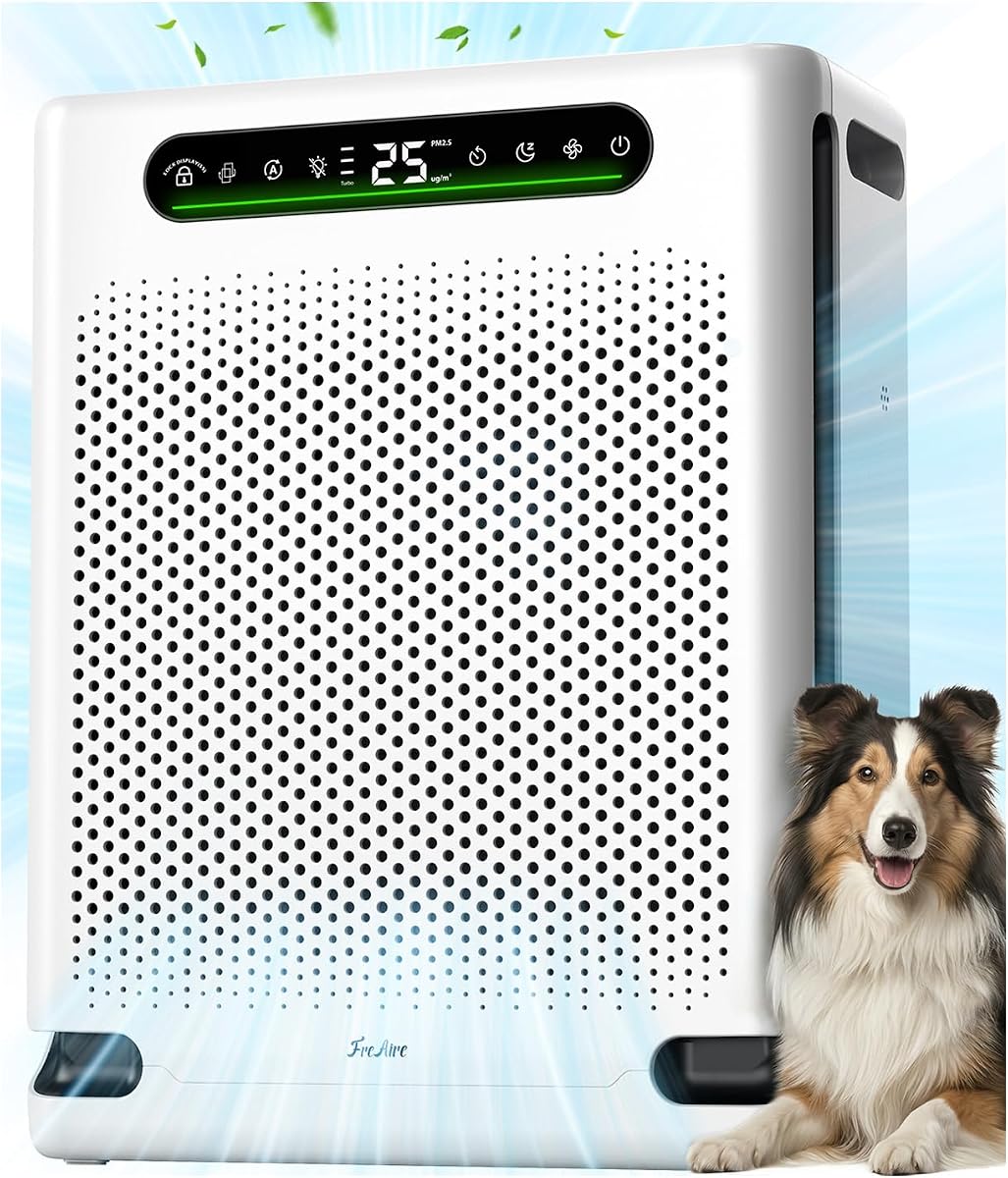
The FreAire HAP605 combines a stated 2,600-square-foot design target with a 4.8 customer rating, making it the most broadly balanced model in this guide. Its wide front inlet and two side inlets are especially relevant to city apartments, where smog may enter through windows, doors, and gaps in an older building envelope. A visible PM2.5 reading gives users an immediate indication of changing conditions.
We may earn a commission when you buy through this link, at no additional cost to you.
Automation is one of the HAP605's strongest features. In Auto Mode, the purifier monitors PM2.5 and adjusts its fan speed as conditions change, then reduces output when the air improves. This behavior makes it practical during commutes, wildfire-smoke events, and periods when outdoor pollution remains elevated. The dedicated Turbo Pet Mode adds another high-airflow option for homes where dander, hair, and everyday odors collect around furniture.
Maintenance is unusually approachable. The reusable pre-filter can be removed, rinsed, and fully dried before reinstallation, reducing waste associated with frequently washing disposable mesh filters. The trade-off is that the main filter still needs regular replacement, and the supplied guidance recommends genuine FreAire filters because fit and airflow can be affected by incompatible alternatives. The red replacement reminder also reduces the need to estimate filter life manually.
For most urban households, the HAP605 is the strongest all-around recommendation. It combines useful sensing, multi-directional intake, quiet nighttime operation, and straightforward care without becoming an app-dependent device. Its 20 dB sleep mode and display-light shutdown make it particularly well suited to a bedroom or living area where nighttime noise and light would be distracting.
The PM2.5 sensor and automatic fan adjustment make the HAP605 easy to leave operating when outdoor pollution changes quickly. A manual Turbo Pet Mode is also available when faster circulation is wanted around pet areas.
The washable pre-filter handles routine upkeep, while the red indicator alerts owners when the main filter needs attention. Following the stated replacement interval and using compatible filters helps preserve airflow.
We may earn a commission when you buy through this link, at no additional cost to you.
The Levoit Core 300-P is a compact bedroom-focused purifier with a 4.7 customer rating and independently documented performance. Its 56-watt motor and 143 CFM smoke CADR make it more purposeful than a basic fan with a filter attached. That level of output is well suited to a small bedroom, office, or closed living room where outdoor pollution needs to be reduced without disturbing sleep.
We may earn a commission when you buy through this link, at no additional cost to you.
Filtration is the model's defining strength. The stated 99.97% efficiency for airborne particles from 0.1 to 0.3 microns covers fine particulate concerns associated with dust, pollen, and animal dander. AHAM VERIFIDE certification adds independent validation for air-cleaning performance and energy efficiency, while the listed smoke, dust, and pollen CADR values make room-size comparisons more useful than filtration percentages alone.
The 24 dB Sleep Mode and ability to turn off display lights make the Core 300-P easy to place on a nightstand or side table. It also offers two-, four-, six-, and eight-hour timers, giving users simple scheduling options. Its limitations are primarily about scale: it is not intended to provide the rapid circulation of the much larger Core 600S-P, and optimal performance depends on using the official Levoit filter.
This is the best choice for a smaller urban apartment, bedroom, or home office where a quieter, more compact machine is preferable to maximum coverage. It is also a sensible value-oriented option for shoppers who prioritize independently verified filtration, recognizable filtration architecture, and low nighttime noise over app controls or extra specialized modes.
AHAM VERIFIDE status and a 143 CFM smoke CADR make this a credible choice for bedrooms, offices, and other compact spaces. The independent test context adds confidence when choosing a smaller purifier.
Sleep Mode lowers noise to 24 dB, and the display can be switched off entirely. Programmable timers offer simple ways to limit operation without leaving the unit running continuously.
We may earn a commission when you buy through this link, at no additional cost to you.
The Winix 5510 combines a stated 1,881-square-foot capacity, true HEPA filtration, and app support, earning a 4.6 customer rating. It is a strong middle ground for urban homes that want high particle capture and convenient remote monitoring without moving to an extra-large premium purifier. The built-in sensor and LED air-quality indicator also make local status checks straightforward.
We may earn a commission when you buy through this link, at no additional cost to you.
The Winix filtration system captures 99.99% of listed airborne allergens as small as 0.01 microns, including smoke, pollen, dust, and pet dander. An advanced odor carbon filter adds a separate layer for volatile organic compounds and household smells, while the washable mesh pre-filter catches larger airborne debris before it reaches the more delicate filter stages.
App compatibility is the main feature that separates it from many conventional bedroom purifiers. Users can remotely monitor and control the machine, while Auto Mode adjusts the fan using real-time sensor input. A light-responsive Sleep Mode also stands out by activating in a darkened room and returning to automatic operation when light returns. The trade-off is that the Wi-Fi and app experience is unnecessary for some households, and the washable pre-filter still needs routine cleaning.
The Winix 5510 is well suited to tech-oriented households, pet owners, and users of medium to large rooms. It is particularly attractive when a city apartment needs both smoke filtration and odor management. For buyers who prefer simple physical controls and no app connection, the FreAire HAP605 or GermGuardian AC4825E may be easier to operate.
The Winix Smart App provides remote control and monitoring, while the built-in sensor supports automatic fan adjustment. These features are useful for checking indoor conditions without entering the room each time.
The true HEPA stage addresses fine particles, while the carbon filter is intended to reduce odors from cooking, pets, and smoke. The washable pre-filter helps intercept larger debris before it reaches the main filter.
We may earn a commission when you buy through this link, at no additional cost to you.
The Levoit Core 600S-P is the premium choice here, combining a 4.7 customer rating with a stated 391 CFM CADR and coverage up to 2,933 square feet. It is designed for open floor plans, high ceilings, large living rooms, basements, and entire apartments where rapid, repeated air exchange matters. For a large urban residence or open-plan loft, this model offers substantially more stated output than the compact alternatives.
We may earn a commission when you buy through this link, at no additional cost to you.
VortexAir Technology 3.0 supports the high air-delivery figure, and the purifier can be described as cleaning a 2,933-square-foot space once per hour or a 606-square-foot space every 12.5 minutes under the manufacturer's stated conditions. Its three-stage filtration system provides 99.97% efficiency for listed particles from 0.1 to 0.3 microns, including dust, pollen, and animal dander. Smart controls allow remote operation and automatic fan adjustment based on changing air quality.
The trade-offs are physical and financial rather than functional. A high-output purifier needs more room than a compact bedroom model, and its premium purchase tier may not make sense for a studio or single small room. As with other Levoit models, the original filter is recommended to maintain stated filtration performance, and compatible replacement filters add an ongoing ownership consideration.
For buyers who want one purifier to serve a large apartment, duplex, or open-plan home, the Core 600S-P is the most capable model in this guide. It is also the logical choice for households that prioritize fast room turnover over minimum footprint. Smaller rooms can still benefit, but a compact model may deliver comparable daily results with less energy and space.
A 391 CFM CADR gives the Core 600S-P the highest stated output in the group. That performance makes it especially relevant to large apartments, basements, and open floor plans with high ceilings.
The integrated sensor adjusts fan output as air quality changes, while smart-home features add remote convenience. Automatic operation reduces the need to adjust speeds manually during changing pollution levels.
We may earn a commission when you buy through this link, at no additional cost to you.
The KNKA APH4000 is a feature-rich large-room purifier with a 4.6 customer rating and a stated smoke, dust, and PM2.5 CADR of 226 CFM. It offers coverage up to 1,695 square feet, enough for many city apartments and open living areas. Its dual cartridge arrangement and multiple intake and outlet directions are designed to improve circulation throughout a room.
We may earn a commission when you buy through this link, at no additional cost to you.
Each cartridge has a three-stage design: a washable pre-filter, a high-efficiency filter, and an activated carbon filter. The resulting setup addresses large debris, fine particles, and odors in one system. A real-time sensor and color-coded AQI display allow quick indoor-air checks, while Auto Mode changes fan output according to measured conditions.
Mode selection is unusually extensive. PET Mode increases airflow for hair, dander, and odors, ECO Mode enters standby when air quality is excellent, and Sleep Mode operates at 22 to 24 dB. Four manual fan speeds add further control. The main drawback is that dual filters can make maintenance more involved, and the range of modes may take time to master. The plastic packaging around a new filter must also be removed before installation.
This model is a good match for households that want visible air-quality feedback, dedicated odor and pet controls, and strong circulation without moving into the largest premium tier. It is particularly useful in apartments with open plans, active kitchens, or pet households where both particles and everyday smells need attention.
A 226 CFM smoke CADR and dual front, back, and side air paths support circulation in spaces up to 1,695 square feet. The design emphasizes fast air exchange rather than only a narrow intake zone.
Auto, PET, ECO, Sleep, and four manual speeds cover different household needs. ECO standby can reduce unnecessary operation when the air is already clean, while PET mode addresses concentrated hair and odor sources.
We may earn a commission when you buy through this link, at no additional cost to you.
The MOOKA 2200 has a 4.5 customer rating and a design explicitly focused on wildfire smoke, floating ash, and heavy smog. Its stated coverage of 2,200 square feet makes it a plausible choice for a large bedroom or open city apartment. A high-precision PM2.5 sensor, digital display, and Auto Mode allow the unit to increase airflow when incoming smoke or household odors are detected.
We may earn a commission when you buy through this link, at no additional cost to you.
Filtration uses a washable pre-filter, a high-efficiency stage, and activated carbon. This combination is intended to capture micro-sized particles, combustion ash, pollen, dust, and pet dander while also absorbing unpleasant odors. The larger front intake and dual side inlets improve the chance that polluted air is drawn into the unit, although actual placement still matters for effective circulation.
The 20 dB sleep mode and light-free nighttime display make this one of the quietest choices listed. Four fan speeds and two-, four-, six-, and eight-hour timers support flexible use, while the child lock helps prevent accidental changes. Its aromatherapy pad and essential-oil compatibility are optional extras rather than necessary functions. The filter reminder appears after 2,000 hours, and the protective plastic bag must be removed before use.
The MOOKA 2200 is a strong recommendation for city residents who want an explicit smog-response appliance with automatic PM2.5 monitoring and quiet bedroom operation. It is less compelling for users who prioritize a specific independently stated CADR figure, but its sensor, intake layout, and filtration stages make it a practical choice for reactive indoor-air management.
The PM2.5 sensor tracks changing conditions, while Auto Mode raises the fan when smoke or odors are detected. This makes the purifier practical to keep running during unpredictable pollution events.
Sleep Mode reaches 20 dB and disables lights, making the unit suitable for bedrooms and nurseries. Programmable timers add control over when it operates throughout the day.
We may earn a commission when you buy through this link, at no additional cost to you.
The ECOSELF HAP602 carries a 4.7 customer rating and combines a 2,400-square-foot stated coverage figure with 360-degree airflow. It is designed to pull air from multiple directions, distribute cleaned air throughout larger rooms, and provide immediate awareness of changing PM2.5 levels through a large touch display. Those traits align well with apartments that experience short, sudden pollution spikes.
We may earn a commission when you buy through this link, at no additional cost to you.
The three-stage filtration system combines a high-efficiency purification filter with additional layers intended to address dust, pollen, pet dander, and smoke. The manufacturer states that the air can be refreshed in a space up to 2,400 square feet in 30 minutes, although this is a promotional claim and should be considered in the context of actual room volume and pollutant levels.
Auto Mode uses the PM2.5 sensor to increase the fan as air quality worsens, with green, blue, yellow, and red indicators providing quick visual feedback. Three manual speeds, a child lock, and a 20 dB sleep mode make the controls versatile. The main filter must not be cleaned with water or other liquids, and replacement is generally needed every three to six months according to the supplied guidance.
The HAP602 is a good option for large urban rooms where fast, multidirectional circulation and simple on-device controls are priorities. It is less ideal for people who require a published CADR value or prefer washable main filters. Even so, its sensor, airflow orientation, strong customer feedback, and large stated room capacity give it a compelling place in this shortlist.
The 360-degree airflow layout is designed to draw polluted air from several directions and distribute filtered air more broadly. That approach can be useful in open rooms with multiple windows or pollutant entry points.
A real-time PM2.5 display and color-coded indicators make indoor pollution easy to monitor. Auto Mode can respond to worsening conditions without requiring constant manual speed changes.
We may earn a commission when you buy through this link, at no additional cost to you.
The DREO 539 is the best budget-oriented option for buyers who still want independently verified performance and useful automation. It has a 4.5 customer rating, AHAM VERIFIDE status, and a 158 CFM CADR. The stated maximum coverage of 1,176 square feet is based on one air change per hour, while the stated 245-square-foot figure corresponds to 4.8 air changes per hour.
We may earn a commission when you buy through this link, at no additional cost to you.
Its TurboPure system uses a large intake and 360-degree spiral airflow to improve circulation. The three-in-one filter combines a pre-filter, high-efficiency stage, and activated carbon layer for PM2.5, pollen, dust, smoke, and household odors. A high-precision sensor displays AQI readings from 1 to 999, while a four-color indicator and transparent filter window make status and maintenance easier to inspect.
Auto, Turbo, Sleep, and Normal modes cover most daily needs. Turbo mode provides maximum purification when smoke, pet dander, or pollen rises, while Sleep Mode turns off display lights for restful use. Four manual speeds offer direct control, and the BLDC motor supports quiet operation. Its compact feature set, ENERGY STAR certification, and reported annual energy consumption make it an efficient choice for regular use.
The DREO 539 is best for a bedroom, office, or moderately sized living space where verified CADR and real-time monitoring matter more than app connectivity. Its 158 CFM output is not as strong as the largest models, but it is a balanced and economical option for addressing city particles within a sensibly sized room.
AHAM VERIFIDE status and a 158 CFM CADR provide a useful performance baseline. The 1,176-square-foot maximum is an hourly coverage estimate, so rooms requiring faster turnover should be evaluated carefully.
The LED AQI display, color-coded indicator, and transparent filter window reduce uncertainty about operation. These details make it easier to respond to pollution changes and check filter condition.
We may earn a commission when you buy through this link, at no additional cost to you.
The GermGuardian AC4825E is a compact tower purifier with a 4.6 customer rating and a clear emphasis on fine-particle filtration. It is designed to circulate and filter a small bedroom every 12.5 minutes and a larger space up to 743 square feet once per hour. That makes it most appropriate for a closed bedroom, study, home office, or compact apartment area.
We may earn a commission when you buy through this link, at no additional cost to you.
Its HEPA PURE filter captures 99.97% of listed allergens as small as 0.1 microns, including dust, pollen, and pet dander. An activated carbon layer reduces cooking and pet scents, and an optional UV-C light further assists with airborne-particle reduction. CARB, ETL, and Zero Ozone verification add useful certifications for shoppers who pay close attention to safety claims.
Three fan speeds include a quiet sleep mode, and the tower shape makes it relatively easy to place beside a bed or against a wall. The main limitation is scale: the AC4825E cannot match the room-turnover claims of the large models, and it is not the right choice for a sprawling open-plan residence. Official GermGuardian filters and bulbs are also recommended for certified fit and performance.
This is a worthwhile compact option for urban residents who need dependable filtration in a smaller room, particularly during high-smog months when windows stay shut. It offers a straightforward three-speed interface and strong stated allergen performance without a complex app. Larger shared spaces are better served by a higher-CADR model such as the Winix 5510 or Levoit Core 600S-P.
The HEPA PURE stage targets fine allergens, while the carbon filter helps with odors from cooking and pets. This combination works well in smaller rooms where relatively quick circulation matters more than maximum coverage.
The optional UV-C light provides an additional layer of airborne-particle treatment. Buyers should still maintain the HEPA and carbon filters as specified to preserve overall performance.
We may earn a commission when you buy through this link, at no additional cost to you.
The Coway AP-1512HH combines a 4.6 customer rating, coverage up to 1,748 square feet, and a three-year warranty. It is a compelling long-term option for households that want more substantial coverage than a bedroom purifier without moving to the largest premium model. The wall-style design also gives it a familiar, unobtrusive presence in a living room or main living area.
We may earn a commission when you buy through this link, at no additional cost to you.
Its four-stage system combines a washable pre-filter, deodorization filter, bipolar device, and HEPA filter. The stated filtration reduces 99.97% of 0.3-micron particles, including pollen and other allergens, while also reducing volatile organic compounds and odors. This layered design is relevant in city homes where both fine outdoor particles and indoor cooking or pet smells may be present.
Auto Mode continuously monitors conditions and adjusts the fan, while Eco Mode reduces energy use when cleaning is not required. A pollution sensor communicates air status through colored LEDs that can be turned off at night. Filter and pre-filter alerts help prevent owners from overlooking maintenance, although there is no app-based remote control in the supplied details.
The Coway is best for medium and large apartments, family rooms, and homes seeking a generous warranty. Its longer coverage and multi-stage system offer a more substantial alternative to compact units, while the lack of app controls may appeal to buyers who prefer physical operation. Check the latest listing for filter compatibility and the current warranty terms before purchase.
The pre-filter, deodorization stage, bipolar device, and HEPA filter address different airborne concerns in sequence. This makes the model suitable for homes dealing with both fine particles and household odors.
Auto Mode responds to measured pollution, while Eco Mode can reduce unnecessary operation. Filter alerts and a washable pre-filter help keep long-term airflow consistent.
We may earn a commission when you buy through this link, at no additional cost to you.
The right urban air purifier depends on room size, pollutant type, acceptable noise, filter expense, and how much automation you want. These factors help separate useful specifications from marketing language.
Start with the room's usable square footage, but pay attention to how the manufacturer defines coverage. Some figures assume one full air change per hour, while others represent faster, more intensive purification. A model that works well for a bedroom may be undersized for an open living room, high-ceilinged apartment, or combined bedroom and office. Larger rooms generally benefit from a higher clean air delivery rate because the purifier must move more air without relying only on a powerful fan.
Choose a purifier whose stated coverage comfortably exceeds the area you expect it to serve. Leave some margin for furniture, open doors, and pollution entering from outside. If several units appear suitable, compare their CADR values rather than choosing solely by the largest advertised room size.
Clean Air Delivery Rate, or CADR, indicates how quickly a purifier delivers filtered air under standardized test conditions. A higher smoke CADR is particularly relevant for outdoor particulate pollution. ACH, or air changes per hour, expresses the estimated number of times room air is exchanged. A unit capable of 4.8 ACH may make a smaller room feel cleaner more quickly, but it does not necessarily mean it can treat a 2,400-square-foot space at that rate.
Read CADR and ACH together. CADR tells you the delivery capability, while ACH explains the effect in a particular room volume. These measurements are more useful for comparison than broad room-size claims because they reveal the rate at which filtered air is actually circulated.
Smog includes very fine suspended particles, so look for a HEPA-grade or true HEPA stage and a stated minimum particle size. The strongest models in this guide specify performance from 0.1 to 0.3 microns, while the Winix 5510 lists capture of particles as small as 0.01 microns. A washable pre-filter can intercept hair and dust, but it should not be treated as a substitute for the main high-efficiency filter.
Match the filtration claims to the pollutants you care about. Fine particles and smoke require high-efficiency particle filtration, while odors and gases call for an activated carbon layer. The best systems address both needs with separate stages rather than relying on one filter to perform every task.
City pollution may require running a purifier for long periods, including overnight. Sleep-mode noise among the listed models ranges from 20 dB to 24 dB, while the Winix 5510 lists 23.5 dB on its slowest setting. Lower sound levels are generally preferable in bedrooms, nurseries, and home offices. Also check whether display lights can be disabled, because bright indicators can be disruptive even when airflow is quiet.
Prioritize a purifier that is comfortable in the room where it will run continuously. A slightly louder maximum mode can be useful during pollution spikes, but the default and sleep settings should still support the household's normal routine.
A PM2.5 sensor can distinguish changing pollution conditions and allow Auto Mode to adjust fan output. Real-time displays, color-coded indicators, and automatic responses are particularly valuable when users cannot monitor the purifier constantly. App support adds remote visibility and control, but it is not automatically better than reliable local controls. Buyers should decide whether smartphone convenience is worth the additional setup involved.
Look for automation that matches your habits. Continuous sensor response is helpful in a home near traffic or during wildfire events, while manual controls and a timer may be sufficient in a stable indoor environment. Avoid paying for complexity that you will not use.
A purifier's ownership experience depends on recurring filter care. Some models use a washable pre-filter that can be rinsed and dried, reducing waste and routine replacement frequency. The main HEPA or high-efficiency filter still usually needs scheduled replacement, and proprietary cartridges can add long-term cost. Filter reminders, viewing windows, and clear maintenance instructions make upkeep easier to manage.
Confirm the required replacement interval and compatible filter model before buying. Using the manufacturer's genuine or original filters helps maintain airflow and avoid fit problems. Treat filters and other replacement parts as part of the product's long-term operating cost rather than an afterthought.
Intake and outlet design influences how well a purifier captures polluted air. Wide front inlets, multiple side intakes, and 360-degree airflow can make a unit more effective when pollution enters from several directions. However, the purifier still needs unobstructed airflow and enough distance from walls, curtains, and furniture. Placing it near an open window can help during moderate outdoor pollution, but very dirty outdoor air may be better managed by closing windows and purifying a sealed room.
Consider the room's layout before choosing. A tall tower may fit beside a bed, while a high-output model may need more open floor space. Select a design that can be placed where it can actually draw and distribute air rather than in a convenient but obstructed corner.
AHAM VERIFIDE certification provides independently tested information about air-cleaning performance and energy efficiency. UL, ETL, CARB, FCC, and related safety certifications can also help buyers assess the appliance. The GermGuardian AC4825E is specifically noted as Zero Ozone Verified, while the MOOKA listing states that it does not release ozone and does not use UV light. These details are useful when comparing treatment methods.
Look for credible certification and clear manufacturer guidance rather than relying on vague claims. Ozone-generating devices, UV systems, and conventional filter replacements should be understood before use. Always follow the installation and safety instructions for the exact model.
Before first use, remove the unit from its packaging, confirm that all filter components are installed correctly, and remove any protective plastic wrapping from the filter. Place the purifier on a level surface with enough clearance around its intake and outlet. Avoid positioning it directly against a wall, inside a closed cabinet, or behind furniture. For outdoor pollution, close windows and doors when outdoor air is unhealthy, and run the purifier in Auto Mode or on a higher manual setting during brief pollution spikes.
Allow the sensor to initialize and compare the displayed PM2.5 or air-quality status with conditions in the room. When smoke, dust, or odors accumulate, use Turbo or the highest appropriate speed until conditions improve, then allow Auto Mode to reduce the fan. Sleep Mode is best for bedrooms and other quiet spaces. Use a timer to stop the unit after a fixed period if continuous daytime operation is unnecessary, but avoid assuming that a purifier left off during a severe pollution event will reverse the accumulated contamination as quickly.
Maintain the pre-filter according to the manual and clean it only with the approved method. If a pre-filter is washable, remove it, rinse it as directed, and let it dry completely before reinstalling it. Replace the main filter when the reminder activates or according to the stated schedule, and use compatible filters to preserve proper fit and airflow. Keep the exterior vents clean, avoid blocking the controls, and contact the manufacturer or an authorized service provider if the unit vibrates, smells persistently, or displays a fault indication.
No single purifier can guarantee perfect air throughout an entire home. The right model can substantially reduce airborne particles within its stated coverage area, especially when doors and windows are closed during heavy pollution. Air already deposited on floors, furniture, and curtains must still be addressed through normal cleaning, and very high pollution levels may justify staying in a cleaner indoor area until conditions improve.
A high-efficiency HEPA-grade filter is the most important feature for fine particulate smoke. CADR helps indicate how quickly the unit can move air through that filter, while a PM2.5 sensor allows the purifier to increase output as conditions worsen. Activated carbon is useful for odors, but it should complement rather than replace high-efficiency particle filtration.
No. A large maximum coverage figure may assume only one air change per hour, while a smaller room figure may represent several air changes per hour. Check the stated CADR and ACH to understand actual delivery performance. A more powerful purifier is most useful when you need rapid cleaning, a large open space, or several connected rooms.
Continuous or Auto Mode operation is generally useful when outdoor pollution is elevated and windows must remain closed. Auto Mode can react to worsening PM2.5 levels without manual intervention. During especially dirty periods, temporarily using Turbo or maximum speed may accelerate the initial cleanup, after which automatic operation can settle into a lower and more comfortable level.
Place it in the room where clean air is needed most, while keeping its intake and outlet clear. For a bedroom, prioritize a spot near the bed but with sufficient airflow clearance. In an open-plan apartment, a central location may help one powerful unit cover more area. If two units are used, place them in separate rooms rather than expecting one compact purifier to clean the entire home.
A washable pre-filter only handles larger debris and does not replace the need to maintain the main high-efficiency filter. Follow the stated replacement interval, clean the pre-filter as directed, and never wash a filter unless its instructions specifically permit it. Compatible genuine or original filters help maintain proper fit, airflow, and filtration performance.
They can reduce odors to the extent that activated carbon captures odor molecules, while HEPA filtration removes the associated particles. Carbon performance depends on the filter's quantity, condition, and the duration of exposure. Severe smoke odors may require a larger carbon-equipped unit, repeated filter changes, and continued source control such as keeping windows closed during peak pollution.
An appropriately sized purifier can be an important indoor measure, but it is only one part of a broader strategy. Monitor local air-quality alerts, keep windows closed when outdoor pollution is severe, avoid unnecessary exposure, and consider a properly fitted respirator or higher-protection mask for unavoidable outdoor exposure. People with respiratory concerns should seek guidance from a qualified healthcare professional.
The FreAire HAP605 is the most balanced overall recommendation because it combines three-direction intake, PM2.5 sensing, automatic adjustment, a washable pre-filter, and a dark 20 dB sleep mode. The Levoit Core 300-P serves smaller bedrooms well, while the DREO 539 offers verified performance and useful smoke-focused controls at a budget-friendly tier.
Prioritize CADR and real room needs rather than the largest headline coverage number. Large apartments and open plans may require the high output of the Levoit Core 600S-P, while compact rooms may be better served by quieter models. Also account for filter availability, ongoing replacement requirements, control preferences, and whether odor control is as important as particle removal.
Finally, check the current product listing, certification details, filter specifications, and warranty terms before ordering. Inventory, promotions, and model revisions can change, and current information should confirm that the unit you select still fits the room and feature priorities identified in this guide.