
X5 AM FM Radio Headphones
4.1Editor score
Rechargeable lithium battery
Up to 24-hour runtime
AM and FM reception
Wired AUX connection
Foldable lightweight design
Our Amfm Headphones guide compares 10 models across radio reception, noise protection, battery life, comfort, connectivity, and preset options for shoppers.
Amfm headphones combine electronic hearing protection with a built-in radio tuner, giving users music, news, and local programming while working around loud equipment. The right model should balance dependable reception, appropriate noise reduction, all-day comfort, simple controls, and reliable power, whether used for mowing, construction, shooting, or outdoor listening.
The products in this guide were compared using the supplied specifications and feature descriptions, focusing on AM and FM coverage, station memory, audio inputs, power options, attenuation claims, comfort features, portability, and intended working environments. The list includes rechargeable and battery-operated models, some with Bluetooth and some designed strictly for radio and wired AUX listening.
Each review identifies the reason that model may suit a particular buyer, from compact personal-radio use to extended shifts around power tools. Ratings and specifications reflect the available product information, while availability and pricing change frequently, so readers should confirm the current listing and important safety details before purchasing.
4.1Editor score
4.6Editor score

4.2Editor score
The comparison covers each model's radio bands, attenuation specification, power arrangement, station storage, audio connectivity, and portability. These differences help separate true hearing-protection earmuffs from lightweight personal-radio headsets and rechargeable all-day work models.


The ZOHAN EM042 is a well-rounded AM/FM radio hearing protector with a 4.4 rating and a feature set that suits mowing, woodworking, welding-related tasks, landscaping, snow blowing, and other noisy jobs. Its digital display, 25dB NRR specification, twenty preset locations, and included charging cable make it more versatile than a basic radio headset, while the push-button tuning system avoids fragile external knobs.
We may earn a commission when you buy through this link, at no additional cost to you.
Comfort receives particular attention in the product description. The headband is described as wider, thicker, and softer than many conventional earmuff bands, while snap-in ear cushions can be removed for cleaning or replacement. That replaceable-cushion design is valuable for long-term ownership because sealed foam cushions can degrade with sweat, dust, and repeated compression. An auxiliary input and stored AM/FM stations make it possible to switch between local radio and a connected device without replacing the entire headset.
The main compromise is its reliance on two AA batteries, which are not included. Users will also need a supply of suitable cells and should follow the stated guidance about battery type. Another limitation is the lack of Bluetooth, which makes this less convenient for phone calls or wireless everyday audio. Nevertheless, the combination of hearing protection, radio memory, automatic scanning, replaceable cushions, and a pouch justifies choosing it for regular tool use.
This is a strong recommendation for someone who wants one headset to cover radio entertainment and hearing protection across home and outdoor work. It is less appropriate for buyers who require wireless phone connectivity, extended rechargeable operation, or a more formally certified modern attenuation standard. For those priorities, the feature-rich alternatives in this list may be better matches, but the ZOHAN remains a persuasive all-purpose option.
The broad padded headband and replaceable snap-in cushions address two common comfort problems: pressure from a narrow band and fatigue from worn ear seals. The cushions can also be cleaned or replaced without replacing the complete headset, which is practical for dusty workshop environments.
Push-button volume and tuning controls are less vulnerable to accidental impacts than small rotary knobs. Manual tuning, automatic scanning, and memory for ten AM plus ten FM stations provide useful ways to move quickly between stations in changing work locations.
We may earn a commission when you buy through this link, at no additional cost to you.
The BJKing AM/FM Radio Headphones pair a 4.3 rating with a particularly generous 30dB SNR specification and room for 40 stored stations. The digital screen can show information such as battery capacity, time, and the active channel. That combination gives the model a strong starting point for buyers who want modern station management and hearing protection without moving into a Bluetooth-equipped design.
We may earn a commission when you buy through this link, at no additional cost to you.
Its noise-reduction package uses sealed ear cups and acoustic foam, and the product is certified according to ANSI S3.19 and CE EN352-1 as described by the manufacturer. A flexible adjustable headband and soft foam cushions are intended to create a close fit. The 3.5mm AUX connection also broadens the listening options by allowing a phone, laptop, MP3 player, or MP4 device to provide audio when radio reception is poor.
The three-AAA battery arrangement is less convenient than a built-in rechargeable cell, particularly for extended outdoor work. Batteries are not included, and users will need to plan for replacements or carry a suitable power supply. The push-button design also means there are no delicate tuning or volume knobs to lose, although the model does not include wireless connectivity for calls or phone-based media.
The BJKing is a good recommendation for lawn care, landscaping, shooting, construction, and workshop users who prioritize a high attenuation figure, many presets, and an informative screen. It is less suitable for anyone who wants a lightweight travel headset or expects the convenience of USB-C charging. Its strengths otherwise make it one of the most complete battery-powered options in the roundup.
Storing up to 20 AM and 20 FM stations is one of the BJKing's clearest advantages over simpler models. Combined with manual tuning and automatic scanning, the larger memory can be especially useful for workers moving between areas where different stations carry local news, traffic information, or music.
The included 3.5mm AUX cable provides a dependable alternative to broadcast reception. It also gives users a way to listen to stored audio or device content without adding Bluetooth pairing complexity, making the headset more versatile across work and leisure settings.
We may earn a commission when you buy through this link, at no additional cost to you.
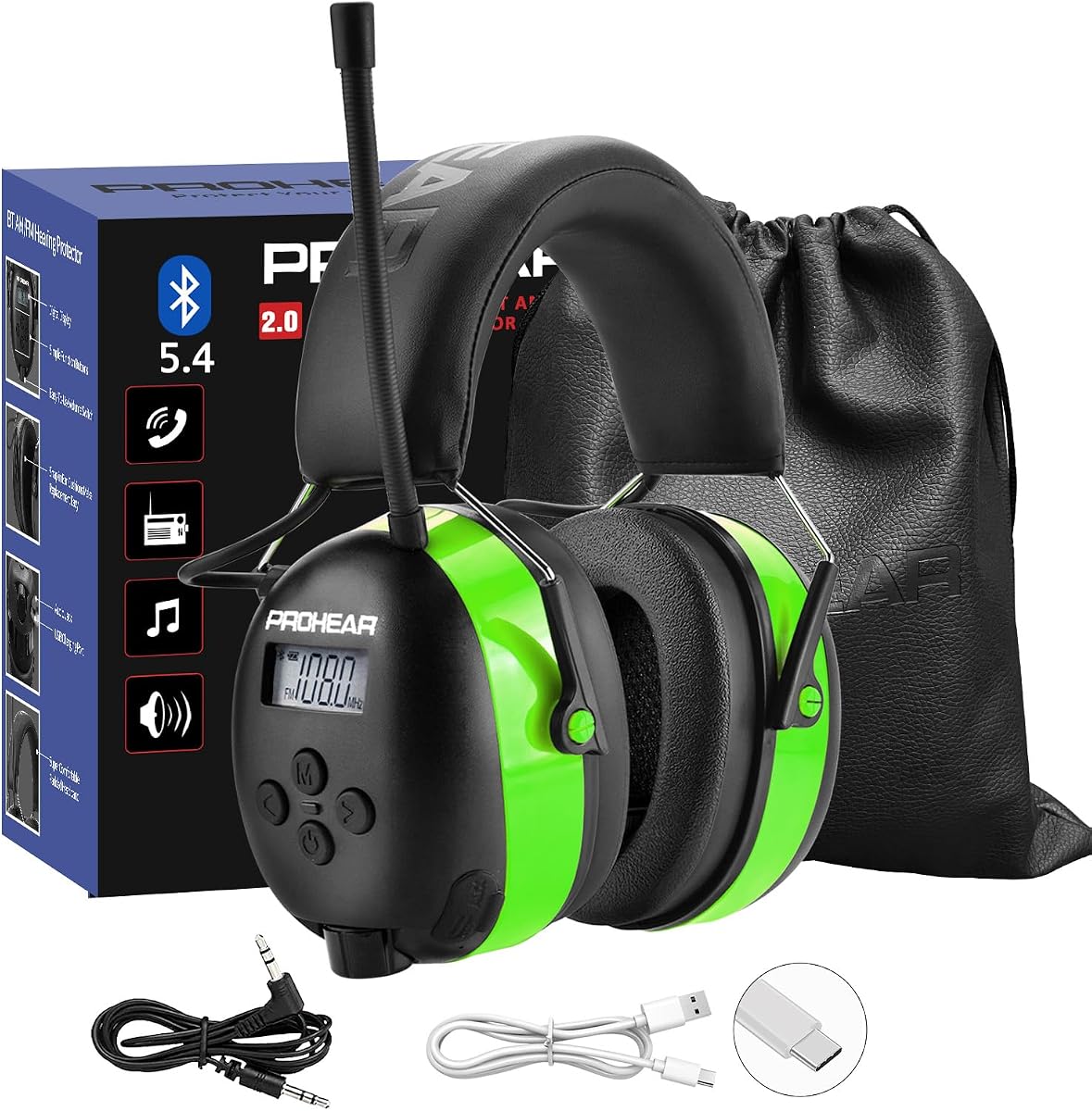
The PROHEAR 033 stands out with a 4.6 rating, Bluetooth 5.4 connectivity, a rechargeable 1500mAh battery, and a 31dB SNR specification. It is the most complete headset in the group for buyers who want radio, wireless device audio, and hearing protection in one rechargeable package. The stated runtime reaches 58 hours in Bluetooth mode and 125 hours in AUX mode.
We may earn a commission when you buy through this link, at no additional cost to you.
Its digital tuner can preset and memorize ten AM and ten FM stations, while the AUX input and included cable support wired devices. Multifunction controls on the earcup can answer, cancel, reject, or redial calls. The padded headband, anti-sweat cushions, and snap-in cushion design are intended to improve comfort and maintenance, and the supplied 1500mAh battery removes the need to carry disposable cells.
Its apparent drawback is complexity relative to simpler radio-only headsets. Bluetooth, radio, calls, and wired audio create more controls that a new user may need to learn, and the large battery and electronics may add weight. The manufacturer does not say it can operate while charging, so users should charge it between extended sessions. It also remains a hearing-protection product with specified attenuation, not a universal guarantee that every loud environment will be safe.
This is our strongest recommendation for all-around use because it combines wireless flexibility with credible hearing-protection specifications and long battery life. It is particularly attractive for mowing, workshop tasks, yard work, and commutes where the user wants one headset for music, radio, and calls. Those who value simplicity above everything else can find a lighter and more basic option elsewhere in the guide.
Bluetooth 5.4 allows the headset to function as a connected audio device rather than a radio-only product. Users can move between wireless playback, AM/FM stations, and AUX mode, which makes the 033 useful across commuting, working, and leisure environments.
The included 1500mAh lithium battery and USB-C charging make daily preparation more predictable than carrying spare cells. Claimed playback of 58 hours in Bluetooth mode and 125 hours in AUX mode reduces the likelihood of interruption during extended work sessions.
We may earn a commission when you buy through this link, at no additional cost to you.
The X5 offers a straightforward combination of AM/FM radio, a rechargeable battery, a backlit display, and a wired AUX input. Its 4.1 rating reflects a serviceable package for listeners who want radio and hearing-protection-style muffs without spending more for advanced connectivity. The built-in lithium battery runs for as long as 24 hours and reaches a full charge in about 2.5 hours.
We may earn a commission when you buy through this link, at no additional cost to you.
Its DSP filter chip is intended to improve reception sensitivity, while one-touch access to a preset favorite reduces the need to search manually. The included 3.5mm AUX cable provides a useful fallback in areas with weak broadcast reception and works with smartphones, computers, and MP3 players. Wider, softer memory-foam cushions and an adjustable head strap are designed for extended wear.
The principal concern is the absence of a stated NRR or SNR attenuation figure in the supplied details. That makes the X5 less straightforward to compare with models marketed specifically for certified hearing protection. Its station-memory capacity is also not clearly specified, and the lack of Bluetooth limits its use with modern phones. Nevertheless, the rechargeable design, foldable form, and light construction are meaningful advantages for portability.
Choose the X5 for outdoor radio listening, mowing, cycling, camping, and occasional workshop use where convenience and a compact footprint matter. Buyers who require a published attenuation rating for a particular workplace or who want wireless calling should look to the BJKing, PROHEAR 033, or 2025 model instead. Within the broader category, the X5 is a sensible rechargeable starting point.
A built-in rechargeable cell removes the recurring task of buying and carrying spare AA or AAA batteries. The stated 24-hour runtime and roughly 2.5-hour charge time fit comfortably into many workdays, while the included AUX cable offers another source of audio.
The foldable, lightweight construction is useful for storage in a vehicle, backpack, or equipment bag. Wider memory-foam cushions and an adjustable strap attempt to make the headset comfortable during long periods of wear.
We may earn a commission when you buy through this link, at no additional cost to you.
Walker's Digital AM/FM Radio Muff is a compact, straightforward headset aimed particularly at shooting ranges, hunting, and noisy work environments. It carries a 4.1 rating and a 25dB NRR specification. A digital display, eight preset channels, and channel memory make radio operation uncomplicated, while the included two AAA batteries remove the need to obtain power before first use.
We may earn a commission when you buy through this link, at no additional cost to you.
The rugged housing is designed for active use, and the extra-wide padded headband is intended to distribute pressure over longer periods. An input jack expands compatibility with an MP3 or CD player. Rather than attempting to combine several modern wireless standards, this model concentrates on radio, basic wired audio, and the practical benefit of a compact muff that can move between the range, the workshop, and outdoor activities.
Eight preset stations are noticeably fewer than the 20 or 40 locations offered by some competitors, and the model lacks Bluetooth. Its disposable-battery design also creates a longer-term expense than a rechargeable headset. More importantly, listeners who require the latest formal attenuation certification may find the 25dB NRR description less aligned with their needs than models listing current SNR standards and broader certification details.
Walker's is a sensible option for buyers who value simple controls, included batteries, compact storage, and a traditional radio muff format. It is especially relevant to shooting and hunting users who want entertainment without a large wireless headset. For extensive station memory, phone connectivity, or rechargeable convenience, one of the feature-rich alternatives may be preferable.
A compact housing, 25dB NRR, and a wide padded headband align well with the supplied use cases of shooting ranges, hunting, and other high-noise conditions. The digital display and straightforward switch and volume controls keep radio operation unobtrusive.
Two AAA batteries are included, so the headset can be used without an immediate trip to obtain cells. The wired input also permits connection to compatible personal-audio devices, although the product is primarily centered on the built-in radio.
We may earn a commission when you buy through this link, at no additional cost to you.
The PROHEAR 027 is a work-first AM/FM radio headset with a 4.3 rating and a 25dB NRR specification. Its stated uses include mowing, snow blowing, construction, workshops, gardening, manufacturing, and automotive work. The bright orange finish also makes it visually distinct, while a durable ABS shell and lightweight materials suit repeated handling around tools and machinery.
We may earn a commission when you buy through this link, at no additional cost to you.
The LCD display supports manual and automatic scanning, and the tuner can store ten AM and ten FM stations. A 3.5mm AUX port and included cable allow connected devices to serve as an audio source. The product description also identifies an 85dB volume limit and notes that two AA batteries power all radio and auxiliary modes.
Its tradeoff is the disposable-battery design. The manufacturer recommends regular alkaline batteries and does not recommend lithium cells, which means owners must maintain a supply of suitable batteries. There is also no Bluetooth, and the included carrying bag helps with storage but does not change the headset's reliance on cells. As with other protective products, the attenuation figure alone should not be treated as a guarantee of complete protection in every environment.
The PROHEAR 027 is a solid recommendation for buyers who prioritize traditional work earmuffs, clear radio controls, and broad prescribed use cases. It is less attractive for people who want phone connectivity or rechargeable convenience. Among battery-powered models, however, its balance of robust construction, station memory, volume management, and storage support remains compelling.
The lightweight ABS shell, padded headband, and snug ear cushions are designed for repeated use in industrial and outdoor environments. Its stated 25dB NRR and 85dB volume limit support the product's work-safety positioning without promising protection beyond the published specification.
Two AA batteries keep replacement simple, and the maker provides specific guidance about using alkaline cells. A practical display troubleshooting note also recommends confirming battery installation when the screen does not show content correctly.
We may earn a commission when you buy through this link, at no additional cost to you.
The A1 AM FM Radio Headphones provide a basic dual-band radio experience with manual and automatic searching, preset stations, and an LCD display. Its 3.9 rating is the lowest among the listed products, but the model still targets a clear need: inexpensive radio headphones with wired-audio support and replaceable everyday convenience.
We may earn a commission when you buy through this link, at no additional cost to you.
A DSP filter chip and antenna are intended to provide stable reception with minimal static. Users can save favorite stations for quick access, while the included 3.5mm AUX cable provides an alternative when broadcast signals are weak. Wider memory-foam cushions, an adjustable strap, and a foldable, lightweight design support commuting, mowing, cycling, home use, and other outdoor activities.
The largest concern is the absence of a supplied NRR or SNR figure, making it difficult to assess the headset as certified hearing protection. It also requires two AA batteries that are not included. Its 3.9 rating may also reflect more mixed customer experiences than those of the higher-rated models, although individual results can vary by use and environment.
The A1 makes sense for buyers seeking an inexpensive, easy-to-operate radio headset for general listening or light-duty yard work. It is not the strongest recommendation for regulated workplaces, extended noise exposure, or users who need a published attenuation specification. Those needs are better served by the PROHEAR, BJKing, ZOHAN, or 2025 options with explicit protection claims.
Manual search, automatic scanning, and preset storage cover the common radio-control needs without adding Bluetooth menus or complex pairing. The result is a headset that should be approachable for older users and anyone who prefers physical buttons.
A folding structure and lightweight frame make the A1 easier to place in a bag, drawer, or vehicle. Soft memory-foam ear cushions and an adjustable head strap aim to preserve comfort despite the model's economical positioning.
We may earn a commission when you buy through this link, at no additional cost to you.
The 2025 Radio Ear Protection Headphones combine a 4.2 rating with several notable work-oriented features: a rechargeable 2000mAh battery, up to 120 hours of stated working time, 30dB SNR, and a large color backlit display. The screen is designed for visibility in sunlight and darkness, while the rechargeable design avoids the continual expense of disposable batteries.
We may earn a commission when you buy through this link, at no additional cost to you.
Station storage is a major strength, with room for 50 AM and 50 FM stations, manual tuning, and semi-automatic scanning. The upgraded internal chip is intended to improve reception stability. A 3.5mm AUX input and included cable offer a wired option for phones and other devices in places where radio interference is significant, although Bluetooth is explicitly absent.
The headset cannot be used while charging, so users must plan around that limitation when starting long shifts. Its feature set also includes adjustable construction, breathable mesh lining, ultra-soft pads, and a carrying bag, but the electronics and battery may make it heavier than simpler portable models. Most importantly, a 30dB SNR figure should be interpreted within the conditions and standards under which it was evaluated.
This is an excellent choice for landscapers, construction workers, woodworkers, mechanics, and homeowners who want extended runtime, a highly visible display, and extensive station memory. It is less suitable for buyers who require wireless calls. Against the PROHEAR 033, the deciding factors are the 2025 model's larger preset capacity and longer claimed runtime versus the 033's Bluetooth functionality and 31dB SNR specification.
The 1.8-inch color display is larger than a basic monochrome screen and is designed to remain readable in bright daylight or darkness. Showing station and battery information clearly can reduce the need to remove the headset and handle controls while wearing gloves or working near equipment.
One hundred available station locations provide far more flexibility than most competing products. USB-C fast charging and a claimed 120-hour working time suit intensive schedules, although the headset must be charged beforehand because it cannot operate while connected to power.
We may earn a commission when you buy through this link, at no additional cost to you.
The Rechargeable and Portable Personal FM Radio Headphones are optimized for people who want a light, simple headset for jogging, mowing, cycling, meetings, and other active settings. They weigh 160 grams according to the product information and use a 650mAh rechargeable lithium battery with up to 32 hours of runtime and a charging time of about two hours.
We may earn a commission when you buy through this link, at no additional cost to you.
The radio is FM-only, covering 50–108MHz, and offers high reception sensitivity plus a memory function for a favorite channel. That station can also serve as an emergency channel. A 3.5mm AUX jack and included cable provide a fallback for listening to phone or media content where FM coverage is weak. One-button handling combines mode switching, tuning, volume adjustment, and power control.
The lack of AM reception limits news, talk, and emergency information compared with dual-band models. No formal NRR or SNR figure appears in the supplied details, so the product should be considered primarily a lightweight personal-radio headset rather than a clearly certified workplace protector. Its simple one-button design may also be less flexible for advanced users, although that simplicity can be a benefit for quick outdoor operation.
This is a good recommendation for runners, cyclists, casual outdoor listeners, and anyone who prioritizes low weight and quick charging. For AM news, detailed hearing-protection certification, or advanced station memory, a dual-band model is the better choice. Within lightweight personal FM headsets, the supplied specification and 4.2 rating make this a capable, uncomplicated option.
At a listed 160 grams, the headset is designed to feel light during jogging, cycling, and outdoor chores. A double-deck adjustable headband and wide over-ear cushions help maintain comfort and reduce external noise without the bulk of a full industrial earmuff.
The 650mAh battery reaches up to 32 hours of use and charges in about two hours. That makes the headset convenient to prepare overnight for a long outing, while the included AUX cable provides a useful option in locations with weak radio reception.
We may earn a commission when you buy through this link, at no additional cost to you.
The Portable Personal FM Radio Headphones offer a simple digital FM radio with a 4.3 rating, an easy-to-read LCD, and controls designed for everyday walking and jogging. The headset supports both automatic and manual station searching, while an external metal antenna is intended to improve reception and channel memory provides quick access to a favorite program.
We may earn a commission when you buy through this link, at no additional cost to you.
Its adjustable double-deck headband, soft ear cushions, and lightweight construction are designed to remain comfortable while staying close to the head. The folding design makes it easy to place in a suitcase, backpack, or drawer. These portability-oriented qualities give it a different role from heavier work earmuffs, even though the broad ear-cup form can visually resemble them.
FM-only reception is a meaningful limitation for buyers who want AM news, talk radio, or broader access to local broadcasting. The product description also notes that an AUX cable is not included, and no NRR or SNR value is stated. As a result, it is difficult to position the model as certified hearing protection for a defined work environment. Battery operation is straightforward, but the cells themselves are not supplied.
This is a sensible final recommendation for travelers, walkers, joggers, and casual listeners who want a compact FM radio with minimal complexity. It is less appropriate for serious noise reduction, AM listening, or frequent phone-based audio. Buyers seeking those capabilities should look upward in the guide, where dual-band tuners, explicit attenuation specifications, and rechargeable options are available.
The folding frame and compact construction make the headset convenient to carry between the house, vehicle, gym, or walking route. Adjustable headbands and soft cushions help it serve as a comfortable personal listening device for longer periods.
Automatic scanning, manual search, and channel memory cover the essentials without requiring a complex companion device. The external antenna and easy-to-see display are useful for finding stations while moving through different environments.
We may earn a commission when you buy through this link, at no additional cost to you.
The most useful buying decision depends on where the headset will be used, whether genuine hearing protection is required, and how much control users want over power and connectivity. Review attenuation claims, radio bands, station memory, battery arrangement, fit, and input options before choosing.
There is a meaningful difference between a lightweight personal-radio headset and certified or safety-oriented hearing protection. Mowing, construction, workshop use, shooting, landscaping, and snow blowing are the environments most often named in the supplied descriptions. If exposure is substantial, a product with a clearly published attenuation rating and relevant certification should be prioritized, and workplace requirements should be verified by a qualified safety professional.
Choose the product category first, then compare features. A runner may only need an FM radio with a comfortable fit, while a contractor needs reliable protection, a visible display, long battery life, and simple controls that can be operated with gloves.
The Noise Reduction Rating and Single Number Rating describe attenuation under specific testing conditions, but neither should be interpreted as an absolute guarantee for every environment. The products here list figures ranging from 25dB NRR to 31dB SNR, and one or two personal-radio models do not provide an attenuation value in the supplied information. Comparing unlike NRR and SNR numbers directly can be misleading, so buyers should examine the complete certification details and intended use.
Look for ANSI, CE, or other relevant documentation and follow the manufacturer's fitting instructions. Proper seal around the ears, consistent use, and a safe volume level all affect real-world protection. Published ratings are useful for comparison, but they do not replace appropriate workplace controls.
Dual-band models offer broader access to local news, weather, talk radio, traffic reports, sports, and music. The ZOHAN, BJKing, PROHEAR 027, A1, and 2025 headset all list both AM and FM. The X5 also covers both bands, while the personal FM-only models may appeal to users who mainly want portable entertainment or local FM programming.
If radio is used around work sites, farms, or outdoor areas where AM reception is important, dual-band support is the safer specification to seek. FM-only models can be simpler and lighter, but they may miss broadcasts available on AM frequencies.
Disposable batteries offer a familiar replacement model and can be useful where electricity is unavailable, but they add ongoing cost and the need to carry spares. Rechargeable models such as the PROHEAR 033, X5, 2025 headset, and Rechargeable Personal FM Headphones are better suited to frequent use. Claimed runtimes range from 24 hours to as much as 120 hours, though real results depend on the selected mode and use.
Check whether the battery and charging cable are included. The PROHEAR 033 includes its rechargeable battery, while the 2025 product includes a USB-C cable and the personal FM model uses a built-in rechargeable cell. Some disposable-battery products include cells, whereas the ZOHAN, BJKing, PROHEAR 027, A1, and personal FM headset do not.
Comfort depends on headband width, cushion softness, stability, weight, and the seal around the ears. Models with adjustable padded bands and replaceable snap-in cushions are especially practical for extended work. The 2025 model adds breathable mesh lining, the BJKing uses soft foam cups, and the X5 and A1 emphasize wider memory-foam cushions.
A broad double-deck band can distribute pressure effectively, as seen in the lightweight personal-radio designs. Users should also consider whether they will wear glasses, helmets, or other equipment with the headset. Since fit varies by head shape, adjustable construction and replaceable cushions offer more flexibility than a fixed one-size design.
Station memory makes repeated listening more convenient, especially when moving between worksites or outdoor locations. Available capacities range from eight presets on the Walker's muff to 50 AM and 50 FM stations on the 2025 model. Manual tuning, automatic scanning, and quick-access buttons are all useful, but simpler interfaces may be preferable for casual users.
Physical push-button controls are common throughout the category and avoid the fragility associated with small tuning knobs. A backlit or color display can help during nighttime use. The BJKing and 2025 models provide especially information-rich screens, while the X5 uses a backlit digital display and the personal FM models keep operation deliberately straightforward.
A 3.5mm AUX connection is the most widespread secondary input, letting users connect a phone or media player when radio reception is poor. Every model except the Portable Personal FM Headphones in this roundup includes an AUX cable, although the product description for that model notes that it is not included. Bluetooth appears in the PROHEAR 033, adding wireless audio and integrated call controls.
Wired AUX is dependable and avoids pairing and battery concerns, but it occupies the headphone input while in use. Bluetooth offers greater everyday flexibility for calls and device audio at the expense of additional controls and power consumption. Choose based on actual work and listening habits rather than assuming the most advanced wireless option is necessary.
Folding construction, low weight, and included carrying bags can make a meaningful difference when equipment is moved between a vehicle, garage, and outdoor job site. The personal FM models prioritize compactness, while the heavier work-oriented designs generally add electronics, cushions, and battery capacity. Accessories such as pouches, cables, manuals, and spare-capable cushion systems improve convenience but should not outweigh core safety requirements.
Also consider storage conditions. Heat, moisture, dust, and pressure can affect electronics and cushions, so a breathable case or designated equipment location is helpful. Replacing ear cushions promptly when they become hard, dirty, or misshapen is preferable to continuing with a poor seal.
Before first use, install the correct batteries or fully charge the internal battery, check the polarity or charging connection, and read the included instructions. For disposable-battery models, follow the manufacturer's battery guidance exactly; some products specifically recommend alkaline AA or AAA cells. If the display is dim, incomplete, or unresponsive, verify that the batteries are fresh and correctly installed before troubleshooting other functions.
Turn the volume down before powering on or switching from radio to AUX, then tune the desired AM or FM station manually or with automatic scanning. Save frequently used stations in the available preset locations. To use a wired source, turn off radio mode, connect the supplied or compatible 3.5mm cable, and raise the device volume gradually. For the PROHEAR 033, pair Bluetooth devices through its multifunction control and use the earcup buttons for calls and playback.
For proper protection, place the ear cushions over the ears so the seals sit evenly without obvious gaps, adjust the headband, and keep the connected device or radio volume at a comfortable level. Remove the headset carefully, clean replaceable cushions with a mild cleaning method, and let them dry fully. Store the unit in a dry bag or carrying pouch away from excessive heat and moisture, and do not operate a non-chargeable model with rechargeable cells unless its instructions expressly permit them.
Only models with a clearly published attenuation rating and relevant certification should be considered for hearing-protection use. Even with a stated NRR or SNR, the level of protection depends on correct fitting, consistent use, the noise environment, and workplace rules. Buyers should verify documentation and seek guidance from a qualified safety professional when exposure is significant.
FM generally provides cleaner stereo sound and is well suited to music and local entertainment, while AM is often used for news, talk programming, traffic reports, and emergency information. Dual-band headphones offer more choices, whereas FM-only models may be lighter and simpler for jogging, walking, or general listening.
Rechargeable headphones are usually more convenient for frequent use because they eliminate routine battery replacement and may provide longer operating times. Battery-operated models can still be practical for remote locations, emergency preparation, or users who prefer standardized AA and AAA cells. Compare included accessories, charging time, and real-world runtime rather than relying on one specification alone.
Most models in this roundup include a 3.5mm AUX connection that can work with a compatible phone or media player, although the cable is not included with the Portable Personal FM Headphones. The PROHEAR 033 additionally supports Bluetooth 5.4 and includes call controls. Buyers should verify connector compatibility because some modern phones require an appropriate adapter.
SNR is a single-number measure used to describe noise attenuation under specified laboratory conditions. It can help compare products when their test standards and conditions are equivalent, but it is not a promise that the same reduction will occur in every real environment. Fit, seal, volume, exposure duration, and proper equipment use all influence outcomes.
Capacity varies considerably across the roundup. The Walker's muff offers eight preset channels, the ZOHAN and PROHEAR 027 provide ten AM plus ten FM locations, the BJKing provides forty total presets, and the 2025 model offers 50 AM plus 50 FM stations. The PROHEAR 033 stores 20 stations, while some lightweight personal models offer memory without clearly stating a larger limit.
Remove the cushions according to the manufacturer's instructions, clean them gently, and let them dry completely before reassembly. Replace them if they become cracked, hard, dirty, or lose their seal. Models with snap-in cushions are especially convenient for maintenance, while fixed cushions may require more careful hand cleaning.
The radio tuner is designed to receive local AM and FM broadcast signals without internet service, although reception depends on transmitter range, terrain, interference, and antenna performance. In areas with weak reception, the included AUX connection can provide device audio when an appropriate 3.5mm source and cable are available.
The PROHEAR 033 is the strongest all-around choice because it combines AM/FM radio, Bluetooth 5.4, rechargeable power, 31dB SNR protection, and long stated playback times. The 2025 Radio Ear Protection Headphones serve as the premium work-focused alternative with a 30dB SNR rating, 120-hour claimed runtime, a color display, and extensive station memory. For buyers seeking a more economical rechargeable radio headset, the X5 provides AM/FM reception, AUX connectivity, a backlit display, and a portable folding design.
Prioritize the features your environment actually requires. Workers exposed to substantial noise should focus first on attenuation specifications, certification, fit, and consistent use, while outdoor listeners may care more about weight, antenna performance, controls, and battery life. AM support matters for news and talk radio; Bluetooth matters for phone calls; and high preset capacity helps users who move among different local stations.
Always confirm the current product listing, included accessories, battery requirements, and safety documentation before ordering. Ratings, station presets, runtime claims, and availability can change, and prices also fluctuate over time. Comparing the current details against the use case will produce the most satisfying and practical choice.