
Donner MAMP2
4.0Editor score
Built-in phono input
Multiple digital and analog inputs
Remote tone and EQ controls
Our amplifier for turntable guide compares ten top-rated models, covering phono inputs, power, connectivity, speaker compatibility, and setup needs today.
An amplifier for turntable can make a vinyl collection sound fuller, clearer, and easier to enjoy, but choosing the right unit requires more than comparing headline power figures. Important considerations include phono-stage compatibility, speaker impedance, input options, amplifier size, tone controls, and how the equipment will fit into your home audio system.
This guide compares ten relevant amplifiers and companion preamplifiers using the supplied specifications, customer ratings, connectivity, power claims, and practical feature sets. The list covers full-size stereo receivers, compact Class D amplifiers, tube-inspired integrated units, and dedicated phono preamplifiers for different system configurations.
Each numbered review explains the most useful strengths, limitations, and likely buyer profile. The top selections recognize the best balance of turntable support, features, and value, while prices and availability can change, so readers should verify the current listing and compatibility before purchasing.
4.0Editor score

4.5Editor score
4.7Editor score
The table below compares all ten selections by their most relevant turntable-system features, including phono support, power, speaker flexibility, and source connectivity.




The Sony STRDH190 is a two-channel home stereo receiver built around a useful combination of turntable compatibility, familiar receiver controls, and flexible speaker options. It carries a 4.5 customer rating, and its dedicated phono input, 100 watts per channel at 8 ohms, Bluetooth support, and A/B speaker switching make it the most versatile all-around model in this guide.
We may earn a commission when you buy through this link, at no additional cost to you.
Its main attraction for vinyl listeners is the built-in phono input. That removes the need for a separate phono preamplifier when connecting a compatible magnetic-cartridge turntable. The receiver also provides four stereo RCA audio inputs, a 3.5 millimeter input, and an RCA output, giving users more ways to combine and route components than a minimalist mini amplifier. Bluetooth 5, FM radio, and High-Resolution Audio support broaden its role beyond record playback.
The main compromise is that this is a traditional stereo receiver rather than a modern digital hub. It does not list HDMI or optical inputs, so it cannot serve as a one-box solution for a television and turntable. Its 5.25-inch height is still reasonably compact, and the supplied remote and FM antenna support everyday operation, but buyers seeking TV connectivity may prefer an amplifier with digital audio inputs.
This is the strongest general recommendation for a listener who wants a straightforward home audio receiver that can serve vinyl, Bluetooth, radio, and conventional wired sources. It is particularly suitable for people with passive bookshelf or floor-standing speakers and a desire to use two speaker pairs. Anyone already using substantial digital equipment or television audio may need to consider a model with more current digital connectivity.
The integrated phono stage makes setup considerably simpler for most compatible turntables. Connect the turntable to the phono input, connect its ground wire, select the input on the receiver, and begin listening without adding another box.
A/B switching lets the STRDH190 drive two groups of speakers, either together or separately. This is useful for comparing a main stereo pair with a secondary pair in another part of the room.
We may earn a commission when you buy through this link, at no additional cost to you.
The Donner MAMP2 is a feature-heavy stereo receiver whose 4.0 rating reflects its broad approach to home audio. It combines a built-in phono input with 60 watts RMS per channel, Bluetooth 5.3, USB, RCA, AUX, optical, coaxial, FM, and two microphone connections. That unusually broad source support makes it an attractive budget option for a turntable-centered system.
We may earn a commission when you buy through this link, at no additional cost to you.
Its phono input is the most important feature for vinyl buyers, while the 600-watt peak-power claim is presented separately from the more useful 60-watt-per-channel RMS figure. The product supports speaker groups from 4 to 16 ohms and allows two channels to be controlled independently. Bass, midrange, treble, echo, and Talkover adjustments are available from the included remote.
The MAMP2 also remembers its mode, volume, and EQ settings after startup, which is convenient in a permanent installation. Digital optical and coaxial inputs can accommodate compatible televisions and other digital sources, although there is no HDMI input. The dual quarter-inch microphone inputs and Talkover function serve hosting and karaoke rather than hi-fi use, making this a general-purpose receiver rather than a narrowly focused audiophile component.
This amplifier makes the most sense for listeners who want one inexpensive box to handle records, phones, computers, television audio, radio, and even presentations. It may be busier than a minimalist integrated amplifier, and the missing remote battery is a small inconvenience, but the breadth of connections is exceptional for the budget category.
Optical, coaxial, USB, Bluetooth, and analog inputs mean the MAMP2 can consolidate several source components. The built-in phono stage is especially useful when the turntable is the centerpiece.
Independent bass, midrange, and treble controls offer quick tonal adjustment. Automatic recall of input mode, volume, and EQ settings reduces setup time after the unit is switched on.
We may earn a commission when you buy through this link, at no additional cost to you.
The Nobsound NS-13G MAX is a compact Class D amplifier designed for listeners who want meaningful power and a turntable input in a small enclosure. Its 4.1 rating is supported by a feature set that includes 300 watts per channel at 4 ohms, an MM phono stage, RCA connectivity, passive speaker outputs, and adjustable bass and treble.
We may earn a commission when you buy through this link, at no additional cost to you.
The amplifier uses a Texas Instruments TPA3255 chip and the listed specifications include distortion of 0.005% THD and a signal-to-noise ratio of 107 dB. Its stated 5.1-by-4-by-1.5-inch CNC-milled aluminum body can fit on a desk, shelf, or equipment rack, while dual cooling vents support passive thermal management. A 48-volt, 5-amp adapter is included for setup.
The trade-off is a narrower source-selection feature set than the Donner MAMP2 offers. Its advantage is instead focused performance in a compact footprint, with a direct MM phono connection, volume control, and independent bass and treble settings. The product also offers a volume-synchronized 3.5 millimeter auxiliary passthrough, which can be useful for adding a subwoofer or extending the system.
This is a compelling choice for someone building a small but powerful stereo system around a compatible MM-cartridge turntable. It suits desktop listening, compact home theater arrangements, office background music, or a dedicated vinyl setup where minimal visual clutter matters more than a broad collection of digital inputs.
The NS-13G MAX offers a listed 300-watt-per-channel output while occupying only a fraction of the space of a conventional receiver. That makes it easier to place close to a turntable and bookshelf speakers.
The MM phono input supports a direct connection for compatible turntables, while the RCA inputs expand the unit's use with other line-level sources. A 3.5 millimeter passthrough adds another connection option.
We may earn a commission when you buy through this link, at no additional cost to you.
The Pyle PP999 is a dedicated miniature phono preamplifier rather than a full speaker amplifier, making it a useful companion for a turntable owner whose receiver or powered speakers lack a phono input. It has a 4.3 rating and focuses on a clear job: converting a turntable's phono-level signal into a line-level signal that ordinary audio inputs can accept.
We may earn a commission when you buy through this link, at no additional cost to you.
Its circuitry is designed for magnetic pickups with a stated input sensitivity of 3 mV at 50 kilohms. Low-noise operational amplifiers support clean signal handling, and the maximum output is stated as 2 volts peak-to-peak at 10 kilohms. Stereo RCA inputs and outputs make the signal path familiar, while the included 12-volt DC adapter powers the unit.
This preamp cannot drive passive speakers on its own, so a receiver, powered speakers, or a separate stereo amplifier remains necessary. Keeping the PP999 physically close to the turntable can also help reduce unwanted noise and interference, as stated in the product information. Its simplicity is a strength, but users with advanced tone needs or multiple turntables may want a more elaborate preamp.
The PP999 is best for a simple setup involving one turntable and an amplifier or powered speaker system without a built-in phono stage. It offers a more direct solution than routing a turntable through an unrelated input, provided the user understands that another audio component will provide the final power amplification.
Turntable output is not designed to feed ordinary line-level inputs directly. The PP999 performs the required conversion so that a compatible amplifier or powered speakers can reproduce the record.
Use stereo RCA cables to connect the turntable to the preamp and the preamp to the amplifier. The turntable's ground wire also needs to be attached to the preamp's grounding connection.
We may earn a commission when you buy through this link, at no additional cost to you.
The Fosi Audio MC331 combines a DAC, preamplifier, tube-style power amplifier, and headphone amplifier in one compact enclosure. Its 4.4 rating and mix of modern digital connections with visible tubes and a VU meter make it an appealing choice for a listener who wants a visually distinctive centerpiece and broad source support.
We may earn a commission when you buy through this link, at no additional cost to you.
Bluetooth, USB, coaxial, optical, and RCA inputs provide plenty of ways to connect a system. The maximum output is listed at 105 watts per channel into 4 ohms, enough for the stated bookshelf-speaker use case, and a pre-out plus 3.5 millimeter headphone output increases flexibility. A remote control provides bass and treble adjustment, while replaceable tubes let the user change the sound signature.
The crucial vinyl limitation is that the supplied compatibility information specifically references turntables with built-in phono preamps. A turntable that outputs phono-level signals needs a separate phono stage or a suitable preamp before it can feed this amplifier's line-level inputs. It is therefore not a direct replacement for an amplifier with a built-in phono input.
The MC331 is ideal for a stylish desktop or living-room system combining a preamped turntable, computer, phone, CD player, or television with digital audio. It is less suited to a first-time vinyl buyer who wants one box to handle every part of the signal chain without checking cartridge and turntable compatibility first.
Visible tubes and a VU meter give the MC331 a distinctive presentation. At the same time, Bluetooth, USB, optical, and coaxial connections let it serve as the central component for a contemporary listening setup.
The pre-out allows the unit to feed another component, while the headphone output supports private listening. These options make it more versatile than a basic two-channel integrated amplifier.
We may earn a commission when you buy through this link, at no additional cost to you.
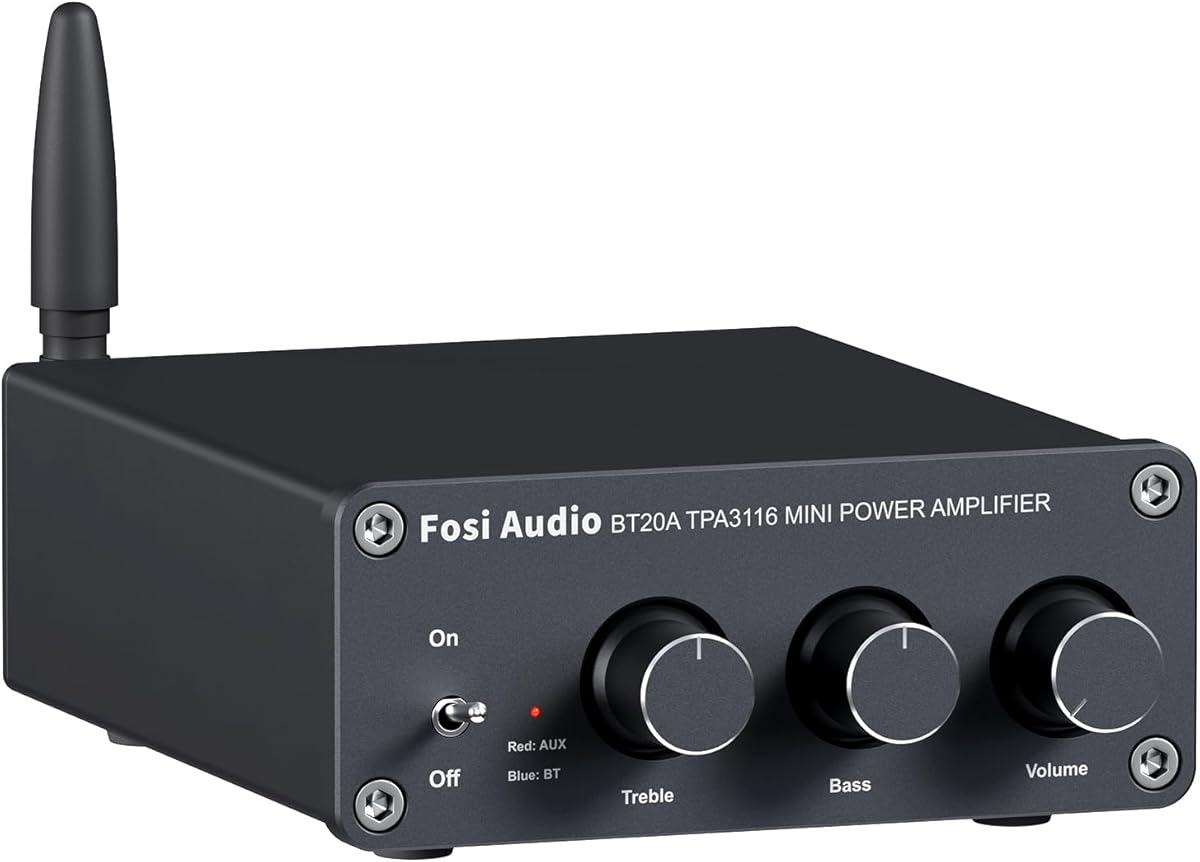
The Fosi Audio BT20A is a compact stereo amplifier for passive speakers, with a 4.5 rating and a maximum output listed at 100 watts per channel. It is designed for straightforward Bluetooth and RCA operation, with smooth bass and treble controls and a simple power switch. Its all-black enclosure and small footprint suit shelves, offices, bedrooms, garages, patios, and other secondary listening spaces.
We may earn a commission when you buy through this link, at no additional cost to you.
The Class D design keeps the amplifier compact, and the integrated one-piece body is intended to minimize clutter. Bluetooth allows convenient streaming from a phone, while RCA inputs accommodate wired line-level sources. The unit can power multiple passive speaker cabinets, making it useful for a small distributed speaker setup where a full-size receiver would be excessive.
For a turntable, the crucial point is that the listed input set does not include a phono input. Users should therefore plan to connect a turntable with a built-in preamp or add a separate phono preamplifier before using the RCA input. The product is better viewed as a compact power amplifier and wireless source hub than an all-purpose turntable receiver.
The BT20A is an effective option for a small living-room system, outdoor pair of passive speakers, office setup, or secondary listening area. It works especially well for someone who wants convenient Bluetooth playback and sufficient power without a large receiver, provided the turntable's signal level is appropriate.
The amplifier integrates the power stage into a compact housing and uses straightforward RCA and Bluetooth connections. A one-touch power switch keeps day-to-day operation uncomplicated.
Its listed indoor and outdoor use cases include a bedroom, garage, patio, and small venue. Speaker placement and suitable weather-resistant installation remain the listener's responsibility.
We may earn a commission when you buy through this link, at no additional cost to you.
The Qlearsoul HiCore H2 is a compact Class D stereo hub that combines Bluetooth 5.4, RCA, and 3.5 millimeter auxiliary inputs. It has a 5.0 rating, a listed output of 100 watts per channel at 4 ohms, and a particularly useful anti-hijack feature that physically disconnects Bluetooth when an analog input is selected.
We may earn a commission when you buy through this link, at no additional cost to you.
Its Texas Instruments TPA3255 platform is specified with a signal-to-noise ratio of at least 95 dB and total harmonic distortion plus noise of no more than 0.1%. The smart knob rotates for volume, short-presses to change inputs, and can clear Bluetooth pairings with a two-second long press. Separate bass and treble controls offer direct tonal adjustment without navigating deeper menus.
The H2 accepts a broad DC input range and includes a 30-volt, 5-amp adapter. Its stated potential for 300 watts per channel of peak output depends on using a higher-voltage power supply, so buyers should interpret the standard rated output as the more practical starting point. A CNC aluminum chassis, side ventilation, and non-slip feet support stable placement.
No phono input is listed, which makes this more suitable for a turntable with an integrated phono stage or for use with a separate preamp. It is a strong fit for a compact secondary system where Bluetooth convenience, easy source switching, and straightforward passive-speaker control matter more than a full receiver format.
Selecting RCA or AUX mode physically cuts the Bluetooth signal, helping prevent other devices from taking over playback. A two-second long press also clears the saved pairing history when a fresh start is needed.
The multifunction control handles volume and input selection, while independent bass and treble knobs make everyday tonal changes immediate. The result is a user-friendly interface without complex menus.
We may earn a commission when you buy through this link, at no additional cost to you.
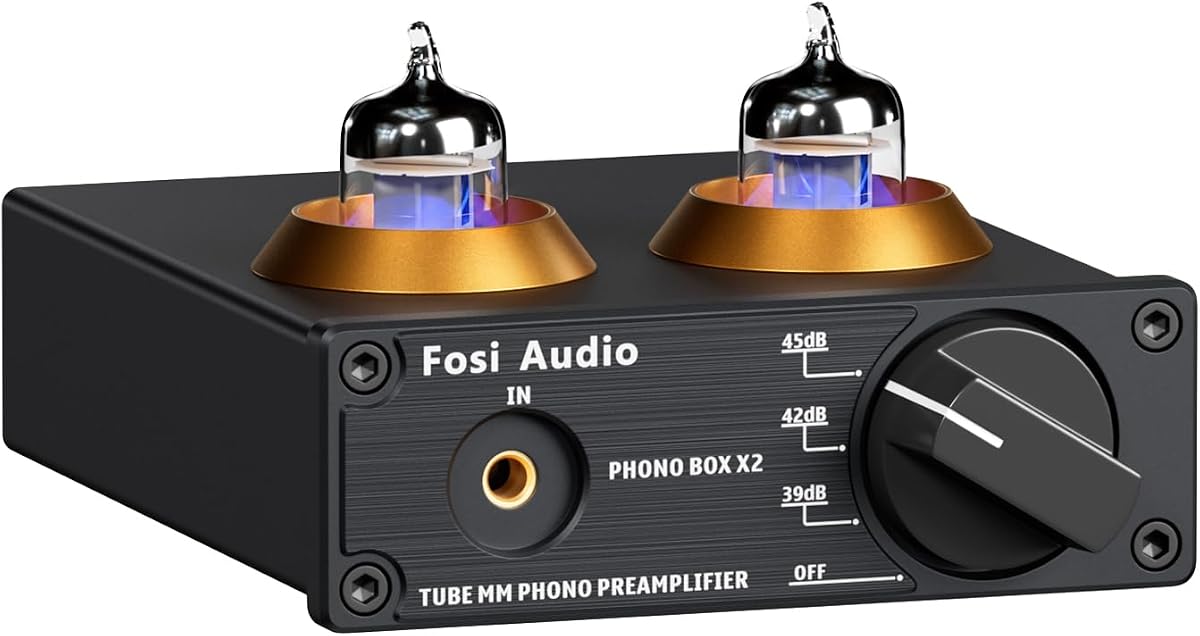
The Fosi Audio Box X2 is a dedicated MM phono preamplifier for turntables that need their low-level signal converted before reaching a power amplifier. It carries a 4.5 rating and is especially appealing to listeners who want adjustable gain and the option to experiment with replaceable vacuum tubes.
We may earn a commission when you buy through this link, at no additional cost to you.
Three gain settings—39, 42, and 45 dB—provide a way to match the preamp more closely to a compatible MM cartridge. The unit uses low-noise integrated circuitry and is described as removing low-frequency noise while preserving clear output. Its grounding post supports proper turntable-to-preamp grounding, an important step in reducing hum.
The Box X2 also works as a tube preamp through its 3.5 millimeter auxiliary input. Compatible tube models include 6K4, 6J1, 6J4, GE5654, 6AK5, and 66, allowing users to change the sound character. The package includes the preamp, two vacuum tubes, an RCA cable, a power adapter, and a manual.
This is an appealing companion for a system built around a separate integrated amplifier or receiver with line-level inputs. It is not a complete amplifier and cannot power passive speakers by itself. It also focuses on MM cartridges, so a turntable with a different cartridge type would require checking compatibility before purchase.
The three-position gain control gives users a practical range for compatible MM cartridges. This is more flexible than a fixed-gain companion box and can help optimize the relationship between the turntable and preamp.
Replaceable tubes let listeners try different compatible models and experience a different tonal presentation. The included tubes provide a starting point, while the auxiliary input broadens the unit's role beyond phono conversion.
We may earn a commission when you buy through this link, at no additional cost to you.
The Fosi Audio BT20A Pro is an upgraded version of the compact BT20A concept, with a 4.4 rating and a stated maximum output of 300 watts per channel. It uses the Texas Instruments TPA3255 chip, offers Bluetooth 5.0, and includes replaceable NE5532 op-amps, giving listeners more customization potential than a completely fixed compact amplifier.
We may earn a commission when you buy through this link, at no additional cost to you.
The listed performance includes a signal-to-noise ratio of at least 108 dB and total harmonic distortion of no more than 0.005%. Bass and treble controls sit at the neutral midpoint for a balanced starting point. A 32-volt, 5-amp adapter provides power, while a Bluetooth antenna, AC cord, and manual are included in the package.
Unlike the standard BT20A, the Pro model uses plug-in op-amps that can be replaced with compatible LME49720HA, MUSES02, OPA2604AP, OPA2134PA, LM4562, or NJM4556AD options. This makes the amplifier appealing to technically curious users who want to experiment with internal components. Pairing can be cleared by holding the volume control for five seconds, and a memory function simplifies repeated use.
The product does not list a phono input, so a turntable should use its built-in preamp or connect through a separate phono stage. It is well suited to a powerful compact stereo, garage, patio, or secondary room system where Bluetooth and flexible internal components are priorities.
The Pro model retains the small Class D format while claiming up to 300 watts per channel. That makes it suitable for passive speakers where greater headroom is desired without a large receiver.
The replaceable op-amp slots are the defining enthusiast-oriented feature. Users comfortable with internal audio components can experiment with several supported designs, while the included NE5532 chips provide the default configuration.
We may earn a commission when you buy through this link, at no additional cost to you.
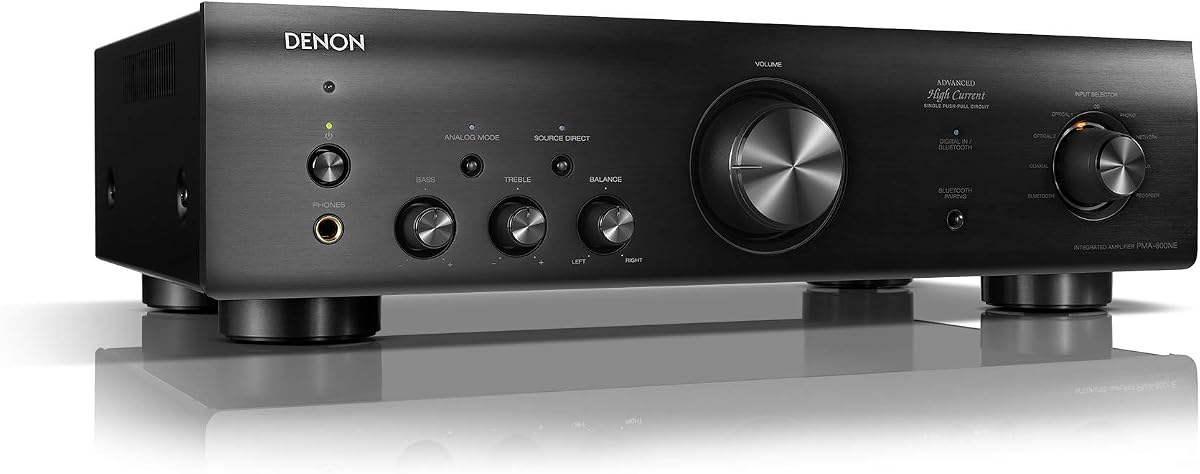
The Denon PMA-600NE is a two-channel integrated amplifier with a 4.7 rating, the highest customer rating among the products in this guide. It combines a dedicated phono input, Bluetooth, two optical inputs, one coaxial input, and a stated 70 watts of power at 4 ohms in a slim, vibration-resistant enclosure.
We may earn a commission when you buy through this link, at no additional cost to you.
A major feature is the ability to disengage the digital circuits and turn off Bluetooth for an undivided analog listening path. This gives a vinyl-focused user the option of reducing digital involvement in the signal chain. The phono input is designed for turntable use, and Denon's Advanced High Current push-pull circuit is intended to balance power with music detail.
The PMA-600NE also includes a built-in DAC for Bluetooth and offers both digital and analog connectivity. It can accommodate a turntable, CD player, Blu-ray player, television with compatible optical or coaxial audio, and a phone or other Bluetooth source. That range makes it a practical centerpiece for a mixed entertainment and music system.
This is the premium recommendation for a listener willing to place more emphasis on integrated construction, source flexibility, and a dedicated phono stage. It may be more than a buyer needs for a single room or one turntable, but for a system intended to serve music and home entertainment, its combination of features is difficult to overlook.
Bluetooth, optical, and coaxial inputs make the amplifier easy to pair with modern equipment. Turning off the digital circuits provides an analog-focused option for turntable listening when desired.
The stated 70-watt 4-ohm output and high-current push-pull circuit target clean, controlled amplification. The slim enclosure also makes the unit less visually dominant than a full-size home theater receiver.
We may earn a commission when you buy through this link, at no additional cost to you.
The right amplifier for turntable depends on cartridge type, signal level, speaker characteristics, available sources, room size, and whether a compact or full-size system best fits your space. These factors determine whether you need a built-in phono stage, a separate preamplifier, more speaker power, or additional digital connectivity.
A turntable with a moving-magnet cartridge usually needs a phono preamplifier to raise its low-level signal and apply the correct equalization. Some turntables include a switchable built-in phono stage, while amplifiers such as the Sony STRDH190, Donner MAMP2, Nobsound NS-13G MAX, and Denon PMA-600NE provide their own phono inputs. The Fosi Audio MC331 is intended for turntables that already have built-in phono preamps. The Pyle PP999 and Fosi Audio Box X2 are companion preamps rather than power amplifiers.
Moving-magnet and moving-coil cartridges have different output levels and electrical requirements. A moving-magnet phono stage is the primary configuration represented by the dedicated phono products in this guide. Moving-coil cartridges often require a much higher gain phono stage and careful impedance matching, so their requirements should be checked separately. If the turntable provides a built-in phono stage with a line-level output, it can feed a suitable line input on a compact amplifier.
Speaker power requirements depend on sensitivity, impedance, room dimensions, and how loudly you listen. The products here range from compact Class D units with 100-watt maximum outputs to receivers listing higher peak-power figures. A receiver's 100-watt-per-channel rating and a mini amplifier's 100-watt maximum output are not necessarily equivalent under identical conditions, so compare continuous or RMS figures where available and avoid relying on peak power alone.
The supported speaker impedance should always be checked. The Sony STRDH190 supports 6- to 16-ohm speakers, while the Donner MAMP2 lists support for 4- to 16-ohm groups. Other compact amplifiers offer varying speaker outputs and should be matched to the passive speakers in use. Stereo pairing is common for turntable listening, but several selections can also operate two speaker groups, making room layout an important part of the purchase decision.
A full-size receiver provides a familiar layout, room for connections, and easy speaker switching. A mini Class D amplifier can sit discreetly on a shelf or beside a turntable, but may require an external power adapter and offer fewer input choices. Dedicated preamplifiers are exceptionally small because they do not need to include speaker power. The Fosi Audio MC331 and Denon PMA-600NE occupy a middle ground by combining integrated amplification with more elaborate styling and source control.
Bluetooth is convenient for phone and computer playback, while optical and coaxial inputs can carry digital audio from a television or other source. The Donner MAMP2 and Denon PMA-600NE offer the broadest digital selection in this group. The Fosi Audio MC331 adds USB, Bluetooth, optical, coaxial, and RCA in a tube-styled package. If a turntable is your only source, extra connections may add little, but they can make the amplifier more useful as the center of a complete household system.
Basic bass and treble controls are useful for matching speakers to a room, while the Donner MAMP2 adds separate midrange, echo, and Talkover adjustments. The Fosi Audio BT20A Pro offers replaceable op-amps, and the Fosi Audio Box X2 supports replaceable vacuum tubes. Customizable components can be enjoyable for enthusiasts, but they also require more care and technical interest than a straightforward receiver with basic controls.
A proper ground connection is essential when using a turntable and phono preamp. The Pyle PP999 and Fosi Audio Box X2 both emphasize grounding and low-noise operation, while the latter uses selectable gain. The Nobsound and Fosi products specify low distortion and signal-to-noise figures, although real-world noise also depends on cables, placement, speaker quality, and the rest of the system. Keep the preamp close to the turntable and away from interference sources when possible.
Begin by checking the turntable's output type and the amplifier's input specifications. If the turntable has a switchable built-in phono stage, set it appropriately for the cartridge. If it outputs phono-level signals, connect the turntable to a phono input or external phono preamplifier. Attach the turntable's ground wire to the amplifier or preamp grounding terminal, and confirm that the selected cartridge is compatible with the phono stage.
Power down the amplifier before making cable changes. Connect the appropriate left and right speaker outputs, observing polarity, and place the amplifier on a stable, ventilated surface. Select the phono or line input, set a moderate volume, and then power up. Begin with tone controls centered, adjust the turntable's own controls if it has any, and then fine-tune the amplifier for the speakers and room rather than compensating for an unsuitable setup.
For regular care, keep the unit free of dust, liquids, and direct heat, and avoid leaving it in a location where cables are strained. Clean the exterior with a dry or lightly damp cloth rather than spraying cleaner directly onto the controls. Check ground and RCA connections if hum appears, keep ventilation openings unobstructed, and review the manufacturer's instructions before changing tubes, op-amps, power supplies, or internal components.
Usually, a turntable with a moving-magnet cartridge needs a phono preamp, either inside the amplifier or as a separate box. The Sony STRDH190, Donner MAMP2, Nobsound NS-13G MAX, and Denon PMA-600NE include phono inputs. If your turntable has a built-in phono stage, you can connect it to a line-level input instead.
Only if the turntable provides a suitable line-level output through its built-in phono stage. Otherwise, the turntable must connect through a dedicated phono preamp before reaching the amplifier's RCA or auxiliary input. Bluetooth itself is normally used for phone or computer streaming rather than for receiving the turntable's analog signal.
No. Amplifier power should be matched to the passive speakers, their impedance, the room, and the desired listening level. Clean operation at moderate or high volume matters more than a large headline number. Peak-power claims can also make compact amplifiers look more powerful than a receiver's lower continuous rating, so compare comparable specifications when possible.
A phono preamp converts the turntable's low-level phono signal to line level and applies the required equalization. A stereo amplifier then provides volume control and power to passive speakers. The Pyle PP999 and Fosi Audio Box X2 are phono preamps, while the Sony, Donner, Nobsound, and Denon products combine power amplification with a phono input.
Compact listeners should compare the Nobsound NS-13G MAX, Fosi Audio BT20A, Fosi Audio BT20A Pro, and Qlearsoul HiCore H2. Each offers a small Class D-style enclosure suitable for a shelf or desk. The Nobsound includes a phono input, while the other compact units may require a turntable with a built-in preamp or a separate phono preamp.
First, confirm that the turntable is connected to the correct phono input and that its ground wire is attached to the proper terminal. Check that the turntable's built-in phono stage is configured correctly, use suitable RCA cables, and keep the preamp close to the turntable. If hum persists, check for ground loops, loose connections, and interference from nearby power or audio equipment.
The Sony STRDH190, Donner MAMP2, Fosi Audio MC331, Fosi Audio BT20A, Qlearsoul HiCore H2, Fosi Audio BT20A Pro, and Denon PMA-600NE list Bluetooth connectivity. This is useful for switching from records to phone or computer playback, although Bluetooth adds wireless compression and is normally intended as a convenience source rather than the primary vinyl path.
Choose a receiver when you want more built-in connectivity, familiar controls, and straightforward multi-speaker switching. Choose a compact integrated amplifier when shelf space is limited and your source list is simple. The Donner MAMP2 is the broadest receiver-style option, while the Nobsound NS-13G MAX provides a dedicated phono input in a much smaller enclosure.
The Sony STRDH190 stands out as the most complete general-purpose choice because it combines a phono stage, 100 watts per channel, Bluetooth, FM radio, and A/B speaker switching in a relatively low-profile receiver. The Donner MAMP2 is the standout budget selection because it combines a phono input with a particularly broad collection of analog, digital, USB, Bluetooth, radio, and microphone connections.
For a premium one-box system, the Denon PMA-600NE offers a dedicated phono input, 70 watts at 4 ohms, Bluetooth, optical and coaxial digital inputs, and the option of disabling its digital circuitry. Listeners seeking a smaller footprint should consider the Nobsound NS-13G MAX, while the Pyle PP999 and Fosi Audio Box X2 are better understood as phono-stage companions for systems that already have stereo power amplification.
Whichever option you choose, verify the cartridge type, phono-stage compatibility, speaker impedance, connection requirements, and available space before ordering. Customer ratings and technical specifications provide a useful starting point, but current prices, bundle contents, availability, and the latest product details can change, so check the live listing before making a final purchase.