
BAOFENG BF-5RH PRO
4.4Editor score
GPS location sharing
Ten-watt handheld output
640 channels across ten zones
NOAA emergency weather alerts
CPS computer programming
Explore the 10 best APRS radio for GPS tracking options, comparing GPS, APRS, mapping, power, ruggedness, programming, connectivity, and field-ready features
An APRS radio for GPS tracking combines position reporting, two-way communication, navigation data, and beaconing in one field-ready device. The best models make it easy to share coordinates, inspect nearby traffic, monitor weather, and maintain contact when conventional cellular coverage is unreliable or unavailable.
This guide compares ten GPS and APRS radios across their location features, mapping workflows, radio flexibility, output power, battery design, ruggedness, programming options, and connectivity. It includes amateur-radio handhelds, a high-powered mobile model, a GMRS-focused alternative, and a DMR radio for users with different licensing and communication needs.
Each entry highlights the strongest reason to consider that model and the trade-offs to understand before buying. The list covers radios suitable for hiking, off-roading, field teams, events, mobile installations, and emergency preparation. Product configurations and current prices can change, so confirm the latest listing details before purchasing.
4.4Editor score

4.5Editor score

4.1Editor score
The table below compares all ten radios by their most important positioning, communication, power, and field-use characteristics. It is intended to make the differences between basic handhelds, app-connected radios, wide-band models, and vehicle-oriented equipment easier to understand.




The TIDRADIO TD-H9 is a feature-dense handheld that combines GMRS, amateur-radio, and unlocked operation with built-in GPS and APRS. Its 4.4 rating reflects a broad collection of capabilities rather than a minimalist design. The standout combination is GPS position viewing, APRS beaconing and messaging, a 10-watt GMRS mode, NOAA alerts, a compass, and Bluetooth-based APRS operation.
We may earn a commission when you buy through this link, at no additional cost to you.
The radio is particularly compelling for users who want one device to cover several communication systems. Its version switch changes among GMRS, ham, and unlocked configurations, while the GMRS channel plan includes repeater access and customizable receive channels. The built-in KISS-mode TNC can connect to the ODmaster app over Bluetooth BLE, allowing supported APRS operations without requiring a separate TNC.
Programming is handled through CPS, USB-C, or Bluetooth, although the supplied information explicitly notes that Chirp is not supported for this model. Bluetooth headset operation is possible through HFP-compatible equipment, while VOX and push-to-talk control provide additional hands-free options. The menu structure and broad range of functions may feel complicated to a first-time radio user, but they reward buyers who want to customize the radio extensively.
This is a strong recommendation for hikers, off-road travelers, search-and-resourcers, and family groups that want GPS and APRS in a flexible handheld. It is particularly useful for people who participate in GMRS as well as amateur radio and do not want to carry separate devices for each service. Buyers should be comfortable learning a deeper menu before relying on advanced APRS functions.
The built-in KISS-mode TNC is a meaningful convenience for mobile APRS use. Once connected to the ODmaster app through Bluetooth BLE, users can work with supported position, beacon, and message functions directly from the field.
Switching among GMRS, ham, and unlocked modes gives this radio unusual breadth. That makes it easier to keep one primary device for everyday group communication, amateur-radio work, and broader receive or transmit activity.
We may earn a commission when you buy through this link, at no additional cost to you.
The BTECH UV-PRO is a rugged dual-band handheld built around dependable GPS, APRS, and app-assisted operations. It carries a 4.5 rating and stands out for IP67 dust-tight and water-resistant construction, making it a convincing choice for wet trails, dusty work sites, and outdoor events. Bluetooth data, Bluetooth audio, and location sharing between the radio and app broaden its usefulness beyond conventional voice communication.
We may earn a commission when you buy through this link, at no additional cost to you.
Its APRS toolkit includes tracking, messaging workflows, smart beaconing, and improved packet handling in current firmware. The built-in GPS can share locations with the app and radio, which is helpful when a team wants a live map, coordinated status reports, or a record of field movement. The BTECH UV app also allows channel plans to be shared or live-edited, reducing the need to repeat menu configuration across multiple units.
Receiving features add further value. The radio monitors the aviation band, supports NOAA alerts, and uses Frequency Sync Rapid Scanning to help users locate active nearby traffic. Bluetooth HFP audio can work with compatible headsets, though a compatible PTT accessory is needed for full control. As with most feature-rich radios, the initial learning curve can be substantial.
The UV-PRO is best suited to licensed users, field teams, travelers, and club operators who want a reliable handheld with serious environmental protection. It is a particularly good fit when phone-based coordination is as important as traditional radio communication. Buyers should confirm that the app, firmware, and radio are configured together before a critical trip.
IP67 protection gives the UV-PRO an advantage over handhelds with lesser weather resistance. It is a sensible primary radio for marine edges, rain-soaked hikes, construction environments, and other conditions where moisture ingress would be costly.
Shared and live-edited channel plans can save significant time when deploying several radios. A team can establish a common configuration through the app rather than navigating every control on each handset.
We may earn a commission when you buy through this link, at no additional cost to you.
The BTECH UV-50PRO is designed for licensed amateur-radio operators who need a mobile platform rather than a pocketable tracker. Its 4.1 rating is supported by substantial output power, with selectable 5-watt, 25-watt, and 50-watt modes. Built-in GPS, advanced APRS tools, Bluetooth programming, AI noise reduction, and satellite tracking give it a serious vehicle-oriented feature set.
We may earn a commission when you buy through this link, at no additional cost to you.
APRS functionality is one of the model’s strongest areas. Smart beaconing, Mic-E support, acknowledgment handling, destination settings, GPWPL upload, and a custom location override give operators fine control over position reporting. That makes it well suited to road trips, convoys, mobile teams, and fixed-area reporting where a dependable platform antenna and stable power supply are available.
Bluetooth programming through the BTECH UV Programmer app allows channel, tone, offset, and zone editing from an iOS or Android device. CSV import and export can help clubs or event organizers clone templates across several installations. AI noise reduction targets wind, engine rumble, and background noise, while satellite tools, NOAA monitoring, and FM reception add useful functions during downtime.
The UV-50PRO is the premium choice in this guide for users who prioritize high power, connected configuration, and advanced position reporting over portability. Its trade-off is obvious: it is a mobile radio and does not offer the same convenience as a handheld in a pack or on a ridge. Installation, power management, and appropriate antennas should be planned carefully.
The 50-watt option gives mobile operators a substantial advantage when they need to reach more distant stations or work through challenging terrain. Lower selectable output levels provide flexibility for local communication and reduced power use.
Mic-E, smart beaconing, acknowledgment handling, and custom locations make this radio suitable for continuous reporting. Those controls are more useful than a simple coordinate display for organized mobile or field operations.
We may earn a commission when you buy through this link, at no additional cost to you.
This TIDRADIO TD-H9 listing combines 10-watt GMRS operation with GPS, APRS, NOAA alerts, a compass, and several programming options. Its 4.4 rating makes it a credible all-purpose handheld for off-roading, hiking, work groups, and family communication. The model supports app or web-based customization, USB-C CPS programming, and Bluetooth programming.
We may earn a commission when you buy through this link, at no additional cost to you.
GPS coordinates and direction can be viewed through the radio, while the built-in KISS-mode TNC supports supported APRS operations over Bluetooth BLE. The radio also includes SMS-style messaging, dual PTT buttons, frequency matching, wireless cloning, Morse code transmission, spectrum analysis, and repeater import. Those additions make it appealing to users who want a GPS radio that doubles as a broader communications tool.
The 2,400mAh battery is designed for portable use, and USB-C charging simplifies routine power management. However, the range statement is heavily influenced by terrain, antenna choice, repeater availability, and other real-world conditions. Bluetooth headset buttons cannot act as PTT, and Chirp is not supported, so buyers should align their programming expectations with the supplied compatibility information.
This TD-H9 is well suited to buyers who want high power, GPS, APRS, and extensive radio functions in one handheld. It is especially relevant for off-road groups that may use GMRS repeaters and users who value flexible phone-based configuration. First-time operators should plan to learn the shortcut controls and verify their preferred programming method before heading into the field.
Bluetooth programming reduces the need for a laptop in the field. For users moving between vehicles, camps, or work locations, the ability to prepare channels from a phone is a meaningful operational convenience.
APRS beaconing, messaging, a compass, spectrum analysis, and repeater import all support field awareness. This broader toolset can help users understand their surroundings before relying on the radio for critical communication.
We may earn a commission when you buy through this link, at no additional cost to you.
The BAOFENG BF-5RH PRO package pairs two GPS/APRS handhelds with 10-watt output, a 1.8-inch color display, NOAA monitoring, and a substantial accessory set. Its 4.4 rating reflects a capable value-focused package. For groups that need matching radios, the included two-pack simplifies setup and makes it easier to begin communicating immediately after configuring each unit.
We may earn a commission when you buy through this link, at no additional cost to you.
GPS supports one-touch distress and location sharing, while the radio can request another team member’s location, direction, and distance. APRS is described as using firmware version 2.0.9, and the radio covers VHF, 1.25-meter, UHF, AM, and FM. Its ten zones contain 64 channels each, with dual-band monitoring available for keeping track of two frequencies.
CPS programming is supported through the manufacturer’s software or compatible walkie-talkie programming resources. Chirp and Bluetooth programming are explicitly not supported, which is the clearest limitation for buyers accustomed to phone-based configuration. The supplied 18.89-inch tactical antenna is intended to improve transmission and reception, but antenna height and terrain will still determine practical range.
The BF-5RH PRO is an attractive option for two-person teams, family communication, clubs, and outdoor organizations that want GPS/APRS without purchasing several separate radios. Beginners who only need basic push-to-talk voice may find a simpler model easier to manage, but users ready to learn CPS will gain a broad and capable radio.
Matching radios, batteries, antennas, and charging equipment reduce the friction of building a coordinated set. A two-person group can also identify itself more easily when each radio has been programmed with a unique contact ID.
The ability to request another station’s location, direction, and distance adds context to voice communication. That is useful when members become separated or a group needs to confirm where everyone is located.
We may earn a commission when you buy through this link, at no additional cost to you.
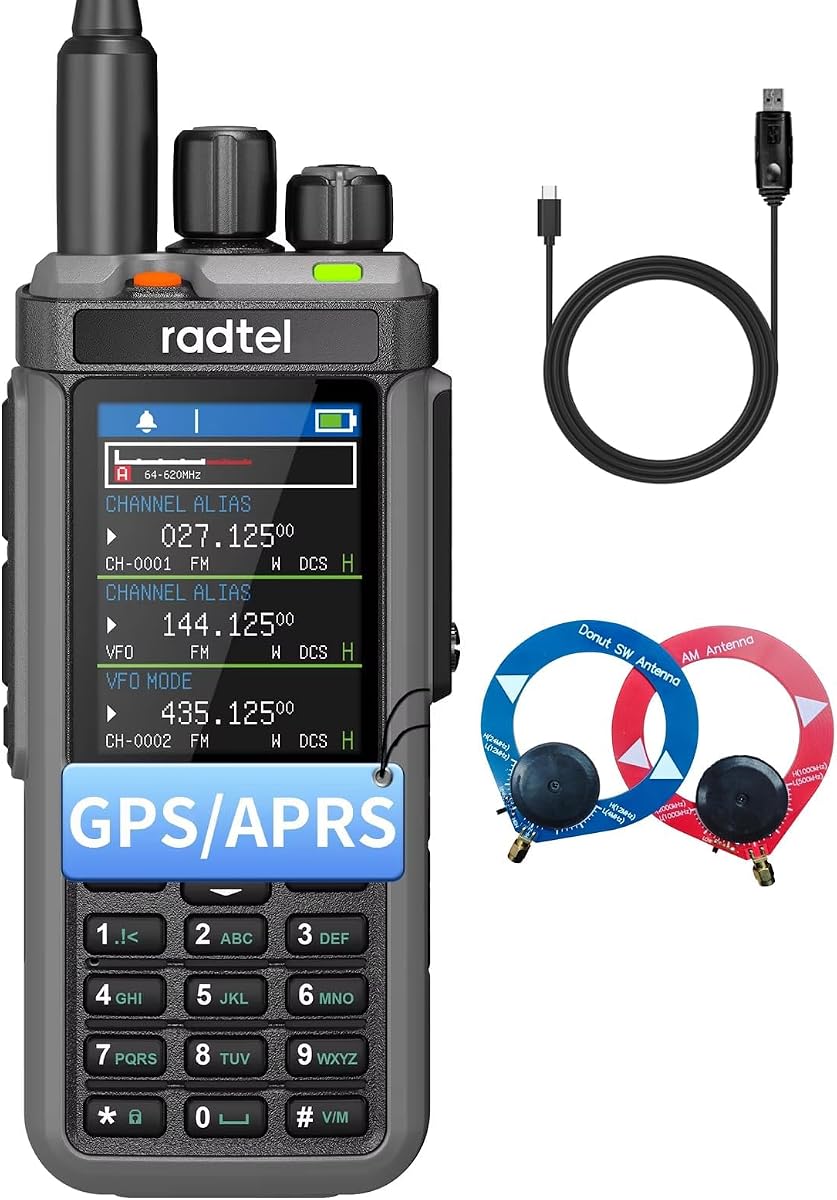
The Radtel RT-880G is a wide-band handheld with GPS positioning, APRS, a 2.4-inch color display, and 10-watt output. Its 4.3 rating reflects a broad set of receiving and positioning functions. It is particularly interesting to operators who want more than conventional VHF/UHF handheld coverage and need APRS distance and direction calculations.
We may earn a commission when you buy through this link, at no additional cost to you.
GPS position recording can be configured manually or on a timer, and coordinate queries help users measure distance and direction from a selected starting point. APRS data can be encoded and decoded in real time, with distance and direction calculated when coordinates are included. The radio supports AM, FM, USB, LSB, CW, CB, LW, MW, SW, SSB, and aviation-band reception, plus a shortwave antenna connection.
Cross-band repeater functionality can link UHF and VHF activity, expanding coverage options where appropriate infrastructure is available. Users can also customize side keys and keypad functions for faster access. The 2,400mAh battery and USB-C charging provide a practical portable power setup, although the broad receiver and repeater feature set rewards careful configuration.
This radio fits advanced amateur-radio users, travelers, and preparedness-minded buyers who want GPS tracking inside a flexible multi-band platform. It may be less intuitive for someone seeking a simple GPS-enabled walkie-talkie, but it offers considerable control for users who understand frequencies, bands, and repeater behavior.
Manual and timed recording options make it easier to document movement during a hike, drive, or field task. Coordinate queries add a second way to evaluate distance and direction relative to a known point.
The ability to bridge VHF and UHF activity can improve coverage when compatible repeaters and operating conditions are present. It is a useful capability for technically experienced users managing traffic across multiple bands.
We may earn a commission when you buy through this link, at no additional cost to you.
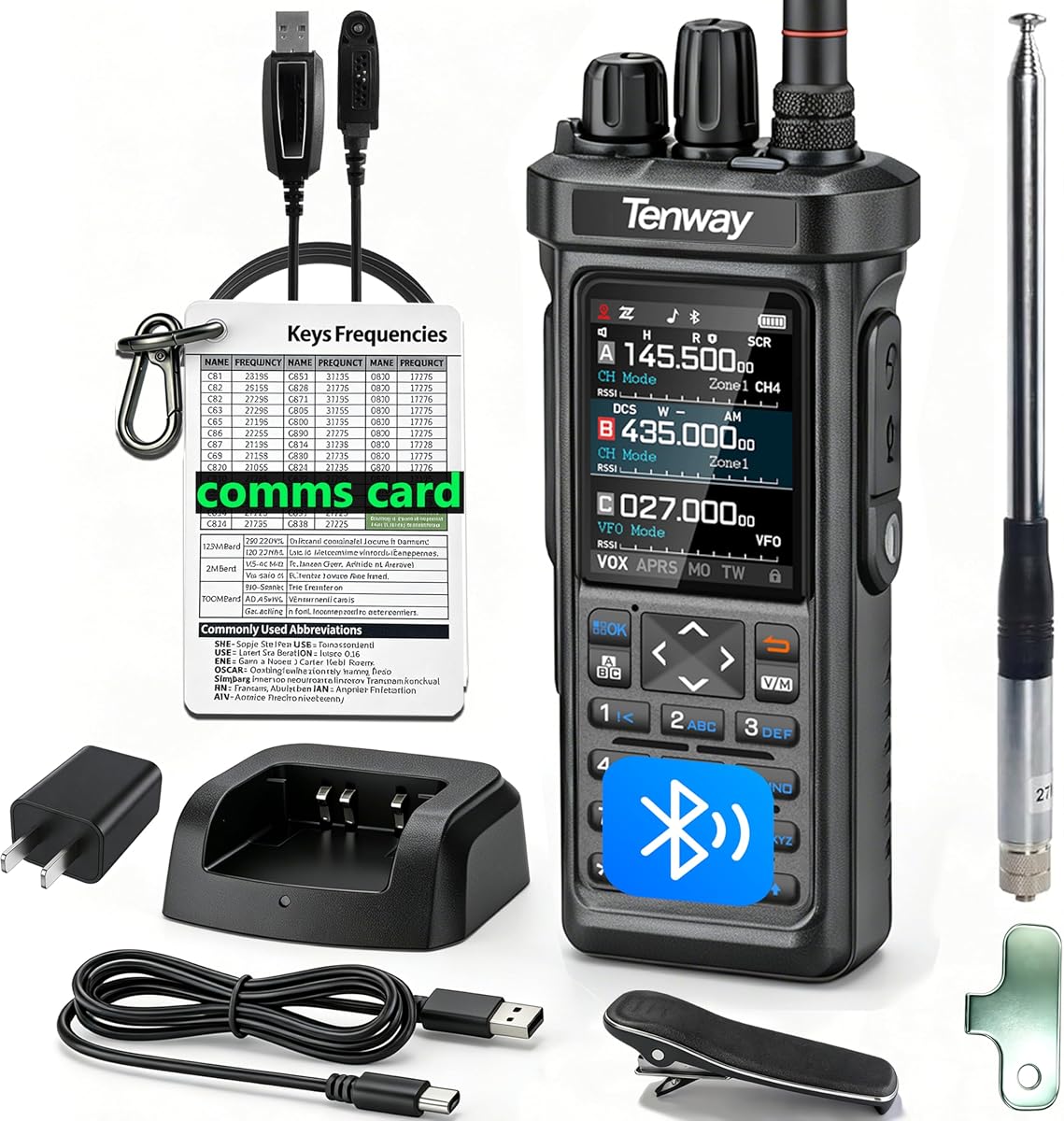
The Tenway TP-900 PRO is a 10-watt handheld with a 5.0 rating, built-in GPS and APRS, NOAA weather reception, and 27MHz FM operation. Its standout qualities are the combination of high customer rating, smartphone-based programming, and an integrated spectrum analyzer. The radio also supports wide-band reception across AM, FM, shortwave, medium-wave, and long-wave signals.
We may earn a commission when you buy through this link, at no additional cost to you.
Bluetooth app programming simplifies setup without a conventional programming cable, which is valuable for users preparing a radio away from a desk. The spectrum analyzer can display nearby signal activity, helping operators identify less crowded channels. For team coordination, GPS and APRS provide real-time location sharing, while NOAA reception keeps weather information accessible during outdoor trips.
There is an important limitation to the 27MHz operation: the handheld supports only FM-modulated transmit and receive on that band. The broader receive capability does not mean every supported frequency can transmit. Users should also verify their desired radio modes, regional rules, and antenna expectations against the complete product listing.
The TP-900 PRO is a compelling recommendation for amateur-radio operators, outdoor teams, and emergency-preparedness buyers who want phone programming and signal visibility in a portable radio. Its strong rating is encouraging, although the supplied product information provides less detail about its exact APRS beacon controls than some competing models. Prospective buyers should review those functions carefully before committing.
Bluetooth app programming reduces setup friction and makes field reconfiguration more convenient. It is particularly useful for travelers who may move between different repeaters or group channel plans.
The integrated spectrum analyzer helps users inspect nearby signals and select cleaner channels. It adds situational awareness that can improve communication efficiency, especially at busy events or in active radio areas.
We may earn a commission when you buy through this link, at no additional cost to you.
This BAOFENG BF-5RH PRO offering is a single-radio configuration of a handheld with GPS, APRS, 10-watt power, and NOAA emergency monitoring. It carries a 4.4 rating and includes a 1.77-inch color display, a 2,500mAh battery, USB-C charging, a base charger, an earpiece, a belt, a hand strap, and a manual.
We may earn a commission when you buy through this link, at no additional cost to you.
GPS and APRS provide one-key location sharing and emergency positioning, while NOAA alerts provide severe-weather information. Ten zones with 64 channels per zone create 640 channels in total, and dual-band monitoring allows simultaneous reception on two frequencies. These capabilities suit event teams, security staff, and outdoor groups that need organized channel access.
Charging can be performed through a wall outlet, computer, car, laptop, power bank, or any suitable USB port, which adds convenience for field and travel use. As with the two-pack version, the radio does not support Chirp or Bluetooth programming, so setup depends on compatible CPS software. This is less convenient than the app-driven models in the guide but can still provide a complete traditional programming workflow.
This listing is best for buyers who want one capable handheld without purchasing a matched second radio. It may suit an individual operator, a traveler keeping a backup radio, or a group member who already owns a compatible unit. Those wanting the simplest deployment should choose the two-pack version instead.
Ten zones and 640 total channels make it easier to separate teams, activities, or repeaters. Rapid zone changes reduce the time required to move between different groups or operating plans.
USB-C power allows the radio to recharge from several common sources. That flexibility is helpful on long trips where access to a dedicated charging outlet may be limited.
We may earn a commission when you buy through this link, at no additional cost to you.
The BAOFENG DM-32UV combines DMR digital communication, analog operation, GPS, and APRS in a field-oriented handheld. Its 4.4 rating reflects a capable combination of features, particularly for teams that need both digital and conventional voice compatibility. It delivers 10 watts on VHF and UHF and displays coordinates on the radio screen.
We may earn a commission when you buy through this link, at no additional cost to you.
APRS location sharing lets base camp or another member know a user’s position, which is useful for hiking, off-roading, boating, and organized outdoor activities. NOAA reception adds emergency weather alerts, while the included gooseneck antenna, MOLLE-compatible handbag, laminated communication card, programming cable, USB-C charging cable, and 2,500mAh battery create a ready-to-use kit.
Programming and firmware updates can be handled through one cable according to the supplied information. The Type-C port is positioned on the battery, and the radio also includes a base charger. Digital DMR operation will be most valuable when the intended group has compatible systems and programming in place; traditional analog use remains available for broader compatibility.
The DM-32UV is a strong recommendation for buyers who want high power, GPS, APRS, and digital-radio capability in one package. It is less suitable for someone seeking a wide-band receiver or a highly visual app ecosystem. Confirm that your team’s digital talk groups and channels align before relying on the radio for operations.
Supporting both digital and analog modes provides more flexibility than a single-standard radio. That is valuable for mixed groups or users transitioning between DMR and conventional communication.
The gooseneck antenna, carry bag, emergency card, charging cables, and battery create a practical bundle. It reduces the need to source separate accessories before an outdoor trip.
We may earn a commission when you buy through this link, at no additional cost to you.
This two-pack version of the TIDRADIO TD-H9 combines 10-watt output with GPS tracking, APRS sharing, ODmaster app control, and emergency features. Its 4.5 rating makes it one of the strongest entries for buyers who want connected configuration. Position reporting, beaconing, APRS text messaging, global talk, Morse code, NOAA alerts, spectrum analysis, and repeater import give the radio broad utility.
We may earn a commission when you buy through this link, at no additional cost to you.
The ODmaster app can be used to program the radio, search and import repeaters, back up configurations, share setups, and communicate with other app users. Bluetooth device pairing supports speakers, earpieces, and PTT microphones for hands-free operation. The radio also supports dual PTT, frequency copying, wireless cloning, dual watch, adjustable squelch, and firmware upgrades.
The built-in GPS is accessed through the radio menu, while APRS provides position reporting, beaconing, and messaging. Some users will appreciate the convenience of the full-color 1.77-inch screen and 18 menu colors, while others may find the customization options excessive. The included two-radio format is particularly useful for couples, families, or small field pairs.
The TD-H9 two-pack is an excellent choice for outdoor emergency preparation and coordinated group travel. It combines real tracking hardware with a mature app workflow and extensive programmable features. Buyers should remember that actual radio reach depends on terrain, antenna setup, and repeater infrastructure, and they should update firmware before relying on newly listed functions.
Repeater discovery, configuration backups, sharing, and phone-based customization reduce the need to carry a laptop. The app also creates a path for teams that want a shared digital layer around their APRS operation.
NOAA warnings, Morse code, global talk, spectrum analysis, and Bluetooth PTT accessories add ways to communicate when conventional voice is inconvenient. These supporting tools make the radio more adaptable in the field.
We may earn a commission when you buy through this link, at no additional cost to you.
The right GPS and APRS radio depends on how you travel, who will use it, what radio services you need, and how you plan to configure and power the equipment. Comparing these factors before buying prevents an expensive mismatch between a complex mobile radio and a simple handheld.
A radio may include GPS hardware, APRS beaconing, location messaging, or some combination of those features, but the implementations differ. The BTECH UV-PRO supports smart beaconing and radio-to-app location sharing, while the BTECH UV-50PRO adds Mic-E, acknowledgment handling, destination settings, GPWPL upload, and custom location overrides. The TIDRADIO models use a built-in KISS-mode TNC with the ODmaster app for supported APRS operations. Check that the radio can display and transmit the position format required by your tracking service or team.
Position reporting is only useful if other members can view, store, or respond to it. Consider whether the radio works directly with a mapping application, requires a phone connection, or only exchanges position reports with compatible radios. Also determine whether you need continuous beaconing, periodic reporting, distance and direction calculations, distress messaging, or acknowledgment of received packets.
A GPS tracker also needs the right radio architecture for your group. Some models center on VHF and UHF amateur operation, while others combine GMRS, ham, and unlocked modes. The TIDRADIO TD-H9 offers a three-way version switch, and the BAOFENG BF-5RH PRO supports eight listed bands, including VHF, 1.25-meter, UHF, AM, and FM. The Radtel RT-880G covers an especially broad receiver range and includes aviation and multiple shortwave-style bands.
Make sure transmit and receive capabilities are not confused. The Tenway TP-900 PRO, for example, supports broad reception but only FM operation on 27MHz. Digital users should also check whether a radio such as the BAOFENG DM-32UV supports the exact DMR system, talk groups, and programming conventions used by their team. License and regional operating requirements also need to be considered.
Higher transmit power can improve access to distant stations and repeaters, but it does not guarantee a fixed mileage figure in every environment. The BAOFENG BF-5RH PRO and TIDRADIO TD-H9 handhelds provide 10 watts, while the BTECH UV-50PRO offers selectable 5-, 25-, and 50-watt output for vehicle installation. The mobile model is intended to operate with appropriate mounting, power, and an installed antenna rather than being carried like a small handheld.
Antenna selection also matters. The BF-5RH PRO includes a long 18.89-inch tactical antenna, while mobile installations may require a proper roof or body-mounted antenna. Match the antenna to the intended bands and mounting position, keep it clear of obstructions, and avoid assuming a more powerful radio will overcome unfavorable terrain, dense vegetation, or a poorly positioned antenna.
Programming determines how quickly you can prepare a radio and maintain a group of matching devices. App-based models offer the most mobile convenience. The BTECH UV-PRO can share or live-edit channel plans, the UV-50PRO supports CSV fleet templates and Bluetooth programming, and the Tenway TP-900 PRO supports Bluetooth app programming. Several TIDRADIO listings support Bluetooth or web-based configuration alongside CPS programming.
CPS remains important for some users because it provides detailed control over channels, tones, offsets, and other radio settings. The BAOFENG BF-5RH PRO requires compatible CPS software and explicitly does not support Bluetooth programming or Chirp. The TIDRADIO TD-H9 listings also note that Chirp is temporarily unsupported. Before buying, download the relevant software, check operating-system compatibility, and confirm how contact IDs and APRS parameters will be assigned.
Field radios must tolerate rain, dust, vibration, temperature changes, and repeated handling. The BTECH UV-PRO is rated IP67, offering dust-tight construction and water resistance up to one meter for 30 minutes according to the supplied information. The TIDRADIO TD-H9 listings specify IP54 rugged construction, while the BAOFENG BF-5RH PRO also lists IP54 protection. These ratings are useful distinctions when choosing between radios for wet trails, dusty worksites, or general outdoor use.
A rugged rating does not make a radio waterproof in every situation. Keep charging ports covered when appropriate, avoid exposing the radio beyond the stated limits, and use a protective case if drops and impacts are likely. Accessories should not block the GPS antenna area or interfere with the radio's external connections.
Battery capacity affects how long the radio can provide GPS fixes, beacon reports, receive monitoring, and voice communication. The BAOFENG BF-5RH PRO and DM-32UV include 2,500mAh batteries, the TIDRADIO listing at rank four identifies a 2,400mAh battery, and the Radtel RT-880G also uses a 2,400mAh cell. USB-C charging improves convenience by supporting power banks, computers, vehicles, and wall adapters, although actual endurance depends on transmit use, GPS activity, display time, and battery condition.
For a mobile radio, the power requirement is more substantial than for a handheld. Plan a secure connection to a vehicle electrical system, manage cable routing, and include a dependable backup power option. For portable radios, carry a charged spare battery when the mission extends beyond the expected operating window, especially if frequent APRS beaconing is planned.
Bluetooth can simplify phone-based programming, APRS data connections, audio monitoring, and hands-free control, but these functions are not interchangeable. The TIDRADIO TD-H9 supports Bluetooth speakers, earpieces, and PTT microphones, along with BLE data for the KISS-mode TNC. The BTECH UV-PRO and UV-50PRO support Bluetooth HFP audio and data workflows where enabled. Compatibility depends on the specific accessory profile and the radio's role as emitter or receiver.
A headset may support listening without providing a usable PTT control. That limitation appears in the TIDRADIO information and is worth considering before planning around a particular Bluetooth headset. Verify the required profile, pairing procedure, accessory power, and control behavior. Wired earpieces remain useful when reliability and immediate push-to-talk response are more important than wireless convenience.
A GPS radio should let users find essential information without navigating a complicated menu. The BTECH UV-PRO and Radtel RT-880G use 2.4-inch color screens, while the TIDRADIO TD-H9 and BAOFENG BF-5RH PRO use displays around 1.8 inches. Larger screens can make maps, menus, and status information easier to read, while compact displays may preserve handheld portability. The UV-50PRO takes a different approach with a mic-first mobile interface designed for vehicle operation.
Consider the controls used most often: pushing to talk, selecting a channel, checking GPS coordinates, changing zones, accessing beacons, and adjusting squelch. Some radios offer programmable side keys, dual PTT, customizable menu colors, compass displays, and multiple display modes. Practice the essential functions before a trip so you do not need to search through a deep menu while moving or under pressure.
Before using the radio outdoors, install the correct antenna, charge the battery fully, and confirm that the device powers on normally. Create a written channel plan with separate entries for transmit and receive frequencies, offsets, tones, APRS parameters, and unique user IDs. For any radio with Bluetooth app support, install the correct application, pair the radio, and test every control before relying on it in the field.
Move to an open area when first activating the GPS so the receiver can acquire satellites. Set the correct GPS or GNSS mode, allow the position to stabilize, and verify the displayed coordinates against another reference. Learn how to start and stop beaconing, send a position request, open a track record, and return from the GPS screen to normal communications. Test these functions with another member of the group rather than waiting until an emergency requires them.
Care for the radio by following its stated water-resistance limits, keeping ports dry during charging, and avoiding extreme heat or impact. Update firmware and programming software when improvements are available, while preserving a backup of your configuration. Store the radio with a partially charged battery for extended periods, carry a spare power source for long missions, and inspect the antenna, connector, belt clip, and cable before every trip.
It depends on the model. The TIDRADIO TD-H9 includes a built-in KISS-mode TNC and supports supported APRS operations over Bluetooth BLE with the ODmaster app. The BTECH UV-PRO and UV-50PRO support Bluetooth data workflows, including KISS TNC use where enabled. Other listed radios may implement GPS location sharing or APRS differently, so check the product's specified data features before buying additional hardware.
No. GPS is the satellite-based positioning system that determines coordinates, while APRS is a radio protocol used to transmit position and related information. A GPS radio may display coordinates without transmitting them, support APRS beacons and messaging, or provide both through an app. The useful distinction is whether the device can share its position with a live map, compatible radio, or tracking service.
Bluetooth app programming is generally the most convenient option because it allows setup from a phone without a computer. The BTECH UV-PRO, UV-50PRO, and Tenway TP-900 PRO emphasize app-based workflows, while the TIDRADIO TD-H9 supports app or web programming and CPS. Traditional CPS software remains useful for detailed channel management, but buyers should confirm the supported software and cable for their exact model.
These radios can provide valuable position reporting and emergency beaconing, but they should not be the only safety device. APRS coverage depends on compatible stations, internet gateways, repeaters, terrain, and network availability. Carry a separate GPS device, first-aid supplies, appropriate clothing, navigation tools, and an emergency communication plan. Test the tracking system before remote travel.
Higher power improves the strength of the radio signal carrying position data, but GPS reception and APRS tracking quality also depend on the antenna, terrain, horizon, network coverage, beacon settings, and device implementation. The radio's own GPS must first obtain a reliable satellite fix. Select power based on the operating environment and required range rather than treating wattage as the only measure of tracking performance.
The BAOFENG BF-5RH PRO two-pack and TIDRADIO TD-H9 two-pack are convenient starting points because they include matching radios. The BAOFENG emphasizes CPS programming, wide-band coverage, and 10-watt output, while the TIDRADIO adds richer Bluetooth app control and APRS workflows. Choose based on whether the team values traditional configuration or connected phone-based operation.
Operating rules depend on the country, region, frequency band, power level, and whether an amateur-radio license is required. Some radios support unlocked or general-market modes, while others are intended for licensed users. A model supporting multiple modes does not authorize every transmission. Confirm the applicable license requirements and channel rules before operating.
Charge the battery, install a suitable antenna, update firmware, create and back up the channel plan, and assign a unique APRS identity to each radio. Test GPS acquisition, beaconing, position requests, and voice communication with another device in the same area. Download offline maps, carry a backup power source, and ensure at least one team member knows how to interpret the tracking data.
The BTECH UV-PRO is the most balanced overall choice because it combines built-in GPS, mature APRS tools, app-based coordination, Bluetooth support, and IP67 protection. The BAOFENG BF-5RH PRO two-pack delivers a capable traditional handheld setup with two radios, while the BTECH UV-50PRO stands apart for licensed users who need high mobile power and advanced positioning tools.
For the right user, the TIDRADIO TD-H9 family offers perhaps the most versatile connected handheld experience, while the Tenway TP-900 PRO is attractive for its spectrum analyzer and app programming. The Radtel RT-880G appeals to wide-band listeners, and the BAOFENG DM-32UV is a logical choice for teams already using compatible DMR systems. Prioritize the APRS workflow, radio bands, programming method, ruggedness, and power requirements that match your actual mission.
Before ordering, verify the current product listing, supported accessories, firmware status, and regional radio requirements. Product configurations and current prices can change, so compare the latest package contents and seller information carefully. A radio that works seamlessly with your team, map service, and communication habits will provide more value than one with the longest feature list.