
DEVMO 1/2-Inch Water Flow Sensor
4.9Editor score
1–30 L/min flow range
Hall effect pulse output
Half-inch threaded connection
Arduino flow meters turn moving water into measurable electrical pulses, making them useful for irrigation control, leak monitoring, beverage machines, water heaters, and reverse osmosis systems. A dependable model must fit the available pipe, match the expected flow, and provide a clean signal that the controller can interpret accurately.
The ten products in this guide were compared using their published specifications, covering connection size, supported flow range, operating voltage, pressure limits, output type, sensor technology, and stated Arduino or Raspberry Pi compatibility. The list includes compact hose-compatible units, common half-inch models, transparent turbine sensors, and higher-capacity options for larger plumbing.
Each review explains the strongest reason to consider the sensor while also identifying practical limitations. The top three receive the budget, editor's choice, and premium designations, but the remaining models can be better choices for particular plumbing arrangements. Availability and prices change, so confirm current listings and specifications before purchasing.
4.9Editor score

5.0Editor score
3.2Editor score
As an Amazon Associate we earn from qualifying purchases.
This side-by-side comparison highlights the major differences in flow capacity, plumbing connection, electrical operation, and output format so you can identify the most appropriate Arduino flow meter for a specific installation.


This compact half-inch Hall effect flow sensor combines a stated 1–30 L/min range with direct compatibility for Arduino and Raspberry Pi systems. Its 4.7 rating reflects a broadly practical design, while the integrated magnetic sensor and separated electronics make it suitable for water-monitoring projects where reliable pulse output matters.
We may earn a commission when you buy through this link, at no additional cost to you.
The standout feature is the half-inch NPT connection, which can simplify a plumbing installation when the mating hardware uses the same thread standard. A magnetic rotor turns as water passes, and the integrated Hall effect sensor generates an electrical pulse for each revolution. Its sealed construction keeps the sensing electronics dry while maintaining separation from the water path.
Installation direction is essential because the product does not produce its normal signal when installed backward. The published specifications do not provide a detailed accuracy formula, so builders should calibrate the final system against a known quantity of water rather than assuming every installation will produce identical readings.
This is a strong overall choice for compact irrigation, purification, appliance, and DIY monitoring projects using half-inch plumbing. It is especially appealing when direct NPT compatibility and broad Arduino compatibility matter more than a fully published accuracy curve.
The half-inch NPT thread provides a defined mechanical connection for compatible plumbing. Confirm the fitting standard, apply suitable sealing material, and tighten without placing excessive stress on the plastic housing.
The Hall effect sensor produces pulses as the internal rotor rotates. Counting those pulses over time gives an Arduino a practical basis for displaying flow, logging consumption, or triggering an alert.
We may earn a commission when you buy through this link, at no additional cost to you.
The DEVMO half-inch water flow sensor earns a 4.9 rating and stands out as an economical option for Arduino projects that need a compact flow counter. Its 1–30 L/min range covers many household water circuits, while the product description emphasizes water testing and water-cooling applications.
We may earn a commission when you buy through this link, at no additional cost to you.
One particularly useful detail is the stated electrical output: a high amplitude of at least 4.6 V and a low amplitude of no more than 0.5 V. That separation can make pulse transitions easier for a digital input to recognize, especially when a project uses a common ground and a straightforward signal threshold.
The listing does not provide the same level of thread or accuracy detail as some competing models. Buyers should therefore inspect the physical connector and calibrate the measured output before relying on the sensor for billing, process control, or another high-consequence application.
For a maker building a water-cooling monitor, leak indicator, or simple consumption logger, this sensor is a strong budget pick. Its strong rating and clear pulse characteristics make it especially suitable for beginners who want uncomplicated Hall-effect measurement.
The published high and low voltage levels give Arduino builders useful targets for setting an input threshold. This can make pulse detection more predictable than relying on an unspecified output level.
Water cooling is one of the sensor's named applications. It can support coolant-flow monitoring, pump checks, and basic leak-warning systems when the plumbing arrangement and calibration are handled carefully.
We may earn a commission when you buy through this link, at no additional cost to you.
This DIGITEN model is the high-capacity choice in the guide, with a 5–150 L/min range that exceeds every other listed sensor. It carries a 5.0 rating and is designed for Arduino, Raspberry Pi, and reverse osmosis installations requiring a larger G1.5-inch connection.
We may earn a commission when you buy through this link, at no additional cost to you.
The electrical characteristics suit typical embedded projects. A DC 5–18 V operating range gives the builder some flexibility, while the square-wave pulse output provides a clear digital signal for frequency and duration measurements. The listed pressure limit is 1.75 MPa.
Its connection uses a G1.5-inch BSPT male thread. If the intended plumbing uses NPT, the product information specifically advises using thread seal tape, so compatibility must be verified before assembly. Despite its larger size, this limitation is manageable in a properly planned installation.
Choose this model when the required flow can exceed the range of a half-inch residential sensor. It is best suited to higher-flow water systems, commercial equipment, or a dedicated test rig where a larger inlet and broad measurement range justify the added footprint.
A maximum listed flow of 150 L/min makes this model suitable for installations beyond ordinary household branch lines. Confirm that the rest of the plumbing can sustain the intended flow without excessive restriction or pressure loss.
Compatibility with Arduino, Raspberry Pi, and reverse osmosis applications gives the sensor broad project appeal. The square-wave output also makes it suitable for microcontrollers that count external pulses.
We may earn a commission when you buy through this link, at no additional cost to you.
This half-inch Hall effect sensor combines a 1–30 L/min range with food-grade plastic construction, making it relevant to coffee machines, water heaters, purifiers, dispensers, and other water-handling equipment. Its 4.1 rating is respectable, though not as strong as the leading models in the list.
We may earn a commission when you buy through this link, at no additional cost to you.
One of its most useful published specifications is the output relationship, stated as F=(7.5*Q) with a tolerance of plus or minus 2%, where Q is in liters per minute. That gives builders a concrete starting point for converting pulse frequency into a flow estimate.
The sensor operates across DC 5–24 V and is rated for water pressure up to 1.75 MPa. Its G1/2-inch BSPT male connection may require thread seal tape when paired with NPT hardware, so installers should verify thread compatibility before purchase.
This is a good option for a food-water equipment prototype that needs a documented calculation relationship. It is less compelling when maximum customer ratings or broad connection standardization are the main priorities, but its material specification and accuracy detail are valuable.
The published pulse relationship gives the Arduino firmware a clear starting point. Actual readings can still vary with hose geometry, turbulence, and the specific installation, so a measured-volume check remains sensible.
Food-grade plastic and stated ROHS conformity make this model relevant to equipment handling drinking water or preparing beverages. Material suitability should still be assessed for the specific fluid, temperature, and regulatory context.
We may earn a commission when you buy through this link, at no additional cost to you.
The YF-S201C twin pack contains two transparent G1/2-inch turbine flow sensors, giving builders a useful option for monitoring two water lines or keeping a spare installation ready. Its 1–30 L/min range and DC 3.5–24 V transparent-version rating support many common Arduino projects.
We may earn a commission when you buy through this link, at no additional cost to you.
The clear valve body is the defining feature. It allows the rotor and water movement to be observed directly, which can help diagnose low flow, trapped air, an obstruction, or an incorrectly mounted unit. Stainless steel beads embedded in the impeller add wear resistance.
Its 3.7 rating is lower than the scores of most alternatives, and the listing distinguishes between black and transparent voltage versions. Buyers should therefore confirm that the received version is the transparent DC 3.5–24 V model and not the black DC 3.5–12 V version.
This package is most appealing to builders who value visual diagnostics or need two matched sensors. It can also be useful for comparing two channels, although projects requiring the most detailed accuracy specifications may prefer a sensor with a published calculation relationship.
A transparent housing makes mechanical movement visible during setup. Watching the impeller can help verify flow direction, reveal trapped air, and confirm that water is reaching the sensor.
Two units allow a builder to monitor separate lines, compare flow behavior, or stage a second installation. Matching sensors can also simplify the process of developing one firmware configuration for both channels.
We may earn a commission when you buy through this link, at no additional cost to you.
This quarter-inch sensor is designed for small hoses and low-volume water movement. It accepts a hose with an inner diameter of approximately 5–7 mm and is published with a 0.5–3 L/min operating range, although the product title references a broader 0.3–6 L/min range.
We may earn a commission when you buy through this link, at no additional cost to you.
Because the title and detailed specifications differ on capacity, buyers should use the narrower listed specification for initial design planning and confirm the actual performance with a measured-volume test. The output relationship is stated as F=(98*Q) with a tolerance of plus or minus 3%.
The sensor operates from DC 5–24 V, is made from food-grade plastic, and has a stated maximum water pressure of 0.8 MPa. These traits suit a compact tubing arrangement rather than a fixed threaded plumbing line.
Choose this model for a drink dispenser, miniature irrigation line, coffee or beverage apparatus, or other low-flow hose installation. Its smaller connection is the main advantage, provided the required flow remains comfortably inside the published operating range.
The quarter-inch connector accepts 5–7 mm inner-diameter hose, making it convenient for projects without standard threaded plumbing. Check the hose dimensions before assembly and secure the connection to prevent movement or leakage.
The stated formula offers a starting point for translating pulse frequency into flow. Because the title and specifications show different upper limits, calibration against a known water volume is especially important.
We may earn a commission when you buy through this link, at no additional cost to you.
The Taidacent YF-S201 is a four-point, half-inch Hall effect flow sensor designed around water-heater and water-dispenser applications. Its 5.0 rating makes it one of the strongest customer-rated products in this guide, although the supplied listing provides less of the quantitative detail found on several alternatives.
We may earn a commission when you buy through this link, at no additional cost to you.
Its operating principle is clearly described. Water moving through the inlet turns a magnetic rotor, the rotor's speed changes with flow rate, and the Hall sensor sends a corresponding pulse signal to a controller. The controller can then use that signal to determine the magnitude of the flow and perform regulation.
The listing does not clearly publish a flow range, operating voltage, pressure limit, or accuracy relationship for this version. Those omissions require buyers to verify the package variant and compare the connector with the appliance's existing plumbing before making a final decision.
This model is a compelling choice for a controlled appliance project where the four-point output and stated water-heater use fit the design. It is less suitable for quick selection based solely on detailed specifications, so the physical documentation should be checked before committing to it.
The Hall sensor reports changes in magnetic rotor speed as water flow changes. This gives the controller a physically meaningful signal for regulating appliance inlet flow.
The product is intended for the inlet side of a water heater, where it can detect influent flow. That focus makes it useful for displaying usage, confirming operation, or supporting automatic control.
We may earn a commission when you buy through this link, at no additional cost to you.
The DIGITEN G1/2-inch model is a well-rated Hall effect flow sensor with a 1–30 L/min range and an attached 1.2-meter cable. Its 4.8 rating and stated compatibility with Arduino, Raspberry Pi, and reverse osmosis systems make it a versatile choice for projects where the controller is not directly beside the plumbing.
We may earn a commission when you buy through this link, at no additional cost to you.
The square-wave pulse output is easy for a microcontroller to count, and the DC 5–18 V operating range suits common embedded supplies. The sensor also has a stated pressure limit below 1.75 MPa and uses a G1/2-inch BSPT male connection.
The preattached cable is a meaningful convenience, but it may still fall short if the electronics enclosure is far from the valve. A cable also introduces opportunities for strain, accidental disconnection, and electrical noise, so the routing should be protected and kept away from moving parts.
This is a strong choice for a reverse osmosis monitor or a distributed Arduino installation. It combines good ratings, useful documentation, and flexible platform support, making it easier to integrate than a sensor that requires a short custom lead.
The 1.2-meter cable creates more freedom between the water line and the controller enclosure. Secure the lead at both ends so its weight or movement does not pull against the sensor connection.
A square-wave signal can be counted over a defined interval to estimate flow. The firmware should use stable timing, appropriate input thresholds, and regular zero-flow checks for dependable results.
We may earn a commission when you buy through this link, at no additional cost to you.
The DIGITEN G3/8-inch flow sensor fills the gap between very small hose sensors and larger half-inch models. It supports a 0.3–10 L/min range, operates from DC 3.5–12 V, and offers a square-wave pulse output with a 4.5 customer rating.
We may earn a commission when you buy through this link, at no additional cost to you.
Its intermediate size can be useful where G1/2-inch plumbing is not available but a compact threaded connection is needed. The stated waterproof, heat-resistant, pressure-resistant, and cold-resistant construction also makes it a reasonable candidate for typical water-handling environments.
The listing does not provide a detailed accuracy relationship or a specific pressure value, so a project requiring documented precision would need additional confirmation. Builders should validate the pulse-to-flow conversion using a measured quantity of water.
This model is best for compact water lines in the low-to-moderate flow range, particularly when a 3.8–12 V supply is convenient. It combines a respectable rating with straightforward pulse output, but it does not offer the extended cable or detailed calibration formula of the other DIGITEN models.
The G3/8-inch interface offers another connection option between small hose fittings and half-inch plumbing. Confirm mating thread details and adequate clearance around the sensor body before installation.
A DC 3.5–12 V working range is compatible with many small regulated supplies and microcontroller projects. The wiring still needs a common reference between the sensor output and the controller.
We may earn a commission when you buy through this link, at no additional cost to you.
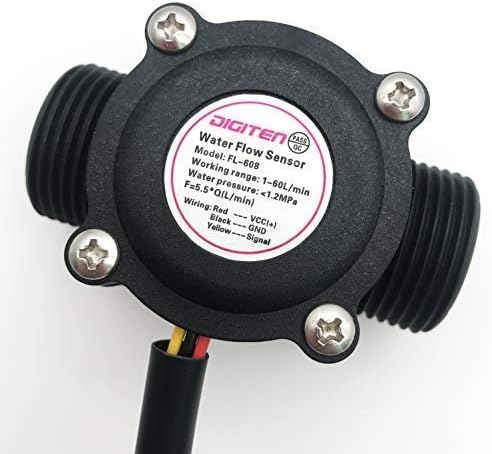
The DIGITEN G3/4-inch sensor is designed for medium-flow plumbing, offering a stated range of 1–60 L/min and a 1.2-meter attached cable. It supports Arduino, Raspberry Pi, and reverse osmosis projects while fitting between the half-inch and G1.5-inch models in this guide.
We may earn a commission when you buy through this link, at no additional cost to you.
The square-wave pulse signal is compatible with a conventional microcontroller counting routine, and the DC 5–18 V operating range is broad enough for many embedded systems. A stated pressure limit below 1.75 MPa provides another planning reference for suitable water installations.
Its 3.2 rating is the lowest in the comparison, which makes careful review important. The G3/4-inch BSPT connection may not mate with NPT plumbing, and the product information notes that thread seal tape is needed when using NPT. The listing also provides no detailed accuracy formula.
Despite its lower rating, the model is a practical consideration when 60 L/min is required and a G3/4-inch line is already present. It is best suited to builders who value capacity and cable placement flexibility more than a strong published customer-rating profile.
The 1–60 L/min range gives the sensor more headroom than the common 1–30 L/min units. This makes it useful for medium-flow lines where the lower-capacity models could approach their stated limit.
The 1.2-meter cable allows the sensor to sit in the plumbing while the electronics remain in a nearby enclosure. Protect the cable from abrasion, moisture, and excessive pull.
We may earn a commission when you buy through this link, at no additional cost to you.
Choosing an Arduino flow meter requires balancing measured flow against connection size, electrical requirements, signal quality, and installation conditions. The most important first step is to define the plumbing and expected operating range before comparing pulse characteristics.
Choose a sensor whose stated minimum and maximum flow encompass the normal operating conditions of your project with some margin. A unit limited to 0.5–3 L/min may work well for a small drink line but become inaccurate or unusable in a broader household circuit. A 1–30 L/min model covers many common applications, while the 1–60 and 5–150 L/min options address progressively larger systems. Consider both startup flow and peak demand, because a flow that occasionally falls below the sensor's minimum may not register correctly.
In short, select a range that comfortably contains your expected flow rather than one that merely reaches the target at its absolute limit.
The connector must physically match the pipe or hose without extensive modification. The guide includes half-inch NPT, half-inch BSPT, G1.5-inch BSPT, G3/8-inch, G3/4-inch, and quarter-inch hose arrangements. BSPT and NPT are not automatically interchangeable merely because their nominal sizes are similar. The product information specifically notes that some G1.5-inch, G1/2-inch, and G3/4-inch models require thread seal tape when used with NPT. Builders should also leave enough space for the sensor body, cable bend, fittings, and service access.
In short, identify the exact thread or hose size before buying, and confirm the physical clearance around the completed installation.
The sensor's operating voltage must be supported by the available power supply and the Arduino input arrangement. Listed voltages range from DC 3.5–12 V to DC 5–24 V, with one transparent YF-S201C version supporting DC 3.5–24 V. Most products use Hall effect outputs and square-wave pulse signals. A published example gives a high amplitude of at least 4.6 V and a low amplitude of no more than 0.5 V, which can help define an input threshold. The sensor and controller should share the appropriate reference, and the wiring should be protected from moisture and electrical interference.
In short, match both the power supply and pulse levels to the Arduino input, then plan a wiring arrangement that keeps the dry electronics away from the plumbing.
A useful sensor should provide enough information to convert pulse frequency into a believable flow estimate. Two of the food-grade models publish a relationship: one states F=(7.5*Q) plus or minus 2%, while the quarter-inch model states F=(98*Q) plus or minus 3%, with Q in liters per minute. Other products do not publish an equally detailed accuracy formula. Even with a stated relationship, actual readings can change with hose length, fittings, turbulence, rotor condition, and orientation. A measured-volume comparison remains the best way to validate a prototype.
In short, favor a published conversion relationship when precision matters, but always calibrate the installed system against a known water volume.
Pressure ratings determine whether the sensor can withstand the mechanical forces inside the plumbing. Several models list a maximum water pressure of 1.75 MPa, while the quarter-inch hose sensor lists 0.8 MPa. These figures describe the sensor's stated operating limits, not a guarantee that every connection, seal, or adjacent plastic fitting is equally robust. Temperature specifications are not provided for most products, so hot-water applications require particular attention to the complete component ratings rather than assuming the sensor can handle any water-heater condition.
In short, confirm that both the pressure and temperature of the planned water circuit remain within the limits of every installed part.
Cable length determines how far the electronics can be placed from the plumbing. The DIGITEN half-inch and G3/4-inch versions include a 1.2-meter cable, which offers useful flexibility in a distributed installation. Other products may require a shorter lead or a custom connection. Longer leads make servicing the controller easier, but they should be secured to prevent strain on the sensor and kept away from sharp edges and moving machinery. A clear body, such as that of the YF-S201C, can also help during commissioning by making rotor movement visible.
In short, plan the cable route, strain relief, and service access before assembly, and consider a transparent sensor when visual diagnosis will help setup.
The listed applications include water heaters, coffee machines, water purifiers, drinking fountains, beverage machines, reverse osmosis filters, water-cooling systems, card readers, and automatic dispensers. Several models use food-grade plastic and state that their materials conform to ROHS testing standards; one product description also says it can be used for potable water. These claims make the sensors candidates for relevant equipment, but actual suitability depends on the fluid, temperature, cleaning requirements, and local regulations. The sensor should be installed in a way that prevents trapped air and keeps the rotor and Hall sensing arrangement operating as intended.
In short, select the material and flow construction that suit the fluid and equipment, while following the required installation direction and pressure limits.
These sensors primarily provide electrical pulses rather than a direct digital flow reading. A magnetic rotor changes speed as water moves, and a Hall effect sensor generates pulses that an Arduino counts over time. The firmware converts those pulses into an estimated flow rate, usually using a published formula or a calibration established with a known quantity of water.
Both use an internal rotor to translate water movement into measurable signals, but their construction and presentation differ. Hall effect models detect rotor movement electronically and often have a sealed or opaque housing, while turbine-style models may expose the rotor through a transparent body. The YF-S201C package in this guide is transparent, but it also includes a Hall sensor for electronic output.
Choose primarily by matching the existing plumbing and required flow, not by connection size alone. A half-inch model commonly covers up to 30 L/min in this guide, while the G3/4-inch model is rated for 1–60 L/min. The larger sensor can handle more flow but requires compatible fittings, adequate clearance, and potentially an NPT-to-BSPT transition if the plumbing standards differ.
Several listed products specifically state compatibility with Raspberry Pi as well as Arduino. The sensor outputs pulses, and the Raspberry Pi can count them using appropriate software and wiring. A voltage divider or other interface may be needed if the sensor's output levels do not safely match the Pi's input arrangement, and a common ground is normally required.
First check that the sensor is installed in its required flow direction. Next verify the supply voltage, common ground, signal wire, and the digital input assigned by the sketch. Also check the input threshold against the sensor's published high and low output levels. Air bubbles, an obstructed rotor, a reversed fitting, and pulse-counting mistakes are additional common causes of a zero reading.
No, the Arduino must calculate the value from the pulse rate. Some products publish a relationship such as F=(7.5*Q) or F=(98*Q), which provides a starting point, but other models require calibration. For dependable results, compare the sensor output with a known volume of water and adjust the conversion factor for the completed installation.
No. Several products in this guide use food-grade plastic, state ROHS conformity, or specifically mention potable-water use, but suitability also depends on temperature, pressure, cleaning practices, and local requirements. Confirm the exact model, material documentation, and application conditions before using a sensor in drinking-water or food-processing equipment.
Calibration should be checked during initial setup, after any major change to the hose or fittings, and whenever readings appear inconsistent. Frequency also depends on fluid conditions and the accuracy required by the project. Periodic zero-flow checks help reveal a partially stuck rotor, trapped air, electrical noise, or a wiring problem.
The DEVMO half-inch unit is a strong budget option for compact projects, while the DIGITEN G1.5-inch model leads the guide for high-capacity installations. The DIGITEN G3/4-inch sensor provides a practical middle ground when medium flow and a longer cable are priorities, and the 1/2-inch NPT model offers a straightforward overall option for common Arduino builds.
Start with the plumbing, not the pulse formula. Match the exact connector, ensure the expected flow remains within the sensor's range, and confirm that the voltage and signal levels suit the Arduino. Then use the published conversion relationship when available and verify it with a measured quantity of water before trusting the displayed flow.
Finally, review the current listing, availability, and specifications before purchasing, since product details and prices can change. Confirm the exact package variant, especially for the transparent YF-S201C, and inspect the connector details for any model that uses BSPT or NPT hardware.
How to Use and Care for Your Arduino Flow Meter