
HiLetgo 5pcs DHT11
4.5Editor score
Five modules with cables
Digital single-bus output
3.3V to 5.5V operation
Compare the best Arduino Temperature Sensor options by accuracy, humidity support, voltage, interface, probe design, range, and Arduino project compatibility.
Arduino temperature sensors range from inexpensive single-bus modules to precision I2C devices and waterproof probes designed for damp, enclosed, or physically demanding environments. A good sensor matches the project rather than simply offering the longest specification list, especially when accuracy, humidity measurement, voltage, and installation method must all work together.
This guide compares ten temperature sensor modules and probes using the supplied specifications, including sensor technology, measurement range, stated accuracy, communication method, operating voltage, physical design, and intended applications. It covers indoor air monitoring, environmental projects, temperature logging, aquatic setups, and embedded systems without claiming that any product was personally tested.
Each review explains the strongest reasons to choose a particular model, along with practical limitations and better-suited projects. The top selections highlight a low-cost DHT11 package, a high-resolution AHT30 module, and a wide-range SHT31 option. As with all Amazon products, availability and prices can change, so confirm current listings before purchasing.
4.5Editor score

5.0Editor score

4.7Editor score
The table below places all ten modules and probes side by side, emphasizing the distinctions that matter most in Arduino builds: sensing technology, interface, operating voltage, measurement range, accuracy, humidity support, and installation format.



The HiLetgo 5pcs DHT11 package is an approachable choice for Arduino temperature and humidity experiments, with a 4.5 rating and a useful bundle of five modules with cables. Its main strength is simplicity: the board already includes the supporting circuitry, and a three-wire connection makes it approachable for first-time builders, classroom work, and straightforward environmental monitors.
We may earn a commission when you buy through this link, at no additional cost to you.
The module combines a pre-calibrated DHT11 sensor with a bypass capacitor and pull-up resistor. It operates from 3.3V to 5.5V DC and communicates through a single digital bus, substantially reducing the programming burden compared with analog sensing. The stated measurement range is 0-50°C for temperature and 20-90%RH for humidity, while accuracy is listed at ±2°C and ±5%RH.
The limitations are important for project planning. Its temperature span is narrower than the DS18B20, AHT30, and SHT31 options, and the listed humidity accuracy is less impressive than the more advanced modules. The DHT11 should therefore be viewed as a general-purpose teaching and monitoring component rather than a precision environmental instrument. Its digital output is still easier to work with than a bare thermistor.
This is a strong choice for a first Arduino weather station, a simple room monitor, a multi-node classroom display, or a project where temperature and humidity are both useful but exact measurement is not essential. Five modules also provide flexibility for experimenting with multiple locations. Choose the AHT30 when resolution matters more than simplicity, or a waterproof DS18B20 when the sensor must enter water, soil, or another damp environment.
The preassembled module and included leads remove most of the initial setup work. Because the DHT11 provides digital output, a compatible Arduino library can handle signal timing without requiring careful analog calibration.
Adding humidity output broadens the module beyond simple thermometry. It is particularly useful for demonstrating environmental awareness, although the stated ±5%RH accuracy should be considered when interpreting the readings.
We may earn a commission when you buy through this link, at no additional cost to you.
The two-pack AHT30 module combines a 5.0 rating with specifications that stand out for precision-oriented Arduino projects. It offers a temperature range of -40-85°C, humidity coverage from 0-100%RH, and a fine 0.01°C temperature resolution, making it a compelling all-around module for displays, environmental logging, and compact monitoring stations.
We may earn a commission when you buy through this link, at no additional cost to you.
I2C communication provides an orderly way to connect the module and can support simultaneous access to other I2C devices when addresses are managed correctly. The operating range of 2.0-5.5V is unusually broad, offering flexibility across low-voltage and standard Arduino configurations. The package includes two modules and four-wire test leads, so it is also practical for comparing readings at two locations.
The most significant trade-off is complexity for newcomers. I2C requires attention to data and clock connections, and multiple devices can create address conflicts. The specifications also state a humidity accuracy of ±2%RH at 25°C, which is strong in principle but still means the module should not be treated as laboratory instrumentation. Fast transmission and low power consumption further improve its suitability for embedded monitoring.
Choose the AHT30 when you want a compact environmental sensor with high temperature resolution, digital output, and broad range without moving to a threaded probe. It is a particularly effective option for a desk climate display, controlled-storage monitor, or multi-sensor environmental logger. Projects using only temperature at a basic educational level may still prefer the DHT11, while applications needing the broadest temperature span should consider the SHT31-D.
The 0.01°C resolution makes small changes easier to represent in software and on a display. Resolution is not the same as absolute accuracy, but it can still improve the visual usefulness of short-term trend graphs and controlled-environment monitoring.
I2C is valuable when an Arduino build already uses a display or another digital peripheral. Designers should check address assignments and use common ground and suitable wiring practices to keep communication dependable.
We may earn a commission when you buy through this link, at no additional cost to you.
The Teyleten SHT31-D stands out with a 4.7 rating, a -40-125°C temperature range, and a stated temperature accuracy of ±0.3°C. It also measures humidity across 0-100%RH with ±2%RH accuracy, combining one of the broadest operating envelopes in this guide with an I2C interface suited to modern Arduino boards.
We may earn a commission when you buy through this link, at no additional cost to you.
The 2.4-5.5V operating range provides ample flexibility, and the three-module quantity supports multi-location experiments or a spare for expansion. Digital output makes the measurements straightforward to integrate into a data logger, indoor climate display, or temperature-controlled demonstration. The SHT31 is particularly attractive when both sides of the environmental picture matter, rather than temperature alone.
As with other I2C modules, wiring and firmware setup require more care than a single-bus sensor. Multiple sensors placed on the same bus may need address changes or separate bus management. The broad range also does not mean the module is suitable for every physical environment without protection, and the sensor is a bare board rather than a sealed remote probe.
This is a strong pick for precision-conscious indoor projects, cool-storage monitoring, controlled environments, and multi-point temperature or humidity logging. It earns the premium position because of its combination of range, stated accuracy, humidity capability, and three-module flexibility. For simple temperature-only work, a DS18B20 may be simpler; for the highest listed resolution, the AHT30 deserves consideration.
A -40-125°C measurement range covers conditions far beyond ordinary room temperatures. That makes the module suitable for experiments involving chilled, heated, or variable environments, provided the electronics themselves remain within safe operating conditions.
The listed ±0.3°C temperature and ±2%RH humidity accuracies make the SHT31-D a balanced precision choice. It is well suited to charting environmental changes where both measurements must be available through one digital module.
We may earn a commission when you buy through this link, at no additional cost to you.
The Gikfun EK1183 is a three-pack of one-meter DS18B20 waterproof probes with adapter boards, earning a 4.4 rating. It is designed for temperature monitoring where the sensing point must be separated from the Arduino, including fish tanks, greenhouses, machinery, thermostatic controls, and other thermally sensitive installations.
We may earn a commission when you buy through this link, at no additional cost to you.
Each pluggable probe uses a familiar three-wire arrangement: yellow for data, red for power, and black for ground. The adapter board includes a pull-up resistor and can connect directly to most microcontrollers, reducing setup complexity. The DS18B20 measurement range is -55-125°C, and the 3.3-5V working voltage fits common Arduino environments.
The probe lead has a stated maximum temperature rating of 85°C, which matters even though the sensor itself supports readings up to 125°C. The remote probe should also be checked for moisture resistance and appropriate immersion depth according to the manufacturer’s instructions. This model measures temperature only, so humidity projects require a different sensor.
The bundle is ideal for users who want several remote measurement points and an Arduino-friendly adapter. It is more specialized than a bare DHT11 and offers easier physical placement than a board-mounted module. For a single probe, a two-pack option may be more practical, but for multi-point monitoring or classroom work, the three included sets are useful.
The long probe lead lets the sensing element sit in a tank, enclosure, pipe, or storage area while the Arduino remains accessible. The adapter board reduces the need to assemble a separate external pull-up circuit.
The sensor specification and cable specification are not identical. Although the DS18B20 can report up to 125°C, the supplied lead is listed only for 85°C, which should guide applications involving elevated temperatures.
We may earn a commission when you buy through this link, at no additional cost to you.
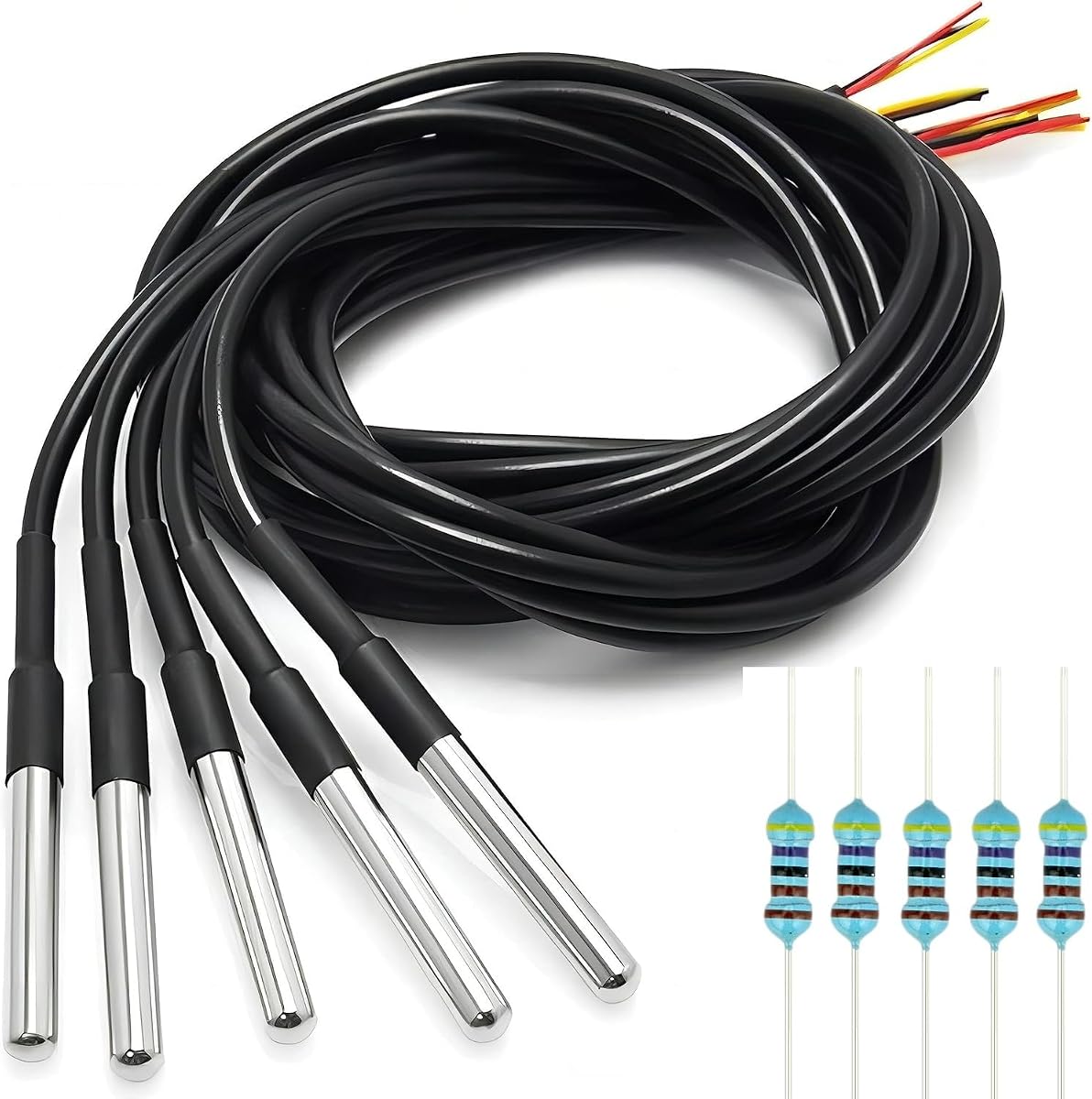
The WWZMDiB five-pack is a well-equipped DS18B20 bundle for makers who need several remote temperature points. Its 4.4 rating reflects a practical combination of waterproof probes, a wide -55-125°C measurement range, and five included 4.7K resistors for projects built around the One-Wire interface.
We may earn a commission when you buy through this link, at no additional cost to you.
The red, yellow, and black lead arrangement establishes a familiar connection scheme for VCC, data, and ground. A 3-5.25V supply range supports Arduino, Raspberry Pi, ESP32, and STM platforms, although each board may require its own library or GPIO approach. Including the resistors is helpful because the data line needs appropriate pull-up support for reliable communication.
The major installation task is wiring five sensors correctly without creating bus, resistor, or power problems. A large number of probes also increases the importance of unique addressing, cable quality, and stable power. As with other waterproof cable sensors, the exact sealing quality should be judged from the assembled product rather than assumed from the probe shape alone.
This package is best for temperature-monitoring arrays, greenhouse or storage experiments, multi-point logging, and makers who want spare probes. It offers more temperature range than a DHT11 without the need to interpret humidity values. If the project requires very fine temperature resolution, the AHT30’s stated 0.01°C resolution is more appropriate, while the SHT31 offers humidity as well.
Five probes make it practical to compare several locations or create a small distributed logger. Each DS18B20 has a unique address, allowing software to identify the source of each reading when the bus and power wiring are configured correctly.
The included 4.7K resistors support the pull-up arrangement needed by the data bus. Correct placement between the data line and supply is important, particularly when several sensors share the same bus.
We may earn a commission when you buy through this link, at no additional cost to you.
This two-pack DHT11 is a straightforward option for Arduino and Raspberry Pi beginners who want temperature and humidity data without a complex sensor interface. Its 4.3 rating reflects a familiar design with digital output, a 3.3-5V operating range, and modules that are easy to connect to common development boards.
We may earn a commission when you buy through this link, at no additional cost to you.
The sensor combines a resistive sensing element, an NTC temperature device, and an onboard 8-bit microcontroller. That integrated approach handles signal generation directly, while the single-bus communication scheme keeps wiring to three connections. The stated temperature range is 0-50°C with ±2°C error, while humidity spans 20-95%RH with ±5% error.
The trade-offs are resolution, precision, and measurement span. This is not a high-accuracy laboratory module, and readings near the edge of its humidity range should be interpreted cautiously. A two-pack is convenient for comparing indoor conditions, but users wanting more nodes may prefer the five-module DHT11 bundle. Bare environmental awareness projects are its strongest use case.
Choose this option for tutorials, a small room monitor, a two-location comparison, or a first Arduino display project. It is especially attractive when the simplicity of one-wire communication and readily available libraries matter more than fine resolution. For precision logging or extreme-range conditions, move up to the AHT30, SHT31-D, or a DS18B20 probe.
The three-wire module and single-bus protocol provide a manageable introduction to environmental sensing. A compatible library handles the communication sequence, allowing the builder to focus on displaying or logging the data.
Two sensors can provide a simple way to compare a room, cabinet, and nearby reference point. Their value increases when both modules are mounted in similar airflow conditions and calibrated against the same reference.
We may earn a commission when you buy through this link, at no additional cost to you.
The DROK two-pack is one of the most complete temperature-probe kits in this comparison, receiving a 4.9 rating. It combines two waterproof stainless steel DS18B20 probes, two adapter boards, female-to-female jumper wires, and 4.7K resistors, reducing the number of separate parts required for a two-point Arduino installation.
We may earn a commission when you buy through this link, at no additional cost to you.
The probes cover -55-125°C with a stated ±0.5°C accuracy and operate from 3.0V to 5.5V. Clearly separated red, yellow, and black leads make identification straightforward, while the adapter boards include a pull-up arrangement. The listing also recommends a 4.7K resistor between data and supply for optimal stability, giving users flexibility in how the bus is configured.
Its main limitation is that it measures temperature without humidity. The stainless steel enclosure and waterproof sealant are beneficial in wet environments, but continuous submersion suitability still depends on correct assembly, cable entry sealing, and environmental conditions. The extra accessories are valuable for beginners, though dedicated users may already own equivalent wiring hardware.
This kit is a strong match for aquarium, refrigerator, greenhouse, soil, and general remote-monitoring projects. Its included adapters and jumper wires make it especially convenient for a first probe-based build. Choose it when a ready-to-wire package matters; choose a five-probe bundle when the primary requirement is more measurement points.
Including probes, adapters, jumper wires, and resistors removes much of the uncertainty surrounding a One-Wire build. A newcomer can assemble the parts methodically and focus on the Arduino sketch.
The stainless steel probe case and thermal sealant are designed for wet and corrosive surroundings. Proper cable sealing, stable connections, and suitable immersion depth remain essential for dependable operation.
We may earn a commission when you buy through this link, at no additional cost to you.
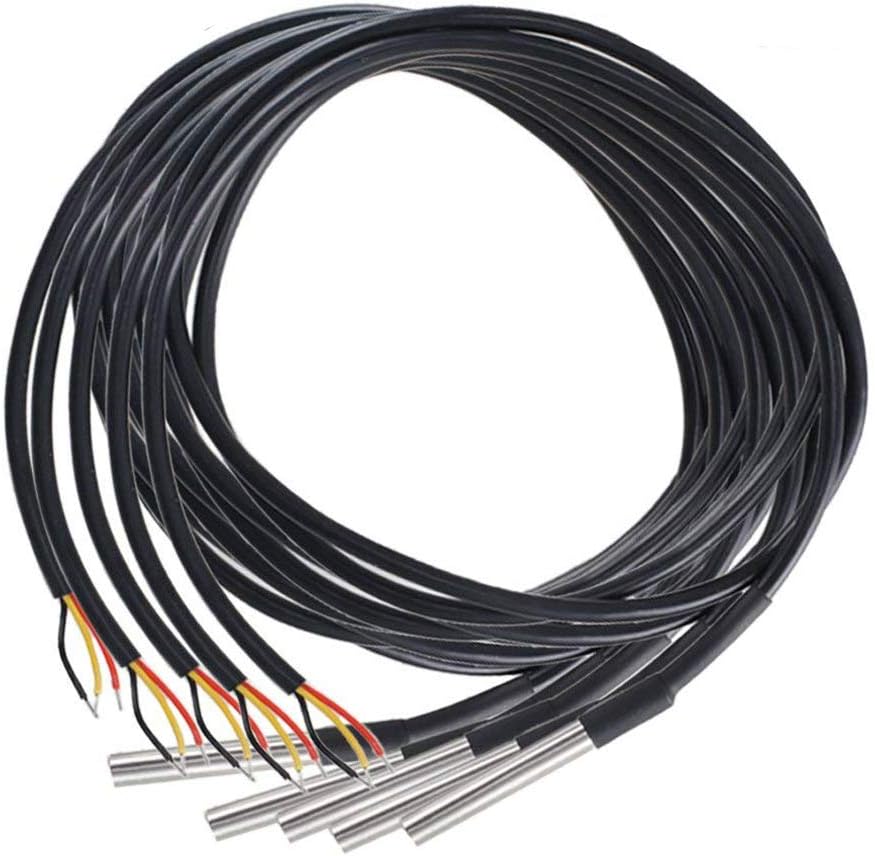
The Gikfun EK1083 supplies five approximately one-meter DS18B20 probes, making it useful for Arduino temperature loggers, classroom experiments, and multi-location environmental monitoring. Its 4.5 rating and familiar red, yellow, and black wiring make it approachable for builders who want more than one measurement point.
We may earn a commission when you buy through this link, at no additional cost to you.
The single-bus interface lets multiple sensors share a data line when the bus is wired correctly, while each sensor maintains a unique address. A 3.0-5.5V power range suits common Arduino boards and other embedded platforms. The probes are waterproof and are listed for a broad -55-125°C temperature range, although the actual operating environment and connection quality still matter.
The product listing recommends placing a 4.7K resistor between the data and VCC lines to make testing easier. That requirement is common in DS18B20 circuits, but it means the package may not include every item required for a fully assembled project. A large number of long leads can also make cable management and electrical noise control more demanding.
The five-probe format is ideal for comparing conditions across several locations or building a compact environmental data logger. It is less suitable for humidity or ultra-high-resolution work. Buyers who need only one or two remote points may prefer a smaller kit, while those assembling a classroom-scale array will find the quantity useful.
Each connected DS18B20 can be identified by its own address, allowing one Arduino to collect readings from multiple locations. Software must query each device separately rather than expecting a single combined value.
The approximately one-meter cables make it easier to place probes in separate rooms, containers, or environmental zones. Their length should be planned around bus reliability and the amount of exposed wiring.
We may earn a commission when you buy through this link, at no additional cost to you.
The HiLetgo DHT22/AM2302 provides a balanced combination of temperature and humidity sensing in a familiar single-bus format. Its 4.4 rating reflects a dependable choice for Arduino environmental monitors, and the stated -40-80°C temperature range is substantially broader than that of the DHT11 options in this guide.
We may earn a commission when you buy through this link, at no additional cost to you.
Temperature accuracy is listed at ±0.5°C, while humidity spans 0-100%RH with ±2%RH accuracy. The module uses bidirectional serial data over a single bus and includes a fixing screw hole for more permanent installation. Two modules are included, making it possible to compare different rooms or compare a sensor with a reference location.
Compared with the AHT30, the DHT22 does not offer a stated 0.01°C temperature resolution or the same fine humidity resolution. It also measures only near the board rather than at the end of a remote probe, which limits use in tanks, soil, pipes, or enclosed machinery. The listed operating-voltage information is less detailed than for the I2C modules, so the relevant library documentation should be consulted before wiring.
Choose this product for a desktop weather display, room monitor, greenhouse controller, or classroom environmental station where the single-bus connection and stronger specifications than a DHT11 are important. The AHT30 is preferable when maximum resolution and explicit voltage specifications are priorities, while a DS18B20 is the better choice for remote or waterproof temperature-only measurements.
The DHT22 combines familiar wiring with improved stated temperature accuracy and a wide measurement span. It fills the gap between basic DHT11 modules and more specialized I2C sensors without changing the familiar single-bus workflow.
A screw hole allows the module to be mounted more securely than a loose breadboard component. The sensor should still be positioned away from heat-generating components, direct sunlight, and airflow obstructions that would distort its reading.
We may earn a commission when you buy through this link, at no additional cost to you.
The HiLetgo five-pack provides five one-meter DS18B20 temperature probes in a straightforward remote-sensing format. With a 4.5 rating, it is a practical choice for multi-point Arduino logging, tank monitoring, and temperature experiments where a waterproof cable probe is more useful than a board-mounted module.
We may earn a commission when you buy through this link, at no additional cost to you.
Each probe uses a red lead for VCC, yellow for data, and black for ground. The 3.0-5.5V power range is compatible with common Arduino electronics, and the stated -55-125°C measurement range covers a broad set of conditions. The product guidance recommends a 4.7K resistor between the data and VCC lines to support stable communication.
The main drawback is that the package focuses on probes rather than a complete wiring kit. Users may need to source a resistor, breadboard or terminal connectors, and a suitable library. Long parallel data runs and numerous sensors can also demand more attention to wiring quality than a single short probe installation.
This product suits makers who already understand basic electronics or want several inexpensive remote sensing points. It is a good fit for refrigerator monitoring, aquarium temperature checks, greenhouse experiments, and multi-node logging. Choose the DROK pack for included adapters and jumper wires, the Gikfun EK1083 for a similar five-probe format, or the AHT30 when humidity and fine resolution are priorities.
The DS18B20 is designed around dependable temperature measurement over a long cable. Projects that also need relative humidity should choose the AHT30, SHT31-D, or DHT22 instead of adding another sensor unnecessarily.
Multiple probes can be placed in different containers or zones while sharing a controller. Each sensor must be addressed individually, and the data bus should be configured with suitable pull-up support.
We may earn a commission when you buy through this link, at no additional cost to you.
Choosing an Arduino temperature sensor means balancing sensing method, electrical interface, measurement range, accuracy, environmental exposure, and software support. The most capable specification sheet does not always produce the most reliable project if the sensor is installed poorly or exceeds its intended conditions.
Start by deciding whether your project actually needs relative humidity. A DHT11, DHT22, AHT30, or SHT31-D measures both temperature and humidity, while the DS18B20 products are temperature-only sensors. A basic DHT11 is suitable for educational demonstrations and non-critical room monitoring, but its stated ±2°C temperature accuracy and ±5%RH humidity error are modest. The DHT22 lists ±0.5°C and ±2%RH accuracy, the AHT30 lists ±0.3°C and ±2%RH, and the SHT31-D also lists ±0.3°C and ±2%RH. These figures describe stated performance, not the uncertainty introduced by installation, airflow, self-heating, calibration, and rapid environmental changes.
Choose a temperature-and-humidity module when condensation risk, comfort, storage conditions, or air quality context matters. Choose a dedicated DS18B20 when you need a remote waterproof probe and do not need humidity.
Compare the complete range with the temperatures your project will actually encounter. The DHT11 modules cover 0-50°C, the DHT22 extends to -40-80°C, the AHT30 covers -40-85°C, and the SHT31-D reaches -40-125°C. All of the DS18B20 products list a broad -55-125°C sensor range. A wide nominal range is useful, but the probe cable, sealant, enclosure, and connection materials may have lower limits. The Gikfun EK1183 specifically states that its lead can withstand a maximum of 85°C, even though the sensor can report up to 125°C.
Select a range with comfortable headroom around the expected conditions. Also verify whether the entire sensing chain, rather than only the chip, can tolerate the target temperature.
Accuracy describes closeness to the true value, while resolution describes the smallest change the output can represent. Resolution is valuable for trend displays and tight feedback loops, but it does not guarantee equal absolute accuracy. The AHT30 has a stated 0.01°C resolution, the DS18B20 products are described as accurate to ±0.5°C in several listings, the DHT22 lists ±0.5°C, and the AHT30 and SHT31-D each list ±0.3°C temperature accuracy. The DHT11's ±2°C specification is adequate for many simple projects but not for careful thermal control.
Prioritize accuracy for setpoint control, data logging, and comparisons. Prioritize resolution when you need to see small changes over time, while remembering that additional precision at the output does not remove errors elsewhere in the system.
The interface determines how the Arduino communicates and how much wiring your project requires. Single-bus sensors such as the DHT11, DHT22, and DS18B20 are generally straightforward for beginners. I2C modules such as the AHT30 and SHT31-D use data and clock lines and can share a bus with compatible peripherals, provided addresses do not conflict. A DS18B20 One-Wire bus also supports multiple uniquely addressed sensors, but a 4.7K pull-up resistor is normally required. The DROK package includes adapters, jumper wires, and resistors, while the Gikfun EK1183 adapter includes its pull-up resistor.
Choose the interface your team can wire and program confidently. If a project already uses I2C, an AHT30 or SHT31-D may integrate cleanly; if simplicity is paramount, a single-bus module is usually less involved.
The sensor's operating range must overlap the voltage available from the Arduino board or regulator. The listed DHT11 and DHT22 modules operate around 3.3-5V, the AHT30 accepts 2.0-5.5V, the SHT31-D accepts 2.4-5.5V, and the DS18B20 products operate across approximately 3.0-5.5V. These ranges are broad, but wiring mistakes can still damage a module. A 5V data signal may also be unsuitable for some 3.3V-only GPIO pins, so verify the logic level of the chosen Arduino-compatible board and use appropriate level shifting if necessary.
Match the sensor to the board rather than assuming every module is electrically identical. Confirm voltage, ground, signal compatibility, and the library requirements for the specific development board.
A board-mounted module measures the air or surface immediately around the sensor and is suitable for open-room projects. A cable probe places the sensing element at a distance, which is essential for tanks, soil, refrigerators, pipes, and enclosed equipment. Every DS18B20 option listed here uses a waterproof probe format, but proper sealing, immersion depth, strain relief, and connector protection still affect reliability. Stainless steel cases offer mechanical strength, while the thermal sealant and cable entry determine how well moisture is excluded.
Choose a remote probe when the sensing location is inconvenient, wet, or potentially hazardous. For room-level monitoring, a compact DHT or AHT module is generally easier to position and protect.
The package quantity can shape both the cost and complexity of a project. Two modules are enough for a straightforward comparison, while five-probe packs support distributed logging, classroom exercises, and multi-zone monitoring. A larger number of DS18B20 sensors on one bus is manageable, but each device needs a unique address, adequate pull-up support, careful wiring, and enough current for the data line. Multiple I2C modules similarly require attention to address conflicts. Sharing a bus saves Arduino GPIO pins, but it also introduces a point where one poorly wired probe can affect multiple readings.
Buy only as many sensors as the project will actively use, and keep a spare when reliability is important. Plan the addressing and wiring before assembling a larger array.
Begin by confirming the sensor type, voltage range, pin labels, and communication method. Connect ground first, then power and signal, using the three-wire or four-wire arrangement specified for your model. For a DS18B20, place a 4.7K pull-up resistor between data and VCC unless the adapter already provides it. For an I2C module, use the board's SDA and SCL pins and confirm that no other device uses the same address. Use a compatible Arduino library and begin with a simple sketch that prints raw readings at a modest interval.
Place the sensor where it can experience the air or material you intend to measure. Keep board-mounted modules away from Arduino chips, voltage regulators, display backlights, sunlight, heaters, and other sources of heat. Remote probes should sit at the intended measurement point without their sensing section being pressed against a warmer surface. Allow the device to settle after installation, and compare readings with a trusted reference if accuracy is important. For wet installations, inspect the probe seam and cable entry, preserve strain relief, and follow the specified immersion limits.
Care for the electronics by keeping the sensor and connector dry unless the probe is explicitly designed for that exposure, using stable power, and avoiding long wires that could degrade bus communication. Log the raw values alongside timestamps, installation notes, and any calibration offsets so that unexpected changes can be diagnosed. Clean exposed probes only with methods suitable for their casing and sealant, and do not immerse an adapter board that is only intended to remain dry. Recheck connections, pull-up placement, and the data address if readings become erratic, and replace the module before suspecting the Arduino when a known-good test confirms the problem is with the sensor.
A DHT11 module is usually the easiest starting point because it uses a simple digital connection, is widely supported by Arduino libraries, and measures both temperature and humidity. Its accuracy is modest, so it is better for demonstrations than precision control. A beginner who specifically needs only temperature can use a DS18B20 with a compatible One-Wire library.
All four families provide digital temperature and humidity measurements, but their specifications and interfaces differ. The DHT11 uses a single-bus design with a relatively narrow 0-50°C range and modest accuracy, while the DHT22 offers a broader -40-80°C range and stronger stated accuracy. The AHT30 and SHT31-D use I2C, with the AHT30 listing 0.01°C resolution and the SHT31-D listing an especially broad -40-125°C temperature range.
DS18B20 probes in this guide are designed for wet environments and can be used where their specified waterproofing and immersion requirements are met. The sensing element and sealed cable are the relevant parts, while the adapter board and Arduino must remain dry. Check the cable entry, connectors, and sealant for damage, and confirm the probe model’s immersion guidance before continuous submersion.
Yes, a 4.7K pull-up resistor is normally placed between the DS18B20 data line and VCC to support stable One-Wire communication. Some adapter boards already include that resistor, while kits may supply it separately. If an adapter includes the pull-up, adding an unnecessary second resistor can create an effective value lower than intended, so check the board before adding another one.
Yes. DS18B20 sensors can share a One-Wire data bus because each has a unique address, while I2C sensors can share data and clock lines if their addresses differ or are configured appropriately. Good common ground, suitable pull-up resistors, stable power, and careful wiring are essential when several sensors operate on the same bus.
Start by reducing installation errors: keep the sensor away from board heat, direct sunlight, fans, and nearby hot components, and let it reach a stable temperature before recording values. For a remote probe, ensure the sensing tip is not pressed against a warmer structure. Comparing the output with a calibrated reference can reveal a consistent offset, while the AHT30 or SHT31-D may be more appropriate when the sensor's stated accuracy is insufficient.
No. A wider range is useful only if the project can safely operate across that range. The probe body, cable, sealant, enclosure, and connectors can have lower limits than the sensing chip. Choose a sensor with comfortable headroom around the expected temperatures, and verify the environmental limits of every part of the assembly.
The DHT11, DHT22, AHT30, and SHT31-D families measure both temperature and relative humidity. The DS18B20 products in this guide are temperature-only sensors and do not provide humidity output. If a project needs humidity, choose one of the combined modules and account for its stated accuracy and placement requirements.
The best budget option is the five-pack DHT11 for uncomplicated projects that value low cost, familiar wiring, and combined temperature and humidity output. The AHT30 is the strongest all-around precision choice for fine temperature resolution, broad I2C compatibility, and detailed environmental measurements, while the SHT31-D earns the premium recommendation for its especially broad temperature range and strong stated accuracy.
Prioritize the sensor format that fits the physical project. Use a DHT or AHT module for open-room sensing, and choose a waterproof DS18B20 when the sensing point must be remote, wet, or inside equipment. Match the communication method and voltage to the Arduino board, confirm that humidity is genuinely required, and allow enough range and accuracy for the intended use rather than selecting on one specification alone.
Before purchasing, check the current Amazon listing, package contents, electrical specifications, and availability because product details and prices can change. The links provided in this guide preserve the specified affiliate tag, and the side-by-side table makes it easier to verify the key distinctions between all ten options.