
ASUS ProArt PA248QV
4.6Editor score
24-inch WUXGA IPS panel
100% sRGB color coverage
Factory Delta E under two
Fully adjustable ergonomic stand
DisplayPort HDMI and D-Sub
An ASUS Proart Monitor is designed for creators who need dependable color, useful resolution, and flexible connectivity rather than a display optimized only for general office work. The strongest choices balance accurate color, IPS technology, ergonomic stands, USB-C power delivery, and enough screen space for demanding creative workflows.
This guide compares ten ProArt models across color-gamut coverage, factory calibration, panel resolution, refresh rate, HDR capability, port selection, stand adjustment, and specialized features. It includes models for photo editing, graphic design, video production, multi-device work, and high-end color-critical applications.
Each review identifies the strongest use case and the compromises worth considering. The top three picks provide distinct paths for budget-conscious buyers, demanding creative professionals, and users seeking premium visual performance. Product ratings and availability can change, so check the latest listing and current price before purchasing.
The ProArt range is broad because creative work is not one activity. A photographer may prioritize reference accuracy, a developer may value a tall or high-resolution workspace, and a video editor may need brighter HDR output or professional SDI connectivity. The right monitor should fit the software, color standards, devices, and working habits used most often.
For this comparison, the supplied specifications were grouped around display quality, color performance, connectivity, ergonomics, and workflow-specific functions. Ratings reflect the listings provided, while technical claims come from the corresponding product information. No personal testing claims are made, and readers should validate current specifications with the seller.
The list includes accessible 24-inch and 27-inch options, QHD and 4K IPS panels, 6K and OLED models, and Mini-LED displays with local dimming. It also highlights USB-C systems that can charge compatible laptops, daisy-chaining for multi-monitor desks, KVM switching, monitor hoods, and calibration tools for specialized studios.
4.6Editor score

4.4Editor score
As an Amazon Associate we earn from qualifying purchases.
The table below places all ten monitors side by side, emphasizing the specifications that most strongly affect professional creative work. It highlights differences in resolution, color coverage, connectivity, motion performance, HDR, and workstation features without reducing each model to a single use case.
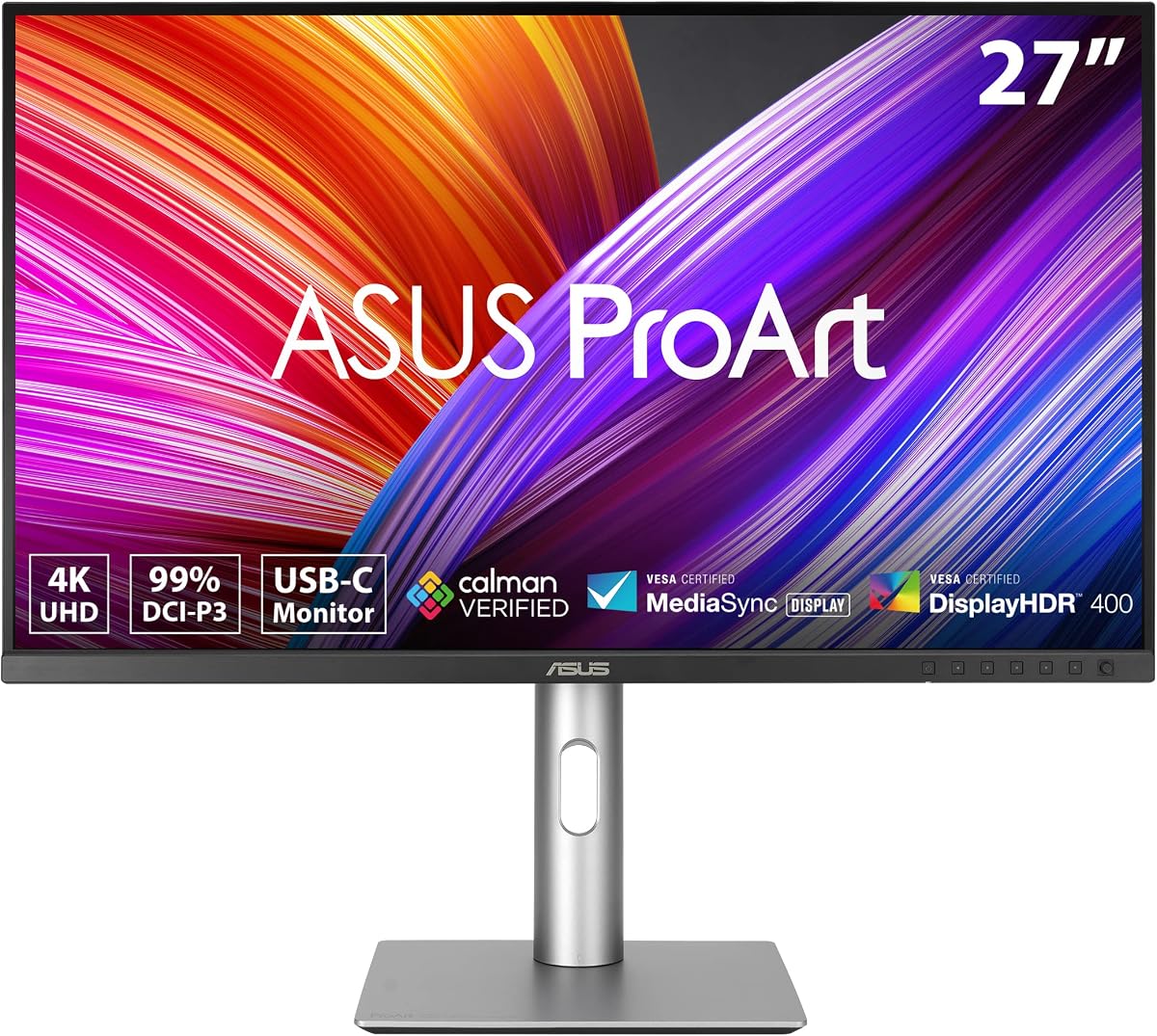


The ASUS ProArt PA279CRV combines a 27-inch 4K IPS panel with broad professional color coverage, making it a versatile choice for photography, design, video, and detailed office work. Its supplied rating is 4.2, and the standout combination of 3840 x 2160 resolution, 99% DCI-P3, 99% Adobe RGB, and factory calibration gives it a strong foundation for color-sensitive tasks.
We may earn a commission when you buy through this link, at no additional cost to you.
Connectivity is particularly useful for modern hybrid desks. DisplayPort over USB-C supports up to 96 watts of power delivery, while DisplayPort, HDMI, and a USB hub provide alternatives for desktop workstations. DisplayPort daisy-chaining can simplify a multi-monitor arrangement, and the adjustable stand supports tilt, swivel, pivot, and height changes for a more comfortable and adaptable desk.
The trade-offs are modest for a professional 4K display. It is less focused on high-refresh-rate interaction than some gaming-oriented panels, and its 27-inch footprint requires enough desk depth to benefit fully from 4K. Buyers who need extreme HDR brightness or specialist broadcast inputs will find more purpose-built alternatives elsewhere in this list.
This is the strongest all-around recommendation for a creator who wants accurate color, ample screen detail, a clean single-cable laptop workflow, and flexible adjustment. It is particularly suitable for Mac users, designers, photographers, and editors who value a balance of color gamut and desktop utility over motion-led features.
Factory calibration to Delta E below two and Calman Verified status support consistent, accurate results out of the box. The combination of 99% DCI-P3 and 99% Adobe RGB is useful when moving between digital photography, print preparation, and web-oriented work.
The 96-watt USB-C connection can carry video, data, and power to a compatible laptop while reducing desk clutter. A built-in USB hub and conventional DisplayPort and HDMI inputs preserve flexibility for external drives, peripherals, and desktop systems.
We may earn a commission when you buy through this link, at no additional cost to you.
The ASUS ProArt PA248QV is a compact 24-inch professional monitor built around a 1920 x 1200 WUXGA IPS panel. Its supplied rating of 4.6 is the highest numerical rating among the listed models, while 100% sRGB and Rec.709 coverage, Delta E below two, and Calman Verified calibration target users who need dependable standard-gamut color.
We may earn a commission when you buy through this link, at no additional cost to you.
The 16:10 format provides a useful balance between a 16:9 display and a larger, more complex multi-panel arrangement. Its anti-glare treatment helps control reflections during long sessions, and the stand allows tilt, swivel, pivot, and height adjustment. DisplayPort, HDMI, and D-Sub inputs cover many common desktop, laptop, and legacy-device arrangements.
Its primary limitation is the absence of a documented wide color gamut. It also lacks USB-C power delivery, making it less convenient for a modern laptop-centered desk than the PA279CRV or PA278CV. For users who only need accurate sRGB work at a manageable screen size, these restrictions may matter much less than the strong supplied rating and flexible stand.
Choose the PA248QV for students, office-based designers, photo managers, and budget-conscious professionals who want a dependable 16:10 workspace. It is a sensible starting point for color-accurate general work, coding, document editing, and image review without the footprint or complexity of a larger 4K display.
The extra vertical space compared with a standard 16:9 screen is helpful for photo cropping, document layouts, timelines, and application palettes. It also makes the 24-inch format more versatile for productivity-focused creative work.
An anti-glare surface reduces distracting reflections, while the adjustable stand allows the screen to be positioned for the user's line of sight. These features are especially useful for long editing, writing, and general office sessions.
We may earn a commission when you buy through this link, at no additional cost to you.
The ASUS ProArt PA32QCV is built for creators who want maximum working detail on a single panel. Its 31.5-inch 6K display resolves at 6016 x 3384, while the supplied rating is 3.9. IPS technology, a 178-degree viewing angle, 98% DCI-P3, 100% sRGB, and Delta E below two make it a serious high-resolution reference option.
We may earn a commission when you buy through this link, at no additional cost to you.
Thunderbolt 4 is the defining feature. Two Thunderbolt 4 ports provide up to 96 watts of power delivery and daisy-chaining, while HDMI 2.1, DisplayPort 1.4, and a built-in USB hub broaden device support. The Auto KVM function can switch between two connected laptops or PCs using one keyboard and mouse, making the display well suited to a comparative Mac-and-PC workflow.
The M Model-P3 Color Preset is intended to match the color performance of a MacBook display, and the Intelligent Light Sync system uses ambient and backlight sensors to support reliable color behavior. These are sophisticated features, but the model remains specialized, and the supplied 3.9 rating is the lowest among the ten selections. Users needing SDR-only office work may find the specification excessive.
The PA32QCV is best for Mac-centric photographers, motion designers, editors, and developers who work with detailed applications and want room for large timelines, tool panels, and multiple documents. It is a strong choice when 6K resolution, Thunderbolt 4, and seamless switching matter more than budget or compactness.
The 6K panel provides 6016 x 3384 native resolution, allowing fine detail to remain visible without relying on scaling. It is particularly compelling for retouching, large layouts, detailed illustration, and applications that benefit from additional interface space.
Dual Thunderbolt 4 ports, 96-watt power delivery, daisy-chaining, and Auto KVM reduce cable complexity and simplify switching between two computers. This makes the monitor particularly relevant to mobile creative professionals and mixed-platform studios.
We may earn a commission when you buy through this link, at no additional cost to you.
The ASUS ProArt PA278CV delivers a 2560 x 1440 IPS display with Calman Verified factory calibration and Delta E below two. Its supplied rating is 4.4. For creative professionals who want accurate color and a generous QHD workspace without moving to a larger 4K model, it offers a practical balance of resolution, features, and desk footprint.
We may earn a commission when you buy through this link, at no additional cost to you.
USB-C with 65 watts of power delivery handles compatible laptops with a single cable, while DisplayPort daisy-chaining supports expanded multi-monitor workspaces. The 90-degree pivot makes it possible to rotate the display vertically, an advantage for coding, long documents, and narrow visual tasks. USB-C, HDMI, and DisplayPort connections provide a broad selection of routes into the display.
Compared with the PA279CRV, this model has a lower pixel count and a more modest charging rating. The 65-watt USB-C output may also be less suitable for the most power-intensive workstation laptops. Conversely, QHD is easier to run at high pixel densities and can provide a comfortable balance between detail and system demands for general creative work.
The PA278CV is a strong recommendation for hybrid workers, web designers, illustrators, and video editors who need accurate sRGB, flexible cables, and a two- or three-monitor setup. It is especially attractive when vertical orientation and USB-C convenience matter more than maximum resolution.
Calman Verified factory settings, Delta E below two, and full sRGB coverage support predictable results in office, design, photo, and video applications. The 27-inch QHD panel also provides room for common editing palettes without the scale of a 4K or 6K display.
Height adjustment, swivel, tilt, and 90-degree pivot support multiple orientations. DisplayPort daisy-chaining can make a larger workspace easier to organize, especially when the display serves as a central panel for a laptop and desktop.
We may earn a commission when you buy through this link, at no additional cost to you.
The ASUS 27-inch ProArt Display offers a 2560 x 1440 IPS panel, 100% sRGB and Rec.709 coverage, Calman Verified calibration, and Delta E below two. Its supplied rating is 5.0, the highest available in the product data, giving it an especially strong entry for users focused on standard-gamut photo and video work.
We may earn a commission when you buy through this link, at no additional cost to you.
The monitor's ergonomic stand supports tilt, swivel, pivot, and height adjustment, making it practical for a full workday or a multi-monitor configuration. DisplayPort, HDMI, DVI, mini DisplayPort, and a USB hub provide broad compatibility with older and newer workstation equipment. ASUS Eye Care technology adds flicker-free and low-blue-light features for extended use.
The main limitation is that its listed specifications do not claim DCI-P3 or Adobe RGB coverage, so it is not the most suitable choice for demanding wide-gamut workflows. There is also no USB-C power delivery, requiring a separate charger and potentially more desk wiring when used with a modern laptop. DVI and mini DisplayPort may be unnecessary for buyers assembling a new USB-C-centric setup.
Choose this model for photographers, editors, and office professionals who value a highly rated QHD display, accurate sRGB output, and excellent physical adjustability. It is a confident recommendation when the priority is a dependable standard-gamut workflow rather than premium HDR, ultra-high resolution, or a one-cable laptop connection.
Full sRGB and Rec.709 coverage is appropriate for much web, office, photography, and general video work. Factory calibration and a stated Delta E below two give creators confidence that the panel starts from a controlled and repeatable baseline.
The stand's broad range of motion lets users set the screen precisely for different desks and seating positions. Eye Care features also help reduce common sources of visual fatigue during extended editing and general productivity sessions.
We may earn a commission when you buy through this link, at no additional cost to you.
The ASUS PA329CRV-P combines a 31.5-inch 4K IPS panel with 98% DCI-P3 and 100% sRGB coverage. It has a supplied rating of 4.4, factory calibration to Delta E below two, and Calman Verified status. Its Trade Agreements Act compliance makes it notable for buyers working in procurement environments where that designation matters.
We may earn a commission when you buy through this link, at no additional cost to you.
Connectivity is extensive for a professional display. USB-C provides 96-watt power delivery and DisplayPort Alt Mode, dual DisplayPort 1.4 inputs support daisy-chaining, dual HDMI 2.1 ports accommodate multiple media sources, and a four-port USB hub connects peripherals. The stand adjusts through tilt, swivel, pivot, and height, helping manage the size and weight of a 32-class display.
Its HDR400 implementation and 3000:1 contrast ratio provide a modest HDR upgrade, but they are not comparable to the brighter local-dimming or OLED models in this guide. The 31.5-inch 4K panel also demands desk space, and effective use may depend on operating-system scaling. Buyers who need maximum HDR impact should examine the more specialized premium options.
This is an excellent choice for government buyers, Mac-based studios, and creative teams that value a large 4K canvas, accurate wide-gamut color, and broad connectivity. The included quick-release stand, calibration report, cables, and warranty card also support a straightforward professional setup.
The native 3840 x 2160 resolution gives creative applications substantially more room than a QHD display. It is useful for arranging reference images, comparing edits, working with detailed timelines, and keeping essential tools visible without moving between windows.
Two DisplayPort 1.4 connections, dual HDMI 2.1 inputs, a four-port USB hub, and 96-watt USB-C support several classes of source device. Daisy-chaining adds a practical route to building a larger professional workstation.
We may earn a commission when you buy through this link, at no additional cost to you.
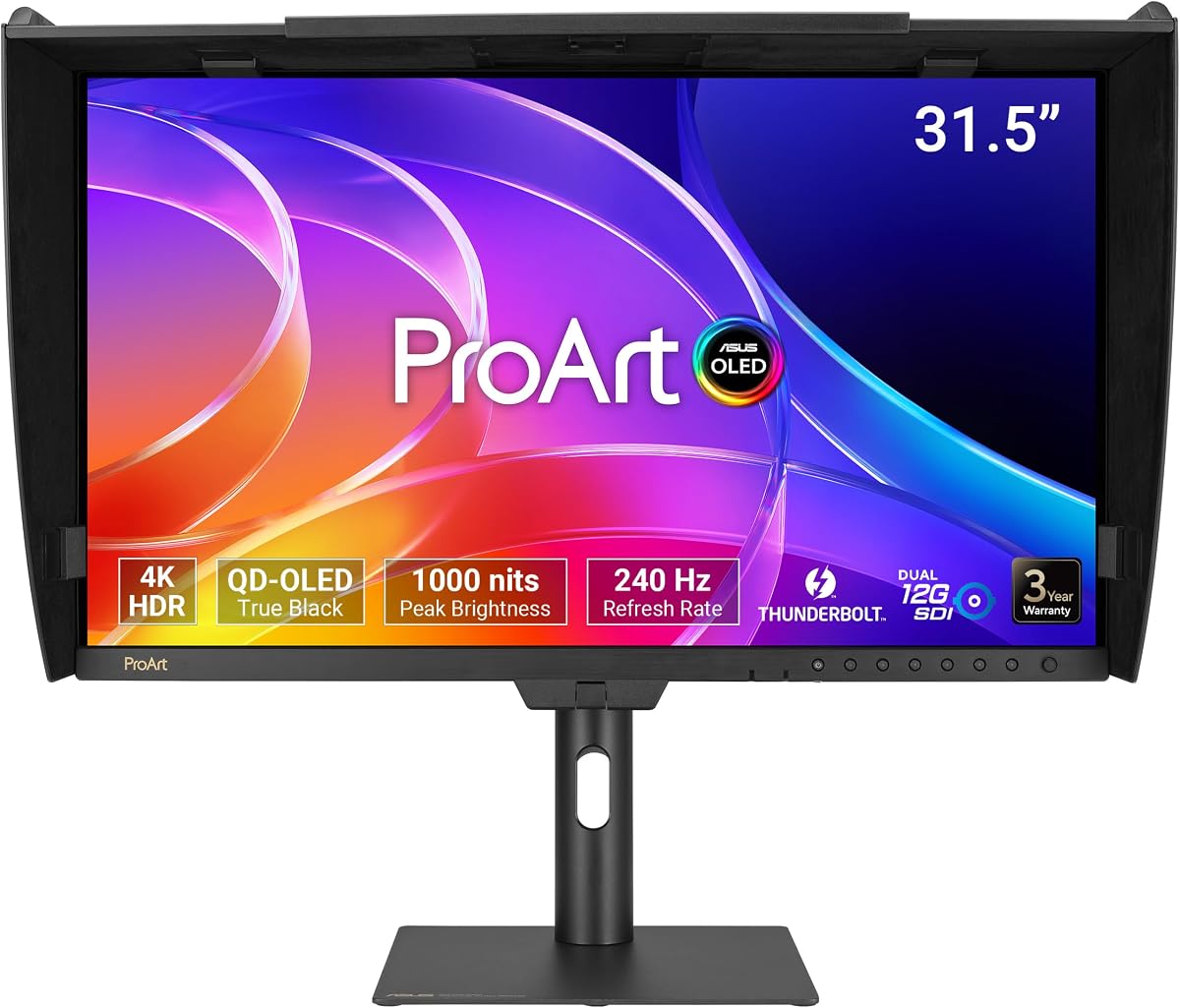
The ASUS ProArt Display PA32USD is a high-end 31.5-inch 4K QD-OLED professional monitor built for demanding color, motion, and broadcast work. Its key specifications include a 240Hz refresh rate, 0.1ms GTG response time, 1000-nit peak brightness, and DisplayHDR True Black 400. No numerical rating is supplied for this listing, so its value is best assessed through its specialized specifications.
We may earn a commission when you buy through this link, at no additional cost to you.
Unlike conventional office monitors, the PA32USD includes dual 12G-SDI for uncompressed 4K at 60Hz real-time playback. It also supports 6G and 3G Level A and B signals, Dolby Vision, HLG, and HDR10. True 10-bit color, 100% sRGB, 99% DCI-P3, BT.2020 coverage, Delta E below one, and ProArt Hardware Calibration Technology reinforce its studio credentials.
Its professional accessories include a monitor hood, cable-management clips, an ergonomic stand, a mini stand, and a metal handle. Dual Thunderbolt 4 ports provide up to 96 watts of power delivery, alongside HDMI 2.1, DisplayPort 2.1, and a USB hub. These features make it comprehensive for high-end post-production, broadcast, motion, and reference workflows, but potentially excessive for general office use.
The PA32USD is ideal for users whose work directly benefits from near-instant motion response, deep blacks, uncompressed SDI workflows, or hardware calibration. The absence of a numerical rating and the specialized feature set make it less easy to recommend universally, but it is the most performance-focused and workflow-specific model in this guide.
Dual 12G-SDI is uncommon in general-purpose creative monitors and supports uncompressed 4K playback at 60Hz. For production teams already working with compatible SDI equipment, this can offer a more direct and dependable workflow than ordinary display connections.
The 4K QD-OLED panel pairs a 240Hz refresh rate with 0.1ms response and DisplayHDR True Black 400. True 10-bit color, broad gamut coverage, Delta E below one, and profile write-back support professional precision work.
We may earn a commission when you buy through this link, at no additional cost to you.
The ASUS ProArt PA32UCR-K is a 32-inch 4K Mini-LED monitor aimed at users who want a bright panel, high-resolution workspace, and precise reference performance. Its supplied rating is 3.7. The display reaches 1,000 cd/m2 peak brightness and uses quantum-dot technology to cover 99.5% Adobe RGB, 98% DCI-P3, and 100% sRGB.
We may earn a commission when you buy through this link, at no additional cost to you.
Color precision is another major selling point. The stated Delta E below one, ProArt Hardware Calibration technology, and included X-rite i1 calibrator allow the display to be optimized and have profiles written back to the hardware. That combination is particularly relevant to photographers, print workers, and studios maintaining repeatable color across multiple machines.
The model's HDR support is limited to HDR10 and HLG, which may disappoint buyers expecting a broader format suite. USB-C and HDMI connectivity supports modern and conventional source devices, but the information does not present the same extensive port matrix as the PA329CRV-P. Its 32-inch size also requires a generous desk and careful display scaling.
This monitor suits professionals who value brightness, broad gamut, a bundled calibration device, and reference-oriented features. It is less attractive for users prioritizing the newest high-end connectivity, maximum local-dimming capability, or Dolby Vision support. Review current configuration details carefully before purchase.
The bundled X-rite i1 calibrator and Delta E below one claim make the model compelling for users who want to measure and refine the display. Hardware profile write-back can make color settings easier to preserve across compatible workstation computers.
Mini-LED backlighting supports a listed 1,000 cd/m2 peak, while quantum-dot coverage spans Adobe RGB, DCI-P3, and sRGB. The 4K panel also provides ample working space for demanding editing and design applications.
We may earn a commission when you buy through this link, at no additional cost to you.
The ASUS ProArt PA278CGV bridges professional color work and smoother everyday interaction. It has a 27-inch 2560 x 1440 IPS panel, a 144Hz refresh rate, 95% DCI-P3, 100% sRGB and Rec.709 coverage, and a supplied rating of 4.2. Calman Verified factory calibration and Delta E below two support accurate creative output.
We may earn a commission when you buy through this link, at no additional cost to you.
The 90-watt USB-C connection is particularly useful with demanding laptops, while DisplayPort, HDMI, and a USB hub provide alternative routes. FreeSync Premium and the 144Hz refresh rate make the monitor more fluid for animation, motion previews, and general interactive use than typical 60Hz professional panels. DisplayHDR 400 adds a modest high-dynamic-range option.
Its QHD resolution may be limiting for users who routinely work with highly detailed images, large timelines, or many side-by-side panels. HDR400 is useful but modest compared with OLED, Mini-LED, or more advanced HDR400 implementations. These limitations keep it from being the first choice for every color-critical professional.
The PA278CGV is a compelling recommendation for illustrators, animators, UI designers, and developers who want ProArt color performance with higher refresh. It is also effective for hybrid creative systems where smooth motion and convenient laptop charging matter more than 4K resolution.
A 144Hz panel can make animation previews, navigation, and everyday interactions feel more fluid than a standard 60Hz display. FreeSync Premium also supports smoother variable-refresh operation when paired with compatible source hardware.
The 95% DCI-P3 specification expands on standard sRGB coverage, making the monitor more relevant for digital photography and video. Factory calibration to Delta E below two supports consistent results in common editing applications.
We may earn a commission when you buy through this link, at no additional cost to you.
The ASUS ProArt PA32UCG-K represents the highest-end Mini-LED option in this comparison. Its 32-inch 4K panel uses 1,152 local-dimming zones and reaches a listed 1,600 nits peak brightness, with 1,000 nits sustained full-screen. The supplied rating is 3.0, the lowest numerical score in the list, so its exceptional specifications should be weighed against the product's listed customer feedback.
We may earn a commission when you buy through this link, at no additional cost to you.
The display supports Dolby Vision, HDR10, and HLG, offering a broader format mix than many professional monitors. True 10-bit color and quantum-dot coverage across DCI-P3, Rec.2020, Adobe RGB, and sRGB suit demanding color work. A stated Delta E below one, ProArt Hardware Calibration Technology, uniformity optimization, and profile write-back reinforce its reference-oriented design.
Motion performance is another strength. The 120Hz maximum refresh rate and variable range of 48 to 120Hz with FreeSync 2 HDR can benefit game development, animation, and interactive tasks. Thunderbolt 3 and HDMI 2.1 provide modern connectivity, but the port selection is less extensive than the newest Thunderbolt 4 models in the range.
Choose the PA32UCG-K for color-critical users who need serious HDR brightness, dense local dimming, broad format support, and high-resolution creative work. Its specialized panel and calibration orientation make it most appropriate for advanced studios rather than routine office productivity. Current rating trends and configuration details deserve close attention before purchase.
The 1,152-zone Mini-LED backlight provides much finer control than a conventional edge-lit display. Combined with the listed peak and sustained brightness levels, it is designed to produce convincing HDR impact in dark scenes and bright highlights.
True 10-bit output, broad quantum-dot gamut coverage, Delta E below one, and hardware profile write-back serve demanding photo and video workflows. The broad HDR format support also gives editors more options when preparing and reviewing content.
We may earn a commission when you buy through this link, at no additional cost to you.
Choosing a ProArt monitor requires matching panel technology, color capability, resolution, connectivity, and specialized features to the way you work. The most important principle is to prioritize the requirements of your applications and source devices rather than selecting solely by screen size or a single headline specification.
Resolution determines how much information fits on screen and how finely small details can be inspected. The 24-inch PA248QV uses a 1920 x 1200 WUXGA panel, which offers a comfortable 16:10 workspace without requiring operating-system scaling. The 27-inch PA278CV and PA278CGV provide 2560 x 1440 QHD, a popular balance between detail, graphics performance, and physical screen size. The PA279CRV and PA329CRV-P step up to 4K, while the PA32QCV goes to 6K and the PA32USD and PA32UCG-K combine 4K resolution with large 31.5-inch or 32-inch panels.
Choose resolution based on the applications you use. Larger canvases benefit photo retouching, illustration, video timelines, and code. Very high resolution can make small interface text harder to read if the operating system is not scaled properly, so verify your preferred scaling before purchasing.
Color-gamut figures indicate how much of a standardized color space the panel can display, while calibration describes how closely it can reproduce those colors. The PA248QV and 27-inch WQHD model emphasize full sRGB and Rec.709 coverage. The PA279CRV extends to 99% DCI-P3 and 99% Adobe RGB, while the PA329CRV-P offers 98% DCI-P3. The PA278CGV reaches 95% DCI-P3, which is meaningful for digital creation but should not be confused with the broader Adobe RGB coverage of the PA32UCR-K.
Look for factory calibration, Calman Verified status, and stated Delta E values when accurate output matters. Delta E below two is a strong professional target, while models claiming Delta E below one provide an even more tightly controlled factory specification. Continued color accuracy still depends on the application, room lighting, display settings, and connected hardware.
Most ProArt models use IPS panels, offering broad viewing angles and consistent professional output. The PA32USD instead uses a 4K QD-OLED panel, adding exceptionally high contrast, a 240Hz refresh rate, and a 0.1ms response time. Its deep blacks and quick response make it appealing for motion, post-production, and high-end media work. OLED displays require more consideration for static professional interfaces, so workflow habits matter.
When choosing between IPS and OLED, think about the type of contrast you actually need. IPS models are dependable for general creative work, while OLED excels in dark-room viewing and cinematic imagery. The QD-OLED model also supports professional formats such as Dolby Vision, HLG, and HDR10 alongside its SDI connections.
HDR performance is more than a compatibility label. The PA279CRV and PA329CRV-P list HDR and HDR400 respectively, which are useful but relatively modest specifications. The PA32UCG-K uses Mini-LED backlighting with 1,152 local-dimming zones, a 1,600-nit peak, and 1,000-nit sustained full-screen brightness. This local-dimming structure can manage bright highlights and dark areas much more precisely than a simple full-screen backlight.
The PA32USD reaches a listed 1,000-nit peak using QD-OLED and supports VESA DisplayHDR True Black 400. For demanding HDR grading, previewing, or content creation, compare peak brightness, sustained output, black level, dimming behavior, and supported formats. For ordinary office work, the additional cost and complexity of these flagship HDR panels may not be justified.
Modern connectivity can determine how clean and practical a creative desk becomes. USB-C with power delivery appears on the PA279CRV at 96 watts, the PA278CV at 65 watts, the PA278CGV at 90 watts, and the PA329CRV-P at 96 watts. The PA32QCV and PA32USD use dual Thunderbolt 4 connections with up to 96 watts of power delivery. The PA32UCR-K includes USB-C and HDMI, while the PA32UCG-K provides Thunderbolt 3 and HDMI 2.1.
Check whether your laptop charges within the monitor's stated power rating and whether your devices support the required protocol. Video editors and broadcast users should also examine HDMI versions, DisplayPort capabilities, and SDI inputs. Existing equipment matters: a sophisticated monitor cannot improve a workflow if the source or dock lacks the necessary connection.
A professional display is used for long periods, so stand adjustment is more than a comfort feature. Most models support height adjustment, tilt, swivel, and pivot. The PA278CV specifically supports a 90-degree pivot, making it suitable for a vertical orientation, while the larger PA329CRV-P and PA32USD models include particularly broad movement ranges. The PA32USD also includes a mini stand and a metal handle for alternate installations.
Before buying, check the desk depth, monitor width, and available clearance. A 32-inch model may provide a luxurious canvas while making a dual-monitor arrangement impossible. Also consider the supplied anti-glare treatment, the position of ports, and whether your chair and desk height allow the screen to be placed comfortably.
Daisy-chaining can simplify extended workstations by allowing one video output to feed multiple compatible monitors. It is listed for the PA279CRV, PA278CV, and PA329CRV-P. The PA32QCV also supports daisy-chaining through Thunderbolt 4 and includes an Auto KVM switch that can move between two connected computers using one keyboard and mouse.
KVM functionality is particularly useful for users who alternate between a Mac and PC, or between a laptop and workstation. Confirm that the KVM switching method and attached peripherals are compatible with your setup. For a simpler two-computer arrangement, physical input switching or a dedicated dock may be sufficient.
Some ProArt displays include hardware calibration or a bundled colorimeter. The PA32UCR-K includes an X-rite i1 Calibrator, while several models support ASUS ProArt Hardware Calibration Technology and profile write-back. These features are valuable when consistent output across systems matters. The PA32USD includes a monitor hood and cable clips, accessories that can improve glare control and desk organization in professional environments.
Calibration is not the same as choosing a wide-gamut panel. A smaller-gamut display can still be accurately calibrated, while a wide-gamut screen may need careful profiling and suitable software. Decide whether your work demands ongoing measurement or whether factory-calibrated sRGB and DCI-P3 performance are sufficient.
Begin by positioning the monitor at the center of your primary viewing area, with the top edge near or slightly below eye level. Attach the stand securely, connect the appropriate video and USB-C or Thunderbolt cable, and use the included power cord. For a USB-C workflow, confirm that the computer supports video output and compatible power delivery before relying on a single-cable setup.
Choose the correct operating-system resolution and scaling mode before judging image quality. A 4K or 6K display may work best with appropriate scaling, while QHD and WUXGA models are often more comfortable at native resolution. After setup, update the graphics driver, select the correct input, and adjust brightness according to the room and application rather than relying on exaggerated contrast or saturation settings.
For color-critical work, install the manufacturer's recommended color profile and calibration utility when applicable. Use controlled ambient lighting, avoid placing the panel in direct sunlight, and allow it to warm up before making fine visual judgments. Clean the screen with a soft, lint-free cloth and avoid aggressive cleaners, and route cables through the provided clips or stand channels to protect connectors and keep the workstation organized.
The best choice depends on your preferred color space and the amount of workspace you need. The PA279CRV is a versatile 4K option with 99% DCI-P3 and 99% Adobe RGB coverage, while the PA32QCV provides 6K resolution and 98% DCI-P3. The PA32USD and PA32UCG-K are worth considering for high-end reference work requiring very low stated Delta E values and advanced calibration support.
A 4K model can be worthwhile when you regularly work with detailed photographs, large illustrations, video timelines, or multiple application panels. It also provides more usable space for side-by-side references. For lighter work, the 24-inch WUXGA and 27-inch QHD models may feel more comfortable and require less graphics processing, especially if your operating system does not scale 4K well.
QHD generally refers to 2560 x 1440, while 4K provides 3840 x 2160. The 4K panel offers substantially more pixels, which benefits detailed editing and multitasking but can make text and controls smaller. Your choice should account for screen size, operating-system scaling, viewing distance, and the graphics capability of your computer.
Thunderbolt 4 is valuable when you want high-resolution output, laptop charging, data transfer, and daisy-chaining through a compact connection. It is especially relevant to the PA32QCV and PA32USD. If your computer does not support the protocol, the included DisplayPort or HDMI options can still provide a strong workflow, but charging and docking functions may differ.
The PA32QCV offers 6K detail, 98% DCI-P3 coverage, HDMI 2.1, and Thunderbolt 4 connectivity. The PA32USD is better suited to high-end HDR, fast motion, and broadcast workflows because of its QD-OLED panel and dual 12G-SDI inputs. For conventional editing on a smaller budget, the PA278CV offers accurate sRGB color, QHD resolution, and a convenient USB-C connection.
No. It indicates that measured color differences are, on average, below a commonly accepted professional threshold under controlled testing conditions. Actual results can vary with brightness, graphics settings, ambient light, application output, and the connected device. Calibration software and controlled viewing conditions remain important for demanding work.
Yes, because the wattage determines whether a compatible laptop can charge adequately while the display and attached devices are operating. Options range from 65 watts on the PA278CV to 90 watts on the PA278CGV and 96 watts on several 4K and Thunderbolt models. Check your laptop's power requirements and whether it requires more than the monitor supplies for full performance.
The PA32USD is a QD-OLED model suited to deep blacks, fast response, 240Hz motion, and advanced HDR, while the PA32UCG-K uses Mini-LED local dimming for high peak brightness and broad HDR formats. OLED offers exceptional contrast and response, whereas Mini-LED provides strong brightness with finely controlled backlighting. Both are specialized choices for demanding media workflows.
The ASUS ProArt PA279CRV is the most balanced overall choice, combining a detailed 4K panel, wide color coverage, 96-watt USB-C, daisy-chaining, and an adjustable stand. The PA248QV is the value-focused alternative for users who want accurate sRGB color in a compact 16:10 format, while the PA32USD is the premium pick for high-end motion, HDR, and professional SDI workflows.
Prioritize the needs that directly affect your work. Photographers should examine gamut and calibration, developers should compare resolution and scaling, video editors should investigate HDR formats and brightness, and mobile professionals should confirm charging and docking support. A larger or more advanced display is not automatically better if it does not match the applications, source devices, desk, or viewing environment.
Ratings, included accessories, port configurations, and current prices can change over time, so review the latest Amazon listing before ordering. Also verify operating-system scaling, included cables, warranty registration details, and the compatibility of any calibration or KVM feature. With those checks completed, the right ProArt model can provide a dependable foundation for years of professional creative work.