
Automatic Curtain Opener with Remote and Smart Home Controls
4.6Editor score
Voice, app, and remote control
25dB silent operating mode
Tool-free installation
Timer and sensor automation
Works with common curtain systems
An automatic curtain opener can make everyday routines more comfortable by bringing curtains to life through a remote, phone, voice command, or automated schedule. A worthwhile system should move curtains smoothly, operate quietly, fit the existing hardware, and remain simple to install and control.
We compared these ten products by examining motor power, supported rods and tracks, remote range, smart-home integration, noise specifications, battery life, installation requirements, and practical features such as timers, sensors, route memory, and manual operation. The list covers retrofit devices and complete motorized track systems.
Each review identifies the product's strongest use case and any meaningful limitations, helping you distinguish a simple remote-controlled opener from a fully connected home-automation solution. Product details and availability can change, so confirm current specifications, compatibility, and pricing before purchasing.
4.6Editor score

5.0Editor score

4.6Editor score
As an Amazon Associate we earn from qualifying purchases.
The table below provides a quick side-by-side view of the ten systems, emphasizing their principal control methods, hardware compatibility, motor capabilities, and distinguishing features. The full reviews explain the trade-offs that matter when choosing a model for a particular room or curtain arrangement.


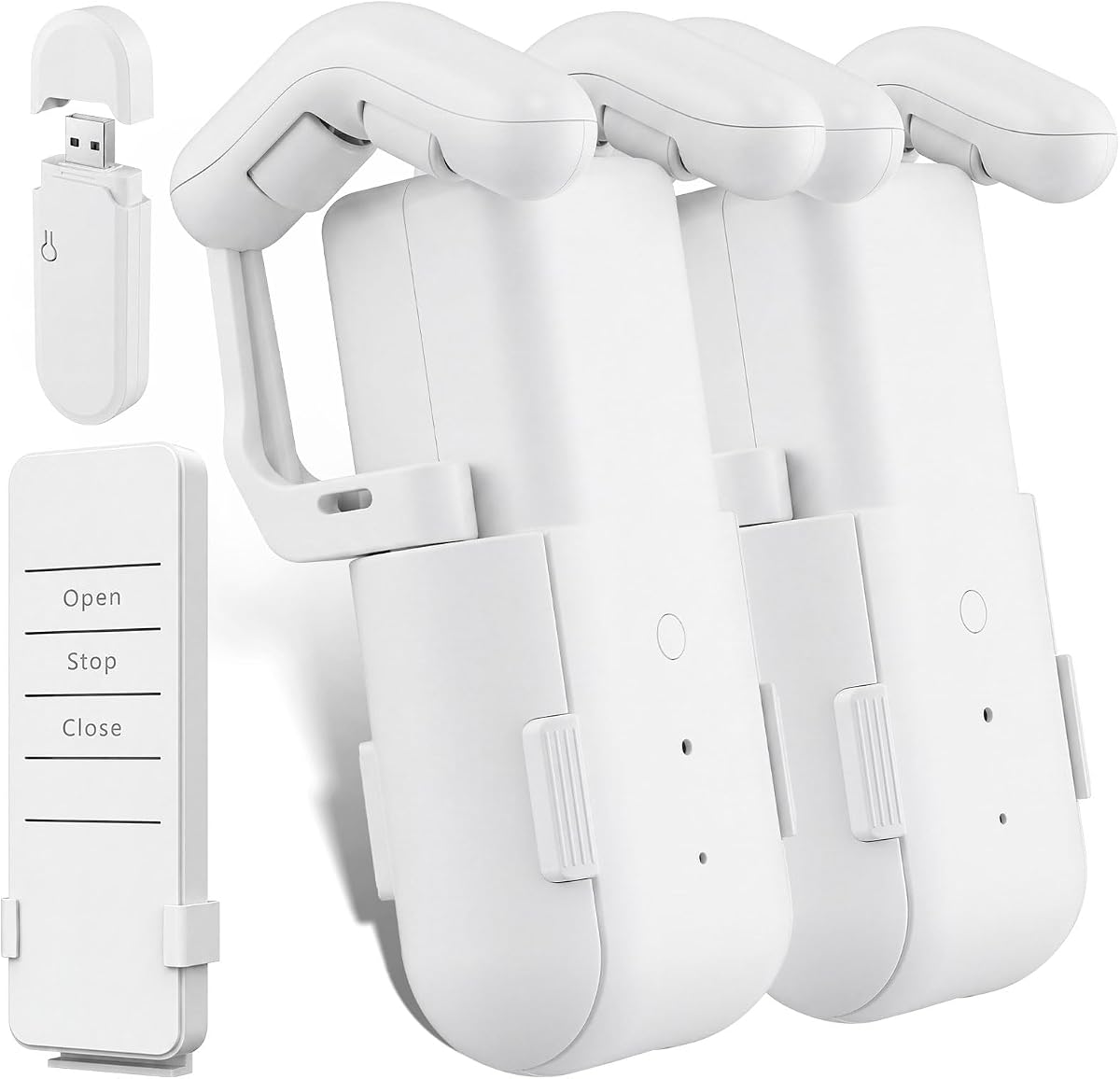


This two-pack curtain opener combines a straightforward remote with rechargeable motors, making it appealing for households that want motorized curtains without constructing a full smart-home setup. Its 4.4 rating reflects a generally useful balance of compatibility, quiet operation, and route memory, although the supplied information does not describe every aspect of the setup process.
We may earn a commission when you buy through this link, at no additional cost to you.
The standout feature is its dual operating approach. Quiet Mode runs at as little as 25dB, which is useful in bedrooms and nurseries, while Power Mode moves at approximately 0.1 meters per second for regular daytime use. The included remote reaches up to 65 feet, and route memory preserves the learned opening and closing path after initial setup.
Each unit uses two built-in 2000mAh lithium batteries, giving the pair a stated total capacity of 4000mAh and up to six months of normal use per full charge. Compatibility covers Roman rods measuring 0.31 to 1.57 inches and many standard T-shaped and U-shaped tracks, with a recommended track length of 10 meters. It appears less versatile than app-connected models, but it covers the essentials cleanly.
This is a strong option for people who value physical remote control, nearly inaudible nighttime movement, and the ability to automate a pair of curtains. It may be less appropriate if voice assistants, phone-based routines, environmental sensors, or smart-home scenes are central to your goal. Verify that your rod or track and curtain arrangement meet the stated limits before ordering.
Quiet Mode prioritizes low sound for restful spaces, while Power Mode provides more purposeful movement for everyday use. Having both options makes it easier to tailor behavior to a bedroom nap, nursery bedtime, or a faster daytime opening.
The dual-motor format is well suited to paired curtains, while the built-in batteries eliminate the need for a permanent outlet at the window. Route memory also reduces repeated setup, allowing the system to behave more consistently after the initial learning cycle.
We may earn a commission when you buy through this link, at no additional cost to you.
This automatic opener focuses on the mechanical essentials: strong torque, flexible installation, and uncomplicated Bluetooth remote control. Its 4.2 rating indicates a capable middle-of-the-market option, with the product particularly well suited to thick, layered, or blackout curtains that require more force than a lightweight motor can provide.
We may earn a commission when you buy through this link, at no additional cost to you.
The 20W motor produces up to 44 pounds of torque, and the 4000mAh rechargeable lithium battery is stated to last up to six months on a charge. A Type-C port simplifies recharging, while a 20-meter, or 65-foot, Bluetooth remote range lets users operate the curtains from across a room without requiring a hub, Wi-Fi connection, or voice assistant.
Installation hardware is designed for Roman rods with diameters from 8 to 40 millimeters, along with T-type and U-type tracks. Clip-on accessories, track adapters, fabric clips, and a dual-direction interface are included to reduce compatibility errors. One important detail is that the product should face outward; incorrect orientation can alter the movement direction.
Choose this model if strong pulling power and a simple remote matter more than timers, environmental sensing, or broad smart-home integration. Before installation, confirm rod diameter, track shape, and orientation. Fully charge the unit before first use so that route setup and range can be evaluated under normal operating conditions.
The stated 44-pound torque provides meaningful headroom for thick, layered, and blackout fabrics. It also makes the opener less dependent on lightweight sheers, where excess force could potentially create uneven tension if the installation is not adjusted carefully.
The remote uses a stable Bluetooth connection rather than requiring a Wi-Fi network. That simplifies ownership for people who want convenient remote operation without commissioning another smart-home device or managing an account and network configuration.
We may earn a commission when you buy through this link, at no additional cost to you.
This opener earns the Editor's Choice position because it combines a well-defined 5.0 rating with a balanced feature set. It is not positioned as a voice-control appliance; instead, it focuses on dependable remote operation, smooth route learning, flexible operating modes, and compatibility with common curtain hardware.
We may earn a commission when you buy through this link, at no additional cost to you.
Its 20W motor delivers up to 20 kilograms of torque, enough for supported everyday curtain arrangements. Power Mode travels at 0.1 meters per second, while Quiet Mode is stated at 25dB and moves at 26 seconds per meter. The 20-meter remote range provides practical control from a bed, sofa, or desk, and the included remote is paired for immediate route setup.
A 4000mAh rechargeable battery keeps the unit cordless at the window. Under normal conditions, it is stated to last more than six months per charge; each internal battery takes approximately 3.5 to 4 hours to recharge, with red indicating charging and blue indicating a full charge. Compatibility includes 8-to-40-millimeter Roman rods and supported T- and U-shaped tracks up to a recommended 10 meters.
This is the most broadly persuasive choice for a typical household seeking dependable automation rather than a full connected ecosystem. Its limitations are clear: specialty tracks are unsupported, and there is no documented app or voice-assistant operation. Confirm the hardware dimensions, fully charge the opener, and learn the route before relying on unattended schedules or daily routines.
The opener can learn the preferred endpoint and repeat the same path, reducing the need for manual repositioning. After a full reset, the remote must be paired again and the route relearned, a normal maintenance step worth understanding before installation.
Two operating modes let the same motor serve both rapid daytime movement and gentle nighttime adjustments. The 25dB quiet specification is especially relevant for nurseries, reading areas, and homes where a motor that wakes light sleepers would undermine the convenience of automation.
We may earn a commission when you buy through this link, at no additional cost to you.
This is the most feature-rich budget-oriented connected opener in the group. It earns a 4.6 rating and offers remote, app, Wi-Fi, Bluetooth, and voice-assistant control, making it suitable for users who want automation without installing a complete motorized track.
We may earn a commission when you buy through this link, at no additional cost to you.
The kit includes a dedicated gateway, remote, and installation accessories. It supports Alexa and Google Assistant, along with app-based control, while the remote reaches up to 32.8 feet and can work even without an internet connection. A 25dB Silent Mode supports light sleepers, while Power Mode is intended to move heavier blackout curtains.
Installation is presented as a three-step, tool-free process that avoids drilling and rewiring. The opener supports Roman rods, U-shaped tracks, and T-shaped tracks, along with grommet, hook, and tab-top curtains. A telescopic rod accessory can help it glide smoothly over joints, while front-facing and hidden mounting options provide some flexibility in appearance.
The built-in timer, light sensor, and temperature control add practical automation without requiring separate sensors. For a center-opening double curtain, the manufacturer recommends a two-pack, so single-unit buyers should confirm that one motor can achieve the desired visual result. This is a strong choice for renters, smart-home beginners, and users who value several control methods in one kit.
Remote, app, voice, and offline remote access cover different routines and levels of technical comfort. The included gateway enables the connected functions, while the physical remote remains useful if the internet connection is unavailable.
The tool-free approach is valuable in rental homes and finished rooms where drilling is undesirable. Existing rods, tracks, and supported curtain attachment styles can remain in place, reducing both installation work and visual disruption.
We may earn a commission when you buy through this link, at no additional cost to you.
This two-pack combines strong motor output with connected control, earning a 5.0 rating in the supplied catalog. It is designed for users who want the pulling force to manage heavy blackout curtains and who also value access through an RF remote, smartphone app, or compatible voice assistant.
We may earn a commission when you buy through this link, at no additional cost to you.
Its 20W motor delivers up to 44 pounds of torque, while Quiet Mode is stated at 25dB. A High-Torque Mode is available for moving heavy curtains quickly. The RF remote is highlighted as less prone to disconnection than a Bluetooth remote, which may be useful in larger rooms or when line-of-sight reliability matters.
The product supports Roman rods and U-shaped tracks and is described as easy to install without tools. Voice and app operation extend beyond the remote, making it practical for offices, renovated older homes, villas, bedrooms, and other environments where hands-free control is convenient. The included pair also provides a logical solution for two independent curtain openings.
The product information is less detailed than some alternatives: it does not provide a battery capacity, recharge time, or complete track-length guidance. It is best for buyers willing to confirm compatibility with the seller before installation. For heavier curtains, strong voice integration, and dependable RF remote control, it stands out as a capable two-unit package.
A 44-pound motor output gives this opener more authority than many lighter retrofit devices. That makes it a logical consideration for blackout curtains, layered treatments, or users who prefer one motor system to handle substantial fabric loads.
The RF remote offers a different signal behavior from Bluetooth, with the product specifically emphasizing improved range and fewer reconnection issues. App and voice support add convenience without eliminating the need for a straightforward physical controller.
We may earn a commission when you buy through this link, at no additional cost to you.
This two-pack offers one of the broadest control menus in the list, but its 2.2 rating is the lowest among the ten products. Buyers should therefore approach it with more attention to current customer feedback and a careful check of the seller's documentation before committing.
We may earn a commission when you buy through this link, at no additional cost to you.
Its defining advantage is the four-in-one control system: remote, timed automatic operation, app control, and manual movement. The two robots can work synchronously to open and close left- and right-side curtains, which suits conventional center-opening arrangements. A timer allows curtains to move at selected times, while manual control provides a useful backup during setup.
Installation is described as tool-free, drilling-free, and wiring-free. The robots attach to existing curtains and are described as compatible with most common tracks and straight rods. The product data says they can handle thick, thin, sheer, and blackout curtains, while a high-strength ABS body and upgraded quiet motor support regular use.
Its lower rating may reflect buyer satisfaction, fit, or execution issues that cannot be determined from the supplied specifications alone. The feature set is attractive for renters and users who want manual and app-based options, but the lack of stated battery life, remote range, and explicit track dimensions makes pre-purchase verification especially important. Consider it only after confirming hardware fit and reading recent reviews.
The ability to push the curtains for manual operation can be helpful during initial setup, when a learned endpoint is being established, or if a preferred position lies between the fully open and fully closed points. It also reduces dependence on a single control method.
The pair is intended to move two curtain sections together, producing a balanced center-opening appearance. Synchronization is more relevant to paired installations than to a single curtain, so measure the window and confirm whether both sides require independent motors.
We may earn a commission when you buy through this link, at no additional cost to you.
This opener provides a recognizable feature mix—RF remote, app and voice control, quiet operation, and high torque—but its 3.4 rating is below the stronger products in the collection. It may suit a buyer who values those features and finds the current customer feedback reassuring for the intended installation.
We may earn a commission when you buy through this link, at no additional cost to you.
The 20W motor produces up to 44 pounds of torque, and a High-Torque Mode is intended for heavy blackout curtains. Quiet Mode operates at a stated 25dB, allowing the same unit to serve both daytime and nighttime routines. The RF remote is promoted as less susceptible to disconnection than a Bluetooth controller.
Roman rods and U-shaped tracks are identified as supported, and installation is described as requiring no tools. Voice control works with compatible assistants, while app operation allows management from a phone. These controls make it relevant to smart-home users who do not want to stand at the window to open or close curtains.
The product listing does not state battery capacity, charging method, remote range, or detailed track dimensions, so buyers should seek those details before buying. Its moderate rating makes recent customer feedback particularly important. The core hardware appears capable, but adequate documentation and a confirmed fit would make this a lower-risk purchase.
RF is highlighted as a way to receive signals farther away and avoid the reconnection frustration associated with some Bluetooth controls. This can be helpful in wide rooms where the motor sits beyond easy line of sight.
The combination of a physical remote, app operation, and voice commands accommodates different users and routines. A family member can use the remote while another integrates the opener into a broader smart-home setup.
We may earn a commission when you buy through this link, at no additional cost to you.
This is the premium choice because it is a complete motorized curtain track rather than a small retrofit motor. Its 4.6 rating reflects a robust feature set, broad sizing options, smart-home integration, and several safety-focused details that go beyond basic remote operation.
We may earn a commission when you buy through this link, at no additional cost to you.
The thickened aluminum-alloy track uses a 12-millimeter belt containing eight steel wires, high-load gliders, and stainless-steel hardware. A quiet DC motor provides soft starts and stops. Custom tracks support widths up to 244 inches and can be ceiling-mounted or wall-mounted, with center-split, left-side-draw, and right-side-draw configurations.
Smart controls include remote operation, mobile app access, timing schedules, device sharing, and compatibility with Alexa, Google Assistant, and Siri. Because it connects to 2.4GHz Wi-Fi, no separate hub is needed. Auto calibration saves travel limits, obstacle detection stops the motor, and hand-pulling the curtain about 10 centimeters while powered can trigger movement.
This system is best for a renovation, new installation, or homeowner willing to replace the existing track. It offers a cleaner integrated result than a clip-on opener and supports wider windows, but installation is more involved. The stated five-year warranty, installation video, printed instructions, mounting hardware, power cord, and support commitment add confidence, although buyers should still confirm the custom dimensions before ordering.
A complete track system integrates the motor, belt, gliders, and mounting structure in one design. This can produce a more integrated appearance and smoother operation than adapting a small motor to miscellaneous existing hardware.
Obstacle detection can halt movement if an obstruction is encountered, while auto calibration records the system's travel limits. Manual pull triggering also provides a physical way to start the curtain when it is powered.
We may earn a commission when you buy through this link, at no additional cost to you.
This two-pack is presented as a versatile smart curtain robot with remote, app, voice, timer, and manual control. Its 3.8 rating places it in the middle of the group, and the supplied product information is brief, so exact installation and performance details should be confirmed before purchase.
We may earn a commission when you buy through this link, at no additional cost to you.
Its main attraction is control flexibility. Users can operate the curtains from a smartphone, use compatible voice commands, activate a timer, or move them manually. The included remote version offers a physical alternative when someone does not want to use a phone, and a two-pack is useful for covering more than one curtain section or window.
The listing identifies the product as a smart-home device designed for automated curtain movement, but it does not provide a detailed motor wattage, torque figure, noise rating, battery capacity, remote range, or supported track dimensions. Those omissions make direct comparison with the more fully documented products difficult.
The product may be a reasonable choice for buyers who prioritize the number of control options and a paired package over a published motor specification. Check the seller's current compatibility chart, confirm whether the two robots operate independently or in synchronization, and review recent customer feedback. Manual control and scheduled operation add useful flexibility once installation is complete.
App, voice, remote, and manual operation allow the opener to suit different levels of comfort with technology. It also provides multiple paths for troubleshooting when a particular control method is unavailable.
A two-robot package only works as intended if the track, curtain weight, and spacing fit the manufacturer's requirements. Because the supplied listing omits detailed dimensions and load information, checking current seller documentation is essential.
We may earn a commission when you buy through this link, at no additional cost to you.
This opener distinguishes itself through app and voice control without requiring a gateway, plus built-in timer, light, and temperature sensors. Its 3.2 rating is modest, and its narrow Roman-rod compatibility makes it more specialized than the flexible retrofit systems listed above.
We may earn a commission when you buy through this link, at no additional cost to you.
The product includes one motor for a single-sided curtain. It supports app-based operation and voice commands through Alexa and Google Home Assistant, while a timer allows scheduled opening and closing. The light and temperature sensors can trigger automatic closing under the stated conditions, providing environmental logic beyond a simple timer.
Its upgraded motor is rated for a maximum load of 10 kilograms, or 22 pounds. A built-in 4000mAh lithium battery is stated to provide up to six months of use per charge. Installation is based on hanging the unit and adding positioning magnets, with no mention of a full track replacement.
This is most appropriate for a light-to-medium Roman-rod curtain, particularly in a living room, bedroom, or study. It is not suitable for a T-track, U-track, center-opening pair, or heavy curtain beyond its load limit. Confirm the rod type and fabric weight before ordering, and review recent customer feedback to better understand the product's fit and reliability.
Light and temperature sensors can support automatic responses to changing conditions. These features are most useful in rooms where curtains contribute to glare control, privacy, heat management, or a consistent daily lighting routine.
The ability to use app and voice control without a separate gateway reduces setup complexity. It also makes the opener easier to incorporate into a connected home without adding another networked accessory.
We may earn a commission when you buy through this link, at no additional cost to you.
Choosing an automatic curtain opener involves balancing hardware compatibility, curtain weight, control preferences, installation tolerance, and budget. The most capable specification sheet is not automatically the best choice if the device cannot fit the rod, track, window arrangement, or smart-home ecosystem already in use.
Begin with the physical hardware above the window, not with the motor. Most retrofit openers support Roman rods and common T-shaped or U-shaped tracks, but exact rod diameters and track limits vary. The two most highly specified retrofit products list Roman rods from 0.31 to 1.57 inches, or 8 to 40 millimeters, and some T/U tracks up to 10 meters. The premium complete-track system replaces the existing track and can be custom-sized to 244 inches. Specialty-shaped tracks, unusually heavy curtain assemblies, and center-opening systems may require two motors or a purpose-built track.
Motor torque determines whether a system can move thick blackout curtains, layered drapery, or a large fabric span without stalling. Published outputs in this group range from 20 kilograms for the Editor's Choice model to 44 pounds, or 20 kilograms, for several high-torque products, while the Roman-rod-focused option supports up to 10 kilograms, or 22 pounds. A larger figure is useful for heavy treatments, but it should be matched to the hardware and curtain rather than treated as a guarantee of better performance. Proper gliders, fabric attachment, track alignment, and balanced fabric distribution matter just as much as motor output.
A remote should be usable from the places where you actually need to control the curtains. Stated ranges include approximately 20 meters, or 65 feet, for the Bluetooth and general dual-mode openers, 20 meters for the Editor's Choice unit, and 32.8 feet for the connected budget pick. RF remotes are highlighted in two products as receiving signals farther away and disconnecting less often than Bluetooth. Range is still affected by walls, room layout, interference, and how the receiver is positioned, so treat the published figure as a guide rather than an absolute guarantee.
Remote-only operation is simple and dependable, while app and voice control can integrate curtains into broader routines. Compatible assistants mentioned across the group include Alexa, Google Assistant or Google Home, and Siri. Additional gateway requirements vary: the connected budget kit includes a gateway, whereas the Roman-rod-only app model explicitly requires none, and the premium complete-track system connects directly to 2.4GHz Wi-Fi. Timers are also common, but sensors offer different logic: light and temperature sensors can close curtains in response to environmental conditions rather than a fixed clock.
Quiet Mode matters in bedrooms, nurseries, home offices, and any room occupied at night. Several products state a low noise level of 25dB, while the Editor's Choice model is also specified at 26 seconds per meter in Quiet Mode and 0.1 meters per second in Power Mode. Dual-mode operation lets users select a gentler setting for restful periods and a faster mode for blackout curtains or daytime use. Published decibel figures are useful for comparison, but room acoustics, curtain fabric, track condition, and installation alignment also influence the sound heard in practice.
Rechargeable battery operation removes the need to run a cord to the window and is common among the retrofit openers. Several products state a 4000mAh capacity and up to six months of use under normal conditions. Actual runtime varies with fabric weight, opening frequency, track friction, and the number of motors. One product uses two internal 2000mAh batteries, with a 3.5-to-4-hour charging estimate given for each internal battery in another model, and a Type-C port appears on the Bluetooth opener. Always use the specified original charger where required, and never assume a stated six-month figure applies under unusually heavy daily use.
The least disruptive route is usually a tool-free retrofit that attaches to an existing Roman rod or supported track. Several products advertise installation without drilling, wiring, or professional tools, while the premium track system involves replacing the existing track and mounting it to the ceiling or wall. Tool-free does not necessarily mean effortless: rod diameter, track shape, curtain weight, motor orientation, and positioning sensors must all be correct. A complete track also offers the cleanest integrated result, but it creates a larger permanent change and is less attractive for temporary rentals or frequently rearranged windows.
Useful safety and convenience features include route memory, stop controls, manual movement, obstacle detection, and automatic calibration. Route learning lets a device reproduce the same opening endpoint, while manual pull or push operation can serve as a backup. The premium track includes obstacle detection and a hand-pull trigger, and some retrofit openers remember the learned route. Whatever the feature set, keep hands away from moving rollers during setup, test the full travel path before attaching curtains, and confirm that the curtains do not snag on joints, brackets, or window frames.
Begin by identifying the motor type and reading the current setup instructions for that specific model. Check the rod diameter, track shape, curtain weight, and required motor orientation before mounting anything. The product must be positioned correctly; for example, the Bluetooth opener specifically states that an outward-facing orientation is necessary for correct movement. Clean the rod or track, remove debris, and confirm that the gliders or fabric clips move freely by hand before attaching the motor.
Install the supplied brackets, adapters, clips, and positioning components according to the manual. Pair the remote if required, fully charge the battery, and then perform the route-learning or calibration process. Move the curtain slowly to the intended open and closed endpoints, save the route, and test the Stop function several times. For connected models, complete the app, Wi-Fi, gateway, and voice-platform setup only after the physical operation works reliably.
For care, keep the track clean and periodically inspect clips, screws, fabric attachment points, and motor mounts. Use the appropriate operating mode for the fabric and avoid manually forcing the curtain while the motor is engaged, except where a product specifically provides a hand-pull trigger. Recharge with the original charger when required, and do not leave the unit in a location exposed to moisture or extreme heat. If the remote stops responding, first test the physical controls and battery, then re-pair or recalibrate only as directed by the manufacturer.
Most of the retrofit models in this guide are designed to work with existing curtains supported by a compatible Roman rod, T-track, or U-track. They may use fabric clips, hooks, or included adapters to connect the curtain to the motor. Compatibility still depends on rod diameter, track length, fabric weight, and whether the curtain has an attachment style that can be adapted. Check all measurements before purchasing, and confirm whether a center-opening curtain needs two units.
Noise depends on the operating mode, motor quality, curtain weight, and track condition. Several products specify a Quiet Mode as low as 25dB, making them suitable for bedrooms and nurseries when installed correctly. Faster Power or High-Torque modes will generally create more sound and vibration, particularly with heavy blackout fabric. Smooth tracks, evenly hung curtains, and properly sized adapters can also reduce clicking and strain.
Many of the battery-powered openers can run without a permanent outlet because they use rechargeable lithium batteries. Several state up to six months of operation per full charge under normal use, though heavy curtains and frequent cycling can shorten that period. The premium complete-track system uses a 120-inch power cord and is a wired installation, so power access is an important consideration for that model.
Several products support app-based control, including the connected budget pick, the two-pack high-torque model, the RF remote model, the two-pack robot, the Roman-rod-focused opener, and the complete motorized track. App setup may require Wi-Fi, Bluetooth, or a gateway depending on the model. The premium track connects to 2.4GHz Wi-Fi and states that no hub is required, while some retrofits include or specify a gateway.
Two motors are usually the better approach when a window has separate left and right curtain panels that should open symmetrically from the center. Some two-packs are explicitly designed to synchronize the two sections. A single motor may work for one-sided curtains, but it can leave the opposite panel stationary or create an uneven appearance. Confirm the motor direction, synchronization behavior, and whether the kit contains enough units for your window.
They can be, but the motor's rated torque and the curtain's total weight must be sufficient. Products with a stated 20W motor and up to 44 pounds of torque are better suited to heavy or layered curtains than a system rated at 10 kilograms, or 22 pounds. Hardware still matters: the track, gliders, clips, and rod must handle the load, and the fabric should hang evenly. Exceeding the motor or track limits can cause poor movement, strain, or damage.
A retrofit opener attaches to supported existing rods or tracks and is generally easier to install without major changes. A complete motorized track replaces the track and integrates the motor, belt, gliders, and mounting system for a more unified result. The complete-track option supports larger custom widths and offers built-in calibration and obstacle detection, but it involves a more involved installation and a permanent change to the window area.
First check for fabric snags, loose clips, debris in the track, and an unevenly hung curtain. Then confirm that the motor still has power and that the remote remains paired. If the endpoint has changed, repeat the route-learning or calibration process described in the manual. Do not force the moving roller or continue operating the unit if it strains against the curtain; power it down, remove the obstruction, and consult the product instructions.
The Editor's Choice electronic opener offers the strongest overall balance of quiet operation, useful torque, rechargeable power, remote reach, and learned routes. For shoppers seeking connected automation on a more modest budget, the smart-home opener with Alexa and Google Home support stands out, while the complete motorized track earns the premium position for larger or newly renovated window installations.
Prioritize compatibility before features. Measure the rod or track, establish the curtain's approximate weight, confirm the opening direction, and decide whether a single-sided or center-opening arrangement needs one or two motors. Then choose remote-only, app-enabled, or voice-assisted control based on your actual routine rather than on feature count alone. Quiet operation, dependable stopping, route memory, and a manual fallback are especially valuable in daily use.
Ratings, availability, technical specifications, and pricing can change, so review the current listing before buying. In particular, confirm battery details, included accessories, network requirements, and the seller's compatibility guidance. Taking a few minutes to verify the installation environment will usually prevent the most common disappointment: selecting a capable opener that is not physically suited to the curtain system.