
5 Gallon Hanging Deer Feeder with Accurate Timer
4.3Editor score
Four programmable daily feed times
Collapsible five-gallon hopper
AA battery operation
Real-time clock scheduling
Automatic Deer Game Feeder guide comparing ten top models for capacity, scheduling, weather resistance, portability, coverage, and dependable outdoor feeding.
An automatic deer game feeder makes feeding more consistent, reduces the need for frequent trips to refill a hopper, and helps establish predictable movement around a hunting or wildlife-management area. The right model depends on capacity, feed type, terrain, scheduling controls, power source, varmint protection, and how far you need to carry it.
This guide compares ten automatic deer game feeders using the supplied specifications, including hopper size, feed-event controls, broadcast coverage, construction, portability, battery requirements, and resistance to weather and pests. It covers compact hanging models, high-capacity tripod feeders, powered systems, and gravity-fed designs for buyers with different needs.
Each review explains the product's strongest benefits, practical limitations, and ideal user, while the comparison table provides a faster way to scan the entire field. Ratings reflect the listed customer feedback and may change over time. Product prices and configurations also vary, so confirm current details before purchasing.
4.3Editor score

4.5Editor score
4.2Editor score
This side-by-side comparison highlights each feeder's capacity, control method, coverage, portability, construction, and power requirements, helping you identify the model that best matches your location and feeding routine.


This 5-gallon hanging deer feeder combines a compact plastic hopper with scheduled dispensing, giving buyers a straightforward way to automate a small or remote feeding station. Its 4.3 rating reflects a generally positive balance of portability, scheduling, and ease of use. The standout feature is a real-time clock that helps maintain programmed feed times consistently from day to day.
We may earn a commission when you buy through this link, at no additional cost to you.
The hopper holds approximately 20–30 pounds of feed, depending on material and density, and folds down when it is not being used. That makes the unit practical for hunters or wildlife managers who need to move their feeding station or store it during off-season months. Owners can establish up to four feed times per day without dealing with complicated wiring or a mains-power connection.
Power comes from four AA batteries, which are simple to replace, although batteries are not included. The outdoor plastic construction is described as lightweight, corrosion-resistant, and suitable for seasonal temperature changes. While it cannot match the capacity or coverage of a large broadcast tripod, it offers a practical feature set without a complicated power system.
This is a strong choice for buyers who want affordable automatic scheduling, modest capacity, and easy portability. It is less suitable for a heavily trafficked station that must remain full for long periods, or for hunters who need remote app control. For its intended scale, however, it delivers a clear and useful automated-feeding package.
The real-time clock and four daily programs make this feeder easier to run consistently than a purely mechanical model. Once the schedule is configured, the automatic dispensing routine reduces the need for repeated visits simply to release the expected amount of feed.
Its collapsible five-gallon container saves space during transport and storage. That portability is especially useful for temporary feeding locations, scouting trips, and setups where a full-sized tripod feeder would be difficult to move.
We may earn a commission when you buy through this link, at no additional cost to you.
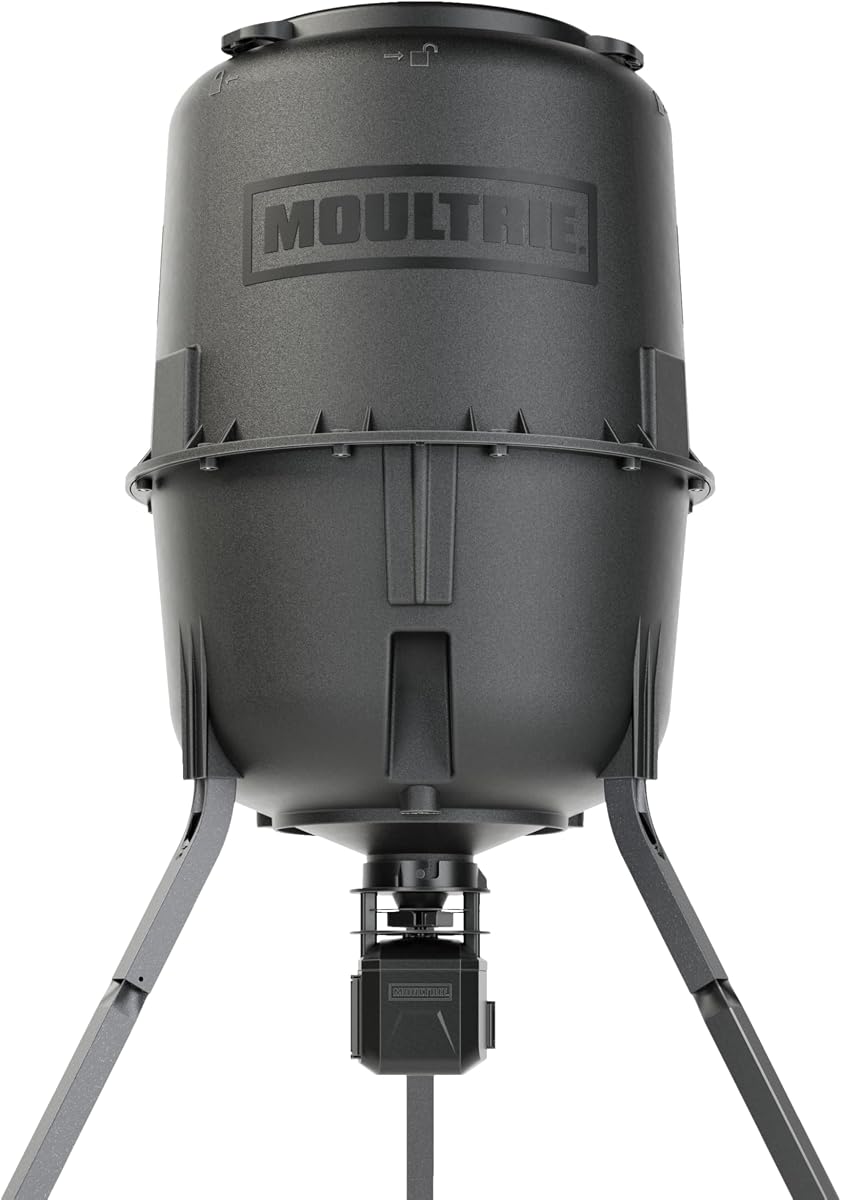
The Moultrie 250 Lb Pro Hunter III is designed for hunters and land managers who want a high-capacity station with precise, remotely adjustable feeding. Its 4.2 rating makes sense for a feature-rich product that combines a USA-made polymer hopper, app-based control, a heavy-duty broadcast kit, and support for long-term deployments.
We may earn a commission when you buy through this link, at no additional cost to you.
The hopper holds up to 250 pounds and offers a six-foot fill height, reducing the frequency of refill trips while making loading more convenient than a deeply recessed container. The Pro Hunter III kit attaches through the Quick-Lock system without tools, while the broadcast mechanism distributes feed through 360 degrees to bring deer in from multiple directions.
Control is a major advantage. Moultrie Connect Bluetooth allows schedule changes from up to 300 feet through the Moultrie App, and pairing the setup with an Edge 3 Series camera can extend control through cellular without a subscription. Ten feed events per day, adjustable durations of up to 60 seconds, and high, medium, or low spin plate speeds provide considerable scheduling flexibility.
The feeder accepts a 6-volt rechargeable battery and includes a solar panel port, though the specified battery and compatible panel are sold separately. Its weight and size make it less attractive for frequent moving than a hanging model, but for a permanent station it offers the most complete high-capacity system in this group.
Bluetooth control makes nearby schedule changes straightforward, while Edge 3 Series camera pairing adds cellular access for buyers who need to manage the station away from camp. The system provides useful control without requiring a paid subscription.
A 250-pound hopper is the central attraction for established feeding programs. The high fill height and large opening make regular replenishment more efficient, helping maintain a consistent feed source while reducing human activity around the location.
We may earn a commission when you buy through this link, at no additional cost to you.
This hanging deer feeder is built around a digital timer, adjustable dispensing durations, and a five-gallon hopper. Its 4.0 rating places it among the more moderately rated products in the list, but the supplied details show a versatile design for hunters, bird keepers, and other users who need programmable feeding in a hanging format.
We may earn a commission when you buy through this link, at no additional cost to you.
The timer supports up to four feed times per day, and each event can run from one to 20 seconds. This makes it possible to vary portions rather than relying on a single fixed discharge setting. A galvanized steel rotating disc and an engineering-plastic housing support regular operation with hard feed such as corn.
The tilt-down digital screen is a practical usability feature because it lets the operator check and change settings without repositioning the unit. It also has broader compatibility than a deer-only product, working with most deer feed containers and potentially supporting fish, chickens, ducks, birds, and pigs in appropriate rearing situations.
This model is best for buyers who value adjustable portions and a clear local display in a portable hanging feeder. Its absence of stated app control means it is less attractive for remote monitoring, while the five-gallon capacity limits how long it can operate between refills. It remains a flexible middle ground for scheduled feeding.
The one-to-twenty-second adjustment range gives the operator more control over each release than a basic fixed-volume feeder. That flexibility is useful when aiming to attract target species without placing an excessive amount of feed on the ground at once.
The tilt-down screen makes the control panel visible during setup and routine maintenance. Buyers do not need to navigate a remote app to review or adjust basic programming.
We may earn a commission when you buy through this link, at no additional cost to you.
The Moultrie All-in-One Hanging Deer Feeder combines local Bluetooth control with a collapsible 30-pound hopper and a 360-degree broadcast plate. Its 4.5 rating is among the strongest in the group, reflecting a balanced combination of convenience, portability, and app-supported scheduling.
We may earn a commission when you buy through this link, at no additional cost to you.
The hopper folds down inside itself, and the All-In-One feeder kit fits inside the hopper to create a compact bundle. It can be hung from a tree with a rope, strap, or cord, making it suited to remote locations and temporary setups. Its 30-pound capacity is more substantial than a basic five-gallon unit while remaining far easier to transport than a full tripod.
Through Moultrie Connect Bluetooth and the Moultrie App, users can change feed times and durations from up to 300 feet. Pairing it with an Edge 3 Series camera provides cellular remote control without a subscription. Four feed events per day, with one-to-20-second durations, cover common dawn and dusk feeding routines, and the broadcast plate spreads corn in a full circle.
It runs on four AA batteries or eight for extended runtime, with a removable tray for tool-free swaps. This is an excellent compromise for hunters who want remote convenience without a permanent high-capacity installation. It suits buyers who value a complete package, good portability, and dependable integration with the Moultrie ecosystem.
Nearby Bluetooth control is useful when adjusting a schedule without walking directly to the feeder. When paired with an Edge 3 Series camera, the same system can extend control through cellular, expanding options for remote monitoring.
The internal kit and collapsible hopper create a convenient carry-all arrangement. A hunter can move the entire station, hang it, and begin feeding with less setup than a conventional tripod model requires.
We may earn a commission when you buy through this link, at no additional cost to you.
The Moultrie Gravity Deer Feeder offers a battery-free alternative to conventional powered feeders. With a 4.4 rating, a 250-pound hopper, and three adjustable funnels, it appeals to land managers and hunters who value dependable outdoor feeding over timed broadcasts.
We may earn a commission when you buy through this link, at no additional cost to you.
Gravity operation eliminates batteries, timers, and electronic moving parts, reducing the types of components that can fail in a remote location. The three adjustable feed-flow funnels accommodate corn, protein pellets, mixed grains, and other feed types, allowing the operator to influence discharge rate without relying on a digital controller.
Construction uses rugged, UV-resistant plastic, while the reinforced tripod base is designed to remain stable on uneven ground and resist tipping from wind or deer interaction. A twist-on lid supports quick refills and helps protect feed from pests. The integrated Quick-Lock mount also allows future upgrades with other Moultrie feeder kits.
This model is ideal for a permanent, low-maintenance station where continuous availability matters more than precisely timed releases. It is less appropriate for hunters seeking scheduled broadcasts, remote control, or a narrow feed window. Within gravity feeders, however, its capacity, pellet compatibility, and upgrade path make it especially versatile.
Without a battery compartment, timer, or powered motor, the feeder has fewer components exposed to moisture, cold, or animal interference. That simplicity makes it attractive for installations that are difficult to service regularly.
Three adjustable funnels let the operator accommodate different feed textures and tune the flow. This broadens the unit's usefulness for corn-heavy, pellet-based, or mixed-feed programs.
We may earn a commission when you buy through this link, at no additional cost to you.
This large metal gravity feeder provides a substantial 130–150-pound capacity and a four-leg base designed for stability. Its 4.5 rating indicates strong customer feedback, while the galvanized carbon steel construction, locking closures, and drainage details distinguish it as a rugged option for established outdoor feeding stations.
We may earn a commission when you buy through this link, at no additional cost to you.
The oversized hopper cuts down on refill frequency, and two wide troughs allow multiple deer to feed without crowding at a single opening. An acrylic window provides a quick view of the remaining feed, reducing unnecessary lid handling. The top lid and feeding ports use secure lockable latches to help exclude raccoons, squirrels, rodents, and other pests.
Weather protection is addressed through a sealed cover and drain gaps designed to prevent standing water. Thick galvanized carbon steel with a protective green finish is intended to resist rain, snow, UV exposure, and temperature extremes. The four-leg foundation and included ground stakes offer more stability than a three-legged arrangement, particularly in uneven soil or exposed locations.
Assembly is required, but the included hardware and illustrated manual are intended to make setup manageable. This feeder is best for hunters and wildlife enthusiasts who want a battery-free, low-maintenance station with large capacity. It will not provide timed feed events, but it offers a straightforward way to keep feed available continuously.
Locking the lid and troughs helps protect valuable feed from common nighttime pests. Drain gaps also reduce the chance that water will collect and keep the exposed feed damp, supporting a cleaner feeding area.
The four-leg layout spreads the load across the ground and works with the supplied stakes. That configuration is useful in open or uneven locations where a narrower tripod could be more vulnerable to shifting or tipping.
We may earn a commission when you buy through this link, at no additional cost to you.
The WILDGAME Evolution 6V Digital Power Control Unit is a programmable control-and-dispensing kit designed to upgrade or build a varmint-resistant deer feeder. Its 4.4 rating reflects a solid feature set centered on precise scheduling, broad distribution, and a self-sealing spinner plate.
We may earn a commission when you buy through this link, at no additional cost to you.
The digital timer offers one to four feed events per day, with each event adjustable from one to 30 seconds. The centrifugal arm design lowers the spinner plate during a feed cycle and uses a spring to return it against the feed container when the cycle ends. This mechanism also supports a 360-degree distribution range of up to 30 feet.
Varmint protection is a defining feature. The recessed, self-sealing spinner sits beneath a heavy-duty mounting bracket, denying access to feed when the feeder is not actively dispensing. Corrosion-resistant powder-coated galvanized steel and a galvanized spinner plate are intended to provide durable outdoor operation, while a two-inch drop funnel simplifies installation.
This product is best for a hunter who already owns a suitable hopper or wants to assemble a custom feeding station. It is not a complete large-capacity feeder, and a compatible power and mounting setup is necessary. Within that use case, it offers dependable programming and unusually deliberate attention to keeping feed away from pests.
Four daily programs and adjustable event durations make it possible to place feed releases around the periods when deer are most active. The approximately 30-foot distribution range helps bring animals toward a central feeding point.
The spinner plate retracts beneath the mounting bracket after each cycle. This mechanical closure keeps the feed opening protected without requiring a separate powered locking mechanism.
We may earn a commission when you buy through this link, at no additional cost to you.
The AMERICAN HUNTER 50 LB Hanging Feeder combines a camouflage metal hopper with the XD-Pro automatic delivery kit. Its 3.4 rating is the lowest among the listed products, but the supplied specifications show broad scheduling options, accessory readiness, and a feature set aimed at hunters who want control over feed release.
We may earn a commission when you buy through this link, at no additional cost to you.
The timer supports up to 16 feed events per day, and its adjustable feed rate runs from one to 60 seconds. Two preconfigured Q-Sets simplify initial setup, while the analog clock timer gives users a straightforward local control method. The metal spin plate and 50-pound hopper make it suitable for regular suspended feeding stations.
The XD-Pro kit includes a metal varmint guard and an optional shocking circuit. It is also pre-wired for a Varmint Zapper Module Activator, solar panel, and remote activator, although those accessories and the recommended DE-30045 battery are not included. The camo finish helps the feeder blend into a hunting environment, and the metal hanger simplifies mounting.
The product is a good fit for an established hunter who values many possible feed times and accessory integration, but it comes with more setup and potential accessory expense than a simpler hanging unit. Its lower rating and analog interface make it less appealing for buyers who prioritize app control or the strongest customer-feedback score in this comparison.
As many as 16 daily events give the owner detailed control over when feed is released. Combined with one-to-60-second durations, this supports feeding routines far more granular than the four-event models in the guide.
The XD-Pro kit's compatibility with optional remote, solar, and varmint-related components makes it adaptable to a more elaborate station. Buyers should account for the fact that the required battery and optional modules are sold separately.
We may earn a commission when you buy through this link, at no additional cost to you.
The Wildgame Innovations Quick-Set Pro is a high-capacity tripod feeder with a 270-pound hopper, programmable timer, and wide broadcast range. Its 4.0 rating reflects a capable package that emphasizes fewer refill trips, fast setup, and effective feed distribution for permanent hunting stations.
We may earn a commission when you buy through this link, at no additional cost to you.
Its digital timer supports up to six feed events per day, with each event lasting from one to 30 seconds. The included funnel supports accurate dispersal, while the stated 50-foot feed radius allows the unit to draw animals from a broad surrounding area. A rigid varmint guard is included as standard to protect both the feed and power control unit.
Powder-coated square-tube legs and a galvanized steel spinner plate are designed to withstand outdoor conditions. The box-shaped poly barrel has a handle intended to simplify filling and transport, and the listed setup time of approximately 15–20 minutes is useful for buyers establishing a location quickly. The unit can hold corn or pellets.
This feeder is best for a hunter who wants high capacity, timed broadcasts, and a broad effective range without buying a separate varmint guard. Its size makes it less convenient for frequent moves than a hanging feeder, and manual feed-rate tuning is less flexible than app-based controls. Even so, it remains a practical, established high-capacity option.
At 270 pounds, the hopper is the largest stated capacity in this guide. That reduces refill frequency and is particularly useful where travel time, access, or a desire to minimize human disturbance makes frequent maintenance inconvenient.
The handled barrel design and straightforward tripod frame support transport and assembly. Buyers can establish a feeding point quickly, then use six daily programs to direct activity toward preferred hunting periods.
We may earn a commission when you buy through this link, at no additional cost to you.
The PROLEE 60–70-pound gravity feeder delivers a 4.6 rating, the highest customer-feedback score among the listed products. Its four-port tray, galvanized steel body, weatherproof lid, and anchorable four-leg stand make it a practical option for buyers who want reliable continuous feeding without electronic controls.
We may earn a commission when you buy through this link, at no additional cost to you.
The large 12-gallon hopper is stated to hold approximately 60–70 pounds of feed, depending on density, and reduces the need for frequent refills. A four-port gravity tray allows several deer to feed simultaneously, while built-in drainage in each port helps keep feed dry and reduce clogging. This layout is useful for creating a less crowded feeding surface.
Construction begins with thick, rust-resistant galvanized steel intended for rain, snow, wind, and intense sun. The tightly sealed lid and locking mechanism help keep moisture out, while the reinforced structure resists corrosion and impact. Four sturdy legs and pre-drilled anchor holes allow the unit to be secured in the ground for added wind resistance.
All necessary hardware is included for assembly, and the smooth galvanized surface is easy to clean. This feeder is ideal for a backyard, ranch, forest, or wildlife area where feed should remain available without scheduled broadcasts. Its lack of electronics maximizes simplicity, but buyers needing timed releases or remote control will need a powered model.
Dividing access among four ports allows more deer to reach the feed at once. This can reduce crowding around the hopper and makes the station more useful for wildlife management as well as hunting.
The locking lid, galvanized steel, drainage features, and ground-anchor points work together to protect feed and maintain stability. With no battery, timer, or motor, the feeder has relatively few components that can fail.
We may earn a commission when you buy through this link, at no additional cost to you.
The most useful feeder is the one that matches your feed volume, terrain, travel routine, and preferred level of scheduling control. Consider the following factors before choosing a model.
Capacity determines how long a station can operate between refills. Compact hanging models commonly hold around 20–30 pounds, while gravity and powered tripods in this guide range from about 60 pounds to 250 pounds or more. A larger hopper is advantageous where access is difficult, human disturbance should be minimized, or a large group of deer consumes feed quickly. A smaller model is easier to carry and may suit temporary or occasional use.
Choose a hopper that matches your refill routine rather than simply choosing the largest option. Check the stated capacity for corn versus lighter pellets, since feed density changes the usable weight of a given volume.
Powered feeders use timers, motors, and spin plates to release measured portions at selected times. They are ideal for creating predictable activity during dawn, dusk, or other chosen periods. Gravity feeders dispense continuously as feed is consumed and require no batteries or electronics, making them simple and reliable but unable to create narrow feed windows.
Choose a powered model when timing and portion control matter. Choose gravity when low maintenance, continuous availability, and fewer possible failure points are the priority.
Hanging feeders commonly use AA batteries, while larger powered systems may use rechargeable 6-volt packs or solar-compatible connections. Compare the number of batteries supported, expected battery or charger requirements, and how quickly the battery tray can be accessed. Some listed accessories and batteries are not included, so verify the complete contents before ordering.
For long deployments, a larger battery option or a compatible solar panel can reduce maintenance. Carry spare batteries for simpler hanging feeders and schedule battery checks around the hunting or wildlife-management season.
Bluetooth app control allows nearby schedule changes without a physical control panel. Compatible camera systems may extend this access through cellular connectivity, which is helpful for remote stations. The benefit is greater flexibility, but it also makes the feeder dependent on a supported app, compatible hardware, and reliable power.
App control is worth prioritizing when travel distances or frequent schedule changes make physical access inconvenient. A local digital display may be preferable for buyers who want a simple, visible interface and no ecosystem dependency.
A wide broadcast pattern can pull deer toward the feeder from several directions, useful in open landscapes or locations where travel routes vary. Hanging models generally use compact broadcast plates, while high-capacity tripods may cover 30 to 50 feet or more. The amount of feed discharged also depends on motor duration and, on some models, selectable spin plate speed.
Match distribution to the site rather than choosing the largest stated radius. A broad pattern works well in open terrain, while a controlled local spread may be more appropriate near gardens, roads, or neighboring properties.
Outdoor feeders must withstand rain, snow, sunlight, temperature changes, and persistent animal pressure. Locking lids, sealed ports, drainage gaps, and self-sealing spinner plates help protect feed and internal components. Galvanized steel offers strong corrosion resistance, while rugged plastic keeps hanging units lighter and easier to transport.
Inspect how the hopper closes and how the feed ports are protected. A recessed mechanism or rigid varmint guard can provide a meaningful advantage where raccoons, squirrels, or other animals are frequent visitors.
Hanging feeders are generally the easiest options to carry, especially when the hopper collapses and the feeder kit fits inside. Tripods occupy more space and are best on level or suitably reinforced ground. Look for wide legs, ground stakes, pre-drilled anchor holes, and durable bases when wind, uneven soil, or large deer are concerns.
Choose a lightweight hanging design for roaming setups or tight access. Choose a sturdy tripod for a fixed location where stability, capacity, and broadcast coverage outweigh the inconvenience of transport.
Consider how the feeder opens, how you check remaining feed, and how difficult it is to clean. Tilt-down screens, transparent windows, twist-on lids, and easy-open metal lids can simplify routine checks. Feed type also matters: gravity models with adjustable funnels may handle corn, pellets, and mixed grains better than units designed only for a specific mechanical feed path.
Choose a design that can be serviced without complicated tools and that suits the feed you plan to use. Confirm the opening, cleaning access, and stated material compatibility before purchasing.
Choose a stable, accessible location with appropriate clearance around the feeder, and place it where feed will not create hazards for neighboring properties, roads, or other animals. Assemble the frame, secure any ground stakes, and check that the hopper, lid, spinner, or gravity funnels are correctly positioned before adding feed. Hang a portable model from a sound branch or support using a suitable strap, rope, or cord.
Program powered feeders before relying on the automatic schedule. Set the clock to the correct time, select the desired feed events, and set an appropriate duration. Test the mechanism with a small quantity of feed, confirm that the plate turns evenly, and observe the broadcast pattern. For gravity models, adjust the funnels gradually and check that the ports remain open and dry. Install any required battery, charger, or compatible solar accessory according to its instructions.
Inspect the feeder at regular intervals, particularly after rain, snow, strong wind, or a change in weather. Check the lid, ports, spinner, battery compartment, and structural connections for corrosion, damage, moisture, or pest entry. Remove spoiled or wet feed, clean the dispensing surfaces, and make sure drain openings remain unobstructed. Replace batteries before a long period away from the site, and test the schedule after every battery change or major adjustment.
The right amount depends on how many deer visit, how often you can refill, and whether you use corn, pellets, or another feed. A compact hanging feeder may suit a temporary or lightly used station, while a 150–250-pound tripod is more practical where access is limited or regular feeding is necessary. Because feed density changes the weight stored in a given volume, check both the hopper's volume and its stated weight capacity.
Gravity feeders are simpler because they have no batteries, timers, or motors, and they provide feed continuously as it is consumed. Powered feeders are better when you want timed releases, controlled portions, and concentrated deer movement during specific periods. The best choice depends on whether reliability and low maintenance or scheduling flexibility matter more for your location.
Some models support Bluetooth app control, while selected systems can connect through a compatible camera and cellular service. This allows schedule and duration changes without approaching the feeder. Remote control still depends on a functioning power supply and compatible hardware, so buyers should verify support for their own devices and setup before ordering.
Look for locking lids, covered feed ports, recessed spinner plates, rigid varmint guards, or self-sealing discharge mechanisms. A ground feeder should also have secure closures around every port where animals could reach the corn. Even protected feeders may require periodic inspection because lids and latches can loosen over time.
Refill frequency depends on capacity, animal traffic, feed type, and access to the site. A smaller hanging feeder may need attention more often, while a 150-pound or larger gravity model can operate for longer between fills. Check the remaining level regularly rather than waiting until the hopper is empty, and remove damp or spoiled feed before adding fresh corn or pellets.
Many models are designed around corn, while some gravity feeders explicitly accommodate protein pellets, mixed grains, and other feed types. The feed should match the dispensing mechanism and flow settings. Avoid using a feed that can bridge, crumble unpredictably, or jam the spinner, and clean the hopper between feed changes if switching between materials.
Yes, especially when the feeder must operate for several days without a visit. Check the battery level before the hunting or feeding season, carry replacement batteries, and confirm that the clock remains correct after a power change. Rechargeable systems and compatible solar panels can extend runtime, but the required battery and panel may be separate purchases.
It depends on the model. The Moultrie Gravity Tripod Feeder in this guide has three adjustable funnels and is specifically described as ready for protein pellets as well as corn and mixed grains. Other feeders may perform best with a particular feed type, so verify the manufacturer's compatibility information and the recommended discharge settings before changing feeds.
The 5 Gallon Hanging Deer Feeder with Accurate Timer is the practical budget choice for buyers seeking a compact, foldable, battery-powered feeder with four daily programs. The Moultrie All-in-One Hanging Feeder is the strongest all-around option for portability and app control, while the Moultrie 250 Lb Pro Hunter III stands out for high capacity, ten daily events, and integration with compatible cameras.
Prioritize capacity when refill trips are difficult, app control when remote schedule changes are valuable, and gravity operation when low maintenance is the main requirement. Hopper size alone is not enough: consider power requirements, broadcast coverage, feed compatibility, varmint protection, anchoring, and how often you can realistically inspect the station.
Customer ratings and product configurations can change, and prices vary by seller and time. Before purchasing, confirm the current hopper capacity, included accessories, battery requirements, scheduling limits, warranty terms, and compatibility with your intended feed and setup. Those details will help you select an automatic deer game feeder that fits the location and the feeding program.