
TiFFCOFiO Indoor Mechanical Outlet Timer
4.4Editor score
Forty-eight daily settings
Compact outlet design
Thirty-minute intervals
ETL Listed
Discover automatic light timer options, comparing mechanical, digital, smart, indoor, and outdoor models for scheduling ease, reliability, and control.
An automatic light timer gives lamps, holiday displays, fans, and other compatible devices a dependable schedule without requiring daily manual switching. The right model may use simple mechanical pins, precise digital programming, a light sensor, or a connected app. The most useful choice depends on the space, schedule, and degree of control you need.
This guide compares ten indoor and outdoor timers across scheduling methods, outlet capacity, programming resolution, power-loss handling, environmental suitability, and smart-control features. It includes basic 24-hour mechanical models, seven-day digital outlets, app-connected plugs, and dusk-to-dawn units, with each pick designed for a particular type of user and installation.
The list shows how the ten products differ rather than treating every timer as interchangeable. Mechanical options are best for repeatable daily routines, digital timers suit more varied schedules, and smart plugs add remote access. Product availability and prices can change, so readers should confirm current specifications, outlet compatibility, and the latest listing before purchasing.
4.4Editor score
4.6Editor score

4.4Editor score
The comparison covers ten automatic light timers using their stated programming, power, control, outlet, and installation features, helping shoppers distinguish simple daily controls from seven-day scheduling, sensor-based automation, and app-connected operation.


The BN-LINK U47 Indoor Mini 24-Hour Mechanical Outlet Timer has a 4.4 rating and is built around a straightforward idea: set the daily on and off periods with mechanical pins, plug in the device, and let the schedule repeat. The two-pack is particularly useful when separate areas need independent daily control, such as a living room lamp and a set of holiday lights.
We may earn a commission when you buy through this link, at no additional cost to you.
Its compact construction is the defining feature. The mini format is intended to reduce the amount of space occupied at the receptacle, while the three-prong configuration supports grounded plugs. Each timer permits up to 24 on and off settings per day, with changes possible in 30-minute intervals. The product is listed as compatible with compact fluorescent lighting, LED bulbs, and most small appliances, giving it broader usefulness than a decoration-only timer.
The main limitation is the nature of a 24-hour mechanical schedule. It cannot create different patterns for separate weekdays or automatically adjust around sunrise and sunset. The pins are adjusted manually, and the supplied instructions emphasize that the pins initially arrive pressed down, so new owners need to pull them up before setting the cycle. Users should also follow the stated load limits rather than assuming every appliance is appropriate.
This is a strong choice for anyone who values compactness and straightforward operation over app access or week-specific programming. It is especially appropriate for a table lamp, grow light, small fan, or holiday arrangement that should follow the same routine every day. Among the mechanical options, its mini footprint and two-pack format make it a particularly versatile pick for controlling lights in more than one location.
The mini body helps the timer fit where a large plug-in housing would be inconvenient. That makes it easier to keep furniture against the wall or preserve access to an adjacent outlet, while two included timers allow separate rooms to be automated.
Mechanical pins offer a direct way to define daily on and off periods in half-hour steps. Once configured, the same routine repeats every day without Wi-Fi, an application, or recurring button presses.
We may earn a commission when you buy through this link, at no additional cost to you.
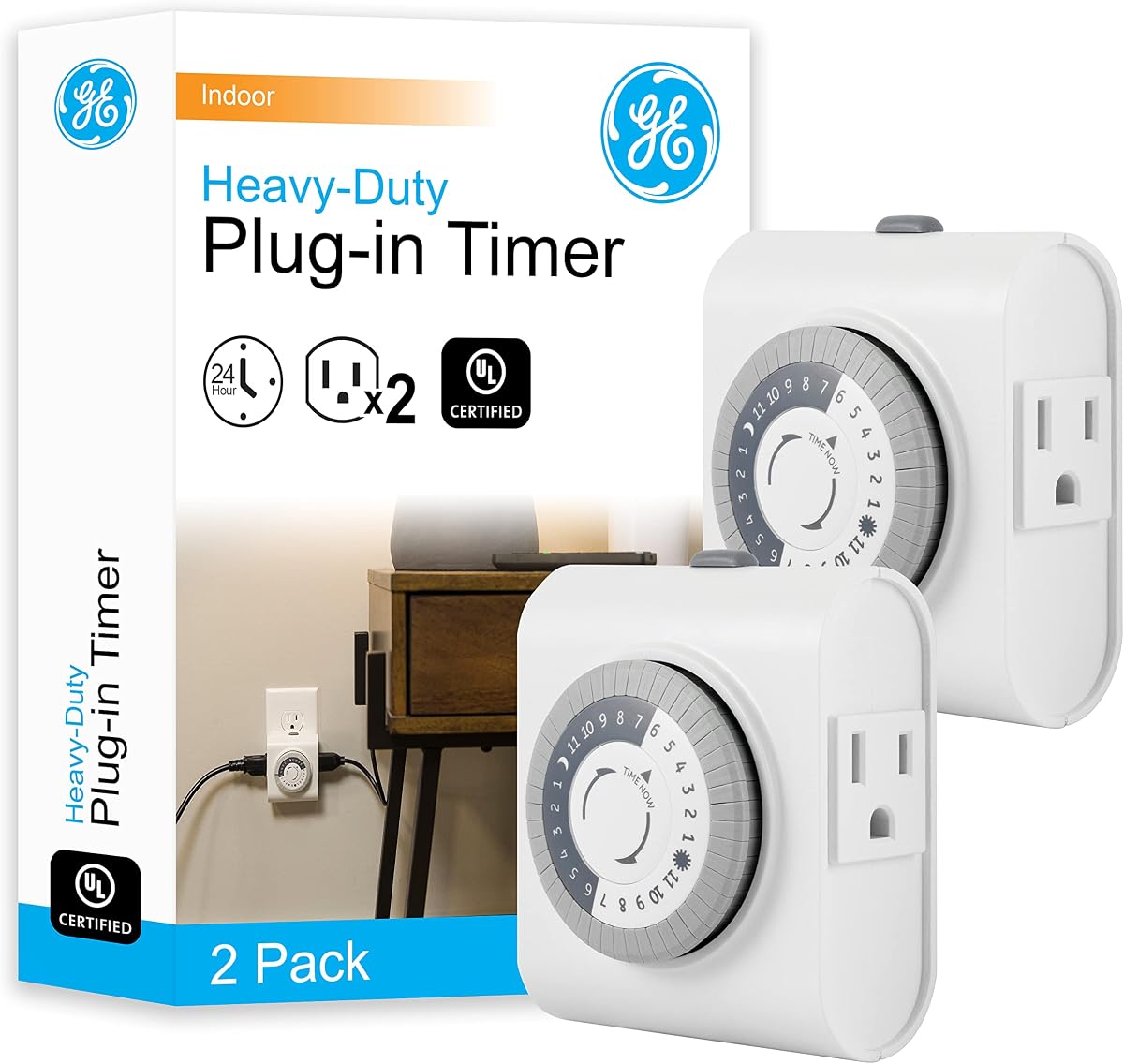
The GE 24-Hour Plug-in Mechanical Timer Outlet carries a 4.6 rating, the highest among the ten products listed, and combines familiar mechanical programming with two grounded outlets. Each timer can automate multiple three-prong devices at once, making it a practical option for paired lamps, seasonal decorations, or a light and small fan that should always share the same schedule.
We may earn a commission when you buy through this link, at no additional cost to you.
Setup uses 30-minute interval pushpins rather than a digital menu. That simplicity is one of the timer's strongest features. There is no Wi-Fi requirement, app download, or complicated programming sequence, which is beneficial for anyone who wants dependable automation without maintaining a connected network. The override switch also gives users a convenient way to pause the programmed cycle when they need to operate a connected device immediately.
The tradeoff is that both outlets on each timer are governed by the same daily pattern, and the 24-hour format cannot distinguish Monday from Saturday. If your lighting needs change throughout the week, a seven-day digital model would be more flexible. Its indoor-ready white design is intended to blend into home spaces, though buyers should confirm that the receptacle and connected loads meet the timer's requirements.
Overall, this is the most balanced mechanical option in the lineup. The dual grounded outlets reduce the need for additional timers, the 4.6 rating indicates strong customer satisfaction, and the override switch adds practical control. It is an excellent recommendation for everyday indoor lamps and recurring household routines, particularly when simplicity and shared outlet control matter more than remote access.
The dual-outlet layout gives users more control per wall position. Because both outlets are timed together, it works especially well when two compatible devices should follow exactly the same daily on and off cycle.
Pushpin programming keeps configuration intuitive and visible. The override control provides a quick manual exception, while the compact white housing suits everyday indoor installations.
We may earn a commission when you buy through this link, at no additional cost to you.
The BN-LINK Indoor 7-Day Programmable Digital Timer Outlet has a 4.4 rating and raises the scheduling level beyond a single repeating 24-hour cycle. It can store up to eight on and off programs, allowing users to select particular days or use preset day combinations. Its minimum interval is one minute, making it suitable for applications where half-hour mechanical timing would be too broad.
We may earn a commission when you buy through this link, at no additional cost to you.
Two grounded outlets are controlled simultaneously, so one programmed timer can operate a pair of compatible three-prong devices. The interface also includes a Daylight Savings mode, a helpful feature for anyone whose lighting routine changes with the clock. A long-lasting backup battery preserves the programmed settings if power is interrupted, and the listed Random Vacation mode can vary lighting activity to give the home a less predictable appearance while the owner is away.
This level of programming comes with more complexity than a pin-based timer. Users have to learn how individual days, preset combinations, programs, and the backup system work. The outlets remain synchronized rather than allowing each one to follow an independent schedule, so someone wanting two completely different patterns would need separate timers. As with any connected load, the manufacturer states a 120V, 60Hz, 15A, and 1725W rating.
The timer is best suited to households with a varied weekly rhythm, such as different lighting on workdays and weekends. It is also a strong choice for decorative lights that should not repeat exactly at the same time every day. For a user who wants precise schedules and outage memory but does not need internet control, this digital model offers a capable middle ground.
Individual day selection and preset combinations make it possible to create schedules that differ across the week. Eight program slots provide room for multiple lights, fans, or coffee makers without changing the core hardware.
The backup battery helps preserve the programmed schedule during a power failure. This reduces the need to reconstruct a complex timetable, while the red indicator on the two-pack version clearly shows outlet status.
We may earn a commission when you buy through this link, at no additional cost to you.
The BN-LINK Indoor 7-Day Programmable Digital Timer Outlet 2-Pack has a 4.4 rating and extends the flexibility of the seven-day design to two separate timer units. This makes it a practical choice for controlling lights in different rooms or scheduling unrelated devices such as holiday decorations in one area and a fan or coffee maker in another.
We may earn a commission when you buy through this link, at no additional cost to you.
Each timer supports up to eight on and off programs, selected days or preset combinations, and intervals as short as one minute. The two outlets on each unit operate simultaneously, so the two timers provide more placement flexibility than a single dual-outlet model without requiring completely separate programming styles. A Daylight Savings mode and a long-lasting backup battery further support unattended operation.
Random Vacation mode is another useful addition. It randomizes programmed light activity, which can make an occupied home appear less predictable during an absence. The product is ETL listed and carries a stated 120V, 60Hz, 15A, and 1725W rating. The red LED indicator provides visible confirmation when a timer's outlets are on, which helps with troubleshooting or routine checks.
The main limitation is that the two outlets attached to each timer remain synchronized. If one device needs to operate only in the morning and another only in the evening, they cannot use different schedules while sharing that unit. Buyers seeking completely independent outlet behavior should plan around one outlet per timer. Even with that limitation, the two-pack format provides substantial weekly scheduling capacity across separate areas.
Because each included timer can be programmed separately, the pack is useful in rooms or for devices with unrelated routines. This is more adaptable than using two outlets on a single timer when the devices do not need to operate together.
The on-state LED provides a quick visual status check. Combined with one-minute intervals, daily program selection, and backup memory, it offers precise control without a connected ecosystem.
We may earn a commission when you buy through this link, at no additional cost to you.
The GHome Smart Plug has a 4.4 rating and is the most connected product in this guide. Rather than relying solely on a local dial or display, it links to a compatible mobile application so a connected lamp, fan, humidifier, or Christmas light can be monitored and controlled from away. It also supports voice-command workflows involving Alexa or Google Assistant.
We may earn a commission when you buy through this link, at no additional cost to you.
Its scheduling functions can operate devices on a repeating circular pattern or a randomized pattern. That makes it useful when a fixed daily schedule is undesirable, particularly for holiday displays or a home-security impression while the owner is traveling. Group control lets several supported plugs respond with one action, and family sharing allows authorized household members to access the same setup. Compatibility with GHome, Smart Life, and Tuya applications gives users more than one route for managing the plug.
Connectivity requirements are the main consideration. The product supports Bluetooth or Wi-Fi, but its network connection is limited to 2.4GHz, so it will not directly use a 5GHz-only network. Alexa and Google Home integration also requires the plug to be connected to the network and configured through GHome first; it does not function as a direct voice-assistant device without that setup.
This smart plug is the best choice for users who value remote access and flexible scheduling more than a completely independent plug-in timer. It is particularly attractive for seasonal lights, fans, and other compatible devices that benefit from remote management. Users should ensure a stable 2.4GHz network is available and accept the dependence on app and network operation before choosing it over a mechanical or local digital model.
The companion app puts schedules and connected devices within reach while away. After initial network and app configuration, supported voice assistants can add another convenient way to operate compatible loads.
Circular schedules create repeatable routines, while random schedules reduce the predictability of an empty home. Grouping and sharing also make the plug easier to manage across a household with multiple supported devices.
We may earn a commission when you buy through this link, at no additional cost to you.
The TiFFCOFiO Indoor Mechanical Outlet Timer has a 4.4 rating and offers a direct, budget-conscious route to automatic lighting. The two-pack includes two three-prong timers, each with 48 on and off options across a 24-hour period. Every pin represents a 30-minute interval, allowing users to arrange multiple periods for lights, holiday decorations, or other compatible indoor devices.
We may earn a commission when you buy through this link, at no additional cost to you.
The operating principle is easy to understand: pull the relevant pins up for off and press them down for on. The schedule then repeats daily without a screen, app, or Wi-Fi connection. Its compact design places the output ports underneath, which can help conserve space around the receptacle and make the timer less intrusive in occupied outlets.
The model is ETL Listed and is marketed for indoor use. Its daily repeating schedule is suitable for many ordinary routines, but it cannot distinguish different days of the week or follow daylight automatically. Thirty-minute increments also cannot reproduce the one-minute precision offered by digital timers. Users should treat it as a simple daily scheduler rather than an advanced automation controller.
This pack is best for seasonal lights, a bedside lamp, or an indoor device that needs to follow the same schedule every day. Two units make it possible to automate two locations without buying separately, while the mechanical interface avoids ongoing app maintenance. It is a compelling budget pick for shoppers who prioritize a direct setup, visible schedule, and dependable daily repetition.
The pulled-up and pressed-down pins give users a clear visual representation of the daily schedule. This makes the timer approachable for people who prefer not to navigate a digital menu.
Two timers support separate rooms or devices, while the underside outlet placement helps maintain a compact profile. The result is a versatile pack for recurring indoor lighting needs.
We may earn a commission when you buy through this link, at no additional cost to you.
The DEWENWILS Indoor 24 Hour Programmable Digital Timer Outlet has a 4.5 rating and focuses on quiet, precise daily operation. It uses four control buttons to provide three repeating schedule groups: Always On, Auto, and Always Off. A side switch adjusts the mode, and the large display makes the selected status easier to identify at a glance.
We may earn a commission when you buy through this link, at no additional cost to you.
One of the timer's most useful qualities is silent operation, making it suitable for a bedroom where a mechanical relay noise could be distracting. It schedules to the minute and can retain programmed settings for up to three months if power is removed or disconnected. The compact body, smooth sides, and frosted front allow it to blend with a range of interior styles without dominating the outlet area.
Despite being digital, this model is designed around a repeating 24-hour routine rather than separate schedules for each weekday. That limitation keeps the controls manageable but makes it less suitable for users whose lighting needs vary substantially by day. Each timer also has one outlet, although the package includes two timers, so multiple devices require additional receptacle positions.
The listed electrical rating is 125V, 60Hz, 15A, and 1000W, and the three-prong format suits grounded plugs. It is offered for indoor holiday decorations, plant lights, indoor lights, and electronics. This is an appealing pick for bedrooms or quiet living spaces where precise timing, easy status checking, and retained settings matter more than remote access.
Silent switching makes the timer more suitable for bedrooms and other quiet rooms. Its display provides schedule feedback without requiring users to infer the mode from mechanical pins.
The stated three-month memory helps retain the configuration through a power interruption or disconnection. Minute-level timing and three daily modes add useful precision to a simple repeating schedule.
We may earn a commission when you buy through this link, at no additional cost to you.
The BN-LINK Outdoor 24-Hour Mechanical Timer Outlet has a 4.5 rating and is designed for exterior lighting where an indoor plug-in timer would be unsuitable. Its rainproof casing is intended to protect string lights, landscape lighting, porch decorations, and other outdoor devices. The instructions recommend mounting the unit upright at least two feet above the ground.
We may earn a commission when you buy through this link, at no additional cost to you.
Two grounded outlets allow one timer to control multiple compatible devices simultaneously. The 48-pin interface sets on and off times in 30-minute intervals, creating up to 48 daily options that repeat without an application. A master override switch provides a convenient way to bypass the programmed cycle for temporary control.
Unlike a dusk-to-dawn sensor, this model relies on the clock-based mechanical program. That makes it useful for lights that should operate during fixed hours even when darkness arrives early or late. The product is stated as ETL certified, rated for 125V and 15A, and capable of handling a one-half-horsepower load. Its pin settings are retained even if power fails.
This is a strong recommendation for yard displays, holiday lights, garden decorations, and other exterior schedules that remain consistent from day to day. It is less suitable for lighting that should begin precisely at dusk, since no photocell is listed. Buyers should follow the upright mounting guidance and ensure every connected outdoor device and extension setup is suitable for the location.
The rainproof enclosure and elevated upright mounting requirement distinguish this model from indoor timers. It is designed for exterior installations where lights need dependable daily operation.
Both grounded outlets follow the same daily pattern, making it convenient for grouped displays. The one-half-horsepower rating also supports compatible outdoor equipment beyond basic decorative strings.
We may earn a commission when you buy through this link, at no additional cost to you.
The G-Homa 24-Hour Mechanical Timer Outlet has a 4.4 rating and combines a clear dial-based schedule with two grounded outlets. It provides 48 on and off programs, with each pin representing a 30-minute interval. A master switch makes it possible to override the programmed behavior when a connected device needs immediate manual control.
We may earn a commission when you buy through this link, at no additional cost to you.
Its two-outlet arrangement is useful for lamps that should turn on and off together, paired holiday lights, or compatible devices around the home. The product information lists ratings of 125V, 60Hz, 15A, 1875W resistive, 1250W tungsten, and one-half horsepower. A troubleshooting note advises rotating the dial if a pin appears stuck and is not pressed down at the current-time position.
This is a basic 24-hour model rather than a programmable seven-day unit. It cannot assign a unique timetable to each weekday, although users can adjust the pins as needed. The 30-minute increments are sufficient for many lighting routines but not for appliances requiring shorter or more exact timing. It also lacks remote monitoring and voice-control features.
The G-Homa timer suits shoppers who want one visible mechanical schedule controlling multiple indoor devices. It may be particularly useful for holiday lights, bedside lamps, or a pair of lights that always need to operate in unison. Its approachable controls and override switch reduce the learning curve, while the dual outlets improve installation flexibility.
The dial and pins make the programmed routine visible and easy to adjust. A top-mounted override switch gives users a quick way to interrupt automation without dismantling the timer.
Both grounded outlets follow one schedule, which is ideal for coordinated lights. The stated load ratings also make the unit more broadly applicable than a decoration-only controller.
We may earn a commission when you buy through this link, at no additional cost to you.
The TiFFCOFiO Outdoor Timer Outlet has a 4.3 rating and offers an alternative to clock-based scheduling through its built-in photocell. It automatically switches connected outdoor devices according to detected light, making it well suited to Halloween decorations, Christmas lights, yard lighting, garden decorations, and compatible pool pumps.
We may earn a commission when you buy through this link, at no additional cost to you.
The selector provides eight countdown functions that turn devices on at dusk and then off after 2, 4, 5, 6, 7, 8, 9, or 10 hours. It also includes always-on and always-off switch positions, along with a dusk-to-dawn mode that activates at dusk and deactivates at dawn. These choices allow the same unit to handle all-night displays, a timed evening window, or continuous operation.
Its weatherproof construction is intended to withstand outdoor conditions and cold. To preserve performance, the manufacturer recommends mounting it vertically at least two feet above the ground. The two grounded outlets provide capacity for multiple three-prong devices, while the stated 15A and one-half-horsepower rating supports appropriate outdoor loads. The timer is ETL Listed and does not require an app or complicated programming.
This model is best for users who want lights to respond naturally to darkness instead of following a fixed clock. Its main limitation is that the photocell cannot schedule a device to start before dusk, and a countdown duration cannot extend beyond the longest listed period. For seasonal displays and overnight exterior lighting, however, it provides a convenient and weather-oriented solution.
The photocell removes the need to estimate sunset or manually activate outdoor lights. Dusk-to-dawn and timed countdown modes cover different overnight operating patterns.
Waterproof materials and a two-grounded-outlet layout suit exterior displays. Vertical mounting at least two feet above ground helps maintain the stated weather-resistant performance.
We may earn a commission when you buy through this link, at no additional cost to you.
Choosing an automatic light timer means balancing the schedule you need with the installation environment, outlet design, control method, and electrical requirements. The following factors help narrow the field before comparing individual models.
Mechanical timers are best when the same routine should repeat every day. Their pins or dial make the schedule easy to inspect, and they continue working without an app or network. A 24-hour model is appropriate when on and off times remain constant, while a seven-day digital timer is better when weekdays, weekends, or individual days require different patterns. Sensor-based timers serve a different need: they activate at dusk rather than at a preset clock time. Smart plugs add the greatest flexibility because schedules can be created or adjusted through an application and may repeat circularly or randomly.
An indoor timer should not be assumed suitable for a wet exterior location. Outdoor models feature weather-resistant or waterproof enclosures intended to protect the internal components when mounted according to the manufacturer’s instructions. The BN-LINK Outdoor and TiFFCOFiO sensor models specifically direct users to mount the unit vertically and at least two feet above the ground. Indoor models may have smaller housings designed to blend into living spaces, but that attractive appearance does not translate into weather resistance.
The number of controlled outlets affects installation convenience. A two-outlet timer can run two compatible plugs together, reducing the need for extra wall receptacles. However, those outlets are generally synchronized, so both devices must accept the same schedule. A one-outlet model can be preferable when a single device needs control and preserving access to an adjacent socket matters. Packs with two separate timers offer another approach: they can be placed in different rooms and programmed independently while still providing useful outlet capacity within each timer.
Mechanical models in this roundup generally operate in 30-minute intervals. That is appropriate for lighting that does not need to change during a typical hour. Digital timers can offer finer resolution, with some models supporting intervals as short as one minute. Finer timing is useful for coffee makers or other routines with precise starting points, but it does not make a timer suitable for every appliance. The connected GHome plug also supports app-created schedules and randomized patterns. Buyers should match timing precision to the device and avoid treating any outlet timer as automatically appropriate for high-draw equipment.
Every selected timer has a stated voltage, frequency, current, and wattage framework. Some listings also distinguish resistive, tungsten, ballast, and horsepower limits. These figures matter because a timer is both a switch and a power-distribution enclosure. A three-prong timer requires a grounded receptacle, while two-outlet models may occupy more of the receptacle face. Compare the connected device with the manufacturer’s limits and avoid exceeding them. The supplied data also mentions ballast, tungsten, and motor-type limits on several products, so a lighting-only use case should not be treated as permission for every appliance.
Override switches offer immediate manual control over a scheduled outlet. This is particularly helpful when a device needs to be turned on outside its programmed hours without unplugging and reprogramming the timer. Digital models add another layer of resilience through backup memory, with the BN-LINK options using a long-lasting battery and the DEWENWILS model stating up to three months of retention. Mechanical pin models can also preserve their settings through a power interruption. These features matter most for recurring schedules because they reduce the chance that an interruption or temporary override will disrupt the routine.
A smart plug is valuable when remote control, shared household access, or randomized operation is important. It also introduces network and app requirements, including a stable 2.4GHz Wi-Fi connection for the GHome model. Mechanical and digital timers remain local devices, which many users may prefer for simplicity and independence. Before paying for connected functionality, consider whether you truly need to change a schedule while away. If the main goal is a fixed lighting routine, a local timer may deliver the same result with fewer setup requirements.
The physical design should match the outlet location. Compact mini models reduce the space consumed around a receptacle, while digital housings may offer a larger display for easier status checks. Models with output ports underneath can preserve access to neighboring outlets. Outdoor timers need enough clearance from the ground and a stable upright mounting point. Think about whether the schedule must be visible at a glance, whether furniture can block the device, and whether cords will fit without creating a trip hazard or preventing doors and furniture from sitting flush.
Begin by confirming that the timer, receptacle, and connected device are compatible. Read the included instructions, identify the current-time dial or digital clock, and set the correct time before configuring on and off periods. Mechanical users should pull the pins up and move them in 30-minute steps, while digital users should select the relevant days and programs. Smart plugs should first be connected to a stable 2.4GHz network and configured in the compatible application.
Test the schedule before relying on it over a full day. Keep the connected device in place, manually invoke or observe the first switching event, and make sure the timer does not exceed its stated electrical limits. For outdoor equipment, mount the timer vertically at the recommended height and use suitable weather-rated connections. Do not assume an indoor extension arrangement or plug is suitable for an outdoor installation.
Care for the timer by keeping it unplugged when cleaning and by avoiding moisture around indoor electronic controls. Follow the manufacturer’s instructions for battery replacement in digital models and periodically confirm that scheduled events still occur. If a mechanical pin seems stuck, do not force it; consult the troubleshooting guidance and ensure the dial is not positioned incorrectly. Review the current product instructions whenever an outlet, plug, or connected appliance changes.
Mechanical timers are usually simpler and better suited to a routine that repeats at the same time every day. Digital timers are preferable when you need different schedules for different days, finer timing resolution, or backup memory. Choose based on scheduling complexity rather than assuming one technology is automatically better in every home.
Several models include two outlets, allowing two compatible plugs to operate together. The connected devices generally follow the same schedule because the outlets are synchronized. If each device needs an independent routine, use separate timers or a model with programmable individual outlets.
Outdoor-rated models are designed with weather-resistant or waterproof construction, but correct mounting remains important. The listed outdoor timers specify vertical placement at least two feet above the ground. Also confirm that the connected cords, plugs, and devices are suitable for outdoor exposure.
A scheduled mechanical timer switches on and off at programmed clock times. A dusk-to-dawn timer uses a photocell to detect darkness and activate the connected devices, then either turns them off at dawn or after a selected countdown period. The sensor option is convenient when sunset and sunrise times vary.
Only if the product listing permits that type of load and the device remains within the stated electrical limits. Some digital models specifically list coffee makers and fans among compatible devices. Check voltage, amperage, wattage, and any special motor or resistive-load requirements before connecting an appliance.
That depends on the model. The BN-LINK digital timers use a long-lasting backup battery, while the DEWENWILS model states that programmed settings can be preserved for up to three months. The outdoor mechanical model retains its pin settings. After an outage, check the displayed or dial time before assuming the full schedule is synchronized.
The GHome Smart Plug listed here supports only a 2.4GHz Wi-Fi network for its Wi-Fi connection. A stable 2.4GHz signal is needed for reliable remote access. It also supports Bluetooth during setup, but the product must still be connected through the network and application before voice-assistant control is available.
For a mechanical timer, rotate the dial to the current time and wait for the mechanism to establish the cycle before setting the pins. For a digital timer, use the controls or application to set the current date and time accurately. Confirm that a programmed event occurs as expected before leaving the schedule unattended.
The GE mechanical timer stands out as the strongest all-around option because its 4.6 rating, two grounded outlets, simple pushpin setup, and override control cover common indoor needs without unnecessary complexity. The TiFFCOFiO indoor mechanical two-pack is a value-focused alternative, while the GHome Smart Plug is the most capable connected selection for remote and randomized scheduling.
Prioritize the type of repetition your lighting actually needs. Choose a mechanical model for a fixed daily routine, a seven-day digital model for weekday differences, an outdoor mechanical model for fixed exterior hours, or a photocell model for automatic dusk activation. Outlet count, power ratings, installation space, and electrical compatibility should be checked before control features.
Prices, availability, and manufacturer details can change, so review the current listing before buying. Confirm the latest schedule settings, package contents, load limits, and installation guidance, especially when using outdoor devices, high-wattage lamps, motors, or smart plugs that depend on a 2.4GHz network.