
ASRock DeskMeet B760
5.0Editor score
Eight-liter desktop capacity
Discrete graphics support
Four DDR4 memory slots
PCIe 4.0 storage support
Compare 10 Barebone Gaming Pcs, with key specifications, product ratings, pros and cons to help you choose.
Barebone gaming PCs offer a compelling way to build a compact, tailored gaming system without paying for components you may already own or plan to select yourself. A good barebone kit provides a compatible chassis, motherboard, and power delivery, while leaving the processor, memory, storage, operating system, and sometimes graphics to the buyer.
This guide compares ten barebone and compact gaming-oriented desktop options across processor support, memory capacity, storage expansion, graphics readiness, display connectivity, networking, cooling, and physical size. The list includes traditional mini PCs, larger eight-liter systems, modern systems with OCuLink external graphics support, and one complete gaming PC included for comparison with fully assembled alternatives.
Each review highlights the strongest reasons to consider the system, along with the components you must source separately and the compromises that may affect a build. Ratings reflect the supplied customer feedback and do not represent hands-on testing by the author. Product configurations, bundles, and pricing can change, so verify the current listing and component compatibility before purchasing.
5.0Editor score

4.5Editor score

3.9Editor score
The comparison below places the ten systems side by side, emphasizing their processor platforms, memory options, graphics paths, and compact form factors. The list mixes do-it-yourself barebones with one fully equipped CyberPowerPC, making clear which products require additional components before they can be used.



The ASRock DeskMeet X300 is an eight-liter barebone kit built around the AMD AM4 platform, offering an unusual degree of flexibility for a compact gaming desktop. It carries a 4.8 customer rating, and its defining strength is the ability to use a broad selection of Ryzen 2000, 3000, 4000 G-Series, 5000, and 5000 G-Series processors up to 65W.
We may earn a commission when you buy through this link, at no additional cost to you.
Four DDR4-3200 memory slots support as much as 128GB, which is unusually generous for a small system and allows buyers to use multiple modules without being restricted to a laptop-style two-slot layout. Storage is also flexible, with an Ultra M.2 PCIe Gen3 x4 position and two SATA3 connections. For gaming performance beyond integrated graphics, the PCIe 3.0 x16 slot opens the door to a discrete desktop graphics card.
The older PCIe generation and AM4 platform are the main limitations. Newer graphics cards and AM5 processors generally rely on faster interfaces, so this kit is better suited to value-conscious builders with compatible hardware than to someone seeking the newest platform. The supplied 500W 80 Plus Bronze power supply simplifies assembly, but buyers must still select a CPU, memory, storage, operating system, and possibly a graphics card and CPU cooler.
This is an excellent choice for someone who understands the second-hand and component-matching side of PC building but wants a compact, serviceable chassis rather than a typical tower. It is especially attractive when an affordable AM4 processor and suitable DDR4 memory are already available. Verify GPU length, cooler height, and operating system requirements before ordering, but the X300 offers a capable and unusually expandable base for small gaming builds.
Four DDR4 slots make this system easier to populate with a balanced multi-module configuration. That can benefit memory bandwidth, multitasking, and future headroom, although users should still verify the motherboard's supported memory configuration before mixing modules.
The full-length PCIe 3.0 x16 slot is the decisive feature for gaming. It permits a desktop GPU when integrated graphics are insufficient, making the DeskMeet X300 more versatile than many similarly compact barebones limited to integrated graphics or external docks.
We may earn a commission when you buy through this link, at no additional cost to you.
The AOOSTAR MACO combines a Ryzen 7 PRO 8845HS processor and Radeon 780M graphics with a broad collection of high-speed ports in a compact barebone platform. Its supplied 4.0 rating reflects a promising but less universally praised configuration, while its specification sheet is aimed at gamers, creators, and professionals who want strong integrated performance with a path to external graphics.
We may earn a commission when you buy through this link, at no additional cost to you.
The processor provides eight cores, 16 threads, a 3.8GHz base clock, and boost speeds up to 5.1GHz within a maximum 65W thermal envelope. Two DDR5 SO-DIMM slots support up to 128GB, while dual PCIe 4.0 x4 M.2 positions offer substantial internal storage expansion. The standout gaming feature is the dedicated OCuLink port, which can connect an external GPU over a high-bandwidth PCIe path rather than relying on USB4.
Connectivity is unusually extensive. There are two USB4 ports with 40Gbps data transfer, 100W reverse power delivery, and triple-display capability, plus HDMI, DisplayPort, two 2.5G Intel LAN ports, WiFi 6, and Bluetooth 5.2. A vapor chamber, turbo fans, and fin-based heat dissipation support sustained workloads. The trade-off is that this is not a conventional gaming chassis with an internal expansion card slot, and buyers need an appropriate OCuLink enclosure or dock for a powerful external GPU.
Choose the MACO if you want a portable, modern platform with strong CPU performance, abundant connectivity, and occasional access to a much more powerful graphics solution. It is less suitable for a conventional fixed gaming build where internal full-size GPU support is the priority. Confirm the dimensions, external GPU enclosure requirements, and barebone contents before making the final decision.
Dual USB4, dual 2.5G Ethernet, and wireless networking make this more than a simple gaming box. The ports can support a broad collection of high-resolution displays, fast storage, wired network paths, and accessories without relying on a larger desktop motherboard.
OCuLink gives the MACO a more direct route for an external GPU than USB4-based docks. That makes it appealing for portable gaming, but an enclosure, suitable graphics card, and careful attention to bandwidth and power requirements remain part of the build.
We may earn a commission when you buy through this link, at no additional cost to you.
The AOOSTAR GEM12+ stands out as a flexible compact PC with a Ryzen 7 PRO 8845HS, Radeon 780M graphics, and an OCuLink port. Its 4.5 rating places it among the stronger-reviewed options in this list, while the broad feature set makes it suitable for a gaming desktop that also doubles as a productivity or content-creation machine.
We may earn a commission when you buy through this link, at no additional cost to you.
The eight-core, 16-thread processor boosts to 5.1GHz and combines with Radeon 780M graphics rated at a 2700MHz graphics frequency, AV1 decoding, and an advertised AI performance of up to 16 TOPS. Two DDR5-5600 SO-DIMM slots accept up to 128GB, while dual M.2 2280 positions support PCIe 3.0 or 4.0 storage and a combined maximum of 8TB. Silent, balanced, and performance BIOS modes let the owner tune the power profile.
OCuLink is the key gaming-oriented feature because it operates on an independent 64Gbps channel without occupying an M.2 slot. It can support high-performance external GPUs with less restriction than USB4, although the port must not be hot-swapped. The system also offers two USB4 connections, HDMI 2.1, DisplayPort 1.4, dual 2.5G Intel LAN, WiFi 6, Bluetooth 5.2, and support for four simultaneous 4K displays.
The GEM12+ is our Editor's Choice because it balances a capable processor, modern integrated graphics, serious connectivity, flexible BIOS modes, and an external graphics path without becoming as large as a traditional tower. It is an excellent fit for a compact, highly connected build with a dedicated OCuLink enclosure. As a barebone, it requires separate memory, storage, and an operating system, so buyers should budget the entire configuration rather than treating the chassis as a finished gaming PC.
The three BIOS modes are valuable because the same system can favor quieter operation during lighter tasks or unlock a higher sustained power profile for gaming and work. Owners gain a degree of control often associated with larger enthusiast desktops.
HDMI 2.1, DisplayPort 1.4, and two USB4 connections support a four-screen 4K arrangement. That makes the GEM12+ useful for a compact gaming station, streaming setup, trading desk, or creative workstation where integrated graphics and display flexibility matter.
We may earn a commission when you buy through this link, at no additional cost to you.
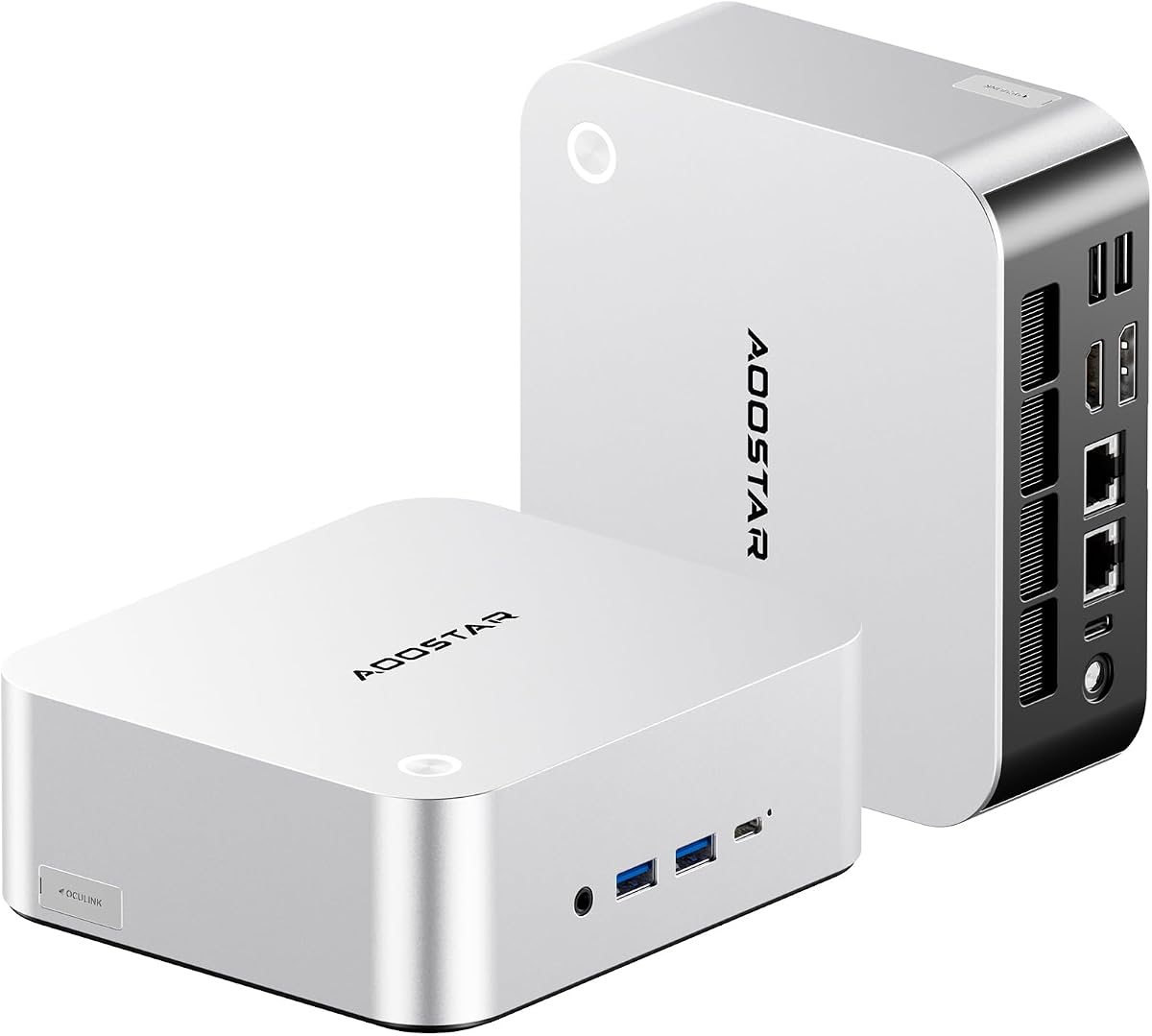
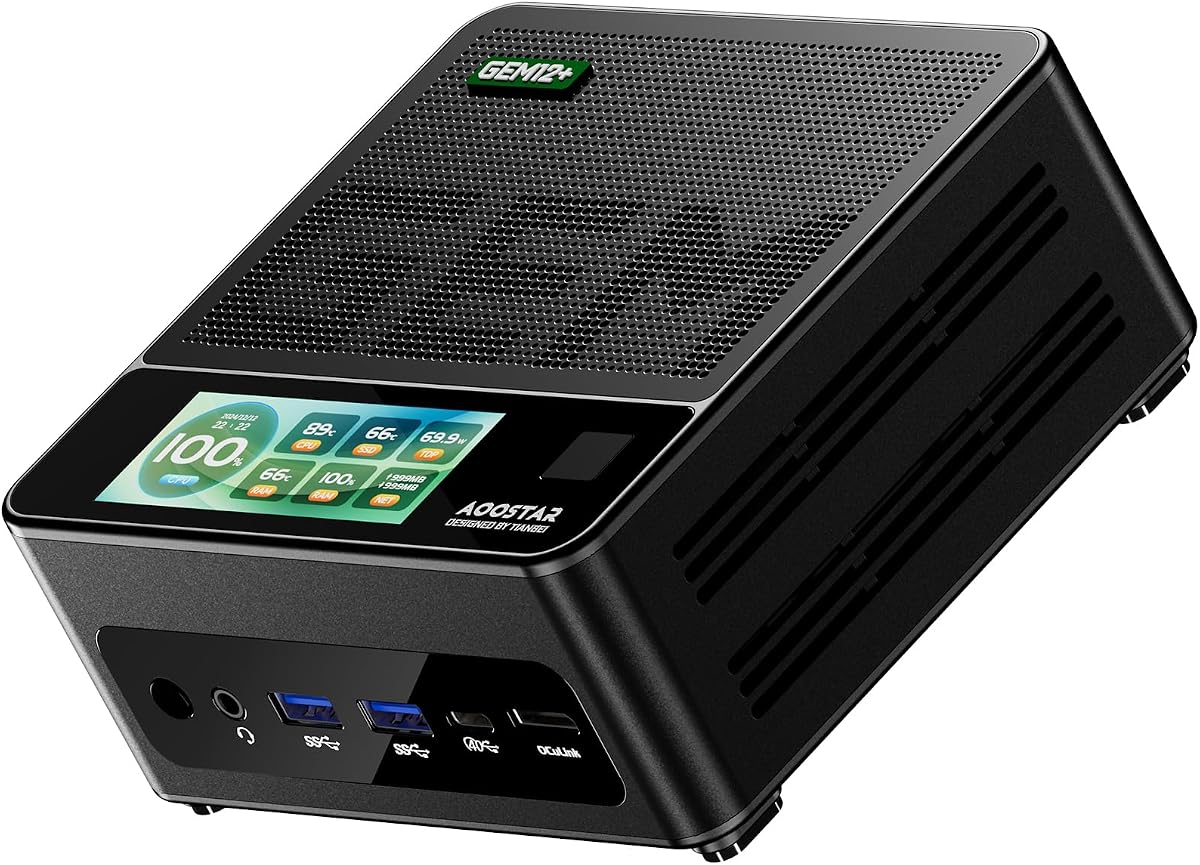
The AOOSTAR GEM12+ PRO takes the familiar 8845HS platform and adds visible design and convenience features. Its built-in display can show CPU, GPU, and RAM information or custom background images, while fingerprint recognition provides a quick alternative to typed passwords. The system has a 4.1 rating and is positioned for home-office gaming as well as compact professional use.
We may earn a commission when you buy through this link, at no additional cost to you.
Core performance comes from the eight-core, 16-thread Ryzen 7 PRO 8845HS with boost speeds up to 5.1GHz and Radeon 780M graphics. Silent, balanced, and performance modes are available through BIOS controls, while dual DDR5-5600 slots support up to 128GB and dual M.2 2280 slots support up to 8TB of storage. A vapor chamber and CPU fan form the primary cooling system.
Its gaming upgrade path is provided by a dedicated 64Gbps OCuLink port. This independent channel can connect an external GPU such as an RTX 4070 or RTX 4080 with minimal performance loss, as described in the supplied product information. The system also includes two USB4 ports, HDMI 2.1, DisplayPort 1.4, dual 2.5G Intel LAN, WiFi 6, Bluetooth 5.2, and support for four simultaneous 4K screens.
The PRO version is most compelling for someone who values its integrated display, fingerprint reader, refined connectivity, and external GPU capability more than traditional internal expansion. It remains a barebone, so memory, storage, and an operating system must be acquired separately, and the external graphics route requires additional hardware. Buyers should power the system down before connecting or disconnecting OCuLink because hot-swapping is not supported.
The customizable display turns system monitoring into a permanent desktop feature rather than something that requires opening software. It can show hardware activity or personal images, making the chassis feel more like a polished personal computer than a generic enclosure.
Fingerprint recognition reduces the friction of repeated logins while avoiding the need to remember a complex password. It is a small feature, but particularly convenient for a compact system intended to sit within easy reach on a desk.
We may earn a commission when you buy through this link, at no additional cost to you.
The ASRock DeskMeet B760 is an eight-liter barebone that combines a familiar Intel platform with a full-size discrete graphics option. Its perfect 5.0 supplied rating makes it the most favorably reviewed product here, and the combination of PCIe 4.0 x16 expansion, four DDR4 slots, and an installed 500W power supply gives it broad appeal as a budget-oriented gaming foundation.
We may earn a commission when you buy through this link, at no additional cost to you.
The motherboard supports 12th, 13th, and 14th Gen Intel Core processors on LGA1700. Four DDR4 DIMM positions support up to 128GB at speeds up to 3200MHz. Storage includes two Hyper M.2 positions with PCIe Gen4 x4 support and three SATA3 connections for larger or secondary drives. The graphics slot can accept a dual-slot card up to 20 centimeters long, subject to the chassis's physical limits.
Connectivity is appropriately modern for this platform, with front USB 3.2 Gen1 Type-C, multiple USB 3.2 Gen1 and USB 2.0 ports, and DisplayPort, HDMI, and D-Sub outputs. An M.2 Key-E position makes the system wireless-ready. The preinstalled 500W 80 Plus Bronze unit, advertised with a 550W peak, simplifies the build and reduces the need for a separate power supply.
Our Best Budget selection is not the least expensive complete computer, but it balances enclosure, platform, expansion, and customer feedback in a package that can be configured around different budgets. It suits a builder who wants a compact traditional gaming PC with a discrete GPU and already understands PC assembly. Confirm the exact CPU, cooler height, GPU dimensions, memory type, and storage hardware before purchasing.
Unlike systems that rely exclusively on integrated graphics or an external dock, the DeskMeet B760 provides an internal PCIe 4.0 x16 slot. This makes it easier to choose a current gaming GPU without adding an external enclosure to the build.
Four DIMM slots provide more flexibility than the two slots common in mini PCs. Users can choose a dual-channel kit without using every slot or plan additional memory later, subject to the board's supported configurations and operating system limits.
We may earn a commission when you buy through this link, at no additional cost to you.
The CyberPowerPC Gaming PC is the list's fully assembled gaming alternative, built around an AMD Ryzen 5 5500 and Radeon RX 6500 XT 4GB. It has a 4.0 rating and includes Windows 11 Home, so it answers a different question from the other systems: not how to configure a barebone, but whether a ready-made compact gaming PC makes more sense.
We may earn a commission when you buy through this link, at no additional cost to you.
The Ryzen 5 5500 operates at 3.6GHz across six cores and is paired with an AMD B550 chipset, 8GB of DDR4 memory, and a 500GB PCIe 4.0 NVMe solid-state drive. The Radeon RX 6500 XT provides dedicated graphics with HDMI and DisplayPort output, while a tempered side panel and custom RGB lighting give the case a recognizable gaming appearance.
The package also includes a keyboard and mouse, four USB-A 3.2 ports, four USB-A 2.0 ports, one LAN connection, WiFi 5, Bluetooth 5.0, and 7.1-channel audio. A one-year parts and labor warranty and lifetime technical support add value for a buyer who does not want to assemble or troubleshoot a system independently.
This is the practical choice for someone who wants a gaming PC without sourcing a processor, memory, storage, operating system, graphics card, or peripherals. It is also a useful benchmark against the barebones, whose apparent value must be evaluated alongside the additional assembly work and component cost. The eightGB memory is modest for modern multitasking, so buyers who need more should confirm whether the manufacturer supports upgrades.
A fully assembled system removes the most time-consuming parts of a barebone build. It is particularly useful for gamers who already know the desired components but do not want to research case compatibility, install an operating system, or assemble the hardware themselves.
This system demonstrates what a complete package includes: processor, graphics, memory, storage, operating system, networking, audio, keyboard, and mouse. Comparing that package with the component requirements of each barebone makes the true convenience difference easier to understand.
We may earn a commission when you buy through this link, at no additional cost to you.
The BRENUC NUC 11 Extreme is a compact barebone with a particularly strong expansion story. It carries a 5.0 customer rating and pairs the Intel Core i9-11900KB with a PCIe 4.0 x16 gold-finger expansion connection, allowing a high-performance dual-slot graphics card up to 12 inches long to be used.
We may earn a commission when you buy through this link, at no additional cost to you.
The processor has eight cores and 16 threads, runs from 3.3GHz to a listed 5.0GHz turbo frequency, includes 24MB of cache, and operates at 65W. Integrated Intel UHD Graphics handles basic output. Two DDR4-3200 SO-DIMM slots support up to 64GB, while three M.2 Key M positions provide considerable storage flexibility: one CPU-attached PCIe 4.0 x4 NVMe position and two chipset-attached PCIe 3.0 x4 positions that can also use SATA3 SSDs.
Connectivity includes two Thunderbolt 4 ports, a 2.5Gb Intel Ethernet port, HDMI 2.0b, six USB 3.2 Gen2 Type-A ports, additional internal USB headers, an M.2 Key E wireless position, and support for three 4K displays. Intel WiFi 6E and Bluetooth 5.2 are also specified. The supplied information notes that original packaging may have been opened for inspection or upgrade installation, with defects and blemishes reduced through inspection and testing.
This NUC-style platform is a good fit for a compact workstation that may later receive a full-size GPU, particularly when a high-core-count processor and abundant ports are priorities. It is less forward-looking than newer platforms because it uses 11th Gen Intel silicon and DDR4, but the mature architecture can still be practical. Confirm physical GPU clearance, cooling demands, and the condition of the particular unit before ordering.
The PCIe 4.0 x16 gold-finger connector is unusual in a mini PC and supports dual-slot cards up to 12 inches. It creates a path to gaming performance that many small systems require an external enclosure to achieve.
Three M.2 positions allow a system to combine a fast CPU-attached drive with additional storage elsewhere. For a gaming library, this makes it easier to separate the operating system, active games, and large media files across multiple NVMe or SATA3 SSDs.
We may earn a commission when you buy through this link, at no additional cost to you.
The ASRock DeskMini 310W prioritizes an extremely small footprint over modern platform breadth. Its two-liter Mini-STX enclosure measures 155 by 155 by 80 millimeters and supports Intel 9th and 8th Gen LGA1151 processors, including Core, Pentium, and Celeron chips. Its 4.2 rating reflects an established platform with a loyal niche around compact builds and media-center use.
We may earn a commission when you buy through this link, at no additional cost to you.
Memory is handled by two DDR4 SO-DIMM slots with a maximum capacity of 64GB. Storage includes an Ultra M.2 PCIe Gen3 x4 slot that can also carry a SATA 6Gb signal, plus two SATA3 bays for 7mm or 9.5mm 2.5-inch drives. A front USB 3.1 Gen1 Type-C port provides modern device connectivity, while an M.2 2230 position supports CNVi-compatible wireless modules.
Display output includes DisplayPort, HDMI, and D-Sub, with support for two displays simultaneously according to the supplied information. The system is also ready for a VESA mount, making it possible to place the computer behind a compatible display. The major limitation is platform age: LGA1151 components, DDR4 memory, and PCIe 3.0 storage are established technologies rather than current high-end platforms.
The DeskMini 310W makes the most sense for a compact, moderate-power build using compatible components the buyer may already own. It is less appropriate for a new enthusiast system centered on the latest processors or graphics. Since the listing title contains conflicting memory wording, the detailed compatibility information should be treated as the governing guidance: a maximum of 64GB across two DDR4 SO-DIMM slots.
At just two liters, the DeskMini 310W takes up very little desk space. VESA mounting support can further reduce visual clutter by attaching it behind a display, making it practical for office, living-room, and compact workstation setups.
DisplayPort, HDMI, and D-Sub provide options for different display equipment, while the front Type-C connector simplifies modern peripheral use. That mix is still useful when reusing an existing monitor collection or building around older and newer accessories.
We may earn a commission when you buy through this link, at no additional cost to you.
The MINISFORUM X1 Lite-255 combines a Ryzen 7 255, Radeon 780M graphics, OCuLink support, and a broad set of display and network connections. It has a 3.9 rating, the lowest among the listed products, but its specification sheet is among the most forward-looking. That combination earns a place as the premium option for buyers who value a modern, well-connected compact platform.
We may earn a commission when you buy through this link, at no additional cost to you.
The Ryzen 7 255 uses Zen 4 architecture with eight cores, 16 threads, a 16MB L3 cache, and boost speeds up to 4.9GHz. Two DDR5 SO-DIMM slots support up to 128GB at frequencies up to 5600MHz. Dual M.2 2280 PCIe 4.0 x4 positions accept up to 4TB each, while Radeon 780M provides integrated graphics suitable for general productivity, media, and lighter gaming.
Display flexibility is a major strength. HDMI 2.1 FRL, USB4, and DisplayPort 1.4 can drive three independent displays, with listed maximum resolutions reaching 8K at 60Hz or 4K at higher refresh rates. The full USB4 port transfers data at up to 40Gbps and supports host power input plus a stated 15W external output function. Networking includes 2.5G Ethernet, WiFi 6E, and Bluetooth 5.2, alongside five USB ports.
OCuLink provides a PCIe 4.0 x4 connection at 64Gbps for an external GPU, potentially using a dedicated enclosure such as the MINISFORUM DEG1. Unlike dedicated implementations on some competitors, the supplied information states that this OCuLink arrangement requires an included adapter plate and occupies one M.2 2280 PCIe 4.0 x4 storage slot. A three-dimensional airflow design, a phase-change-material CPU fan, and a lower cooling fan support sustained performance.
Three independent display outputs with high refresh-rate options make the X1 Lite-255 appealing for gaming, creative work, and command-center setups. The mix of HDMI 2.1, DisplayPort 1.4, and USB4 gives the builder several ways to connect displays and accessories.
Dual PCIe 4.0 x4 M.2 slots provide very fast storage, but the OCuLink implementation uses one of those positions when an external GPU is connected. Builders using OCuLink should plan the storage layout accordingly and confirm the adapter arrangement before assembly.
We may earn a commission when you buy through this link, at no additional cost to you.
The ASRock DeskMini B760 is an ultra-compact barebone focused on modern storage, flexible display connections, and a current Intel processor platform. Its 4.3 rating reflects solid customer feedback, while the platform supports 12th, 13th, and 14th Gen Intel Core processors up to a 65W TDP.
We may earn a commission when you buy through this link, at no additional cost to you.
Storage is the standout specification. One Blazing M.2 slot uses PCIe 5.0 x4 for a next-generation NVMe SSD, while an additional Hyper M.2 position uses PCIe 4.0 x4. Two 2.5-inch bays provide room for conventional SATA storage and support RAID 0 or RAID 1 configurations. Two DDR4-3200 SO-DIMM slots accept up to 64GB, enough for many gaming builds but less than some competing barebones.
The DeskMini includes DisplayPort, HDMI, and D-Sub for multiple monitor arrangements. Its USB selection includes a USB 3.2 Gen2x2 Type-C port rated at 20Gbps, a USB 3.2 Gen2 Type-C port rated at 10Gbps with Alt Mode, and USB 3.2 Gen2 Type-A connections. An M.2 Key-E slot provides wireless capability when populated with a suitable module.
This is a strong option for a compact general-purpose gaming system that benefits from fast NVMe loading and will primarily use integrated graphics. Unlike the larger DeskMeet B760, it does not provide a conventional internal graphics slot, so demanding gaming may require a more capable CPU or an external solution not specified in the supplied information. Check the case dimensions, cooling, and display needs carefully before choosing components.
The primary Blazing M.2 position supports PCIe 5.0 x4, making it one of the more storage-forward barebones in this list. It can benefit game launch times, content creation workflows, and large project files when paired with a compatible high-performance NVMe drive.
The ultra-compact footprint is suitable for a home office, media center, or space-constrained gaming station. DisplayPort, HDMI, and VGA provide broad monitor compatibility, while high-speed Type-C connections simplify modern accessory use.
We may earn a commission when you buy through this link, at no additional cost to you.
Choosing a barebone gaming PC means balancing processor support, graphics options, memory, storage, connectivity, physical size, and the cost and effort of sourcing missing components. The most important decision is whether you want a traditional compact chassis with internal graphics expansion or a smaller system designed around integrated graphics and OCuLink.
Start with the processor socket and generation because it determines which CPUs you can install, which memory type is required, and how much performance is realistically available. The ASRock systems in this guide support Intel LGA1700 or the older LGA1151 platform, while the AMD-based ASRock DeskMeet X300 supports AM4. AOOSTAR and MINISFORUM models pair Ryzen processors with integrated Radeon 780M graphics, reducing the need for a separate graphics card in suitable games.
Check power limits as well as socket compatibility. Several systems are designed around 65W processors, which favors strong efficient chips but can exclude higher-power desktop parts. The processor also influences cooling needs, and compact systems generally benefit from a low-profile or suitably short cooler. Always verify the exact supported list rather than assuming that every processor in a generation will work.
Decide early how the system will handle demanding games. The ASRock DeskMeet X300, DeskMeet B760, and BRENUC NUC 11 Extreme provide internal full-length expansion options suitable for desktop graphics cards. Smaller systems such as the AOOSTAR GEM12+, GEM12+ PRO, MACO, and MINISFORUM X1 Lite-255 use Radeon 780M or Intel UHD graphics and offer OCuLink for an external GPU upgrade.
OCuLink offers a direct high-bandwidth PCIe connection, but it requires a compatible enclosure, suitable power delivery, the correct adapter arrangement, and careful port management. It also cannot be assumed to match the performance of the same GPU in a conventional desktop chassis. For the most predictable gaming results, an internal graphics slot is usually simpler, while external graphics is attractive for portability and occasional upgrades.
Memory capacity affects game loading, multitasking, streaming, background applications, and the ability to run demanding creation tools. The guide includes systems with 64GB, 128GB, and 64GB maximum memory, although the DeskMeet B760 and DeskMini 310W use two slots while the DeskMeet X300 and DeskMeet B760 use four. Two-slot systems are common in compact PCs, but four-slot boards can make it easier to balance modules or add capacity later.
DDR4 and DDR5 are not interchangeable, and the supported speed, capacity, module organization, and operating system limits should all be checked. Use matched modules where possible and avoid assuming that four populated slots will always deliver better gaming performance than two well-configured modules.
Modern games can consume a large amount of space, so barebones with two M.2 positions have a meaningful advantage over systems with fewer high-speed drive options. The AOOSTAR GEM12+ and GEM12+ PRO support dual M.2 2280 storage and larger combined capacities, while the ASRock DeskMini B760 combines PCIe 5.0 and PCIe 4.0 M.2 positions with two 2.5-inch drive bays. The DeskMeet B760 also offers two M.2 positions and three SATA3 connections.
Remember that the OCuLink implementation in the MINISFORUM X1 Lite-255 uses an M.2 2280 position when the adapter arrangement is active. A gaming build should reserve one fast drive for the operating system and active titles, while additional capacity can hold larger libraries, recordings, and creative files. HDD space is useful for bulk storage even when NVMe drives handle the most latency-sensitive workloads.
Display outputs should match your monitor plan. DisplayPort and HDMI are the most common modern choices, while D-Sub and VGA remain useful with older equipment. Four-screen 4K support on the AOOSTAR GEM12+ and GEM12+ PRO, and triple-display support on the BRENUC NUC 11 Extreme and MINISFORUM X1 Lite-255, make those systems suitable for mixed gaming and productivity layouts.
High-speed USB matters for external storage, controllers, headsets, and displays. USB 4 provides up to 40Gbps in the AOOSTAR and MINISFORUM systems, while the DeskMini B760 includes USB 3.2 Gen2x2 Type-C at 20Gbps. Check whether a USB port supports video output, how many display outputs can operate simultaneously, and whether the included cable and adapter arrangement meets your needs.
Low-latency networking matters for online games, cloud gaming, streaming, and large downloads. Several systems include 2.5G Ethernet, including the AOOSTAR MACO, GEM12+, GEM12+ PRO, and MINISFORUM X1 Lite-255. The BRENUC NUC 11 Extreme includes a 2.5Gb Intel Ethernet connection, while older or more conventional barebones provide a standard LAN port.
WiFi capability also varies. AOOSTAR systems specify WiFi 6 and Bluetooth 5.2, the BRENUC model includes WiFi 6E and Bluetooth 5.2, and the MINISFORUM X1 Lite-255 includes WiFi 6E and Bluetooth 5.2. The ASRock systems include M.2 Key-E positions, making them wireless-ready, but a module may still need to be purchased and installed. Confirm whether the needed module and antenna are included.
Compact systems must move heat away from the processor, memory, and storage without creating excessive noise. The AOOSTAR GEM12+ and GEM12+ PRO use a CPU fan with a vapor chamber, while the MACO combines a vapor chamber, turbo fans, and fin heat dissipation. The MINISFORUM X1 Lite-255 uses side and bottom ventilation, a phase-change-material CPU fan, and a lower fan aimed at memory and storage cooling.
Performance modes can help balance temperatures and noise, but sound levels and sustained performance depend on the selected CPU, cooler, ambient temperature, and workload. Integrated graphics generally create less heat than a high-end discrete card, while a full-size GPU in an eight-liter chassis demands careful attention to airflow. Do not block vents or place the system inside a closed cabinet without adequate clearance.
A barebone listing is not automatically a complete computer. Most products in this guide exclude memory, storage, and the operating system, while many also require the user to install a processor, graphics card, and operating system. The ASRock DeskMeet B760 includes a preinstalled power supply, and the AOOSTAR packages include a power supply and mounting hardware, but those accessories do not replace the core computing components.
Before ordering, make a complete parts list and check each item's form factor and compatibility. Look for CPU socket, RAM generation and maximum capacity, M.2 and SATA support, GPU length, cooler height, operating system requirements, and included cables. Some listing text may mix barebone and complete-system information, so the explicit barebone reminder and detailed compatibility notes should guide the decision.
Begin by unpacking the barebone on a stable, static-safe work surface and identifying the chassis, motherboard or processor board, power supply, mounting hardware, cables, and documentation. Install the processor, compatible memory, storage, and graphics card according to the manual. Confirm that all cooling components are attached, connect the display and peripherals, and only then apply power. For Windows-based systems, use a valid license and complete the operating system installation before installing demanding games and drivers.
After the initial setup, update the system firmware and chipset, networking, graphics, and storage drivers in a sensible order. Use the supplied BIOS modes to establish a suitable balance between quiet operation and sustained performance. If an external GPU is connected through OCuLink, power the mini PC down fully before connecting or disconnecting the device, and verify that the enclosure provides sufficient power and cooling.
Keep the intake and exhaust openings clear, clean out accumulated dust periodically, and avoid placing the system on soft fabric that blocks ventilation. Monitor processor and storage temperatures during long gaming sessions, especially in an eight-liter case with a full-size graphics card. Back up important files, maintain a current list of installed components, and check the manufacturer's support and warranty information before making upgrade-related changes.
Usually not. Most barebones require a compatible processor, memory, storage device, and operating system, while graphics may also be required depending on the model and games. Some models integrate a processor and graphics, but they still need RAM and storage. Carefully read the barebone reminder and the included-accessories list before ordering.
A barebone can be excellent when paired with appropriate components. Systems with modern Ryzen processors and Radeon 780M graphics can handle many mainstream games, while internal PCIe slots support stronger discrete cards. Performance ultimately depends on the CPU, GPU, memory, cooling, game settings, and display resolution rather than the barebone label alone.
OCuLink provides a high-bandwidth PCIe connection for an external graphics card, usually through a compatible enclosure or dock. It can be useful in a very compact build where a conventional internal graphics card is impossible. It requires extra equipment, suitable power delivery, correct adapters, and careful cooling, and the port should not be hot-swapped.
The motherboard determines the answer; DDR4 and DDR5 modules are not interchangeable. DDR5 systems generally provide newer bandwidth and feature sets, while DDR4 platforms may be more accessible when compatible components are already available. Check the supported memory type, maximum capacity, speed, and recommended module configuration before purchasing.
No. The DeskMeet X300, DeskMeet B760, and BRENUC NUC 11 Extreme have internal expansion arrangements for desktop graphics, with listed length limits. The smaller AOOSTAR and MINISFORUM systems generally rely on integrated Radeon 780M graphics or an OCuLink external GPU. Check slot type, physical clearance, power capacity, and cooling before selecting a card.
That depends on the system and the parts you add. The ASRock DeskMeet models include a 500W 80 Plus Bronze supply, while AOOSTAR systems include their specified power supply. A high-end CPU and GPU can create much greater demand than an integrated build, so calculate likely power consumption and check the chassis limitations and the power supply's suitability.
Many do, but the maximum number and resolution depend on the specific processor and output combination. The AOOSTAR GEM12+ and GEM12+ PRO support four-screen 4K output, while the MINISFORUM X1 Lite-255 and BRENUC NUC 11 Extreme support three-display configurations. Confirm the supported output modes and active display limitations before connecting multiple monitors.
A fully assembled PC is usually more convenient because the processor, graphics, memory, storage, operating system, and often peripherals are already installed and tested together. A barebone offers greater control over components and may be more attractive when you already own suitable parts. The best choice depends on your compatibility knowledge, desired configuration, and tolerance for assembly.
The leading choices serve different needs. The ASRock DeskMeet B760 is the best budget foundation for buyers who want an eight-liter case, internal discrete graphics, four memory slots, and an included power supply. The AOOSTAR GEM12+ is the Editor's Choice for a modern, feature-rich system with strong integrated performance, OCuLink expansion, multiple BIOS modes, and four-screen 4K capability. The MINISFORUM X1 Lite-255 serves as the premium pick for its Ryzen 7 255 platform, high-speed connectivity, and flexible display options.
Prioritize the graphics path before choosing the smallest chassis. A traditional internal PCIe slot offers the simplest path to a strong gaming card, while OCuLink can make an ultra-compact system flexible but adds enclosure, adapter, power, and cooling requirements. After that, confirm processor support, memory capacity, storage layout, networking, display outputs, and the complete list of components that still need to be purchased.
Barebone pricing alone is not the total cost of the finished computer. Compare the processor, memory, storage, operating system, graphics, cooling, and any external enclosure or dock required for your chosen configuration. Check the current listing and compatibility details before ordering, since bundles and component configurations can change and current prices may differ considerably.