
AMBIR Photo Scanner with Photo Cleaning Kit Bundle
4.1Editor score
300 or 600 DPI
Automatic crop and deskew
Photo cleaning kit included
Custom albums and searchable tags
A batch photo scanner is designed to turn boxes of printed photographs into organized digital files without requiring each print to be placed and scanned individually. The best models combine automatic feeding, reliable edge detection, useful restoration tools, and software that makes searching and sharing the resulting collection straightforward.
This guide compares ten batch photo scanners across essential considerations such as photo capacity, scanning speed, resolution, automatic cropping, feeder design, wireless support, editing features, and compatibility with common computers and mobile workflows. The list includes dedicated photo scanners, flatbed models, portable sheet-fed units, and multifunction scanners that can handle both photographs and documents.
Each entry highlights the strongest reasons to consider the model, along with realistic trade-offs in workflow or features. The top picks emphasize value, balanced photo-digitization performance, and advanced organization, while the remaining scanners provide worthwhile alternatives for different collections and budgets. Prices and configurations can change, so check current listings before purchasing.
4.1Editor score

4.5Editor score

4.5Editor score
As an Amazon Associate we earn from qualifying purchases.
This side-by-side comparison shows the major differences in batch capacity, resolution, feeder design, connectivity, and photo-focused software across all ten scanners.




The Plustek ePhoto Z300 is a purpose-built photo scanner with a 4.5 rating and an emphasis on fast, uncomplicated digitization. Its CCD sensor captures prints at up to 600 dpi, while automatic cropping and deskewing reduce the need for manual adjustments. The claimed two-second scan time for a 4×6-inch photograph makes it appealing for collections organized one print at a time.
We may earn a commission when you buy through this link, at no additional cost to you.
The scanner accepts standard photographs from 3×5 inches through 8×10 inches and can also scan letter and A4 paper. Two resolution settings support both everyday sharing and more detailed preservation work. Image enhancement tools can quickly improve faded scans, and compatibility with Windows and Mac systems makes it accessible to a broad range of users.
Its main limitation is the single-item feeding approach. Unlike a true automatic document feeder, it does not accept a substantial stack of loose photographs in one cycle, so every image must be inserted individually. It also lacks the wireless transfer and cloud-oriented organization seen in higher-end scanners. Those compromises are reasonable when simplicity and consistent photo handling matter most.
Choose the Z300 if you want a dedicated scanner for standard prints, anticipate scanning a moderate collection, and prefer direct insertion over complicated setup. It is especially suitable for users who already have a straightforward folder system and need quick, automatically aligned scans rather than extensive metadata management.
Automatic crop and deskew help produce consistently framed results as prints are fed through the device. For standard snapshots, this saves time compared with manually framing every image on a flatbed.
The Z300 supports widely used Windows and Mac systems and offers two straightforward resolution choices. That makes it a practical option for families creating a digital archive without a complex professional workflow.
We may earn a commission when you buy through this link, at no additional cost to you.
The Epson FastFoto FF-680W combines impressive batch throughput with features tailored specifically to printed photographs. Its 4.5 rating reflects a strong balance of speed, restoration tools, connectivity, and document handling. The scanner can process as many as 36 photographs at once and is rated to scan one 4×6 photo per second at 300 dpi.
We may earn a commission when you buy through this link, at no additional cost to you.
Automatic enhancement, color restoration, red-eye reduction, cropping, rotation, and deskewing address many common problems with older prints. Single-step scanning captures the image and handwritten notes on the reverse, making it useful for historical collections. Resolution options include 300 dpi for sharing, 600 dpi TIFF for archiving, and 1200 dpi for enlargement-related workflows.
The FastFoto app adds voice and text overlays, slideshow creation, smartphone-based organization, and direct backup to Dropbox or Google Drive. USB and wireless connectivity also provide flexibility in where the scanner is placed. The trade-off is that this feature-rich system demands more setup than a basic flatbed and sits at the upper end of the list.
This is the strongest general recommendation for most collections. It suits users who want high-volume photo processing, meaningful restoration controls, and convenient sharing without giving up document scanning. For a large family archive or a serious digitization project, its feeder and duplex capabilities can substantially reduce the time spent handling individual prints.
A 36-photo feeder and one-photo-per-second performance make the FF-680W well suited to albums, envelopes, and loose stacks. Large batches move through with far less operator involvement than manual flatbed scanning.
Built-in color restoration, enhancement, red-eye reduction, cropping, and rotation simplify common photo corrections. These tools can turn faded originals into more vivid digital files before they are shared.
We may earn a commission when you buy through this link, at no additional cost to you.
The AMBIR Photo Scanner with Photo Cleaning Kit Bundle combines a dedicated photo scanner with supplies intended for handling fragile prints. Its 4.1 rating reflects a capable package at a value-oriented position. Automatic crop and deskew, two resolution settings, and support for common and panoramic photographs make it practical for mixed collections.
We may earn a commission when you buy through this link, at no additional cost to you.
The included bellow-style blower, microfiber cloth, anti-static brush, and protective carrier sheet form a thoughtful maintenance kit. This is particularly useful when prints carry dust or are too fragile to place directly against a scanner surface. Picture Studio by AMBIR also accepts images imported from Apple Photos, Google Photos, cameras, and memory drives.
Organization features include custom albums, tags, favorites, notes, filters, borders, and detailed controls for brightness, contrast, exposure, sharpness, and gamma. That depth is unusual for a value-oriented model. On the other hand, its rating is lower than those of the Epson and ScanSnap options, and it connects only through USB, so it lacks built-in wireless transfer.
The bundle is best for beginners who need both a scanner and proper cleaning tools. It also makes sense for users who already keep part of their archive in digital services and want one application for importing and managing both prints and existing files. Its included warranty adds reassurance for those creating a long-term archive.
The included blower, cloth, brush, and carrier sheet help prepare and protect delicate originals. This bundle reduces the need to purchase basic photo-care supplies separately.
Picture Studio by AMBIR can import existing images and place them into the same album system. Tags, notes, favorites, and editing controls make the collection easier to browse over time.
We may earn a commission when you buy through this link, at no additional cost to you.
The ScanSnap iX2500 Photo Edition is the most advanced photo-oriented model in this guide, combining a 4.5 rating with a large touchscreen and a claimed capacity of 100 photographs per minute. Its automatic document feeder holds up to 36 photos or 100 documents, making it one of the strongest choices for large collections.
We may earn a commission when you buy through this link, at no additional cost to you.
Automatic optimization, naming, and sorting reduce the administrative work involved in digitizing a substantial archive. Users can create personalized scanning profiles, then send files to a PC, Mac, mobile device, or supported cloud service. Built-in Wi-Fi 6 and USB-C connectivity allow flexible placement and eliminate the need for a computer beside the scanner.
Three photo carrier sheets are included for delicate prints and for building repeatable photo-scanning profiles. The touchscreen-based Quick Menu can route scans toward preferred computer applications. Compared with more basic scanners, this model requires deliberate setup, and its advanced hardware and photo edition command a premium. However, the same features that add complexity also reduce repetition when processing thousands of images.
Choose this model for a serious archive where volume, organization, and direct cloud or mobile delivery are priorities. It is particularly attractive to users who want to avoid manually naming and sorting every scan. For occasional photo digitization, a simpler flatbed or dedicated single-photo scanner may be enough.
The 36-photo feeder and stated speed of 100 photos per minute are ideal for albums and large groups of prints. Capacities this substantial reduce pauses and operator intervention.
Personalized touchscreen profiles can automate naming, sorting, and destinations. Setting up reusable workflows is especially valuable when many boxes contain photographs of a similar format or source.
We may earn a commission when you buy through this link, at no additional cost to you.
The standard ScanSnap iX2500 is a 4.3-rated high-speed document scanner with capabilities that also make it useful for occasional photo digitization. It supports 45 pages per minute in duplex mode, holds 100 sheets in its feeder, and uses a large touchscreen for defining custom scan profiles.
We may earn a commission when you buy through this link, at no additional cost to you.
Automatic optimization, file naming, and sorting apply to receipts, business cards, photographs, and documents. Files can be directed to computers, mobile devices, or cloud services, while the Quick Menu supports a scan-drag-drop workflow. Wi-Fi 6 and USB-C connectivity make it straightforward to integrate into an office or shared workspace.
Paper-protection features include a brake roller, a multi-feed sensor for detecting stuck pages, and skew detection. These mechanisms are useful with mixed stacks of office documents, although the model is not as photo-specific as the iX2500 Photo Edition. The touchscreen and profile system also create a steeper setup curve for occasional users.
This is a strong choice for offices that need to digitize documents regularly while occasionally scanning prints. Its feeder, speed, and paper-handling systems make it more versatile than a dedicated photo-only device. Buyers focused primarily on albums and photographic restoration should compare it closely with the Photo Edition.
Skew detection, a brake roller, and multi-feed sensing help protect originals and prevent missing pages. These details matter when the feeder contains stapled material or documents of varied sizes.
Documents, receipts, cards, and photographs can be handled through the same touchscreen and profile system. This flexibility is useful for offices and home businesses that need more than a dedicated photo scanner.
We may earn a commission when you buy through this link, at no additional cost to you.
The Epson Perfection V19 II is a compact flatbed scanner with a 3.9 rating and 4800 dpi optical resolution. It provides a useful alternative for albums, books, artwork, and individual photographs where an automatic feeder could be inconvenient. Its one-touch buttons reduce the number of steps needed for routine scans.
We may earn a commission when you buy through this link, at no additional cost to you.
Epson ScanSmart supports photos, artwork, illustrations, books, and documents. Easy Photo Fix restores color to faded photographs with one click, while optical character recognition creates searchable PDFs and editable Microsoft Office files. The high-rise removable lid allows the lid to be raised when scanning bound pages or material beneath books.
As a flatbed model, it requires the user to position and press each item manually. Its 3.1-pound, USB-powered design saves space and offers convenient vertical storage through the built-in kickstand. The rated scanning speed of up to 10 seconds for a letter-sized document is reasonable, but it cannot match the throughput of automatic feeders.
The V19 II makes the most sense for selective scanning rather than converting a huge box of loose photographs. It is attractive for crafters, students, and home users who want high resolution without a large device. For extensive batch work, choose a model with automatic feeding.
The 4800 dpi optical resolution captures fine detail for photos, illustrations, and artwork. A removable high-rise lid also makes bound books and albums easier to scan.
Searchable PDF and editable Office-document creation add value beyond photo capture. One-click color restoration provides a simple starting point for faded prints.
We may earn a commission when you buy through this link, at no additional cost to you.
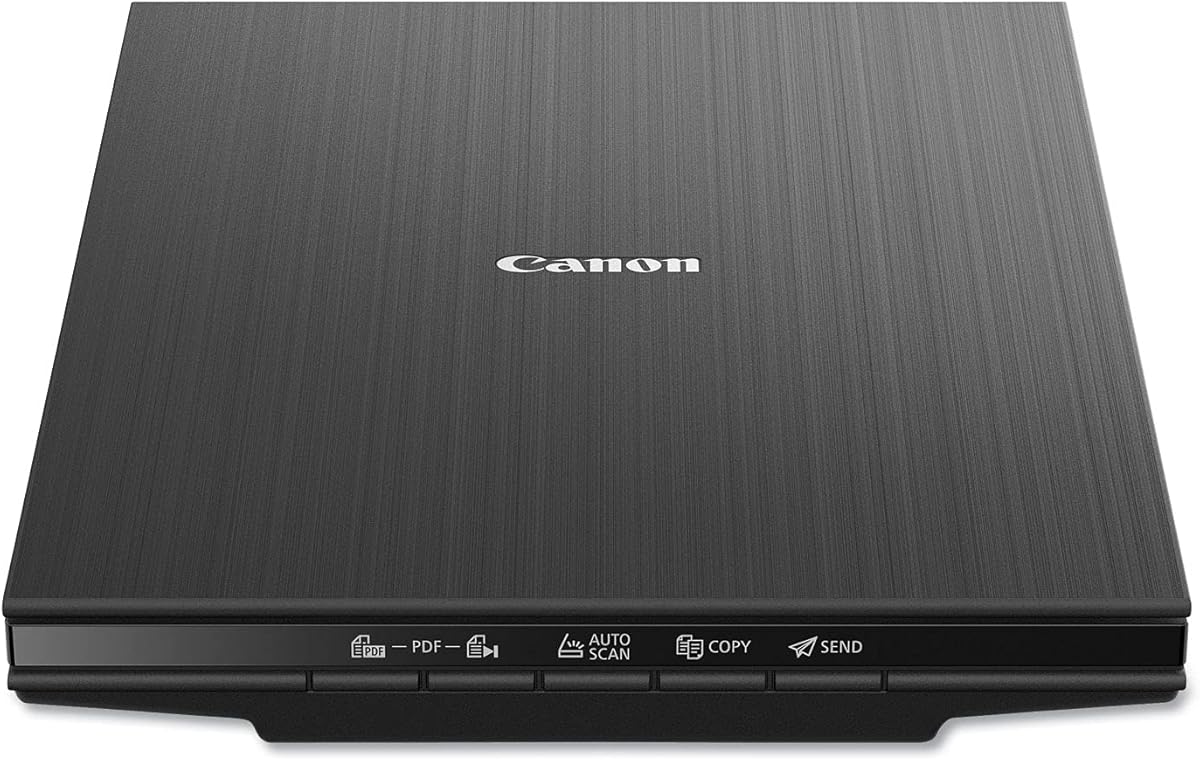
The Canon CanoScan LiDE 400 is a 4.1-rated flatbed scanner distinguished by its slim body and 4800 by 4800 dpi resolution. At only 0.4 inch thick, it is easier to store in a narrow cabinet, drawer, or workspace than many conventional scanners. It handles documents and photographs while preserving useful high-resolution detail.
We may earn a commission when you buy through this link, at no additional cost to you.
The included USB Type-C cable carries both data and power, simplifying setup on compatible computers. Auto Scan mode detects what is being scanned, and the EZ buttons allow multi-page PDFs to be saved as editable, searchable files. Image enhancements such as color restoration and dust removal help improve older originals during the initial scan.
Its main limitation is the lack of an automatic document feeder. Each print or page must be placed manually, making it less suitable for a large collection of loose photographs. The feature set is also more modest than that of scanners with dedicated cloud workflows and album-based photo organization.
Choose the LiDE 400 for a compact, high-resolution scanning station or for occasional photo and document capture. It is well suited to small desks and simple workflows. If the main objective is rapid digitization of hundreds of prints, look instead to a scanner with automatic feeding and batch controls.
The scanner's 0.4-inch profile makes it unusually easy to store. It suits users who want a flatbed's versatility without a bulky desktop footprint.
Auto Scan mode reduces setup, while the dedicated PDF controls produce editable and searchable files. Color restoration and dust removal add convenience for older prints.
We may earn a commission when you buy through this link, at no additional cost to you.
The HP Small USB Scanner, model HPPS100, is a portable 4.2-rated sheet-fed scanner designed for spaces where a full-size desktop unit is inconvenient. It accepts paper from 2×2.9 inches up to 8.5×14 inches and can scan at up to 1200 dpi. The one-sided feeder handles documents and images in a single pass.
We may earn a commission when you buy through this link, at no additional cost to you.
Its stated speed of 15 pages per minute makes it suitable for small and medium batches of invoices, contracts, reports, receipts, business cards, and photographs. HP WorkScan software adds automatic size detection, previewing, zooming, cropping, background cleanup, edge and hole cleanup, and image optimization for Windows and MacOS.
Because it scans only one side at a time, duplex content requires two passes and separate page management. It also offers fewer dedicated photo-restoration features than the Epson FastFoto and ScanSnap models. Nevertheless, the compact design and broad sheet-size range are meaningful advantages for travel, home offices, and businesses handling unusual small documents.
This scanner is best for users who need portability and basic batch documents more than advanced photo restoration. It can still capture photographs up to 1200 dpi, making it a credible choice for small photo batches and quick records. Those digitizing large albums should prioritize feeder capacity and automatic photo alignment instead.
The slim USB-powered body fits easily into a briefcase or travel case. It supports Windows and Mac systems, making it convenient for work away from a permanent office.
The wide supported paper range accommodates everything from compact cards to long legal sheets. HP WorkScan adds preview, cropping, background cleanup, and image optimization for common scanning imperfections.
We may earn a commission when you buy through this link, at no additional cost to you.
The Epson Perfection V39 II is a 4,800 dpi flatbed scanner aimed at users who want detailed photos alongside artwork, illustrations, books, and documents. Its 3.7 rating is the lowest among the models reviewed, but the underlying feature set supports both archival images and creative projects at a manageable entry point.
We may earn a commission when you buy through this link, at no additional cost to you.
Epson ScanSmart can stitch oversized images together and send scans to cloud storage services. One-touch buttons simplify routine operation, and Easy Photo Fix restores color to faded pictures with a single click. The high-rise removable lid accommodates books, albums, and other materials that would prevent a standard lid from closing.
The flatbed format requires each item to be positioned manually, and there is no feeder for processing loose photographs in batches. The 3.7 rating may also suggest that some buyers have encountered reliability or usability concerns, though the supplied information does not specify a particular issue. It is important to consider the absence of batch automation when comparing it with dedicated photo scanners.
The V39 II is most appropriate for selective creative work and occasional photo restoration. Choose it when image detail and flexible flatbed placement matter more than speed. Users converting a substantial album will likely obtain a smoother workflow from a model built around automatic photo feeding.
The 4800 dpi resolution supports detailed scans of artwork, illustrations, documents, and photographs. Image stitching also expands the scope of larger creative projects.
Easy Photo Fix provides a quick way to improve faded images. The removable high-rise lid improves access to albums and bound materials during flatbed scanning.
We may earn a commission when you buy through this link, at no additional cost to you.
The AMBIR PICTURESTUDIO Scanner is a dedicated photo device with a 3.4 rating and a software-centered approach to digitizing and editing. It scans a 4×6-inch color photo in about three seconds at 300 dpi and supports 300 or 600 dpi resolution options. Photographs from 1×1 inches to 8×10 inches and panoramas up to 12 inches are supported.
We may earn a commission when you buy through this link, at no additional cost to you.
PICTURESTUDIO can import images from a computer or connected device, including Apple Photos, Google Photos, digital cameras, and memory drives. One-touch tools cover auto-enhancement, color restoration, grayscale colorization, filters, and borders. More advanced controls adjust brightness, contrast, exposure, sharpness, gamma, and other image properties.
The AI-assisted colorization is the most distinctive feature, but the scanner's 3.4 rating is the lowest in this list. USB-only connectivity means it lacks direct wireless delivery, and users who value mature batch workflows may prefer the automatic feeders of the Epson and ScanSnap products. The software still offers useful search tools through tags and notes.
Choose this scanner if photo restoration and creative editing are more important than maximum feeder capacity. It is especially attractive to users with mixed sources who want printed and existing digital images brought into one workflow. Buyers prioritizing reliability across a large archive should weigh its rating against the higher-rated alternatives.
The software can analyze grayscale photographs and add color automatically. This is a distinctive creative option for old monochrome images and unusual archival prints.
PICTURESTUDIO imports images from connected devices and established photo services. Searchable tags and notes make it easier to organize a collection that did not originate entirely on paper.
We may earn a commission when you buy through this link, at no additional cost to you.
The right batch photo scanner depends on collection size, print condition, desired resolution, organization needs, and tolerance for manual handling. Reviewing these factors before buying can prevent an expensive unit from creating an inefficient workflow.
Feeder capacity determines how many loose photographs or documents can be loaded without stopping. The Epson FastFoto FF-680W handles up to 36 photos per batch, while the ScanSnap iX2500 family uses a 100-sheet feeder and the Photo Edition is specified for up to 36 photos. A larger capacity matters most when you have albums, envelopes, or several boxes to process. It reduces operator fatigue and the chance that batches will be interrupted before completion.
Prioritize capacity only after confirming that the feeder is designed for photographs. Some large feeders perform better with rigid documents and may require special carrier sheets for fragile prints. Dedicated flatbeds require one item at a time and therefore suit selective projects more than mass digitization.
Speed is meaningful when processing hundreds or thousands of images. The Epson FastFoto FF-680W is rated for one 4×6-inch photo per second at 300 dpi, and the ScanSnap iX2500 Photo Edition states up to 100 photos per minute. Smaller scanners such as the Plustek ePhoto Z300 and AMBIR PICTURESTUDIO models focus on quick individual scans rather than large automatic batches.
Compare advertised speeds only when they refer to the same resolution and task. A high resolution setting or duplex capture naturally takes longer than a basic one-sided scan. For a realistic estimate, include the time required to clear jams, review images, and change carrier sheets.
Resolution controls the amount of visible detail captured from each print. Dedicated batch photo scanners commonly offer 300 and 600 dpi, while flatbed models such as the Epson Perfection V19 II, Epson Perfection V39 II, and Canon CanoScan LiDE 400 advertise 4800 dpi optical resolution. The Epson FastFoto also offers 1200 dpi for enlargement-oriented workflows.
More resolution is not automatically better for every task. A 300 dpi file is often sufficient for web sharing and standard prints, while 600 dpi provides more latitude for cropping and restoration. Very high resolutions create larger files and can expose defects such as dust and scratches, so image enhancement should be considered alongside raw detail.
Automatic cropping, deskewing, rotation, color restoration, and dust removal can save considerable editing time. The Plustek ePhoto Z300, AMBIR Cleaning Kit Bundle, Epson FastFoto, and ScanSnap Photo Edition all emphasize automatic alignment and enhancement. These features are especially valuable for mixed prints placed at slightly different angles.
Look for a software interface that makes corrections easy to undo and inspect. One-click tools are convenient for faded colors, while advanced controls allow finer adjustments to exposure, sharpness, gamma, and contrast. A photo scanner should improve originals without making subtle color changes that alter their historical appearance.
USB provides reliable direct control, while wireless connectivity allows the scanner to sit away from a computer. The Epson FastFoto FF-680W and both ScanSnap iX2500 models support Wi-Fi, with the ScanSnap devices adding Wi-Fi 6 and USB-C. The Plustek, both AMBIR photo scanners, and the HP Small USB Scanner rely on wired USB connections.
Consider where the device will live and how files will reach the archive. Cloud destinations and mobile-device transfers are useful for immediate sharing, while direct computer storage may offer simpler control over local folders. Confirm compatibility with your operating system and preferred backup services before buying.
A scanner that creates attractive files but makes them difficult to find is only partly useful. The ScanSnap iX2500 models emphasize automatic naming, sorting, and custom profiles, while Picture Studio by AMBIR offers albums, tags, favorites, notes, and imported images from existing photo services. The Epson FastFoto app supports annotations and slideshow creation.
Choose the system whose folders, metadata, and search behavior match your own habits. Some users prefer a simple folder structure, while others want tags that can be combined across albums. A good workflow should make it easy to locate a photograph by date, event, family member, or collection without renaming every file manually.
Fragile photographs benefit from a protective carrier sheet, soft cleaning cloth, and anti-static tools. The AMBIR Cleaning Kit Bundle includes a bellow-style blower, microfiber cloth, anti-static brush, and carrier sheet. The Epson FastFoto includes a carrier sheet and microfiber cloth, while the ScanSnap Photo Edition includes three photo carrier sheets.
Check the maximum supported dimensions and make sure common prints fit within the feeder's specifications. Small panoramic images may require a different path than standard 4×6-inch prints. Handling accessories are inexpensive compared with replacing a torn or scratched photograph, so they deserve consideration before digitizing an irreplaceable collection.
Some buyers need a dedicated photo workflow, while others want one machine for receipts, paperwork, business cards, and prints. The Epson FastFoto FF-680W includes OCR-capable document scanning, the ScanSnap iX2500 is optimized for both media, and the HP Small USB Scanner supports multiple document types in a portable design. The Epson and Canon flatbeds also handle books and albums.
Mixed-use scanning can be more convenient than owning separate devices, but document-oriented models may not offer the same restoration tools as photo-first scanners. Match the machine to the type of material that will be scanned most often rather than paying for capabilities you are unlikely to use.
Begin by organizing prints into small groups based on size, condition, and likely project. Remove loose debris with a soft brush or microfiber cloth, but avoid abrasive cleaners or moisture. Check that the scanner is on a stable surface, connect it by the recommended interface, and install the current software before selecting a photo-oriented scan profile.
Load only the number of prints allowed by the feeder and keep fragile items in a compatible carrier sheet. Use automatic crop, deskew, and enhancement for routine batches, then review a sample from each group. Inspect the live preview for reversed edges, missing details, and color casts before processing the entire collection. Use separate output folders or profiles for different albums or events.
After scanning, verify that the number of files matches the number of originals and that important photographs are legible. Store the originals in a clean, labeled location and make at least one backup of the digital files. Periodically clean the scanner glass or feeder path according to the manufacturer's instructions, and always unplug the device before removing a jam.
A batch photo scanner uses an automatic feeder to accept multiple prints with less manual handling. A flatbed scanner places one item on the glass at a time, which can be safer for very fragile, mounted, or unusually shaped photographs. Batch scanners are usually faster for large collections, while flatbeds offer more precise positioning for books and albums.
A 300 dpi file is generally suitable for sharing and viewing on a screen, while 600 dpi captures more detail and provides greater flexibility for cropping or enlargement. The best choice depends on the condition of the print and intended use. Very old or faded photographs may benefit more from restoration software than from simply increasing resolution.
It depends on the model. The Epson FastFoto FF-680W has single-step duplex scanning that can capture an image and notes on its reverse in one operation. Other scanners may scan only the front or require you to turn the photograph over for a separate scan. Check the duplex specifications carefully before processing historically important prints.
Gentle cleaning can reduce visible dust and help protect originals, but very old or fragile prints should not be treated aggressively. Use a soft brush or microfiber cloth and avoid liquids unless a conservator or manufacturer has confirmed that the print and cleaning method are safe. A protective carrier sheet can also reduce the risk of scratches.
Wireless models offer more placement flexibility and may send files directly to computers, mobile devices, or cloud services. USB models are often simpler to connect and can be dependable for local archiving. Consider your computer's available ports, whether you want mobile access, and how you plan to organize and back up the digital collection.
Create a clear folder or album structure before starting, using names based on dates, events, or family groups. Automatic naming and tagging tools can help, but review the results and make sure each file is linked to the correct print. Keep two backups in separate locations and preserve the physical originals in a labeled archive.
Yes. The Epson FastFoto FF-680W, both ScanSnap iX2500 models, the HP Small USB Scanner, and several flatbed options can handle both photographs and documents. Dedicated photo scanners may provide stronger restoration tools, while document scanners may offer faster OCR and mixed-office workflows. Choose according to your most frequent scanning task.
Stop the scan and unplug the scanner before opening the feed path. Remove the photograph carefully without pulling it sideways, and inspect the rollers or carrier sheet for debris. If the print is bent, torn, or stuck, stop and seek guidance rather than forcing it. A damaged original may require a flatbed or professional scanning service.
The AMBIR Cleaning Kit Bundle stands out as the best value choice because it combines a dedicated scanner with cleaning supplies and capable organization software. The Epson FastFoto FF-680W is the strongest all-around option, offering excellent throughput, restoration features, duplex photo capture, and flexible sharing. The ScanSnap iX2500 Photo Edition takes advanced organization to the next level with its large touchscreen, high-capacity feeder, and wireless workflow.
Prioritize the collection's size and condition first. Large groups of loose prints call for an automatic feeder, while albums or fragile prints may be better handled one at a time. Resolution, restoration tools, wireless connectivity, and metadata features should then be matched to how you intend to use the digital files rather than selected on specification alone.
Finally, check current prices, software requirements, operating-system compatibility, and included accessories before purchasing. Scanner performance can also depend on the condition and variety of your prints. Once you have chosen the right model, prepare the originals carefully, use protective accessories, and maintain more than one backup of the finished digital archive.