
Canon RF50mm F1.8 STM Lens
4.7Editor score
Compact 50mm prime design
Large f/1.8 aperture
Smooth quiet STM focusing
Broad EOS R compatibility
Discover the best camera lens for product photography by comparing focal lengths, apertures, stabilization, focusing, compatibility, and practical features.
Product photography places unusual demands on a lens. Sharp detail, accurate color, clean backgrounds, controlled perspective, and reliable autofocus all influence the final image, while the right focal length determines how naturally an item is represented. A useful camera lens for product photography balances optical performance with practical versatility.
The lenses and camera kits in this guide were compared using the supplied specifications, focusing on focal length, maximum aperture, stabilization, focusing systems, minimum focus distance, lens construction, and camera-system compatibility. The list includes Canon EF and RF options, a Sigma telephoto prime, a smartphone attachment kit, and a DSLR bundle for different budgets and workflows.
Each review explains where the option is strongest, where its limitations matter, and which photographers it may suit best. Featured selections include the Canon RF 24-70mm F2.8 L for versatile studio work, the Canon RF 50mm F1.8 STM as a compact mirrorless choice, and the Sigma 135mm F1.8 DG HSM Art as a premium specialty lens. Product availability and prices change over time.
4.7Editor score

4.8Editor score

This side-by-side comparison covers focal length, aperture, stabilization, focusing capability, and camera compatibility so product photographers can identify the option that best fits their subjects, working space, and equipment.




The Canon RF24-70mm F2.8 L is USM Lens earns a 4.8 rating and stands out as the most complete general-purpose option in this guide. Its 24-70mm range covers environmental product compositions, detail-focused views, and natural-looking portraits without requiring a lens change. The constant f/2.8 aperture also provides useful exposure control as the photographer moves closer to a subject.
We may earn a commission when you buy through this link, at no additional cost to you.
Three details make this lens particularly effective for products. First, the wide zoom range allows a single setup to handle items of different sizes. Second, optical stabilization with up to five stops of shake correction can make handheld framing more manageable, especially when using slower shutter speeds. Third, the high-speed, smooth, and quiet Nano USM autofocus system supports both still images and video workflows.
The minimum focusing distance of 0.69 feet at the wide end and 1.25 feet at the telephoto end provides practical working room for close compositions. A dedicated control ring also allows direct changes to settings. The trade-off is compatibility: the lens is designed for Canon mirrorless cameras such as the EOS RP, EOS R, EOS R5, and EOS R6, not older EF-mount DSLRs.
This is the strongest choice for a photographer who wants one capable RF lens rather than a limited prime or kit zoom. It is especially appropriate for small studios, ecommerce listings, food, accessories, and beauty content where framing changes quickly. For those who require the Canon RF system and can justify a premium L-series investment, the flexibility makes this the top overall recommendation.
The 24-70mm span reduces the need to switch lenses when a session moves from a full-table composition to a close detail. That flexibility is valuable when products have irregular shapes, reflective surfaces, or multiple viewing angles.
The constant f/2.8 aperture supports consistent exposure throughout the zoom range, while five-stop optical stabilization helps control camera movement. Together, they are useful in live studios and dimmer product sets where light is limited.
We may earn a commission when you buy through this link, at no additional cost to you.
The Canon EF 50mm f/1.8 STM Lens has a 4.8 rating and is a straightforward choice for photographers who already own a compatible Canon DSLR. Its 50mm focal length gives a natural perspective that works well for individual products, small arrangements, and selected lifestyle scenes. The f/1.8 maximum aperture is also bright enough to support shallow depth of field and low-light shooting.
We may earn a commission when you buy through this link, at no additional cost to you.
The stepping motor is one of the lens's most useful traits. It delivers near-silent continuous servo autofocus for movies and smooth focusing for still photographs, reducing the chance that operating sounds will be recorded during demonstrations. A minimum focusing distance of 1.15 feet and maximum magnification of 0.21x make close work possible, although a dedicated macro lens will be more specialized.
Its principal limitations are practical rather than fundamental. A 50mm prime does not offer the framing flexibility of a zoom, and the lens has no listed optical stabilization. On APS-C Canon DSLRs it provides an 80mm-equivalent field of view, which is more flattering for isolated products but requires greater shooting distance than the full-frame 50mm view.
Buy this lens if you want a simple, capable prime without moving to a full-frame system. It is particularly useful for portrait-style product images, tabletop demonstrations, and online listings where a clean perspective and dependable autofocus matter more than having multiple focal lengths. A compatible DSLR body is required, and the absence of stabilization makes a tripod or steady support sensible.
A 50mm focal length offers a balanced view that can render products without the exaggerated proportions sometimes associated with very wide lenses. It also gives photographers enough separation to create clean backgrounds when working at f/1.8.
The near-silent STM focusing motor is especially valuable during video reviews or demonstrations. It supports continuous servo operation while remaining smooth enough for close product work and changing compositions.
We may earn a commission when you buy through this link, at no additional cost to you.
The Canon EF 75-300mm f/4-5.6 III Telephoto Zoom Lens has a 4.7 rating and offers a long, flexible working range. Its 75mm to 300mm span is useful when a product must be photographed from far away or when detail is more important than context. The lens can isolate distant objects and compress their visual appearance, although that makes it a specialized rather than universal choice.
We may earn a commission when you buy through this link, at no additional cost to you.
The supplied specifications describe a 4.9-foot minimum focusing distance, a 58mm filter thread, and dimensions of approximately 2.8 inches in diameter by 4.8 inches long. At 16.8 ounces, its listed weight is relatively manageable for a telephoto zoom. An improved mechanism is intended to make zooming smoother, which can help when reframing between product details.
The aperture varies from f/4 to f/5.6, so this lens does not provide the same low-light flexibility or background separation as a fast prime. Its 32- to 8-degree diagonal angle of view also creates a clear shift from moderate telephoto framing to strong magnification. The renewed designation should be considered carefully, particularly regarding condition and included accessories.
This lens makes the most sense for photographers documenting large rooms, outdoor installations, race events, stage displays, or products that cannot be approached closely. It is less suitable for a compact tabletop studio where a normal or short telephoto prime would be easier to use. For a compatible Canon SLR owner who wants reach and flexible framing, it remains a capable specialized tool.
The long end of the zoom can photograph details without bringing the camera close to the subject. That makes the lens relevant for inventory documentation, installations, and live events where access is restricted.
The listed dimensions and weight support easier carrying than many larger telephoto zooms. The trade-off is the slower aperture range, which calls for more light or a higher ISO when working in controlled environments.
We may earn a commission when you buy through this link, at no additional cost to you.
The Lightdow EF 85mm f/1.8 Manual lens carries a 4.1 rating and appeals to photographers who deliberately prefer manual focusing. Its 85mm focal length produces a flattering, compressed perspective for products and people, while the f/1.8 aperture offers strong background blur. Six rounded aperture blades can create smoother-edged highlights than a basic polygonal diaphragm.
We may earn a commission when you buy through this link, at no additional cost to you.
This is a fully manual EF-mount lens with no electronic contacts for focusing. The supplied guidance recommends setting the camera to manual mode after installation and notes that some bodies may require the release-shutter-without-lens option to avoid a no-lens error. That setup consideration makes it less convenient than an autofocus lens for fast-moving product work.
The listed optical design combines a hybrid aspherical element, ultra multi-coating, and internal focusing. The supplied information describes these features as helping reduce aberrations and glare while supporting a smooth focus ring and quiet operation. Since this lens does not autofocus, the photographer must manage shutter speed, ISO, aperture, and focus distance manually for consistent results.
The product suits photographers who value deliberate control and already understand manual-focus workflows. It can be effective for hero products on a tripod, controlled tabletop sets, and portraits where precise focus placement is more important than rapid changes. The lower 4.1 rating reflects a narrower user experience, and compatibility should be confirmed with the exact Canon DSLR model before purchase.
The bright aperture creates shallow depth of field, allowing a sharply rendered product to stand out against a softened environment. Six rounded aperture blades help keep out-of-focus highlights from appearing excessively angular.
A tripod, marked focus position, and disciplined exposure settings can make manual operation predictable. For fast-moving sessions, however, a lens with electronic autofocus will generally be easier to manage.
We may earn a commission when you buy through this link, at no additional cost to you.
The Canon RF50mm F1.8 STM earns a 4.7 rating and is the budget-focused selection for photographers building around the EOS R mirrorless system. Its fixed 50mm focal length is versatile enough for isolated products, small groups, and carefully composed lifestyle images. The large f/1.8 aperture allows shallow depth of field while helping in subdued light.
We may earn a commission when you buy through this link, at no additional cost to you.
The gear-type stepping motor supports smooth, quiet continuous autofocus during video recording and still photography. A control ring enables direct setting changes, and optimized lens placement and coatings are intended to improve color balance while minimizing ghosting and flare. Those features are relevant when photographing glossy products under controlled illumination.
Compactness is a central advantage. A lighter lens is easier to move between a tabletop set, location shoot, and mobile selling kit. The trade-off is that a prime does not provide the quick framing changes of a zoom, and the supplied specifications do not list optical image stabilization. Photographers will need adequate light or a stable support when shooting still objects.
This lens is best for RF owners who want a simple prime for everyday product work without carrying a larger zoom. It also works for portraits and landscapes, as the full title suggests. Those who need maximum framing flexibility should consider a zoom, while those who regularly work on a small table and value automatic focus will find this lens particularly straightforward.
The compact, lightweight design makes this lens convenient for sellers who photograph in changing locations. Its smaller physical footprint also leaves room for a stand, reflector, and other essential equipment in the same bag.
Optimized coatings and lens placement are designed to minimize flare and ghosting while supporting balanced color. These characteristics can help when working with reflective packaging, polished surfaces, and carefully positioned light sources.
We may earn a commission when you buy through this link, at no additional cost to you.
The Sigma 135mm F1.8 DG HSM ART is the premium specialty pick in this guide. No numeric customer rating was supplied for this product, so it cannot be evaluated on the same rating scale as the rated options. Its specification nevertheless identifies it as a professional fast-aperture telephoto prime built around image quality, speed, and creative control.
We may earn a commission when you buy through this link, at no additional cost to you.
The large Hyper Sonic motor provides ample torque and fast focusing, including stable performance at lower focusing speeds. Its f/1.8 aperture creates substantial creative control over depth of field and exposure. At the same time, the 135mm focal length produces a compressed perspective that can make products appear visually close together and isolate details from their surroundings.
The mount is described as dust and splash proof, which is useful when changing locations or working in environments where particles may be present. Each Global Vision lens is stated to be handcrafted in Aizu, Japan and individually evaluated before leaving the facility. These are manufacturing and quality-control details rather than proof of specific performance in an individual copy.
This lens is most compelling for high-end editorial, fashion, beauty, and fine-product work where shallow depth of field and compression are worth the dedicated investment. It requires a compatible EF-mount camera and a large working distance, so compact tabletop setups may be awkward. For photographers who value a 50mm or short-telephoto view, a faster standard zoom is more flexible, but this Sigma delivers a distinctive premium result.
The 135mm focal length compresses spatial relationships, allowing coordinated product groups to appear tightly composed. This can give bottles, cosmetics, fashion accessories, and editorial sets a more deliberate visual structure.
The high-torque HSM motor is designed to support rapid, stable focusing even at lower speeds. Combined with the f/1.8 aperture, it gives premium workflows strong control over both movement and depth of field.
We may earn a commission when you buy through this link, at no additional cost to you.
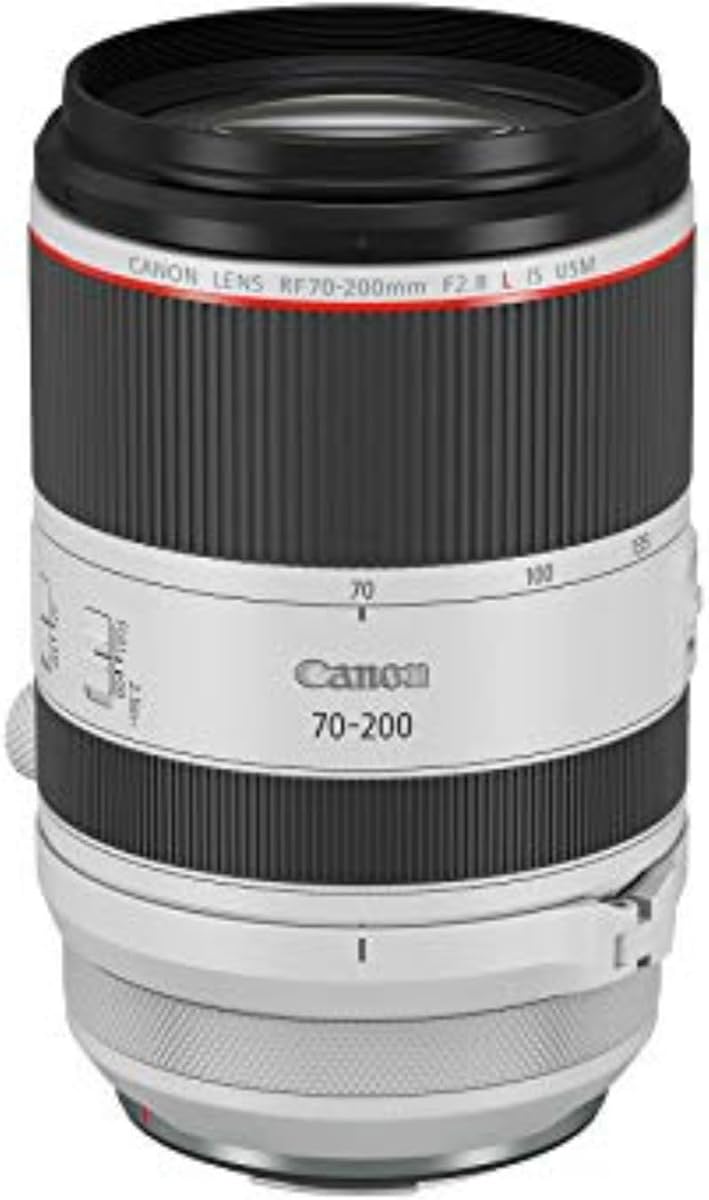
The Canon RF70-200mm F2.8 L is USM has a 4.7 rating and delivers the reach and brightness of a professional telephoto zoom. Its 70-200mm range is particularly relevant to portrait-oriented products, beauty items, packaging details, and compressed compositions that benefit from a narrow field of view. The constant f/2.8 aperture keeps exposure consistent throughout the zoom.
We may earn a commission when you buy through this link, at no additional cost to you.
Dual Nano USM motors provide high-speed, smooth, and quiet autofocus. Optical image stabilization supplies up to five stops of shake correction, which can help with handheld framing or slow-shutter detail work. A 2.3-foot minimum focusing distance at 0.7 meters gives more close-focusing capability than many telephoto zooms of its class.
The main challenge is physical and logistical. A 70-200mm lens needs more shooting distance than a standard zoom, and a small product table may not provide enough space to reach the desired framing. The premium L-series specification also represents a substantial investment, while the lens is limited to the Canon RF mount and listed compatible mirrorless bodies.
Professional photographers producing compressed hero shots, detailed beauty images, or event content should give this lens strong consideration. It is less appealing for tiny tabletop subjects because working distance can become awkward and depth of field may become extremely shallow. For RF users who need telephoto reach without sacrificing aperture, it is one of the most capable choices in the list.
The fixed f/2.8 aperture prevents exposure changes when zooming. That consistency is valuable when composing multiple product angles or moving between wider context and tighter details.
Up to five stops of optical shake correction can make slow shutter speeds more practical. It is particularly helpful for close telephoto compositions where camera movement can soften fine texture and edges.
We may earn a commission when you buy through this link, at no additional cost to you.
The Xenvo Pro Lens Kit has a 4.1 rating and provides a highly portable alternative for product photographers who do not want to carry a dedicated camera. It is designed to work with all smartphones, tablets, and laptops, including iPhone, Samsung Galaxy and Note, Google Pixel, and Huawei devices. That broad compatibility makes it useful for rapid social-commerce content.
We may earn a commission when you buy through this link, at no additional cost to you.
The TruView 0.45x wide-angle attachment is designed to capture a broader scene and reduce the dark-corner vignetting associated with some inexpensive add-ons. Coated multi-element optical glass is intended to limit ghosting, reflections, and flare. The Clarus 15x macro attachment provides close magnification, with the supplied guidance recommending placement approximately one-half inch from the subject.
A rechargeable GlowClip LED light adds warm continuous illumination with three brightness settings. That is useful when photographing objects in dim rooms without relying on the phone's often abrupt built-in flash. The kit also includes a TruGrip clip, lanyard, charging cable, travel case, alternate clip, and cleaning cloth, creating a more complete portable package than a single add-on lens.
The kit is best for quick marketplace listings, travel shoots, and creators who value mobility over dedicated-camera consistency. Mobile processors, computational processing, and camera control vary widely among devices, so image quality is not determined by the attachments alone. It is not a substitute for a dedicated interchangeable-lens system when extreme detail, shallow depth of field, or fully manual control is required.
The 15x attachment gives compatible phones a way to examine small textures, labels, jewelry-like details, and craft features. Because it is designed for close subjects, it is not a telephoto attachment for distant objects.
The inclusion of an LED light, secure grip, lanyard, and protective case addresses several practical needs at once. This makes the package more suitable for sustained on-location work than a lone clip-on lens.
We may earn a commission when you buy through this link, at no additional cost to you.
The Canon EOS Rebel T7 DSLR Camera Double Zoom Lens Kit has a 4.7 rating and offers a complete starting point for product photography. Rather than providing only a lens, the package includes a 24.1-megapixel APS-C DSLR, an EF-S 18-55mm lens, and an EF 75-300mm lens. This gives new photographers both a general-purpose zoom and a longer-range option.
We may earn a commission when you buy through this link, at no additional cost to you.
The standard 18-55mm lens is the more useful of the pair for tabletop product work because its shorter wide-angle end is easier to use in confined spaces. The 75-300mm lens supports distant details, events, and compressed compositions. Dual Pixel CMOS AF, eye detection autofocus, a 9-point AF system, and AI Servo AF provide the focusing tools needed for common static and moving subjects.
Built-in Wi-Fi and NFC make image transfer and sharing convenient, which is useful for sellers updating listings quickly. The optical viewfinder offers approximately 95% viewing coverage. Video capture is Full HD 1080p, and compatible cameras can use EOS Utility Webcam Beta software on Mac or Windows systems for webcam use.
This kit is ideal for beginners, students, and small sellers who want to begin shooting without selecting every component separately. It is not a pro-grade body, and its APS-C sensor, basic viewing coverage, and 1080p video ceiling should inform expectations. For isolated product images, the bundled standard zoom will be more useful than the telephoto, but the second lens adds genuine creative range.
The 18-55mm lens handles most room-scale and tabletop compositions, while the 75-300mm lens expands the kit to distant subjects. Beginners can learn how focal length changes perspective without buying every useful range separately.
Built-in Wi-Fi and NFC reduce the friction of moving images from the camera to a phone or computer. This is particularly helpful for sellers who need to process and publish listings away from a fixed studio.
We may earn a commission when you buy through this link, at no additional cost to you.
The Canon EF 200mm f/2.8L II USM has a 4.6 rating and is a specialized telephoto prime for product photographers who want pronounced compression and exceptional light-gathering ability. Its 200mm focal length strongly isolates details, while the maximum f/2.8 aperture supports shallow depth of field and controlled exposure in challenging lighting.
We may earn a commission when you buy through this link, at no additional cost to you.
The lens construction uses nine elements in seven groups. Its closest focusing distance is 1.5 meters, or 4.9 feet, and the filter size is 72mm. Listed dimensions are 83.2 by 136.2mm, with a weight of 765g, or 1.7 pounds. Those dimensions make it notably restrained for a professional 200mm f/2.8 lens.
The fixed focal length is both its main strength and its main constraint. It cannot move between a contextual view and a tight detail without changing position, and the long working distance can be problematic for small products on a compact table. A tripod or another stable support is likely to be valuable, especially at the f/2.8 aperture where depth of field becomes extremely thin.
This lens makes sense for stage products, runway details, distant inventory, editorial accessories, and tightly controlled commercial work where compression is a deliberate creative priority. It is less suitable for beginners seeking flexible framing or sellers working with very small objects in limited space. Within that specialized use, however, its fast aperture and 200mm perspective can produce a highly distinctive look.
A 200mm perspective visually compresses depth, which can make separated product components feel cohesive. It is especially effective for distant editorial details and products arranged along a single axis.
The listed 765g weight is relatively modest for a 200mm f/2.8 lens. That portability helps during longer sessions, although the long minimum focusing distance still demands careful placement.
We may earn a commission when you buy through this link, at no additional cost to you.
The best camera lens for product photography depends on subject size, working distance, required background separation, camera system, and the balance between autofocus and creative control. These factors narrow the field faster than any single specification.
Choose a focal range that matches your working environment. Compact 50mm and 85mm primes suit manageable product tables, while long telephoto lenses need more space.
Prioritize a bright aperture for dramatic isolation, but use a slower lens when multiple product layers must remain sharp or when consistent depth of field matters more.
Choose autofocus for speed and reliability; choose manual focus when deliberate control, specialized practice, or tripod-based precision outweighs convenience.
Look for optical stabilization when handheld shooting is common, but use a tripod for maximum detail and repeatability on static products.
For close-up work, compare magnification rather than focus distance alone, and consider a true macro lens when tiny details must be critically sharp.
Confirm the mount, body type, and model-specific compatibility before ordering. A strong lens is not useful if it cannot attach and communicate with your camera.
For reflective products, prioritize controlled lighting and coatings that reduce flare. Adjust source position and angle rather than relying on optics alone to eliminate reflections.
Match the lens to the space you can realistically use. Portability and simple setup can deliver more consistent results than a specialized lens that is difficult to position.
Begin by matching the lens to the camera and confirming all required settings. Mount the lens securely, remove the rear and front caps only when ready, and select an appropriate exposure mode. For autofocus lenses, verify that the camera recognizes the lens and that the correct focus area is active. For the fully manual EF 85mm option, switch the camera to manual mode and follow the supplied instruction to enable release shutter without a lens if the body displays a no-lens message.
Build the set around the product before making final adjustments. Use the focal length that accurately represents the item, position the camera to preserve natural proportions, and control reflections by changing the angle and distance of each light. For macro shots, stabilize the camera, move the product or lens gradually, and check sharpness at the intended viewing size. A tripod, low ISO, and a suitable shutter speed help preserve texture and reduce movement.
Care for the optics by keeping lenses capped when not in use, cleaning fingerprints and dust with a soft lens cloth, and avoiding harsh chemicals. Store equipment in a dry, padded location and protect filters from impact. Before a paid session, check that the lens, camera body, tripod, lighting, background, cables, and storage media work together. Test autofocus, stabilization, manual focus, and image transfer well before products or customers arrive.
A 50mm lens is an excellent general-purpose choice because it offers a natural perspective and works well for many tabletop subjects. An 85mm or 135mm prime provides stronger compression and background separation, while a 24-70mm zoom offers more framing flexibility. The ideal choice depends on the product size, available working distance, camera system, and whether isolation or context is more important.
A macro lens is not essential for full-size products, but it becomes valuable when tiny textures, labels, stitching, jewelry, or ingredients must appear sharply. General lenses can handle ordinary details at moderate reproduction ratios. If fine close-ups are central to the work, compare maximum magnification and minimum focus distance, and consider a dedicated macro option rather than expecting a phone or standard prime to replace it.
Choose an EF lens for a compatible Canon DSLR and an RF lens for a compatible Canon mirrorless body. The two mounts are not directly interchangeable. Always check the camera model against the lens's published compatibility list, particularly if the camera is older, newer than the listed models, or part of a newer product line.
Autofocus is highly useful when products move, compositions change quickly, or one person must manage lights and camera settings alone. Manual focus can be excellent for deliberate tripod work, but it requires more practice and careful control of focus distance. For most sellers and small studios, a quiet autofocus system is the more versatile choice.
The correct depth of field depends on the product's depth. A shallow setting can isolate a single bottle or cosmetic item, while a larger group with layered elements may need more of the scene in focus. A bright lens does not have to be opened fully; stopping down can retain the f/1.8 lens's light-gathering advantage while making focus more forgiving.
A smartphone attachment kit can replace a dedicated camera for quick listings, travel work, and lightweight setups. The included wide-angle, macro, LED light, and grip make it more versatile than a single clip-on accessory. However, image quality, stabilization, focus behavior, and dynamic range depend heavily on the phone, so dedicated cameras remain preferable for demanding commercial work.
Image stabilization is helpful but not mandatory. It can reduce camera shake during handheld setup and make slower shutter speeds more practical, especially with telephoto lenses. A tripod remains the strongest choice for critically sharp static compositions because it removes movement from the camera without relying on the lens's stabilization system.
Check the physical condition, glass for haze, scratches, fungus, or separation, focusing smoothness, aperture operation, mount alignment, and electronic contact behavior. Confirm the included accessories, return terms, warranty coverage, and exact camera compatibility. For a renewed telephoto zoom, these checks are particularly important because internal dust or a damaged zoom mechanism may not be obvious in a listing photograph.
The Canon RF24-70mm F2.8 L is the most versatile overall selection because its zoom range, constant bright aperture, quiet autofocus, and stabilization cover many product styles without changing lenses. The Canon RF50mm F1.8 STM offers a more economical route into quality product imagery for EOS R users, while the Sigma 135mm F1.8 DG HSM ART delivers a premium combination of compression, aperture control, and fast focusing.
Prioritize compatibility and working distance before any other feature. A theoretically excellent lens is less useful if it cannot mount to the camera or cannot be positioned in the available studio. Then consider autofocus for speed, maximum aperture for isolation, and magnification for tiny details. Stable support, controlled lighting, careful camera positioning, and a repeatable workflow will influence final quality more than small differences between similarly rated lenses.
Finally, review current availability, condition, warranty terms, accessories, and prices before purchasing. Lens deals and product configurations can change, and renewed or marketplace listings may differ from new stock. Confirm the mount, inspect compatibility with your exact camera, and ensure the included equipment matches the photographed product before placing an order.