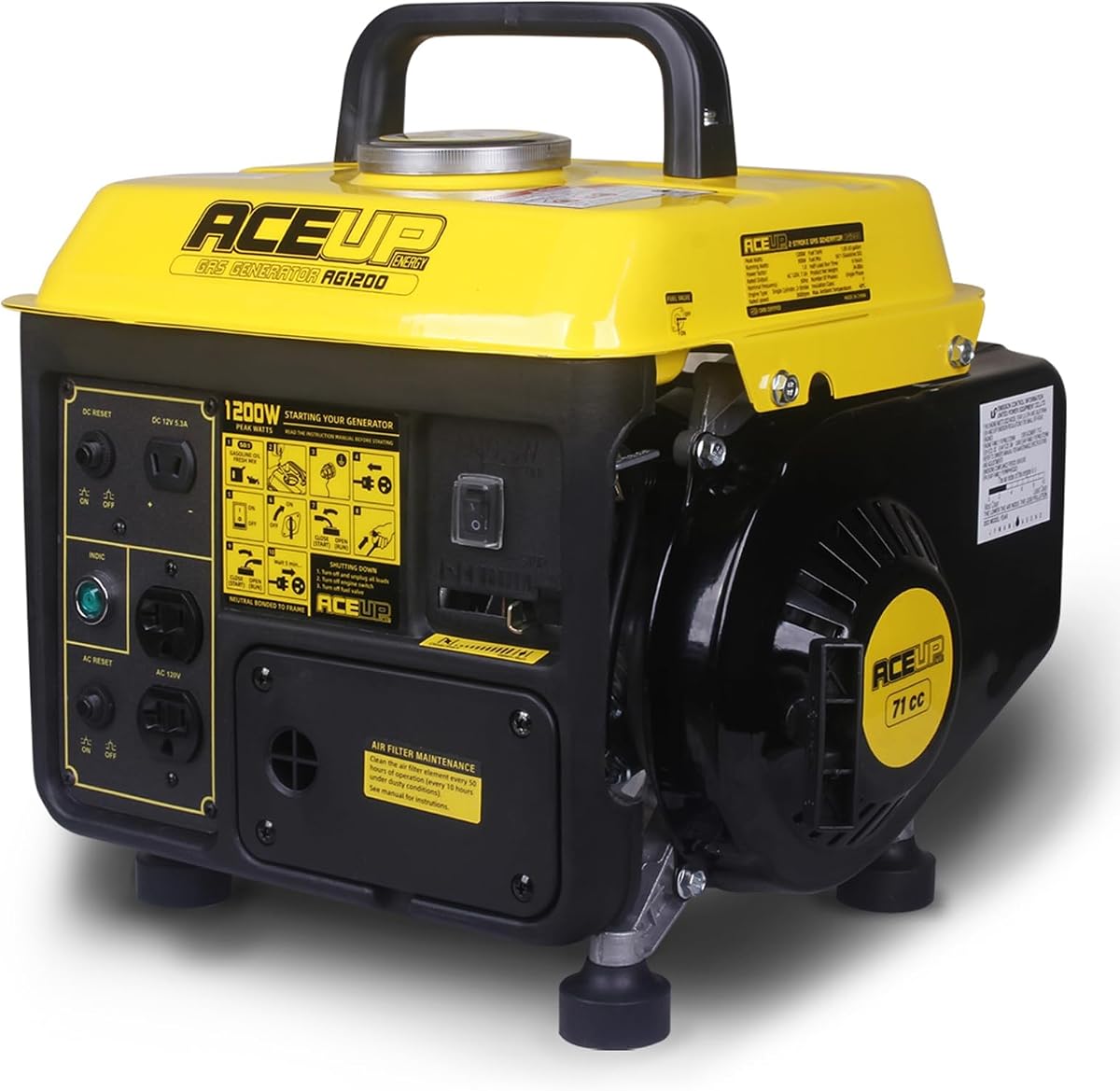
Aceup Energy 1,200W Gas Powered Generator
4.1Editor score
1,200 peak watts
900 running watts
35.3-pound portable design
Six-hour half-load runtime
Our cheap gas generator guide compares ten affordable models for power output, runtime, noise, portability, safety, and home backup use.
A cheap gas generator can provide valuable electricity during outages, but low cost does not have to mean weak output or poor portability. The right model depends on the devices you plan to power, how much noise you can tolerate, and whether you need basic household outlets or RV-ready connections.
We compared ten generators using their stated peak and running wattage, runtime, engine size, outlet selection, weight, noise level, safety features, and fuel flexibility. The list covers compact inverter units, portable gasoline models, dual-fuel machines, and larger tri-fuel systems for more demanding backup applications.
Each review identifies the most useful application for that generator and the compromises involved. Ratings reflect the supplied customer feedback, while specifications and features come from the listed product information. Availability and prices change, so confirm the current listing and your local operating requirements before buying.
4.1Editor score

4.6Editor score

4.8Editor score
The comparison below highlights each generator's rated power, fuel capability, portability, and practical outlet or runtime features so shoppers can quickly identify the model that matches their budget and backup requirements.


The Oxseryn 4400-Watts Inverter Generator combines useful household capacity with a relatively portable 56-pound design, making it a strong all-around choice for buyers seeking a cheap gas generator without settling for a very small unit. Its 4.6 rating reflects generally favorable customer feedback, while its 4,400 peak watts and 3,400 running watts give it enough capacity for numerous essentials.
We may earn a commission when you buy through this link, at no additional cost to you.
Output connections include two 120V household outlets, a 30A RV outlet, and a 12V DC outlet. That flexibility is particularly helpful for RV travel, tailgating, outdoor work, and emergency use. A two-gallon tank supports up to 14 hours of operation at a 25% load, and the fuel gauge makes it easier to monitor remaining supply. ECO mode adjusts engine output to demand, while inverter technology helps provide stable power for compatible electronics.
The open-frame layout and 56-pound weight mean this is portable enough to move but not as easy to carry as a compact camping generator. It also does not include an oil according to the supplied listing, so new owners should check the package and manual before first use. A slight gas smell may be present because the generator is functionally tested in the factory; that note does not indicate a used machine.
This is our top overall recommendation for households that need a versatile balance of running power, runtime, and portability. It can support a refrigerator, lighting, electronics, and selected household equipment when loads stay within its rating. People wanting ultra-quiet operation or a closed enclosure may prefer a smaller inverter unit, but this model delivers the most balanced set of features for general-purpose backup power.
With 3,400 running watts, the Oxseryn provides enough headroom for many common essentials without moving into the size and weight of a full home standby system. The 12V DC outlet also adds utility for equipment that can charge from a cigarette-lighter-style connection.
The dedicated 30A RV outlet is the standout feature for travelers. Combined with inverter operation and ECO mode, it makes this a practical option for campsite use, provided the RV's connection requirements and load needs match the generator.
We may earn a commission when you buy through this link, at no additional cost to you.
This second Oxseryn 4400-watt model offers a similar power package with an emphasis on low-noise operation and user-friendly monitoring. It carries a 4.5 rating and supplies 4,400 peak watts and 3,400 running watts, placing it among the stronger portable options for essential household and RV applications.
We may earn a commission when you buy through this link, at no additional cost to you.
Its connection panel includes two 120V AC outlets, one 12V DC outlet, and one RV port. The built-in fuel gauge is a practical addition, allowing users to check the two-gallon tank without stopping the machine. It can run for up to 14 hours at a 25% load with ECO mode, and its stated noise level is under 72 dBA when measured 23 feet away.
At 56 pounds, the generator is light enough for many users to reposition but still substantial for regular hand-carrying. The open-frame design supports service access and portability, although it offers less physical shielding than a fully enclosed unit. The supplied data does not list engine oil among the included components, and the factory-testing note explains why a slight gas odor might be detected on receipt.
This model is best for RV owners, homeowners, and outdoor users who value a visible fuel gauge alongside strong output. It is especially attractive for extended low-load operation where conserving fuel matters. Those seeking a smaller unit should compare the lower-output inverter models, while buyers needing a transfer switch connection should look to a dedicated dual-fuel generator.
The integrated fuel gauge helps reduce the inconvenience of opening the tank or guessing how much fuel remains. This is especially useful during long camping sessions or extended outages when refueling supplies may not be immediately available.
Its stated operating noise is lower than that of many open-frame conventional generators while retaining 3,400 running watts. The result is a practical middle ground for users who need meaningful capacity but also value a less disruptive operating environment.
We may earn a commission when you buy through this link, at no additional cost to you.
The Aceup Energy 1,200W Gas Powered Generator is the most straightforward entry point for shoppers who want backup electricity for a small collection of essentials. Its 4.1 rating reflects a more mixed customer experience than the higher-rated models, but the 1,200 peak watts and 900 running watts remain useful for appropriately selected low-draw devices.
We may earn a commission when you buy through this link, at no additional cost to you.
It uses a 71cc single-cylinder, two-cycle engine with air cooling and recoil starting. One American-style duplex household outlet is provided, along with a 12V DC supply, overload protection for both AC and DC, and an indicator light. The one-gallon-capacity tank is listed as 1.1 gallons and supports approximately six hours of operation at half load.
Its main limitation is output. It is unsuitable for large power tools, central air systems, water heaters, or several high-draw household appliances at once. The two-stroke design also uses a 50:1 gasoline-to-oil mixture and does not require separate oil changes, simplifying storage and preparation compared with some four-stroke models, but fuel handling still needs care.
Choose this generator for charging phones, powering lights, running a small fan, maintaining a refrigerator during a brief interruption, or providing limited backup in a small workspace. It is most useful as an emergency-lightweight option rather than a whole-home solution. Buyers needing more capacity can move up to a 1,600W or 2,500W inverter model.
The 900-watt running capacity is enough for several low-draw essentials if they are used selectively. Keeping a written load plan prevents overload and makes the generator more useful during an outage.
Weighing 35.3 pounds, the Aceup is easier to transport than the larger 4,400-watt models. Its compact size can also make it more practical for a garage, apartment storage area, or occasional outdoor job.
We may earn a commission when you buy through this link, at no additional cost to you.
The AIVOLT 1600W Super Quiet Inverter Generator is built around portability, clean output, and low acoustic impact. Its 4.1 rating is modest compared with several larger options, yet the 28-pound weight and stated 57 dBA noise level make it one of the most interesting choices for camping and other mobile uses.
We may earn a commission when you buy through this link, at no additional cost to you.
The generator produces 1,600 starting watts and 1,260 running watts through a 60cc four-stroke OHV engine. Its inverter technology is specified to keep total harmonic distortion below 3%, making it suitable for phones, laptops, cameras, drones, and other sensitive electronics. The panel has two 120V outlets and two USB ports, while three indicator lights and an hour meter help users monitor operation.
Runtime reaches up to eight hours at a 25% load, but only about two hours at full output. Buyers should therefore treat the 1,260-watt figure as the sustained limit for longer sessions. Two compatible units can be connected with a separately sold parallel kit for greater output. The engine oil is not included, and legal use outside California is specifically noted.
This is an excellent choice for campers, tailgaters, remote workers, and homeowners seeking quiet, low-weight emergency power for electronics. It is less suitable for power tools, large appliances, or extended heavy-load use. Its safety features, clean output, and low weight outweigh the limited full-load endurance for the audience it targets.
Keeping total harmonic distortion below 3% is the central benefit for users who need more stability than a basic open-frame generator may provide. It is especially appealing for laptops, phones, photography equipment, and other compact electronics.
At 28 pounds, the AIVOLT is easy to carry, and its stated 57 dBA output is suited to campsites and outdoor gatherings. The two USB ports also reduce the need to occupy household outlets with chargers.
We may earn a commission when you buy through this link, at no additional cost to you.
The Oxseryn 5000-Watts Portable Inverter Generator is a practical choice for buyers who want more power than the 4,400-watt Oxseryn models while retaining a portable open-frame format. Its 4.3 rating and 5,000 peak watts position it as a flexible middle-to-upper option for home backup, RV travel, and outdoor work.
We may earn a commission when you buy through this link, at no additional cost to you.
Rated output is 4,000 watts, and the inverter is specified to provide clean power with total harmonic distortion below 5%. A 30A outlet supports RV use, while ECO mode adjusts engine speed to demand. The two-gallon tank provides up to six hours at a 50% load, and a fuel gauge helps with monitoring. The unit weighs 60 pounds and measures 19 by 15 by 18 inches.
The trade-off is weight and size. At 60 pounds, it is the heaviest of the listed portable inverter generators in this group. The six-hour half-load runtime is also shorter than the extended low-load runtimes of several smaller models. Nevertheless, for users who need 4,000 continuous watts, the added capacity is more valuable than a longer but much lighter alternative.
The package includes a funnel, screwdriver, socket wrench, and manual, making initial setup more convenient. This generator suits households that want to run several moderate appliances during an outage, provided the combined starting and running loads remain within its ratings. It is also a good RV option for owners whose equipment demands exceed smaller inverter units.
The 4,000-watt rated output creates more room for simultaneous essentials such as lighting, networking equipment, refrigeration, and selected household loads. Starting wattage must still be checked for motors and compressors.
A built-in fuel gauge reduces uncertainty during operation, while the included basic tools help with routine setup and maintenance. The open frame keeps service access straightforward for owners comfortable performing basic checks.
We may earn a commission when you buy through this link, at no additional cost to you.
The Westinghouse 12500 Watt Dual Fuel generator is built for buyers who need serious household backup capacity rather than a lightweight emergency unit. Its 4.7 rating is among the strongest in the group, and the gasoline output of 9,500 running and 12,500 peak watts gives it ample room for larger essential appliances.
We may earn a commission when you buy through this link, at no additional cost to you.
It can also run on propane, delivering 8,500 running and 11,200 peak watts. A 457cc four-stroke OHV engine with a cast-iron sleeve provides the mechanical foundation, while remote electric starting allows operation without walking back to the engine. The 6.6-gallon tank supports up to 12 hours and includes a fuel gauge.
Outlet selection is unusually useful: two GFCI 20A household receptacles, a 30A transfer-switch-ready receptacle, and a 50A RV-ready connection. The included key fob, battery charger, oil, funnel, tool kit, and manual provide a useful starting package. Its size, fuel consumption during heavy use, and need for suitable outdoor placement make it less convenient than a camping generator.
Choose this model for larger homes, extended outages, or users who want gasoline flexibility with a propane option. It is appropriate for RV use when the required outlet and load levels match. Installation near a home should follow local codes, and a transfer switch should only be installed by a qualified professional.
With 9,500 running watts on gasoline, the Westinghouse can support several properly selected household essentials at once. The generous peak rating also gives motor-driven appliances more room for startup surges.
Gasoline supports longer conventional use, while propane provides an alternative when preferred. Remote electric starting adds convenience, and the VFT display provides operating information such as voltage, frequency, and lifetime hours.
We may earn a commission when you buy through this link, at no additional cost to you.
The SIOKIUU 2500W Portable Generator offers an interesting combination of compact weight, clean inverter output, and long low-load runtime. It has a 4.1 rating and produces 2,500 peak and 1,900 running watts, placing it above the smallest camping models without reaching the physical bulk of a 4,400-watt open-frame generator.
We may earn a commission when you buy through this link, at no additional cost to you.
Its 1.06-gallon fuel tank is listed as supporting up to 17 hours at a 25% load and 8.6 hours at a 50% load. An 80cc four-stroke engine, ECO mode, and parallel function help manage consumption and allow compatible units to be combined. Total harmonic distortion is stated below 3%, making the output suitable for laptops, televisions, lights, fans, phones, cameras, drones, and small tools.
Noise is rated under 59 dBA from 23 feet, and the carrying handle helps with transport at 39.46 pounds. A CO sensor provides automatic shutdown if unsafe carbon-monoxide levels are detected. The listing notes that a small amount of residual oil or gasoline odor may remain after factory inspection and testing, which is a normal condition described by the manufacturer.
This generator is best for campers, RV users, and households wanting a step up from a 1,200-watt unit without carrying a 60-pound frame. Its 1,900-watt running limit should be respected, especially when starting refrigerators or power tools. It is not intended for heavy appliances, but its long runtime and clean output make it a versatile middle-size option.
The 17-hour quarter-load figure is the standout specification. It makes the generator appealing for overnight camping, remote work, and outage periods when the connected load remains modest.
CO-triggered shutdown adds a valuable layer of protection, while low total harmonic distortion supports sensitive devices. Users should still operate the generator outdoors in an approved location with proper ventilation.
We may earn a commission when you buy through this link, at no additional cost to you.
The DuroStar DS13000MXT is a substantial tri-fuel portable generator intended for buyers who want flexibility during extended outages. Its 4.4 rating and 13,000-watt peak output place it among the higher-capacity options, while the ability to run on gasoline, propane, or natural gas distinguishes it from many similarly powerful gasoline-only units.
We may earn a commission when you buy through this link, at no additional cost to you.
A 500cc engine provides the mechanical power, and the control panel includes push-button starting, a fuel-selection knob, and several outlets, including a transfer-switch-ready 50A connection. Remote electric starting improves operation when the generator is positioned away from the user, such as beside a house or at a campsite. CO Alert shuts the engine down when harmful carbon-monoxide levels are detected.
Fuel flexibility can improve resilience because the owner is not restricted to a single fuel source. However, natural-gas operation requires an appropriate supply connection, and switching fuels involves setup and operating procedures. The 13,000-watt figure also represents a portable system with substantial size, noise, fuel consumption, and maintenance demands, particularly during sustained maximum output.
This generator is suited to owners of larger homes, serious RV users, or buyers who want a portable alternative to a permanently installed standby system. It should not be connected to household wiring without the appropriate transfer switch and professional guidance. For buyers who need only dual-fuel capability and a smaller footprint, the Westinghouse or WEN models may be easier to manage.
Gasoline offers familiarity, propane simplifies storage, and natural gas can support extended use when properly connected. Having multiple options is valuable for households concerned about fuel availability during a prolonged emergency.
The transfer-switch-ready 50A outlet allows the generator to support a properly configured home-backup connection. The remote start and push-button controls also reduce the need to access the machine once it is running.
We may earn a commission when you buy through this link, at no additional cost to you.
The WEN DF475T is a capable mid-size dual-fuel generator with a 4.4 rating. It is a particularly practical choice for users who need both 120V and 240V output but do not require the capacity or bulk of a 12,000-watt home-backup system. On gasoline, it provides 3,800 running and 4,750 surge watts.
We may earn a commission when you buy through this link, at no additional cost to you.
Propane operation produces 3,500 running and 4,350 surge watts, and a selection dial makes the change straightforward. The generator can deliver 120V or 240V through a 120V/240V NEMA 30A twist-lock connection, while two 120V GFCI outlets handle ordinary household devices. A 12V DC cigarette-lighter-style plug expands the available charging options.
The 224cc four-stroke OHV engine starts electrically with a key, and the four-gallon tank can provide up to 11 hours at half load. A wheel-and-handle kit helps movement, although it remains a larger unit than a compact camping generator. The package also includes oil, an LPG connection hose, and a two-year warranty, giving buyers a fairly complete setup.
This model works well for emergency power, RV trips, backup tools, and appliances that require 240V. It is a strong middle option for buyers comparing dual-fuel machines, though it cannot run on natural gas and does not include the same high-capacity outlets found on the larger Westinghouse and DuroStar systems.
The ability to switch between 120V and 240V is a major advantage for supported appliances and transfer-switch applications. Buyers should verify device requirements and use the correct outlet for each load.
Gasoline and propane broaden fuel options without moving into a full tri-fuel system. The turn of the selection dial and included LPG hose make the transition straightforward after setup.
We may earn a commission when you buy through this link, at no additional cost to you.
The Westinghouse 14,500 Peak Watt Tri-Fuel generator is the premium choice in this guide, combining the highest supplied rating with substantial home-backup capacity. It can run on gasoline, propane, or natural gas, offering three operating paths for owners who want flexibility during a long outage or prefer different fuels for different applications.
We may earn a commission when you buy through this link, at no additional cost to you.
On gasoline, output reaches 11,500 running and 14,500 peak watts. Propane provides 10,500 running and 13,500 peak watts, while natural gas delivers 9,500 running and 12,000 peak watts. A heavy-duty 550cc four-stroke OHV engine uses a durable cast-iron sleeve, and remote electric starting makes operation convenient once the unit is set up.
Fuel capacity is 9.5 gallons with a built-in gauge, supporting up to 19 hours of gasoline operation. A 20-pound propane tank can support up to seven hours. The unit is transfer-switch ready and engineered for low total harmonic distortion, with copper windings intended to produce cleaner power and operate cooler. Three-year service, labor, and parts coverage adds support beyond the warranty periods offered by several compact models.
This generator is intended for larger homes and users who expect to power a broad selection of essential loads. It is not a lightweight camping choice, and natural-gas use requires the correct supply setup. Among the listed options, it offers the most complete combination of capacity, fuel flexibility, long runtime, remote starting, and warranty coverage.
With 11,500 running watts on gasoline, the Westinghouse has enough capacity for several essential appliances and well-defined household loads. A careful startup plan remains essential because compressors and motors can require substantial surge power.
The ability to use gasoline, propane, or natural gas reduces dependence on one fuel type. This is especially useful for prolonged outages, provided the owner has the appropriate connections and safe operating area for the selected fuel.
A built-in fuel gauge and nationwide customer service network add convenience and confidence. The three-year service, labor, and parts coverage also provides a stronger ownership package than the basic one-year coverage listed for the Aceup model.
We may earn a commission when you buy through this link, at no additional cost to you.
The right inexpensive generator depends on load requirements, fuel access, portability, noise, safety, and outlet type. Comparing these factors before shopping prevents buyers from selecting a unit that is too small, too noisy, or incompatible with the equipment they need to run.
Prioritize sustained running watts over the largest headline figure. A generator that advertises high peak power but offers limited running capacity may stall when multiple devices operate together.
Choose the fuel type you can obtain and store safely in your area. Confirm connection requirements before buying a natural-gas-capable model.
Compare runtime at the same load percentage. Do not assume a quarter-load figure applies when powering heavy appliances.
Match carrying effort to the frequency of use. A heavier generator with longer runtime is less attractive if you need to move it often.
Choose a quieter inverter for close use and electronics. Accept more noise when larger fuel capacity and higher output are the priorities.
Match the outlet to the equipment and never connect a portable generator directly to household wiring. Use a qualified electrician for transfer-switch installation.
Look for automatic shutdown and monitoring features, but always follow the manual and local safety requirements. Keep combustion exhaust away from doors, windows, and vents.
Compare engine construction, included oil, warranty coverage, and technical support. Larger engines are not automatically better for light-duty use.
Before first use, read the manual, confirm the oil and fuel requirements, inspect the generator for damage, and prepare an appropriate operating area. Outdoor placement is essential: set the unit on a stable, level surface with its exhaust pointed away from buildings, vehicles, doors, windows, and ventilation openings. Connect loads before starting, keep the generator dry, and avoid operating it in enclosed or poorly ventilated spaces.
Start according to the controls, allow it to stabilize, and confirm that the output and connected loads remain within the running and surge ratings. Do not exceed capacity, overload the generator, or connect it to household wiring without an appropriate transfer switch. Use compatible extension cords rated for the load and outdoor use. Turn connected appliances off before shutting down, let the engine run briefly to cool, and then stop it according to the manual.
For storage, turn off the generator, allow it to cool, disconnect loads, and follow the manual's fuel and oil procedures. Keep it covered in a dry, ventilated location, away from ignition sources. Check oil, filters, spark plugs, fuel lines, connections, and the battery on the schedule specified by the manufacturer. Before extended storage, run the unit long enough to stabilize the fuel according to the manual, and never test it in an unsafe or improvised location.
The right size depends on the running and starting watts of the devices you want to power. A 1,200W model can handle a few low-draw essentials, while a 4,400W to 5,000W inverter is more appropriate for several common household loads. Larger homes may need a dual- or tri-fuel system. Add up the running watts and allow headroom for motors and compressors.
An inverter generator is generally better suited to phones, laptops, televisions, cameras, and other sensitive equipment because it regulates output more closely. The AIVOLT and SIOKIUU models are specified below 3% total harmonic distortion, while the Oxseryn 5000W is below 5%. Even with clean output, the generator must operate outdoors with proper ventilation.
Running watts represent the sustained output the generator can maintain. Peak watts cover brief startup surges, such as those produced by refrigerators, pumps, and power tools. Compare the running figure for your normal load and ensure the peak rating is high enough to start larger equipment.
Do not connect a portable generator directly to household wiring without a correctly installed transfer switch. A transfer switch prevents backfeeding and isolates the generator from utility power. For a home connection, use a properly rated unit and have a qualified electrician design and install the system.
They provide additional fuel options, which can be useful during prolonged outages or when one fuel is more accessible. Propane is also convenient to store, while natural gas requires an appropriate supply connection. The extra flexibility comes with more controls and potentially greater complexity, so owners should read the fuel-switching procedure carefully.
Runtime varies with load, engine size, and operating conditions. The Aceup is listed at approximately six hours at half load, while the AIVOLT can run up to eight hours at a 25% load. Higher output consumes fuel faster, so a quarter-load or half-load maximum should not be treated as a full-load figure.
A small generator may run a refrigerator if its running and startup requirements fit within the unit's ratings. Compact models can work for essential cycling, while 4,400-watt and larger units provide more room for refrigerators alongside other loads. Avoid operating multiple high-draw appliances beyond the generator's continuous capacity.
Operate it outdoors on a stable, level surface, with the exhaust directed away from buildings, vehicles, doors, windows, and air intakes. Never run it in a garage, basement, enclosed porch, or other poorly ventilated space. Follow the manual and local regulations, and use a protective outdoor cover only when it does not obstruct ventilation or combustion.
The Aceup Energy 1,200W is the straightforward budget choice for a few essentials, while the Oxseryn 4400-Watts Inverter stands out as the best overall balance of output, runtime, portability, and RV connections. For a premium purchase, the Westinghouse 14,500W Tri-Fuel offers the greatest capacity, fuel flexibility, runtime, remote starting, and support in this group.
Prioritize running watts over headline peak power, then match the generator to your actual loads. Quiet inverter models suit camping and sensitive electronics, open-frame models provide useful capacity at moderate weight, and dual- or tri-fuel systems make sense for larger homes and extended outages. Outlet type, engine construction, safety shutoffs, and actual portability are just as important as maximum wattage.
Prices and availability can change, so check the current listing before purchasing and compare the final cost with the features you genuinely need. Also verify local rules, fuel requirements, noise restrictions, and transfer-switch installation guidance. A slightly higher purchase can be worthwhile when it provides the right capacity, fuel access, and support for your circumstances.